University Clinical Analysis of Case Study 1: Mrs. Walker's Care
VerifiedAdded on 2022/09/03
|15
|2607
|25
Case Study
AI Summary
This paper presents a clinical analysis of a case study involving an 82-year-old patient, Mrs. Julia Walker, who experienced complications after bilateral inguinal incisional hernia surgery, including sinus bradycardia and dysuria, leading to her admission to the ICU. The analysis follows the clinical reasoning cycle, examining the patient's context, gathering and reviewing information, and recalling relevant medical knowledge. The paper interprets the gathered information to identify the primary nursing problems: medications exacerbating hyperkalemia and sinus bradycardia, and untreated penetrating bladder trauma. Goals are established to prevent the worsening of the patient's condition and to address the bladder trauma. The paper emphasizes the importance of halting the administration of Hartmann’s solution and certain medications, and the need for immediate surgical intervention to repair the bladder trauma. The conclusion highlights the critical role of nursing professionals in setting goals and taking actions to save the patient's life, emphasizing the need for a coordinated approach involving surgeons and other medical professionals.
Running head: CLINICAL ANALYSIS OF CASE STUDY
CLINICAL ANALYSIS OF CASE STUDY
Name of the Student:
Name of the University:
Author Note:
CLINICAL ANALYSIS OF CASE STUDY
Name of the Student:
Name of the University:
Author Note:

Paraphrase This Document
Need a fresh take? Get an instant paraphrase of this document with our AI Paraphraser
1CLINICAL ANALYSIS OF CASE STUDY
Abstract:
The paper aims for making a clinical analysis on the case study provided as per clinical
reasoning cycle. 82 year old Mrs. Julia Walker had an open surgery in order to repair bilateral
inguinal incisional hernia. After completion of the surgery, she was brought to the recovery unit
of the hospital. However after 11 hours she was admitted to the ICU. The reason behind this was
that the patient was having sinus bradycardia. The paper analyses the patient condition, gathers
information, interpreting the whole condition, it identifies the problem and set nursing goals with
proper rationale. At last the evaluation of the outcome is done. The nursing professional should
set goals and acting upon them in order to save the life of the patient.
Abstract:
The paper aims for making a clinical analysis on the case study provided as per clinical
reasoning cycle. 82 year old Mrs. Julia Walker had an open surgery in order to repair bilateral
inguinal incisional hernia. After completion of the surgery, she was brought to the recovery unit
of the hospital. However after 11 hours she was admitted to the ICU. The reason behind this was
that the patient was having sinus bradycardia. The paper analyses the patient condition, gathers
information, interpreting the whole condition, it identifies the problem and set nursing goals with
proper rationale. At last the evaluation of the outcome is done. The nursing professional should
set goals and acting upon them in order to save the life of the patient.
2CLINICAL ANALYSIS OF CASE STUDY
Table of Contents
Introduction:....................................................................................................................................3
Discussion:.......................................................................................................................................3
Conclusion:....................................................................................................................................11
Table of Contents
Introduction:....................................................................................................................................3
Discussion:.......................................................................................................................................3
Conclusion:....................................................................................................................................11
⊘ This is a preview!⊘
Do you want full access?
Subscribe today to unlock all pages.

Trusted by 1+ million students worldwide
3CLINICAL ANALYSIS OF CASE STUDY
Introduction:
The paper aims for making a clinical analysis on the case study provided as per clinical
reasoning cycle. In this paper a patient named Mrs. Julia Walker who was 82 year old, went
through a bilateral inguinal incisional hernia surgery and again admitted to the ICU 11 hours post
operation, with dysuria and sinus bradycardia. Now, the paper analyses the patient condition,
gathers information, interpreting the whole condition, it identifies the problem and set nursing
goals with proper rationale. At last the evaluation of the outcome is done.
Discussion:
Consider the
patient situation/
Context
82 year old Mrs. Julia Walker had an open surgery in order to repair
bilateral inguinal incisional hernia. After completion of the surgery, she
was brought to the recovery unit of the hospital. However after 11 hours
she was admitted to the ICU. The reason behind this was that the patient
was having sinus bradycardia. During her stay at the ICU Mrs. Walker was
being provided with enough fluid to intake but she was not being able to
urinate and the administration of the indwelling catheter was not done.
Along with this her GCS score was 15, which meant she had been mildly
comatose.
The alert comes from the fact that only after a few hours of the completion
of a surgery to remove bilateral inguinal incisional hernia, the patient was
showing the symptoms of dysuria along with the condition of sinus
bradycardia. The possibility involves an injury to the urinary bladder
Introduction:
The paper aims for making a clinical analysis on the case study provided as per clinical
reasoning cycle. In this paper a patient named Mrs. Julia Walker who was 82 year old, went
through a bilateral inguinal incisional hernia surgery and again admitted to the ICU 11 hours post
operation, with dysuria and sinus bradycardia. Now, the paper analyses the patient condition,
gathers information, interpreting the whole condition, it identifies the problem and set nursing
goals with proper rationale. At last the evaluation of the outcome is done.
Discussion:
Consider the
patient situation/
Context
82 year old Mrs. Julia Walker had an open surgery in order to repair
bilateral inguinal incisional hernia. After completion of the surgery, she
was brought to the recovery unit of the hospital. However after 11 hours
she was admitted to the ICU. The reason behind this was that the patient
was having sinus bradycardia. During her stay at the ICU Mrs. Walker was
being provided with enough fluid to intake but she was not being able to
urinate and the administration of the indwelling catheter was not done.
Along with this her GCS score was 15, which meant she had been mildly
comatose.
The alert comes from the fact that only after a few hours of the completion
of a surgery to remove bilateral inguinal incisional hernia, the patient was
showing the symptoms of dysuria along with the condition of sinus
bradycardia. The possibility involves an injury to the urinary bladder
Paraphrase This Document
Need a fresh take? Get an instant paraphrase of this document with our AI Paraphraser
4CLINICAL ANALYSIS OF CASE STUDY
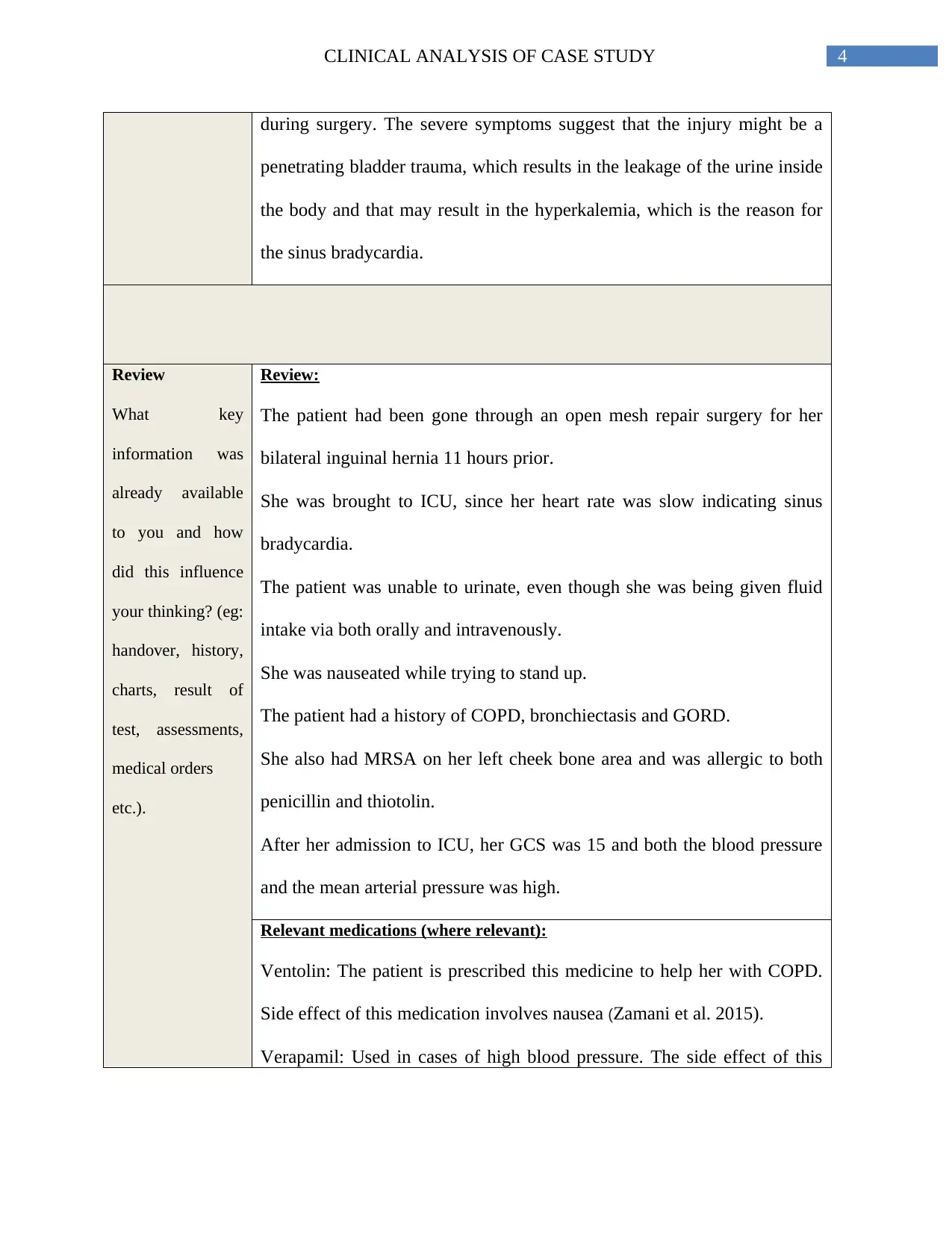
during surgery. The severe symptoms suggest that the injury might be a
penetrating bladder trauma, which results in the leakage of the urine inside
the body and that may result in the hyperkalemia, which is the reason for
the sinus bradycardia.
Review
What key
information was
already available
to you and how
did this influence
your thinking? (eg:
handover, history,
charts, result of
test, assessments,
medical orders
etc.).
Review:
The patient had been gone through an open mesh repair surgery for her
bilateral inguinal hernia 11 hours prior.
She was brought to ICU, since her heart rate was slow indicating sinus
bradycardia.
The patient was unable to urinate, even though she was being given fluid
intake via both orally and intravenously.
She was nauseated while trying to stand up.
The patient had a history of COPD, bronchiectasis and GORD.
She also had MRSA on her left cheek bone area and was allergic to both
penicillin and thiotolin.
After her admission to ICU, her GCS was 15 and both the blood pressure
and the mean arterial pressure was high.
Relevant medications (where relevant):
Ventolin: The patient is prescribed this medicine to help her with COPD.
Side effect of this medication involves nausea (Zamani et al. 2015).
Verapamil: Used in cases of high blood pressure. The side effect of this
during surgery. The severe symptoms suggest that the injury might be a
penetrating bladder trauma, which results in the leakage of the urine inside
the body and that may result in the hyperkalemia, which is the reason for
the sinus bradycardia.
Review
What key
information was
already available
to you and how
did this influence
your thinking? (eg:
handover, history,
charts, result of
test, assessments,
medical orders
etc.).
Review:
The patient had been gone through an open mesh repair surgery for her
bilateral inguinal hernia 11 hours prior.
She was brought to ICU, since her heart rate was slow indicating sinus
bradycardia.
The patient was unable to urinate, even though she was being given fluid
intake via both orally and intravenously.
She was nauseated while trying to stand up.
The patient had a history of COPD, bronchiectasis and GORD.
She also had MRSA on her left cheek bone area and was allergic to both
penicillin and thiotolin.
After her admission to ICU, her GCS was 15 and both the blood pressure
and the mean arterial pressure was high.
Relevant medications (where relevant):
Ventolin: The patient is prescribed this medicine to help her with COPD.
Side effect of this medication involves nausea (Zamani et al. 2015).
Verapamil: Used in cases of high blood pressure. The side effect of this
5CLINICAL ANALYSIS OF CASE STUDY
Gather(@150
words)
What was the new
information you
gathered from
additional
assessment?
Dot points are fine
for this section
Recall(@200
words)
Recall and apply
your existing
knowledge to the
above situation to
ensure you have a
broad
understanding of
what is/may be
occurring before
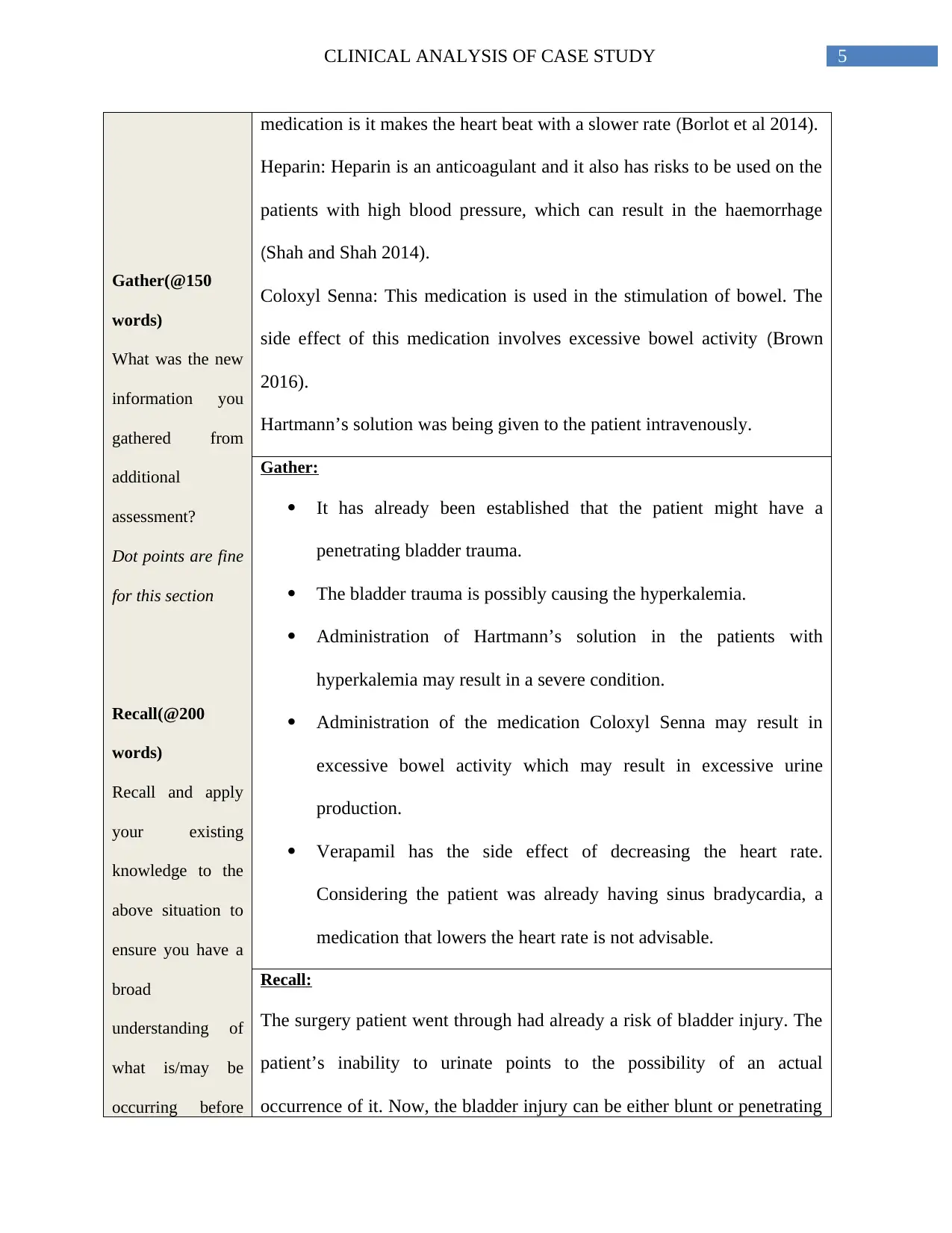
medication is it makes the heart beat with a slower rate (Borlot et al 2014).
Heparin: Heparin is an anticoagulant and it also has risks to be used on the
patients with high blood pressure, which can result in the haemorrhage
(Shah and Shah 2014).
Coloxyl Senna: This medication is used in the stimulation of bowel. The
side effect of this medication involves excessive bowel activity (Brown
2016).
Hartmann’s solution was being given to the patient intravenously.
Gather:
It has already been established that the patient might have a
penetrating bladder trauma.
The bladder trauma is possibly causing the hyperkalemia.
Administration of Hartmann’s solution in the patients with
hyperkalemia may result in a severe condition.
Administration of the medication Coloxyl Senna may result in
excessive bowel activity which may result in excessive urine
production.
Verapamil has the side effect of decreasing the heart rate.
Considering the patient was already having sinus bradycardia, a
medication that lowers the heart rate is not advisable.
Recall:
The surgery patient went through had already a risk of bladder injury. The
patient’s inability to urinate points to the possibility of an actual
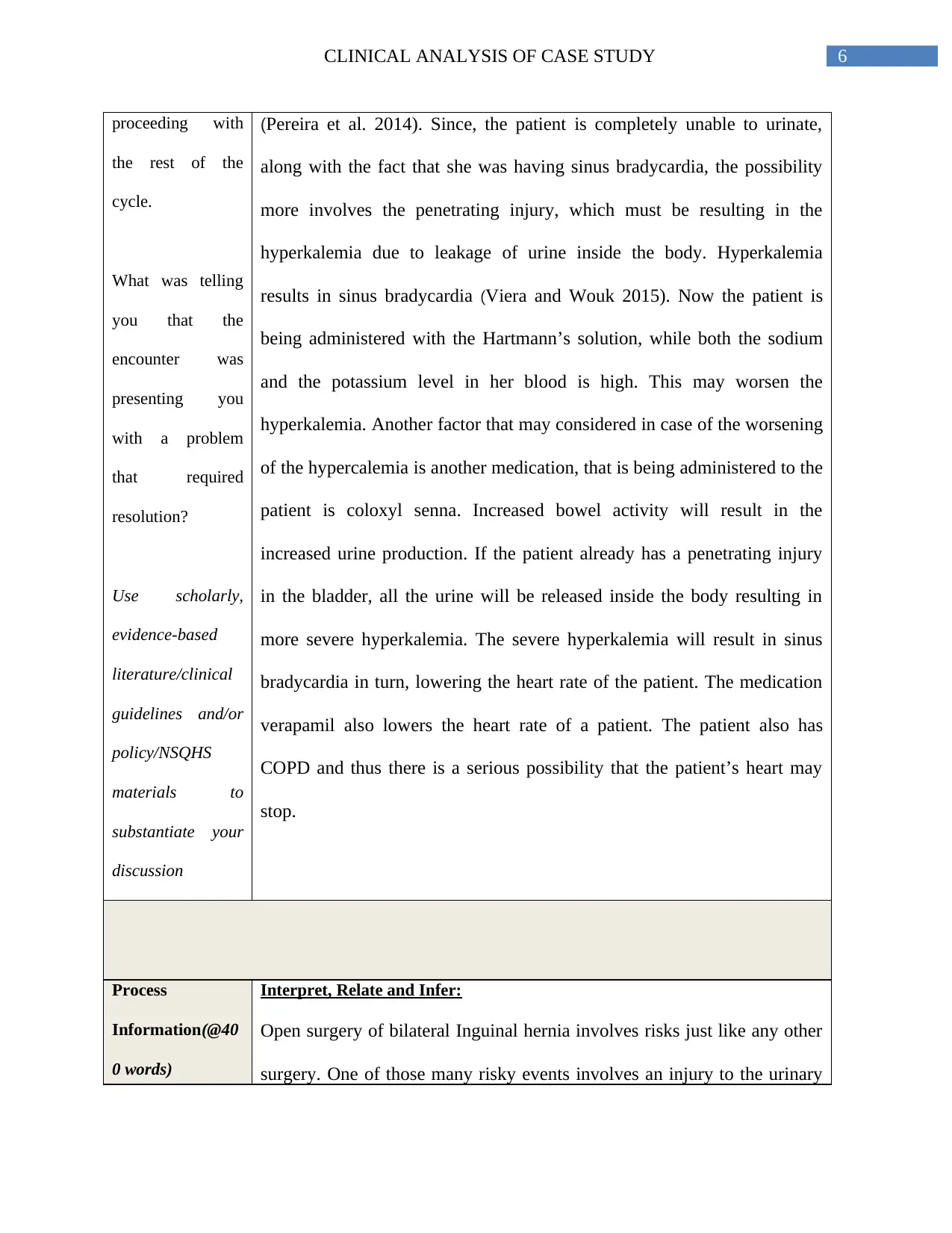
occurrence of it. Now, the bladder injury can be either blunt or penetrating
Gather(@150
words)
What was the new
information you
gathered from
additional
assessment?
Dot points are fine
for this section
Recall(@200
words)
Recall and apply
your existing
knowledge to the
above situation to
ensure you have a
broad
understanding of
what is/may be
occurring before
medication is it makes the heart beat with a slower rate (Borlot et al 2014).
Heparin: Heparin is an anticoagulant and it also has risks to be used on the
patients with high blood pressure, which can result in the haemorrhage
(Shah and Shah 2014).
Coloxyl Senna: This medication is used in the stimulation of bowel. The
side effect of this medication involves excessive bowel activity (Brown
2016).
Hartmann’s solution was being given to the patient intravenously.
Gather:
It has already been established that the patient might have a
penetrating bladder trauma.
The bladder trauma is possibly causing the hyperkalemia.
Administration of Hartmann’s solution in the patients with
hyperkalemia may result in a severe condition.
Administration of the medication Coloxyl Senna may result in
excessive bowel activity which may result in excessive urine
production.
Verapamil has the side effect of decreasing the heart rate.
Considering the patient was already having sinus bradycardia, a
medication that lowers the heart rate is not advisable.
Recall:
The surgery patient went through had already a risk of bladder injury. The
patient’s inability to urinate points to the possibility of an actual
occurrence of it. Now, the bladder injury can be either blunt or penetrating
⊘ This is a preview!⊘
Do you want full access?
Subscribe today to unlock all pages.
Trusted by 1+ million students worldwide
6CLINICAL ANALYSIS OF CASE STUDY
proceeding with
the rest of the
cycle.
What was telling
you that the
encounter was
presenting you
with a problem
that required
resolution?
Use scholarly,
evidence-based
literature/clinical
guidelines and/or
policy/NSQHS
materials to
substantiate your
discussion
(Pereira et al. 2014). Since, the patient is completely unable to urinate,
along with the fact that she was having sinus bradycardia, the possibility
more involves the penetrating injury, which must be resulting in the
hyperkalemia due to leakage of urine inside the body. Hyperkalemia
results in sinus bradycardia (Viera and Wouk 2015). Now the patient is
being administered with the Hartmann’s solution, while both the sodium
and the potassium level in her blood is high. This may worsen the
hyperkalemia. Another factor that may considered in case of the worsening
of the hypercalemia is another medication, that is being administered to the
patient is coloxyl senna. Increased bowel activity will result in the
increased urine production. If the patient already has a penetrating injury
in the bladder, all the urine will be released inside the body resulting in
more severe hyperkalemia. The severe hyperkalemia will result in sinus
bradycardia in turn, lowering the heart rate of the patient. The medication
verapamil also lowers the heart rate of a patient. The patient also has
COPD and thus there is a serious possibility that the patient’s heart may
stop.
Process
Information(@40
0 words)
Interpret, Relate and Infer:
Open surgery of bilateral Inguinal hernia involves risks just like any other
surgery. One of those many risky events involves an injury to the urinary
proceeding with
the rest of the
cycle.
What was telling
you that the
encounter was
presenting you
with a problem
that required
resolution?
Use scholarly,
evidence-based
literature/clinical
guidelines and/or
policy/NSQHS
materials to
substantiate your
discussion
(Pereira et al. 2014). Since, the patient is completely unable to urinate,
along with the fact that she was having sinus bradycardia, the possibility
more involves the penetrating injury, which must be resulting in the
hyperkalemia due to leakage of urine inside the body. Hyperkalemia
results in sinus bradycardia (Viera and Wouk 2015). Now the patient is
being administered with the Hartmann’s solution, while both the sodium
and the potassium level in her blood is high. This may worsen the
hyperkalemia. Another factor that may considered in case of the worsening
of the hypercalemia is another medication, that is being administered to the
patient is coloxyl senna. Increased bowel activity will result in the
increased urine production. If the patient already has a penetrating injury
in the bladder, all the urine will be released inside the body resulting in
more severe hyperkalemia. The severe hyperkalemia will result in sinus
bradycardia in turn, lowering the heart rate of the patient. The medication
verapamil also lowers the heart rate of a patient. The patient also has
COPD and thus there is a serious possibility that the patient’s heart may
stop.
Process
Information(@40
0 words)
Interpret, Relate and Infer:
Open surgery of bilateral Inguinal hernia involves risks just like any other
surgery. One of those many risky events involves an injury to the urinary
Paraphrase This Document
Need a fresh take? Get an instant paraphrase of this document with our AI Paraphraser
7CLINICAL ANALYSIS OF CASE STUDY
Interpret, relate
and infer from the
information
gathered to
demonstrate an
overall
understanding of
the clinical
encounter to
determine the two
main nursing
problems.
Predict(@100
words)
What could/would
have happened in
your encounter if
you were to have
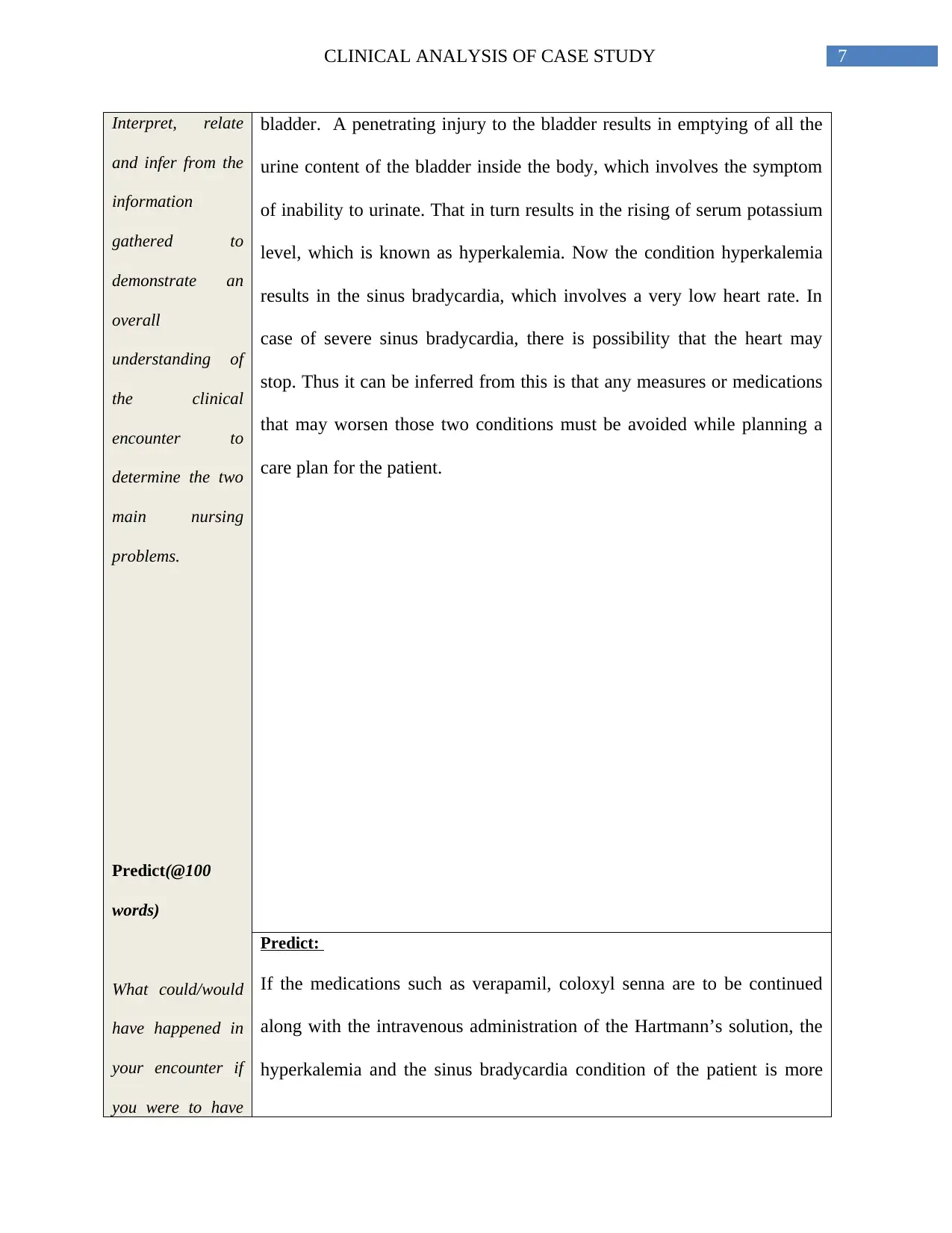
bladder. A penetrating injury to the bladder results in emptying of all the
urine content of the bladder inside the body, which involves the symptom
of inability to urinate. That in turn results in the rising of serum potassium
level, which is known as hyperkalemia. Now the condition hyperkalemia
results in the sinus bradycardia, which involves a very low heart rate. In
case of severe sinus bradycardia, there is possibility that the heart may
stop. Thus it can be inferred from this is that any measures or medications
that may worsen those two conditions must be avoided while planning a
care plan for the patient.
Predict:
If the medications such as verapamil, coloxyl senna are to be continued
along with the intravenous administration of the Hartmann’s solution, the
hyperkalemia and the sinus bradycardia condition of the patient is more
Interpret, relate
and infer from the
information
gathered to
demonstrate an
overall
understanding of
the clinical
encounter to
determine the two
main nursing
problems.
Predict(@100
words)
What could/would
have happened in
your encounter if
you were to have
bladder. A penetrating injury to the bladder results in emptying of all the
urine content of the bladder inside the body, which involves the symptom
of inability to urinate. That in turn results in the rising of serum potassium
level, which is known as hyperkalemia. Now the condition hyperkalemia
results in the sinus bradycardia, which involves a very low heart rate. In
case of severe sinus bradycardia, there is possibility that the heart may
stop. Thus it can be inferred from this is that any measures or medications
that may worsen those two conditions must be avoided while planning a
care plan for the patient.
Predict:
If the medications such as verapamil, coloxyl senna are to be continued
along with the intravenous administration of the Hartmann’s solution, the
hyperkalemia and the sinus bradycardia condition of the patient is more
8CLINICAL ANALYSIS OF CASE STUDY
taken NO action
and why?
Use scholarly,
evidence-based
literature/clinical
guidelines and/or
policy/NSQHS
materials to
substantiate your
discussion
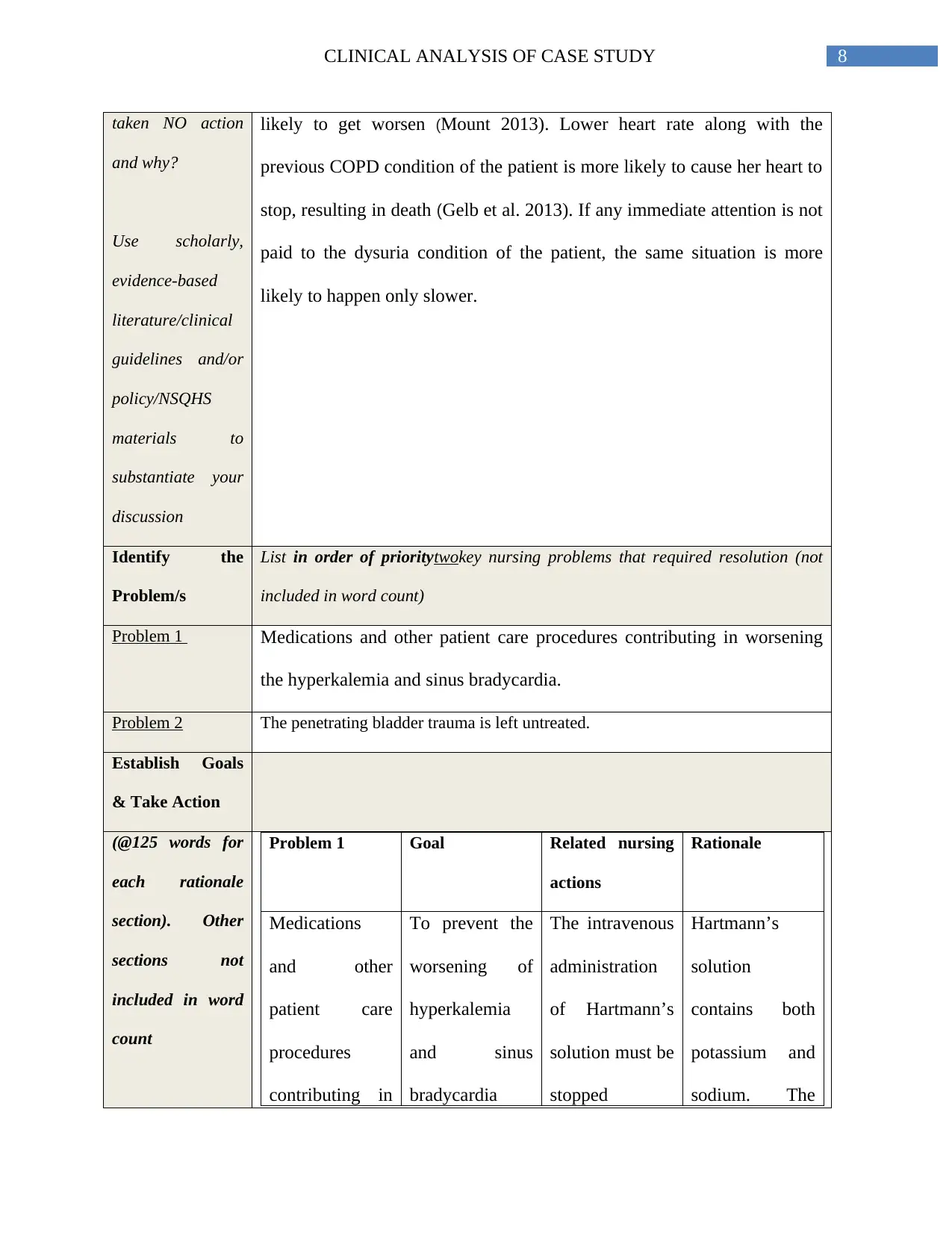
likely to get worsen (Mount 2013). Lower heart rate along with the
previous COPD condition of the patient is more likely to cause her heart to
stop, resulting in death (Gelb et al. 2013). If any immediate attention is not
paid to the dysuria condition of the patient, the same situation is more
likely to happen only slower.
Identify the
Problem/s
List in order of prioritytwokey nursing problems that required resolution (not
included in word count)
Problem 1 Medications and other patient care procedures contributing in worsening
the hyperkalemia and sinus bradycardia.
Problem 2 The penetrating bladder trauma is left untreated.
Establish Goals
& Take Action
(@125 words for
each rationale
section). Other
sections not
included in word
count
Problem 1 Goal Related nursing
actions
Rationale
Medications
and other
patient care
procedures
contributing in
To prevent the
worsening of
hyperkalemia
and sinus
bradycardia
The intravenous
administration
of Hartmann’s
solution must be
stopped
Hartmann’s
solution
contains both
potassium and
sodium. The
taken NO action
and why?
Use scholarly,
evidence-based
literature/clinical
guidelines and/or
policy/NSQHS
materials to
substantiate your
discussion
likely to get worsen (Mount 2013). Lower heart rate along with the
previous COPD condition of the patient is more likely to cause her heart to
stop, resulting in death (Gelb et al. 2013). If any immediate attention is not
paid to the dysuria condition of the patient, the same situation is more
likely to happen only slower.
Identify the
Problem/s
List in order of prioritytwokey nursing problems that required resolution (not
included in word count)
Problem 1 Medications and other patient care procedures contributing in worsening
the hyperkalemia and sinus bradycardia.
Problem 2 The penetrating bladder trauma is left untreated.
Establish Goals
& Take Action
(@125 words for
each rationale
section). Other
sections not
included in word
count
Problem 1 Goal Related nursing
actions
Rationale
Medications
and other
patient care
procedures
contributing in
To prevent the
worsening of
hyperkalemia
and sinus
bradycardia
The intravenous
administration
of Hartmann’s
solution must be
stopped
Hartmann’s
solution
contains both
potassium and
sodium. The
⊘ This is a preview!⊘
Do you want full access?
Subscribe today to unlock all pages.
Trusted by 1+ million students worldwide
9CLINICAL ANALYSIS OF CASE STUDY
Work through the
two nursing
problems
identified and
establish one goal
and then
rationalise with
scholarly,
evidence-based
literature/clinical
guidelines and/or
policy/NSQHS
materials the
related nursing
actions you
did/would
undertake.
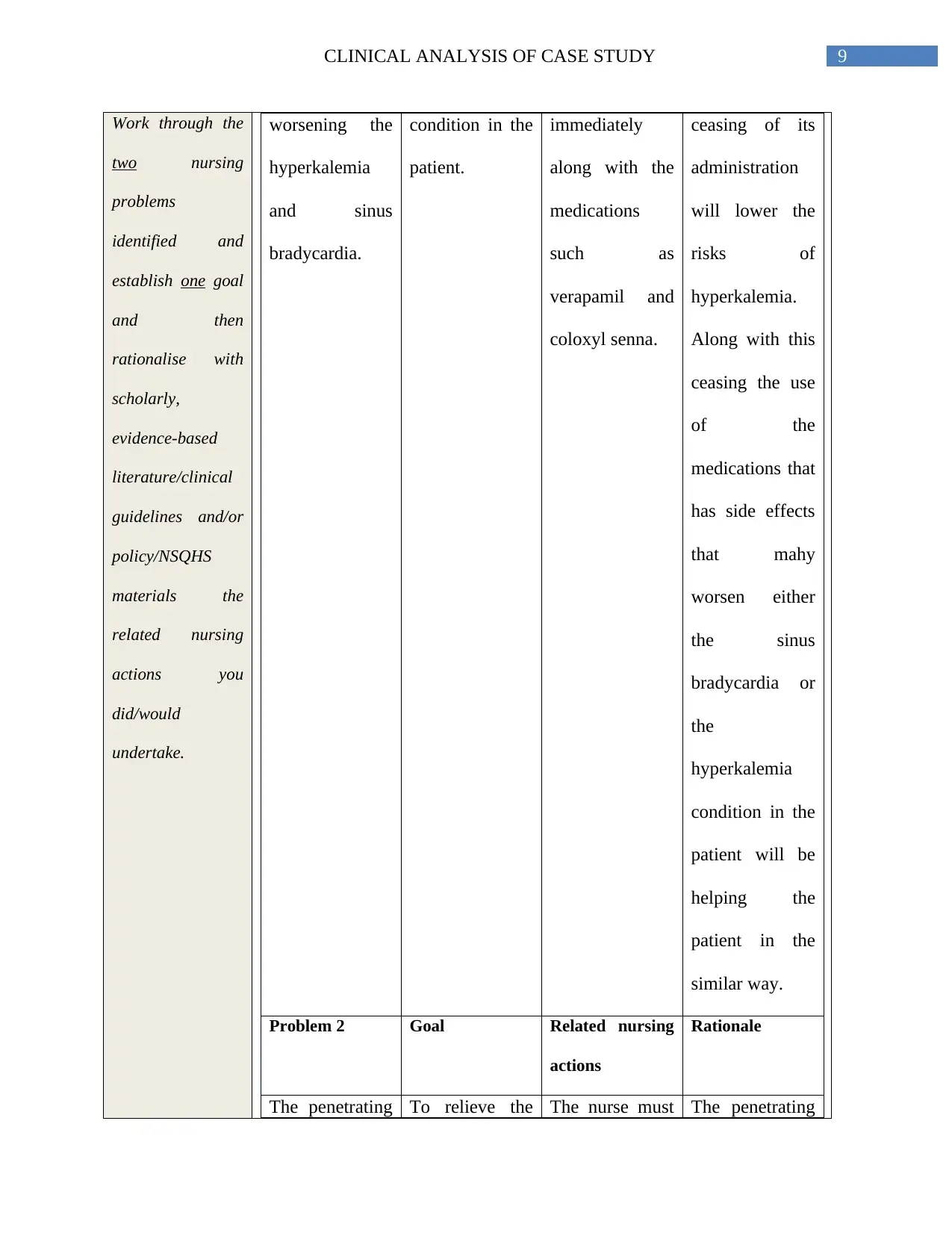
worsening the
hyperkalemia
and sinus
bradycardia.
condition in the
patient.
immediately
along with the
medications
such as
verapamil and
coloxyl senna.
ceasing of its
administration
will lower the
risks of
hyperkalemia.
Along with this
ceasing the use
of the
medications that
has side effects
that mahy
worsen either
the sinus
bradycardia or
the
hyperkalemia
condition in the
patient will be
helping the
patient in the
similar way.
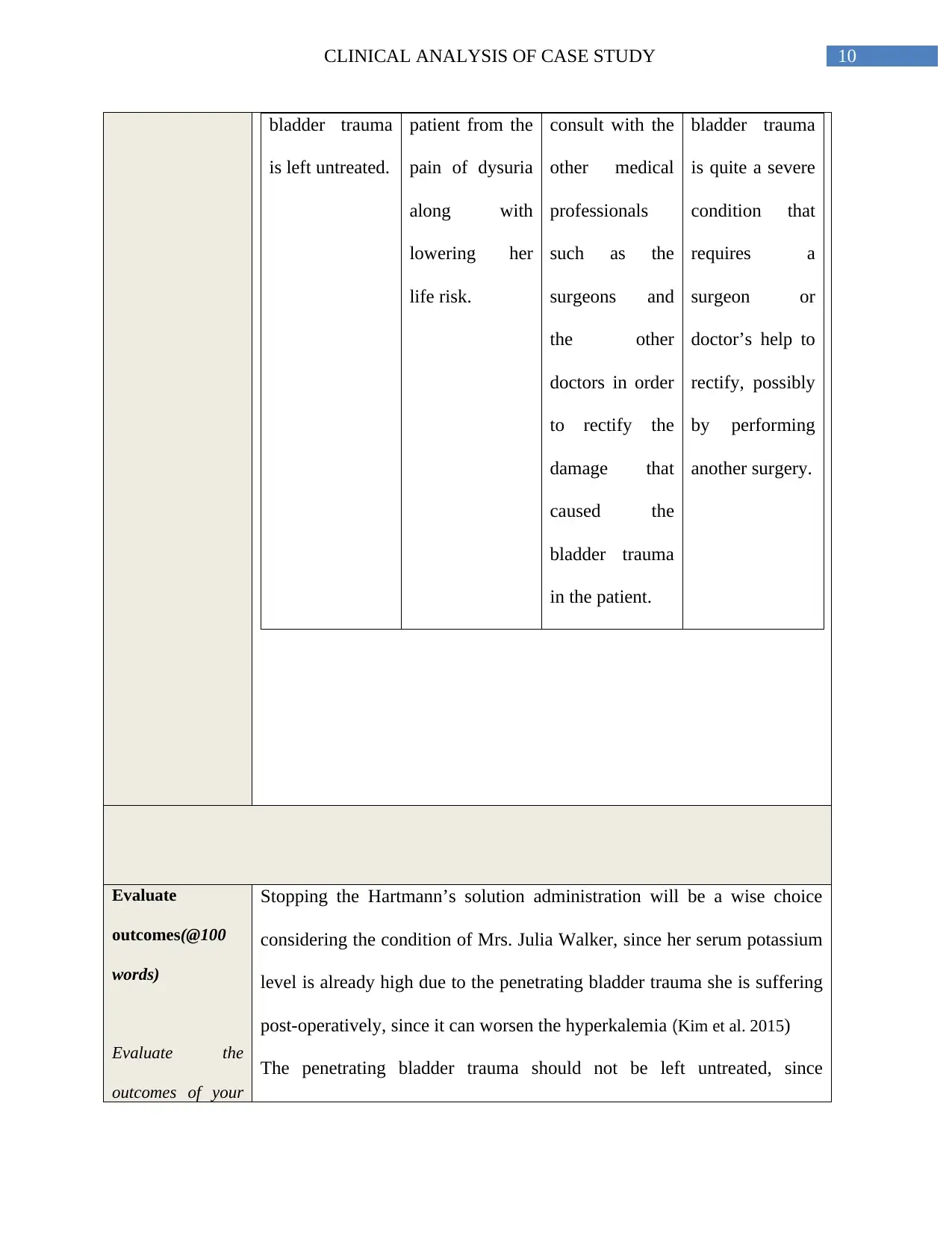
Problem 2 Goal Related nursing
actions
Rationale
The penetrating To relieve the The nurse must The penetrating
Work through the
two nursing
problems
identified and
establish one goal
and then
rationalise with
scholarly,
evidence-based
literature/clinical
guidelines and/or
policy/NSQHS
materials the
related nursing
actions you
did/would
undertake.
worsening the
hyperkalemia
and sinus
bradycardia.
condition in the
patient.
immediately
along with the
medications
such as
verapamil and
coloxyl senna.
ceasing of its
administration
will lower the
risks of
hyperkalemia.
Along with this
ceasing the use
of the
medications that
has side effects
that mahy
worsen either
the sinus
bradycardia or
the
hyperkalemia
condition in the
patient will be
helping the
patient in the
similar way.
Problem 2 Goal Related nursing
actions
Rationale
The penetrating To relieve the The nurse must The penetrating
Paraphrase This Document
Need a fresh take? Get an instant paraphrase of this document with our AI Paraphraser
10CLINICAL ANALYSIS OF CASE STUDY
bladder trauma
is left untreated.
patient from the
pain of dysuria
along with
lowering her
life risk.
consult with the
other medical
professionals
such as the
surgeons and
the other
doctors in order
to rectify the
damage that
caused the
bladder trauma
in the patient.
bladder trauma
is quite a severe
condition that
requires a
surgeon or
doctor’s help to
rectify, possibly
by performing
another surgery.
Evaluate
outcomes(@100
words)
Evaluate the
outcomes of your
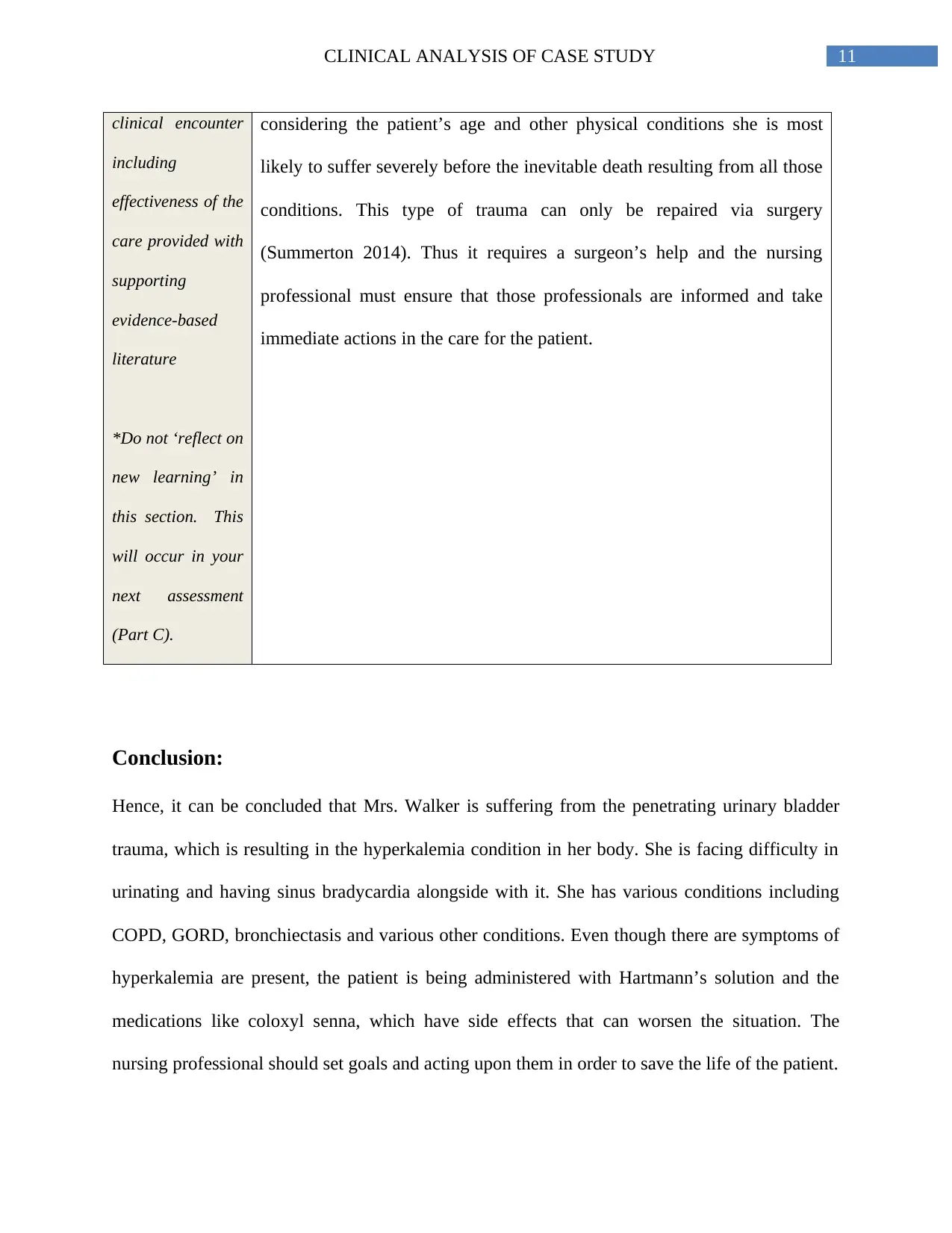
Stopping the Hartmann’s solution administration will be a wise choice
considering the condition of Mrs. Julia Walker, since her serum potassium
level is already high due to the penetrating bladder trauma she is suffering
post-operatively, since it can worsen the hyperkalemia (Kim et al. 2015)
The penetrating bladder trauma should not be left untreated, since
bladder trauma
is left untreated.
patient from the
pain of dysuria
along with
lowering her
life risk.
consult with the
other medical
professionals
such as the
surgeons and
the other
doctors in order
to rectify the
damage that
caused the
bladder trauma
in the patient.
bladder trauma
is quite a severe
condition that
requires a
surgeon or
doctor’s help to
rectify, possibly
by performing
another surgery.
Evaluate
outcomes(@100
words)
Evaluate the
outcomes of your
Stopping the Hartmann’s solution administration will be a wise choice
considering the condition of Mrs. Julia Walker, since her serum potassium
level is already high due to the penetrating bladder trauma she is suffering
post-operatively, since it can worsen the hyperkalemia (Kim et al. 2015)
The penetrating bladder trauma should not be left untreated, since
11CLINICAL ANALYSIS OF CASE STUDY
clinical encounter
including
effectiveness of the
care provided with
supporting
evidence-based
literature
*Do not ‘reflect on
new learning’ in
this section. This
will occur in your
next assessment
(Part C).
considering the patient’s age and other physical conditions she is most
likely to suffer severely before the inevitable death resulting from all those
conditions. This type of trauma can only be repaired via surgery
(Summerton 2014). Thus it requires a surgeon’s help and the nursing
professional must ensure that those professionals are informed and take
immediate actions in the care for the patient.
Conclusion:
Hence, it can be concluded that Mrs. Walker is suffering from the penetrating urinary bladder
trauma, which is resulting in the hyperkalemia condition in her body. She is facing difficulty in
urinating and having sinus bradycardia alongside with it. She has various conditions including
COPD, GORD, bronchiectasis and various other conditions. Even though there are symptoms of
hyperkalemia are present, the patient is being administered with Hartmann’s solution and the
medications like coloxyl senna, which have side effects that can worsen the situation. The
nursing professional should set goals and acting upon them in order to save the life of the patient.
clinical encounter
including
effectiveness of the
care provided with
supporting
evidence-based
literature
*Do not ‘reflect on
new learning’ in
this section. This
will occur in your
next assessment
(Part C).
considering the patient’s age and other physical conditions she is most
likely to suffer severely before the inevitable death resulting from all those
conditions. This type of trauma can only be repaired via surgery
(Summerton 2014). Thus it requires a surgeon’s help and the nursing
professional must ensure that those professionals are informed and take
immediate actions in the care for the patient.
Conclusion:
Hence, it can be concluded that Mrs. Walker is suffering from the penetrating urinary bladder
trauma, which is resulting in the hyperkalemia condition in her body. She is facing difficulty in
urinating and having sinus bradycardia alongside with it. She has various conditions including
COPD, GORD, bronchiectasis and various other conditions. Even though there are symptoms of
hyperkalemia are present, the patient is being administered with Hartmann’s solution and the
medications like coloxyl senna, which have side effects that can worsen the situation. The
nursing professional should set goals and acting upon them in order to save the life of the patient.
⊘ This is a preview!⊘
Do you want full access?
Subscribe today to unlock all pages.
Trusted by 1+ million students worldwide

1 out of 15


Your All-in-One AI-Powered Toolkit for Academic Success.
+13062052269
info@desklib.com
Available 24*7 on WhatsApp / Email
![[object Object]](/_next/static/media/star-bottom.7253800d.svg)
Unlock your academic potential
Copyright © 2020–2026 A2Z Services. All Rights Reserved. Developed and managed by ZUCOL.