Clinical Reasoning Report: Health Assessment of Jonathan Yung, CNA152

Verified

Added on  2023/01/23

|7
|1557
|66
Report
AI Summary
This report presents a health assessment of a 16-year-old student, Jonathan Yung, following a bubble soccer match. The assessment, conducted by a student nurse, utilizes the Levett-Jonas clinical reasoning cycle to evaluate Jonathan's vital signs, including blood pressure, pulse rate, respiratory rate, and temperature, before and after the activity. The report identifies and analyzes both subjective and objective cues, such as flushed skin, excessive sweating, and elevated vital signs post-exercise. It applies principles of physiology, particularly homeostasis and the body's response to physical exertion and environmental conditions like heat and low humidity, to explain the observed changes. The report identifies potential health issues related to dehydration and the need for rest to regain homeostatic balance, and suggests further assessments to rule out any underlying cardiac conditions or exercise intolerance. The report concludes that the changes in vital signs were primarily due to physical activity and temperature, and recommends monitoring and rest to ensure Jonathan's safe return home.
Document Page
Running head: HEALTH ASSESSMENT
HEALTH ASSESSMENT
Name of the Student:
Name of the University:
Author note:
tabler-icon-diamond-filled.svg

Paraphrase This Document

Need a fresh take? Get an instant paraphrase of this document with our AI Paraphraser
Document Page
1HEALTH ASSESSMENT
Collect Information:
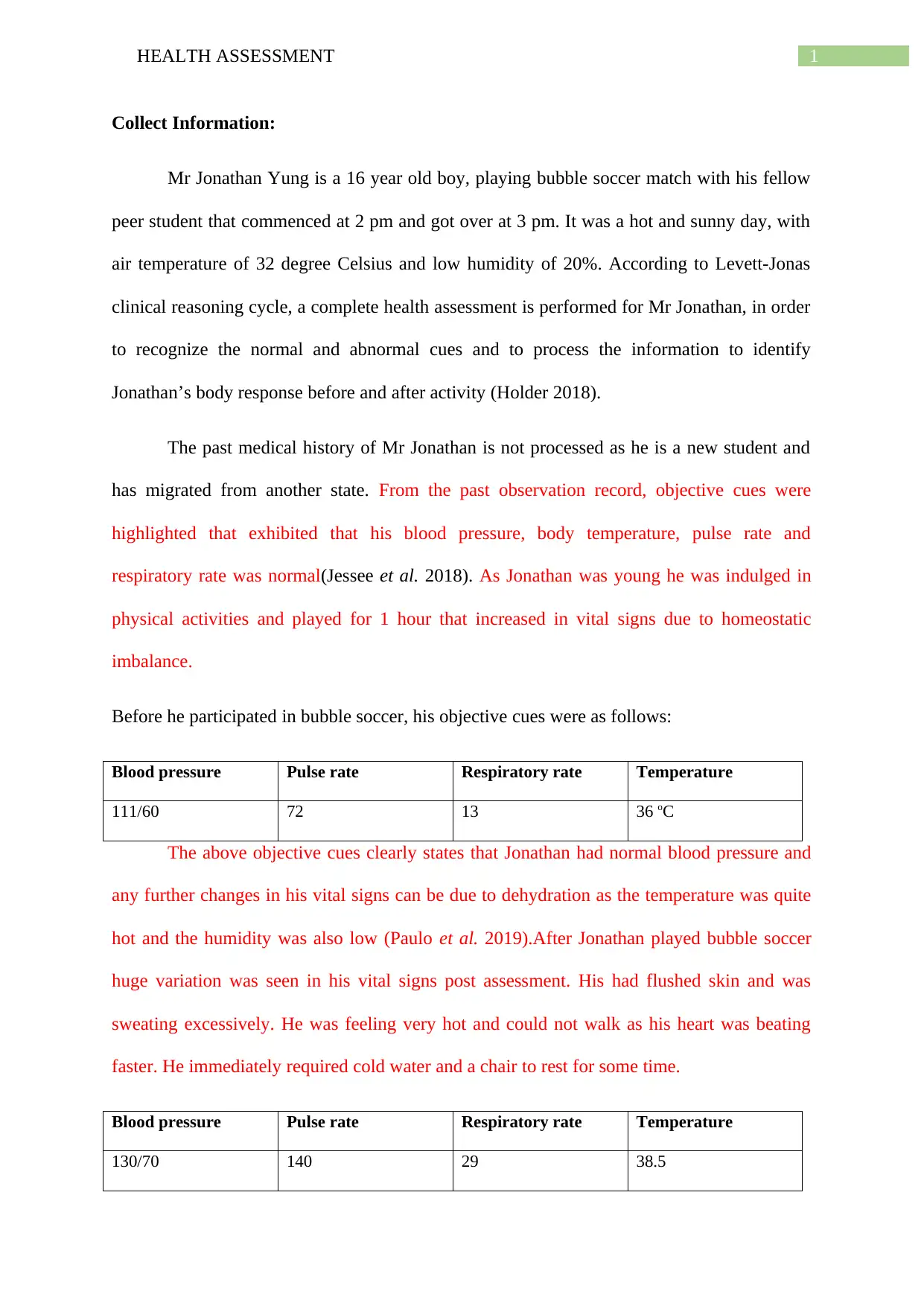
Mr Jonathan Yung is a 16 year old boy, playing bubble soccer match with his fellow
peer student that commenced at 2 pm and got over at 3 pm. It was a hot and sunny day, with
air temperature of 32 degree Celsius and low humidity of 20%. According to Levett-Jonas
clinical reasoning cycle, a complete health assessment is performed for Mr Jonathan, in order
to recognize the normal and abnormal cues and to process the information to identify
Jonathan’s body response before and after activity (Holder 2018).
The past medical history of Mr Jonathan is not processed as he is a new student and
has migrated from another state. From the past observation record, objective cues were
highlighted that exhibited that his blood pressure, body temperature, pulse rate and
respiratory rate was normal(Jessee et al. 2018). As Jonathan was young he was indulged in
physical activities and played for 1 hour that increased in vital signs due to homeostatic
imbalance.
Before he participated in bubble soccer, his objective cues were as follows:
Blood pressure Pulse rate Respiratory rate Temperature
111/60 72 13 36 oC
The above objective cues clearly states that Jonathan had normal blood pressure and
any further changes in his vital signs can be due to dehydration as the temperature was quite
hot and the humidity was also low (Paulo et al. 2019).After Jonathan played bubble soccer
huge variation was seen in his vital signs post assessment. His had flushed skin and was
sweating excessively. He was feeling very hot and could not walk as his heart was beating
faster. He immediately required cold water and a chair to rest for some time.
Blood pressure Pulse rate Respiratory rate Temperature
130/70 140 29 38.5
Document Page
2HEALTH ASSESSMENT
Process information:
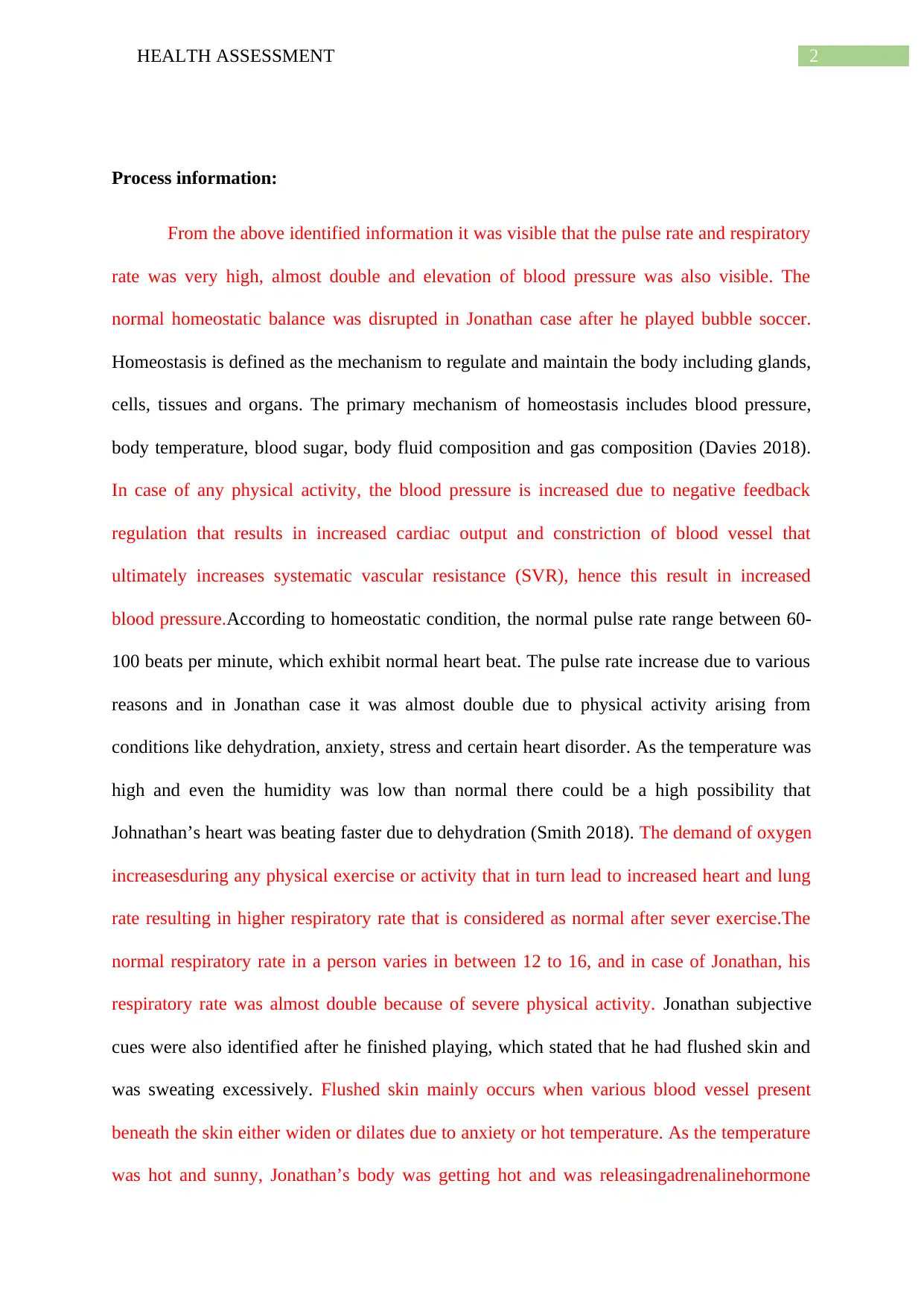
From the above identified information it was visible that the pulse rate and respiratory
rate was very high, almost double and elevation of blood pressure was also visible. The
normal homeostatic balance was disrupted in Jonathan case after he played bubble soccer.
Homeostasis is defined as the mechanism to regulate and maintain the body including glands,
cells, tissues and organs. The primary mechanism of homeostasis includes blood pressure,
body temperature, blood sugar, body fluid composition and gas composition (Davies 2018).
In case of any physical activity, the blood pressure is increased due to negative feedback
regulation that results in increased cardiac output and constriction of blood vessel that
ultimately increases systematic vascular resistance (SVR), hence this result in increased
blood pressure.According to homeostatic condition, the normal pulse rate range between 60-
100 beats per minute, which exhibit normal heart beat. The pulse rate increase due to various
reasons and in Jonathan case it was almost double due to physical activity arising from
conditions like dehydration, anxiety, stress and certain heart disorder. As the temperature was
high and even the humidity was low than normal there could be a high possibility that
Johnathan’s heart was beating faster due to dehydration (Smith 2018). The demand of oxygen
increasesduring any physical exercise or activity that in turn lead to increased heart and lung
rate resulting in higher respiratory rate that is considered as normal after sever exercise.The
normal respiratory rate in a person varies in between 12 to 16, and in case of Jonathan, his
respiratory rate was almost double because of severe physical activity. Jonathan subjective
cues were also identified after he finished playing, which stated that he had flushed skin and
was sweating excessively. Flushed skin mainly occurs when various blood vessel present
beneath the skin either widen or dilates due to anxiety or hot temperature. As the temperature
was hot and sunny, Jonathan’s body was getting hot and was releasingadrenalinehormone
Document Page
3HEALTH ASSESSMENT
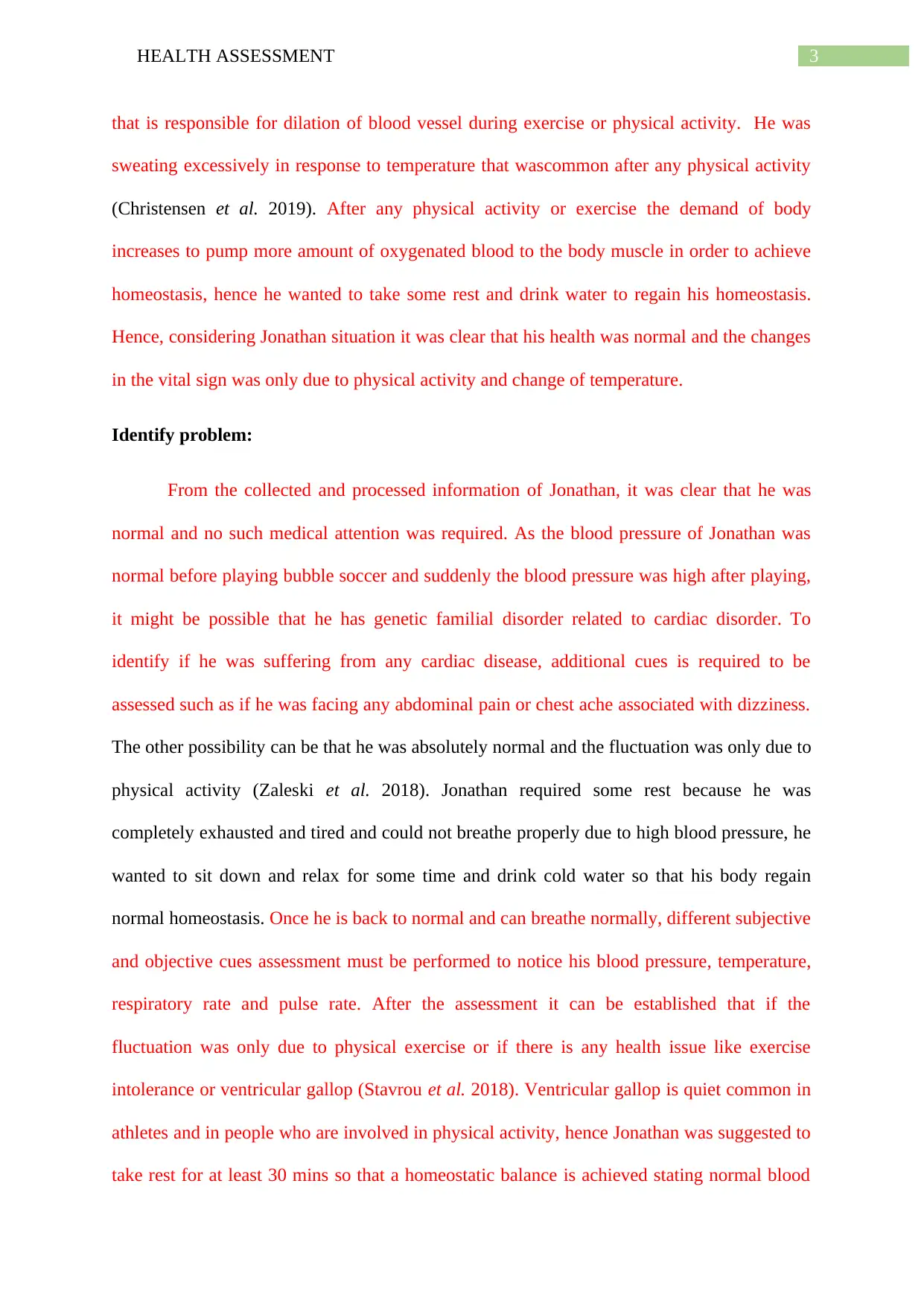
that is responsible for dilation of blood vessel during exercise or physical activity. He was
sweating excessively in response to temperature that wascommon after any physical activity
(Christensen et al. 2019). After any physical activity or exercise the demand of body
increases to pump more amount of oxygenated blood to the body muscle in order to achieve
homeostasis, hence he wanted to take some rest and drink water to regain his homeostasis.
Hence, considering Jonathan situation it was clear that his health was normal and the changes
in the vital sign was only due to physical activity and change of temperature.
Identify problem:
From the collected and processed information of Jonathan, it was clear that he was
normal and no such medical attention was required. As the blood pressure of Jonathan was
normal before playing bubble soccer and suddenly the blood pressure was high after playing,
it might be possible that he has genetic familial disorder related to cardiac disorder. To
identify if he was suffering from any cardiac disease, additional cues is required to be
assessed such as if he was facing any abdominal pain or chest ache associated with dizziness.
The other possibility can be that he was absolutely normal and the fluctuation was only due to
physical activity (Zaleski et al. 2018). Jonathan required some rest because he was
completely exhausted and tired and could not breathe properly due to high blood pressure, he
wanted to sit down and relax for some time and drink cold water so that his body regain
normal homeostasis. Once he is back to normal and can breathe normally, different subjective
and objective cues assessment must be performed to notice his blood pressure, temperature,
respiratory rate and pulse rate. After the assessment it can be established that if the
fluctuation was only due to physical exercise or if there is any health issue like exercise
intolerance or ventricular gallop (Stavrou et al. 2018). Ventricular gallop is quiet common in
athletes and in people who are involved in physical activity, hence Jonathan was suggested to
take rest for at least 30 mins so that a homeostatic balance is achieved stating normal blood
tabler-icon-diamond-filled.svg

Paraphrase This Document

Need a fresh take? Get an instant paraphrase of this document with our AI Paraphraser
Document Page
4HEALTH ASSESSMENT
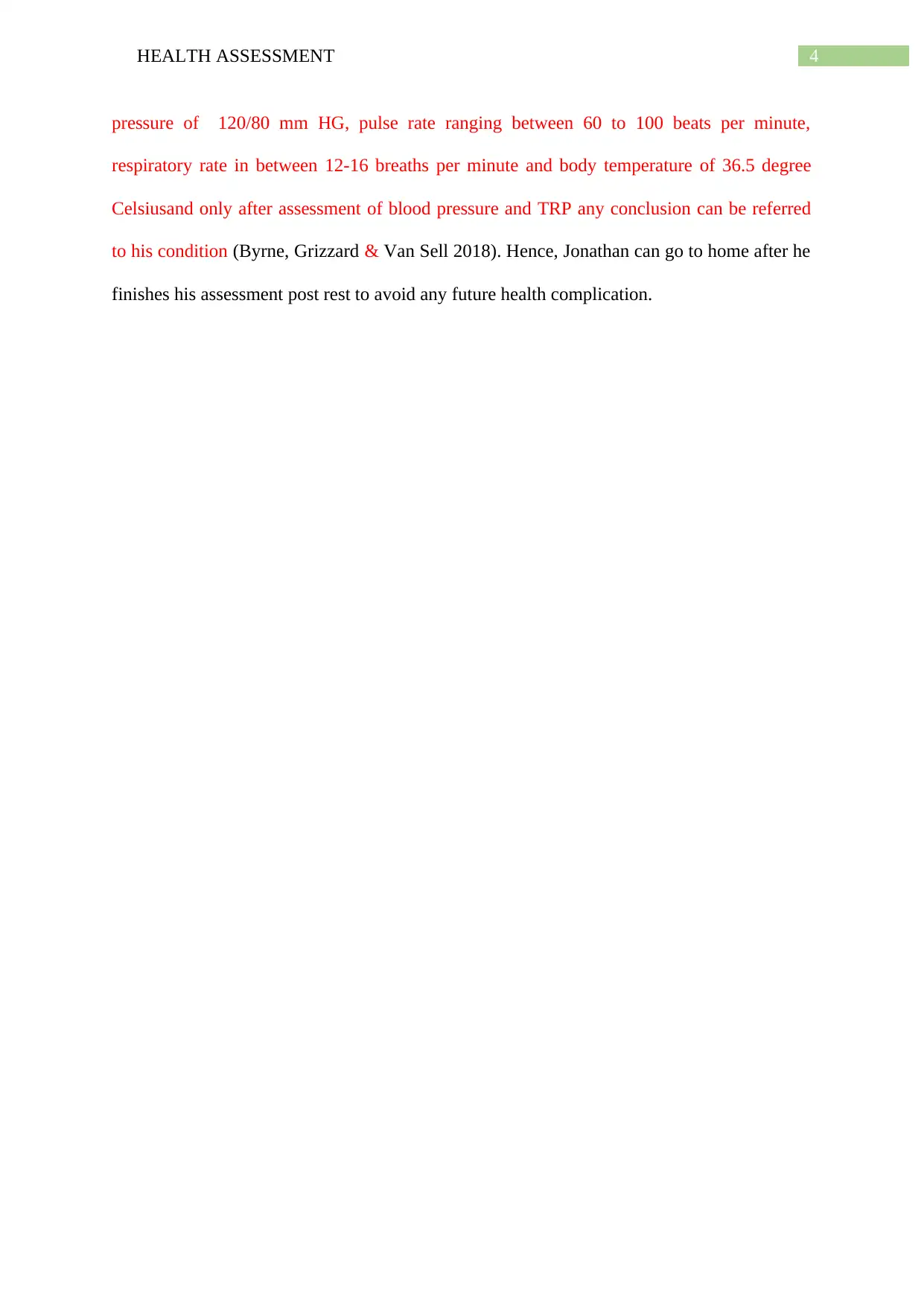
pressure of 120/80 mm HG, pulse rate ranging between 60 to 100 beats per minute,
respiratory rate in between 12-16 breaths per minute and body temperature of 36.5 degree
Celsiusand only after assessment of blood pressure and TRP any conclusion can be referred
to his condition (Byrne, Grizzard & Van Sell 2018). Hence, Jonathan can go to home after he
finishes his assessment post rest to avoid any future health complication.
Document Page
5HEALTH ASSESSMENT
References:
Byrne, S., Grizzard, L. & Van Sell, S., 2018. A Concept Analysis of Balance.
Christensen, M.J., Eller, E., Kjaer, H.F., Broesby-Olsen, S., Mortz, C.G. & Bindslev-Jensen,
C., 2019. Exercise-induced anaphylaxis: causes, consequences, and management
recommendations. Expert review of clinical immunology, vol. 15, no. 3, pp.265-273.
Davies, K.J., 2018. Cardiovascular adaptive homeostasis in exercise. Frontiers in
physiology, vol. 9, no. 369.
Holder, A.G., 2018. Clinical Reasoning: A State of the Science Report. International journal
of nursing education scholarship, vol. 15, no. 1.
Jessee, M.B., Mattocks, K.T., Buckner, S.L., Mouser, J.G., Counts, B.R., Dankel, S.J.,
Laurentino, G.C. & Loenneke, J.P., 2018. The acute muscular response to blood flow
restricted exercise with very low relative pressure. Clinical physiology and functional
imaging, vol. 38, no. 2, pp.304-311.
Paulo, A.C., Tricoli, V., Queiroz, A.C., Laurentino, G. & Forjaz, C.L., 2019. Blood Pressure
Response During Resistance Training of Different Work-to-Rest Ratio. The Journal of
Strength & Conditioning Research, vol. 33, no. 2, pp.399-407.
Smith, J.K., 2018. Exercise, obesity and CNS control of metabolic homeostasis: a
review. Frontiers in physiology, vol. 9, no. 574.
Stavrou, V., Voutselas, V., Karetsi, E. & Gourgoulianis, K.I., 2018. Acute responses of
breathing techniques in maximal inspiratory pressure. Sport Sciences for Health, vol. 14, no.
1, pp.91-95.
Document Page
6HEALTH ASSESSMENT
Zaleski, A.L., Taylor, B.A., Pescatello, L.S. & Armstrong, L.E., 2018. Exercising in Stressful
Environmental Conditions with Hypertension Versus Normal Blood Pressure. Journal of
Clinical Exercise Physiology, vol. 7, no. 3, pp.53-62.
chevron_up_icon
1 out of 7
circle_padding
hide_on_mobile
zoom_out_icon
[object Object]