Strategies for Clinical Risk Management and Patient Safety Improvement

Verified

Added on  2023/06/15

|8
|1375
|331
Report
AI Summary
This report provides an overview of clinical risk management and its direct impact on patient safety within healthcare organizations. It highlights the importance of identifying, assessing, and eliminating potential risks to improve patient outcomes. The report discusses strategies to combat clinical risks, including incident reporting and investigative procedures. It also mentions key organizations involved in clinical risk management, such as AHRQ, CDC, CMS, and ASHRM, focusing on ASHRM's patient safety guidelines and collaborative efforts. The report recommends continuous patient engagement, strict staff scrutiny, and maintaining a sterile environment to enhance patient safety and concludes that preventable clinical risks can be avoided through proactive management and skilled professionals.
Document Page
Running head: CLINICAL RISK MANAGEMENT AND PATIENT SAFETY
Clinical Risk Management and Patient Safety
Name of Student
Name of University
Author Note
tabler-icon-diamond-filled.svg

Paraphrase This Document

Need a fresh take? Get an instant paraphrase of this document with our AI Paraphraser
Document Page
1Clinical Risk Management and Patient Safety
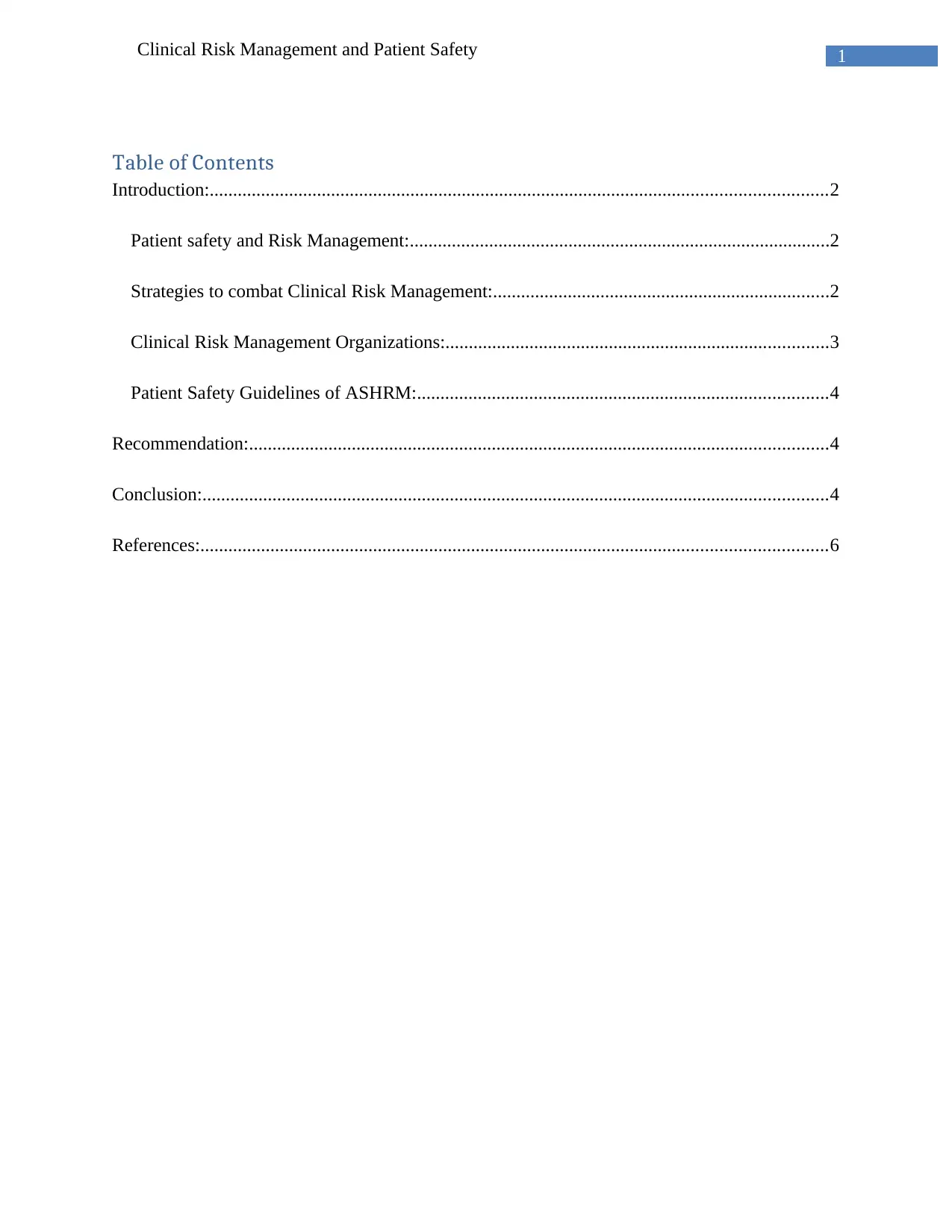
Table of Contents
Introduction:....................................................................................................................................2
Patient safety and Risk Management:..........................................................................................2
Strategies to combat Clinical Risk Management:........................................................................2
Clinical Risk Management Organizations:..................................................................................3
Patient Safety Guidelines of ASHRM:........................................................................................4
Recommendation:............................................................................................................................4
Conclusion:......................................................................................................................................4
References:......................................................................................................................................6
Document Page
2Clinical Risk Management and Patient Safety
Introduction:
Clinical risk management is a complicated process that regards the various risks and
mistakes that might occur in healthcare setting. The authority deals with a number of issues like
strong workforce, leadership management, patient safety and ensures quality assurance. The
aspect of clinical risk management addressed in this report is Patient safety (Nitrosi et al., 2014).
This issue is chosen because ultimate goal of the healthcare industry is to provide good service to
ailing people. There have been numerous reports where it shows that healthcare facilities fail to
prov.ide standard service and patients often face inconvenience.
Patient safety and Risk Management:
Patient safety is directly dependant on clinical risk management, concerning the
improvement of safety and quality of the healthcare organization. Identification of the
circumstances or opportunities that may or may not put the patient at risk is analyzed and
implements proper procedures to avoid that (Briner, Manser & Kessler, 2013).
Strategies to combat Clinical Risk Management:
The basic steps that are undertaken to combat clinical risk management are:
Identification of the risk: Identifying a potential risk is the first step to address an
ongoing risk management. The issue can be identified by reporting the incidence of the
issues as soon as it happens (Middleton et al., 2013). Staff members are advised to keep
record of each of the incidence and its frequency, so that risk can be prioritized. For
example, if a healthcare organization has been facing exposure of patients to unknown
infection, the staff members would be required to record the incidents and report back to
the authority for immediate action.
Document Page
3Clinical Risk Management and Patient Safety
Assessment of the frequency and severity of the risk: If a risk is identified from the
reports provided, investigative procedures should follow to find the source the problem
(Gaffey, 2016). Based on the analysis of the source problem, plan of action can be
devised to attain the solution. The above mentioned example, hypothetically assuming
the root of the problem was found to be leakage in the biohazard department, where vials
of flesh eating bacteria was misplaced and nearby units’ patients were affected.
Elimination of the risk: The staff members of the health organization should be skilled
enough to the address the issue and act quickly to eliminate the risk in order to stop the
issue from proceeding further. Like, in the mentioned example, the staff members of the
biohazard unit should sterilize and evacuate potential threats. The patients in the adjacent
wards should be sterilized and exposed patients should be given immediate medical
attention.
Clinical Risk Management Organizations:
There are various organizations that address clinical risk management issues and work
together to maintain the harmony of the health industry. Agency for Health Research and
Quality (AHRQ), conducts research which provides outcomes of various health related issues
with evidence and helps the organizations make management decisions. Centers for Disease
Control and Prevention (CDC) is a federal organization body that works to provide credible
information for people in homes, hospitals and other health related organization. Centers for
Medicare and Medicaid Services (CMS) are another organization responsible for managing the
health care policies to people and help other organizations function properly without any
financial issues. The most important of all these organization is the American Society for
tabler-icon-diamond-filled.svg

Paraphrase This Document

Need a fresh take? Get an instant paraphrase of this document with our AI Paraphraser
Document Page
4Clinical Risk Management and Patient Safety
Healthcare Risk Management (ASHRM), because it the far wider grasp on the clinical risk
management out of all these organization.
Patient Safety Guidelines of ASHRM:
The ASHRM works in collaboration with American Hospital Association (AHA), Health
Research & Education Trust (HRET) as well as Hospital Engagement Network (HEN) in
maintaining the safety and quality provided to the patients. The organization has set programs
and guidelines that determine the safe procedures implemented to patients (ASHRM Patient
Safety Portal, 2018). The collaborative efforts have addresses several common problems like:
Adverse drug effects, Urinary tract Infection, Blood Stream infections, Injuries, Preventable re-
hospitalizations, surgical infection etc. their patient safety programs are quite efficient in
managing clinical risks, if detected.
Recommendation:
All health-care professionals should be responsible for their patients and work together to
maintain the workforce of the facility and be accountable for patient safety. Although the
ASHRM addresses important issues to engage patient safety but there are issues that could be
further addressed. Constant patient engagement and rapt attention is an important aspect when it
comes to ensure safe service for the patient. Strict scrutiny in the selection of staff members may
also reduce the incidence of clinical malpractice. Maintain the sterile environment in a healthcare
facility is also important to engage patient safety.
Document Page
5Clinical Risk Management and Patient Safety
Conclusion:
Clinical risks are mostly preventable and can be avoided to ensure patient safety.
Organizations work hard to address the issues patients face on a regular basis in hospitals. Health
policy makers, researchers and skilled professionals address these issues to maintain the integrity
of the healthcare industry. Management authority works to ensure that the facilities receive state
of the art technologies and instruments, recruits skilled professionals to ensure safe quality
service for the patients.
Document Page
6Clinical Risk Management and Patient Safety
References:
ASHRM Patient Safety Portal. (2018). Ashrm.org. Retrieved 17 February 2018, from
http://www.ashrm.org/resources/patient-safety-portal/index.dhtml.
Briner, M., Manser, T., & Kessler, O. (2013). Clinical risk management in hospitals: strategy,
central coordination and dialogue as key enablers. Journal of evaluation in clinical
practice, 19(2), 363-369.
Gaffey, A. D. (2016). Setting priorities for reducing risk and advancing patient safety. Journal of
Healthcare Risk Management, 35(4), 3-3.
Ginter, P. M., Duncan, J., & Swayne, L. E. (2018). The Strategic Management of Healthcare
Organizations. John Wiley & Sons.
Lundgren, R. E., & McMakin, A. H. (2013). Risk communication: A handbook for
communicating environmental, safety, and health risks. John Wiley & Sons.
Middleton, B., Bloomrosen, M., Dente, M. A., Hashmat, B., Koppel, R., Overhage, J. M., ... &
Zhang, J. (2013). Enhancing patient safety and quality of care by improving the usability
of electronic health record systems: recommendations from AMIA. Journal of the
American Medical Informatics Association, 20(e1), e2-e8.
Nitrosi, A., Bertolini, M., Sghedoni, R., Notari, P., Pattacini, P., Corazza, A., & Iori, M. (2014).
RIS-PACS, patient safety, and clinical risk management. La Radiologia Medica, 120(6),
498-503. http://dx.doi.org/10.1007/s11547-014-0483-z
tabler-icon-diamond-filled.svg

Paraphrase This Document

Need a fresh take? Get an instant paraphrase of this document with our AI Paraphraser
Document Page
7Clinical Risk Management and Patient Safety
Oppenberg, A. A. (2013). ASHRM member benefits and programs enhance patient
safety. Journal of Healthcare Risk Management, 32(4), 1-1.
chevron_up_icon
1 out of 8
circle_padding
hide_on_mobile
zoom_out_icon
[object Object]