Advanced Practice Registered Nurses (APRNs) Roles Comparison Report

Verified

Added on  2023/06/04

|4
|569
|122
Report
AI Summary
This report provides a comparative analysis of two Advanced Practice Registered Nurse (APRN) roles: the Nurse Practitioner and the Clinical Nurse Specialist. It begins by defining APRNs and their crucial role in the healthcare system, including their involvement in primary health care and preventive services. The report then delves into the specific roles and responsibilities of Nurse Practitioners, who provide acute, specialty, and primary care across all age groups, and Clinical Nurse Specialists, who focus on patient diagnosis, management, and supporting other nurses. The analysis highlights the overlapping and distinct aspects of these roles, emphasizing the importance of certification and a master's degree level of training for both. The report references relevant literature to support its findings, offering a comprehensive overview of the APRN roles in the context of healthcare and nursing practice.

Document Page
Running Head: APRN 1
Advanced Practice Registered Nurses
Name
Date
Lecturer
University
tabler-icon-diamond-filled.svg

Paraphrase This Document

Need a fresh take? Get an instant paraphrase of this document with our AI Paraphraser
Document Page
APRN 2
Advanced Practice Registered Nurses
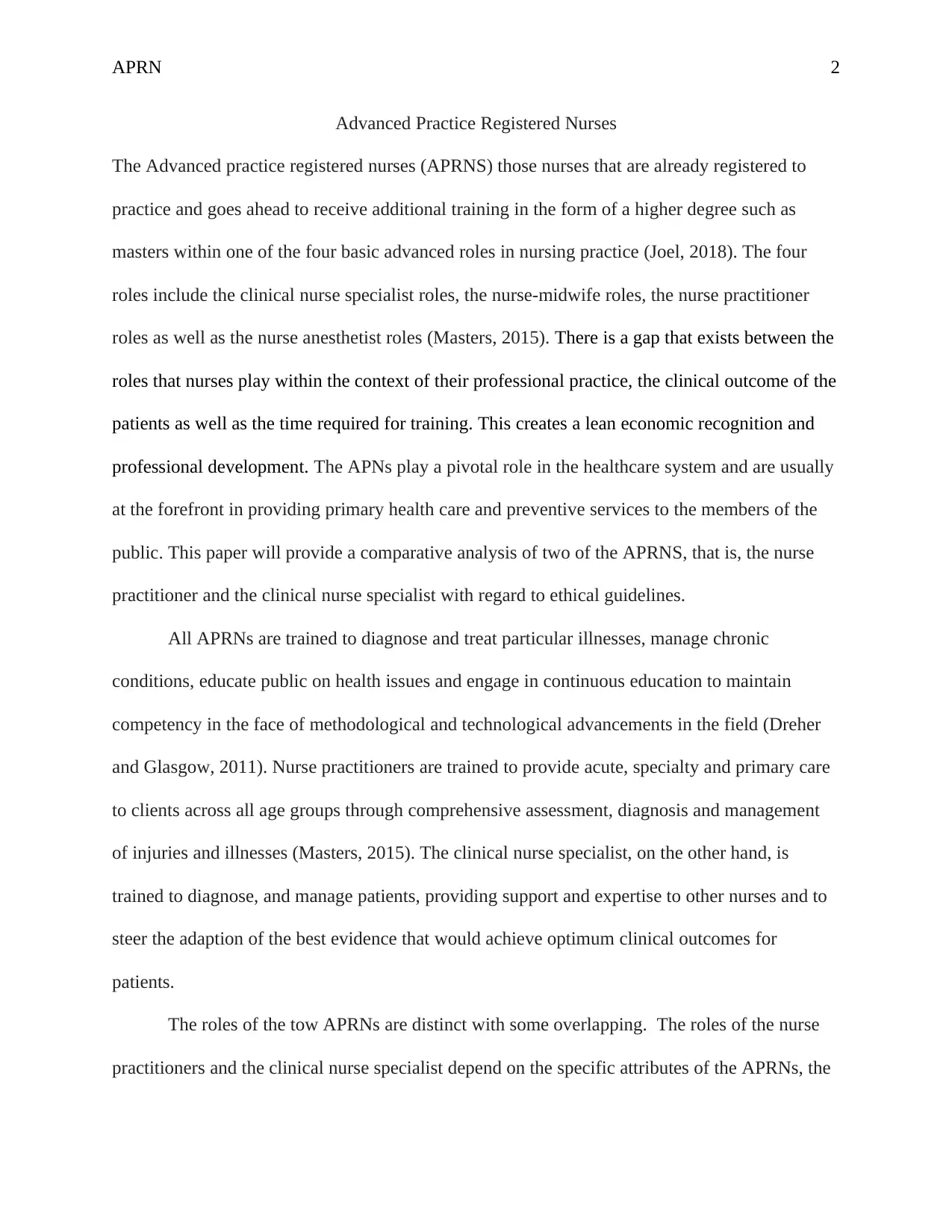
The Advanced practice registered nurses (APRNS) those nurses that are already registered to
practice and goes ahead to receive additional training in the form of a higher degree such as
masters within one of the four basic advanced roles in nursing practice (Joel, 2018). The four
roles include the clinical nurse specialist roles, the nurse-midwife roles, the nurse practitioner
roles as well as the nurse anesthetist roles (Masters, 2015). There is a gap that exists between the
roles that nurses play within the context of their professional practice, the clinical outcome of the
patients as well as the time required for training. This creates a lean economic recognition and
professional development. The APNs play a pivotal role in the healthcare system and are usually
at the forefront in providing primary health care and preventive services to the members of the
public. This paper will provide a comparative analysis of two of the APRNS, that is, the nurse
practitioner and the clinical nurse specialist with regard to ethical guidelines.
All APRNs are trained to diagnose and treat particular illnesses, manage chronic
conditions, educate public on health issues and engage in continuous education to maintain
competency in the face of methodological and technological advancements in the field (Dreher
and Glasgow, 2011). Nurse practitioners are trained to provide acute, specialty and primary care
to clients across all age groups through comprehensive assessment, diagnosis and management
of injuries and illnesses (Masters, 2015). The clinical nurse specialist, on the other hand, is
trained to diagnose, and manage patients, providing support and expertise to other nurses and to
steer the adaption of the best evidence that would achieve optimum clinical outcomes for
patients.
The roles of the tow APRNs are distinct with some overlapping. The roles of the nurse
practitioners and the clinical nurse specialist depend on the specific attributes of the APRNs, the
Document Page
APRN 3
features of the population in question, and the context of practice setting (Oermann, 2015).
Generally, both APRNs must have certification to practice as registered nurses from the
appropriate certifying body and also completed a master’s degree level of training.
Document Page
APRN 4
References
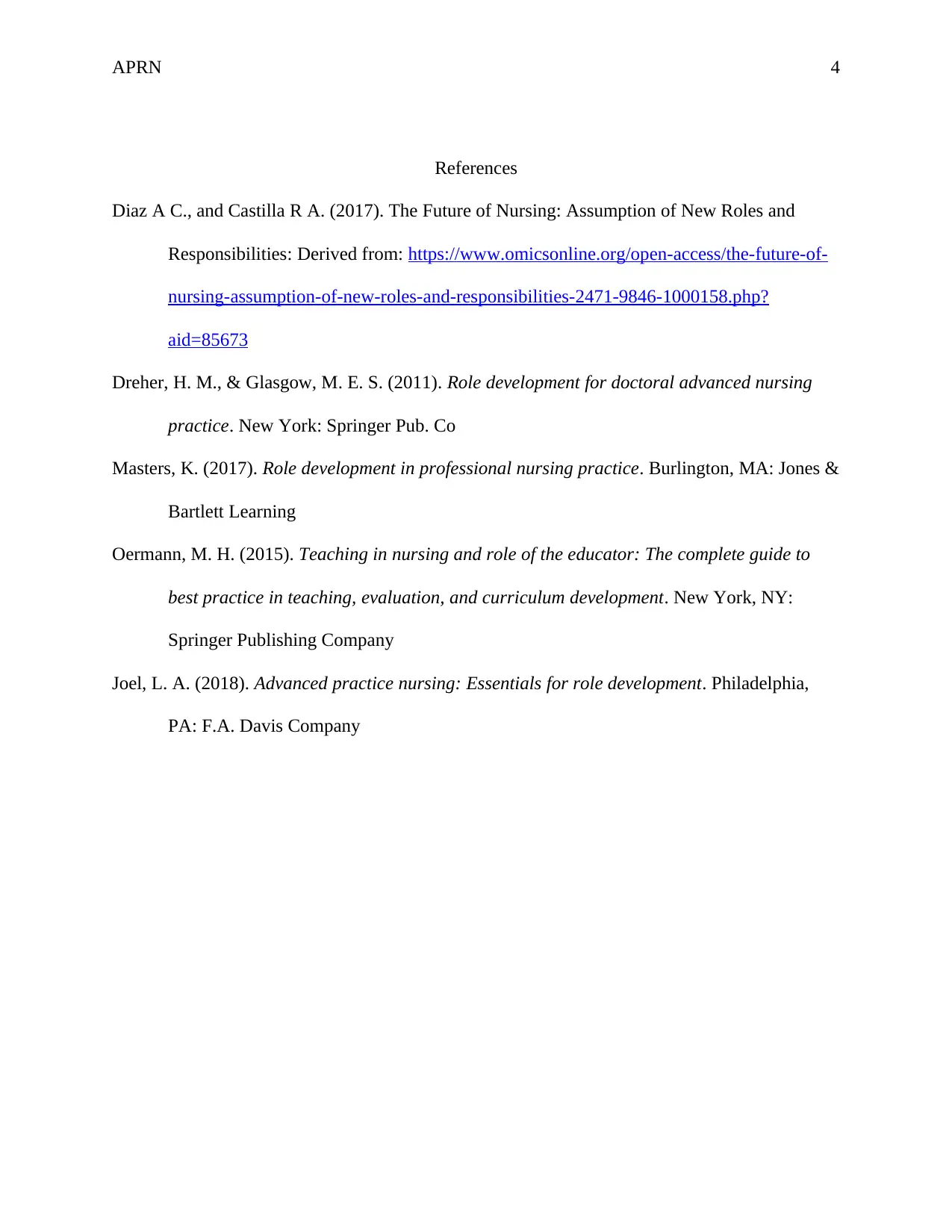
Diaz A C., and Castilla R A. (2017). The Future of Nursing: Assumption of New Roles and
Responsibilities: Derived from: https://www.omicsonline.org/open-access/the-future-of-
nursing-assumption-of-new-roles-and-responsibilities-2471-9846-1000158.php?
aid=85673
Dreher, H. M., & Glasgow, M. E. S. (2011). Role development for doctoral advanced nursing
practice. New York: Springer Pub. Co
Masters, K. (2017). Role development in professional nursing practice. Burlington, MA: Jones &
Bartlett Learning
Oermann, M. H. (2015). Teaching in nursing and role of the educator: The complete guide to
best practice in teaching, evaluation, and curriculum development. New York, NY:
Springer Publishing Company
Joel, L. A. (2018). Advanced practice nursing: Essentials for role development. Philadelphia,
PA: F.A. Davis Company
chevron_up_icon
1 out of 4
circle_padding
hide_on_mobile
zoom_out_icon
[object Object]