HST2122 Health Research: Bill Clinton's Public Health Leadership
VerifiedAdded on 2023/06/13
|10
|3292
|83
Case Study
AI Summary
This case study examines Bill Clinton's public health leadership, providing a brief biography and focusing on the public health issues he addressed. It explores his leadership style, emphasizing transformational leadership and Level Three Leadership abilities. The study highlights Clinton's core functions of leadership, including empathy, and discusses how he managed energy and vision to influence public health initiatives. It also touches on the challenges in public health leadership, such as the complexity of issues and the need for collaboration among various stakeholders. The analysis is framed within the context of contemporary public health challenges and the importance of effective leadership in addressing them.
PUBLIC HEALTH LEADERSHIP
OF
BILL CLINTON
OF
BILL CLINTON

Paraphrase This Document
Need a fresh take? Get an instant paraphrase of this document with our AI Paraphraser
Introduction
While the unpredictability of the difficulties confronting the community health workers have
expanded, numerous have contended that lacking assets have been committed to the readiness
of the workers, together with its leaders. Here the researcher depicts the public health
initiative. Late information to the President, furthermore, Congress on the position of health
faculty in the US have point by point patterns influencing the health of the country, counting
expanded requests for some skillful communal health workers and for suitably trained
administration (Foster, 2016).
A report by Adem and Gelgelo (2016) contended that communal health might possibly help the
social order viably just if a proficient, experimentally stable arrangement of professional and
administration advancement is set up. Different concerns incorporated the absence of
adequate scholarly readiness of fieldworkers, the requirement for proficient advancement for
those directing the framework, and the requirement to extend the work force arranged to do
fundamental communal health service stations inside an inexorably complex framework.
Pioneers such as Bill Clinton in public health are for the most part controlled by a critical and
significant sentiment mission. A sentiment reason motivates them to leave the comfort of the
sidelines and swim into the verbal confrontation, despite the weakness of results. Various are
'harmed healers' who have continued tremendously, notwithstanding, channel their torment
into control for the advantage of everybody. Their souls swell with both the excitement and
sensitivity of the individuals who have seen continuing and need to stop it. Nevertheless,
productive pioneers must move past energy. At the point when often tapping the spaces of
social methodology, political will, and social bent, these individuals ought to in like manner
make a present day, vital expert techniques that extend past running any single affiliation (Aula,
2010).
The adroit general health pioneer will be one who can work in a dubious field without clear
points of confinement or dynamic frameworks, using a disrupted setting as a starting stage for
change. Bill Clinton exceeded expectations in this domain. Not at all like a corporate gathering
room, general health rarely has alone work region where the buck stops. Huge, in this way, is
While the unpredictability of the difficulties confronting the community health workers have
expanded, numerous have contended that lacking assets have been committed to the readiness
of the workers, together with its leaders. Here the researcher depicts the public health
initiative. Late information to the President, furthermore, Congress on the position of health
faculty in the US have point by point patterns influencing the health of the country, counting
expanded requests for some skillful communal health workers and for suitably trained
administration (Foster, 2016).
A report by Adem and Gelgelo (2016) contended that communal health might possibly help the
social order viably just if a proficient, experimentally stable arrangement of professional and
administration advancement is set up. Different concerns incorporated the absence of
adequate scholarly readiness of fieldworkers, the requirement for proficient advancement for
those directing the framework, and the requirement to extend the work force arranged to do
fundamental communal health service stations inside an inexorably complex framework.
Pioneers such as Bill Clinton in public health are for the most part controlled by a critical and
significant sentiment mission. A sentiment reason motivates them to leave the comfort of the
sidelines and swim into the verbal confrontation, despite the weakness of results. Various are
'harmed healers' who have continued tremendously, notwithstanding, channel their torment
into control for the advantage of everybody. Their souls swell with both the excitement and
sensitivity of the individuals who have seen continuing and need to stop it. Nevertheless,
productive pioneers must move past energy. At the point when often tapping the spaces of
social methodology, political will, and social bent, these individuals ought to in like manner
make a present day, vital expert techniques that extend past running any single affiliation (Aula,
2010).
The adroit general health pioneer will be one who can work in a dubious field without clear
points of confinement or dynamic frameworks, using a disrupted setting as a starting stage for
change. Bill Clinton exceeded expectations in this domain. Not at all like a corporate gathering
room, general health rarely has alone work region where the buck stops. Huge, in this way, is
the availability and limit with regards to the pioneer to be the gathering’s maker or even the
unsung 'reserved bay’ operator, producing and persistently sewing together different,
frequently far-fetched, accomplices.
Brief Biography of Clinton
As the 42nd President and Commander-in-Chief of the US from 1991-2001, William Jefferson
‘Bill’ Clinton has done a lot for health matters. He has accomplished some things in his lifetime.
The former president was a student leader in high school. Furthermore, he was the leader of a
big nation in an era of incredible economic progress. A recent high-level meeting emphasized
on Clinton's exertions and impact in talking about important health matters. He has been
embarking upon some of the major health matters encountered in the US nowadays, such as
medicinal drug abuse, obesity, psychological health complications in addition to health
inequalities, along with controlling dialogue gatherings regarding such forums (Ville and Ilkka,
2017).
After such a gathering in the summit, novel concepts and inventiveness came about. The
Clinton Foundation organized the Health Matters Summit. Moreover, the Clinton Foundation
has succeeded to bring together energetic and talented influential folks who oversee the most
important health exertions. One of them has been occupied with increasing the dimensions of
psychological health in addition to element misuse services on university grounds.
Brief Description of Public Health Issue
Public health matters pose extraordinary troubles. They are generally monster in scale,
originate from different and especially complex causes, play out in people in general eye,
influence a colossal scope of accomplices and require oddly whole deal courses of action. The
tremendous degree and unusualness of such issues, including conditions, for instance, harmed
emotional wellness, among others, impact millions around the globe. Additionally, the health
issues quickly trigger a substantial gathering of family, budgetary and social issues that
devastate lives, break down gatherings and incapacitate countries. What's more, general health
is reliable, by definition, 'open', habitually requiring its pioneers to practice their claim to fame
unsung 'reserved bay’ operator, producing and persistently sewing together different,
frequently far-fetched, accomplices.
Brief Biography of Clinton
As the 42nd President and Commander-in-Chief of the US from 1991-2001, William Jefferson
‘Bill’ Clinton has done a lot for health matters. He has accomplished some things in his lifetime.
The former president was a student leader in high school. Furthermore, he was the leader of a
big nation in an era of incredible economic progress. A recent high-level meeting emphasized
on Clinton's exertions and impact in talking about important health matters. He has been
embarking upon some of the major health matters encountered in the US nowadays, such as
medicinal drug abuse, obesity, psychological health complications in addition to health
inequalities, along with controlling dialogue gatherings regarding such forums (Ville and Ilkka,
2017).
After such a gathering in the summit, novel concepts and inventiveness came about. The
Clinton Foundation organized the Health Matters Summit. Moreover, the Clinton Foundation
has succeeded to bring together energetic and talented influential folks who oversee the most
important health exertions. One of them has been occupied with increasing the dimensions of
psychological health in addition to element misuse services on university grounds.
Brief Description of Public Health Issue
Public health matters pose extraordinary troubles. They are generally monster in scale,
originate from different and especially complex causes, play out in people in general eye,
influence a colossal scope of accomplices and require oddly whole deal courses of action. The
tremendous degree and unusualness of such issues, including conditions, for instance, harmed
emotional wellness, among others, impact millions around the globe. Additionally, the health
issues quickly trigger a substantial gathering of family, budgetary and social issues that
devastate lives, break down gatherings and incapacitate countries. What's more, general health
is reliable, by definition, 'open', habitually requiring its pioneers to practice their claim to fame
⊘ This is a preview!⊘
Do you want full access?
Subscribe today to unlock all pages.

Trusted by 1+ million students worldwide
'before a crowd of people' in full viewpoint of admirers and savants alike. Various accomplices
demand and legitimacy straightforwardness (Andi, Liz, Ann, Anneke, Louise & Anne, 2014).
Giles and Yates (2014) asserts that the extra estimation of media thought consistently opens up
strains and convolutes best undertakings to coordinate touchy and discrete plans among
included social affairs. Passing on about complex issues in these settings, particularly identifying
with whole deal abhorrence, can be especially trying. The capacity to decide or even address
such huge challenges, as a rule, lies well outside the capacity to control of any single master. Or
on the other hand perhaps, prudent game plans regularly ask for sweeping societal level
changes, requiring input not just from health experts yet notwithstanding authentic advisors,
policymakers, ethicists, and market investigators, among others. Diverse accomplices can
ascend out of government workplaces, non-government affiliations, exclusive organizations,
bolster social occasions, religious pioneers, philanthropies and neighborhood control delegates
(Elvira, 2015).
This variety of points of view and suppositions can loan a dissonance of voices again and again
touchy and sensitive choices. Truth be told, energetic contradiction on the objectives or
techniques required to tackle broad public health issues dependably describes the field. In
some cases, it is even hard to pick up agreement on characterizing the issue, considerably less
deciding an answer. Discussion, which may fluctuate by setting and culture, routinely goes with
questions regarding if it’s even suitable for the government, the private part, religious
gatherings or others to be engaged with potential arrangements. As anyone might expect, the
synchronous impact of all these numerous measurements frequently makes a feeling of
disarray.
Leadership Style and Practice of Bill Clinton
The repercussions of the September 11, 2001, psychological militant assaults and the risk of
further assaults by organic means have removed public health from the shadows and cast it in a
more noticeable part in securing the country (Dennis and Andrew, 2010). In any case, these
dangers have just exacerbated the requirement for a viable public health foundation, of which a
skilled leadership is an essential component. Significant changes, including oversaw mind ways
demand and legitimacy straightforwardness (Andi, Liz, Ann, Anneke, Louise & Anne, 2014).
Giles and Yates (2014) asserts that the extra estimation of media thought consistently opens up
strains and convolutes best undertakings to coordinate touchy and discrete plans among
included social affairs. Passing on about complex issues in these settings, particularly identifying
with whole deal abhorrence, can be especially trying. The capacity to decide or even address
such huge challenges, as a rule, lies well outside the capacity to control of any single master. Or
on the other hand perhaps, prudent game plans regularly ask for sweeping societal level
changes, requiring input not just from health experts yet notwithstanding authentic advisors,
policymakers, ethicists, and market investigators, among others. Diverse accomplices can
ascend out of government workplaces, non-government affiliations, exclusive organizations,
bolster social occasions, religious pioneers, philanthropies and neighborhood control delegates
(Elvira, 2015).
This variety of points of view and suppositions can loan a dissonance of voices again and again
touchy and sensitive choices. Truth be told, energetic contradiction on the objectives or
techniques required to tackle broad public health issues dependably describes the field. In
some cases, it is even hard to pick up agreement on characterizing the issue, considerably less
deciding an answer. Discussion, which may fluctuate by setting and culture, routinely goes with
questions regarding if it’s even suitable for the government, the private part, religious
gatherings or others to be engaged with potential arrangements. As anyone might expect, the
synchronous impact of all these numerous measurements frequently makes a feeling of
disarray.
Leadership Style and Practice of Bill Clinton
The repercussions of the September 11, 2001, psychological militant assaults and the risk of
further assaults by organic means have removed public health from the shadows and cast it in a
more noticeable part in securing the country (Dennis and Andrew, 2010). In any case, these
dangers have just exacerbated the requirement for a viable public health foundation, of which a
skilled leadership is an essential component. Significant changes, including oversaw mind ways
Paraphrase This Document
Need a fresh take? Get an instant paraphrase of this document with our AI Paraphraser
to deal with healthy mind and evolving socioeconomics, are additionally influencing public
health and require consideration. Additionally, on the grounds that public health offices give
populace centered services to whole groups as opposed to individualized mind, an expanded
need exists for public health workforce fit for driving endeavors to guarantee the viability and
nature of these services (Elvira, 2015).
These current and forming obligations are showing a test to the general health field to re-
examine and improve the abilities of its workforce. The prerequisite for competency building
has been imparted by various who derive that advancing getting ready specifically capacity
domains would better prepare general health specialists and pioneers to be all the more
convincing in responding to consistently changing general health challenges. Among these
particular expertise territories regularly specified are administration and leadership abilities.
According to Field (2010), there is some help for the suggestion that some leader practices are
near all around acknowledged and viable. Transformational leadership has been alluded to as
having such characteristics, particularly charisma, scholarly incitement of devotees and
individualized thought towards supporters. The outcomes from the pursuit directed over the
most recent few months bolster this suggestion. In a few examinations, transformational
leadership has been appeared to decidedly impact both occupation fulfillment and health of
subordinates. The outcomes take after comparative examples, paying little mind to a social and
authoritative setting. The impacts of the assignment and relationship-situated leadership
additionally show up fairly steady crosswise over various social and hierarchical settings (Donna
and Steve, 2013).
Surveys of multifaceted research on leadership have demonstrated that social contrasts
represent a lot of change in leader conduct favored by subordinates and also in real leader
conduct. Certain leadership hypothesis declares that people have socially affected understood
speculations (generalizations, convictions, feelings, and suspicions) of what practices and
qualities make up a decent leader. Leaders are acknowledged based on the level of fit, or
consistency, between the leader practices they institute and the certain leadership hypothesis
held by the attributes or subordinates (Brookes, 2014).
health and require consideration. Additionally, on the grounds that public health offices give
populace centered services to whole groups as opposed to individualized mind, an expanded
need exists for public health workforce fit for driving endeavors to guarantee the viability and
nature of these services (Elvira, 2015).
These current and forming obligations are showing a test to the general health field to re-
examine and improve the abilities of its workforce. The prerequisite for competency building
has been imparted by various who derive that advancing getting ready specifically capacity
domains would better prepare general health specialists and pioneers to be all the more
convincing in responding to consistently changing general health challenges. Among these
particular expertise territories regularly specified are administration and leadership abilities.
According to Field (2010), there is some help for the suggestion that some leader practices are
near all around acknowledged and viable. Transformational leadership has been alluded to as
having such characteristics, particularly charisma, scholarly incitement of devotees and
individualized thought towards supporters. The outcomes from the pursuit directed over the
most recent few months bolster this suggestion. In a few examinations, transformational
leadership has been appeared to decidedly impact both occupation fulfillment and health of
subordinates. The outcomes take after comparative examples, paying little mind to a social and
authoritative setting. The impacts of the assignment and relationship-situated leadership
additionally show up fairly steady crosswise over various social and hierarchical settings (Donna
and Steve, 2013).
Surveys of multifaceted research on leadership have demonstrated that social contrasts
represent a lot of change in leader conduct favored by subordinates and also in real leader
conduct. Certain leadership hypothesis declares that people have socially affected understood
speculations (generalizations, convictions, feelings, and suspicions) of what practices and
qualities make up a decent leader. Leaders are acknowledged based on the level of fit, or
consistency, between the leader practices they institute and the certain leadership hypothesis
held by the attributes or subordinates (Brookes, 2014).
Levels of Leadership
According to Edmonstone (2011), level Three Leadership ability is the speculative chemistry a
fruitful and dynamic leader must have to have the capacity to impact an expansive range of
people. The customary way of thinking towards the early administrative style which firmly lined
up with the mechanical upset kept up an arrangement of "the manager knows the best". The
subordinate or a representative is relied upon to do similarly as he or she is told without
digressing from the guideline. Should certain people step up with regards to recommend
elective methods for handling certain undertakings, they are immediately reminded that they
are not paid to think, but rather to carry out the activity as relegated to them. The leaders or
chiefs that work with that approach is the thing that Mel (2012) called Level One leadership
approach. This primordial approach would work satisfactorily in the previous decades;
tragically, the period of data innovation is progressively driving leaders and administrators to
reassess the way their associations are run, to remain aggressive.
A Level Three Leader has the expertise that enables him or her to comprehend the mental
make-up or feelings that reason the representative's noticeable conduct (Steven, Medea, Owen
& Thai-Son, 2015). The substance of level-three-leader is to go past the unmistakable conduct,
comprehend values of others, and attempt to impact it. On the hand, at Level One Leadership,
the obvious conduct is shown, yet the vibes that offered impact to the conduct isn't known. A
director with a level one leadership aptitude attempts to comprehend the values that persuade
the activity of the worker. The chief anticipates that his mandates will be obeyed by the
subordinates. At Level Two, the individual has a cognizant idea that might possibly be shown in
the conduct communicated at the level one. The individual who has the contemplations will
eventually choose whether to enable the inclination to appear or not. Having said that, a leader
ought to have adequate comprehension of the Levels Three Leadership aptitudes and
practicalized them in respect to the human relations in his or her association (Charles and
Elaine, 2016).
To achieve the Level Three Leadership ability, a leader needs to watch the exercises of the
subordinates, or those working in a similar group with him or her impartially. Leman, Omar,
According to Edmonstone (2011), level Three Leadership ability is the speculative chemistry a
fruitful and dynamic leader must have to have the capacity to impact an expansive range of
people. The customary way of thinking towards the early administrative style which firmly lined
up with the mechanical upset kept up an arrangement of "the manager knows the best". The
subordinate or a representative is relied upon to do similarly as he or she is told without
digressing from the guideline. Should certain people step up with regards to recommend
elective methods for handling certain undertakings, they are immediately reminded that they
are not paid to think, but rather to carry out the activity as relegated to them. The leaders or
chiefs that work with that approach is the thing that Mel (2012) called Level One leadership
approach. This primordial approach would work satisfactorily in the previous decades;
tragically, the period of data innovation is progressively driving leaders and administrators to
reassess the way their associations are run, to remain aggressive.
A Level Three Leader has the expertise that enables him or her to comprehend the mental
make-up or feelings that reason the representative's noticeable conduct (Steven, Medea, Owen
& Thai-Son, 2015). The substance of level-three-leader is to go past the unmistakable conduct,
comprehend values of others, and attempt to impact it. On the hand, at Level One Leadership,
the obvious conduct is shown, yet the vibes that offered impact to the conduct isn't known. A
director with a level one leadership aptitude attempts to comprehend the values that persuade
the activity of the worker. The chief anticipates that his mandates will be obeyed by the
subordinates. At Level Two, the individual has a cognizant idea that might possibly be shown in
the conduct communicated at the level one. The individual who has the contemplations will
eventually choose whether to enable the inclination to appear or not. Having said that, a leader
ought to have adequate comprehension of the Levels Three Leadership aptitudes and
practicalized them in respect to the human relations in his or her association (Charles and
Elaine, 2016).
To achieve the Level Three Leadership ability, a leader needs to watch the exercises of the
subordinates, or those working in a similar group with him or her impartially. Leman, Omar,
⊘ This is a preview!⊘
Do you want full access?
Subscribe today to unlock all pages.
Trusted by 1+ million students worldwide
Won & Yusof (2010) composed that leadership is tied in with overseeing vitality, first in
yourself, and afterward in people around you. A leader who knows where he or she needs to
go, yet does not have the vitality to start the excursion would misuse a superb open door for
himself or herself, and the voting demographic that would have profited from it. Imagine a
scenario in which the leader has the vision, the vitality, yet couldn't appear to get the body
electorate to move towards the objective that he or she can't seek after alone. Bill Clinton had
the vitality, which he oversaw as he culminated his fabulous vision, however, to do that, he
expected to live from the back to front. In the event that he had lived from the outside in, he
would have proceeded down the way that his ancestors had utilized when they exited office. He
may have taken after the way numerous fruitful humanitarian associations previously him had
done the business. Clinton relevantly reacted to the inquiry raised by that he will be more than
the vehicle for the images and qualities of his progenitors on to another age. Clinton's vision
and activity are predictable with view uttered in Popescu and Vlad (2016) that development is
portrayed by deviations, not consistency.
Core Functions of Leadership supported by Bill Clinton
Empathy is one of the core functions supported by Clinton, and one of the imperative
methodologies that a Level Three Leader must have is the capacity to comprehend the stories
of his or her group, relate to them, and offer their own particular stories. Bill Clinton utilized his
book My Life to recount numerous stories of his own disappointment both in his expert goals
and the individual mortifying stories about himself and families. This influences him to appear
to be a leader whom anybody can relate himself or herself to. Having individuals around him
see such a great amount about his story, it showed them lessons in tirelessness that Clinton
may not tell viably (Nubia, 2016).
Rowitz (2014) composed that the most important expertise in creating impact is determination,
an individual story ought to rouse enough to help, in any case, the mystery of enduring impact
will require an association with other people who have faith in you and have confidence in your
thoughts. This is the place Bill Clinton exceeds expectations head and shoulder above other
previous or present heads of government, or leaders from non-legislative or business parts. His
yourself, and afterward in people around you. A leader who knows where he or she needs to
go, yet does not have the vitality to start the excursion would misuse a superb open door for
himself or herself, and the voting demographic that would have profited from it. Imagine a
scenario in which the leader has the vision, the vitality, yet couldn't appear to get the body
electorate to move towards the objective that he or she can't seek after alone. Bill Clinton had
the vitality, which he oversaw as he culminated his fabulous vision, however, to do that, he
expected to live from the back to front. In the event that he had lived from the outside in, he
would have proceeded down the way that his ancestors had utilized when they exited office. He
may have taken after the way numerous fruitful humanitarian associations previously him had
done the business. Clinton relevantly reacted to the inquiry raised by that he will be more than
the vehicle for the images and qualities of his progenitors on to another age. Clinton's vision
and activity are predictable with view uttered in Popescu and Vlad (2016) that development is
portrayed by deviations, not consistency.
Core Functions of Leadership supported by Bill Clinton
Empathy is one of the core functions supported by Clinton, and one of the imperative
methodologies that a Level Three Leader must have is the capacity to comprehend the stories
of his or her group, relate to them, and offer their own particular stories. Bill Clinton utilized his
book My Life to recount numerous stories of his own disappointment both in his expert goals
and the individual mortifying stories about himself and families. This influences him to appear
to be a leader whom anybody can relate himself or herself to. Having individuals around him
see such a great amount about his story, it showed them lessons in tirelessness that Clinton
may not tell viably (Nubia, 2016).
Rowitz (2014) composed that the most important expertise in creating impact is determination,
an individual story ought to rouse enough to help, in any case, the mystery of enduring impact
will require an association with other people who have faith in you and have confidence in your
thoughts. This is the place Bill Clinton exceeds expectations head and shoulder above other
previous or present heads of government, or leaders from non-legislative or business parts. His
Paraphrase This Document
Need a fresh take? Get an instant paraphrase of this document with our AI Paraphraser
notoriety and capacity to impact was reflected in the surveys, where he beat out all the major
political leaders with critical edge (Stansfield, 2015).
political leaders with critical edge (Stansfield, 2015).
References
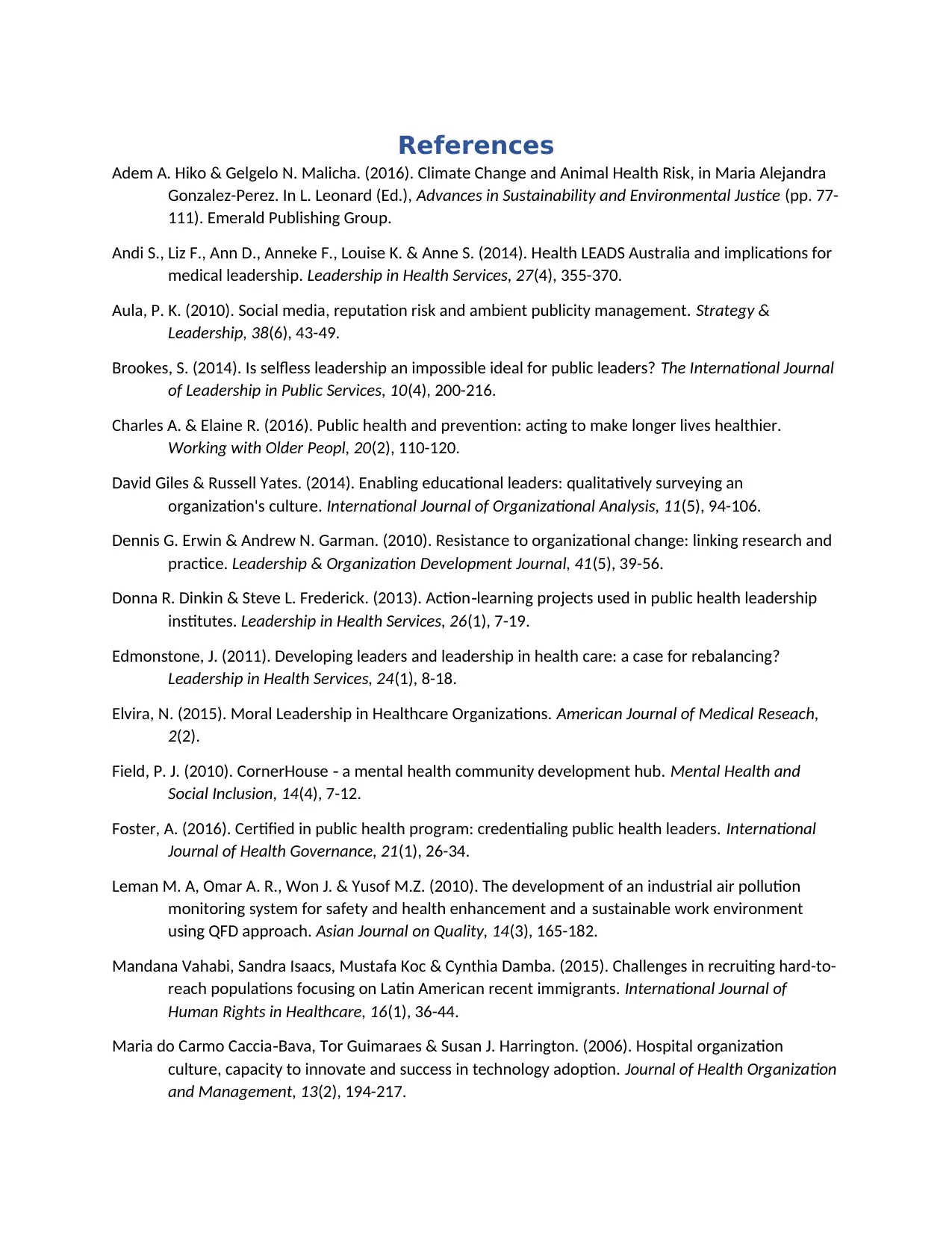
Adem A. Hiko & Gelgelo N. Malicha. (2016). Climate Change and Animal Health Risk, in Maria Alejandra
Gonzalez-Perez. In L. Leonard (Ed.), Advances in Sustainability and Environmental Justice (pp. 77-
111). Emerald Publishing Group.
Andi S., Liz F., Ann D., Anneke F., Louise K. & Anne S. (2014). Health LEADS Australia and implications for
medical leadership. Leadership in Health Services, 27(4), 355-370.
Aula, P. K. (2010). Social media, reputation risk and ambient publicity management. Strategy &
Leadership, 38(6), 43-49.
Brookes, S. (2014). Is selfless leadership an impossible ideal for public leaders? The International Journal
of Leadership in Public Services, 10(4), 200-216.
Charles A. & Elaine R. (2016). Public health and prevention: acting to make longer lives healthier.
Working with Older Peopl, 20(2), 110-120.
David Giles & Russell Yates. (2014). Enabling educational leaders: qualitatively surveying an
organization's culture. International Journal of Organizational Analysis, 11(5), 94-106.
Dennis G. Erwin & Andrew N. Garman. (2010). Resistance to organizational change: linking research and
practice. Leadership & Organization Development Journal, 41(5), 39-56.
Donna R. Dinkin & Steve L. Frederick. (2013). Action learning projects used in public health leadership‐
institutes. Leadership in Health Services, 26(1), 7-19.
Edmonstone, J. (2011). Developing leaders and leadership in health care: a case for rebalancing?
Leadership in Health Services, 24(1), 8-18.
Elvira, N. (2015). Moral Leadership in Healthcare Organizations. American Journal of Medical Reseach,
2(2).
Field, P. J. (2010). CornerHouse a mental health community development hub.‐ Mental Health and
Social Inclusion, 14(4), 7-12.
Foster, A. (2016). Certified in public health program: credentialing public health leaders. International
Journal of Health Governance, 21(1), 26-34.
Leman M. A, Omar A. R., Won J. & Yusof M.Z. (2010). The development of an industrial air pollution
monitoring system for safety and health enhancement and a sustainable work environment
using QFD approach. Asian Journal on Quality, 14(3), 165-182.
Mandana Vahabi, Sandra Isaacs, Mustafa Koc & Cynthia Damba. (2015). Challenges in recruiting hard-to-
reach populations focusing on Latin American recent immigrants. International Journal of
Human Rights in Healthcare, 16(1), 36-44.
Maria do Carmo Caccia Bava, Tor Guimaraes & Susan J. Harrington. (2006). Hospital organization‐
culture, capacity to innovate and success in technology adoption. Journal of Health Organization
and Management, 13(2), 194-217.
Adem A. Hiko & Gelgelo N. Malicha. (2016). Climate Change and Animal Health Risk, in Maria Alejandra
Gonzalez-Perez. In L. Leonard (Ed.), Advances in Sustainability and Environmental Justice (pp. 77-
111). Emerald Publishing Group.
Andi S., Liz F., Ann D., Anneke F., Louise K. & Anne S. (2014). Health LEADS Australia and implications for
medical leadership. Leadership in Health Services, 27(4), 355-370.
Aula, P. K. (2010). Social media, reputation risk and ambient publicity management. Strategy &
Leadership, 38(6), 43-49.
Brookes, S. (2014). Is selfless leadership an impossible ideal for public leaders? The International Journal
of Leadership in Public Services, 10(4), 200-216.
Charles A. & Elaine R. (2016). Public health and prevention: acting to make longer lives healthier.
Working with Older Peopl, 20(2), 110-120.
David Giles & Russell Yates. (2014). Enabling educational leaders: qualitatively surveying an
organization's culture. International Journal of Organizational Analysis, 11(5), 94-106.
Dennis G. Erwin & Andrew N. Garman. (2010). Resistance to organizational change: linking research and
practice. Leadership & Organization Development Journal, 41(5), 39-56.
Donna R. Dinkin & Steve L. Frederick. (2013). Action learning projects used in public health leadership‐
institutes. Leadership in Health Services, 26(1), 7-19.
Edmonstone, J. (2011). Developing leaders and leadership in health care: a case for rebalancing?
Leadership in Health Services, 24(1), 8-18.
Elvira, N. (2015). Moral Leadership in Healthcare Organizations. American Journal of Medical Reseach,
2(2).
Field, P. J. (2010). CornerHouse a mental health community development hub.‐ Mental Health and
Social Inclusion, 14(4), 7-12.
Foster, A. (2016). Certified in public health program: credentialing public health leaders. International
Journal of Health Governance, 21(1), 26-34.
Leman M. A, Omar A. R., Won J. & Yusof M.Z. (2010). The development of an industrial air pollution
monitoring system for safety and health enhancement and a sustainable work environment
using QFD approach. Asian Journal on Quality, 14(3), 165-182.
Mandana Vahabi, Sandra Isaacs, Mustafa Koc & Cynthia Damba. (2015). Challenges in recruiting hard-to-
reach populations focusing on Latin American recent immigrants. International Journal of
Human Rights in Healthcare, 16(1), 36-44.
Maria do Carmo Caccia Bava, Tor Guimaraes & Susan J. Harrington. (2006). Hospital organization‐
culture, capacity to innovate and success in technology adoption. Journal of Health Organization
and Management, 13(2), 194-217.
⊘ This is a preview!⊘
Do you want full access?
Subscribe today to unlock all pages.
Trusted by 1+ million students worldwide
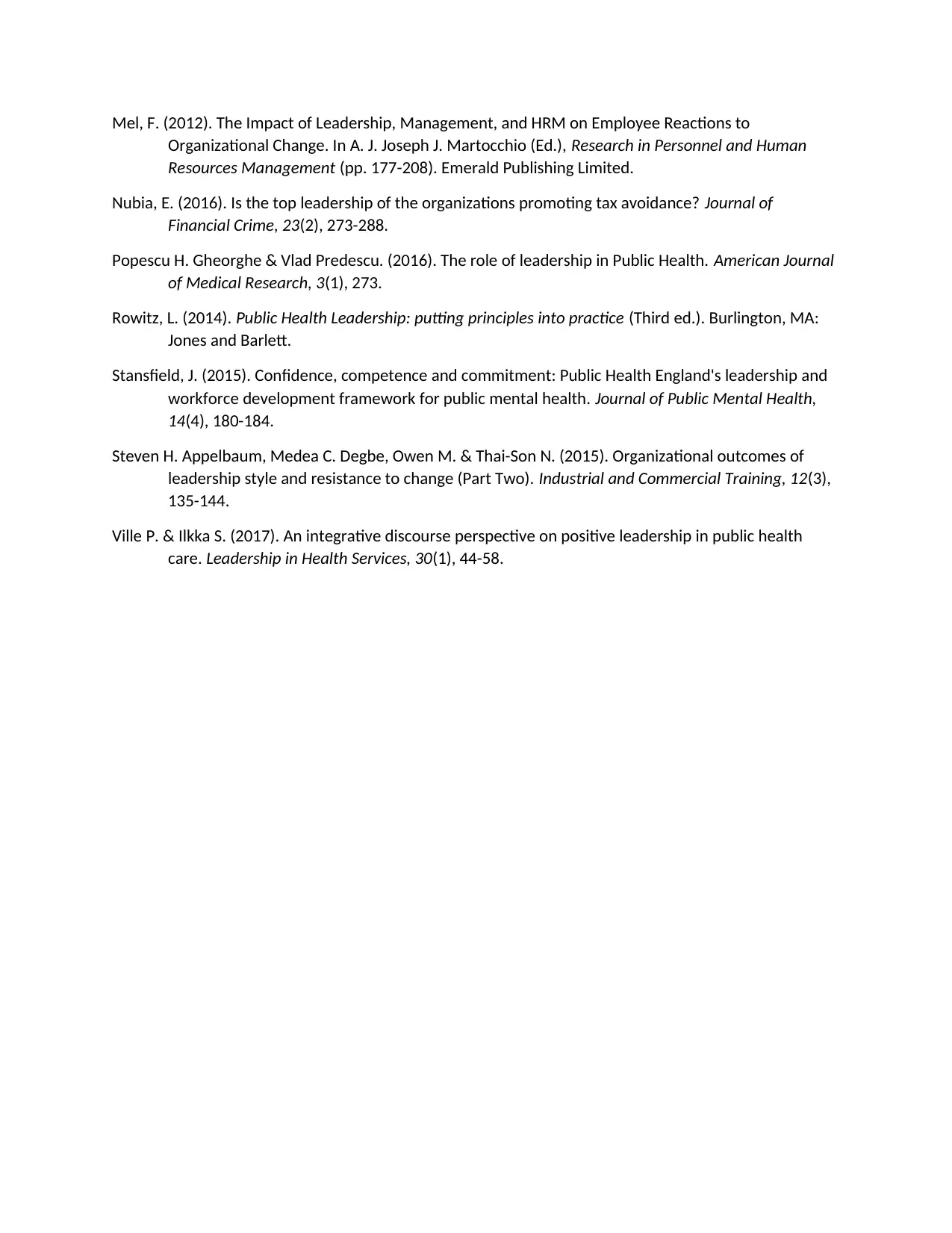
Mel, F. (2012). The Impact of Leadership, Management, and HRM on Employee Reactions to
Organizational Change. In A. J. Joseph J. Martocchio (Ed.), Research in Personnel and Human
Resources Management (pp. 177-208). Emerald Publishing Limited.
Nubia, E. (2016). Is the top leadership of the organizations promoting tax avoidance? Journal of
Financial Crime, 23(2), 273-288.
Popescu H. Gheorghe & Vlad Predescu. (2016). The role of leadership in Public Health. American Journal
of Medical Research, 3(1), 273.
Rowitz, L. (2014). Public Health Leadership: putting principles into practice (Third ed.). Burlington, MA:
Jones and Barlett.
Stansfield, J. (2015). Confidence, competence and commitment: Public Health England's leadership and
workforce development framework for public mental health. Journal of Public Mental Health,
14(4), 180-184.
Steven H. Appelbaum, Medea C. Degbe, Owen M. & Thai-Son N. (2015). Organizational outcomes of
leadership style and resistance to change (Part Two). Industrial and Commercial Training, 12(3),
135-144.
Ville P. & Ilkka S. (2017). An integrative discourse perspective on positive leadership in public health
care. Leadership in Health Services, 30(1), 44-58.
Organizational Change. In A. J. Joseph J. Martocchio (Ed.), Research in Personnel and Human
Resources Management (pp. 177-208). Emerald Publishing Limited.
Nubia, E. (2016). Is the top leadership of the organizations promoting tax avoidance? Journal of
Financial Crime, 23(2), 273-288.
Popescu H. Gheorghe & Vlad Predescu. (2016). The role of leadership in Public Health. American Journal
of Medical Research, 3(1), 273.
Rowitz, L. (2014). Public Health Leadership: putting principles into practice (Third ed.). Burlington, MA:
Jones and Barlett.
Stansfield, J. (2015). Confidence, competence and commitment: Public Health England's leadership and
workforce development framework for public mental health. Journal of Public Mental Health,
14(4), 180-184.
Steven H. Appelbaum, Medea C. Degbe, Owen M. & Thai-Son N. (2015). Organizational outcomes of
leadership style and resistance to change (Part Two). Industrial and Commercial Training, 12(3),
135-144.
Ville P. & Ilkka S. (2017). An integrative discourse perspective on positive leadership in public health
care. Leadership in Health Services, 30(1), 44-58.

1 out of 10


Your All-in-One AI-Powered Toolkit for Academic Success.
+13062052269
info@desklib.com
Available 24*7 on WhatsApp / Email
![[object Object]](/_next/static/media/star-bottom.7253800d.svg)
Unlock your academic potential
Copyright © 2020–2026 A2Z Services. All Rights Reserved. Developed and managed by ZUCOL.