AusEd College: Designing Scalable Cloud Network Infrastructure Project
VerifiedAdded on 2021/06/16
|12
|2546
|42
Project
AI Summary
This project report details the design of a cloud-based network infrastructure for AusEd College, an institution providing distance schooling. The project addresses the need for a scalable and reliable system to support a growing number of students across various locations. It proposes a hierarchical network design incorporating core, distribution, and access layers, utilizing technologies like VLANs, Ether channel, and Open-Flow. The solution integrates both traditional infrastructure and a private cloud, leveraging Moodle and other e-learning platforms. The report includes an implementation plan, cost analysis, and considerations for recycling and e-waste management. The cloud-based approach aims to enhance resource utilization, streamline educational operations, and ensure 24/7 availability while maintaining cost-effectiveness for the non-profit organization. The proposed solution encompasses various cloud services, including base infrastructure, monitoring/management, and backup services. The report emphasizes the importance of network management, security, and scalability to support the college's expanding operations and diverse student base.

A
V [Company address]
[DOCUMENT TITLE]
V [Company address]
[DOCUMENT TITLE]

Paraphrase This Document
Need a fresh take? Get an instant paraphrase of this document with our AI Paraphraser
Contents
Project description................................................................................................................................1
Purpose and scope of the problem........................................................................................................1
System Description................................................................................................................................1
System design, hardware and infrastructure.........................................................................................2
Implementation.....................................................................................................................................3
Cost analysis..........................................................................................................................................5
Recycling and E-waste...........................................................................................................................5
Conclusion.............................................................................................................................................6
References.............................................................................................................................................6
Project description................................................................................................................................1
Purpose and scope of the problem........................................................................................................1
System Description................................................................................................................................1
System design, hardware and infrastructure.........................................................................................2
Implementation.....................................................................................................................................3
Cost analysis..........................................................................................................................................5
Recycling and E-waste...........................................................................................................................5
Conclusion.............................................................................................................................................6
References.............................................................................................................................................6
Project description
AusEd gives distance schooling to college students throughout the world. The students come
from faraway areas of Australia, New Guinea and the South Pacific Islands. Currently,
the employer is restricted to distance learning with college students however now
it needs to amplify its reach with communities, industries, etc. With the increase in
the quantity of registered students and scaling its operations, the corporation is planning
to improve its present day infrastructure.
Purpose and scope of the problem
The college is searching for a solution which is sturdy and scalable in close to future. Along
with this, it is additionally making its footprints in far flung areas so that distance-
learning college students stay in contact with the college 24x7. As given in the case
study, number of new registered college students is growing with each passing day,
the college does no longer favour a bottleneck in its operations. It wants a answer which
can prolong its potential with massive number of new users. The college does have
a physical find out about area, so it wants that there need to not be any data discrepancy of on
line students even if they are no longer in offline present in the college. Also, given
that the college is a non-for-profit organization, the prices has to be stored minimal. The
proposed solution ought to stay reachable to all customers irrespective of their location.
System Description
According to (Xu, Huang, Wang & Heales, 2014), e-learning based organizations have
started using cloud based services at a huge rate. In AusEd. Case, the proposed solution aids
in efficient resource utilization which are available for its implementation and in providing a
platform for streamlining the education operations for the education. The solution shall take
care of the scalability and reliability of the operations. The proposed solution had already
been taken many educational institutions which are providing both physical and online
medium to the end users. They are using private and public cloud as it’s a widely adapted
solution. In this approach, public cloud is managed by the respective cloud service providers.
On the other hand, private cloud will be fully controlled by the college and its staff that is
administration will itself manage the user authentication, resources, applications along with
the services provided by the end-users. The main idea behind the private cloud deployment is
AusEd gives distance schooling to college students throughout the world. The students come
from faraway areas of Australia, New Guinea and the South Pacific Islands. Currently,
the employer is restricted to distance learning with college students however now
it needs to amplify its reach with communities, industries, etc. With the increase in
the quantity of registered students and scaling its operations, the corporation is planning
to improve its present day infrastructure.
Purpose and scope of the problem
The college is searching for a solution which is sturdy and scalable in close to future. Along
with this, it is additionally making its footprints in far flung areas so that distance-
learning college students stay in contact with the college 24x7. As given in the case
study, number of new registered college students is growing with each passing day,
the college does no longer favour a bottleneck in its operations. It wants a answer which
can prolong its potential with massive number of new users. The college does have
a physical find out about area, so it wants that there need to not be any data discrepancy of on
line students even if they are no longer in offline present in the college. Also, given
that the college is a non-for-profit organization, the prices has to be stored minimal. The
proposed solution ought to stay reachable to all customers irrespective of their location.
System Description
According to (Xu, Huang, Wang & Heales, 2014), e-learning based organizations have
started using cloud based services at a huge rate. In AusEd. Case, the proposed solution aids
in efficient resource utilization which are available for its implementation and in providing a
platform for streamlining the education operations for the education. The solution shall take
care of the scalability and reliability of the operations. The proposed solution had already
been taken many educational institutions which are providing both physical and online
medium to the end users. They are using private and public cloud as it’s a widely adapted
solution. In this approach, public cloud is managed by the respective cloud service providers.
On the other hand, private cloud will be fully controlled by the college and its staff that is
administration will itself manage the user authentication, resources, applications along with
the services provided by the end-users. The main idea behind the private cloud deployment is
⊘ This is a preview!⊘
Do you want full access?
Subscribe today to unlock all pages.

Trusted by 1+ million students worldwide
that current infrastructure of college can also be included in the new solution. In addition to
this, private cloud also helps in conducting educational operations efficiently and also
streamlining the integration of cloud structure in a case where there is both physical and
online communication with the user. However, there is a challenge in this approach that is
network has to be maintained for effective use of cloud model.
Proposed solution
A cloud based network for an e-learning cum offline medium as stated in the last section,
requires a robust IT infrastructure at the college. This will facilitate in providing an
uninterrupted and solid e-learning system to all the end-users such as faculty, students,
college management and staffs (Antonopoulos and Gillam, 2017).
The proposed solution should provide 24x7 reliability hence the infrastructure should have
following features: scalability, reliability and availability. This shows that cloud based
network is the best option for academic operations.
this, private cloud also helps in conducting educational operations efficiently and also
streamlining the integration of cloud structure in a case where there is both physical and
online communication with the user. However, there is a challenge in this approach that is
network has to be maintained for effective use of cloud model.
Proposed solution
A cloud based network for an e-learning cum offline medium as stated in the last section,
requires a robust IT infrastructure at the college. This will facilitate in providing an
uninterrupted and solid e-learning system to all the end-users such as faculty, students,
college management and staffs (Antonopoulos and Gillam, 2017).
The proposed solution should provide 24x7 reliability hence the infrastructure should have
following features: scalability, reliability and availability. This shows that cloud based
network is the best option for academic operations.
Paraphrase This Document
Need a fresh take? Get an instant paraphrase of this document with our AI Paraphraser
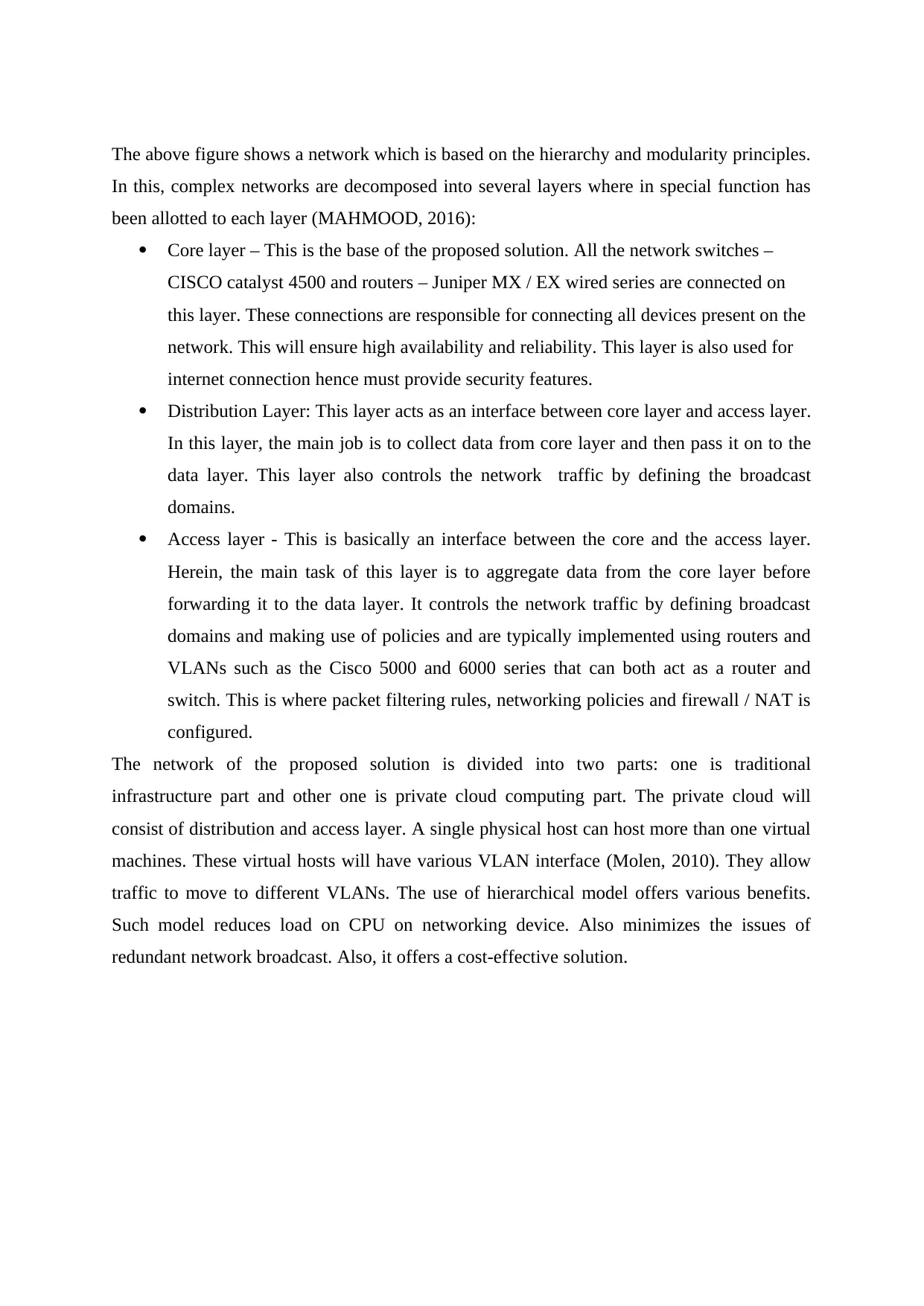
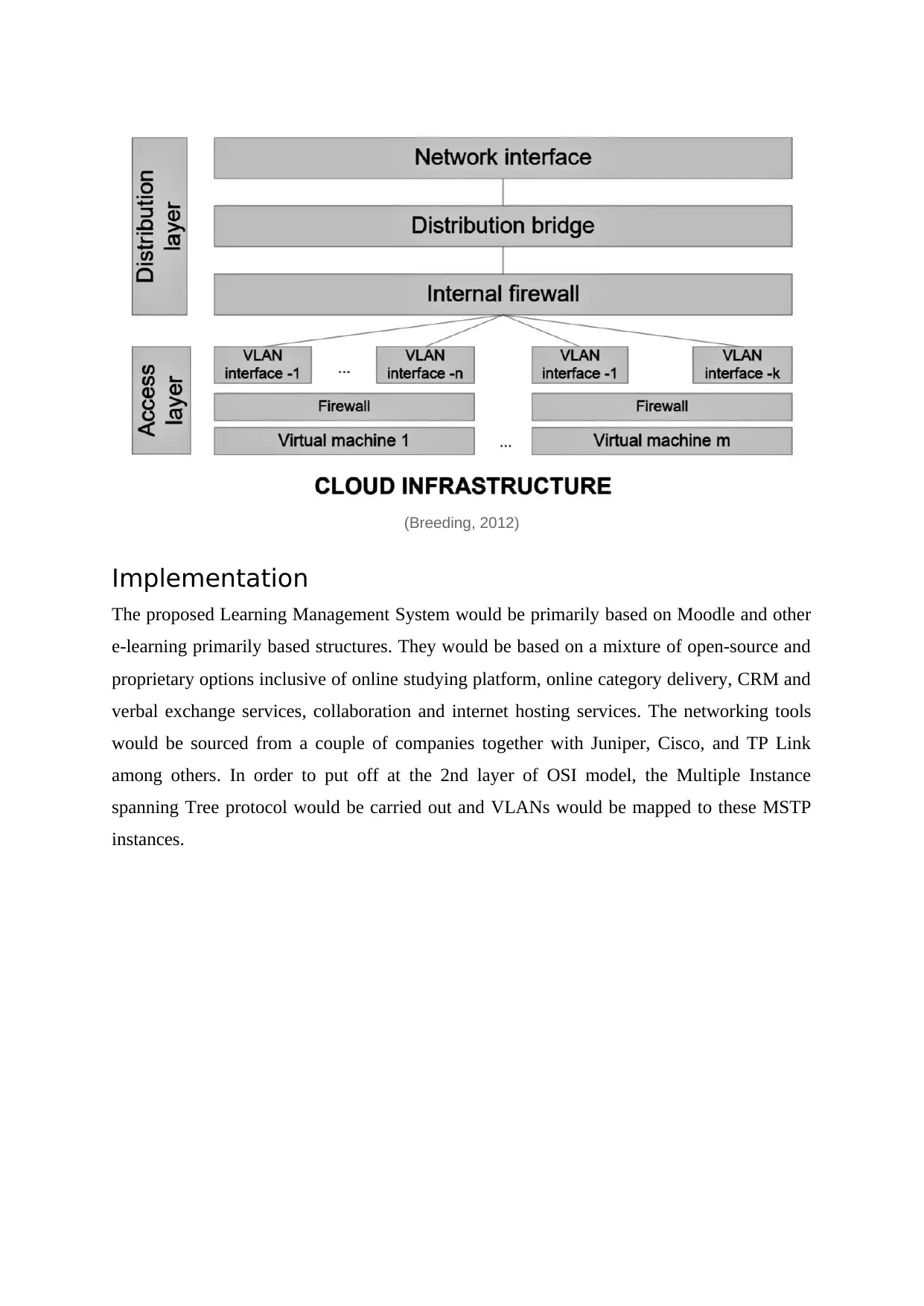
The above figure shows a network which is based on the hierarchy and modularity principles.
In this, complex networks are decomposed into several layers where in special function has
been allotted to each layer (MAHMOOD, 2016):
Core layer – This is the base of the proposed solution. All the network switches –
CISCO catalyst 4500 and routers – Juniper MX / EX wired series are connected on
this layer. These connections are responsible for connecting all devices present on the
network. This will ensure high availability and reliability. This layer is also used for
internet connection hence must provide security features.
Distribution Layer: This layer acts as an interface between core layer and access layer.
In this layer, the main job is to collect data from core layer and then pass it on to the
data layer. This layer also controls the network traffic by defining the broadcast
domains.
Access layer - This is basically an interface between the core and the access layer.
Herein, the main task of this layer is to aggregate data from the core layer before
forwarding it to the data layer. It controls the network traffic by defining broadcast
domains and making use of policies and are typically implemented using routers and
VLANs such as the Cisco 5000 and 6000 series that can both act as a router and
switch. This is where packet filtering rules, networking policies and firewall / NAT is
configured.
The network of the proposed solution is divided into two parts: one is traditional
infrastructure part and other one is private cloud computing part. The private cloud will
consist of distribution and access layer. A single physical host can host more than one virtual
machines. These virtual hosts will have various VLAN interface (Molen, 2010). They allow
traffic to move to different VLANs. The use of hierarchical model offers various benefits.
Such model reduces load on CPU on networking device. Also minimizes the issues of
redundant network broadcast. Also, it offers a cost-effective solution.
In this, complex networks are decomposed into several layers where in special function has
been allotted to each layer (MAHMOOD, 2016):
Core layer – This is the base of the proposed solution. All the network switches –
CISCO catalyst 4500 and routers – Juniper MX / EX wired series are connected on
this layer. These connections are responsible for connecting all devices present on the
network. This will ensure high availability and reliability. This layer is also used for
internet connection hence must provide security features.
Distribution Layer: This layer acts as an interface between core layer and access layer.
In this layer, the main job is to collect data from core layer and then pass it on to the
data layer. This layer also controls the network traffic by defining the broadcast
domains.
Access layer - This is basically an interface between the core and the access layer.
Herein, the main task of this layer is to aggregate data from the core layer before
forwarding it to the data layer. It controls the network traffic by defining broadcast
domains and making use of policies and are typically implemented using routers and
VLANs such as the Cisco 5000 and 6000 series that can both act as a router and
switch. This is where packet filtering rules, networking policies and firewall / NAT is
configured.
The network of the proposed solution is divided into two parts: one is traditional
infrastructure part and other one is private cloud computing part. The private cloud will
consist of distribution and access layer. A single physical host can host more than one virtual
machines. These virtual hosts will have various VLAN interface (Molen, 2010). They allow
traffic to move to different VLANs. The use of hierarchical model offers various benefits.
Such model reduces load on CPU on networking device. Also minimizes the issues of
redundant network broadcast. Also, it offers a cost-effective solution.
(Breeding, 2012)
Implementation
The proposed Learning Management System would be primarily based on Moodle and other
e-learning primarily based structures. They would be based on a mixture of open-source and
proprietary options inclusive of online studying platform, online category delivery, CRM and
verbal exchange services, collaboration and internet hosting services. The networking tools
would be sourced from a couple of companies together with Juniper, Cisco, and TP Link
among others. In order to put off at the 2nd layer of OSI model, the Multiple Instance
spanning Tree protocol would be carried out and VLANs would be mapped to these MSTP
instances.
Implementation
The proposed Learning Management System would be primarily based on Moodle and other
e-learning primarily based structures. They would be based on a mixture of open-source and
proprietary options inclusive of online studying platform, online category delivery, CRM and
verbal exchange services, collaboration and internet hosting services. The networking tools
would be sourced from a couple of companies together with Juniper, Cisco, and TP Link
among others. In order to put off at the 2nd layer of OSI model, the Multiple Instance
spanning Tree protocol would be carried out and VLANs would be mapped to these MSTP
instances.
⊘ This is a preview!⊘
Do you want full access?
Subscribe today to unlock all pages.
Trusted by 1+ million students worldwide
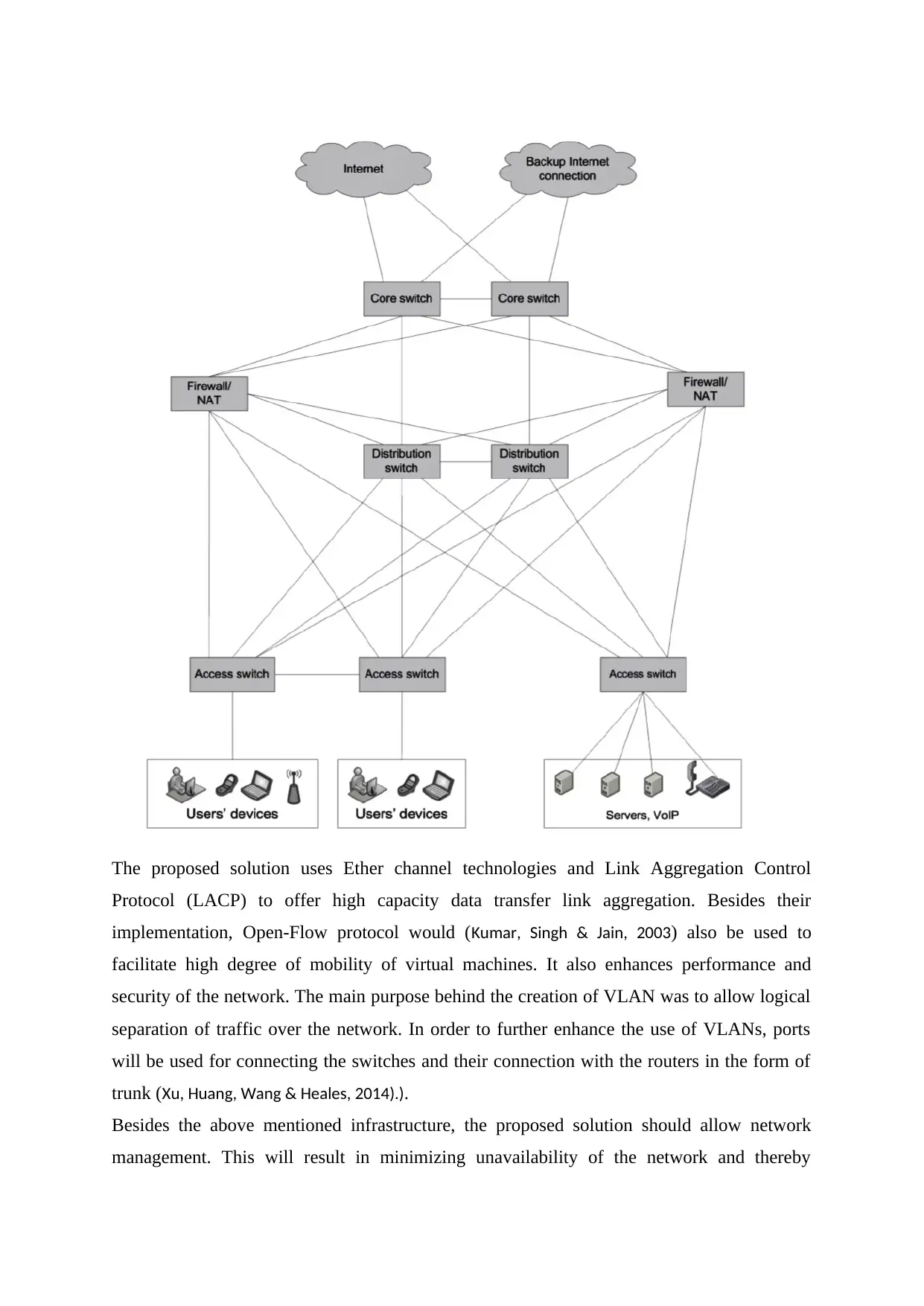
The proposed solution uses Ether channel technologies and Link Aggregation Control
Protocol (LACP) to offer high capacity data transfer link aggregation. Besides their
implementation, Open-Flow protocol would (Kumar, Singh & Jain, 2003) also be used to
facilitate high degree of mobility of virtual machines. It also enhances performance and
security of the network. The main purpose behind the creation of VLAN was to allow logical
separation of traffic over the network. In order to further enhance the use of VLANs, ports
will be used for connecting the switches and their connection with the routers in the form of
trunk (Xu, Huang, Wang & Heales, 2014).).
Besides the above mentioned infrastructure, the proposed solution should allow network
management. This will result in minimizing unavailability of the network and thereby
Protocol (LACP) to offer high capacity data transfer link aggregation. Besides their
implementation, Open-Flow protocol would (Kumar, Singh & Jain, 2003) also be used to
facilitate high degree of mobility of virtual machines. It also enhances performance and
security of the network. The main purpose behind the creation of VLAN was to allow logical
separation of traffic over the network. In order to further enhance the use of VLANs, ports
will be used for connecting the switches and their connection with the routers in the form of
trunk (Xu, Huang, Wang & Heales, 2014).).
Besides the above mentioned infrastructure, the proposed solution should allow network
management. This will result in minimizing unavailability of the network and thereby
Paraphrase This Document
Need a fresh take? Get an instant paraphrase of this document with our AI Paraphraser
reducing costs. The cost effectiveness comes from implementation of two key practices:
OOBM (Out of Band Management) and also deployment of protocols used for
communication for network management. By using combination of these two practices, the
proposed solution will provide proper and efficient network management. However, network
monitoring can also be done using the Cacti application. This application support most of the
network devices. Besides this, network administrators are also responsible for framing access
restriction rules to only authenticated users.
Cloud solution
In the present world, the education based organizations provides various types of educational
services to the end users which are mentioned as follows (Kotut, 2018):
Email
Customer Relation Management
Document support
Decision support system
Identity management
Library management, etc.
Cloud provides all such services on its platform and it can be implemented either on license
or pay per use basis. These services should be implemented on cloud computing platform
which is efficient in grouping them as mentioned below (Lawler, 2011):
Base (Core) infrastructure services – This includes essential and key services which
form the base of the teaching modules within the institution.
Monitoring / Management services – This includes managing services for constant
management of hardware, services and network. They may not the form the base of
the system functioning, but they help in faster identification and resolving problems in
the network infrastructure.
Backup services – These services include creation of backup services of the proposed
solution. They also help in continuous implementation of faster data recovery during
disaster times.
Physically dependent services
These are services which are connected to physical hardware or specific virtual of
systems that are utilized in different institution. However, these types of services are
necessary for allowing functioning, access administration, and replication of services
which are specially related to hardware.
OOBM (Out of Band Management) and also deployment of protocols used for
communication for network management. By using combination of these two practices, the
proposed solution will provide proper and efficient network management. However, network
monitoring can also be done using the Cacti application. This application support most of the
network devices. Besides this, network administrators are also responsible for framing access
restriction rules to only authenticated users.
Cloud solution
In the present world, the education based organizations provides various types of educational
services to the end users which are mentioned as follows (Kotut, 2018):
Customer Relation Management
Document support
Decision support system
Identity management
Library management, etc.
Cloud provides all such services on its platform and it can be implemented either on license
or pay per use basis. These services should be implemented on cloud computing platform
which is efficient in grouping them as mentioned below (Lawler, 2011):
Base (Core) infrastructure services – This includes essential and key services which
form the base of the teaching modules within the institution.
Monitoring / Management services – This includes managing services for constant
management of hardware, services and network. They may not the form the base of
the system functioning, but they help in faster identification and resolving problems in
the network infrastructure.
Backup services – These services include creation of backup services of the proposed
solution. They also help in continuous implementation of faster data recovery during
disaster times.
Physically dependent services
These are services which are connected to physical hardware or specific virtual of
systems that are utilized in different institution. However, these types of services are
necessary for allowing functioning, access administration, and replication of services
which are specially related to hardware.
Range of services for both teacher as well as study would be deployed in infracted
that has illustrated above. KDAP services can be utilized for the authentications of the
users, mailing, radius server might be used for controlling access to various servers,
and file can be also buy utilized to manage file spread, mails across system.
LMS, CRM and the project management systems are incorporated in infrastructures
as a better option. A well equipped utilization of hosting platform can allow student
as well as teachers in computer science department to prepare their own application
and website. Although, these types of hosting services might be utilized in context to
each of student which may need such as services like mobile application and software.
Few sample quizzes, applications as well as other application might be hosted in this
design, execute and the testing their own simulation model. However, system would
ultimate need a lot of the computation prowess but infrastructure as well as cloud
delivery models can be successful in context to fulfilling these revues and testing
simulation models. Hence, system would ultimately needs a lot of the computation
powers are necessary for own simulation models. However, the cloudy rain cloud
delivery model can be utilized successfully in context to these requests.
Cost analysis
Taking investment decision is necessary before going to college as it is considered as
more beneficial for analysis different types of cost which are associated with proposed
solutions. However, cost analysis depends on several factors
Number of the student studied, time for study as well as distance that requires to be
travelled. Such as any different project, fixed and variable costs are there. These are
as follows:
o Maintenance of digital content - Once content is ready, this can be re utilized
but with the changing technology, it requires up gradation at the regular
interval of time.
o Digital content creation - Content can be generated in house or from
outsourced. However, purchase of content generally avoided as well as if
purchase done then it should be proper verified by the technical experts.
Hosting of the content:
Different context can be easily stored as well as hosted on other hosting service provider.
However, organization can even purchase their own server and additional experts are
that has illustrated above. KDAP services can be utilized for the authentications of the
users, mailing, radius server might be used for controlling access to various servers,
and file can be also buy utilized to manage file spread, mails across system.
LMS, CRM and the project management systems are incorporated in infrastructures
as a better option. A well equipped utilization of hosting platform can allow student
as well as teachers in computer science department to prepare their own application
and website. Although, these types of hosting services might be utilized in context to
each of student which may need such as services like mobile application and software.
Few sample quizzes, applications as well as other application might be hosted in this
design, execute and the testing their own simulation model. However, system would
ultimate need a lot of the computation prowess but infrastructure as well as cloud
delivery models can be successful in context to fulfilling these revues and testing
simulation models. Hence, system would ultimately needs a lot of the computation
powers are necessary for own simulation models. However, the cloudy rain cloud
delivery model can be utilized successfully in context to these requests.
Cost analysis
Taking investment decision is necessary before going to college as it is considered as
more beneficial for analysis different types of cost which are associated with proposed
solutions. However, cost analysis depends on several factors
Number of the student studied, time for study as well as distance that requires to be
travelled. Such as any different project, fixed and variable costs are there. These are
as follows:
o Maintenance of digital content - Once content is ready, this can be re utilized
but with the changing technology, it requires up gradation at the regular
interval of time.
o Digital content creation - Content can be generated in house or from
outsourced. However, purchase of content generally avoided as well as if
purchase done then it should be proper verified by the technical experts.
Hosting of the content:
Different context can be easily stored as well as hosted on other hosting service provider.
However, organization can even purchase their own server and additional experts are
⊘ This is a preview!⊘
Do you want full access?
Subscribe today to unlock all pages.
Trusted by 1+ million students worldwide
required for handling such activity. Hardware and software costs proposed solution
requirements are setting hardware and software’s. Thus, it can also add in final cost.
Recycling and E-waste
System proposing that is utilized of reliable set of the network infrastructures in context to
put foundation of systems. Therefore, infrastructure can be implements in institution
themselves that cannot be responsible for the hosting overall systems in instructions rather
than they act as the means for enabling the access of system in the cloud servicers. In this
matter it is possible to cut down the various expenses such as electricity bills as well as
resulting carbon footprint for increasing utilization of high efficient energy hardware. Hence,
delivery of services can is provided them on the customer demand so there is reduction of
computation resource wastage.
Conclusion
In the current paper the network model of the infrastructure that is prepared for the non-
profit educational institutions .It leads to cloud based model and proposed solution utilization
based on hierarchical technical that makes highly scalable and reliable. However, it also
incorporated modern network protocols as well as concepts-Open flow. Deployment of the
proposed solution is scalable as well as effective and this can be utilized for the other
educational institution. Proposed solutions are considered as bit complex and it requires
considerable working with the highly skilled human resources .As per cases, scenarios such
as highly –skilled resources were not present them it is a good publicly clouding approach.
References
Antonopoulos, N. and Gillam, L. (2017). Cloud Computing. Cham: Springer.
Breeding, M. (2012). Cloud computing for libraries. Chicago: ALA TechSource.
Kotut, L. (2018). NETWORK SECURITY CHALLENGES – A Survey. International
Journal Of Recent Trends In Engineering And Research, 4(4), 343-355. doi:
10.23883/ijrter.2018.4245.d7rvv
Kumar, L., Singh, D., & Jain, P. (2003). Cloud Implementation and Cloud
Integration. INTERNATIONAL JOURNAL OF COMPUTERS & TECHNOLOGY, 2(1), 1-5.
doi: 10.24297/ijct.v2i1.2604
requirements are setting hardware and software’s. Thus, it can also add in final cost.
Recycling and E-waste
System proposing that is utilized of reliable set of the network infrastructures in context to
put foundation of systems. Therefore, infrastructure can be implements in institution
themselves that cannot be responsible for the hosting overall systems in instructions rather
than they act as the means for enabling the access of system in the cloud servicers. In this
matter it is possible to cut down the various expenses such as electricity bills as well as
resulting carbon footprint for increasing utilization of high efficient energy hardware. Hence,
delivery of services can is provided them on the customer demand so there is reduction of
computation resource wastage.
Conclusion
In the current paper the network model of the infrastructure that is prepared for the non-
profit educational institutions .It leads to cloud based model and proposed solution utilization
based on hierarchical technical that makes highly scalable and reliable. However, it also
incorporated modern network protocols as well as concepts-Open flow. Deployment of the
proposed solution is scalable as well as effective and this can be utilized for the other
educational institution. Proposed solutions are considered as bit complex and it requires
considerable working with the highly skilled human resources .As per cases, scenarios such
as highly –skilled resources were not present them it is a good publicly clouding approach.
References
Antonopoulos, N. and Gillam, L. (2017). Cloud Computing. Cham: Springer.
Breeding, M. (2012). Cloud computing for libraries. Chicago: ALA TechSource.
Kotut, L. (2018). NETWORK SECURITY CHALLENGES – A Survey. International
Journal Of Recent Trends In Engineering And Research, 4(4), 343-355. doi:
10.23883/ijrter.2018.4245.d7rvv
Kumar, L., Singh, D., & Jain, P. (2003). Cloud Implementation and Cloud
Integration. INTERNATIONAL JOURNAL OF COMPUTERS & TECHNOLOGY, 2(1), 1-5.
doi: 10.24297/ijct.v2i1.2604
Paraphrase This Document
Need a fresh take? Get an instant paraphrase of this document with our AI Paraphraser

Lawler, A. (2011). LMS transitioning to Moodle: A surprising case of successful, emergent
change management. Australasian Journal Of Educational Technology, 27(7). doi:
10.14742/ajet.907
MAHMOOD, Z. (2016). CLOUD COMPUTING. [Place of publication not identified]:
SPRINGER INTERNATIONAL PU.
Molen, F. (2010). Get ready for cloud computing. Zaltbommel: Van Haren Publishing.
Xu, D., Huang, W., Wang, H., & Heales, J. (2014). Enhancing e-learning effectiveness using
an intelligent agent-supported personalized virtual learning environment: An empirical
investigation. Information & Management, 51(4), 430-440. doi: 10.1016/j.im.2014.02.009
change management. Australasian Journal Of Educational Technology, 27(7). doi:
10.14742/ajet.907
MAHMOOD, Z. (2016). CLOUD COMPUTING. [Place of publication not identified]:
SPRINGER INTERNATIONAL PU.
Molen, F. (2010). Get ready for cloud computing. Zaltbommel: Van Haren Publishing.
Xu, D., Huang, W., Wang, H., & Heales, J. (2014). Enhancing e-learning effectiveness using
an intelligent agent-supported personalized virtual learning environment: An empirical
investigation. Information & Management, 51(4), 430-440. doi: 10.1016/j.im.2014.02.009

Appendix
Glossary terms
Router
Switch
Wi-Fi
Cloud
VLAN
CRM
LMS
Distribution Bridge
Architecture
Glossary terms
Router
Switch
Wi-Fi
Cloud
VLAN
CRM
LMS
Distribution Bridge
Architecture
⊘ This is a preview!⊘
Do you want full access?
Subscribe today to unlock all pages.
Trusted by 1+ million students worldwide

1 out of 12


Related Documents


Your All-in-One AI-Powered Toolkit for Academic Success.
+13062052269
info@desklib.com
Available 24*7 on WhatsApp / Email
![[object Object]](/_next/static/media/star-bottom.7253800d.svg)
Unlock your academic potential
Copyright © 2020–2026 A2Z Services. All Rights Reserved. Developed and managed by ZUCOL.