Assessment Item 2: Analysis of Cloud Computing Concepts and Models
VerifiedAdded on 2020/03/01
|15
|3295
|251
Report
AI Summary
This report provides a comprehensive analysis of cloud computing concepts and models, specifically tailored for Webb's Stores. It begins with an executive summary highlighting the benefits of virtualization and cloud computing, emphasizing cost savings, flexibility, and scalability. The report then delves into the different cloud service models, including Infrastructure as a Service (IaaS), Platform as a Service (PaaS), and Software as a Service (SaaS), and their applications in a business context. A hybrid architecture is proposed for Webb's Stores, combining on-premise resources with cloud services to support new branches. The report examines the advantages and disadvantages of SaaS, particularly focusing on Google Apps as a SaaS solution. It also explores database migration strategies, comparing the IaaS and PaaS approaches. The report concludes with recommendations for Webb's Stores, providing a clear roadmap for adopting cloud technologies and optimizing IT infrastructure.
Running head: CONCEPTS AND MODELS
Assessment item 2
Concepts and Models
[Student Name Here]
[Student ID]
[Student Email]
[Professor’s Name Here]
[Date Here]
Assessment item 2
Concepts and Models
[Student Name Here]
[Student ID]
[Student Email]
[Professor’s Name Here]
[Date Here]

Paraphrase This Document
Need a fresh take? Get an instant paraphrase of this document with our AI Paraphraser
CONCEPTS AND MODELS
[Name] [Student Number]
Executive Summary
Virtualization technologies are quickly taking over information technology, an outcome that
is propelled by their abilities to deliver efficient services based on immediate demands. Cloud
computing is the foremost virtualization technology that is well known and commonly used
today. Cloud computing offers leased services to the consumer through online platforms i.e.
the internet. Through this technology, users are able to acquire IT resources that in past were
either unavailable or unaffordable. Furthermore, the same technology enhances access and
facilitate the conveniences of mobility, scalability and flexibility of resources. Now, through
this report, the concepts of cloud computing are analysed and proposals are made to the
company at hand, Webb’s Stores.
2
[Name] [Student Number]
Executive Summary
Virtualization technologies are quickly taking over information technology, an outcome that
is propelled by their abilities to deliver efficient services based on immediate demands. Cloud
computing is the foremost virtualization technology that is well known and commonly used
today. Cloud computing offers leased services to the consumer through online platforms i.e.
the internet. Through this technology, users are able to acquire IT resources that in past were
either unavailable or unaffordable. Furthermore, the same technology enhances access and
facilitate the conveniences of mobility, scalability and flexibility of resources. Now, through
this report, the concepts of cloud computing are analysed and proposals are made to the
company at hand, Webb’s Stores.
2
CONCEPTS AND MODELS
[Name] [Student Number]
Table of Contents
Task 1...................................................................................................4
Task 2...................................................................................................6
Task 3.................................................................................................10
Database and cloud migration.........................................................................10
i. The IaaS approach..................................................................................10
ii. The PaaS approach................................................................................11
Pros and cons of both IaaS and PaaS...........................................................11
Recommendation..........................................................................................13
References..........................................................................................14
3
[Name] [Student Number]
Table of Contents
Task 1...................................................................................................4
Task 2...................................................................................................6
Task 3.................................................................................................10
Database and cloud migration.........................................................................10
i. The IaaS approach..................................................................................10
ii. The PaaS approach................................................................................11
Pros and cons of both IaaS and PaaS...........................................................11
Recommendation..........................................................................................13
References..........................................................................................14
3
⊘ This is a preview!⊘
Do you want full access?
Subscribe today to unlock all pages.

Trusted by 1+ million students worldwide
CONCEPTS AND MODELS
[Name] [Student Number]
Task 1
Slide 2
a. Cloud computing is seen as the next evolution of the internet, where IT services and
resources are delivered on-demand to users. These services are leased to customers which
provide several benefits to business such as lowered operational cost and system
conveniences (i.e. mobility, flexibility and scalability). In all, three broad categories of
service subscription are given: one, Infrastructure as a service (IaaS) where computational
resources are given; Software as a service (SaaS) for application and software packages, and
finally platform as a service (PaaS) where software development environments are given
(Dowling, 2017).
Webb’s Store on integrating these technologies can acquire the following benefits:
• Cost saving – no setup or maintenance expenses are experienced.
• Flexibility and Mobility of resources
• Scalability of resources based on their immediate demands.
• Automation of office services (IBM, 2009).
Speaker note: Cloud computing – is a subscription service that offers users leased services
based on their immediate resource needs.
By leasing resources, cloud computing makes IT resources cheap and affordable.
Furthermore, it increases their mobility, flexibility and scalability.
Webb’s Stores can have the following benefits:
Cost saving: Flexibility and Mobility of resources, Scalability of resources & Automation of
office services
Slide 3
b. To expand its business, Webb’s Stores has taken up some few stores within the Victoria
region. Now, to manage the new location, all the acquired stores must be fitted with the
support systems needed to run and coordinate the stores. This requires IT infrastructures as
4
[Name] [Student Number]
Task 1
Slide 2
a. Cloud computing is seen as the next evolution of the internet, where IT services and
resources are delivered on-demand to users. These services are leased to customers which
provide several benefits to business such as lowered operational cost and system
conveniences (i.e. mobility, flexibility and scalability). In all, three broad categories of
service subscription are given: one, Infrastructure as a service (IaaS) where computational
resources are given; Software as a service (SaaS) for application and software packages, and
finally platform as a service (PaaS) where software development environments are given
(Dowling, 2017).
Webb’s Store on integrating these technologies can acquire the following benefits:
• Cost saving – no setup or maintenance expenses are experienced.
• Flexibility and Mobility of resources
• Scalability of resources based on their immediate demands.
• Automation of office services (IBM, 2009).
Speaker note: Cloud computing – is a subscription service that offers users leased services
based on their immediate resource needs.
By leasing resources, cloud computing makes IT resources cheap and affordable.
Furthermore, it increases their mobility, flexibility and scalability.
Webb’s Stores can have the following benefits:
Cost saving: Flexibility and Mobility of resources, Scalability of resources & Automation of
office services
Slide 3
b. To expand its business, Webb’s Stores has taken up some few stores within the Victoria
region. Now, to manage the new location, all the acquired stores must be fitted with the
support systems needed to run and coordinate the stores. This requires IT infrastructures as
4
Paraphrase This Document
Need a fresh take? Get an instant paraphrase of this document with our AI Paraphraser
CONCEPTS AND MODELS
[Name] [Student Number]
well as software packages. However, with Azure cloud services, the company can choose to
host any operational services it requires. In general, Azure will provide three main services:
Applications, Cloud and Virtual machines (Azure, 2017).
Now, using the applications service, Webb’s Stores can host management packages such as
enterprise systems that collaborate the store’s activities. Moreover, using the cloud services,
Webb’s Stores can host the same services but with an added benefit of extra controls over the
operating systems. Finally, with the virtual machines service, they can have complete control
over any resource they host with the CSP. In all, the company can migrate the resources
hosted in their data centres so as to support the new branches without adding any new
computational infrastructure (Azure, Azure Cloud Services, 2017).
Speaker notes: Azure provides several cloud service that can help facilitates Webb’s Stores
expansion requirements.
They are Applications services, Cloud services and Virtual machines services.
Application services – using this service, the company can host management packages
needed to support the business.
Cloud services – on the other hand, cloud services would offer more control as it provides
back-end functionalities.
Finally, virtual machines services- offer complete control over the hosted resources.
In all, a cloud migration would eliminate the need for computation infrastructure, therefore,
lower the expansion cost.
Slide 4
c. First, we have to consider the resources that are currently being used by Webb’s Stores.
Moreover, there are other business branches in existence which also must be considered. In
light of these outcomes, a hybrid architecture is necessary as it would combine the in-house
resources stored at the existing branches with those of a service provider. Furthermore,
remember that the new stores need to use the information stored in the data centres in Sydney
and Melbourne. Therefore, these resources must be connected to the Victoria branch for
optimal information systems (IS) operations (Nginx, 2015).
5
[Name] [Student Number]
well as software packages. However, with Azure cloud services, the company can choose to
host any operational services it requires. In general, Azure will provide three main services:
Applications, Cloud and Virtual machines (Azure, 2017).
Now, using the applications service, Webb’s Stores can host management packages such as
enterprise systems that collaborate the store’s activities. Moreover, using the cloud services,
Webb’s Stores can host the same services but with an added benefit of extra controls over the
operating systems. Finally, with the virtual machines service, they can have complete control
over any resource they host with the CSP. In all, the company can migrate the resources
hosted in their data centres so as to support the new branches without adding any new
computational infrastructure (Azure, Azure Cloud Services, 2017).
Speaker notes: Azure provides several cloud service that can help facilitates Webb’s Stores
expansion requirements.
They are Applications services, Cloud services and Virtual machines services.
Application services – using this service, the company can host management packages
needed to support the business.
Cloud services – on the other hand, cloud services would offer more control as it provides
back-end functionalities.
Finally, virtual machines services- offer complete control over the hosted resources.
In all, a cloud migration would eliminate the need for computation infrastructure, therefore,
lower the expansion cost.
Slide 4
c. First, we have to consider the resources that are currently being used by Webb’s Stores.
Moreover, there are other business branches in existence which also must be considered. In
light of these outcomes, a hybrid architecture is necessary as it would combine the in-house
resources stored at the existing branches with those of a service provider. Furthermore,
remember that the new stores need to use the information stored in the data centres in Sydney
and Melbourne. Therefore, these resources must be connected to the Victoria branch for
optimal information systems (IS) operations (Nginx, 2015).
5
CONCEPTS AND MODELS
[Name] [Student Number]
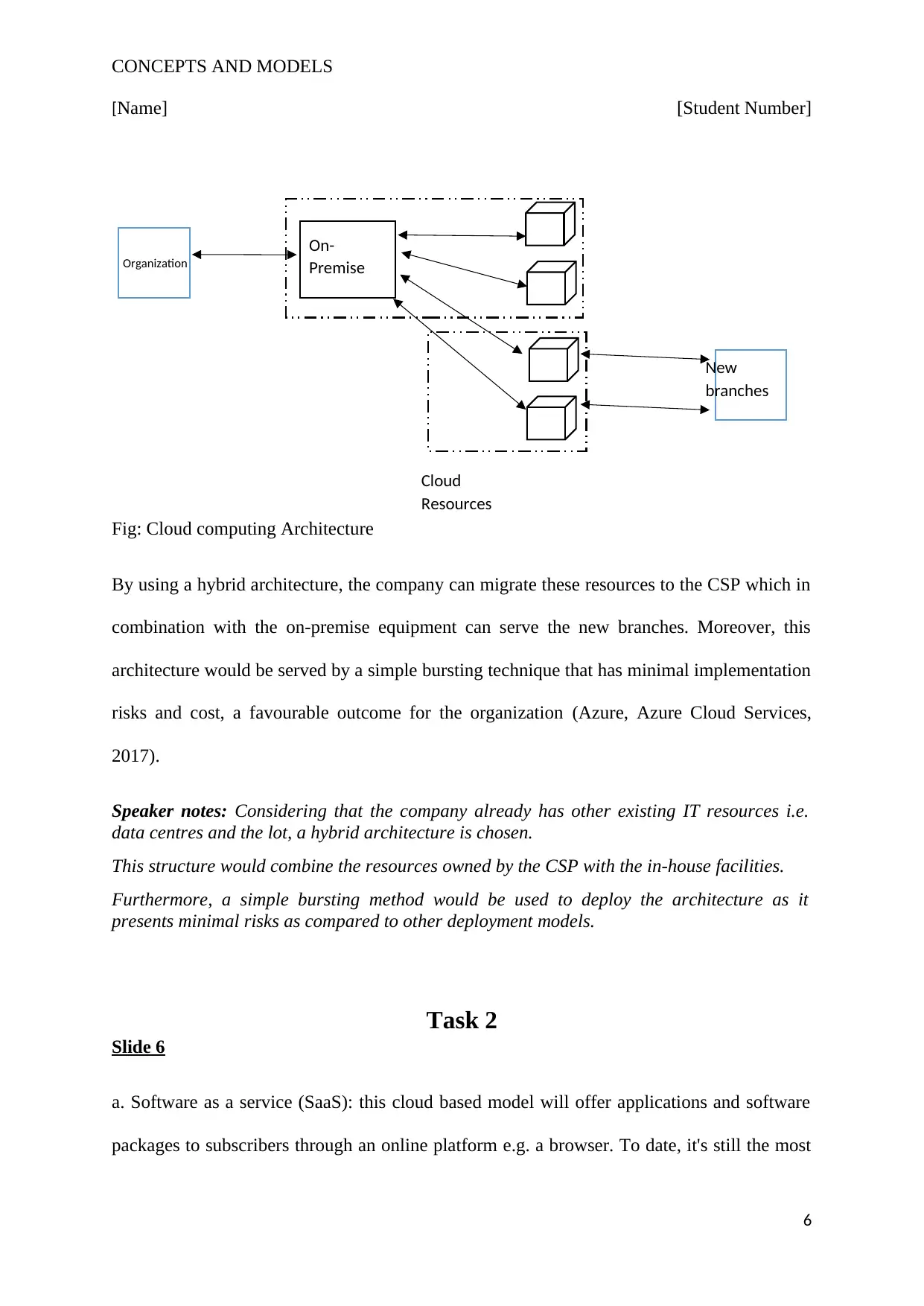
Fig: Cloud computing Architecture
By using a hybrid architecture, the company can migrate these resources to the CSP which in
combination with the on-premise equipment can serve the new branches. Moreover, this
architecture would be served by a simple bursting technique that has minimal implementation
risks and cost, a favourable outcome for the organization (Azure, Azure Cloud Services,
2017).
Speaker notes: Considering that the company already has other existing IT resources i.e.
data centres and the lot, a hybrid architecture is chosen.
This structure would combine the resources owned by the CSP with the in-house facilities.
Furthermore, a simple bursting method would be used to deploy the architecture as it
presents minimal risks as compared to other deployment models.
Task 2
Slide 6
a. Software as a service (SaaS): this cloud based model will offer applications and software
packages to subscribers through an online platform e.g. a browser. To date, it's still the most
6
On-
PremiseOrganization
Cloud
Resources
New
branches
[Name] [Student Number]
Fig: Cloud computing Architecture
By using a hybrid architecture, the company can migrate these resources to the CSP which in
combination with the on-premise equipment can serve the new branches. Moreover, this
architecture would be served by a simple bursting technique that has minimal implementation
risks and cost, a favourable outcome for the organization (Azure, Azure Cloud Services,
2017).
Speaker notes: Considering that the company already has other existing IT resources i.e.
data centres and the lot, a hybrid architecture is chosen.
This structure would combine the resources owned by the CSP with the in-house facilities.
Furthermore, a simple bursting method would be used to deploy the architecture as it
presents minimal risks as compared to other deployment models.
Task 2
Slide 6
a. Software as a service (SaaS): this cloud based model will offer applications and software
packages to subscribers through an online platform e.g. a browser. To date, it's still the most
6
On-
PremiseOrganization
Cloud
Resources
New
branches
⊘ This is a preview!⊘
Do you want full access?
Subscribe today to unlock all pages.
Trusted by 1+ million students worldwide
CONCEPTS AND MODELS
[Name] [Student Number]
popular model used as it delivers front-end services to consumers, users who have little
technical know-how for the rest of the cloud computing models. An example of SaaS, email
services as offered by the likes of Google (Gmail) and Yahoo (Yahoo mail) (Satyanarayana,
2012).
Webb’s Stores would achieve the following advantages with SaaS
• Resource accessibility – considering the access requirements are, internet
enabled devices and the internet itself, the company can achieve an all round
system access.
• Operational resiliency – CSP host resources in several locations which
guarantee the company will always have access to their resources.
Speaker notes: SaaS: a service model that offers software and application packages to users
through online systems such as browsers.
It’s the most popular model as it's easy to use.
An example of SaaS, email services e.g. Gmail and Yahoo mail.
Advantages of SaaS:
Resource accessibility – access is done using the internet at any given location.
Operational resiliency – as the CSP has many redundancy protocols.
Slide 7
• Upgradability – Webb’s Stores can easily choose to upgrade the systems they
use since this requirement is conducted by the CSP.
• Cost efficiency – Finally, this service is offered on a pay per use model which
makes it affordable and compatible with any business operations (Software,
2015).
b. Nevertheless, while SaaS may offer many benefits and conveniences, it does also present
several disadvantages most of which are caused by the data allocation techniques/ Methods.
7
[Name] [Student Number]
popular model used as it delivers front-end services to consumers, users who have little
technical know-how for the rest of the cloud computing models. An example of SaaS, email
services as offered by the likes of Google (Gmail) and Yahoo (Yahoo mail) (Satyanarayana,
2012).
Webb’s Stores would achieve the following advantages with SaaS
• Resource accessibility – considering the access requirements are, internet
enabled devices and the internet itself, the company can achieve an all round
system access.
• Operational resiliency – CSP host resources in several locations which
guarantee the company will always have access to their resources.
Speaker notes: SaaS: a service model that offers software and application packages to users
through online systems such as browsers.
It’s the most popular model as it's easy to use.
An example of SaaS, email services e.g. Gmail and Yahoo mail.
Advantages of SaaS:
Resource accessibility – access is done using the internet at any given location.
Operational resiliency – as the CSP has many redundancy protocols.
Slide 7
• Upgradability – Webb’s Stores can easily choose to upgrade the systems they
use since this requirement is conducted by the CSP.
• Cost efficiency – Finally, this service is offered on a pay per use model which
makes it affordable and compatible with any business operations (Software,
2015).
b. Nevertheless, while SaaS may offer many benefits and conveniences, it does also present
several disadvantages most of which are caused by the data allocation techniques/ Methods.
7
Paraphrase This Document
Need a fresh take? Get an instant paraphrase of this document with our AI Paraphraser
CONCEPTS AND MODELS
[Name] [Student Number]
• Data security – data owned by the organization would be stored in unknown
locations and using unknown security procedures. In essence, a third party is
trusted with sensitive material, a big risk for the organization.
• Loss of control – it’s also easy to lose track of the resources migrated online as
they are operated using the internet.
• Vendor-lock-in – a lot of resources are involved in the migration process
which deters subscribers from switching service providers (Software, 2015).
Speaker notes: Cont.…
Upgradability – operational packages can be updated at any given time.
Cost efficiency – resources are never bought or maintained but leased.
Disadvantages of SaaS
Data security – data is stored in unknown locations.
Loss of control – the IT resources are accessed through the internet, a pervasive technology.
Vendor lock-in because of the size of the migrated resources.
Slide 8
c. The SaaS service
i. Google Apps.
ii. How is it better?
Features: Webb’ Stores requires an office package that would cover emails, online chat
rooms and office automation. Google Apps provide all these services, plus the extended
feature of practicality as many users are already familiar with the services more so through
Gmail and its search engine (Otey, 2017).
Nevertheless, the following features make it the best option as compared to the rest.
• Docs – the resource that hosts all automation services such as word processors
and spreadsheets. Plus, these resources are provided on a real-time basis.
8
[Name] [Student Number]
• Data security – data owned by the organization would be stored in unknown
locations and using unknown security procedures. In essence, a third party is
trusted with sensitive material, a big risk for the organization.
• Loss of control – it’s also easy to lose track of the resources migrated online as
they are operated using the internet.
• Vendor-lock-in – a lot of resources are involved in the migration process
which deters subscribers from switching service providers (Software, 2015).
Speaker notes: Cont.…
Upgradability – operational packages can be updated at any given time.
Cost efficiency – resources are never bought or maintained but leased.
Disadvantages of SaaS
Data security – data is stored in unknown locations.
Loss of control – the IT resources are accessed through the internet, a pervasive technology.
Vendor lock-in because of the size of the migrated resources.
Slide 8
c. The SaaS service
i. Google Apps.
ii. How is it better?
Features: Webb’ Stores requires an office package that would cover emails, online chat
rooms and office automation. Google Apps provide all these services, plus the extended
feature of practicality as many users are already familiar with the services more so through
Gmail and its search engine (Otey, 2017).
Nevertheless, the following features make it the best option as compared to the rest.
• Docs – the resource that hosts all automation services such as word processors
and spreadsheets. Plus, these resources are provided on a real-time basis.
8
CONCEPTS AND MODELS
[Name] [Student Number]
• Google talk – a feature that enables facilitates such as chat rooms and
messaging services.
• Control panel – that enables the organization to manage its users’ accounts.
• Domain integration – which makes it easy to use with the existing in-house
systems
Speaker notes: The SaaS service: Google Apps
How is it better?
The service has many and extended features that set it apart from the rest, they include
Docs – offers office automation resources such as word processor and spreadsheets, all at
real-time basis.
Google talk – facilitates live communication through chat rooms and messaging.
Control panel – facilitates the management of users’ accounts.
Domain integration – can be integrated with the existing online systems.
Slide 9
• Start-up page – this feature allows an organization to customise the service
into an in-house tool possessing the logos and other features of the organization.
• Gadgets – extras features such as News feeds, media players and custom RSS
readers (Otey, 2017).
These features are endless and will only continue to grow with time.
iii. Disadvantages
An online service – connectivity is required which limits offline activities.
Single source support – if Google services are interrupted, the company’s
operations will be affected (Kazmeyer, 2017).
Speaker note: Cont…
Possesses a startup page that allows users to customise the service to include features such
as logos etc.
9
[Name] [Student Number]
• Google talk – a feature that enables facilitates such as chat rooms and
messaging services.
• Control panel – that enables the organization to manage its users’ accounts.
• Domain integration – which makes it easy to use with the existing in-house
systems
Speaker notes: The SaaS service: Google Apps
How is it better?
The service has many and extended features that set it apart from the rest, they include
Docs – offers office automation resources such as word processor and spreadsheets, all at
real-time basis.
Google talk – facilitates live communication through chat rooms and messaging.
Control panel – facilitates the management of users’ accounts.
Domain integration – can be integrated with the existing online systems.
Slide 9
• Start-up page – this feature allows an organization to customise the service
into an in-house tool possessing the logos and other features of the organization.
• Gadgets – extras features such as News feeds, media players and custom RSS
readers (Otey, 2017).
These features are endless and will only continue to grow with time.
iii. Disadvantages
An online service – connectivity is required which limits offline activities.
Single source support – if Google services are interrupted, the company’s
operations will be affected (Kazmeyer, 2017).
Speaker note: Cont…
Possesses a startup page that allows users to customise the service to include features such
as logos etc.
9
⊘ This is a preview!⊘
Do you want full access?
Subscribe today to unlock all pages.
Trusted by 1+ million students worldwide
CONCEPTS AND MODELS
[Name] [Student Number]
Gadgets – that have added features such as media players and custom RSS readers.
Disadvantages
It's solely an online service i.e. internet connection is a must.
It’s a single support service, therefore, if the CSP fails (Google) the company’s operation
fails as well.
Task 3
Database and cloud migration
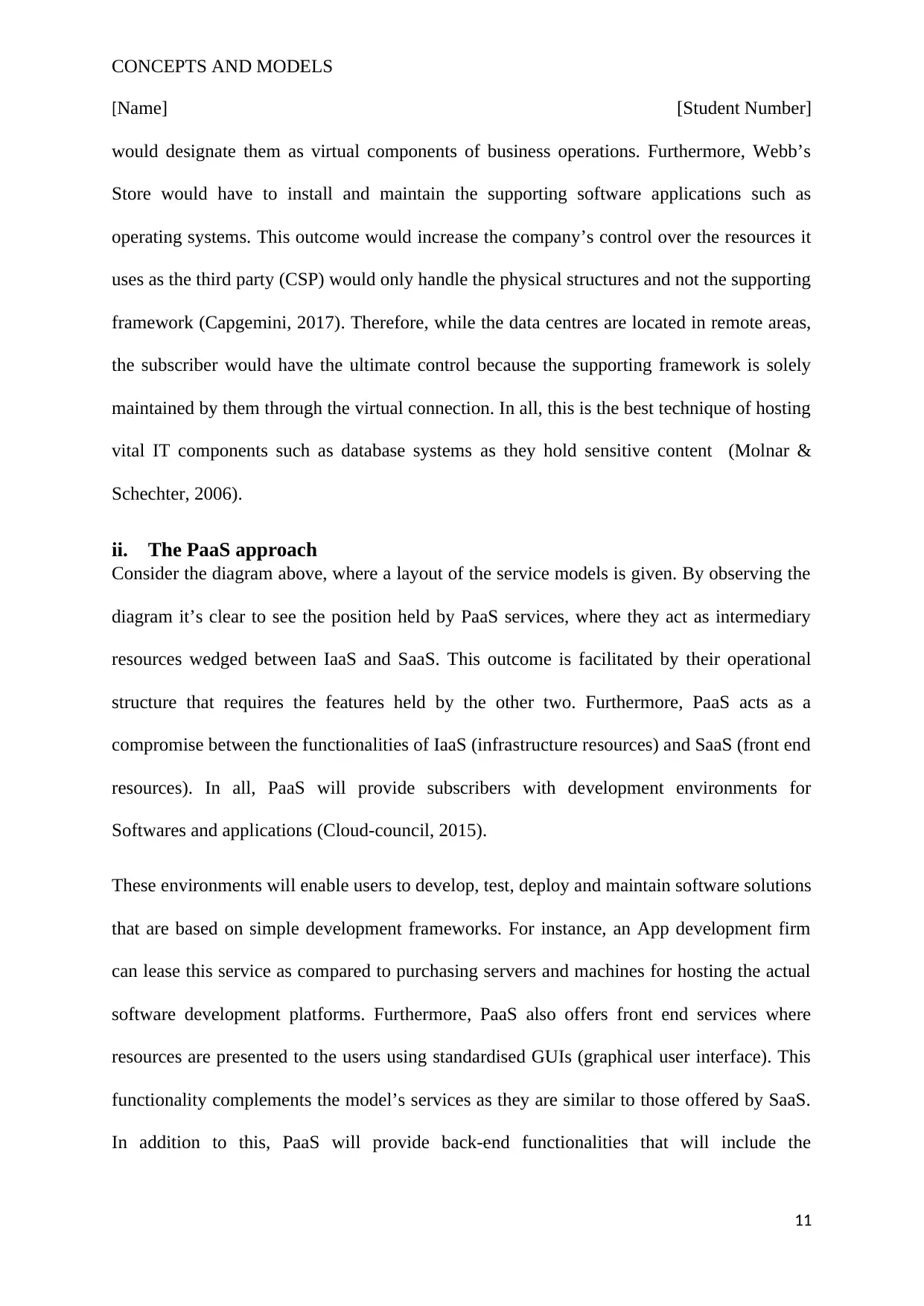
Fig: Cloud computing service models
i. The IaaS approach
As highlighted before, IaaS offers computational resources to subscribers where physical
components (infrastructure) are leased to users based on their needs. Consider the problem
facing Webb’s Stores, where data replication has been faced by many problems e.g. delays.
Moreover, with the new branches, the company will require efficient systems that will deliver
services to customers. Now, IaaS would offer the back-end resources such as servers,
networking equipment and processors among many others (Capgemini, 2017).
These resources would be based in remote environments as established by the CSP. Webb’s
Stores, on the other hand, would access the said resources through online systems which
10
[Name] [Student Number]
Gadgets – that have added features such as media players and custom RSS readers.
Disadvantages
It's solely an online service i.e. internet connection is a must.
It’s a single support service, therefore, if the CSP fails (Google) the company’s operation
fails as well.
Task 3
Database and cloud migration
Fig: Cloud computing service models
i. The IaaS approach
As highlighted before, IaaS offers computational resources to subscribers where physical
components (infrastructure) are leased to users based on their needs. Consider the problem
facing Webb’s Stores, where data replication has been faced by many problems e.g. delays.
Moreover, with the new branches, the company will require efficient systems that will deliver
services to customers. Now, IaaS would offer the back-end resources such as servers,
networking equipment and processors among many others (Capgemini, 2017).
These resources would be based in remote environments as established by the CSP. Webb’s
Stores, on the other hand, would access the said resources through online systems which
10
Paraphrase This Document
Need a fresh take? Get an instant paraphrase of this document with our AI Paraphraser
CONCEPTS AND MODELS
[Name] [Student Number]
would designate them as virtual components of business operations. Furthermore, Webb’s
Store would have to install and maintain the supporting software applications such as
operating systems. This outcome would increase the company’s control over the resources it
uses as the third party (CSP) would only handle the physical structures and not the supporting
framework (Capgemini, 2017). Therefore, while the data centres are located in remote areas,
the subscriber would have the ultimate control because the supporting framework is solely
maintained by them through the virtual connection. In all, this is the best technique of hosting
vital IT components such as database systems as they hold sensitive content (Molnar &
Schechter, 2006).
ii. The PaaS approach
Consider the diagram above, where a layout of the service models is given. By observing the
diagram it’s clear to see the position held by PaaS services, where they act as intermediary
resources wedged between IaaS and SaaS. This outcome is facilitated by their operational
structure that requires the features held by the other two. Furthermore, PaaS acts as a
compromise between the functionalities of IaaS (infrastructure resources) and SaaS (front end
resources). In all, PaaS will provide subscribers with development environments for
Softwares and applications (Cloud-council, 2015).
These environments will enable users to develop, test, deploy and maintain software solutions
that are based on simple development frameworks. For instance, an App development firm
can lease this service as compared to purchasing servers and machines for hosting the actual
software development platforms. Furthermore, PaaS also offers front end services where
resources are presented to the users using standardised GUIs (graphical user interface). This
functionality complements the model’s services as they are similar to those offered by SaaS.
In addition to this, PaaS will provide back-end functionalities that will include the
11
[Name] [Student Number]
would designate them as virtual components of business operations. Furthermore, Webb’s
Store would have to install and maintain the supporting software applications such as
operating systems. This outcome would increase the company’s control over the resources it
uses as the third party (CSP) would only handle the physical structures and not the supporting
framework (Capgemini, 2017). Therefore, while the data centres are located in remote areas,
the subscriber would have the ultimate control because the supporting framework is solely
maintained by them through the virtual connection. In all, this is the best technique of hosting
vital IT components such as database systems as they hold sensitive content (Molnar &
Schechter, 2006).
ii. The PaaS approach
Consider the diagram above, where a layout of the service models is given. By observing the
diagram it’s clear to see the position held by PaaS services, where they act as intermediary
resources wedged between IaaS and SaaS. This outcome is facilitated by their operational
structure that requires the features held by the other two. Furthermore, PaaS acts as a
compromise between the functionalities of IaaS (infrastructure resources) and SaaS (front end
resources). In all, PaaS will provide subscribers with development environments for
Softwares and applications (Cloud-council, 2015).
These environments will enable users to develop, test, deploy and maintain software solutions
that are based on simple development frameworks. For instance, an App development firm
can lease this service as compared to purchasing servers and machines for hosting the actual
software development platforms. Furthermore, PaaS also offers front end services where
resources are presented to the users using standardised GUIs (graphical user interface). This
functionality complements the model’s services as they are similar to those offered by SaaS.
In addition to this, PaaS will provide back-end functionalities that will include the
11
CONCEPTS AND MODELS
[Name] [Student Number]
maintenance of servers, networks and operating systems. Again, these functionalities
complement those of IaaS (Cloud-council, 2015).
Pros and cons of both IaaS and PaaS
Pros Cons
IaaS
High levels of control (IT resources) – this
benefit is attributed to the design structure
of IaaS that enables subscribers to have
back-end operations. This includes;
maintaining the OS, servers and networks.
Geographical limitations – IaaS resources
are heavy in nature thus cannot be ferried
over long distances.
Guaranteed planning and expansion –
CSP will offer unlimited resources as paid
for by the subscriber, therefore Webb’s
Stores can expand their resources at any
given time.
Secondly, the services offered by IaaS are
in the lower tier section.
Power efficiency – all infrastructure
requirements e.g. power and security are
handled by the CSP and are based on
specialised models.
IaaS is very expensive owing to the
amount of the leased resources.
Good security protocols that are based on
single tenant systems.
Finally, the service model is very
distractive to business operations (Sigma,
2017).
PaaS
Automated updates – the platforms and
features involved are automatically
Vendor-lock-in – PaaS is still the least
utilised cloud service which has led to few
12
[Name] [Student Number]
maintenance of servers, networks and operating systems. Again, these functionalities
complement those of IaaS (Cloud-council, 2015).
Pros and cons of both IaaS and PaaS
Pros Cons
IaaS
High levels of control (IT resources) – this
benefit is attributed to the design structure
of IaaS that enables subscribers to have
back-end operations. This includes;
maintaining the OS, servers and networks.
Geographical limitations – IaaS resources
are heavy in nature thus cannot be ferried
over long distances.
Guaranteed planning and expansion –
CSP will offer unlimited resources as paid
for by the subscriber, therefore Webb’s
Stores can expand their resources at any
given time.
Secondly, the services offered by IaaS are
in the lower tier section.
Power efficiency – all infrastructure
requirements e.g. power and security are
handled by the CSP and are based on
specialised models.
IaaS is very expensive owing to the
amount of the leased resources.
Good security protocols that are based on
single tenant systems.
Finally, the service model is very
distractive to business operations (Sigma,
2017).
PaaS
Automated updates – the platforms and
features involved are automatically
Vendor-lock-in – PaaS is still the least
utilised cloud service which has led to few
12
⊘ This is a preview!⊘
Do you want full access?
Subscribe today to unlock all pages.
Trusted by 1+ million students worldwide

1 out of 15


Related Documents


Your All-in-One AI-Powered Toolkit for Academic Success.
+13062052269
info@desklib.com
Available 24*7 on WhatsApp / Email
![[object Object]](/_next/static/media/star-bottom.7253800d.svg)
Unlock your academic potential
Copyright © 2020–2026 A2Z Services. All Rights Reserved. Developed and managed by ZUCOL.