Analyzing the Effects of Cloud Computing on Employees and Storage
VerifiedAdded on 2023/06/15
|10
|2302
|468
Essay
AI Summary
This essay explores the multifaceted effects of cloud computing, particularly its impact on employees and data storage practices. It delves into the economic shifts from capital expenditure to operational procedures, highlighting potential job displacement and the need for new skill sets. The essay also addresses critical security concerns related to data access, modification, and lifecycle management within cloud environments. Furthermore, it compares cloud storage solutions to traditional manual storage methods, emphasizing the advantages of cloud computing in terms of data handling speed, cost savings, and scalability. The conclusion underscores the importance of improved security, privacy, and IT governance in realizing the full benefits of cloud computing for businesses, especially SMEs. Desklib offers a wide range of resources, including past papers and solved assignments, to aid students in understanding these complex topics.
CLOUD COMPUTING

Paraphrase This Document
Need a fresh take? Get an instant paraphrase of this document with our AI Paraphraser
Contents
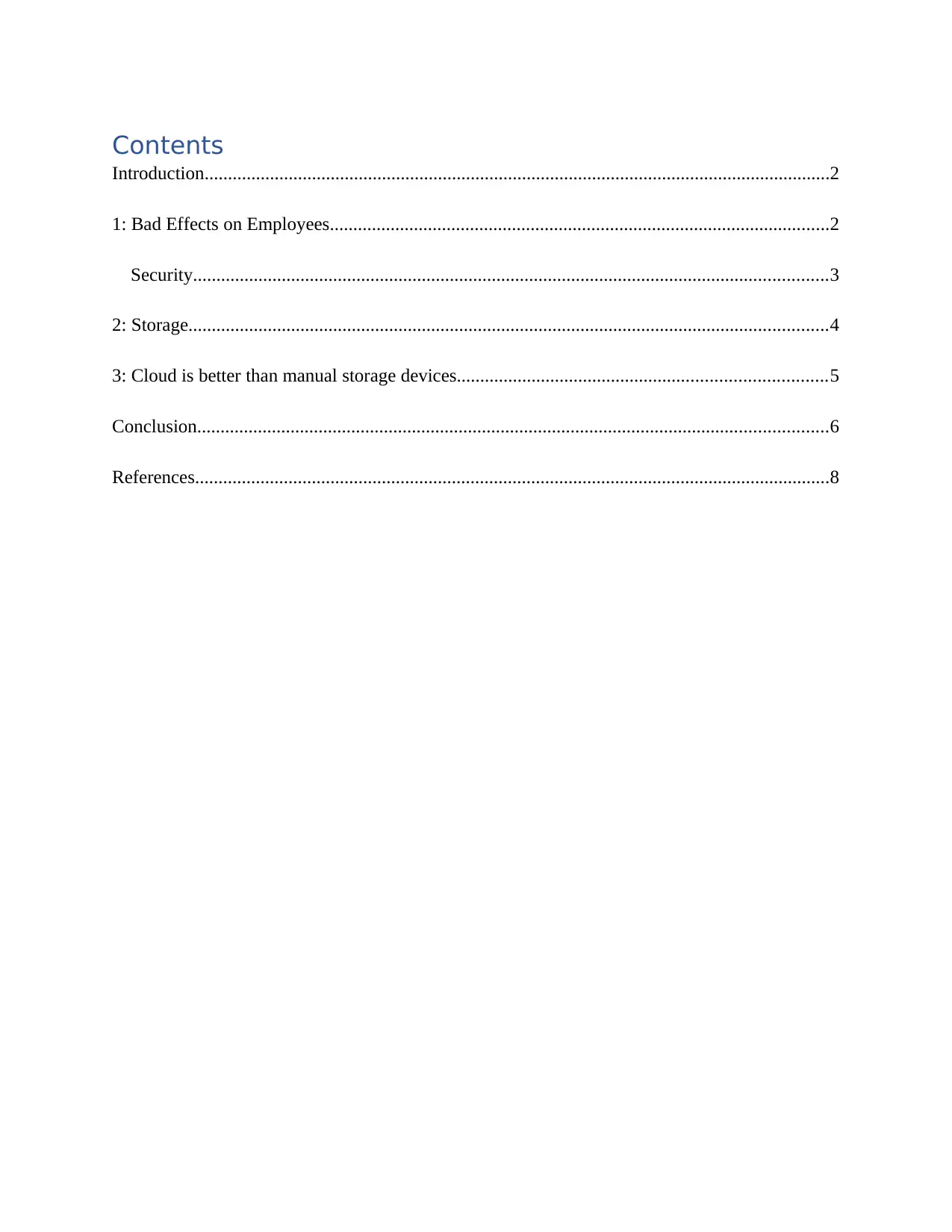
Introduction......................................................................................................................................2
1: Bad Effects on Employees...........................................................................................................2
Security........................................................................................................................................3
2: Storage.........................................................................................................................................4
3: Cloud is better than manual storage devices...............................................................................5
Conclusion.......................................................................................................................................6
References........................................................................................................................................8
Introduction......................................................................................................................................2
1: Bad Effects on Employees...........................................................................................................2
Security........................................................................................................................................3
2: Storage.........................................................................................................................................4
3: Cloud is better than manual storage devices...............................................................................5
Conclusion.......................................................................................................................................6
References........................................................................................................................................8
Introduction
The cloud computing has been promising for the ease of use and cost-effectiveness. It has been
able to focus on the realities and the risks of the model, components and the characteristics. The
focus is also on providing a scalable infrastructure for the application, data and the file storage
where the advent of this technology is based on the cost of computation, application hosting and
handling the storage of the content through a proper delivery of the data as well (Harris, 2013 pp.
1-2). Cloud computing has made it easy to handle the different types of direct cost benefits with
the potential to transform the data from a capital intensive to a variable priced environment. The
idea is mainly about the reusability of IT capabilities and handle the software data centres
through the self-service management and pay-per-use feature. One needs to understand the
enterprise which choose to deploy the applications on the public, private and the hybrid clouds,
where the cloud integrators tend to play a major role in handling the superior economies of scale
to customers. The model aims to address on data security and greater control that lacks in a
public cloud.
1: Bad Effects on Employees
Cloud computing has a major disadvantage when it comes to handling the economic standards. It
has been seen that there is a major move from the capital expenditure to the operating
procedures, where the considerable implications are related to accounting and other investment
practices (Rangendran, 2013). The shifting in the work will have a major effect on the labour
market with displacement of the employees and their skills.
The major impact can be the failure of communication, the deterioration of the quality of service
with ceasing all the operations (Devasena, 2014). The employees will be handling the sending of
The cloud computing has been promising for the ease of use and cost-effectiveness. It has been
able to focus on the realities and the risks of the model, components and the characteristics. The
focus is also on providing a scalable infrastructure for the application, data and the file storage
where the advent of this technology is based on the cost of computation, application hosting and
handling the storage of the content through a proper delivery of the data as well (Harris, 2013 pp.
1-2). Cloud computing has made it easy to handle the different types of direct cost benefits with
the potential to transform the data from a capital intensive to a variable priced environment. The
idea is mainly about the reusability of IT capabilities and handle the software data centres
through the self-service management and pay-per-use feature. One needs to understand the
enterprise which choose to deploy the applications on the public, private and the hybrid clouds,
where the cloud integrators tend to play a major role in handling the superior economies of scale
to customers. The model aims to address on data security and greater control that lacks in a
public cloud.
1: Bad Effects on Employees
Cloud computing has a major disadvantage when it comes to handling the economic standards. It
has been seen that there is a major move from the capital expenditure to the operating
procedures, where the considerable implications are related to accounting and other investment
practices (Rangendran, 2013). The shifting in the work will have a major effect on the labour
market with displacement of the employees and their skills.
The major impact can be the failure of communication, the deterioration of the quality of service
with ceasing all the operations (Devasena, 2014). The employees will be handling the sending of
⊘ This is a preview!⊘
Do you want full access?
Subscribe today to unlock all pages.

Trusted by 1+ million students worldwide
data with the tapping of communication line and corrupting the data or stealing it from the disk
storage.
The impact of cloud computing on employees also include the scalability to store and handle the
large amount of data. It has been critical and there is no proper availability of the data. One of
the pressing demands is to serve the needs of the mobile user in a short time. There is a major
security breach and issues when related to the addressing and delivering the high-quality services
of data (Hashem et al., 2015). Along with this, the major impact is on the data processing where
the employees have to handle the growth of data from multiple sources and then take hold of
semi-structured data formats only to a certain extent.
The major issue is also related to the software and the hardware architecture, where problems are
related to the reliability and the barriers of pricing, capacity and the lack of query processing
techniques (Diakaiokos et al., 2009). There is a need to handle the input output operations per
second to work with a greater capacity at a faster pace. The issues of how the hackers can use the
virtualised infrastructure is also a major problem for the people.
Security
The security is an issue for the cloud provider and the client. For IaaS model, the physical
security, environment and the virtualisation software security need to be acknowledged with
proper applications and data (Ogigau, 2012 pp., 144-145). The issue also arises with the security
and confidentiality where one can access or modify the data, check what happens to the data
when it is deleted, or about the security lifecycle.
The security issues involve the identification of selected security controls with major effect on
handling the reliability, maintainability and supportability (Zissis et al., 2012). The software
storage.
The impact of cloud computing on employees also include the scalability to store and handle the
large amount of data. It has been critical and there is no proper availability of the data. One of
the pressing demands is to serve the needs of the mobile user in a short time. There is a major
security breach and issues when related to the addressing and delivering the high-quality services
of data (Hashem et al., 2015). Along with this, the major impact is on the data processing where
the employees have to handle the growth of data from multiple sources and then take hold of
semi-structured data formats only to a certain extent.
The major issue is also related to the software and the hardware architecture, where problems are
related to the reliability and the barriers of pricing, capacity and the lack of query processing
techniques (Diakaiokos et al., 2009). There is a need to handle the input output operations per
second to work with a greater capacity at a faster pace. The issues of how the hackers can use the
virtualised infrastructure is also a major problem for the people.
Security
The security is an issue for the cloud provider and the client. For IaaS model, the physical
security, environment and the virtualisation software security need to be acknowledged with
proper applications and data (Ogigau, 2012 pp., 144-145). The issue also arises with the security
and confidentiality where one can access or modify the data, check what happens to the data
when it is deleted, or about the security lifecycle.
The security issues involve the identification of selected security controls with major effect on
handling the reliability, maintainability and supportability (Zissis et al., 2012). The software
Paraphrase This Document
Need a fresh take? Get an instant paraphrase of this document with our AI Paraphraser
confidentiality is considered important and needs to be handled to maintain the integrity of
information and preventing the loss or modification due to any unauthorised access or
component failure.
There is a need to take hold of how management of hosting companies or colocation services are
set. With this, the cloud also has to focus on compelling value proposition in terms of cost,
perimeter wall and load balancing (Subhashini et al., 2011). The focus is on portability of
application, with issues related to web application security and data breach.
The traditional risks were mainly about the confidentiality, integrity and the availability of the
system (Asma et al., 2012). There are other issues related to the management of entity
admittances and the rights to specific enterprise resources that ensure the valuable data and
services, misappropriated or stolen.
2: Storage
The cloud computing is mainly to handle the sharing of configurable resources which includes
the network, servers, storage and the applications (Mell et al., 2011). They are mainly for
handling the three service models with the broad network access and rapid elasticity that could
handle the capability to match the monitoring and control for the provider and the consumer of
utilised service.
The storage includes the data integrity verification for the different untrusted servers. The
experience of the failure is mainly to decide and hide any data errors from the client for the
benefit of the company (Wang et al., 2011). The major issue is about the verification and high
scheme efficiency, stateless standards and public verifiability to challenge the correctness of the
data storage.
information and preventing the loss or modification due to any unauthorised access or
component failure.
There is a need to take hold of how management of hosting companies or colocation services are
set. With this, the cloud also has to focus on compelling value proposition in terms of cost,
perimeter wall and load balancing (Subhashini et al., 2011). The focus is on portability of
application, with issues related to web application security and data breach.
The traditional risks were mainly about the confidentiality, integrity and the availability of the
system (Asma et al., 2012). There are other issues related to the management of entity
admittances and the rights to specific enterprise resources that ensure the valuable data and
services, misappropriated or stolen.
2: Storage
The cloud computing is mainly to handle the sharing of configurable resources which includes
the network, servers, storage and the applications (Mell et al., 2011). They are mainly for
handling the three service models with the broad network access and rapid elasticity that could
handle the capability to match the monitoring and control for the provider and the consumer of
utilised service.
The storage includes the data integrity verification for the different untrusted servers. The
experience of the failure is mainly to decide and hide any data errors from the client for the
benefit of the company (Wang et al., 2011). The major issue is about the verification and high
scheme efficiency, stateless standards and public verifiability to challenge the correctness of the
data storage.
The cloud storage is mainly to handle the data and work on the high-quality cloud applications
without any burden of the local hardware and the software management. Here, the distributed
storage integrity auditing mechanism is set to utilise the distributed coded data. Along with this,
the internet based online services also provide a huge amount of computing resources with local
machines set for data maintenance (Wang et al., 2012). The supporting dynamic data operations
are based on working with limited attention in data possession applications.
The capability is mainly based on deploying the cloud consumer created with applications
through using different programming languages (Zhang et al., 2010). In order to work with the
proper on-demand data correctness, there is a need to be updated by the users through insertion,
deletion, modification and appending.
3: Cloud is better than manual storage devices
The cloud computing is able to handle the data effectively and in a much faster process, where
the manual process could be mainly for cloud computing that is not integrate into digital
forensics (Martini et al., 2013). This will be a very time-consuming process along with which it
will be difficult to decrypt the files manually which will be an effort.
The manual calculation of the solution will lead to higher estimated costs and less accuracy. The
cloud computing helps in handling the cloud storage services with proper estimation of cost
savings, using Azure and local clouds under different data requirements (Ruiz et al., 2011). Here,
cloud computing will help in easily storing the different range of devices and handle the different
understanding of artefacts which focus on client and server.
The manual storage is lessened, and cloud computing need to focus on self-services with
resource flexibility and pricing is determined on the level of usage (Govinda et al., 2012). The
without any burden of the local hardware and the software management. Here, the distributed
storage integrity auditing mechanism is set to utilise the distributed coded data. Along with this,
the internet based online services also provide a huge amount of computing resources with local
machines set for data maintenance (Wang et al., 2012). The supporting dynamic data operations
are based on working with limited attention in data possession applications.
The capability is mainly based on deploying the cloud consumer created with applications
through using different programming languages (Zhang et al., 2010). In order to work with the
proper on-demand data correctness, there is a need to be updated by the users through insertion,
deletion, modification and appending.
3: Cloud is better than manual storage devices
The cloud computing is able to handle the data effectively and in a much faster process, where
the manual process could be mainly for cloud computing that is not integrate into digital
forensics (Martini et al., 2013). This will be a very time-consuming process along with which it
will be difficult to decrypt the files manually which will be an effort.
The manual calculation of the solution will lead to higher estimated costs and less accuracy. The
cloud computing helps in handling the cloud storage services with proper estimation of cost
savings, using Azure and local clouds under different data requirements (Ruiz et al., 2011). Here,
cloud computing will help in easily storing the different range of devices and handle the different
understanding of artefacts which focus on client and server.
The manual storage is lessened, and cloud computing need to focus on self-services with
resource flexibility and pricing is determined on the level of usage (Govinda et al., 2012). The
⊘ This is a preview!⊘
Do you want full access?
Subscribe today to unlock all pages.
Trusted by 1+ million students worldwide
cloud allows a proper investigations and auditing of outsourcing the data to ensure the data
security as well.
The cloud computing has been helpful in handling the elimination of up-front by cloud users and
allowing the companies to start with the increased hardware resources (Armbrust et al., 2010).
The ability to pay for the use of computing resources with the short-term basis helps in handling
the automatic scalability and failover mainly because of the semantics because they are set with
the state management issues that are highly application dependent.
Conclusion
The cloud computing has been able to work on the business strategy formulation and
accomplishment of the near future. The SMEs are working over improved security and privacy
so that there is an effective cost reduction and finding easy use, convenient and secured business
forms. The cloud computing focus on the cloud consolidation and aggregation of resources
where a proper support for change in business model is important for the IT governance
arrangement. The outsourcing is set with the upskills of the employees which is based on the IT
shared services, virtualisation and using the multiple technology platforms (Devasena, 2014 pp.,5-
6). The backup and storage are important for collaboration which indicates that there is a
preference of face-to-face meetings, possessing physical devices and working on sharing and
collaboration. Along with this, the cloud computing helps in handling the security and privacy to
monitor the activities and tracking the transactions, providing a selective access to the users and
utilising a strong password. The reliability is also important with built-in factors so that one can
easily match to the downtime of various commercial cloud solutions like Amazon, Gmail and
Google Docs.
security as well.
The cloud computing has been helpful in handling the elimination of up-front by cloud users and
allowing the companies to start with the increased hardware resources (Armbrust et al., 2010).
The ability to pay for the use of computing resources with the short-term basis helps in handling
the automatic scalability and failover mainly because of the semantics because they are set with
the state management issues that are highly application dependent.
Conclusion
The cloud computing has been able to work on the business strategy formulation and
accomplishment of the near future. The SMEs are working over improved security and privacy
so that there is an effective cost reduction and finding easy use, convenient and secured business
forms. The cloud computing focus on the cloud consolidation and aggregation of resources
where a proper support for change in business model is important for the IT governance
arrangement. The outsourcing is set with the upskills of the employees which is based on the IT
shared services, virtualisation and using the multiple technology platforms (Devasena, 2014 pp.,5-
6). The backup and storage are important for collaboration which indicates that there is a
preference of face-to-face meetings, possessing physical devices and working on sharing and
collaboration. Along with this, the cloud computing helps in handling the security and privacy to
monitor the activities and tracking the transactions, providing a selective access to the users and
utilising a strong password. The reliability is also important with built-in factors so that one can
easily match to the downtime of various commercial cloud solutions like Amazon, Gmail and
Google Docs.
Paraphrase This Document
Need a fresh take? Get an instant paraphrase of this document with our AI Paraphraser

References
Armbrust, M., Fox, A., Griffith, R., Joseph, A. D., Katz, R., Konwinski, A., ... & Zaharia, M. (2010). A view
of cloud computing. Communications of the ACM, 53(4), 50-58.
Asma, A., Chaurasia, M. A., & Mokhtar, H. (2012). Cloud Computing Security Issues. International
Journal of Application or Innovation in Engineering & Management, 1(2), 141-147.
Devasena, C. L. (2014). Impact study of cloud computing on business development. Operations
Research and Applications: An International Journal (ORAJ), 1(1), 1-7.
Dikaiakos, M. D., Katsaros, D., Mehra, P., Pallis, G., & Vakali, A. (2009). Cloud computing: Distributed
internet computing for IT and scientific research. IEEE Internet computing, 13(5). 11-12
Govinda, K., Gurunathaprasad, V., & Sathishkumar, H. (2012). Third party auditing for secure data
storage in cloud through digital signature using RSA. International Journal of Advanced Scientific
and Technical Research, 4(2), 525-530.
Harris T.,(2013). Cloud Computing Overview. Available at: <http://www.thbs.com/downloads/Cloud-
Computing-Overview.pdf>
Hashem, I. A. T., Yaqoob, I., Anuar, N. B., Mokhtar, S., Gani, A., & Khan, S. U. (2015). The rise of “big
data” on cloud computing: Review and open research issues. Information Systems, 47, 98-115.
Martini, B., & Choo, K. K. R. (2013). Cloud storage forensics: ownCloud as a case study. Digital
Investigation, 10(4), 287-299.
Mell, P., & Grance, T. (2011). The NIST definition of cloud computing. Page 2
Ogigau-Neamtiu, F. (2012). Cloud computing security issues. Journal of Defense Resources
Management, 3(2), 141. 144-145
Rajendran, S. (2013). Organizational challenges in cloud adoption and enablers of cloud transition
program (Doctoral dissertation, Massachusetts Institute of Technology).
Armbrust, M., Fox, A., Griffith, R., Joseph, A. D., Katz, R., Konwinski, A., ... & Zaharia, M. (2010). A view
of cloud computing. Communications of the ACM, 53(4), 50-58.
Asma, A., Chaurasia, M. A., & Mokhtar, H. (2012). Cloud Computing Security Issues. International
Journal of Application or Innovation in Engineering & Management, 1(2), 141-147.
Devasena, C. L. (2014). Impact study of cloud computing on business development. Operations
Research and Applications: An International Journal (ORAJ), 1(1), 1-7.
Dikaiakos, M. D., Katsaros, D., Mehra, P., Pallis, G., & Vakali, A. (2009). Cloud computing: Distributed
internet computing for IT and scientific research. IEEE Internet computing, 13(5). 11-12
Govinda, K., Gurunathaprasad, V., & Sathishkumar, H. (2012). Third party auditing for secure data
storage in cloud through digital signature using RSA. International Journal of Advanced Scientific
and Technical Research, 4(2), 525-530.
Harris T.,(2013). Cloud Computing Overview. Available at: <http://www.thbs.com/downloads/Cloud-
Computing-Overview.pdf>
Hashem, I. A. T., Yaqoob, I., Anuar, N. B., Mokhtar, S., Gani, A., & Khan, S. U. (2015). The rise of “big
data” on cloud computing: Review and open research issues. Information Systems, 47, 98-115.
Martini, B., & Choo, K. K. R. (2013). Cloud storage forensics: ownCloud as a case study. Digital
Investigation, 10(4), 287-299.
Mell, P., & Grance, T. (2011). The NIST definition of cloud computing. Page 2
Ogigau-Neamtiu, F. (2012). Cloud computing security issues. Journal of Defense Resources
Management, 3(2), 141. 144-145
Rajendran, S. (2013). Organizational challenges in cloud adoption and enablers of cloud transition
program (Doctoral dissertation, Massachusetts Institute of Technology).
⊘ This is a preview!⊘
Do you want full access?
Subscribe today to unlock all pages.
Trusted by 1+ million students worldwide
Ruiz-Alvarez, A., & Humphrey, M. (2011, June). An automated approach to cloud storage service
selection. In Proceedings of the 2nd international workshop on Scientific cloud computing(pp. 39-
48). ACM.
Subashini, S., & Kavitha, V. (2011). A survey on security issues in service delivery models of cloud
computing. Journal of network and computer applications, 34(1), 1-11.
Wang, C., Wang, Q., Ren, K., Cao, N., & Lou, W. (2012). Toward secure and dependable storage
services in cloud computing. IEEE transactions on Services Computing, 5(2), 220-232.
Wang, Q., Wang, C., Ren, K., Lou, W., & Li, J. (2011). Enabling public auditability and data dynamics for
storage security in cloud computing. IEEE transactions on parallel and distributed systems, 22(5),
847-859. Page 2
Zhang, Q., Cheng, L., & Boutaba, R. (2010). Cloud computing: state-of-the-art and research
challenges. Journal of internet services and applications, 1(1), 7-18.
Zissis, D., & Lekkas, D. (2012). Addressing cloud computing security issues. Future Generation computer
systems, 28(3), 583-592. 586-587
selection. In Proceedings of the 2nd international workshop on Scientific cloud computing(pp. 39-
48). ACM.
Subashini, S., & Kavitha, V. (2011). A survey on security issues in service delivery models of cloud
computing. Journal of network and computer applications, 34(1), 1-11.
Wang, C., Wang, Q., Ren, K., Cao, N., & Lou, W. (2012). Toward secure and dependable storage
services in cloud computing. IEEE transactions on Services Computing, 5(2), 220-232.
Wang, Q., Wang, C., Ren, K., Lou, W., & Li, J. (2011). Enabling public auditability and data dynamics for
storage security in cloud computing. IEEE transactions on parallel and distributed systems, 22(5),
847-859. Page 2
Zhang, Q., Cheng, L., & Boutaba, R. (2010). Cloud computing: state-of-the-art and research
challenges. Journal of internet services and applications, 1(1), 7-18.
Zissis, D., & Lekkas, D. (2012). Addressing cloud computing security issues. Future Generation computer
systems, 28(3), 583-592. 586-587

1 out of 10


Related Documents


Your All-in-One AI-Powered Toolkit for Academic Success.
+13062052269
info@desklib.com
Available 24*7 on WhatsApp / Email
![[object Object]](/_next/static/media/star-bottom.7253800d.svg)
Unlock your academic potential
Copyright © 2020–2026 A2Z Services. All Rights Reserved. Developed and managed by ZUCOL.