Research Proposal: Cloud Computing Integration Impact on Business
VerifiedAdded on 2020/03/04
|17
|5190
|137
Project
AI Summary
This research proposal investigates the integration of cloud computing in business, exploring its background, problem statement, purpose, objectives, and research questions. It outlines a theoretical framework, including hypotheses and the significance of the research, defining key terms such as IaaS, PaaS, and SaaS. The proposal details the research methodology, including the research worldview, design, strategy, data collection and analysis methods, population, and sample. It also addresses ethical considerations and potential limitations. The expected results are briefly mentioned, and the proposal aims to analyze the reasons for cloud computing integration and its impact on business performance, contributing to the understanding of cloud technology's role in modern business operations. The study intends to assess the relationship between cloud computing integration and its impact on business performance, considering factors influencing its adoption and providing strategies for effective implementation.
Research Proposal
Integration of Cloud Computing in a Business
Integration of Cloud Computing in a Business

Paraphrase This Document
Need a fresh take? Get an instant paraphrase of this document with our AI Paraphraser
Table of Contents
1. Introduction.............................................................................................................................................3
1.1 Background.......................................................................................................................................3
1.2 Problem Statement.............................................................................................................................4
1.3 Purpose Statement.............................................................................................................................4
1.4 Research objectives and questions.....................................................................................................5
1.5 Theoretical Framework......................................................................................................................5
1.6 Hypothesis.........................................................................................................................................6
1.7 Significance of the research...............................................................................................................6
1.8 Definition of terms.............................................................................................................................7
1.9 ethical considerations........................................................................................................................8
1.10 Delimitations of the study................................................................................................................8
1.11 Limitations of the study...................................................................................................................8
2. Literature Review....................................................................................................................................9
2.1 Introduction.......................................................................................................................................9
2.2 Cloud computing...............................................................................................................................9
2.3 Integration of cloud computing........................................................................................................10
2.4 Factors influencing cloud computing integration in business..........................................................10
2.5 Effect of cloud computing integration on business..........................................................................11
3. Research Methodology..........................................................................................................................11
3.1 Research Worldview........................................................................................................................11
3.2 Research Design..............................................................................................................................12
3.3 Research Strategy............................................................................................................................12
3.4 Data collection method....................................................................................................................12
3.5 Data analysis....................................................................................................................................12
3.6 Population........................................................................................................................................13
3.7 Sample.............................................................................................................................................13
4. Expected Results...................................................................................................................................13
References.................................................................................................................................................14
1. Introduction.............................................................................................................................................3
1.1 Background.......................................................................................................................................3
1.2 Problem Statement.............................................................................................................................4
1.3 Purpose Statement.............................................................................................................................4
1.4 Research objectives and questions.....................................................................................................5
1.5 Theoretical Framework......................................................................................................................5
1.6 Hypothesis.........................................................................................................................................6
1.7 Significance of the research...............................................................................................................6
1.8 Definition of terms.............................................................................................................................7
1.9 ethical considerations........................................................................................................................8
1.10 Delimitations of the study................................................................................................................8
1.11 Limitations of the study...................................................................................................................8
2. Literature Review....................................................................................................................................9
2.1 Introduction.......................................................................................................................................9
2.2 Cloud computing...............................................................................................................................9
2.3 Integration of cloud computing........................................................................................................10
2.4 Factors influencing cloud computing integration in business..........................................................10
2.5 Effect of cloud computing integration on business..........................................................................11
3. Research Methodology..........................................................................................................................11
3.1 Research Worldview........................................................................................................................11
3.2 Research Design..............................................................................................................................12
3.3 Research Strategy............................................................................................................................12
3.4 Data collection method....................................................................................................................12
3.5 Data analysis....................................................................................................................................12
3.6 Population........................................................................................................................................13
3.7 Sample.............................................................................................................................................13
4. Expected Results...................................................................................................................................13
References.................................................................................................................................................14

⊘ This is a preview!⊘
Do you want full access?
Subscribe today to unlock all pages.

Trusted by 1+ million students worldwide
1. Introduction
1.1 Background
With the advent of the internet businesses have been more inclined to utilise internet and
technology to carry on with business activities. There are many companies all across the world
that is largely focused on using technology to improve the overall performance and productivity
of the business. Since the arrival of information technology businesses have become a lot easier.
They are on the move with the owner courtesy the constant advancement of the technology. The
integration of internet in the business has fetched excellent results. It could be said that the even
the small and medium scale businesses have realised the essentiality of this technology that
clearly shows the increasing awareness of information technology in business. In the modern day
market there is hardly organisations that don’t use information technology and derivatives to
operate the business activities and hence it could be said that it is important to understand and
analyse the different tools related to the information technology and their impact on the business
(Xu, 2012).
Cloud is one such tool which has gained significant importance in the field of information
technology and the businesses have shown higher inclination to work with cloud computing. In
the recent past with time more and more businesses have taken up cloud computing and have
integrated it in the businesses which have showed the significance of cloud computing. Various
organizations are acknowledging the importance of this technology and the potential it possesses
to enhance business productivity. However, irrespective of the potential, many are still unclear
about its implementation process. Over the years IT has seen significant improvement and Cloud
computing is one such development. Cloud computing has been in the news for a long time and
since its importance have been realised it has been used by most of the organisations to
streamline their business operations as it provides effective opportunities to access data from
anywhere in the world and makes work easier (Fernando, Loke, & Rahayu 2013). Considering
the current decade, many corporate organizations or companies use cloud computing. Cloud
computing integration has increased to a considerable extent. The present research will take an
opportunity to analyse the key reasons concerning the “integration of cloud computing in a
business” and how it facilitates business operations.
1.2 Problem Statement
Cloud computing integration in business has increased in the last few years which clearly show
the increasing importance of this tool in the business environment. It has to be admitted that with
more and more companies embracing information technology the business environment have
1.1 Background
With the advent of the internet businesses have been more inclined to utilise internet and
technology to carry on with business activities. There are many companies all across the world
that is largely focused on using technology to improve the overall performance and productivity
of the business. Since the arrival of information technology businesses have become a lot easier.
They are on the move with the owner courtesy the constant advancement of the technology. The
integration of internet in the business has fetched excellent results. It could be said that the even
the small and medium scale businesses have realised the essentiality of this technology that
clearly shows the increasing awareness of information technology in business. In the modern day
market there is hardly organisations that don’t use information technology and derivatives to
operate the business activities and hence it could be said that it is important to understand and
analyse the different tools related to the information technology and their impact on the business
(Xu, 2012).
Cloud is one such tool which has gained significant importance in the field of information
technology and the businesses have shown higher inclination to work with cloud computing. In
the recent past with time more and more businesses have taken up cloud computing and have
integrated it in the businesses which have showed the significance of cloud computing. Various
organizations are acknowledging the importance of this technology and the potential it possesses
to enhance business productivity. However, irrespective of the potential, many are still unclear
about its implementation process. Over the years IT has seen significant improvement and Cloud
computing is one such development. Cloud computing has been in the news for a long time and
since its importance have been realised it has been used by most of the organisations to
streamline their business operations as it provides effective opportunities to access data from
anywhere in the world and makes work easier (Fernando, Loke, & Rahayu 2013). Considering
the current decade, many corporate organizations or companies use cloud computing. Cloud
computing integration has increased to a considerable extent. The present research will take an
opportunity to analyse the key reasons concerning the “integration of cloud computing in a
business” and how it facilitates business operations.
1.2 Problem Statement
Cloud computing integration in business has increased in the last few years which clearly show
the increasing importance of this tool in the business environment. It has to be admitted that with
more and more companies embracing information technology the business environment have
Paraphrase This Document
Need a fresh take? Get an instant paraphrase of this document with our AI Paraphraser
become highly competitive and in order to cope up with the increasing pressure of business
many companies have embraced cloud computing as it provides strategic competitive advantage
in the market. It is important to analyse what are the reasons that organisations have shown
higher interest in embracing cloud computing technology in business as it will help to address
the research topic effectively (Arora, Parashar & Transforming, 2013). Cloud computing
integration is not only effective for the businesses to communicate or access data whenever they
want but it also makes decision making easier but does that help in managing competition? Is
that why more and more companies are choosing cloud computing? These are the questions that
naturally arise when discussing cloud computing integration in a business. Hence the main
problem in hand that has to be addressed is why an organisation integrates cloud computing in a
business. The problem arising will be discussed with the help of the existing literature that shows
the reasons regarding this type of integration process. It is important to address this problem as it
would be useful for collecting information regarding the issue for and investigating and resolving
the research topic.
1.3 Purpose Statement
The purpose of the present research is to analyse the aspect concerning cloud computing
integration technology in a business. Mainly this research will delve deep into understanding the
key reasons of why business organisations integrate cloud computing in business and how they
facilitate from this. The present research purports to analyse the subject of integration of cloud
computing on help the readers realise the key aspects involved in the research. The specific focus
will be laid on cloud computing, its business interests and its mechanism in business which
would help to effectively address the research problem and help to come to a suitable conclusion
that could support further study on the same research topic.
1.4 Research objectives and questions
The research objectives framed for the present research are:
To evaluate the importance cloud computing in business.
many companies have embraced cloud computing as it provides strategic competitive advantage
in the market. It is important to analyse what are the reasons that organisations have shown
higher interest in embracing cloud computing technology in business as it will help to address
the research topic effectively (Arora, Parashar & Transforming, 2013). Cloud computing
integration is not only effective for the businesses to communicate or access data whenever they
want but it also makes decision making easier but does that help in managing competition? Is
that why more and more companies are choosing cloud computing? These are the questions that
naturally arise when discussing cloud computing integration in a business. Hence the main
problem in hand that has to be addressed is why an organisation integrates cloud computing in a
business. The problem arising will be discussed with the help of the existing literature that shows
the reasons regarding this type of integration process. It is important to address this problem as it
would be useful for collecting information regarding the issue for and investigating and resolving
the research topic.
1.3 Purpose Statement
The purpose of the present research is to analyse the aspect concerning cloud computing
integration technology in a business. Mainly this research will delve deep into understanding the
key reasons of why business organisations integrate cloud computing in business and how they
facilitate from this. The present research purports to analyse the subject of integration of cloud
computing on help the readers realise the key aspects involved in the research. The specific focus
will be laid on cloud computing, its business interests and its mechanism in business which
would help to effectively address the research problem and help to come to a suitable conclusion
that could support further study on the same research topic.
1.4 Research objectives and questions
The research objectives framed for the present research are:
To evaluate the importance cloud computing in business.
To analyse the process of integration of cloud computing in a business.
To investigate the aspects that influence and impact cloud computing in a business.
To recommend strategies to use cloud computing in a better way in business.
Research questions framed for the present research are given below:
1. What is cloud computing?
2. Why is integration of cloud computing important in a business?
3. What are the possible factors that compel organisations to integrate cloud computing?
4. Explain the various methods to integrate cloud computing in business?
1.5 Theoretical Framework
The theoretical framework is the backbone of any particular research and hence it is important
for the researchers to focus on having the right theories and models to underpin the research
study. The present study will take an opportunity to discuss the research questions using related
theories and models for the purpose, regarding cloud computing, its integration process and its
significance. The literature review will discuss the theories and models which would help to
discuss the research questions and address them in an effective manner. The cloud computing is
an extremely important tool which is used by most of the organisations and the present study will
take an opportunity to discuss why cloud computing is important for the organisation and the
facilities that are apparently there for the organisations after being integrated by the organisation
(Hashem et al., 2015). Hence the present study will discuss the factors necessary for cloud
computing integration, its importance and how it facilitates the business.
To investigate the aspects that influence and impact cloud computing in a business.
To recommend strategies to use cloud computing in a better way in business.
Research questions framed for the present research are given below:
1. What is cloud computing?
2. Why is integration of cloud computing important in a business?
3. What are the possible factors that compel organisations to integrate cloud computing?
4. Explain the various methods to integrate cloud computing in business?
1.5 Theoretical Framework
The theoretical framework is the backbone of any particular research and hence it is important
for the researchers to focus on having the right theories and models to underpin the research
study. The present study will take an opportunity to discuss the research questions using related
theories and models for the purpose, regarding cloud computing, its integration process and its
significance. The literature review will discuss the theories and models which would help to
discuss the research questions and address them in an effective manner. The cloud computing is
an extremely important tool which is used by most of the organisations and the present study will
take an opportunity to discuss why cloud computing is important for the organisation and the
facilities that are apparently there for the organisations after being integrated by the organisation
(Hashem et al., 2015). Hence the present study will discuss the factors necessary for cloud
computing integration, its importance and how it facilitates the business.
⊘ This is a preview!⊘
Do you want full access?
Subscribe today to unlock all pages.
Trusted by 1+ million students worldwide
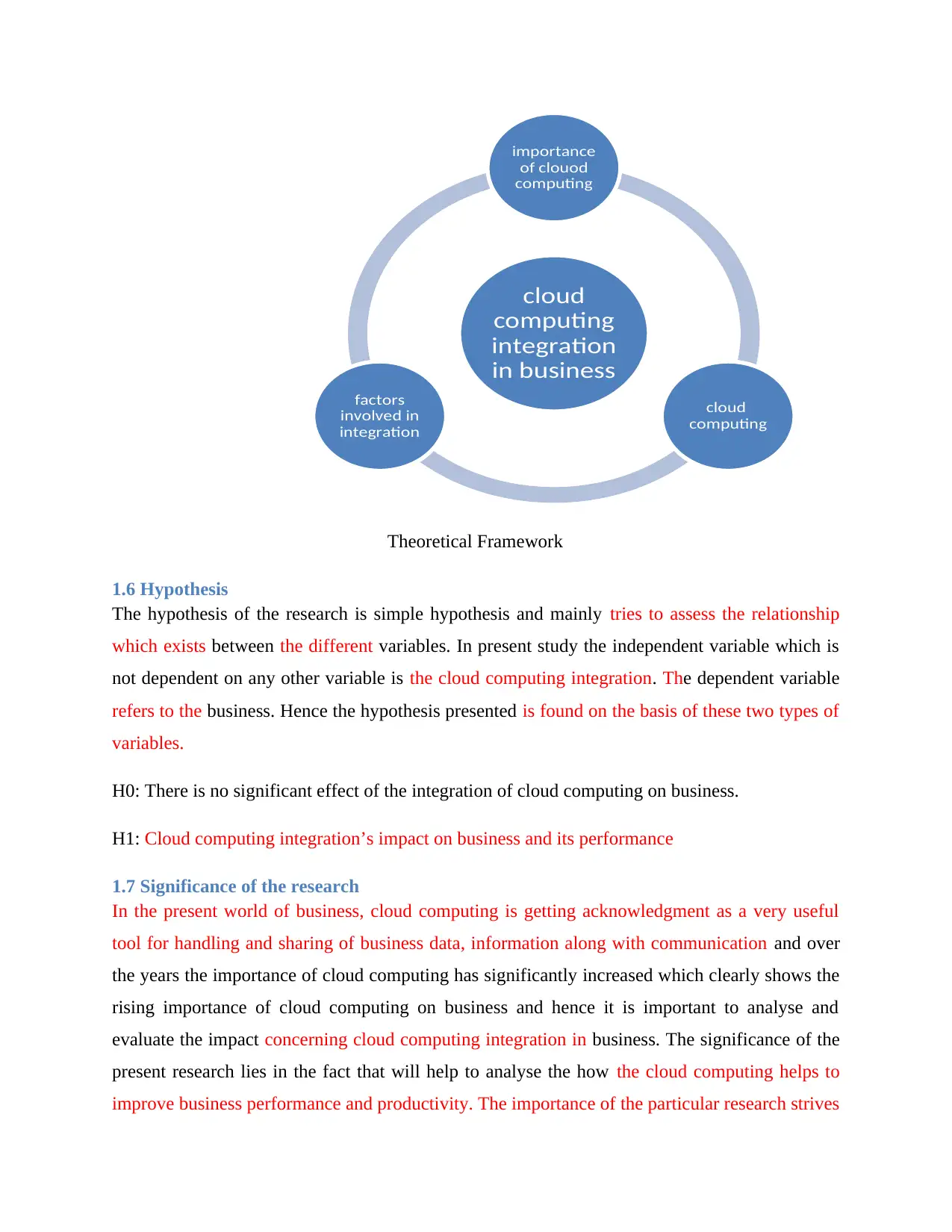
Theoretical Framework
1.6 Hypothesis
The hypothesis of the research is simple hypothesis and mainly tries to assess the relationship
which exists between the different variables. In present study the independent variable which is
not dependent on any other variable is the cloud computing integration. The dependent variable
refers to the business. Hence the hypothesis presented is found on the basis of these two types of
variables.
H0: There is no significant effect of the integration of cloud computing on business.
H1: Cloud computing integration’s impact on business and its performance
1.7 Significance of the research
In the present world of business, cloud computing is getting acknowledgment as a very useful
tool for handling and sharing of business data, information along with communication and over
the years the importance of cloud computing has significantly increased which clearly shows the
rising importance of cloud computing on business and hence it is important to analyse and
evaluate the impact concerning cloud computing integration in business. The significance of the
present research lies in the fact that will help to analyse the how the cloud computing helps to
improve business performance and productivity. The importance of the particular research strives
cloud
computing
integration
in business
importance
of clouod
computing
cloud
computing
factors
involved in
integration
1.6 Hypothesis
The hypothesis of the research is simple hypothesis and mainly tries to assess the relationship
which exists between the different variables. In present study the independent variable which is
not dependent on any other variable is the cloud computing integration. The dependent variable
refers to the business. Hence the hypothesis presented is found on the basis of these two types of
variables.
H0: There is no significant effect of the integration of cloud computing on business.
H1: Cloud computing integration’s impact on business and its performance
1.7 Significance of the research
In the present world of business, cloud computing is getting acknowledgment as a very useful
tool for handling and sharing of business data, information along with communication and over
the years the importance of cloud computing has significantly increased which clearly shows the
rising importance of cloud computing on business and hence it is important to analyse and
evaluate the impact concerning cloud computing integration in business. The significance of the
present research lies in the fact that will help to analyse the how the cloud computing helps to
improve business performance and productivity. The importance of the particular research strives
cloud
computing
integration
in business
importance
of clouod
computing
cloud
computing
factors
involved in
integration
Paraphrase This Document
Need a fresh take? Get an instant paraphrase of this document with our AI Paraphraser
to show the contribution of the particular computing technology responsible for the enhancement
of business performance, leading to further business scopes and opportunities in the process.
This which would further contribute to the research on the same research topic in the near future.
1.8 Definition of the variables
Cloud computing is presented as the core variable of the research and the key terms involved
with cloud computing is defined below in the chronological order:
IaaS: The IaaS or the Infrastructure as a service is regarded as a kind of cloud computing service.
It is the services which, mainly when the IT infrastructure of the organisation is changed in order
to accommodate cloud computing. This is one of the common ways of using or integrating cloud
computing in a business. It is a self service model that helps the organisation to access, monitor
and manage remote data centers which helps to continue working even without an official
physical link. The remote infrastructure helps to compute storage, retrieval, networking services
which are extremely important for the organisation to continue its operation (Garg, Versteeg &
Buyya, 2013).
PaaS: PaaS stands for platform as a service. It is a different type of cloud computing. It is
employed in many companies by organizations. It is useful to state that most of the organisations
in the modern day environment have focused on improving overall system of operation and
switch to cloud and hence platform as a service have emerged important for them. In this mainly
cloud components are used in software that helps to get access to software effectively in different
platforms. In enterprises PaaS helps to provide different line of software which is suitable for the
running of the business organisations. Overall it could be said that PaaS is an effective way of
integrating cloud computing in the business (Rittinghouse & Ransome, 2016).
SaaS: This is the most common way of integrating cloud computing in the system. Mmost of the
organisations in the present day market want to be connected with the internet 24*7 which is
provided by this service. SaaS is software as a service. In this sort of cloud computing service
cloud based software are given to the consumers and businesses which helps them to make sure
the businesses are always connected to the internet and employees of executives could get access
to the software from different regions with simple authentication tests. This helps the businesses
to be constantly in touch with the employees and the consumers which help to communicate with
of business performance, leading to further business scopes and opportunities in the process.
This which would further contribute to the research on the same research topic in the near future.
1.8 Definition of the variables
Cloud computing is presented as the core variable of the research and the key terms involved
with cloud computing is defined below in the chronological order:
IaaS: The IaaS or the Infrastructure as a service is regarded as a kind of cloud computing service.
It is the services which, mainly when the IT infrastructure of the organisation is changed in order
to accommodate cloud computing. This is one of the common ways of using or integrating cloud
computing in a business. It is a self service model that helps the organisation to access, monitor
and manage remote data centers which helps to continue working even without an official
physical link. The remote infrastructure helps to compute storage, retrieval, networking services
which are extremely important for the organisation to continue its operation (Garg, Versteeg &
Buyya, 2013).
PaaS: PaaS stands for platform as a service. It is a different type of cloud computing. It is
employed in many companies by organizations. It is useful to state that most of the organisations
in the modern day environment have focused on improving overall system of operation and
switch to cloud and hence platform as a service have emerged important for them. In this mainly
cloud components are used in software that helps to get access to software effectively in different
platforms. In enterprises PaaS helps to provide different line of software which is suitable for the
running of the business organisations. Overall it could be said that PaaS is an effective way of
integrating cloud computing in the business (Rittinghouse & Ransome, 2016).
SaaS: This is the most common way of integrating cloud computing in the system. Mmost of the
organisations in the present day market want to be connected with the internet 24*7 which is
provided by this service. SaaS is software as a service. In this sort of cloud computing service
cloud based software are given to the consumers and businesses which helps them to make sure
the businesses are always connected to the internet and employees of executives could get access
to the software from different regions with simple authentication tests. This helps the businesses
to be constantly in touch with the employees and the consumers which help to communicate with
them effectively which naturally helps to gain competitive advantage in the market (Hashizume
et al., 2013).
1.9 ethical considerations
Ethical considerations are an extremely important aspect in the research study. It is important for
the researchers to make sure they abide by the ethical considerations to focus on improving the
research outcome. It is required to conduct the work in an ethical manner considering the norms
and regulations stated for the study. There’s number ethical considerations which has to be taken
in the present research. First of all the researcher has to abide by the Data Protection Act 1998 in
order to make sure the data are not commercially used, they are managed properly and also it is
important to take care of the privacy and confidentiality of the data and as well as hold the
anonymity of the respondents who are involved in the research (Flick, 2015). Ethical
consideration also lays how the researcher treats the respondents selected or the secondary
resources selected. The researcher has the responsibility to discuss and convince the respondents
to take part in the research and not intimidate them to join the research. Hence the main focus of
ethical consideration in this research is to focus on doing the research effectively without any
kind of unethical practice. In the research the researcher will not use any information received
commercially. The secondary information received will be checked for authenticity and all will
be cited which helps to helps to keep the ethics of the research intact and will help to complete
the research successfully giving suitable conclusion (Panneerselvam 2014).
1.10 Delimitations of the study
The delimitations are the actions which are under the control of the researcher and could be
managed by the researcher and hence they need to be effectively described in order to make sure
the readers have clear understanding of them. In this case the researcher is not willing to go to
the statistical analysis of the research as it would become too complicated to interpret them and
hence the data resources will be kept simple and effective so that the results could be effectively
described to get a valid and authentic study result.
1.11 Research Limitations
The main limitation concerning the research study, less time that the research has got. It is
important to note that a research needs significant amount of time but this is an academic
research and hence it doesn’t have that much of time in hand which means the research might not
et al., 2013).
1.9 ethical considerations
Ethical considerations are an extremely important aspect in the research study. It is important for
the researchers to make sure they abide by the ethical considerations to focus on improving the
research outcome. It is required to conduct the work in an ethical manner considering the norms
and regulations stated for the study. There’s number ethical considerations which has to be taken
in the present research. First of all the researcher has to abide by the Data Protection Act 1998 in
order to make sure the data are not commercially used, they are managed properly and also it is
important to take care of the privacy and confidentiality of the data and as well as hold the
anonymity of the respondents who are involved in the research (Flick, 2015). Ethical
consideration also lays how the researcher treats the respondents selected or the secondary
resources selected. The researcher has the responsibility to discuss and convince the respondents
to take part in the research and not intimidate them to join the research. Hence the main focus of
ethical consideration in this research is to focus on doing the research effectively without any
kind of unethical practice. In the research the researcher will not use any information received
commercially. The secondary information received will be checked for authenticity and all will
be cited which helps to helps to keep the ethics of the research intact and will help to complete
the research successfully giving suitable conclusion (Panneerselvam 2014).
1.10 Delimitations of the study
The delimitations are the actions which are under the control of the researcher and could be
managed by the researcher and hence they need to be effectively described in order to make sure
the readers have clear understanding of them. In this case the researcher is not willing to go to
the statistical analysis of the research as it would become too complicated to interpret them and
hence the data resources will be kept simple and effective so that the results could be effectively
described to get a valid and authentic study result.
1.11 Research Limitations
The main limitation concerning the research study, less time that the research has got. It is
important to note that a research needs significant amount of time but this is an academic
research and hence it doesn’t have that much of time in hand which means the research might not
⊘ This is a preview!⊘
Do you want full access?
Subscribe today to unlock all pages.
Trusted by 1+ million students worldwide
be able to reach its peak which is needed for the successful completion of the project. On the
other hand finance is also one aspect that needs to be kept in mind as given the nature of the
research there are number of aspects which are important to be used in the research but the
financial limitations hinder the access to them. Another key aspect which needs to be mentioned
in this case is that there are number of aspects which are related to the implementation of the
particular tool in business but as the study has certain boundaries the study cannot elaborate on
those points. Hence it could be said that these limitations are involved with the research study
and they have to be managed effectively in order to make sure the study reaches suitable
conclusion and doesn’t deviate from its research objectives (Panneerselvam, 2014).
2. Literature Review
2.1 Introduction
The present section of literature review will discuss the variables of the research which would
help to address the research questions effectively. This is an important section as it critically
analyses the variables of the research which would help to make sure the research moves in the
right direction. The operationalised variables will be discussed one by one through critical
evaluation which would help to complete project.
2.2 Cloud computing
Cloud computing is defined as the computing with the help of the remote servers not placed on
any physical link but completely on a virtual location. Cloud computing is one of the latest
developments made in the IT industry and has been embraced by a number of organisations
which has showed its growing importance in the business field. It cannot be denied that cloud
computing has become an essential segment for the organisations as it has helped in easy and
effective communication and solid and effective business operations (Venters & Whitley, 2012).
To put it simply, it is the provision of service like storage and recording of data effectively and
also management and retrieval and communication of the same data which is not placed on a
physical location rather in a completely virtual IP address. This information technology service
has helped companies to manage their business even when owners are not in the organisation and
even while they are on the move. It could be said that cloud computing has been an excellent
invention for most of the organisations as it helped to manage business effectively (Wan, Liu &
Deng, 2012).
other hand finance is also one aspect that needs to be kept in mind as given the nature of the
research there are number of aspects which are important to be used in the research but the
financial limitations hinder the access to them. Another key aspect which needs to be mentioned
in this case is that there are number of aspects which are related to the implementation of the
particular tool in business but as the study has certain boundaries the study cannot elaborate on
those points. Hence it could be said that these limitations are involved with the research study
and they have to be managed effectively in order to make sure the study reaches suitable
conclusion and doesn’t deviate from its research objectives (Panneerselvam, 2014).
2. Literature Review
2.1 Introduction
The present section of literature review will discuss the variables of the research which would
help to address the research questions effectively. This is an important section as it critically
analyses the variables of the research which would help to make sure the research moves in the
right direction. The operationalised variables will be discussed one by one through critical
evaluation which would help to complete project.
2.2 Cloud computing
Cloud computing is defined as the computing with the help of the remote servers not placed on
any physical link but completely on a virtual location. Cloud computing is one of the latest
developments made in the IT industry and has been embraced by a number of organisations
which has showed its growing importance in the business field. It cannot be denied that cloud
computing has become an essential segment for the organisations as it has helped in easy and
effective communication and solid and effective business operations (Venters & Whitley, 2012).
To put it simply, it is the provision of service like storage and recording of data effectively and
also management and retrieval and communication of the same data which is not placed on a
physical location rather in a completely virtual IP address. This information technology service
has helped companies to manage their business even when owners are not in the organisation and
even while they are on the move. It could be said that cloud computing has been an excellent
invention for most of the organisations as it helped to manage business effectively (Wan, Liu &
Deng, 2012).
Paraphrase This Document
Need a fresh take? Get an instant paraphrase of this document with our AI Paraphraser
2.3 Integration of cloud computing
Since the emergence and popularity of cloud computing, it has become necessary for the
business companies to understand and realize the potential of this advanced technology.
Realizing the impact, more and more business organisations have become interested in
integrating cloud computing which could be done through three different ways which are by
using cloud in the form of: Infrastructure as a service, platform as a service and finally by
Software as a service. The Software as a service is one of the most commonly used way to
integrate cloud in the organisational operation. The software in this process used by the
organisations are mostly cloud software which helps the organisations to communicate
effectively online and the employees and the consumers could effectively access data which is
extremely for the organisation to be constantly in touch with the consumers and the employees
(Wu, Garg & Buyya, 2012). Amazon Web Services is a part of Amazon that provides excellent
and effective cloud computing services with the help of cloud software. On the other hand the
platform as a service is another key way to integrate cloud computing within the organisation.
This helps to make the platform on which the software are based completely based on a remote
server allowing an organisation to perform over cloud. Finally the infrastructure as a service
form is a tad expensive as compared to the other two but provides excellent opportunity to
effectively avail the cloud services as infrastructure switch means the entire information system
will be based on cloud which clearly helps the organisation to effectively develop the system
operating in the company. The integration of cloud computing has increased exponentially in the
last few decades which clearly shows that integration of cloud have significant benefits for the
organisation (Lin & Chen, 2012).
2.4 Factors influencing cloud computing integration in business
The first and the foremost factor influencing cloud computing in business is the increasing
competition that compels the change among the companies. Cloud provides effective
connectivity even when a person is not present in the office premise which means the access to
the information is extremely effective and fast that allows employees to perform effectively.
Another key factor that influence cloud computing is its easy approach of information storage
and retrieval that improves decision making (Zissis & Lekkas, 2012). Apart from that cloud
service is affordable and definitely smooths which reduces administrative and IT costs and is
also eco-friendly in nature that effectively helps the organisation to perform the duties without
Since the emergence and popularity of cloud computing, it has become necessary for the
business companies to understand and realize the potential of this advanced technology.
Realizing the impact, more and more business organisations have become interested in
integrating cloud computing which could be done through three different ways which are by
using cloud in the form of: Infrastructure as a service, platform as a service and finally by
Software as a service. The Software as a service is one of the most commonly used way to
integrate cloud in the organisational operation. The software in this process used by the
organisations are mostly cloud software which helps the organisations to communicate
effectively online and the employees and the consumers could effectively access data which is
extremely for the organisation to be constantly in touch with the consumers and the employees
(Wu, Garg & Buyya, 2012). Amazon Web Services is a part of Amazon that provides excellent
and effective cloud computing services with the help of cloud software. On the other hand the
platform as a service is another key way to integrate cloud computing within the organisation.
This helps to make the platform on which the software are based completely based on a remote
server allowing an organisation to perform over cloud. Finally the infrastructure as a service
form is a tad expensive as compared to the other two but provides excellent opportunity to
effectively avail the cloud services as infrastructure switch means the entire information system
will be based on cloud which clearly helps the organisation to effectively develop the system
operating in the company. The integration of cloud computing has increased exponentially in the
last few decades which clearly shows that integration of cloud have significant benefits for the
organisation (Lin & Chen, 2012).
2.4 Factors influencing cloud computing integration in business
The first and the foremost factor influencing cloud computing in business is the increasing
competition that compels the change among the companies. Cloud provides effective
connectivity even when a person is not present in the office premise which means the access to
the information is extremely effective and fast that allows employees to perform effectively.
Another key factor that influence cloud computing is its easy approach of information storage
and retrieval that improves decision making (Zissis & Lekkas, 2012). Apart from that cloud
service is affordable and definitely smooths which reduces administrative and IT costs and is
also eco-friendly in nature that effectively helps the organisation to perform the duties without
being harmful to the environment and providing easy and quick access to data which is
extremely important in the contemporary business environment of the organisation. Apart from
that one of the major factors that influence cloud computing integration is to utilise big data
effectively and distribute it effectively for the best possible result of the organisation (Masiyev et
al., 2012).
2.5 Effect of cloud computing integration on business
Cloud computing definitely helps the business to streamline its business decision making by
providing effective access to all the employees of the organisation which helps them to provide
their insights on a particular matter that helps to manage business effectively and make suitable
decisions for the business. The reduction in costs helps the organisation to utilise finance in the
best possible manner (Aljabre, 2012). Cloud computing provides an excellent opportunity to the
employees to work outside office and practically be in the market and gather data and also
communicate with the think tank of the organisation that helps the organisation to effectively
support business operations. Hence having a positive impact on the organisational operation and
getting suitable result from the organisation. Cloud provides tremendous opportunity to manage
business effectively and gain competitive advantage in the market by exposing them to huge pool
of data and accordingly utilising them to get suitable results in the business (Chang, Walters &
Wills, 2013).
3. Research Methodology
3.1 Research Worldview
The research worldview or philosophy is an essential segment of the research and hence it is
important for the researcher to choose this prudently. There are different choices in worldview
like post positivism, constructionist, advocacy, pragmatism. In the present study it is very much
necessary to evaluate the available data and hence post positivism it suitable for the purpose as it
helps to use common sense and scientific reasoning to address the hypothesis which is extremely
important to address the research questions. The post positivism philosophy helps to effectively
dig into scientific data and also supports describing of theoretical data that allows effective
completion of the research (Glesne, 2015).
extremely important in the contemporary business environment of the organisation. Apart from
that one of the major factors that influence cloud computing integration is to utilise big data
effectively and distribute it effectively for the best possible result of the organisation (Masiyev et
al., 2012).
2.5 Effect of cloud computing integration on business
Cloud computing definitely helps the business to streamline its business decision making by
providing effective access to all the employees of the organisation which helps them to provide
their insights on a particular matter that helps to manage business effectively and make suitable
decisions for the business. The reduction in costs helps the organisation to utilise finance in the
best possible manner (Aljabre, 2012). Cloud computing provides an excellent opportunity to the
employees to work outside office and practically be in the market and gather data and also
communicate with the think tank of the organisation that helps the organisation to effectively
support business operations. Hence having a positive impact on the organisational operation and
getting suitable result from the organisation. Cloud provides tremendous opportunity to manage
business effectively and gain competitive advantage in the market by exposing them to huge pool
of data and accordingly utilising them to get suitable results in the business (Chang, Walters &
Wills, 2013).
3. Research Methodology
3.1 Research Worldview
The research worldview or philosophy is an essential segment of the research and hence it is
important for the researcher to choose this prudently. There are different choices in worldview
like post positivism, constructionist, advocacy, pragmatism. In the present study it is very much
necessary to evaluate the available data and hence post positivism it suitable for the purpose as it
helps to use common sense and scientific reasoning to address the hypothesis which is extremely
important to address the research questions. The post positivism philosophy helps to effectively
dig into scientific data and also supports describing of theoretical data that allows effective
completion of the research (Glesne, 2015).
⊘ This is a preview!⊘
Do you want full access?
Subscribe today to unlock all pages.
Trusted by 1+ million students worldwide

1 out of 17


Related Documents


Your All-in-One AI-Powered Toolkit for Academic Success.
+13062052269
info@desklib.com
Available 24*7 on WhatsApp / Email
![[object Object]](/_next/static/media/star-bottom.7253800d.svg)
Unlock your academic potential
Copyright © 2020–2026 A2Z Services. All Rights Reserved. Developed and managed by ZUCOL.