A Literature Review: Advantages and Disadvantages of Cloud Computing
VerifiedAdded on 2023/06/12
|17
|3710
|458
Literature Review
AI Summary
This literature review evaluates existing research on the advantages and disadvantages of cloud computing for businesses. It examines various articles and studies that highlight the benefits, such as cost reduction, enhanced internal efficiencies, and the ability to focus on core competencies. It also addresses the challenges, including security risks, integration limitations, and data ownership concerns. The review compares different cloud adoption frameworks and enterprise systems, emphasizing the need for businesses to balance the benefits and challenges when implementing cloud solutions. The study concludes that while cloud computing offers significant advantages, organizations must carefully consider the potential risks and limitations to ensure successful adoption and operation. Desklib provides access to this and other solved assignments to aid students in their studies.
Running head: ACCOUNTING
Accounting
University Name
Student Name
Authors’ Note
Accounting
University Name
Student Name
Authors’ Note

Paraphrase This Document
Need a fresh take? Get an instant paraphrase of this document with our AI Paraphraser
2
ACCOUNTING
Table of Contents
Introduction:...............................................................................................................................3
Literature review scope and objective:......................................................................................4
Literature review scope:.............................................................................................................4
Literature review objective:.......................................................................................................4
Comparative analysis:................................................................................................................4
Quality and currency of articles and sources used:....................................................................8
Identification of literature gaps:...............................................................................................12
Conclusion:..............................................................................................................................12
ACCOUNTING
Table of Contents
Introduction:...............................................................................................................................3
Literature review scope and objective:......................................................................................4
Literature review scope:.............................................................................................................4
Literature review objective:.......................................................................................................4
Comparative analysis:................................................................................................................4
Quality and currency of articles and sources used:....................................................................8
Identification of literature gaps:...............................................................................................12
Conclusion:..............................................................................................................................12
3
ACCOUNTING
Introduction:
A literature review is the evaluation of available literature on the concerned topic that
providers researcher with the documentation of state of art. In order to make research work
successful, it is essential to conduct literature review that is usually time taking, complicated
and lengthy process. The topic that is selected for this particular research paper is
“Advantages and disadvantages of cloud computing for businesses”. Researchers are required
to have proper knowledge about the theoretical concepts in order to come with successful
outcome of the given or chosen topic. Review of literature for the chosen topic is done by
referring to previously published journal articles and other relevant sources such as previous
research work. Classification of articles is done based on different categories such as business
issues, technological issues, domain and cloud computing conceptualization (Shiau and Chau
2016).
This particular study is conducted for analysing the advantages and disadvantages of
cloud computing for businesses. Such analysis has been done by comparing different article
that is extracted from different sources. Cloud computing is a model that helps in enabling on
demand and convenient network access to shared pool of configurable application, computer
resources that can be rapidly released and provisioned with the minimal effort of service
provider interaction and management. It refers to a collection of networked and integrated
software, hardware and integrated networking services to clients. The computing service is
facilitated through the requirement of internet with the help of cloud computing and making
payment according to use access to group of shared resources such as servers, network,
application and services without physical acquisition of cloud based data management system
(Singh and Chana 2016).
ACCOUNTING
Introduction:
A literature review is the evaluation of available literature on the concerned topic that
providers researcher with the documentation of state of art. In order to make research work
successful, it is essential to conduct literature review that is usually time taking, complicated
and lengthy process. The topic that is selected for this particular research paper is
“Advantages and disadvantages of cloud computing for businesses”. Researchers are required
to have proper knowledge about the theoretical concepts in order to come with successful
outcome of the given or chosen topic. Review of literature for the chosen topic is done by
referring to previously published journal articles and other relevant sources such as previous
research work. Classification of articles is done based on different categories such as business
issues, technological issues, domain and cloud computing conceptualization (Shiau and Chau
2016).
This particular study is conducted for analysing the advantages and disadvantages of
cloud computing for businesses. Such analysis has been done by comparing different article
that is extracted from different sources. Cloud computing is a model that helps in enabling on
demand and convenient network access to shared pool of configurable application, computer
resources that can be rapidly released and provisioned with the minimal effort of service
provider interaction and management. It refers to a collection of networked and integrated
software, hardware and integrated networking services to clients. The computing service is
facilitated through the requirement of internet with the help of cloud computing and making
payment according to use access to group of shared resources such as servers, network,
application and services without physical acquisition of cloud based data management system
(Singh and Chana 2016).
⊘ This is a preview!⊘
Do you want full access?
Subscribe today to unlock all pages.

Trusted by 1+ million students worldwide
4
ACCOUNTING
Literature review scope and objective:
Literature review scope:
It becomes difficult for researcher to conduct research on any particular area if he is
not retrieving information from research work done by other researchers. Researchers are
able to perform critical analysis by considering the views of different researcher by referring
to their previous work (Hashem et al. 2015). This will provide them different insights on one
particular topic and helps in generating findings using different perspectives.
Literature review objective:
Literature review provides the analysis of research evidence related to advantages and
disadvantages of cloud computing for businesses. The first step in performing the research on
cloud computing is enabling researcher to become well known and get clarified with the topic
(Mwilu et al. 2016). There have been different perspectives within academia and practice to
define cloud computing. Some of the objectives of conducting research in literature review
are listed below:
Becoming well acquainted and clarified with the concept of cloud computing
Ascertaining the advantages and disadvantages of cloud computing to businesses.
For identifying any existing gap in literature review
To report on key matters and themes arising in literature review
Comparative analysis:
In this particular section of study, comparative analysis have been done by evaluating
findings generated from different articles and views put forward by different authors. Over
the last decade, cloud computing gave attract attention as it is growing at an unprecedented
rate. In an article extracted from semanticscholar.com titled, “benefits of cloud computing:
Literature review on maturity model perspective” by Sune Muller, Stefan and Jens. It has
ACCOUNTING
Literature review scope and objective:
Literature review scope:
It becomes difficult for researcher to conduct research on any particular area if he is
not retrieving information from research work done by other researchers. Researchers are
able to perform critical analysis by considering the views of different researcher by referring
to their previous work (Hashem et al. 2015). This will provide them different insights on one
particular topic and helps in generating findings using different perspectives.
Literature review objective:
Literature review provides the analysis of research evidence related to advantages and
disadvantages of cloud computing for businesses. The first step in performing the research on
cloud computing is enabling researcher to become well known and get clarified with the topic
(Mwilu et al. 2016). There have been different perspectives within academia and practice to
define cloud computing. Some of the objectives of conducting research in literature review
are listed below:
Becoming well acquainted and clarified with the concept of cloud computing
Ascertaining the advantages and disadvantages of cloud computing to businesses.
For identifying any existing gap in literature review
To report on key matters and themes arising in literature review
Comparative analysis:
In this particular section of study, comparative analysis have been done by evaluating
findings generated from different articles and views put forward by different authors. Over
the last decade, cloud computing gave attract attention as it is growing at an unprecedented
rate. In an article extracted from semanticscholar.com titled, “benefits of cloud computing:
Literature review on maturity model perspective” by Sune Muller, Stefan and Jens. It has
Paraphrase This Document
Need a fresh take? Get an instant paraphrase of this document with our AI Paraphraser
5
ACCOUNTING
been found from the analysis of article that organizations are relying on cloud computing for
wide variety of usages such as for targeting of strategic business capabilities and
enhancement of internal efficiencies. One of the respondents to survey in research comes
employs the cloud computing for building an external capability that enables them to easily
collaborate with external partners (Pdfs.semanticscholar.org 2018). This particular paper
depicts cloud computing as a drive for innovation and transforming business and it also helps
in addressing the benefits of cost reduction to company. It also identifies how business is able
to focus on their core competencies using cloud computing. Benefits attributable from cloud
computing have been identified across three levels of information technology-business
maturity. It was found that cloud computing helps in facilitation, support and enabling of
benefits to business. Diverging application of cloud computing is reviewed, analyzed and
discussed that contributed to establishment of link between benefits of cloud computing and
business applications (Abd Elmonem et al. 2016).
An article is sourced from eprint.soton.ac.uk that conducts review of existing
framework of cloud adoption and cloud computing. A review related to cloud computing on
the background and benefits of adoption of cloud computing is presented in the paper. Such
research work is considered highly relevant to the academia and users of industry as they are
increasingly adopting cloud computing. This particular paper A selected review of cloud
computing is presented in this article by explaining the risk and benefits of adopting the cloud
computing in business environment. The risks that have been identified in the cloud
computation are mainly associated with the challenges faced by businesses concerning it. In
this particular research work, strength and limitations of cloud computing is made by
investigating the eleven cloud computing framework. It has been ascertained from the result
that none of the businesses selected are able to deal with the challenges faced from their
cloud computing services. It would be required by organization to have new comprehensive
ACCOUNTING
been found from the analysis of article that organizations are relying on cloud computing for
wide variety of usages such as for targeting of strategic business capabilities and
enhancement of internal efficiencies. One of the respondents to survey in research comes
employs the cloud computing for building an external capability that enables them to easily
collaborate with external partners (Pdfs.semanticscholar.org 2018). This particular paper
depicts cloud computing as a drive for innovation and transforming business and it also helps
in addressing the benefits of cost reduction to company. It also identifies how business is able
to focus on their core competencies using cloud computing. Benefits attributable from cloud
computing have been identified across three levels of information technology-business
maturity. It was found that cloud computing helps in facilitation, support and enabling of
benefits to business. Diverging application of cloud computing is reviewed, analyzed and
discussed that contributed to establishment of link between benefits of cloud computing and
business applications (Abd Elmonem et al. 2016).
An article is sourced from eprint.soton.ac.uk that conducts review of existing
framework of cloud adoption and cloud computing. A review related to cloud computing on
the background and benefits of adoption of cloud computing is presented in the paper. Such
research work is considered highly relevant to the academia and users of industry as they are
increasingly adopting cloud computing. This particular paper A selected review of cloud
computing is presented in this article by explaining the risk and benefits of adopting the cloud
computing in business environment. The risks that have been identified in the cloud
computation are mainly associated with the challenges faced by businesses concerning it. In
this particular research work, strength and limitations of cloud computing is made by
investigating the eleven cloud computing framework. It has been ascertained from the result
that none of the businesses selected are able to deal with the challenges faced from their
cloud computing services. It would be required by organization to have new comprehensive
6
ACCOUNTING
framework if they intend to overcome such challenges. It has been found that such
framework would help in ensuring that cloud computing challenges are minimized whilst
benefits are maximised. The main focus of cloud computing adoption in next generation is
specialized discipline and big data for cloud adoption (Soltani and Navimipour 2016).
An article named cloud enterprise system: “review of literature and its adoption” is
extracted from pacis.net.org by Caroline Chan and Siti Sallah. The research work discusses
about the advantages and disadvantages of cloud computing system. Some of the advantages
that is offered by enterprise system is that it provide organization with lower initial cost,
providing flexibility on business innovation and greater emphasis on standardization.
Organizations are provided with the option of leaving the non strategic activities to cloud
vendor and fully focusing on strategic activities. The complexities of information technology
are reduced considerably with the help of cloud vendor managing, deploying and maintaining
development of information technology infrastructure. Some other benefits attributable from
the cloud computing are lowering up of front cost, lower total ownership cost, ease of
implementation, reduction in efforts and cost of upgrades, manageability, scalability and
focusing on internal resources (Chang et al. 2014).
Some of the commonly agreed challenges faced by adopters of cloud computing are
related to flexibility, security, integrity of provider, ownership of data and their ability to
move to some other service providers. Cloud enterprise system in terms of organizational
change may fail to provide customer with greater sense of ownership as they neither run the
applications nor own the infrastructure (Kuiper et al. 2014). It is required by customer to
create a balance between their realistic expectations and enthusiasm for cloud enterprise
system.
ACCOUNTING
framework if they intend to overcome such challenges. It has been found that such
framework would help in ensuring that cloud computing challenges are minimized whilst
benefits are maximised. The main focus of cloud computing adoption in next generation is
specialized discipline and big data for cloud adoption (Soltani and Navimipour 2016).
An article named cloud enterprise system: “review of literature and its adoption” is
extracted from pacis.net.org by Caroline Chan and Siti Sallah. The research work discusses
about the advantages and disadvantages of cloud computing system. Some of the advantages
that is offered by enterprise system is that it provide organization with lower initial cost,
providing flexibility on business innovation and greater emphasis on standardization.
Organizations are provided with the option of leaving the non strategic activities to cloud
vendor and fully focusing on strategic activities. The complexities of information technology
are reduced considerably with the help of cloud vendor managing, deploying and maintaining
development of information technology infrastructure. Some other benefits attributable from
the cloud computing are lowering up of front cost, lower total ownership cost, ease of
implementation, reduction in efforts and cost of upgrades, manageability, scalability and
focusing on internal resources (Chang et al. 2014).
Some of the commonly agreed challenges faced by adopters of cloud computing are
related to flexibility, security, integrity of provider, ownership of data and their ability to
move to some other service providers. Cloud enterprise system in terms of organizational
change may fail to provide customer with greater sense of ownership as they neither run the
applications nor own the infrastructure (Kuiper et al. 2014). It is required by customer to
create a balance between their realistic expectations and enthusiasm for cloud enterprise
system.
⊘ This is a preview!⊘
Do you want full access?
Subscribe today to unlock all pages.
Trusted by 1+ million students worldwide
7
ACCOUNTING
This particular paper introduces and consolidates a pragmatic understanding of
definition of cloud enterprise system between academic and practitioners. The literature
review presented in this particular research paper contributes to understanding of advantages
and challenges of adoption of cloud enterprise system adoption. The potential cloud adopters
can be facilitated by having clear objectives on capabilities and features into making decision
of whether cloud computing system should be adopted into their existing system of
information technology. It has been found that small and medium enterprise currently accept
the concept of cloud enterprise system at lower cost with scalable power of processing. The
progress on this research work would contribute by leading to next phase into the
investigation of different types of deployment methods of cloud enterprise system that is used
in organization (Zhan et al. 2015).
In an article extracted from sciencedirect.com titled “Challenges and benefits of cloud
ERP (Enterprise resource planning) system- A systematic literature review” by Geith, Nabr
and Elmonem was published in the year 2016. A systematic literature review has been
followed in this particular research paper for exploring the challenges and benefits of
implementation of enterprise resource planning system over a cloud environment (Ijera.com
2018). There are three stages that are conducting, planning and reporting in which the
literature review is conducted. Research work also addressed research questions such as
benefits and challenges addressed by all research and addressed by all investigated
researchers. It has been found in the research that one of the crucial benefits offered by cloud
ERP solutions is the cost transparency. In the area of cloud ERP system, researcher has used
only one type of searching methods. It also incorporated automatic searching that is based on
five main sources of databases of scientific sources (Aznoli and Navimipour 2017).
Some of the key challenges that have been identified are performance risk, security
risk, limitation of integration and customization, limitations of functionality and ownership of
ACCOUNTING
This particular paper introduces and consolidates a pragmatic understanding of
definition of cloud enterprise system between academic and practitioners. The literature
review presented in this particular research paper contributes to understanding of advantages
and challenges of adoption of cloud enterprise system adoption. The potential cloud adopters
can be facilitated by having clear objectives on capabilities and features into making decision
of whether cloud computing system should be adopted into their existing system of
information technology. It has been found that small and medium enterprise currently accept
the concept of cloud enterprise system at lower cost with scalable power of processing. The
progress on this research work would contribute by leading to next phase into the
investigation of different types of deployment methods of cloud enterprise system that is used
in organization (Zhan et al. 2015).
In an article extracted from sciencedirect.com titled “Challenges and benefits of cloud
ERP (Enterprise resource planning) system- A systematic literature review” by Geith, Nabr
and Elmonem was published in the year 2016. A systematic literature review has been
followed in this particular research paper for exploring the challenges and benefits of
implementation of enterprise resource planning system over a cloud environment (Ijera.com
2018). There are three stages that are conducting, planning and reporting in which the
literature review is conducted. Research work also addressed research questions such as
benefits and challenges addressed by all research and addressed by all investigated
researchers. It has been found in the research that one of the crucial benefits offered by cloud
ERP solutions is the cost transparency. In the area of cloud ERP system, researcher has used
only one type of searching methods. It also incorporated automatic searching that is based on
five main sources of databases of scientific sources (Aznoli and Navimipour 2017).
Some of the key challenges that have been identified are performance risk, security
risk, limitation of integration and customization, limitations of functionality and ownership of
Paraphrase This Document
Need a fresh take? Get an instant paraphrase of this document with our AI Paraphraser
8
ACCOUNTING
data. Some of the other challenges that are explored by investigated researcher are related to
strategic risk, expenses of subscription, information sensitivity, loss of IT competencies,
compliance risk, hidden cost, control over cloud ERP and loss of technical knowledge. The
need of integration by enterprise can be satisfied by availability of huge number of cloud
services. Such integration features can be developed by addition of integration features
followed by additional costs (Bayramust and Nasir 2016).
This particular systematic research covers the entire research article that is published
during the time period from July 2011 to July 2016. It is required by ERP clients to create a
balance between challenges and benefits before they move or shift to cloud ERP system. It
has been found that some benefits could help in solving many challenges while one challenge
can solve some benefits. For improving the operation and implementation of cloud ERP
system, it is required by researcher to consider the research points that are presented by high
rated challenges (Bayramusta and Nasir 2016).
Another paper that has been evaluated is the existing research work on project of cloud
computing for business. In this particular paper, the current cloud computing and its
relationship to business is documented. It is revealed from this research work that cloud
computing phenomenon is not suitable for all type of business. Businesses are required to
provide cloud based provider with the pricing model when an upward movement in move of
IT is expected. Cloud computing adoption in developing countries would help in aiding the
development of start up business (Minerva.leeds.ac.uk 2018).
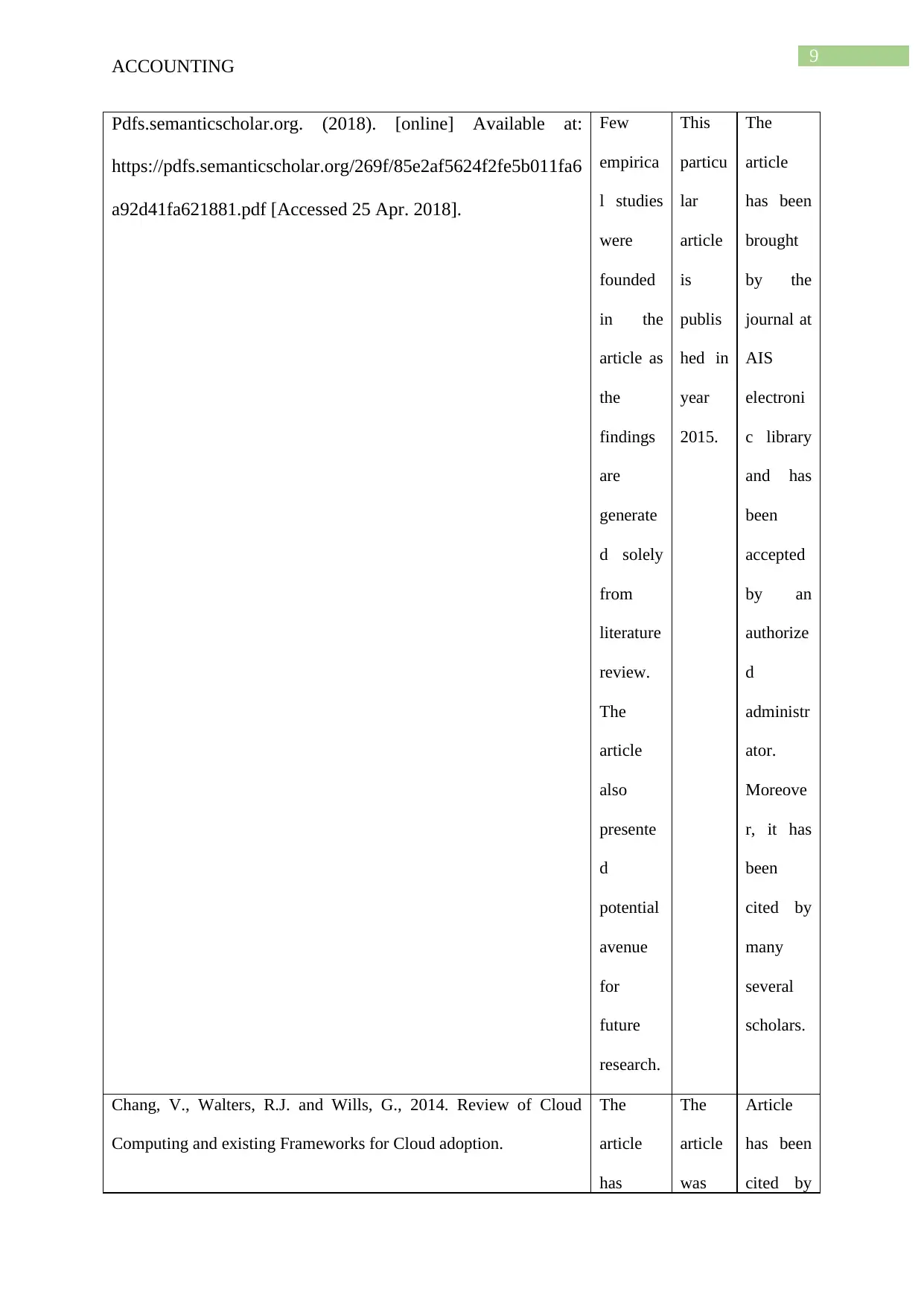
Quality and currency of articles and sources used:
Journal article Quality
of paper
Curre
ncy
Relevan
ce and
validity
ACCOUNTING
data. Some of the other challenges that are explored by investigated researcher are related to
strategic risk, expenses of subscription, information sensitivity, loss of IT competencies,
compliance risk, hidden cost, control over cloud ERP and loss of technical knowledge. The
need of integration by enterprise can be satisfied by availability of huge number of cloud
services. Such integration features can be developed by addition of integration features
followed by additional costs (Bayramust and Nasir 2016).
This particular systematic research covers the entire research article that is published
during the time period from July 2011 to July 2016. It is required by ERP clients to create a
balance between challenges and benefits before they move or shift to cloud ERP system. It
has been found that some benefits could help in solving many challenges while one challenge
can solve some benefits. For improving the operation and implementation of cloud ERP
system, it is required by researcher to consider the research points that are presented by high
rated challenges (Bayramusta and Nasir 2016).
Another paper that has been evaluated is the existing research work on project of cloud
computing for business. In this particular paper, the current cloud computing and its
relationship to business is documented. It is revealed from this research work that cloud
computing phenomenon is not suitable for all type of business. Businesses are required to
provide cloud based provider with the pricing model when an upward movement in move of
IT is expected. Cloud computing adoption in developing countries would help in aiding the
development of start up business (Minerva.leeds.ac.uk 2018).
Quality and currency of articles and sources used:
Journal article Quality
of paper
Curre
ncy
Relevan
ce and
validity
9
ACCOUNTING
Pdfs.semanticscholar.org. (2018). [online] Available at:
https://pdfs.semanticscholar.org/269f/85e2af5624f2fe5b011fa6
a92d41fa621881.pdf [Accessed 25 Apr. 2018].
Few
empirica
l studies
were
founded
in the
article as
the
findings
are
generate
d solely
from
literature
review.
The
article
also
presente
d
potential
avenue
for
future
research.
This
particu
lar
article
is
publis
hed in
year
2015.
The
article
has been
brought
by the
journal at
AIS
electroni
c library
and has
been
accepted
by an
authorize
d
administr
ator.
Moreove
r, it has
been
cited by
many
several
scholars.
Chang, V., Walters, R.J. and Wills, G., 2014. Review of Cloud
Computing and existing Frameworks for Cloud adoption.
The
article
has
The
article
was
Article
has been
cited by
ACCOUNTING
Pdfs.semanticscholar.org. (2018). [online] Available at:
https://pdfs.semanticscholar.org/269f/85e2af5624f2fe5b011fa6
a92d41fa621881.pdf [Accessed 25 Apr. 2018].
Few
empirica
l studies
were
founded
in the
article as
the
findings
are
generate
d solely
from
literature
review.
The
article
also
presente
d
potential
avenue
for
future
research.
This
particu
lar
article
is
publis
hed in
year
2015.
The
article
has been
brought
by the
journal at
AIS
electroni
c library
and has
been
accepted
by an
authorize
d
administr
ator.
Moreove
r, it has
been
cited by
many
several
scholars.
Chang, V., Walters, R.J. and Wills, G., 2014. Review of Cloud
Computing and existing Frameworks for Cloud adoption.
The
article
has
The
article
was
Article
has been
cited by
⊘ This is a preview!⊘
Do you want full access?
Subscribe today to unlock all pages.
Trusted by 1+ million students worldwide
10
ACCOUNTING
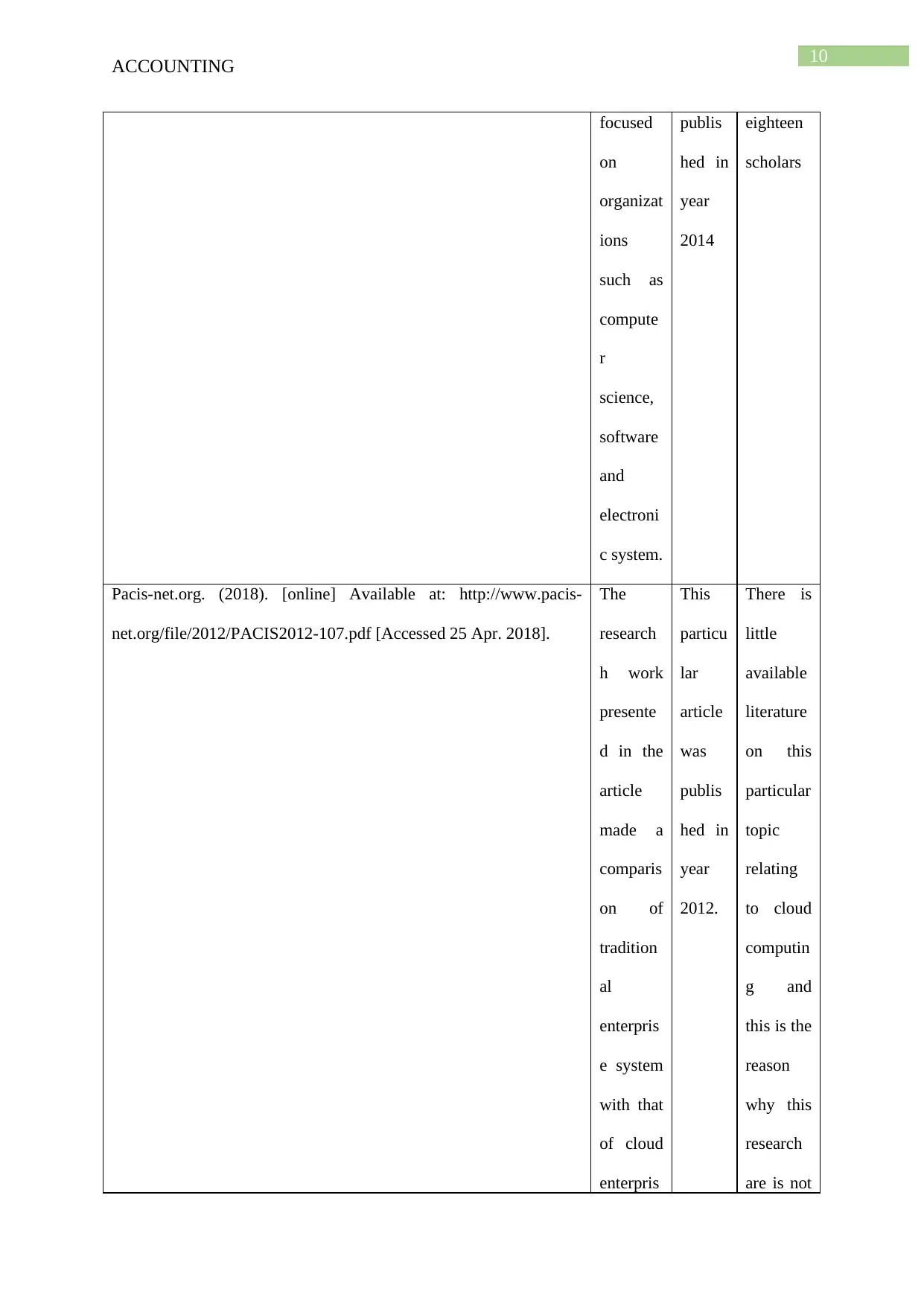
focused
on
organizat
ions
such as
compute
r
science,
software
and
electroni
c system.
publis
hed in
year
2014
eighteen
scholars
Pacis-net.org. (2018). [online] Available at: http://www.pacis-
net.org/file/2012/PACIS2012-107.pdf [Accessed 25 Apr. 2018].
The
research
h work
presente
d in the
article
made a
comparis
on of
tradition
al
enterpris
e system
with that
of cloud
enterpris
This
particu
lar
article
was
publis
hed in
year
2012.
There is
little
available
literature
on this
particular
topic
relating
to cloud
computin
g and
this is the
reason
why this
research
are is not
ACCOUNTING
focused
on
organizat
ions
such as
compute
r
science,
software
and
electroni
c system.
publis
hed in
year
2014
eighteen
scholars
Pacis-net.org. (2018). [online] Available at: http://www.pacis-
net.org/file/2012/PACIS2012-107.pdf [Accessed 25 Apr. 2018].
The
research
h work
presente
d in the
article
made a
comparis
on of
tradition
al
enterpris
e system
with that
of cloud
enterpris
This
particu
lar
article
was
publis
hed in
year
2012.
There is
little
available
literature
on this
particular
topic
relating
to cloud
computin
g and
this is the
reason
why this
research
are is not
Paraphrase This Document
Need a fresh take? Get an instant paraphrase of this document with our AI Paraphraser
11
ACCOUNTING
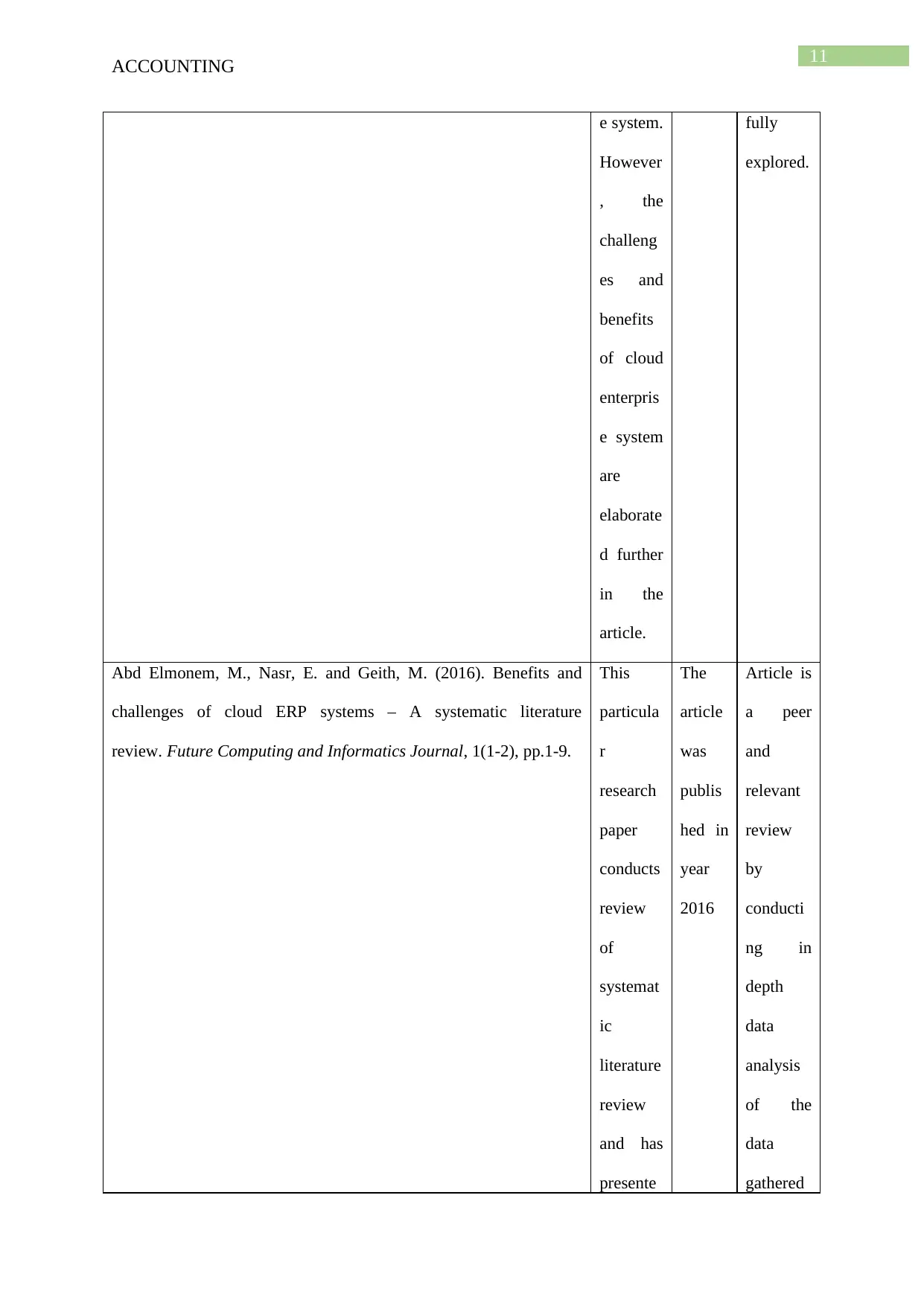
e system.
However
, the
challeng
es and
benefits
of cloud
enterpris
e system
are
elaborate
d further
in the
article.
fully
explored.
Abd Elmonem, M., Nasr, E. and Geith, M. (2016). Benefits and
challenges of cloud ERP systems – A systematic literature
review. Future Computing and Informatics Journal, 1(1-2), pp.1-9.
This
particula
r
research
paper
conducts
review
of
systemat
ic
literature
review
and has
presente
The
article
was
publis
hed in
year
2016
Article is
a peer
and
relevant
review
by
conducti
ng in
depth
data
analysis
of the
data
gathered
ACCOUNTING
e system.
However
, the
challeng
es and
benefits
of cloud
enterpris
e system
are
elaborate
d further
in the
article.
fully
explored.
Abd Elmonem, M., Nasr, E. and Geith, M. (2016). Benefits and
challenges of cloud ERP systems – A systematic literature
review. Future Computing and Informatics Journal, 1(1-2), pp.1-9.
This
particula
r
research
paper
conducts
review
of
systemat
ic
literature
review
and has
presente
The
article
was
publis
hed in
year
2016
Article is
a peer
and
relevant
review
by
conducti
ng in
depth
data
analysis
of the
data
gathered
12
ACCOUNTING
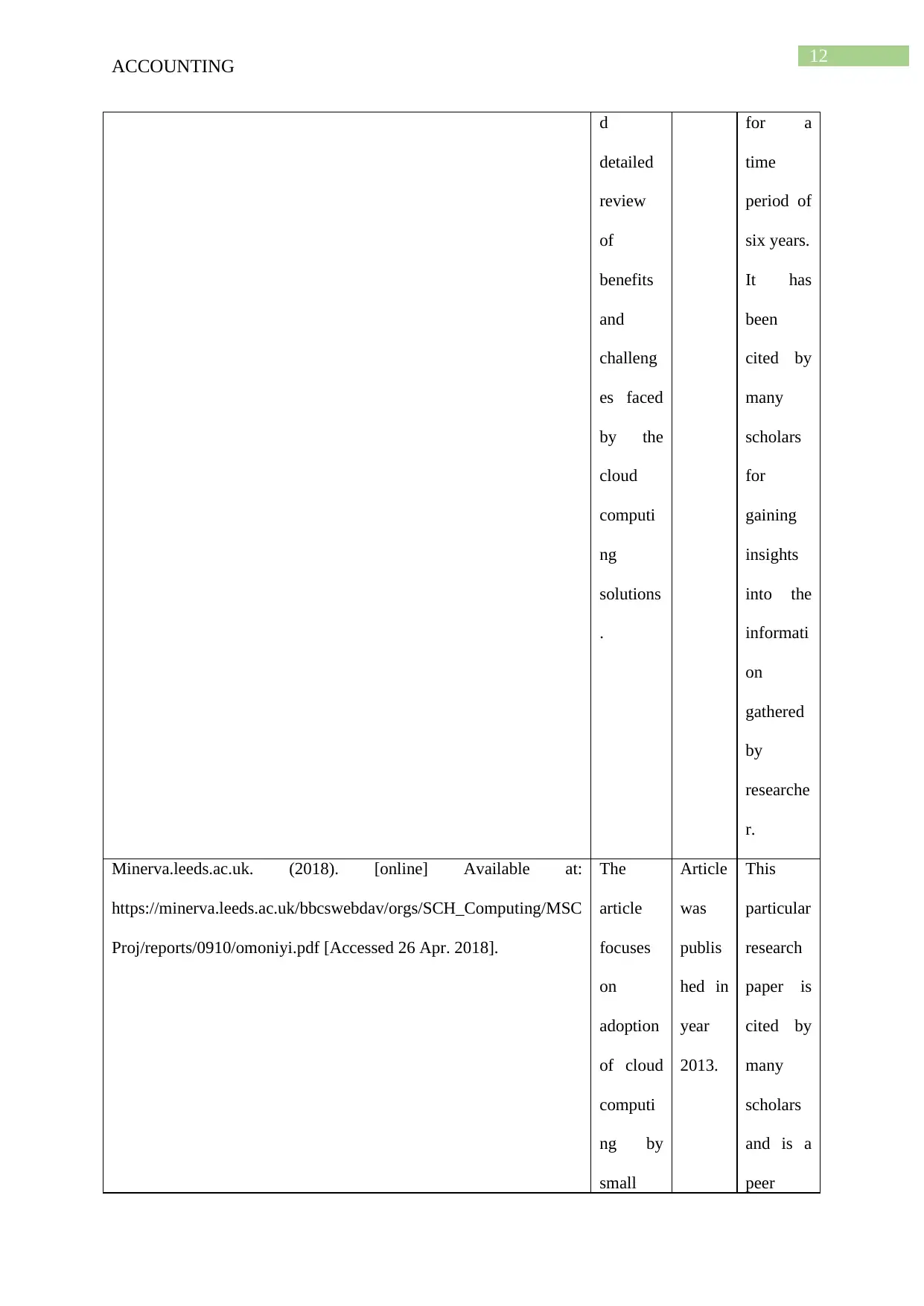
d
detailed
review
of
benefits
and
challeng
es faced
by the
cloud
computi
ng
solutions
.
for a
time
period of
six years.
It has
been
cited by
many
scholars
for
gaining
insights
into the
informati
on
gathered
by
researche
r.
Minerva.leeds.ac.uk. (2018). [online] Available at:
https://minerva.leeds.ac.uk/bbcswebdav/orgs/SCH_Computing/MSC
Proj/reports/0910/omoniyi.pdf [Accessed 26 Apr. 2018].
The
article
focuses
on
adoption
of cloud
computi
ng by
small
Article
was
publis
hed in
year
2013.
This
particular
research
paper is
cited by
many
scholars
and is a
peer
ACCOUNTING
d
detailed
review
of
benefits
and
challeng
es faced
by the
cloud
computi
ng
solutions
.
for a
time
period of
six years.
It has
been
cited by
many
scholars
for
gaining
insights
into the
informati
on
gathered
by
researche
r.
Minerva.leeds.ac.uk. (2018). [online] Available at:
https://minerva.leeds.ac.uk/bbcswebdav/orgs/SCH_Computing/MSC
Proj/reports/0910/omoniyi.pdf [Accessed 26 Apr. 2018].
The
article
focuses
on
adoption
of cloud
computi
ng by
small
Article
was
publis
hed in
year
2013.
This
particular
research
paper is
cited by
many
scholars
and is a
peer
⊘ This is a preview!⊘
Do you want full access?
Subscribe today to unlock all pages.
Trusted by 1+ million students worldwide

1 out of 17


Related Documents


Your All-in-One AI-Powered Toolkit for Academic Success.
+13062052269
info@desklib.com
Available 24*7 on WhatsApp / Email
![[object Object]](/_next/static/media/star-bottom.7253800d.svg)
Unlock your academic potential
Copyright © 2020–2026 A2Z Services. All Rights Reserved. Developed and managed by ZUCOL.