Cloud Computing's European Snag: Privacy, Security, and Solutions
VerifiedAdded on 2021/06/17
|9
|2241
|25
Report
AI Summary
This report analyzes the challenges faced by cloud computing in Europe, primarily focusing on the stringent privacy and security regulations that hinder its widespread adoption. The report discusses a proposed idea for real-time language translation using cloud services and its rejection by European countries due to cross-border data transfer concerns. It delves into the ethical dilemma between protecting citizen privacy and allowing technological advancements, impacting businesses and scholars. The report highlights the strict cyber laws in Europe, the limitations on data sharing, and the slow adoption rate compared to the United States. It explores potential solutions, such as data encryption and user-selected privacy levels, proposed by tech giants. The report emphasizes the need for a middle ground to balance technological benefits with data protection, suggesting that proper measures like encryption and user control can facilitate the effective use of cloud computing in Europe. The report, contributed by a student, provides a comprehensive overview of the topic and offers insights into the current state and future possibilities of cloud computing within the European context, with access to similar assignments on Desklib.
Running head: CLOUD COMPUTING HITS SNAG IN EUROPE
Cloud Computing hits snag in Europe
Name of the student
Name of the University
Authors note
Cloud Computing hits snag in Europe
Name of the student
Name of the University
Authors note
Paraphrase This Document
Need a fresh take? Get an instant paraphrase of this document with our AI Paraphraser

1CLOUD COMPUTING HITS SNAG IN EUROPE
Cloud Computing hits snag in Europe
Technology is the term that has changed the approach and lives of the human. It has
offered some of the most innovative & disruptive innovations such as internet, computers,
mobiles & several others (Gasser & O'Brien, 2014). One of such technological advancement
is the cloud computing where a user owns the capability to use computing services
(processing, storing, analysing, controlling and others) from geographical distance location
without physically investing in the servers, storage, equipment and other computing devices
(Austin, 2016). However, the discussed technology has offered its own share of challenges
which are mostly related to security & privacy. Hence, the government of different states
have their own policies & standards in place to mitigate the threat posed by the challenges
associated with the cloud services (Grodal & Granqvist, 2014). However, a question that have
raised in the recent time is that whether these policies are maintaining the security & privacy
of a user’s information or are acting as a barrier to evolution of the technology.
In a recent scenario, an idea was proposed that would mitigate the communication gap
between geographical distinct persons who belongs to different culture & location and their
languages are foreign to each other (Travis, 2015). The proposed idea was to use cloud
computing services to formulate a plan system where two culturally & lingual different
people would be able to verbally communicate with each other in real time. To attain the
discussed objective, it was proposed that the calls be made through cloud services where the
words spoken by one individual will be translated to the language understandable to the
listener in real-time (Hameed et al., 2016). In other words, Australian English will be
translated to China’s Madrin and the Australian who does not understand Madrin would be
able to convey his/her message to the Chinese who does not understand English and the case
will be the same in other scenario (Ahmed et al., 2015). All the process will be done in real-
time through cloud voice translator to make the communication more effective. The idea
Cloud Computing hits snag in Europe
Technology is the term that has changed the approach and lives of the human. It has
offered some of the most innovative & disruptive innovations such as internet, computers,
mobiles & several others (Gasser & O'Brien, 2014). One of such technological advancement
is the cloud computing where a user owns the capability to use computing services
(processing, storing, analysing, controlling and others) from geographical distance location
without physically investing in the servers, storage, equipment and other computing devices
(Austin, 2016). However, the discussed technology has offered its own share of challenges
which are mostly related to security & privacy. Hence, the government of different states
have their own policies & standards in place to mitigate the threat posed by the challenges
associated with the cloud services (Grodal & Granqvist, 2014). However, a question that have
raised in the recent time is that whether these policies are maintaining the security & privacy
of a user’s information or are acting as a barrier to evolution of the technology.
In a recent scenario, an idea was proposed that would mitigate the communication gap
between geographical distinct persons who belongs to different culture & location and their
languages are foreign to each other (Travis, 2015). The proposed idea was to use cloud
computing services to formulate a plan system where two culturally & lingual different
people would be able to verbally communicate with each other in real time. To attain the
discussed objective, it was proposed that the calls be made through cloud services where the
words spoken by one individual will be translated to the language understandable to the
listener in real-time (Hameed et al., 2016). In other words, Australian English will be
translated to China’s Madrin and the Australian who does not understand Madrin would be
able to convey his/her message to the Chinese who does not understand English and the case
will be the same in other scenario (Ahmed et al., 2015). All the process will be done in real-
time through cloud voice translator to make the communication more effective. The idea

2CLOUD COMPUTING HITS SNAG IN EUROPE
seems feasible and implementable which could have been implemented however, the
European countries rejected the proposed idea.
Unlike most of the countries around the globe, the cyber laws of the European
countries are well defined and structured. They have focused especially on the privacy &
security of the technology that involves transfer of data (Girma et al., 2015). In the proposed
idea, by using the cloud services the data would have been transferred across the borders
which is against the policies defined by the government. The European countries and more
specifically British government are very strict against cross-border data sharing, they have
only signed deals with only a few countries such as US, Canada and Argentina for using
cloud services in their geographical domain (Al-Ayyoub et al., 2015). This strictness over the
sharing of data across the border has made the implementation of the proposed idea a very
difficult task and developing an ethical dilemma. The dilemma is regarding the protection of
the citizen against privacy & security or let the technology offer the citizen comfort and
ability to expand their global approach.
The impact of rejection of this idea will mostly affect the business personals and the
scholars who were wishing that the deemed idea will allow them to increase their approach
(Stergiou et al., 2018). The business associates would have received the opportunity to
increase their consumer & client base while mitigating their expenditure which they bear on
outsourcing of the consumer services due to the language and geographical distance barriers
(Kaur & Rai, 2014). The scholars would have received the opportunity to discuss and analyse
their subject with other scholars from geographically distant location who could have assisted
the former in their work.
Another, notable fact that needs to be noticed that the idea has been suspended and
not rejected because the technological giants such as HP, Google, Oracle and others are
looking for the strategy to mitigate the challenge without deepening the ethical dilemma
seems feasible and implementable which could have been implemented however, the
European countries rejected the proposed idea.
Unlike most of the countries around the globe, the cyber laws of the European
countries are well defined and structured. They have focused especially on the privacy &
security of the technology that involves transfer of data (Girma et al., 2015). In the proposed
idea, by using the cloud services the data would have been transferred across the borders
which is against the policies defined by the government. The European countries and more
specifically British government are very strict against cross-border data sharing, they have
only signed deals with only a few countries such as US, Canada and Argentina for using
cloud services in their geographical domain (Al-Ayyoub et al., 2015). This strictness over the
sharing of data across the border has made the implementation of the proposed idea a very
difficult task and developing an ethical dilemma. The dilemma is regarding the protection of
the citizen against privacy & security or let the technology offer the citizen comfort and
ability to expand their global approach.
The impact of rejection of this idea will mostly affect the business personals and the
scholars who were wishing that the deemed idea will allow them to increase their approach
(Stergiou et al., 2018). The business associates would have received the opportunity to
increase their consumer & client base while mitigating their expenditure which they bear on
outsourcing of the consumer services due to the language and geographical distance barriers
(Kaur & Rai, 2014). The scholars would have received the opportunity to discuss and analyse
their subject with other scholars from geographically distant location who could have assisted
the former in their work.
Another, notable fact that needs to be noticed that the idea has been suspended and
not rejected because the technological giants such as HP, Google, Oracle and others are
looking for the strategy to mitigate the challenge without deepening the ethical dilemma
⊘ This is a preview!⊘
Do you want full access?
Subscribe today to unlock all pages.

Trusted by 1+ million students worldwide

3CLOUD COMPUTING HITS SNAG IN EUROPE
(Rao, Naveena & David, 2015). They have suggested two methods which are ethically sound
and will also enable to keep the data protected while cross border transfer of data. The first
method involves encryption of data at the instant when the data is being uploaded over the
communication channel and after successful deployment it will get decrypted. The discussed
proposed methodology is following the guidelines of the European countries and in the
process is keeping the data protected while communicating cross-border in real time
(Whaiduzzaman et al., 2014). The second idea, proposed by the researchers at the
technological giants is to allow the users who are willing to transfer their data cross-border to
select the level of privacy they want. The guidelines for cyber security in the European
countries are very elaborate which describes about everything from phone number to e-mail
and street address. So, the proposed remedy allows the user to choose the privacy limit where
they will get the opportunity to reveal their phone number while keeping the e-mail, street
address and other data decrypted and safe (Grodal & Granqvist, 2014). Other demands are
also requesting the demands to restructuring of the cyber guidelines to offer more freedom for
the computing services.
The discussed situation can be emphasised to state that the European countries are
arguably justified at their position and so are the organisations who have proposed the
discussed idea (O’Brien, 2010). However, the developed ethical dilemma can be mitigated by
finding a middle path that would fulfil both the demands, if not completely than partially
also. The proposed remedial strategies could be the potential solution to the dilemma.
Additionally, the dilemma should be mitigated in the shortest possible time so that the users
can enjoy the significance benefit that the proposed idea is capable of offering.
(Rao, Naveena & David, 2015). They have suggested two methods which are ethically sound
and will also enable to keep the data protected while cross border transfer of data. The first
method involves encryption of data at the instant when the data is being uploaded over the
communication channel and after successful deployment it will get decrypted. The discussed
proposed methodology is following the guidelines of the European countries and in the
process is keeping the data protected while communicating cross-border in real time
(Whaiduzzaman et al., 2014). The second idea, proposed by the researchers at the
technological giants is to allow the users who are willing to transfer their data cross-border to
select the level of privacy they want. The guidelines for cyber security in the European
countries are very elaborate which describes about everything from phone number to e-mail
and street address. So, the proposed remedy allows the user to choose the privacy limit where
they will get the opportunity to reveal their phone number while keeping the e-mail, street
address and other data decrypted and safe (Grodal & Granqvist, 2014). Other demands are
also requesting the demands to restructuring of the cyber guidelines to offer more freedom for
the computing services.
The discussed situation can be emphasised to state that the European countries are
arguably justified at their position and so are the organisations who have proposed the
discussed idea (O’Brien, 2010). However, the developed ethical dilemma can be mitigated by
finding a middle path that would fulfil both the demands, if not completely than partially
also. The proposed remedial strategies could be the potential solution to the dilemma.
Additionally, the dilemma should be mitigated in the shortest possible time so that the users
can enjoy the significance benefit that the proposed idea is capable of offering.
Paraphrase This Document
Need a fresh take? Get an instant paraphrase of this document with our AI Paraphraser

4CLOUD COMPUTING HITS SNAG IN EUROPE
References
Ahmed, E., Gani, A., Khan, M. K., Buyya, R., & Khan, S. U. (2015). Seamless application
execution in mobile cloud computing: Motivation, taxonomy, and open challenges. Journal
of Network and Computer Applications, 52, 154-172.
Al-Ayyoub, M., Jararweh, Y., Daraghmeh, M., & Althebyan, Q. (2015). Multi-agent based
dynamic resource provisioning and monitoring for cloud computing systems
infrastructure. Cluster Computing, 18(2), 919-932.
Austin, W. (2016). Industry 4.0: Myths vs. Reality.
Gasser, U., & O'Brien, D. (2014). Governments and Cloud Computing: Roles, Approaches,
and Policy Considerations.
Girma, A., Garuba, M., Li, J., & Liu, C. (2015, April). Analysis of DDoS attacks and an
introduction of a hybrid statistical model to detect DDoS attacks on cloud computing
environment. In Information Technology-New Generations (ITNG), 2015 12th International
Conference on (pp. 212-217). IEEE.
Grodal, S., & Granqvist, N. (2014). Great expectations: Discourse and affect during field
emergence. In Emotions and the Organizational Fabric (pp. 139-166). Emerald Group
Publishing Limited.
Hameed, A., Khoshkbarforoushha, A., Ranjan, R., Jayaraman, P. P., Kolodziej, J., Balaji,
P., ... & Khan, S. U. (2016). A survey and taxonomy on energy efficient resource allocation
techniques for cloud computing systems. Computing, 98(7), 751-774.
Kaur, K., & Rai, A. K. (2014). A comparative analysis: Grid, cluster and cloud
computing. International Journal of Advanced Research in Computer and Communication
Engineering, 3(3), 5730-5734.
O’Brien, K. (2010). Cloud Computing Hits Snag in Europe. Retrieved from
https://www.nytimes.com/2010/09/20/technology/20cloud.html?hpw
References
Ahmed, E., Gani, A., Khan, M. K., Buyya, R., & Khan, S. U. (2015). Seamless application
execution in mobile cloud computing: Motivation, taxonomy, and open challenges. Journal
of Network and Computer Applications, 52, 154-172.
Al-Ayyoub, M., Jararweh, Y., Daraghmeh, M., & Althebyan, Q. (2015). Multi-agent based
dynamic resource provisioning and monitoring for cloud computing systems
infrastructure. Cluster Computing, 18(2), 919-932.
Austin, W. (2016). Industry 4.0: Myths vs. Reality.
Gasser, U., & O'Brien, D. (2014). Governments and Cloud Computing: Roles, Approaches,
and Policy Considerations.
Girma, A., Garuba, M., Li, J., & Liu, C. (2015, April). Analysis of DDoS attacks and an
introduction of a hybrid statistical model to detect DDoS attacks on cloud computing
environment. In Information Technology-New Generations (ITNG), 2015 12th International
Conference on (pp. 212-217). IEEE.
Grodal, S., & Granqvist, N. (2014). Great expectations: Discourse and affect during field
emergence. In Emotions and the Organizational Fabric (pp. 139-166). Emerald Group
Publishing Limited.
Hameed, A., Khoshkbarforoushha, A., Ranjan, R., Jayaraman, P. P., Kolodziej, J., Balaji,
P., ... & Khan, S. U. (2016). A survey and taxonomy on energy efficient resource allocation
techniques for cloud computing systems. Computing, 98(7), 751-774.
Kaur, K., & Rai, A. K. (2014). A comparative analysis: Grid, cluster and cloud
computing. International Journal of Advanced Research in Computer and Communication
Engineering, 3(3), 5730-5734.
O’Brien, K. (2010). Cloud Computing Hits Snag in Europe. Retrieved from
https://www.nytimes.com/2010/09/20/technology/20cloud.html?hpw

5CLOUD COMPUTING HITS SNAG IN EUROPE
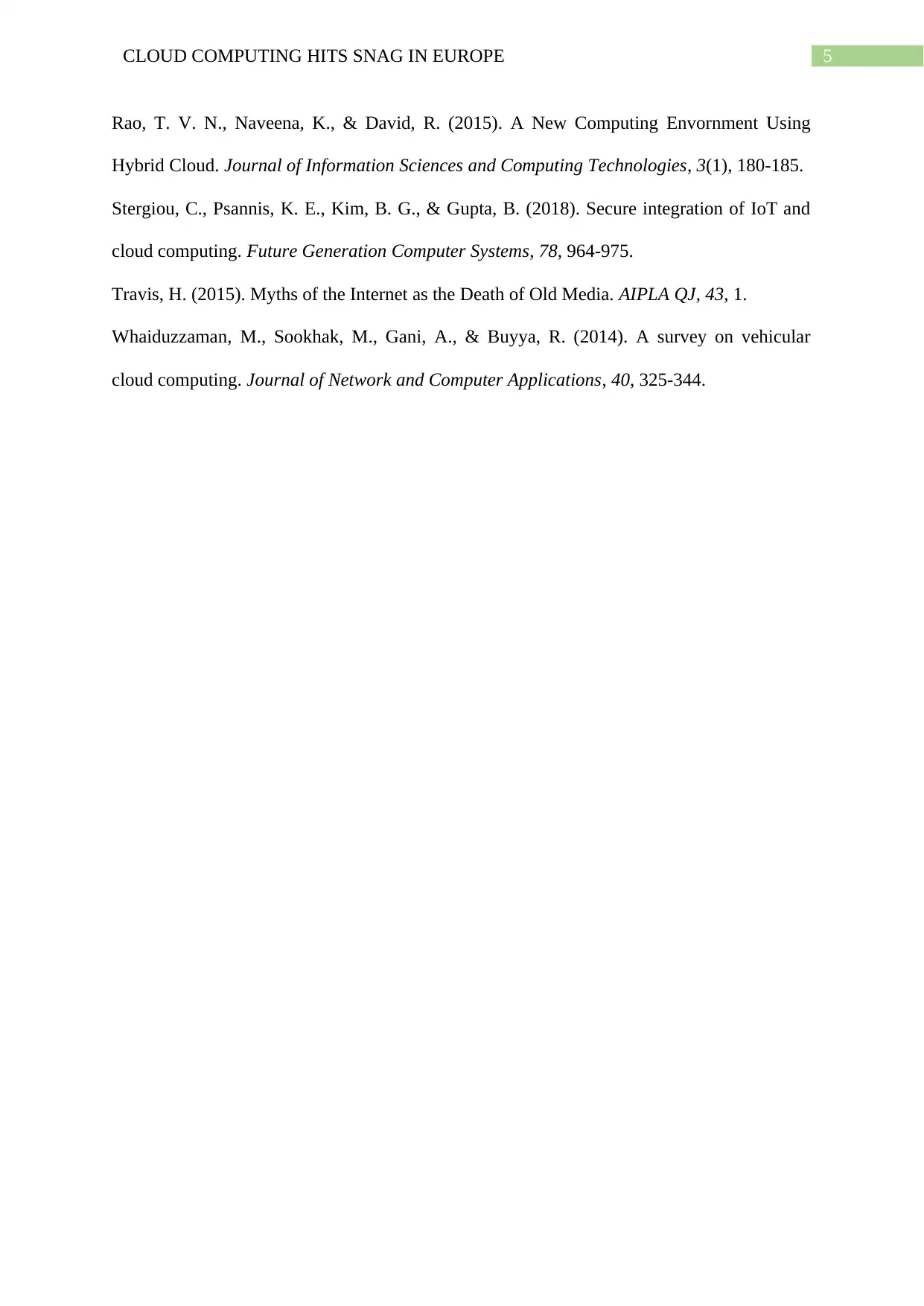
Rao, T. V. N., Naveena, K., & David, R. (2015). A New Computing Envornment Using
Hybrid Cloud. Journal of Information Sciences and Computing Technologies, 3(1), 180-185.
Stergiou, C., Psannis, K. E., Kim, B. G., & Gupta, B. (2018). Secure integration of IoT and
cloud computing. Future Generation Computer Systems, 78, 964-975.
Travis, H. (2015). Myths of the Internet as the Death of Old Media. AIPLA QJ, 43, 1.
Whaiduzzaman, M., Sookhak, M., Gani, A., & Buyya, R. (2014). A survey on vehicular
cloud computing. Journal of Network and Computer Applications, 40, 325-344.
Rao, T. V. N., Naveena, K., & David, R. (2015). A New Computing Envornment Using
Hybrid Cloud. Journal of Information Sciences and Computing Technologies, 3(1), 180-185.
Stergiou, C., Psannis, K. E., Kim, B. G., & Gupta, B. (2018). Secure integration of IoT and
cloud computing. Future Generation Computer Systems, 78, 964-975.
Travis, H. (2015). Myths of the Internet as the Death of Old Media. AIPLA QJ, 43, 1.
Whaiduzzaman, M., Sookhak, M., Gani, A., & Buyya, R. (2014). A survey on vehicular
cloud computing. Journal of Network and Computer Applications, 40, 325-344.
⊘ This is a preview!⊘
Do you want full access?
Subscribe today to unlock all pages.

Trusted by 1+ million students worldwide

6CLOUD COMPUTING HITS SNAG IN EUROPE
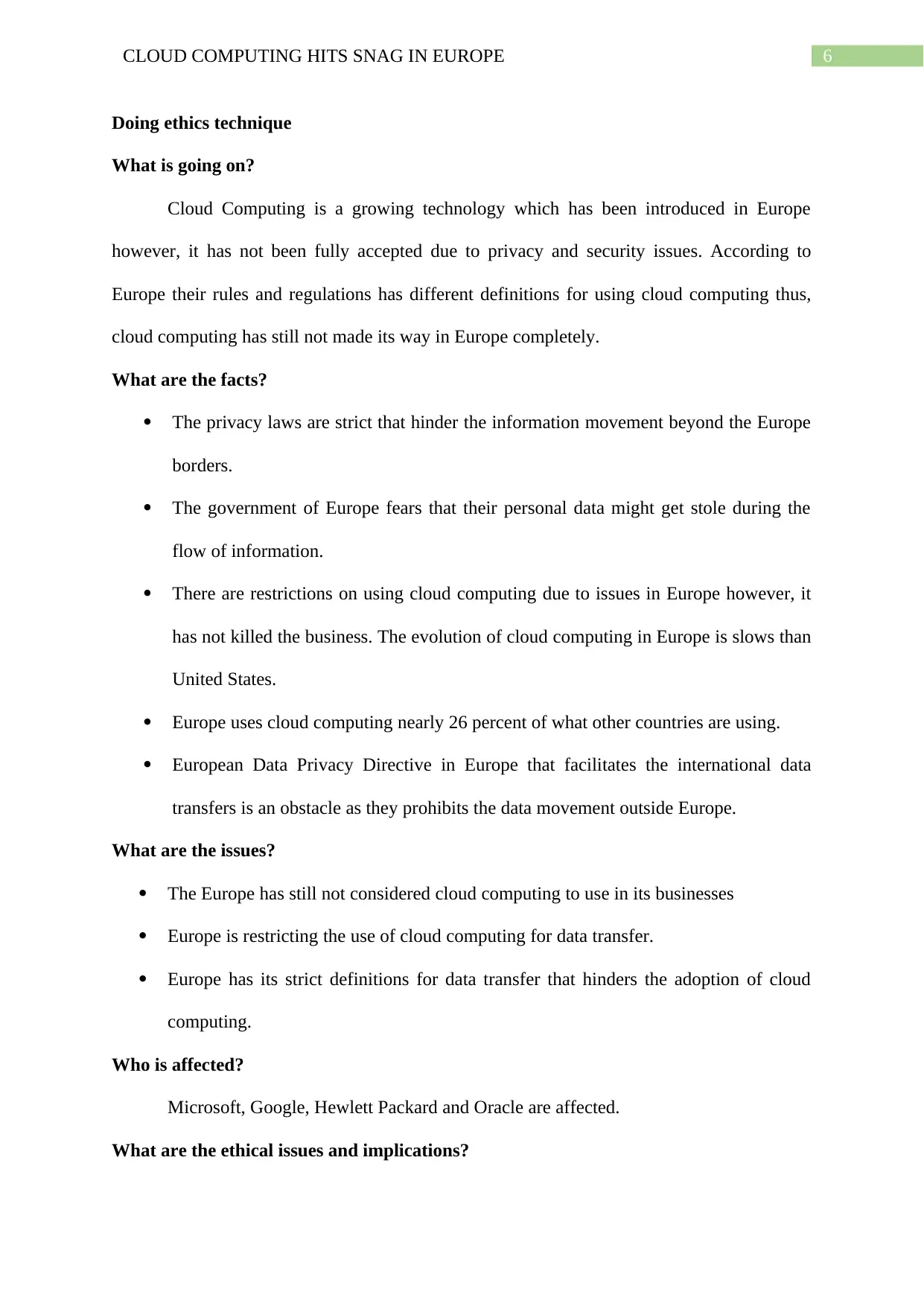
Doing ethics technique
What is going on?
Cloud Computing is a growing technology which has been introduced in Europe
however, it has not been fully accepted due to privacy and security issues. According to
Europe their rules and regulations has different definitions for using cloud computing thus,
cloud computing has still not made its way in Europe completely.
What are the facts?
The privacy laws are strict that hinder the information movement beyond the Europe
borders.
The government of Europe fears that their personal data might get stole during the
flow of information.
There are restrictions on using cloud computing due to issues in Europe however, it
has not killed the business. The evolution of cloud computing in Europe is slows than
United States.
Europe uses cloud computing nearly 26 percent of what other countries are using.
European Data Privacy Directive in Europe that facilitates the international data
transfers is an obstacle as they prohibits the data movement outside Europe.
What are the issues?
The Europe has still not considered cloud computing to use in its businesses
Europe is restricting the use of cloud computing for data transfer.
Europe has its strict definitions for data transfer that hinders the adoption of cloud
computing.
Who is affected?
Microsoft, Google, Hewlett Packard and Oracle are affected.
What are the ethical issues and implications?
Doing ethics technique
What is going on?
Cloud Computing is a growing technology which has been introduced in Europe
however, it has not been fully accepted due to privacy and security issues. According to
Europe their rules and regulations has different definitions for using cloud computing thus,
cloud computing has still not made its way in Europe completely.
What are the facts?
The privacy laws are strict that hinder the information movement beyond the Europe
borders.
The government of Europe fears that their personal data might get stole during the
flow of information.
There are restrictions on using cloud computing due to issues in Europe however, it
has not killed the business. The evolution of cloud computing in Europe is slows than
United States.
Europe uses cloud computing nearly 26 percent of what other countries are using.
European Data Privacy Directive in Europe that facilitates the international data
transfers is an obstacle as they prohibits the data movement outside Europe.
What are the issues?
The Europe has still not considered cloud computing to use in its businesses
Europe is restricting the use of cloud computing for data transfer.
Europe has its strict definitions for data transfer that hinders the adoption of cloud
computing.
Who is affected?
Microsoft, Google, Hewlett Packard and Oracle are affected.
What are the ethical issues and implications?
Paraphrase This Document
Need a fresh take? Get an instant paraphrase of this document with our AI Paraphraser

7CLOUD COMPUTING HITS SNAG IN EUROPE
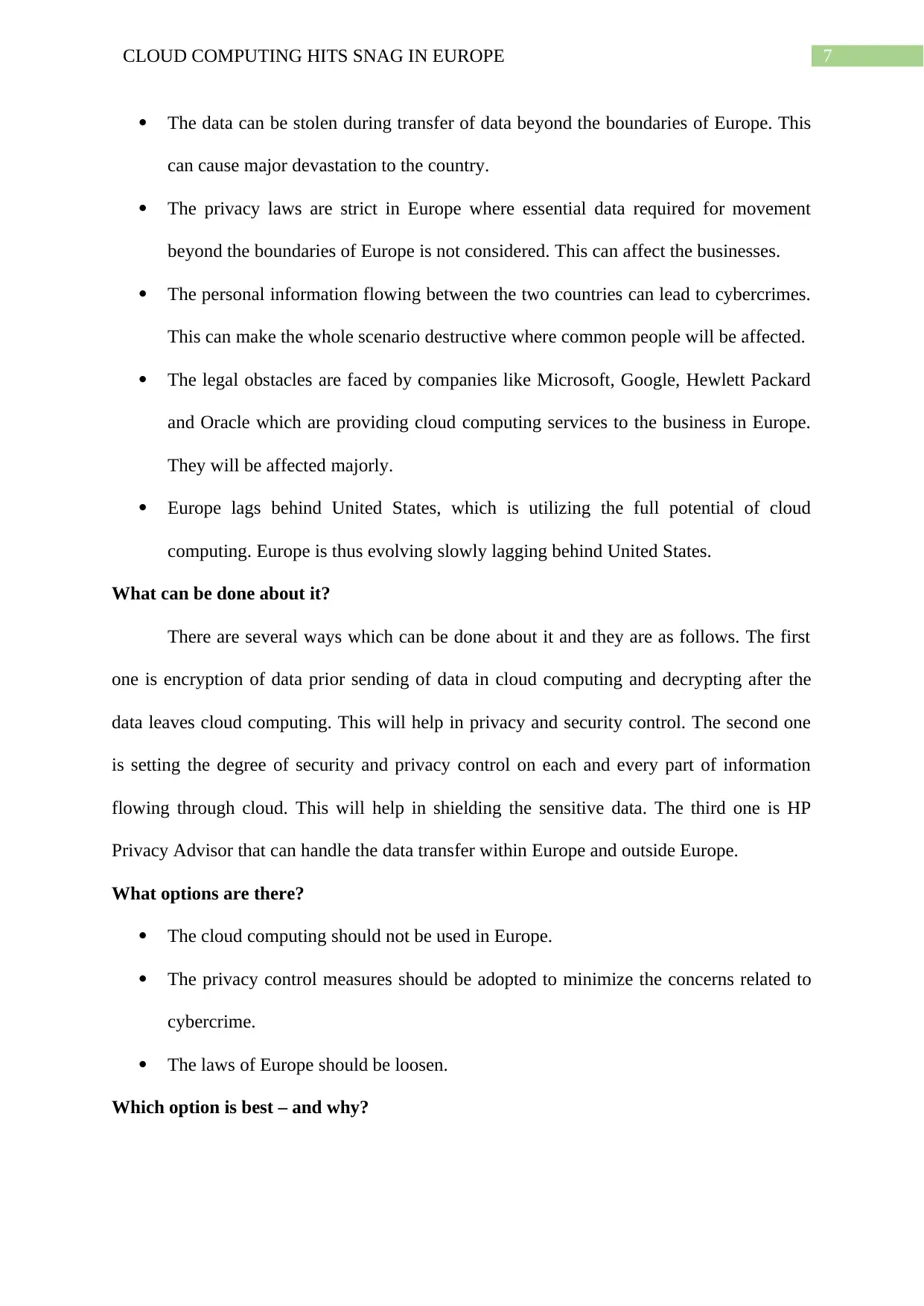
The data can be stolen during transfer of data beyond the boundaries of Europe. This
can cause major devastation to the country.
The privacy laws are strict in Europe where essential data required for movement
beyond the boundaries of Europe is not considered. This can affect the businesses.
The personal information flowing between the two countries can lead to cybercrimes.
This can make the whole scenario destructive where common people will be affected.
The legal obstacles are faced by companies like Microsoft, Google, Hewlett Packard
and Oracle which are providing cloud computing services to the business in Europe.
They will be affected majorly.
Europe lags behind United States, which is utilizing the full potential of cloud
computing. Europe is thus evolving slowly lagging behind United States.
What can be done about it?
There are several ways which can be done about it and they are as follows. The first
one is encryption of data prior sending of data in cloud computing and decrypting after the
data leaves cloud computing. This will help in privacy and security control. The second one
is setting the degree of security and privacy control on each and every part of information
flowing through cloud. This will help in shielding the sensitive data. The third one is HP
Privacy Advisor that can handle the data transfer within Europe and outside Europe.
What options are there?
The cloud computing should not be used in Europe.
The privacy control measures should be adopted to minimize the concerns related to
cybercrime.
The laws of Europe should be loosen.
Which option is best – and why?
The data can be stolen during transfer of data beyond the boundaries of Europe. This
can cause major devastation to the country.
The privacy laws are strict in Europe where essential data required for movement
beyond the boundaries of Europe is not considered. This can affect the businesses.
The personal information flowing between the two countries can lead to cybercrimes.
This can make the whole scenario destructive where common people will be affected.
The legal obstacles are faced by companies like Microsoft, Google, Hewlett Packard
and Oracle which are providing cloud computing services to the business in Europe.
They will be affected majorly.
Europe lags behind United States, which is utilizing the full potential of cloud
computing. Europe is thus evolving slowly lagging behind United States.
What can be done about it?
There are several ways which can be done about it and they are as follows. The first
one is encryption of data prior sending of data in cloud computing and decrypting after the
data leaves cloud computing. This will help in privacy and security control. The second one
is setting the degree of security and privacy control on each and every part of information
flowing through cloud. This will help in shielding the sensitive data. The third one is HP
Privacy Advisor that can handle the data transfer within Europe and outside Europe.
What options are there?
The cloud computing should not be used in Europe.
The privacy control measures should be adopted to minimize the concerns related to
cybercrime.
The laws of Europe should be loosen.
Which option is best – and why?

8CLOUD COMPUTING HITS SNAG IN EUROPE
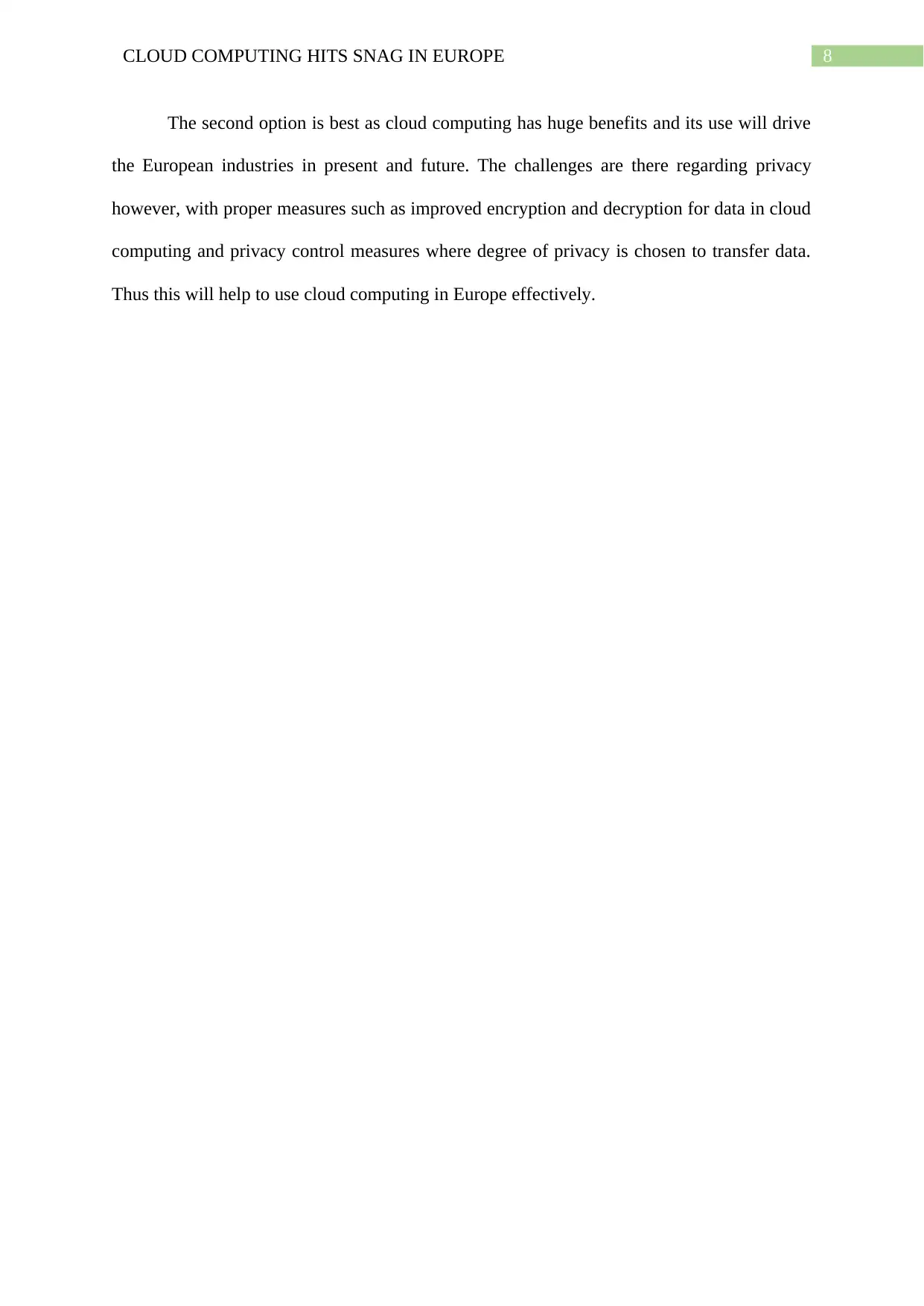
The second option is best as cloud computing has huge benefits and its use will drive
the European industries in present and future. The challenges are there regarding privacy
however, with proper measures such as improved encryption and decryption for data in cloud
computing and privacy control measures where degree of privacy is chosen to transfer data.
Thus this will help to use cloud computing in Europe effectively.
The second option is best as cloud computing has huge benefits and its use will drive
the European industries in present and future. The challenges are there regarding privacy
however, with proper measures such as improved encryption and decryption for data in cloud
computing and privacy control measures where degree of privacy is chosen to transfer data.
Thus this will help to use cloud computing in Europe effectively.
⊘ This is a preview!⊘
Do you want full access?
Subscribe today to unlock all pages.

Trusted by 1+ million students worldwide
1 out of 9
Related Documents
Your All-in-One AI-Powered Toolkit for Academic Success.
+13062052269
info@desklib.com
Available 24*7 on WhatsApp / Email
Unlock your academic potential
Copyright © 2020–2025 A2Z Services. All Rights Reserved. Developed and managed by ZUCOL.