Cloud ERP System Development: Risk Mitigation Plan for Studer Group

Verified

Added on  2023/06/05

|18
|2793
|390
Report
AI Summary
This report presents a risk management plan for the "development of cloud-based ERP system within Studer Group, Australia." The plan focuses on analyzing and assessing risks based on their likelihood and impact, enabling prioritization and effective mitigation. Key processes include risk identification through brainstorming and scanning, risk analysis to evaluate the impact of identified risks, and the development of risk mitigation strategies, assigning responsibilities, and defining preventive actions. The plan also details risk monitoring procedures, stakeholder roles, and communication strategies, ensuring that the steering committee and project managers are well-informed and can take appropriate actions. High-level risks, such as improper scheduling, budget shortfalls, and inadequate infrastructure testing, are prioritized for mitigation to minimize their negative impact on the project's success. Desklib provides access to this and other solved assignments to aid students in their studies.
Document Page
Running head: RISK MITIGATION PLAN
Develop and implement risk mitigation plan: (Case Study- Development of cloud-based ERP
system in Studer Group, Australia)
Name of the Student
Name of the University
Author’s Note
tabler-icon-diamond-filled.svg

Paraphrase This Document

Need a fresh take? Get an instant paraphrase of this document with our AI Paraphraser
Document Page
1
RISK MITIGATION PLAN
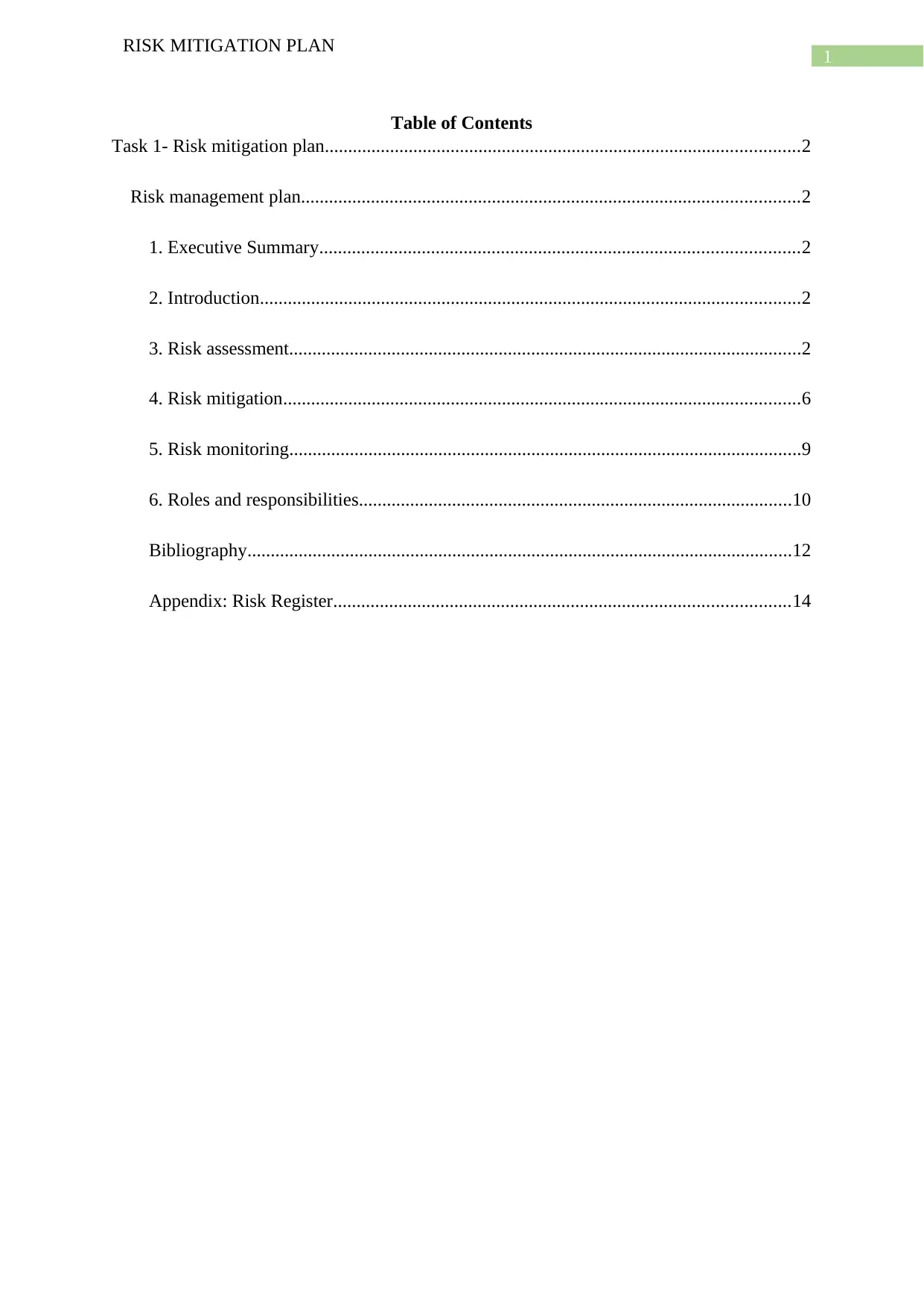
Table of Contents
Task 1- Risk mitigation plan......................................................................................................2
Risk management plan...........................................................................................................2
1. Executive Summary.......................................................................................................2
2. Introduction....................................................................................................................2
3. Risk assessment..............................................................................................................2
4. Risk mitigation...............................................................................................................6
5. Risk monitoring..............................................................................................................9
6. Roles and responsibilities.............................................................................................10
Bibliography.....................................................................................................................12
Appendix: Risk Register..................................................................................................14
Document Page
2
RISK MITIGATION PLAN
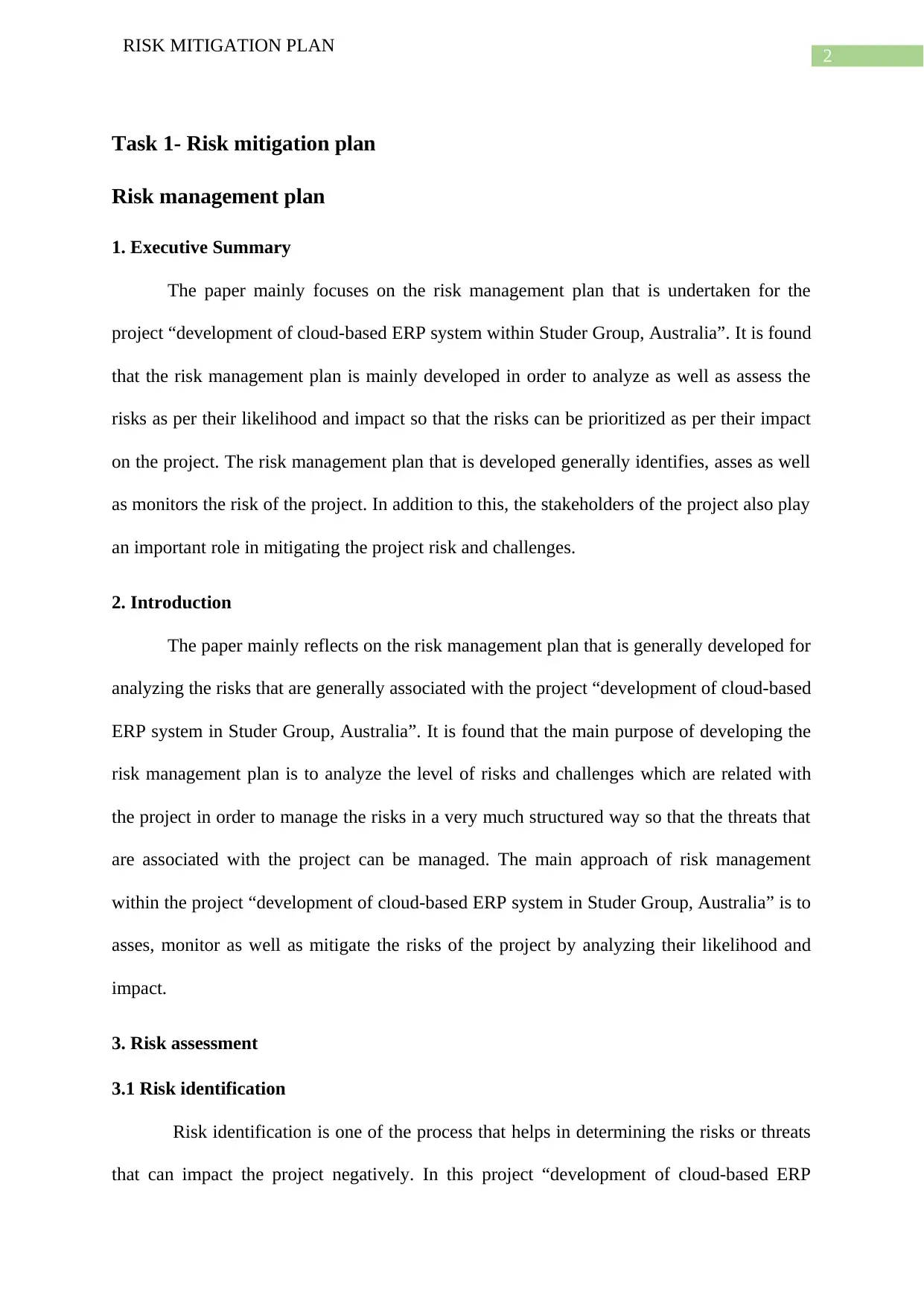
Task 1- Risk mitigation plan
Risk management plan
1. Executive Summary
The paper mainly focuses on the risk management plan that is undertaken for the
project “development of cloud-based ERP system within Studer Group, Australia”. It is found
that the risk management plan is mainly developed in order to analyze as well as assess the
risks as per their likelihood and impact so that the risks can be prioritized as per their impact
on the project. The risk management plan that is developed generally identifies, asses as well
as monitors the risk of the project. In addition to this, the stakeholders of the project also play
an important role in mitigating the project risk and challenges.
2. Introduction
The paper mainly reflects on the risk management plan that is generally developed for
analyzing the risks that are generally associated with the project “development of cloud-based
ERP system in Studer Group, Australia”. It is found that the main purpose of developing the
risk management plan is to analyze the level of risks and challenges which are related with
the project in order to manage the risks in a very much structured way so that the threats that
are associated with the project can be managed. The main approach of risk management
within the project “development of cloud-based ERP system in Studer Group, Australia” is to
asses, monitor as well as mitigate the risks of the project by analyzing their likelihood and
impact.
3. Risk assessment
3.1 Risk identification
Risk identification is one of the process that helps in determining the risks or threats
that can impact the project negatively. In this project “development of cloud-based ERP
Document Page
3
RISK MITIGATION PLAN
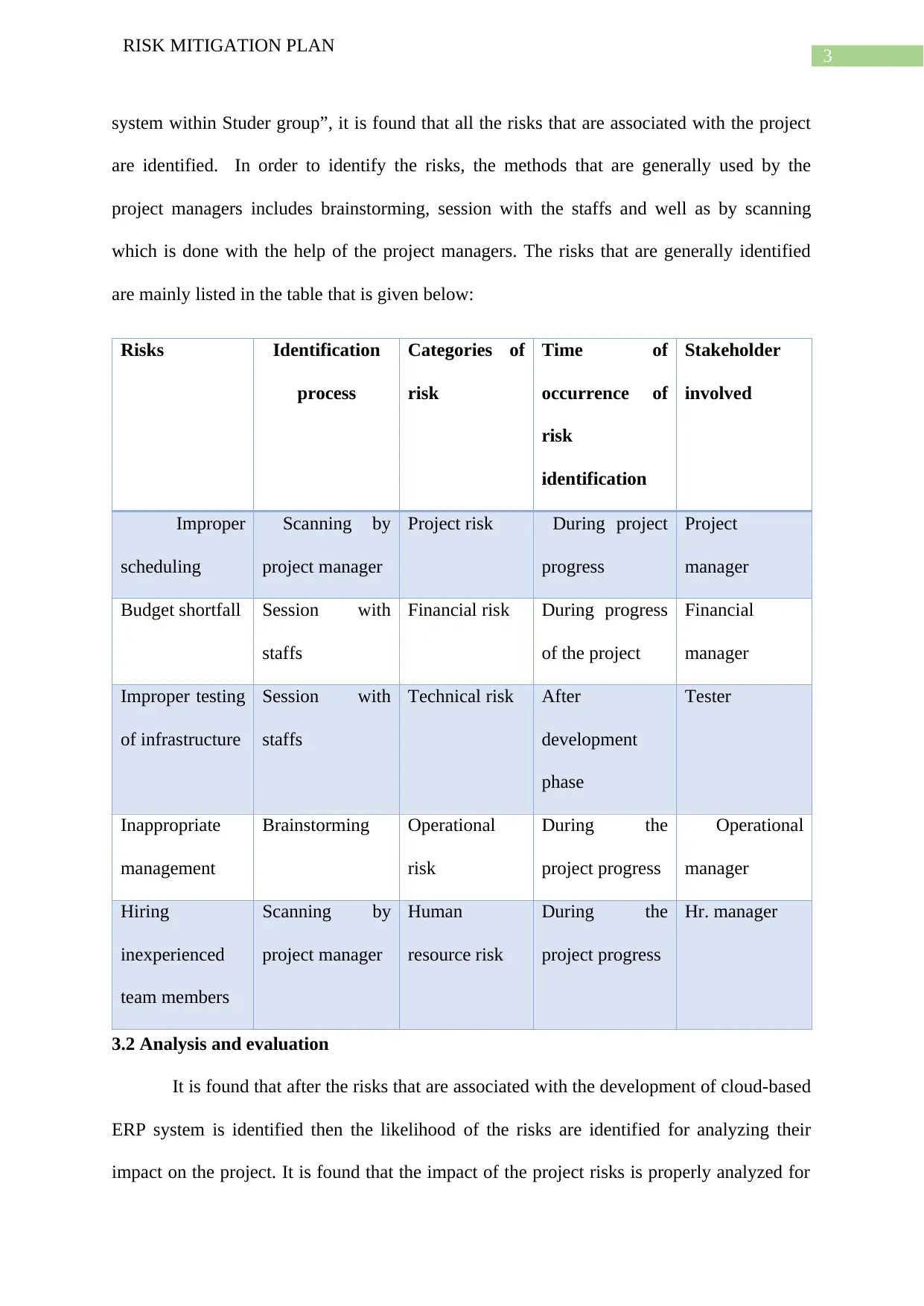
system within Studer group”, it is found that all the risks that are associated with the project
are identified. In order to identify the risks, the methods that are generally used by the
project managers includes brainstorming, session with the staffs and well as by scanning
which is done with the help of the project managers. The risks that are generally identified
are mainly listed in the table that is given below:
Risks Identification
process
Categories of
risk
Time of
occurrence of
risk
identification
Stakeholder
involved
Improper
scheduling
Scanning by
project manager
Project risk During project
progress
Project
manager
Budget shortfall Session with
staffs
Financial risk During progress
of the project
Financial
manager
Improper testing
of infrastructure
Session with
staffs
Technical risk After
development
phase
Tester
Inappropriate
management
Brainstorming Operational
risk
During the
project progress
Operational
manager
Hiring
inexperienced
team members
Scanning by
project manager
Human
resource risk
During the
project progress
Hr. manager
3.2 Analysis and evaluation
It is found that after the risks that are associated with the development of cloud-based
ERP system is identified then the likelihood of the risks are identified for analyzing their
impact on the project. It is found that the impact of the project risks is properly analyzed for
tabler-icon-diamond-filled.svg

Paraphrase This Document

Need a fresh take? Get an instant paraphrase of this document with our AI Paraphraser
Document Page
4
RISK MITIGATION PLAN
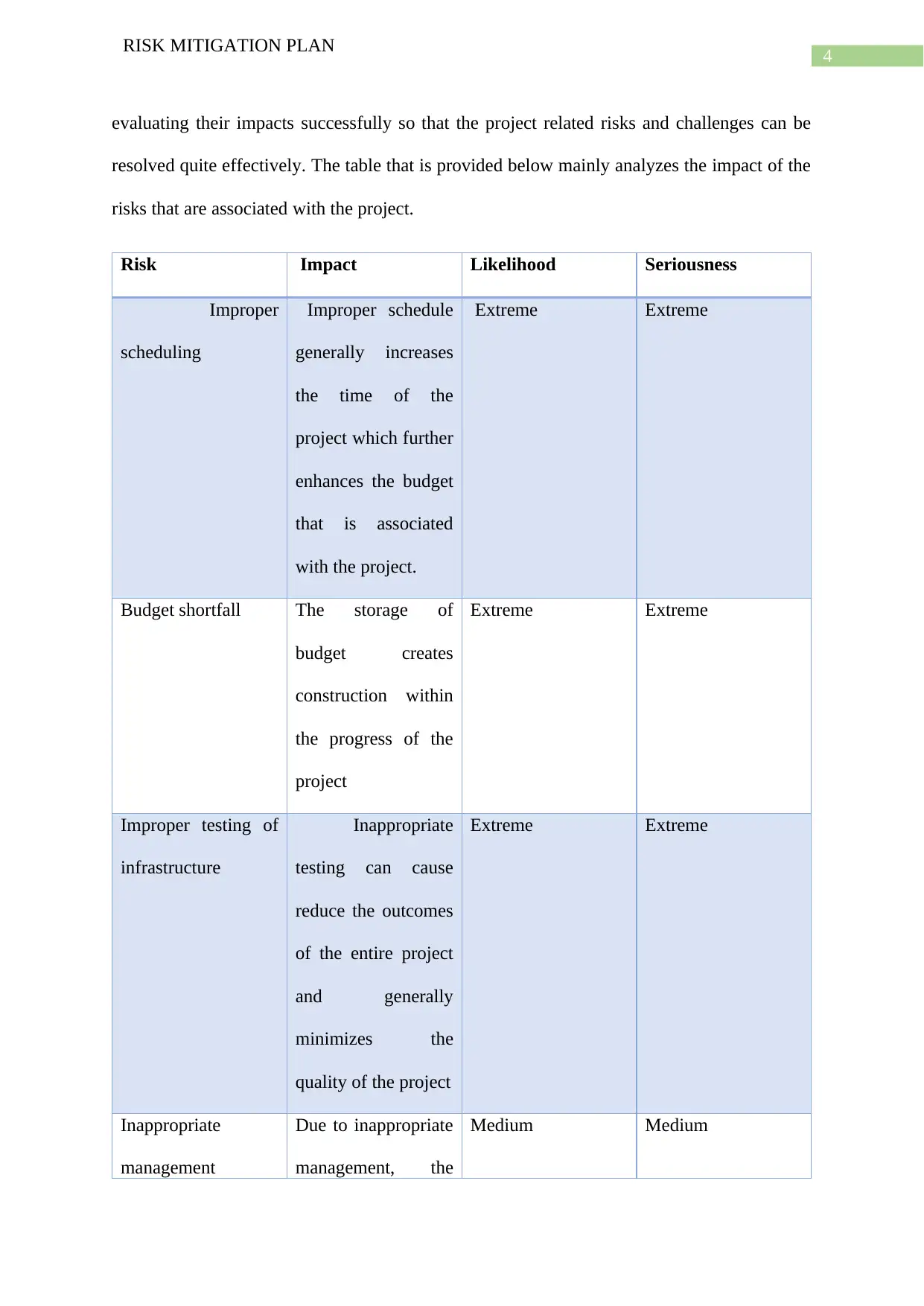
evaluating their impacts successfully so that the project related risks and challenges can be
resolved quite effectively. The table that is provided below mainly analyzes the impact of the
risks that are associated with the project.
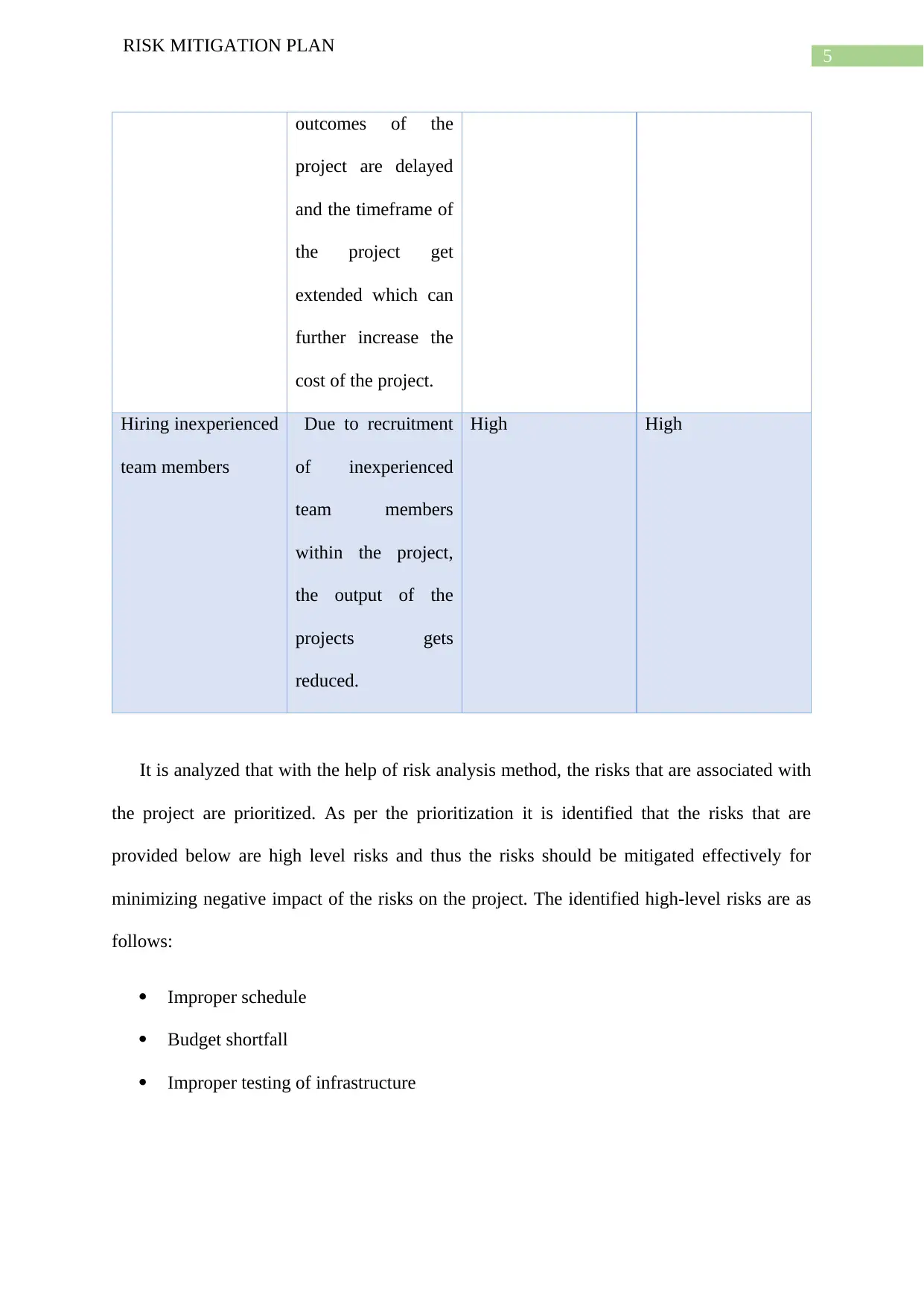
Risk Impact Likelihood Seriousness
Improper
scheduling
Improper schedule
generally increases
the time of the
project which further
enhances the budget
that is associated
with the project.
Extreme Extreme
Budget shortfall The storage of
budget creates
construction within
the progress of the
project
Extreme Extreme
Improper testing of
infrastructure
Inappropriate
testing can cause
reduce the outcomes
of the entire project
and generally
minimizes the
quality of the project
Extreme Extreme
Inappropriate
management
Due to inappropriate
management, the
Medium Medium
Document Page
5
RISK MITIGATION PLAN
outcomes of the
project are delayed
and the timeframe of
the project get
extended which can
further increase the
cost of the project.
Hiring inexperienced
team members
Due to recruitment
of inexperienced
team members
within the project,
the output of the
projects gets
reduced.
High High
It is analyzed that with the help of risk analysis method, the risks that are associated with
the project are prioritized. As per the prioritization it is identified that the risks that are
provided below are high level risks and thus the risks should be mitigated effectively for
minimizing negative impact of the risks on the project. The identified high-level risks are as
follows:
Improper schedule
Budget shortfall
Improper testing of infrastructure
Document Page
6
RISK MITIGATION PLAN
4. Risk mitigation
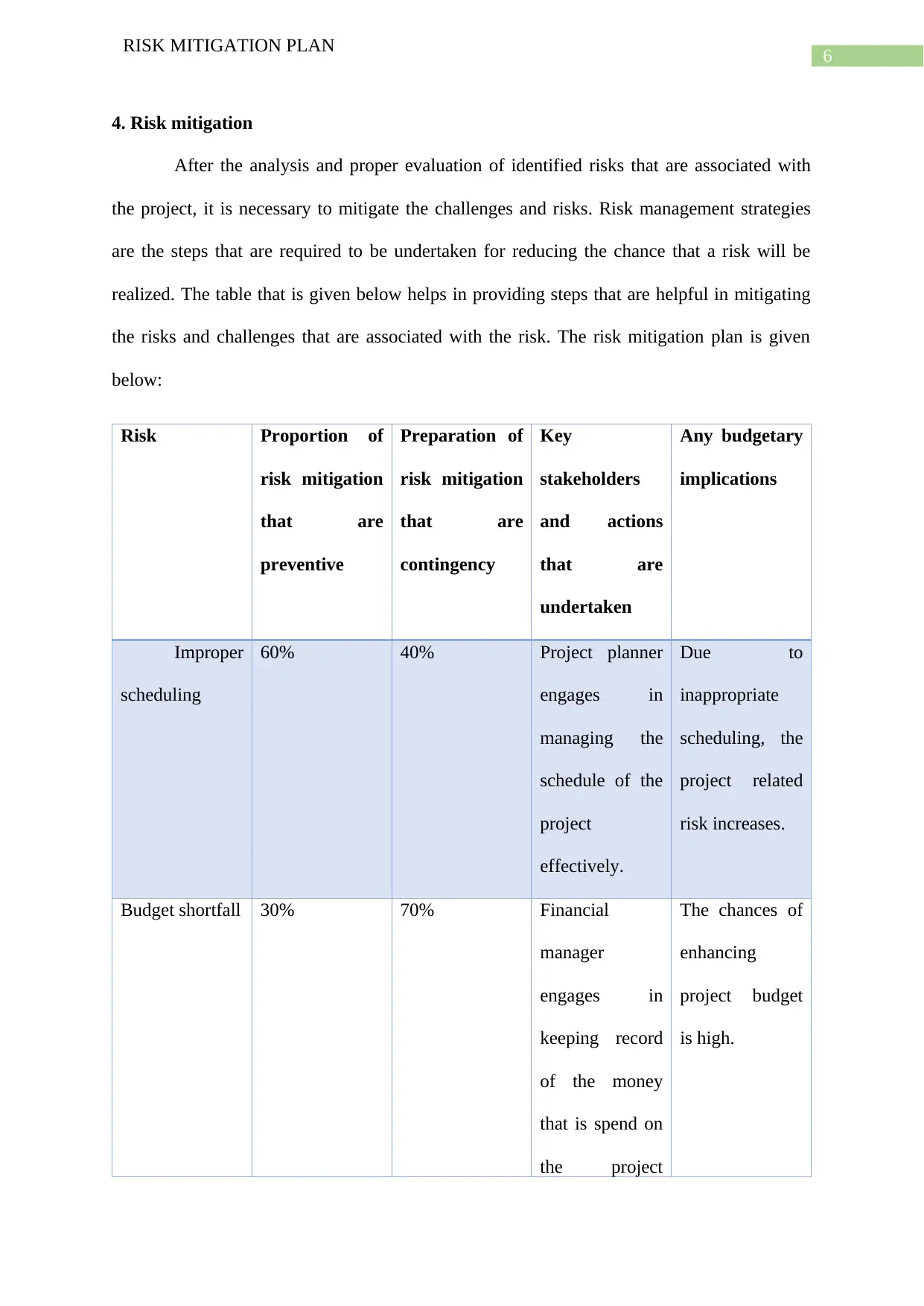
After the analysis and proper evaluation of identified risks that are associated with
the project, it is necessary to mitigate the challenges and risks. Risk management strategies
are the steps that are required to be undertaken for reducing the chance that a risk will be
realized. The table that is given below helps in providing steps that are helpful in mitigating
the risks and challenges that are associated with the risk. The risk mitigation plan is given
below:
Risk Proportion of
risk mitigation
that are
preventive
Preparation of
risk mitigation
that are
contingency
Key
stakeholders
and actions
that are
undertaken
Any budgetary
implications
Improper
scheduling
60% 40% Project planner
engages in
managing the
schedule of the
project
effectively.
Due to
inappropriate
scheduling, the
project related
risk increases.
Budget shortfall 30% 70% Financial
manager
engages in
keeping record
of the money
that is spend on
the project
The chances of
enhancing
project budget
is high.
tabler-icon-diamond-filled.svg

Paraphrase This Document

Need a fresh take? Get an instant paraphrase of this document with our AI Paraphraser
Document Page
7
RISK MITIGATION PLAN
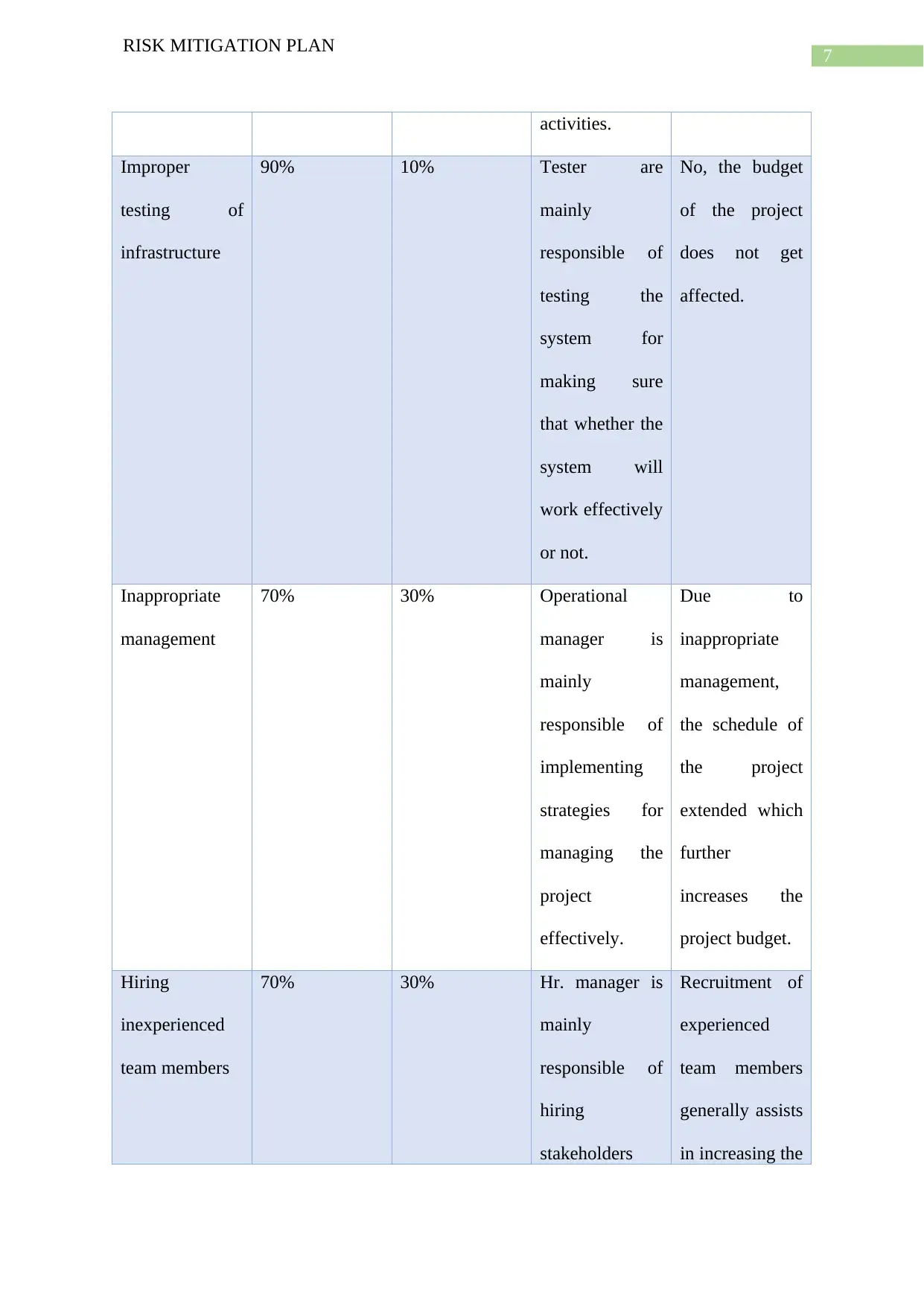
activities.
Improper
testing of
infrastructure
90% 10% Tester are
mainly
responsible of
testing the
system for
making sure
that whether the
system will
work effectively
or not.
No, the budget
of the project
does not get
affected.
Inappropriate
management
70% 30% Operational
manager is
mainly
responsible of
implementing
strategies for
managing the
project
effectively.
Due to
inappropriate
management,
the schedule of
the project
extended which
further
increases the
project budget.
Hiring
inexperienced
team members
70% 30% Hr. manager is
mainly
responsible of
hiring
stakeholders
Recruitment of
experienced
team members
generally assists
in increasing the
Document Page
8
RISK MITIGATION PLAN
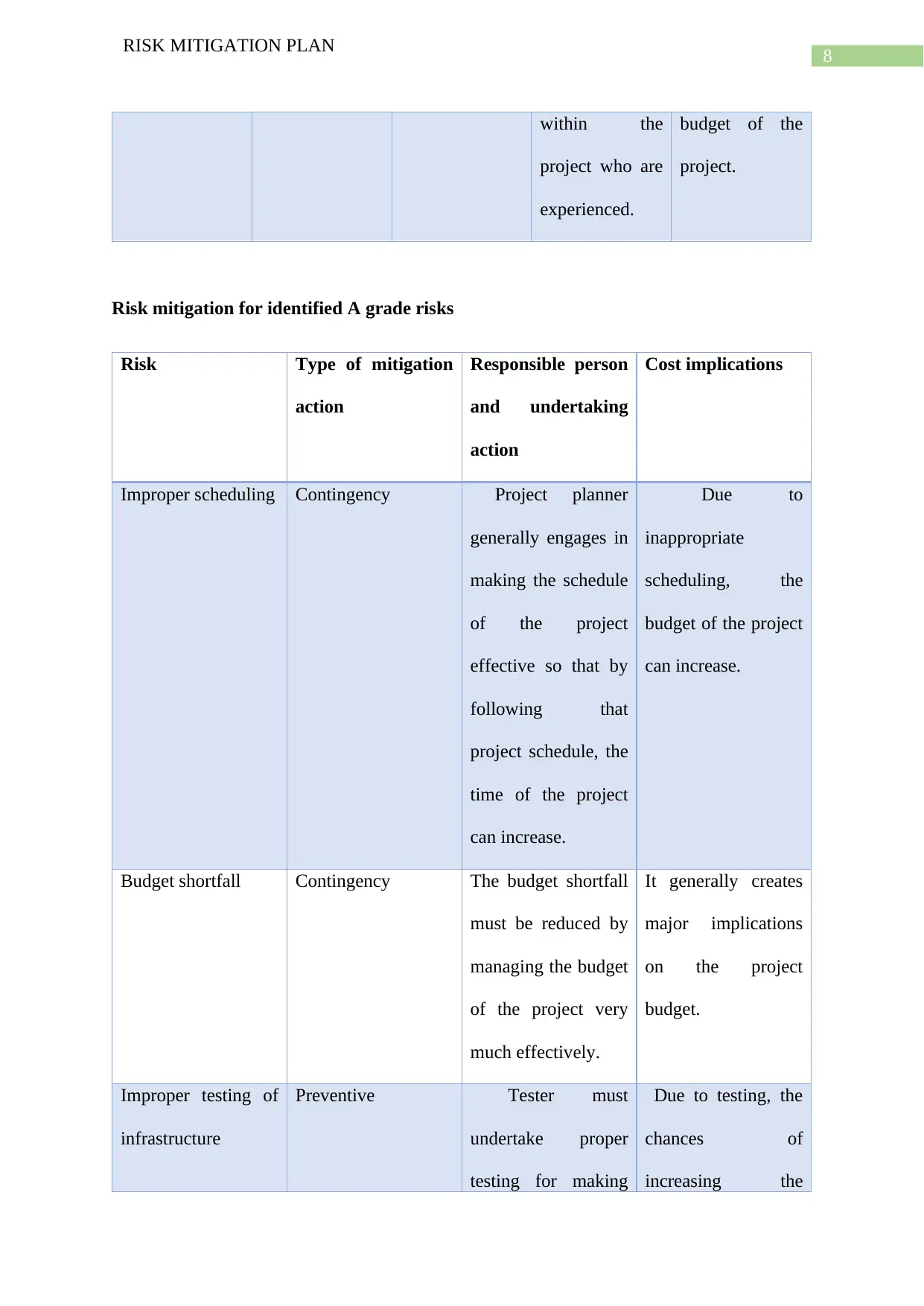
within the
project who are
experienced.
budget of the
project.
Risk mitigation for identified A grade risks
Risk Type of mitigation
action
Responsible person
and undertaking
action
Cost implications
Improper scheduling Contingency Project planner
generally engages in
making the schedule
of the project
effective so that by
following that
project schedule, the
time of the project
can increase.
Due to
inappropriate
scheduling, the
budget of the project
can increase.
Budget shortfall Contingency The budget shortfall
must be reduced by
managing the budget
of the project very
much effectively.
It generally creates
major implications
on the project
budget.
Improper testing of
infrastructure
Preventive Tester must
undertake proper
testing for making
Due to testing, the
chances of
increasing the
Document Page
9
RISK MITIGATION PLAN
sure that the testing
is done with the help
of proper testing
infrastructure are
helpful
budget of the project
generally increases.
5. Risk monitoring
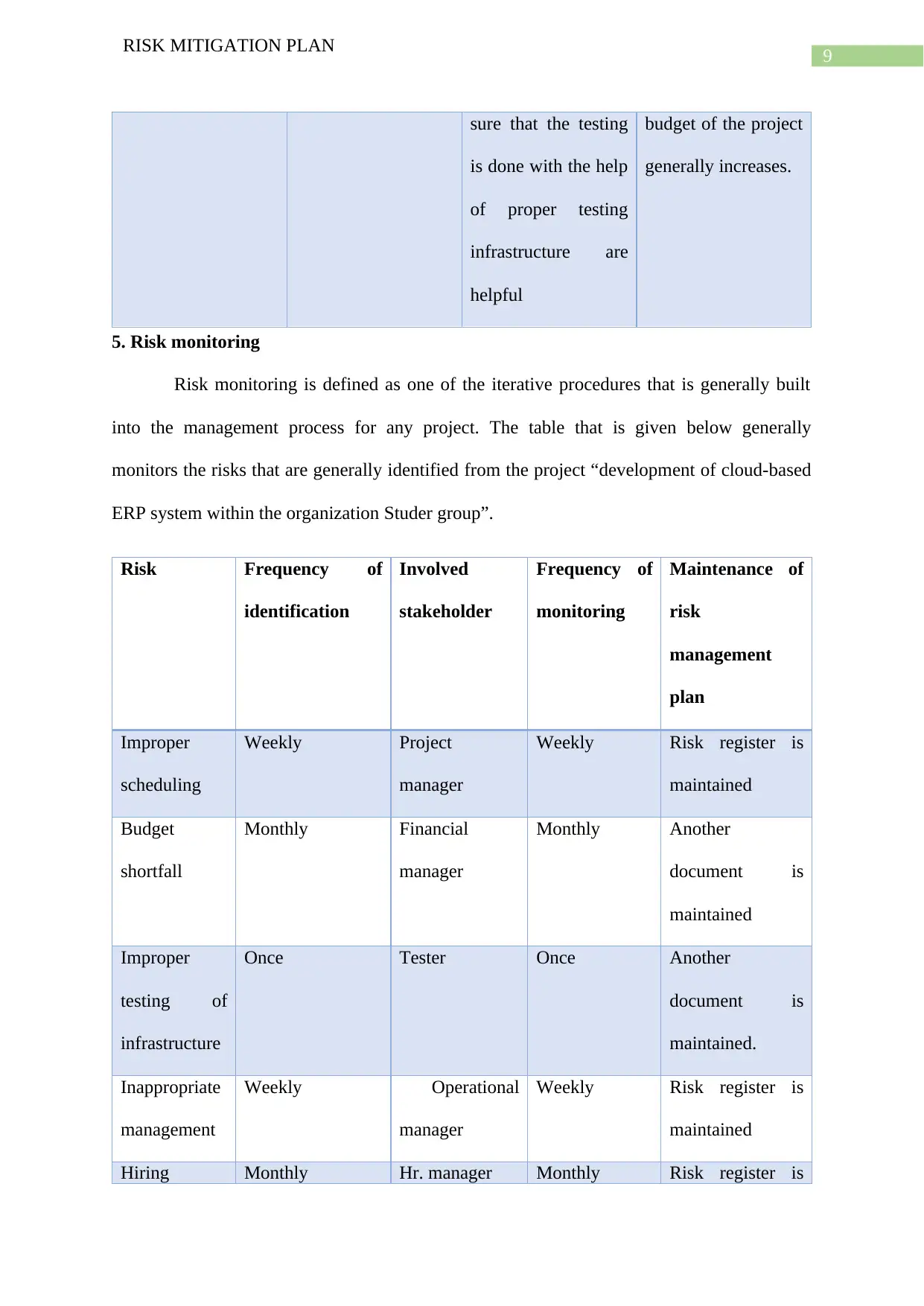
Risk monitoring is defined as one of the iterative procedures that is generally built
into the management process for any project. The table that is given below generally
monitors the risks that are generally identified from the project “development of cloud-based
ERP system within the organization Studer group”.
Risk Frequency of
identification
Involved
stakeholder
Frequency of
monitoring
Maintenance of
risk
management
plan
Improper
scheduling
Weekly Project
manager
Weekly Risk register is
maintained
Budget
shortfall
Monthly Financial
manager
Monthly Another
document is
maintained
Improper
testing of
infrastructure
Once Tester Once Another
document is
maintained.
Inappropriate
management
Weekly Operational
manager
Weekly Risk register is
maintained
Hiring Monthly Hr. manager Monthly Risk register is
tabler-icon-diamond-filled.svg

Paraphrase This Document

Need a fresh take? Get an instant paraphrase of this document with our AI Paraphraser
Document Page
10
RISK MITIGATION PLAN
inexperienced
team
members
maintained
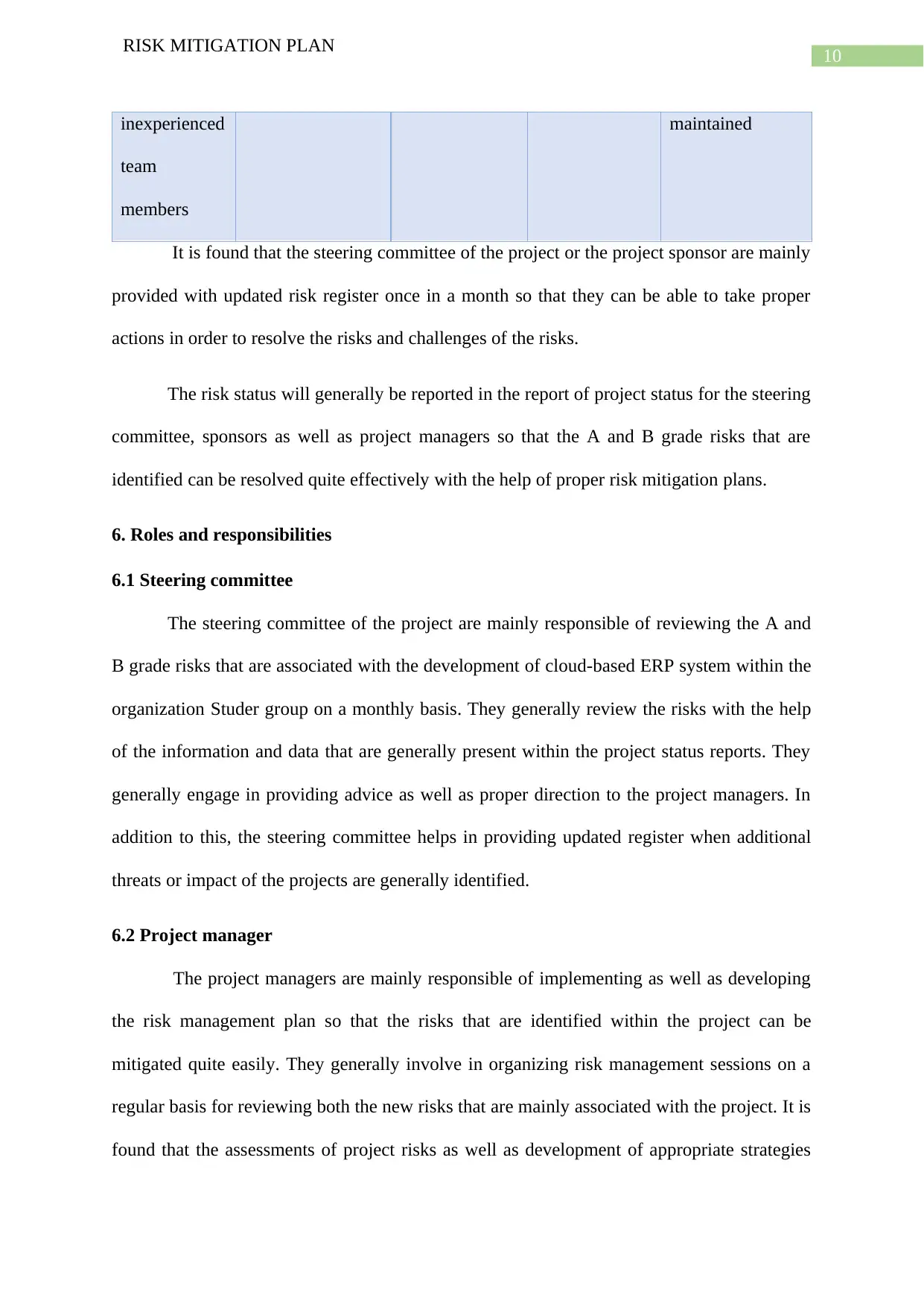
It is found that the steering committee of the project or the project sponsor are mainly
provided with updated risk register once in a month so that they can be able to take proper
actions in order to resolve the risks and challenges of the risks.
The risk status will generally be reported in the report of project status for the steering
committee, sponsors as well as project managers so that the A and B grade risks that are
identified can be resolved quite effectively with the help of proper risk mitigation plans.
6. Roles and responsibilities
6.1 Steering committee
The steering committee of the project are mainly responsible of reviewing the A and
B grade risks that are associated with the development of cloud-based ERP system within the
organization Studer group on a monthly basis. They generally review the risks with the help
of the information and data that are generally present within the project status reports. They
generally engage in providing advice as well as proper direction to the project managers. In
addition to this, the steering committee helps in providing updated register when additional
threats or impact of the projects are generally identified.
6.2 Project manager
The project managers are mainly responsible of implementing as well as developing
the risk management plan so that the risks that are identified within the project can be
mitigated quite easily. They generally involve in organizing risk management sessions on a
regular basis for reviewing both the new risks that are mainly associated with the project. It is
found that the assessments of project risks as well as development of appropriate strategies
Document Page
11
RISK MITIGATION PLAN
for managing the project related risks are mainly recommended by the project manager.
Additionally, assists in giving project status report to the steering committee of the project so
that they can be able to adopt proper methods and techniques for managing the risks and
challenges.
6.3 Project team
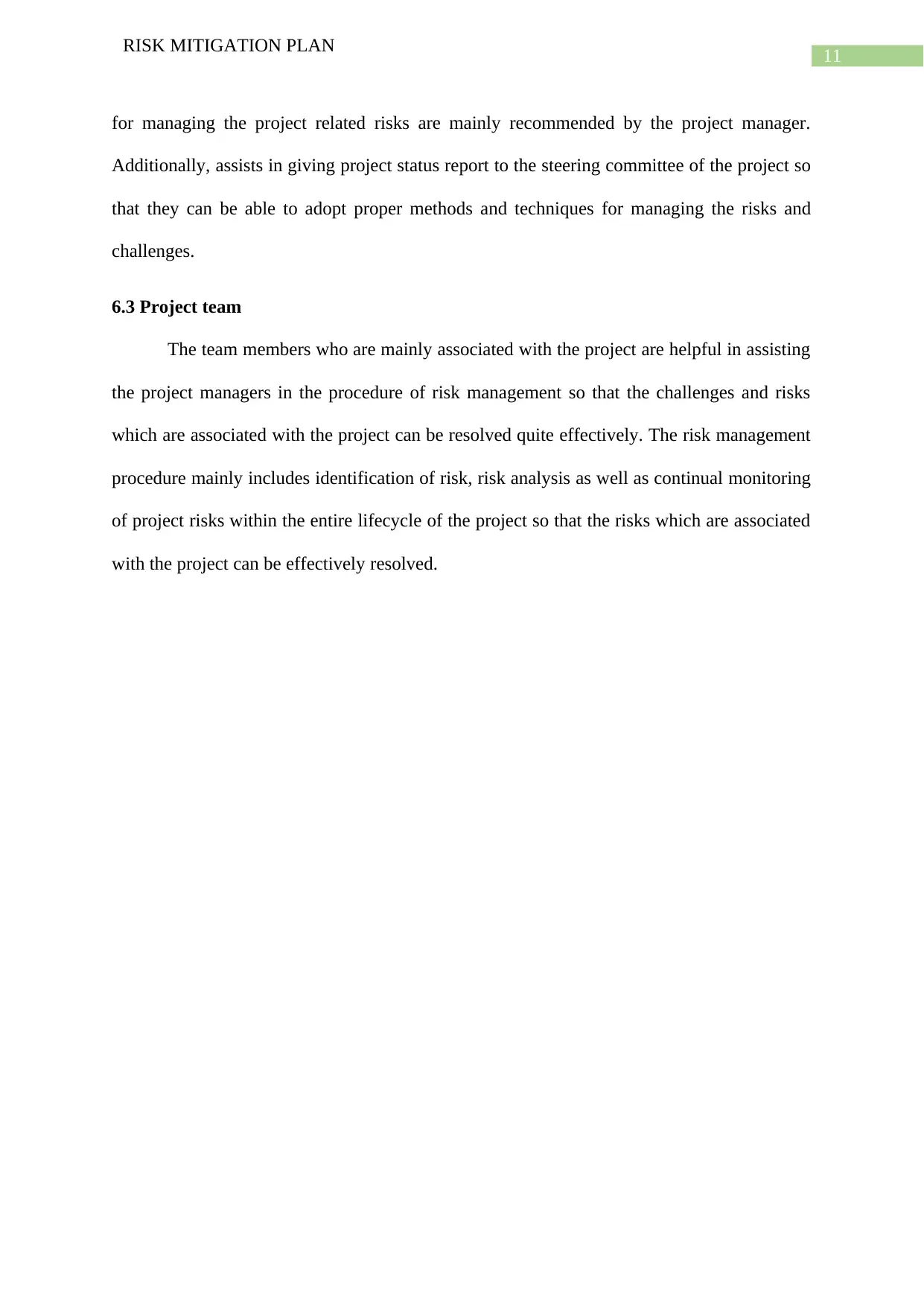
The team members who are mainly associated with the project are helpful in assisting
the project managers in the procedure of risk management so that the challenges and risks
which are associated with the project can be resolved quite effectively. The risk management
procedure mainly includes identification of risk, risk analysis as well as continual monitoring
of project risks within the entire lifecycle of the project so that the risks which are associated
with the project can be effectively resolved.
chevron_up_icon
1 out of 18
circle_padding
hide_on_mobile
zoom_out_icon
[object Object]