Melbourne University: Cloud Computing Impact on SMEs, T2 2018
VerifiedAdded on 2023/06/03
|17
|4835
|350
Report
AI Summary
This research report, BUSN20016, explores the impact of cloud computing on the operational performance of Small and Medium Enterprises (SMEs). The study, conducted in T2 2018 at Melbourne Campus, investigates the benefits and challenges of cloud adoption, aiming to identify the impact of cloud computing, the restraints encountered post-adoption, and potential solutions to mitigate these issues. The methodology includes an interpretivism philosophy, deductive approach, and a mixed research design employing surveys and literature review. The report presents a detailed analysis of the problem statement, research aims and objectives, justification, conceptual framework, hypotheses, and methodology, including data collection, analysis, and ethical considerations. The study also covers the organization structure, budget, and timeline, providing a comprehensive overview of cloud computing's influence on SMEs and offering insights for sustainable business practices. The report is a valuable resource for understanding the nuances of cloud computing in the SME context.
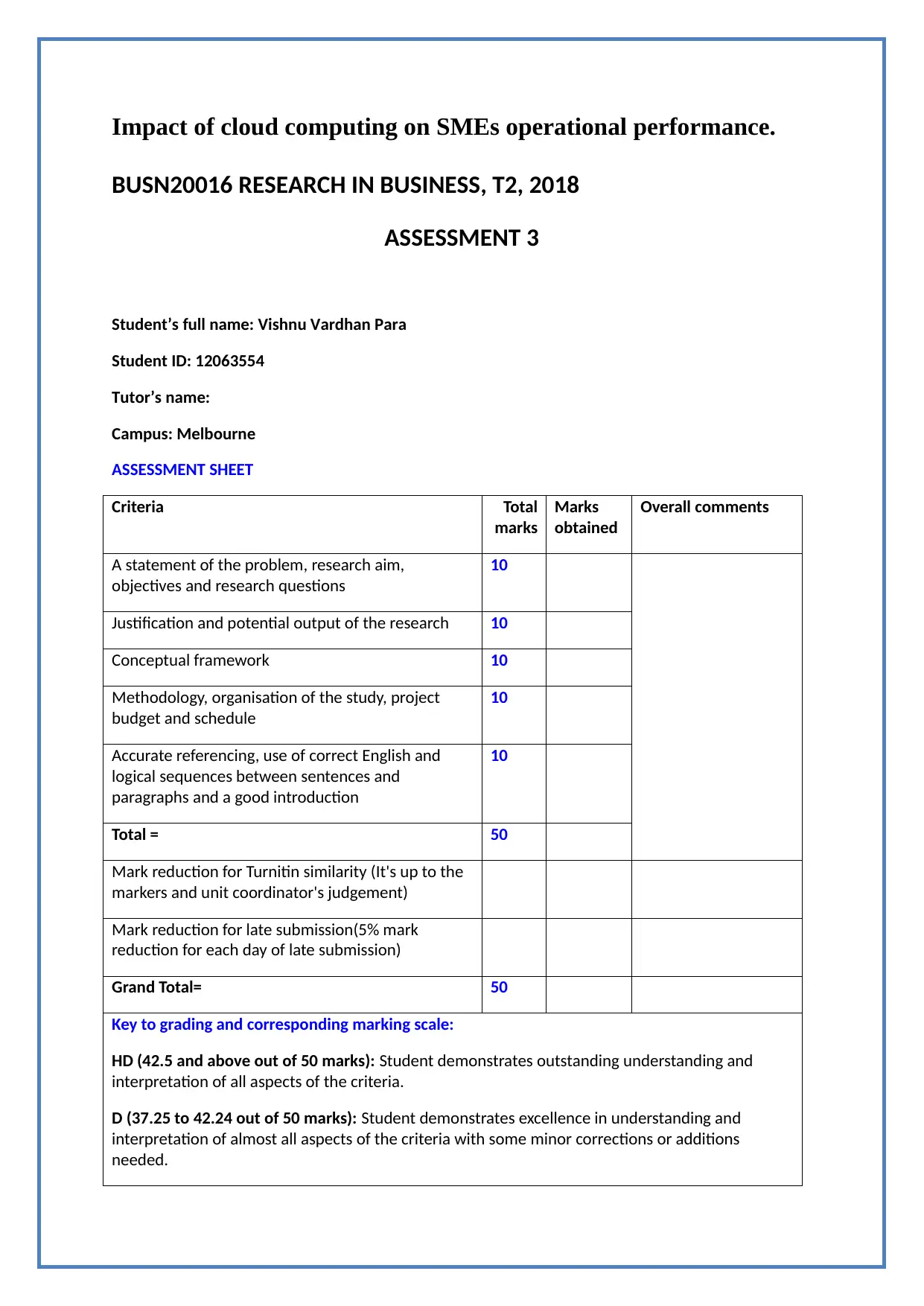
Impact of cloud computing on SMEs operational performance.
BUSN20016 RESEARCH IN BUSINESS, T2, 2018
ASSESSMENT 3
Student’s full name: Vishnu Vardhan Para
Student ID: 12063554
Tutor’s name:
Campus: Melbourne
ASSESSMENT SHEET
Criteria Total
marks
Marks
obtained
Overall comments
A statement of the problem, research aim,
objectives and research questions
10
Justification and potential output of the research 10
Conceptual framework 10
Methodology, organisation of the study, project
budget and schedule
10
Accurate referencing, use of correct English and
logical sequences between sentences and
paragraphs and a good introduction
10
Total = 50
Mark reduction for Turnitin similarity (It's up to the
markers and unit coordinator's judgement)
Mark reduction for late submission(5% mark
reduction for each day of late submission)
Grand Total= 50
Key to grading and corresponding marking scale:
HD (42.5 and above out of 50 marks): Student demonstrates outstanding understanding and
interpretation of all aspects of the criteria.
D (37.25 to 42.24 out of 50 marks): Student demonstrates excellence in understanding and
interpretation of almost all aspects of the criteria with some minor corrections or additions
needed.
BUSN20016 RESEARCH IN BUSINESS, T2, 2018
ASSESSMENT 3
Student’s full name: Vishnu Vardhan Para
Student ID: 12063554
Tutor’s name:
Campus: Melbourne
ASSESSMENT SHEET
Criteria Total
marks
Marks
obtained
Overall comments
A statement of the problem, research aim,
objectives and research questions
10
Justification and potential output of the research 10
Conceptual framework 10
Methodology, organisation of the study, project
budget and schedule
10
Accurate referencing, use of correct English and
logical sequences between sentences and
paragraphs and a good introduction
10
Total = 50
Mark reduction for Turnitin similarity (It's up to the
markers and unit coordinator's judgement)
Mark reduction for late submission(5% mark
reduction for each day of late submission)
Grand Total= 50
Key to grading and corresponding marking scale:
HD (42.5 and above out of 50 marks): Student demonstrates outstanding understanding and
interpretation of all aspects of the criteria.
D (37.25 to 42.24 out of 50 marks): Student demonstrates excellence in understanding and
interpretation of almost all aspects of the criteria with some minor corrections or additions
needed.

Paraphrase This Document
Need a fresh take? Get an instant paraphrase of this document with our AI Paraphraser

C (32.25 to 37.24 marks out of 50 marks): Student demonstrates very good understanding and
interpretation of most aspects of the criteria with some need for additional work, additions or
improvement.
P (24.75% to 32.24% marks): Student demonstrates good understanding and interpretation of the
criteria to warrant the award of a Pass but requires considerable additional work, additions or
improvement.
F (below 24.7%): Student demonstrates an unsatisfactory understanding and interpretation of the
criteria and requires major additional work, additions or improvement to achieve a passing grade.
October 2018
interpretation of most aspects of the criteria with some need for additional work, additions or
improvement.
P (24.75% to 32.24% marks): Student demonstrates good understanding and interpretation of the
criteria to warrant the award of a Pass but requires considerable additional work, additions or
improvement.
F (below 24.7%): Student demonstrates an unsatisfactory understanding and interpretation of the
criteria and requires major additional work, additions or improvement to achieve a passing grade.
October 2018
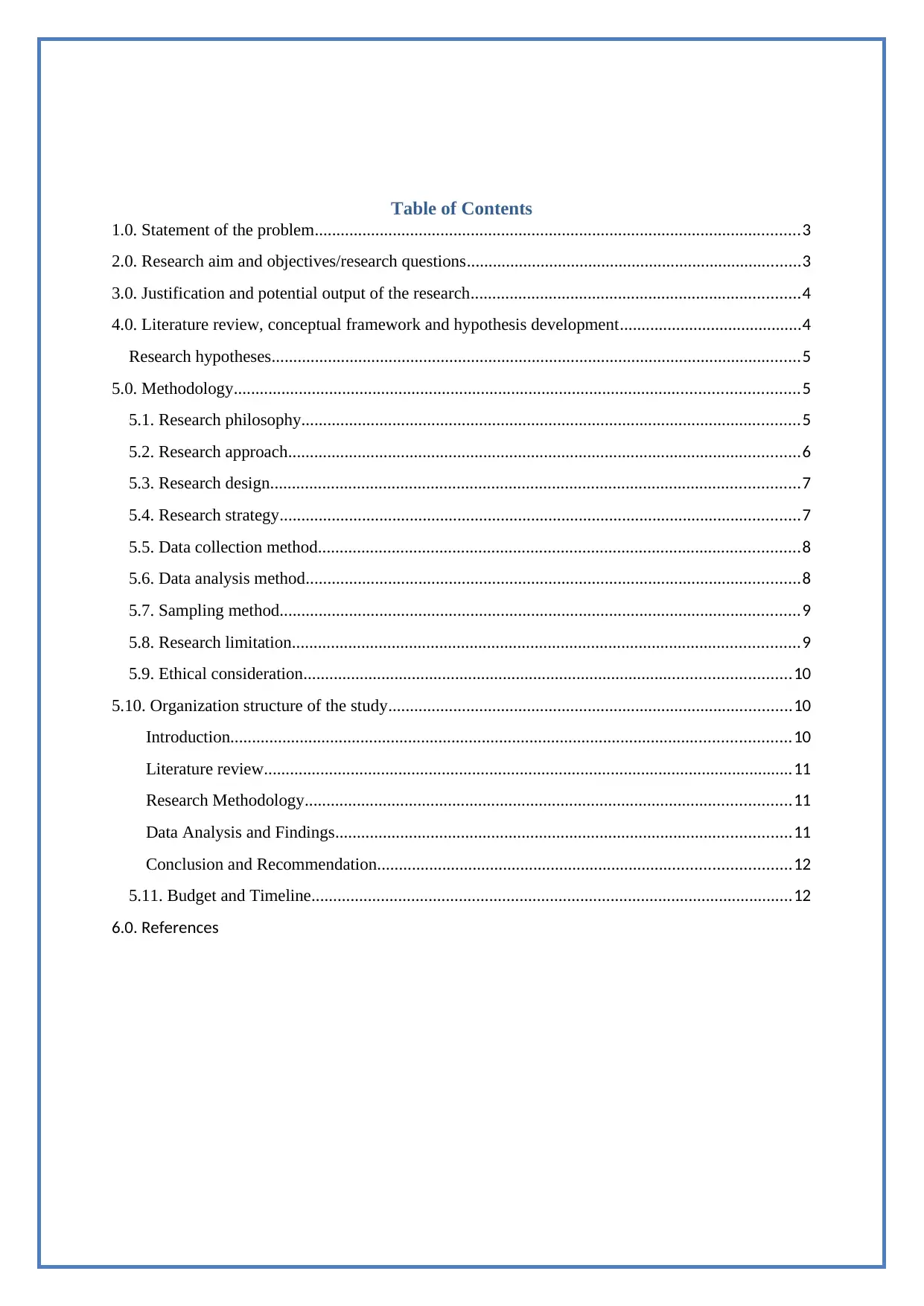
Table of Contents
1.0. Statement of the problem................................................................................................................3
2.0. Research aim and objectives/research questions.............................................................................3
3.0. Justification and potential output of the research............................................................................4
4.0. Literature review, conceptual framework and hypothesis development..........................................4
Research hypotheses..........................................................................................................................5
5.0. Methodology..................................................................................................................................5
5.1. Research philosophy...................................................................................................................5
5.2. Research approach......................................................................................................................6
5.3. Research design..........................................................................................................................7
5.4. Research strategy........................................................................................................................7
5.5. Data collection method...............................................................................................................8
5.6. Data analysis method..................................................................................................................8
5.7. Sampling method........................................................................................................................9
5.8. Research limitation.....................................................................................................................9
5.9. Ethical consideration................................................................................................................10
5.10. Organization structure of the study.............................................................................................10
Introduction.................................................................................................................................10
Literature review..........................................................................................................................11
Research Methodology................................................................................................................11
Data Analysis and Findings.........................................................................................................11
Conclusion and Recommendation...............................................................................................12
5.11. Budget and Timeline...............................................................................................................12
6.0. References
1.0. Statement of the problem................................................................................................................3
2.0. Research aim and objectives/research questions.............................................................................3
3.0. Justification and potential output of the research............................................................................4
4.0. Literature review, conceptual framework and hypothesis development..........................................4
Research hypotheses..........................................................................................................................5
5.0. Methodology..................................................................................................................................5
5.1. Research philosophy...................................................................................................................5
5.2. Research approach......................................................................................................................6
5.3. Research design..........................................................................................................................7
5.4. Research strategy........................................................................................................................7
5.5. Data collection method...............................................................................................................8
5.6. Data analysis method..................................................................................................................8
5.7. Sampling method........................................................................................................................9
5.8. Research limitation.....................................................................................................................9
5.9. Ethical consideration................................................................................................................10
5.10. Organization structure of the study.............................................................................................10
Introduction.................................................................................................................................10
Literature review..........................................................................................................................11
Research Methodology................................................................................................................11
Data Analysis and Findings.........................................................................................................11
Conclusion and Recommendation...............................................................................................12
5.11. Budget and Timeline...............................................................................................................12
6.0. References
⊘ This is a preview!⊘
Do you want full access?
Subscribe today to unlock all pages.

Trusted by 1+ million students worldwide
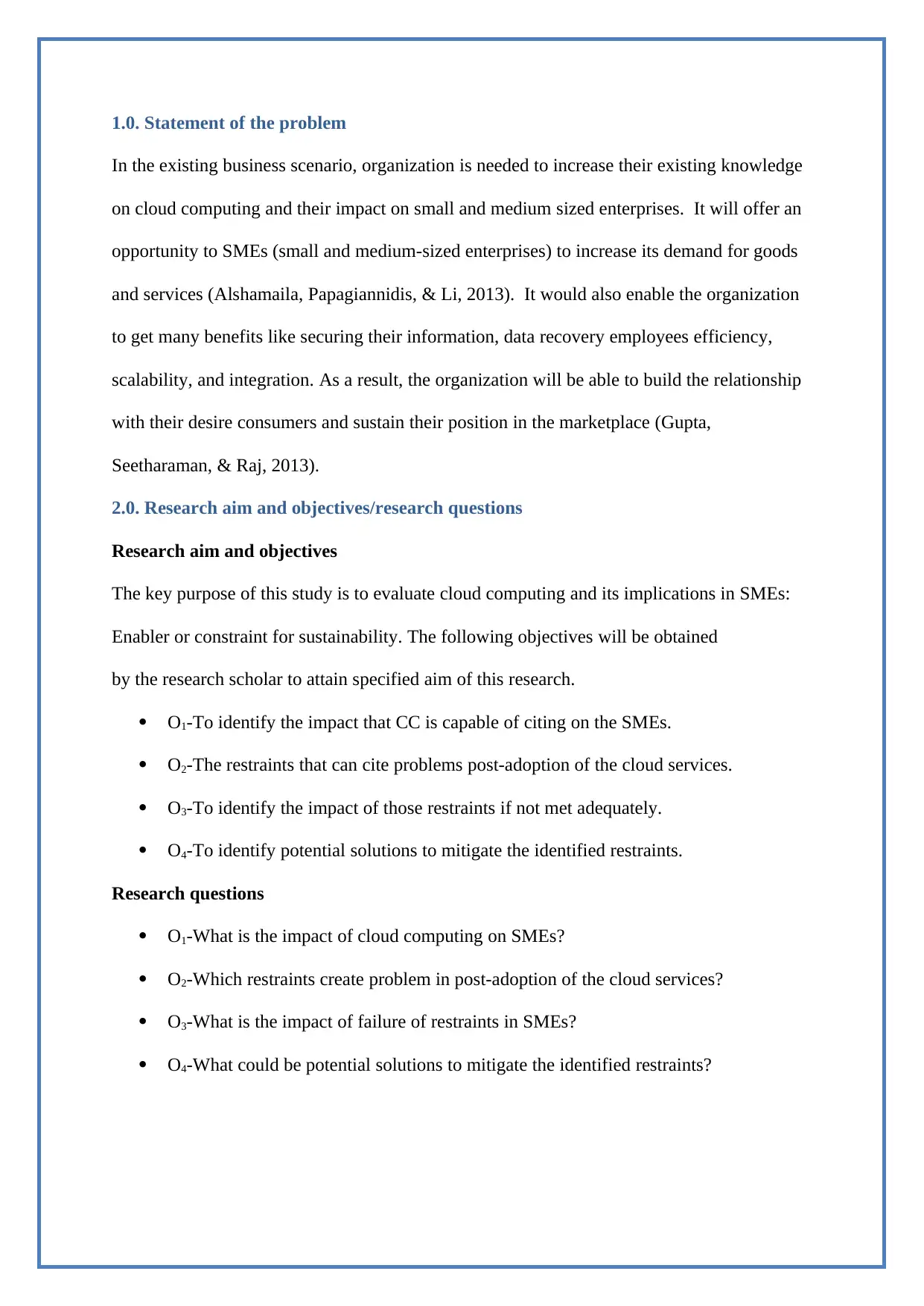
1.0. Statement of the problem
In the existing business scenario, organization is needed to increase their existing knowledge
on cloud computing and their impact on small and medium sized enterprises. It will offer an
opportunity to SMEs (small and medium-sized enterprises) to increase its demand for goods
and services (Alshamaila, Papagiannidis, & Li, 2013). It would also enable the organization
to get many benefits like securing their information, data recovery employees efficiency,
scalability, and integration. As a result, the organization will be able to build the relationship
with their desire consumers and sustain their position in the marketplace (Gupta,
Seetharaman, & Raj, 2013).
2.0. Research aim and objectives/research questions
Research aim and objectives
The key purpose of this study is to evaluate cloud computing and its implications in SMEs:
Enabler or constraint for sustainability. The following objectives will be obtained
by the research scholar to attain specified aim of this research.
O1-To identify the impact that CC is capable of citing on the SMEs.
O2-The restraints that can cite problems post-adoption of the cloud services.
O3-To identify the impact of those restraints if not met adequately.
O4-To identify potential solutions to mitigate the identified restraints.
Research questions
O1-What is the impact of cloud computing on SMEs?
O2-Which restraints create problem in post-adoption of the cloud services?
O3-What is the impact of failure of restraints in SMEs?
O4-What could be potential solutions to mitigate the identified restraints?
In the existing business scenario, organization is needed to increase their existing knowledge
on cloud computing and their impact on small and medium sized enterprises. It will offer an
opportunity to SMEs (small and medium-sized enterprises) to increase its demand for goods
and services (Alshamaila, Papagiannidis, & Li, 2013). It would also enable the organization
to get many benefits like securing their information, data recovery employees efficiency,
scalability, and integration. As a result, the organization will be able to build the relationship
with their desire consumers and sustain their position in the marketplace (Gupta,
Seetharaman, & Raj, 2013).
2.0. Research aim and objectives/research questions
Research aim and objectives
The key purpose of this study is to evaluate cloud computing and its implications in SMEs:
Enabler or constraint for sustainability. The following objectives will be obtained
by the research scholar to attain specified aim of this research.
O1-To identify the impact that CC is capable of citing on the SMEs.
O2-The restraints that can cite problems post-adoption of the cloud services.
O3-To identify the impact of those restraints if not met adequately.
O4-To identify potential solutions to mitigate the identified restraints.
Research questions
O1-What is the impact of cloud computing on SMEs?
O2-Which restraints create problem in post-adoption of the cloud services?
O3-What is the impact of failure of restraints in SMEs?
O4-What could be potential solutions to mitigate the identified restraints?
Paraphrase This Document
Need a fresh take? Get an instant paraphrase of this document with our AI Paraphraser
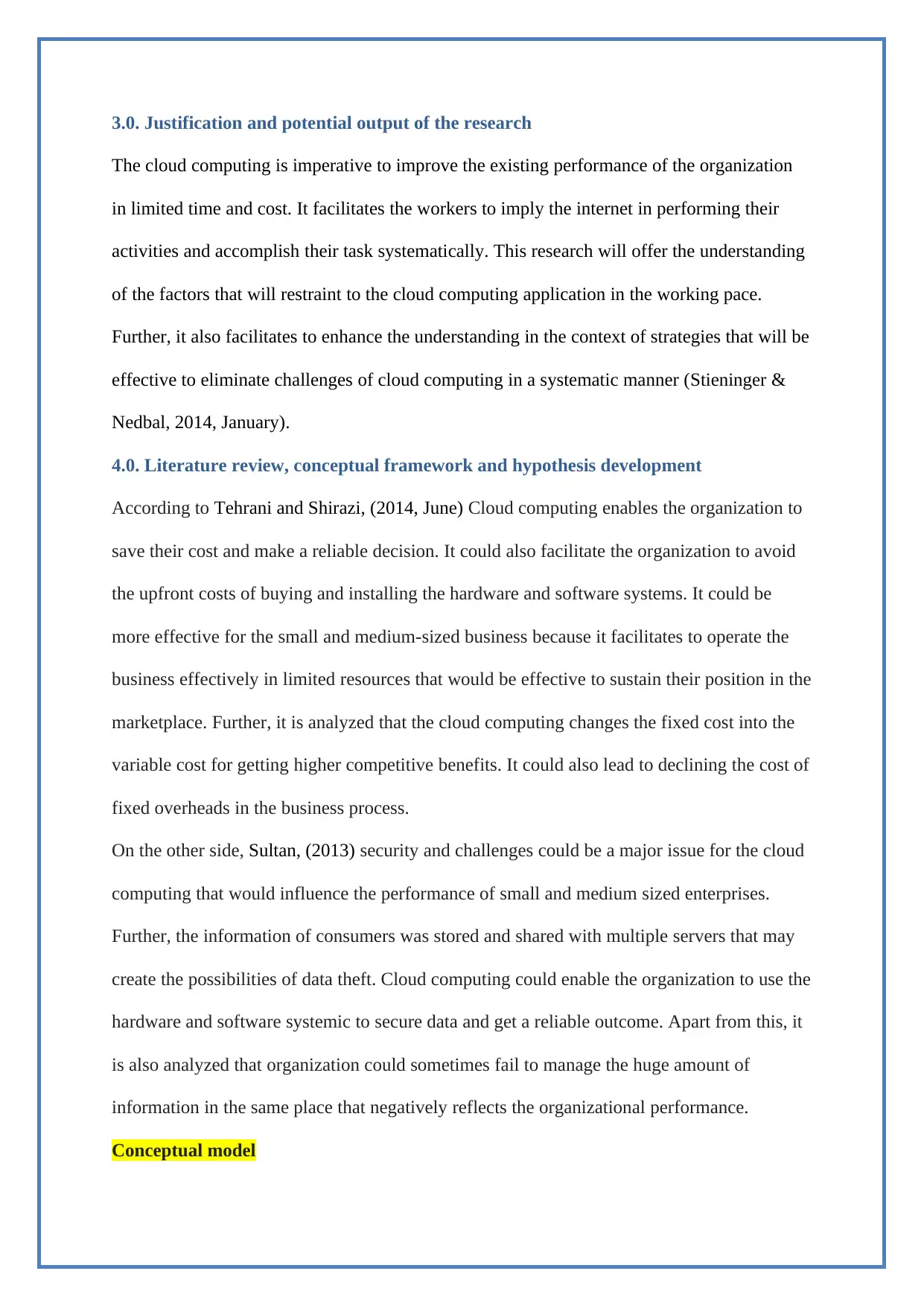
3.0. Justification and potential output of the research
The cloud computing is imperative to improve the existing performance of the organization
in limited time and cost. It facilitates the workers to imply the internet in performing their
activities and accomplish their task systematically. This research will offer the understanding
of the factors that will restraint to the cloud computing application in the working pace.
Further, it also facilitates to enhance the understanding in the context of strategies that will be
effective to eliminate challenges of cloud computing in a systematic manner (Stieninger &
Nedbal, 2014, January).
4.0. Literature review, conceptual framework and hypothesis development
According to Tehrani and Shirazi, (2014, June) Cloud computing enables the organization to
save their cost and make a reliable decision. It could also facilitate the organization to avoid
the upfront costs of buying and installing the hardware and software systems. It could be
more effective for the small and medium-sized business because it facilitates to operate the
business effectively in limited resources that would be effective to sustain their position in the
marketplace. Further, it is analyzed that the cloud computing changes the fixed cost into the
variable cost for getting higher competitive benefits. It could also lead to declining the cost of
fixed overheads in the business process.
On the other side, Sultan, (2013) security and challenges could be a major issue for the cloud
computing that would influence the performance of small and medium sized enterprises.
Further, the information of consumers was stored and shared with multiple servers that may
create the possibilities of data theft. Cloud computing could enable the organization to use the
hardware and software systemic to secure data and get a reliable outcome. Apart from this, it
is also analyzed that organization could sometimes fail to manage the huge amount of
information in the same place that negatively reflects the organizational performance.
Conceptual model
The cloud computing is imperative to improve the existing performance of the organization
in limited time and cost. It facilitates the workers to imply the internet in performing their
activities and accomplish their task systematically. This research will offer the understanding
of the factors that will restraint to the cloud computing application in the working pace.
Further, it also facilitates to enhance the understanding in the context of strategies that will be
effective to eliminate challenges of cloud computing in a systematic manner (Stieninger &
Nedbal, 2014, January).
4.0. Literature review, conceptual framework and hypothesis development
According to Tehrani and Shirazi, (2014, June) Cloud computing enables the organization to
save their cost and make a reliable decision. It could also facilitate the organization to avoid
the upfront costs of buying and installing the hardware and software systems. It could be
more effective for the small and medium-sized business because it facilitates to operate the
business effectively in limited resources that would be effective to sustain their position in the
marketplace. Further, it is analyzed that the cloud computing changes the fixed cost into the
variable cost for getting higher competitive benefits. It could also lead to declining the cost of
fixed overheads in the business process.
On the other side, Sultan, (2013) security and challenges could be a major issue for the cloud
computing that would influence the performance of small and medium sized enterprises.
Further, the information of consumers was stored and shared with multiple servers that may
create the possibilities of data theft. Cloud computing could enable the organization to use the
hardware and software systemic to secure data and get a reliable outcome. Apart from this, it
is also analyzed that organization could sometimes fail to manage the huge amount of
information in the same place that negatively reflects the organizational performance.
Conceptual model
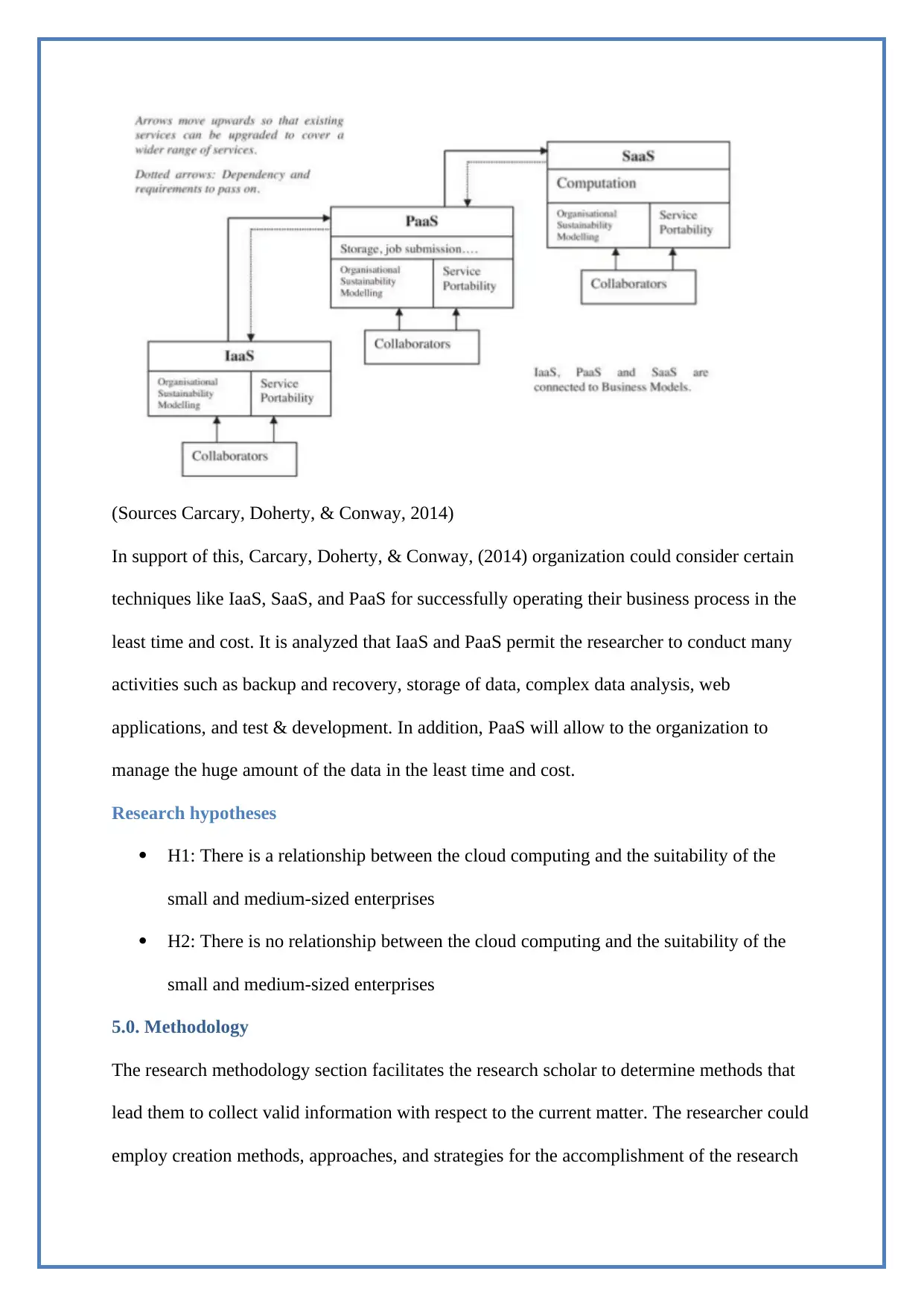
(Sources Carcary, Doherty, & Conway, 2014)
In support of this, Carcary, Doherty, & Conway, (2014) organization could consider certain
techniques like IaaS, SaaS, and PaaS for successfully operating their business process in the
least time and cost. It is analyzed that IaaS and PaaS permit the researcher to conduct many
activities such as backup and recovery, storage of data, complex data analysis, web
applications, and test & development. In addition, PaaS will allow to the organization to
manage the huge amount of the data in the least time and cost.
Research hypotheses
H1: There is a relationship between the cloud computing and the suitability of the
small and medium-sized enterprises
H2: There is no relationship between the cloud computing and the suitability of the
small and medium-sized enterprises
5.0. Methodology
The research methodology section facilitates the research scholar to determine methods that
lead them to collect valid information with respect to the current matter. The researcher could
employ creation methods, approaches, and strategies for the accomplishment of the research
In support of this, Carcary, Doherty, & Conway, (2014) organization could consider certain
techniques like IaaS, SaaS, and PaaS for successfully operating their business process in the
least time and cost. It is analyzed that IaaS and PaaS permit the researcher to conduct many
activities such as backup and recovery, storage of data, complex data analysis, web
applications, and test & development. In addition, PaaS will allow to the organization to
manage the huge amount of the data in the least time and cost.
Research hypotheses
H1: There is a relationship between the cloud computing and the suitability of the
small and medium-sized enterprises
H2: There is no relationship between the cloud computing and the suitability of the
small and medium-sized enterprises
5.0. Methodology
The research methodology section facilitates the research scholar to determine methods that
lead them to collect valid information with respect to the current matter. The researcher could
employ creation methods, approaches, and strategies for the accomplishment of the research
⊘ This is a preview!⊘
Do you want full access?
Subscribe today to unlock all pages.
Trusted by 1+ million students worldwide
aim and objectives in an appropriate manner (Doherty, Carcary, & Conway, 2015).
Furthermore, it is also analyzed that these research methodologies could consider creation
sources to make a decision with respect to the research concern and obtain feasible data like
philosophies, strategies, designs, data collection data analysis sampling research limitation,
and ethical consideration. These are discussed as below:
5.1. Research philosophy
The research philosophy could be a belief about the methods by which the information about
the research matter will be gathered analyzed and used in the research matter. There are
creation methods that could be involved in the research like interpretivism philosophy,
realism philosophy, and positivism philosophy (Assante, Castro, Hamburg, and Martin,
2016). Further, it is examined that the interpretivism philosophy is an effective tool that
assists for collecting feasible data in the context of the current research matter and meet the
aim of research in a reliable manner. Apart from this, the positivist philosophy is used to
collect the factual information in the context of the research matter (Yeboah-Boateng &
Essandoh, 2014). The realism philosophy is emphasized on the real data. In this research, the
interpretivism philosophy is practiced by the researcher and accomplishes the aim and
objective of specified study significantly. Moreover, other methods will not be considered by
the researcher due to the inappropriateness of the research matter.
5.2. Research approach
In the dissertation, approaches of research could also be essential in obtaining feasible
information with respect to the research matter. The research approach could employ
different methods in the study such as inductive and deductive approach. In this, inductive
approach is practice to collect non-numerical information about the research matter (Hsu, F.,
Ray, & Li-Hsieh, 2014). Apart from this, the deductive approach facilitates to develop the
research hypothesis on behalf of the current matter as it would be imperative to meet the aim
Furthermore, it is also analyzed that these research methodologies could consider creation
sources to make a decision with respect to the research concern and obtain feasible data like
philosophies, strategies, designs, data collection data analysis sampling research limitation,
and ethical consideration. These are discussed as below:
5.1. Research philosophy
The research philosophy could be a belief about the methods by which the information about
the research matter will be gathered analyzed and used in the research matter. There are
creation methods that could be involved in the research like interpretivism philosophy,
realism philosophy, and positivism philosophy (Assante, Castro, Hamburg, and Martin,
2016). Further, it is examined that the interpretivism philosophy is an effective tool that
assists for collecting feasible data in the context of the current research matter and meet the
aim of research in a reliable manner. Apart from this, the positivist philosophy is used to
collect the factual information in the context of the research matter (Yeboah-Boateng &
Essandoh, 2014). The realism philosophy is emphasized on the real data. In this research, the
interpretivism philosophy is practiced by the researcher and accomplishes the aim and
objective of specified study significantly. Moreover, other methods will not be considered by
the researcher due to the inappropriateness of the research matter.
5.2. Research approach
In the dissertation, approaches of research could also be essential in obtaining feasible
information with respect to the research matter. The research approach could employ
different methods in the study such as inductive and deductive approach. In this, inductive
approach is practice to collect non-numerical information about the research matter (Hsu, F.,
Ray, & Li-Hsieh, 2014). Apart from this, the deductive approach facilitates to develop the
research hypothesis on behalf of the current matter as it would be imperative to meet the aim
Paraphrase This Document
Need a fresh take? Get an instant paraphrase of this document with our AI Paraphraser
of research. In this research, the researcher will not use inductive approach because it
facilitates the researcher to collect the conceptual information about the Green Cloud
Computing and its implications in SMEs for sustainability. Moreover, the deductive approach
will be used the researcher to conduct their research and meet the specified research
objectives systematically (Garg, Versteeg & Buyya, 2013). Through this approach, the
researcher will develop a research hypothesis and accept or reject them on behalf of collected
data. In this, the researcher will be facilitated to get quality result with respect to the current
research matter.
5.3. Research design
Research design considers certain techniques to collect data in the context of the specified
research matter like qualitative, quantitative, and mixed method. The qualitative research
design is applied if the researcher has needed to collect theoretical information with respect to
any specified research matter. Apart from this, the quantitative research method could be
imperative in getting the factual information as it could be associated with any particular
research. Moreover, the mixed method is practiced for collecting quantitative as well as
quantitative information about the research matter (Gangwar, Date, & Ramaswamy, 2015).
For this research report, research scholar will practice mixed research design that facilitates
the research scholar to obtain numerical as well as non-numerical data in the context of Green
Cloud Computing and its implications in SMEs for sustainability. It could also be effective
for eliminating the disadvantages of both qualitative and quantitative research design as it
would be imperative to obtain the positive result in the favor of the desired outcome.
5.4. Research strategy
Research strategy leads to the researcher to select an appropriate method and obtain a reliable
result. There are creation strategies that could be imperative for the accomplishment of the
desired outcome such as survey through questionnaire, literature review, interview method,
facilitates the researcher to collect the conceptual information about the Green Cloud
Computing and its implications in SMEs for sustainability. Moreover, the deductive approach
will be used the researcher to conduct their research and meet the specified research
objectives systematically (Garg, Versteeg & Buyya, 2013). Through this approach, the
researcher will develop a research hypothesis and accept or reject them on behalf of collected
data. In this, the researcher will be facilitated to get quality result with respect to the current
research matter.
5.3. Research design
Research design considers certain techniques to collect data in the context of the specified
research matter like qualitative, quantitative, and mixed method. The qualitative research
design is applied if the researcher has needed to collect theoretical information with respect to
any specified research matter. Apart from this, the quantitative research method could be
imperative in getting the factual information as it could be associated with any particular
research. Moreover, the mixed method is practiced for collecting quantitative as well as
quantitative information about the research matter (Gangwar, Date, & Ramaswamy, 2015).
For this research report, research scholar will practice mixed research design that facilitates
the research scholar to obtain numerical as well as non-numerical data in the context of Green
Cloud Computing and its implications in SMEs for sustainability. It could also be effective
for eliminating the disadvantages of both qualitative and quantitative research design as it
would be imperative to obtain the positive result in the favor of the desired outcome.
5.4. Research strategy
Research strategy leads to the researcher to select an appropriate method and obtain a reliable
result. There are creation strategies that could be imperative for the accomplishment of the
desired outcome such as survey through questionnaire, literature review, interview method,
content analysis. It leads the researcher to collect the reliable data about the research matter.
For this dissertation, research scholar has use survey through questionnaire method that
facilitates investigator to collect their responses towards the research matter and obtain
reliable research (Brender, & Markov, 2013). Besides this, Investigator has also used
literature review tool for getting theoretical information about the research matter. It is
analyzed that suitable research strategy facilitates to meet specified aim and objectives of
research in a systematic manner.
5.5. Data collection method
Data collection method is imperative in gathering the information of the research issue in the
least time and cost. The data collection method could consider two kinds of methods like
primary data collection method and secondary data collection method. The primary data
collection method could facilitate the research scholar to get the fresh information or first-
hand data in the context of the current research matter (Ghaffari, Delgosha, and Abdolvand,
2014). The primary data is gathered by entailing many methods like an interview, survey
through a questionnaire, and observation method. Apart from this, the secondary data
collection techniques are effectively used by the research by considering many sources like a
journal, books, online and offline sources, articles, company web, and magazine (Lian, Yen,
& Wang, 2014).
In this research both primary as well as secondary data collection tool to meet the aim and
objectives of the research matter. The primary data collection techniques use the interview as
well as a survey through questionnaire method and collect the direct responses of the research
candidates about the research matter.
5.6. Data analysis method
Data analysis technique could be imperative in evaluating the collected information and reach
at the valid conclusions. In the data analysis technique, two kinds of methods are considered
For this dissertation, research scholar has use survey through questionnaire method that
facilitates investigator to collect their responses towards the research matter and obtain
reliable research (Brender, & Markov, 2013). Besides this, Investigator has also used
literature review tool for getting theoretical information about the research matter. It is
analyzed that suitable research strategy facilitates to meet specified aim and objectives of
research in a systematic manner.
5.5. Data collection method
Data collection method is imperative in gathering the information of the research issue in the
least time and cost. The data collection method could consider two kinds of methods like
primary data collection method and secondary data collection method. The primary data
collection method could facilitate the research scholar to get the fresh information or first-
hand data in the context of the current research matter (Ghaffari, Delgosha, and Abdolvand,
2014). The primary data is gathered by entailing many methods like an interview, survey
through a questionnaire, and observation method. Apart from this, the secondary data
collection techniques are effectively used by the research by considering many sources like a
journal, books, online and offline sources, articles, company web, and magazine (Lian, Yen,
& Wang, 2014).
In this research both primary as well as secondary data collection tool to meet the aim and
objectives of the research matter. The primary data collection techniques use the interview as
well as a survey through questionnaire method and collect the direct responses of the research
candidates about the research matter.
5.6. Data analysis method
Data analysis technique could be imperative in evaluating the collected information and reach
at the valid conclusions. In the data analysis technique, two kinds of methods are considered
⊘ This is a preview!⊘
Do you want full access?
Subscribe today to unlock all pages.
Trusted by 1+ million students worldwide
by the researcher like qualitative and quantitative data analysis method. In this research,
research will practice both data collection method to evaluate the gathered information as it
would aid to meet aim and objectives of specified research (Saedi & Iahad, 2013, June). The
qualitative data analysis technique could be considered by the researcher to examine the
information by considering the literature review method and collect the reliable and valid
outcome in the favor of the research outcome. In contrast to this, a quantitative data analysis
method considers the MS- Excel software as well as a statistical method to evaluate the
collected information. Consequently, the researcher will be able to obtain the feasible result
in the favor of the research outcome.
5.7. Sampling method
Sampling is also an imperative tool to select the sample size from the specified or targeted
sample size. It could also facilitate to effectively conduct their research and meet aim and
objectives. In this, there are creation methods that are considered by investigator to obtain
reliable result with respect to the specified research (Carcary, Doherty, Conway, &
McLaughlin, 2014). There are certain methods like probability as well as non-probability
sampling method are considered as the sampling method. It allows the researcher to select a
suitable sample size for conducting their research.
In this research, the probability sampling method is used by the researcher as it permits the
researcher to randomly select the research participants for conducting the research. It also
facilitates the researcher to eliminate the biases form the research. Further, invetigator does
not use the non-probability sampling method to conduct their research as it permits the
researcher to choose candidates on the basis of age, gender, experience, education, and
region. It could create the biases in the research hence this method will not consider by the
researcher.
research will practice both data collection method to evaluate the gathered information as it
would aid to meet aim and objectives of specified research (Saedi & Iahad, 2013, June). The
qualitative data analysis technique could be considered by the researcher to examine the
information by considering the literature review method and collect the reliable and valid
outcome in the favor of the research outcome. In contrast to this, a quantitative data analysis
method considers the MS- Excel software as well as a statistical method to evaluate the
collected information. Consequently, the researcher will be able to obtain the feasible result
in the favor of the research outcome.
5.7. Sampling method
Sampling is also an imperative tool to select the sample size from the specified or targeted
sample size. It could also facilitate to effectively conduct their research and meet aim and
objectives. In this, there are creation methods that are considered by investigator to obtain
reliable result with respect to the specified research (Carcary, Doherty, Conway, &
McLaughlin, 2014). There are certain methods like probability as well as non-probability
sampling method are considered as the sampling method. It allows the researcher to select a
suitable sample size for conducting their research.
In this research, the probability sampling method is used by the researcher as it permits the
researcher to randomly select the research participants for conducting the research. It also
facilitates the researcher to eliminate the biases form the research. Further, invetigator does
not use the non-probability sampling method to conduct their research as it permits the
researcher to choose candidates on the basis of age, gender, experience, education, and
region. It could create the biases in the research hence this method will not consider by the
researcher.
Paraphrase This Document
Need a fresh take? Get an instant paraphrase of this document with our AI Paraphraser
5.8. Research limitation
The research limitation could directly negatively impact on the obtained outcome of the
research. Therefore, the researcher will focus on creation factors and eliminate the
possibilities of failure from the research. These factors are time, cost, availability of
information, and lack of resources (Mohlameane & Ruxwana, 2014). In addition to this, it is
also examined that specified time could force to the researcher to accomplish their task in the
least time but at the same time, it is also analyzed that the data collection techniques take
more time and cost that could negatively impact on the research outcome. Moreover, the lack
of resources could also make bounded to the investigator to complete their research in the
available resources that could negatively impact on the research outcome. Hence, it is also
analyzed that a researcher should need to consider such factors before conducting the
research to obtain a quality outcome.
5.9. Ethical consideration
Ethical consideration is also an essential part of the researcher as it facilitates that research
scholar to conduct their research in a systematic manner. Ethical consideration also permits
the investigator to conduct suitable behavior with their research candidates at the time of
conducting the research (Alkhater, Wills, & Walters, 2014, December). The research
candidates share their confidential information to the researcher during the researcher hence
the researcher will be liable to secure the information of them. There are creation factors that
could also be considered by the researcher to eliminate the ethical issues like plagiarism,
references, citation, and university guideline.
5.10. Organization structure of the study
The organization structure of the study plays an imperative role to perform research. There
are creation factors that are considered by the researcher to accomplish the aim and objectives
of the researcher and meet quality outcome. These factors are an introduction, literature
The research limitation could directly negatively impact on the obtained outcome of the
research. Therefore, the researcher will focus on creation factors and eliminate the
possibilities of failure from the research. These factors are time, cost, availability of
information, and lack of resources (Mohlameane & Ruxwana, 2014). In addition to this, it is
also examined that specified time could force to the researcher to accomplish their task in the
least time but at the same time, it is also analyzed that the data collection techniques take
more time and cost that could negatively impact on the research outcome. Moreover, the lack
of resources could also make bounded to the investigator to complete their research in the
available resources that could negatively impact on the research outcome. Hence, it is also
analyzed that a researcher should need to consider such factors before conducting the
research to obtain a quality outcome.
5.9. Ethical consideration
Ethical consideration is also an essential part of the researcher as it facilitates that research
scholar to conduct their research in a systematic manner. Ethical consideration also permits
the investigator to conduct suitable behavior with their research candidates at the time of
conducting the research (Alkhater, Wills, & Walters, 2014, December). The research
candidates share their confidential information to the researcher during the researcher hence
the researcher will be liable to secure the information of them. There are creation factors that
could also be considered by the researcher to eliminate the ethical issues like plagiarism,
references, citation, and university guideline.
5.10. Organization structure of the study
The organization structure of the study plays an imperative role to perform research. There
are creation factors that are considered by the researcher to accomplish the aim and objectives
of the researcher and meet quality outcome. These factors are an introduction, literature
review, research methodology, data analysis and findings, and conclusion and
recommendation. These are discussed as below:
Introduction
The introduction section is also effective to discuss the basic factors that could be needed to
meet the aim. This section mainly considered creation factors like research aim and
objectives, research questions, problem statement, justification of research, and potential
outcome of the research. These components could be an essential part of the organization as it
could lead to getting higher profit. In addition to this, this chapter facilitates to offer depth
information about the research limitation as it could be imperative in getting positive
responses in limited time and cost (Abubakar, Bass, & Allison, 2014). It is also illustrated
that the first section of the research could direct to the researcher to determine the direction of
the research matter systematically.
Literature review
Under this section, the researcher is capable to explore the issues of research by considering
different theories. Through this, the scholar would be capable to determine the range that will
be delivered in the specified time and period. For this, the researcher will consider creation
sources and collect the feasible information such as articles, journals, articles, online and
offline sources, and books. It could be imperative for the researcher to identify the knowledge
gap and develop a base for collecting the feasible information in the context of the specified
research matter (Ross & Blumenstein, 2015).
Research Methodology
In this chapter, a researcher could gain their understanding about creation approaches,
strategies, tools, and methods that will be effective meet the aim and objectives of the
research matter. Apart from this, the researcher will also be capable to understand about
many data collection tool that leads to meet aim and objectives of the research matter. These
recommendation. These are discussed as below:
Introduction
The introduction section is also effective to discuss the basic factors that could be needed to
meet the aim. This section mainly considered creation factors like research aim and
objectives, research questions, problem statement, justification of research, and potential
outcome of the research. These components could be an essential part of the organization as it
could lead to getting higher profit. In addition to this, this chapter facilitates to offer depth
information about the research limitation as it could be imperative in getting positive
responses in limited time and cost (Abubakar, Bass, & Allison, 2014). It is also illustrated
that the first section of the research could direct to the researcher to determine the direction of
the research matter systematically.
Literature review
Under this section, the researcher is capable to explore the issues of research by considering
different theories. Through this, the scholar would be capable to determine the range that will
be delivered in the specified time and period. For this, the researcher will consider creation
sources and collect the feasible information such as articles, journals, articles, online and
offline sources, and books. It could be imperative for the researcher to identify the knowledge
gap and develop a base for collecting the feasible information in the context of the specified
research matter (Ross & Blumenstein, 2015).
Research Methodology
In this chapter, a researcher could gain their understanding about creation approaches,
strategies, tools, and methods that will be effective meet the aim and objectives of the
research matter. Apart from this, the researcher will also be capable to understand about
many data collection tool that leads to meet aim and objectives of the research matter. These
⊘ This is a preview!⊘
Do you want full access?
Subscribe today to unlock all pages.
Trusted by 1+ million students worldwide

1 out of 17


Related Documents


Your All-in-One AI-Powered Toolkit for Academic Success.
+13062052269
info@desklib.com
Available 24*7 on WhatsApp / Email
![[object Object]](/_next/static/media/star-bottom.7253800d.svg)
Unlock your academic potential
Copyright © 2020–2026 A2Z Services. All Rights Reserved. Developed and managed by ZUCOL.