Co-op: Operations Management, Process, and Capacity Analysis
VerifiedAdded on 2023/03/17
|24
|8225
|24
Report
AI Summary
This report provides a comprehensive analysis of the Co-op, a leading UK cooperative organization, focusing on its operations management, business processes, and capacity utilization. The report begins with an executive summary and an introduction to the Co-op, outlining its business model, which emphasizes member benefits and social welfare over maximizing profit. Part A delves into the overview of the company, operations management in various Co-op services (online food delivery, health services, funeral care, and legal services), and key issues such as economic viability and supply chain weaknesses. Part B examines capacity management, including planning frameworks. Part C offers recommendations for improvement. The report also explores process management, lean management strategies, and the importance of capacity planning to meet customer demands. It concludes with recommendations and a summary of the findings, providing valuable insights into the Co-op's operational strategies and areas for potential enhancement.

Running Head: Co-op
Co-op
Report
System04104
5/11/2019
Co-op
Report
System04104
5/11/2019

Paraphrase This Document
Need a fresh take? Get an instant paraphrase of this document with our AI Paraphraser
Co-op
1
Executive Summary
Operation management in organisations determine the way of business process and efficiency
of the organisation. Operation management helps the organisation to create highest level of
efficiency in the organisation by converting labour and materials into finished goods and
services with high efficiency and maximise the profit of the organisation. Co-op is one of the
leading Cooperative organisations in UK that deals in Food products and also provides
services like insurance, health, and legal to its members. Co-op is operating its business on a
set of value and principles for a fairer and better way of doing business. The members of Co-
op cooperate in the business operation. However, operations management is one of the key
parts of Co-op business as it provides opportunities for the organisation to develop and grow
its business. Operation management also helps in smoothing the organisational functions and
further helps to maintain lean process. Lean process helps the organisation to reduce the
wastes of both material and time. Lean process also helps the organisation to reduce the cost
of operation on different organisational activities. However, Co-op is not known for lean
process or techniques in its business process but it maintain basic principles of lean
management. The organisation uses the various quality management techniques and tools to
manage its online and offline business operations. The efficiency of the business depends of
the capacity utilisation of the organisation. In this report, it has been found that Co-op should
follow the leading strategy for its capacity management because it helps the organisation to
future demands of the customer. Leading strategy also helps Co-op to exactly predict the
future increasing demand of customers and produce food such as pizza, according to the
anticipated demand. However, a major problem in capacity utilisation is that sometimes it
leads to the poor inventory management system and leads to wastage in the organisation of
both raw material and finished products (In case of Pizza, which is perishable). Operation
management
1
Executive Summary
Operation management in organisations determine the way of business process and efficiency
of the organisation. Operation management helps the organisation to create highest level of
efficiency in the organisation by converting labour and materials into finished goods and
services with high efficiency and maximise the profit of the organisation. Co-op is one of the
leading Cooperative organisations in UK that deals in Food products and also provides
services like insurance, health, and legal to its members. Co-op is operating its business on a
set of value and principles for a fairer and better way of doing business. The members of Co-
op cooperate in the business operation. However, operations management is one of the key
parts of Co-op business as it provides opportunities for the organisation to develop and grow
its business. Operation management also helps in smoothing the organisational functions and
further helps to maintain lean process. Lean process helps the organisation to reduce the
wastes of both material and time. Lean process also helps the organisation to reduce the cost
of operation on different organisational activities. However, Co-op is not known for lean
process or techniques in its business process but it maintain basic principles of lean
management. The organisation uses the various quality management techniques and tools to
manage its online and offline business operations. The efficiency of the business depends of
the capacity utilisation of the organisation. In this report, it has been found that Co-op should
follow the leading strategy for its capacity management because it helps the organisation to
future demands of the customer. Leading strategy also helps Co-op to exactly predict the
future increasing demand of customers and produce food such as pizza, according to the
anticipated demand. However, a major problem in capacity utilisation is that sometimes it
leads to the poor inventory management system and leads to wastage in the organisation of
both raw material and finished products (In case of Pizza, which is perishable). Operation
management
Co-op
2
Table of Contents
Executive Summary...................................................................................................................1
Introduction................................................................................................................................4
Purpose of the Report.............................................................................................................4
PART-A.....................................................................................................................................5
Overview about the Company....................................................................................................5
i. Operations Management in Co-op..................................................................................5
Operations Management in Various services of Co-op......................................................6
Key Issues...............................................................................................................................7
ii. Process Management in Co-op........................................................................................8
Process Chart..........................................................................................................................9
1. Process Analysis and improvement...........................................................................10
2. Customer Service Strategies......................................................................................10
3. Inventory Management..............................................................................................11
4. Scheduling operations...............................................................................................11
5. Purchasing and Supplier Management......................................................................12
iii. Lean Management.........................................................................................................12
PART-B....................................................................................................................................14
Capacity Management..........................................................................................................14
Capacity Planning Framework for Co-op.........................................................................15
PART-C....................................................................................................................................16
Recommendations................................................................................................................16
Conclusion............................................................................................................................17
References................................................................................................................................18
2
Table of Contents
Executive Summary...................................................................................................................1
Introduction................................................................................................................................4
Purpose of the Report.............................................................................................................4
PART-A.....................................................................................................................................5
Overview about the Company....................................................................................................5
i. Operations Management in Co-op..................................................................................5
Operations Management in Various services of Co-op......................................................6
Key Issues...............................................................................................................................7
ii. Process Management in Co-op........................................................................................8
Process Chart..........................................................................................................................9
1. Process Analysis and improvement...........................................................................10
2. Customer Service Strategies......................................................................................10
3. Inventory Management..............................................................................................11
4. Scheduling operations...............................................................................................11
5. Purchasing and Supplier Management......................................................................12
iii. Lean Management.........................................................................................................12
PART-B....................................................................................................................................14
Capacity Management..........................................................................................................14
Capacity Planning Framework for Co-op.........................................................................15
PART-C....................................................................................................................................16
Recommendations................................................................................................................16
Conclusion............................................................................................................................17
References................................................................................................................................18
⊘ This is a preview!⊘
Do you want full access?
Subscribe today to unlock all pages.

Trusted by 1+ million students worldwide
Co-op
3
Introduction
The Co-op Food was previously known as ‘The Co-operative Food’. The Co-op is a food
retail business of the consumer co-operative movement in the United Kingdom. The Co-op is
operating its business through more than 4500 stores and it has more than 15 different co-
operative societies, which are operating the business jointly with Co-op (Co-op, 2018).
however, the Co-op does not represent a single food retail business. This research is based on
the business operation of the Co-op Food and its different services. The Co-op food is
accountable for 6.6% of UK grocery markets and it is known for its large number of
customers in the UK (Co-op, 2019). The research report based on the continuous
improvement opportunities in the business of Co-op and how it can improve its business in
the UK. The role of business process management in the Co-op has been also discussed in
consideration with its current business performance and strategies. Cooperative organisations
are known for operating the business on marginal profit and focusing on social welfare in all
over the world because their main motive is not to earn maximum profit. The research paper
also discussed how Co-op supports to its member people and organisations. The main motive
of the research paper is to examine the current business process of Co-op Food and analyse
that what are the management and operation management strategies are available to improve
the business performance of the company (Co-op, 2018).
The present research report analyses the process management in the Co-op organisation. It
further includes a process chart that represents how Co-op operates and manages its business
process. Further, in the report, an analysis has been done on the planning of process
management where it has been described that how Co-op can achieve the operational
excellence by focusing on five factors such as Process analysis and improvement, Customer
service design, inventory management etc. In the third part of the report, several strategies for
lean processes have been discussed which includes that how Co-op can reduce the
operational waste, minimise the time required in business processes, and effectively improve
the efficiency of a business process by implementing lean processes in the organisation. The
report also includes that how Co-op can maximise its capacity and what are the strategies
available for the company to maximise its capacity to fulfil the market demand for its food
products and other services. In the end, of the report, some recommendations have been
added based on the study, followed by a short conclusion which summarises the whole report
in a short paragraph.
3
Introduction
The Co-op Food was previously known as ‘The Co-operative Food’. The Co-op is a food
retail business of the consumer co-operative movement in the United Kingdom. The Co-op is
operating its business through more than 4500 stores and it has more than 15 different co-
operative societies, which are operating the business jointly with Co-op (Co-op, 2018).
however, the Co-op does not represent a single food retail business. This research is based on
the business operation of the Co-op Food and its different services. The Co-op food is
accountable for 6.6% of UK grocery markets and it is known for its large number of
customers in the UK (Co-op, 2019). The research report based on the continuous
improvement opportunities in the business of Co-op and how it can improve its business in
the UK. The role of business process management in the Co-op has been also discussed in
consideration with its current business performance and strategies. Cooperative organisations
are known for operating the business on marginal profit and focusing on social welfare in all
over the world because their main motive is not to earn maximum profit. The research paper
also discussed how Co-op supports to its member people and organisations. The main motive
of the research paper is to examine the current business process of Co-op Food and analyse
that what are the management and operation management strategies are available to improve
the business performance of the company (Co-op, 2018).
The present research report analyses the process management in the Co-op organisation. It
further includes a process chart that represents how Co-op operates and manages its business
process. Further, in the report, an analysis has been done on the planning of process
management where it has been described that how Co-op can achieve the operational
excellence by focusing on five factors such as Process analysis and improvement, Customer
service design, inventory management etc. In the third part of the report, several strategies for
lean processes have been discussed which includes that how Co-op can reduce the
operational waste, minimise the time required in business processes, and effectively improve
the efficiency of a business process by implementing lean processes in the organisation. The
report also includes that how Co-op can maximise its capacity and what are the strategies
available for the company to maximise its capacity to fulfil the market demand for its food
products and other services. In the end, of the report, some recommendations have been
added based on the study, followed by a short conclusion which summarises the whole report
in a short paragraph.
Paraphrase This Document
Need a fresh take? Get an instant paraphrase of this document with our AI Paraphraser
Co-op
4
Purpose of the Report
The purpose of this report is to present the importance of operation management. This report
shows how it can improve the organisational performance and business processes by adopting
various techniques and tools of operation management. The importance of the Lean process
and capacity utilisation is also included in the report that helps to understand how Co-op can
improve its business process.
PART-A
Overview of the Company
Co-op Group was founded by Rochadale Pioneers. In 1863, the independent co-operative
societies formed a Co-operative Wholesale society that was called CWS. These stores
provide hundreds of co-op products by different Co-op stores (Co-op, 2018). However, over
the next century CWS has gone for many more changed in its business model and eventually
become the Co-operative group. This company is located in the UK and headquarter based in
Manchester. The main objective of this company is to serve its members and operate its
business for the benefit of its members in accordance with organisational values and
principles. The Co-op Company is dealing with many services including providing insurance
services, rental services, funeral services, financial services, and it also provides credit
transactions to its members. The business of Co-op depends on a different type of business
process and strategies. The Co-op is owned by individual people and other Co-ops, not big
investors (Co-op, 2018). The members of co-operative organisations determine the way of
business operation by mutual consent and voting system. Overall, Co-op Company working
on the principle of mutual help and they are operating the company with a mutual decision
and they are also working together. Any individual people can join the Co-op for their own
interest or for the promotion of the economic interest of themselves.
i. Operations Management in Co-op
Co-op provides various services to its members and the main objective of Co-op is not to
maximise profit rather than providing services to its members and various other cooperative
organisations that are associated with the Co-op. The C0-op is working on the concept of
“Survival of the weakest instead of survival of the fittest.” Co-op is operated its business by
its own members rather than member organisation and people by its own effort and business
4
Purpose of the Report
The purpose of this report is to present the importance of operation management. This report
shows how it can improve the organisational performance and business processes by adopting
various techniques and tools of operation management. The importance of the Lean process
and capacity utilisation is also included in the report that helps to understand how Co-op can
improve its business process.
PART-A
Overview of the Company
Co-op Group was founded by Rochadale Pioneers. In 1863, the independent co-operative
societies formed a Co-operative Wholesale society that was called CWS. These stores
provide hundreds of co-op products by different Co-op stores (Co-op, 2018). However, over
the next century CWS has gone for many more changed in its business model and eventually
become the Co-operative group. This company is located in the UK and headquarter based in
Manchester. The main objective of this company is to serve its members and operate its
business for the benefit of its members in accordance with organisational values and
principles. The Co-op Company is dealing with many services including providing insurance
services, rental services, funeral services, financial services, and it also provides credit
transactions to its members. The business of Co-op depends on a different type of business
process and strategies. The Co-op is owned by individual people and other Co-ops, not big
investors (Co-op, 2018). The members of co-operative organisations determine the way of
business operation by mutual consent and voting system. Overall, Co-op Company working
on the principle of mutual help and they are operating the company with a mutual decision
and they are also working together. Any individual people can join the Co-op for their own
interest or for the promotion of the economic interest of themselves.
i. Operations Management in Co-op
Co-op provides various services to its members and the main objective of Co-op is not to
maximise profit rather than providing services to its members and various other cooperative
organisations that are associated with the Co-op. The C0-op is working on the concept of
“Survival of the weakest instead of survival of the fittest.” Co-op is operated its business by
its own members rather than member organisation and people by its own effort and business
Co-op
5
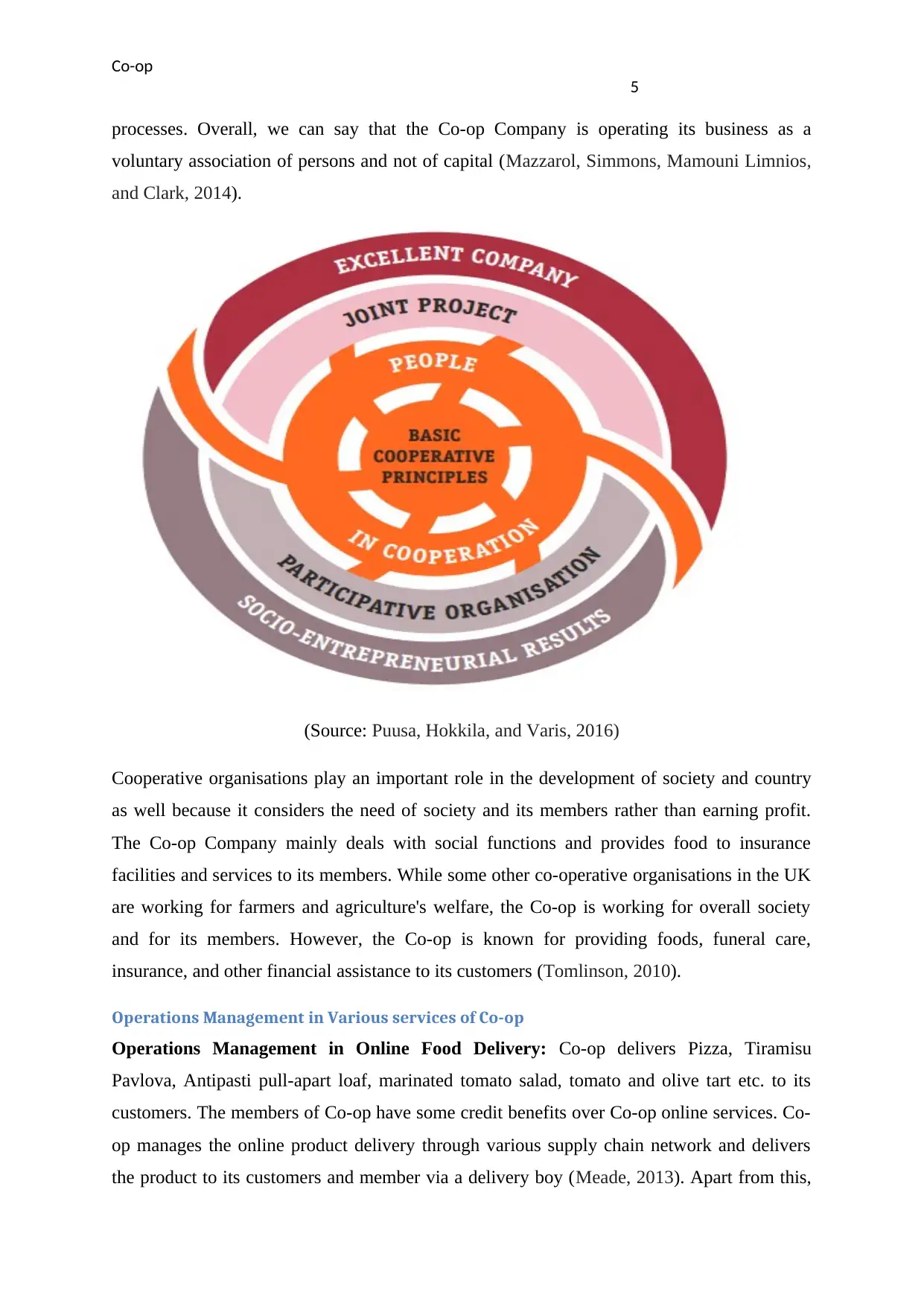
processes. Overall, we can say that the Co-op Company is operating its business as a
voluntary association of persons and not of capital (Mazzarol, Simmons, Mamouni Limnios,
and Clark, 2014).
(Source: Puusa, Hokkila, and Varis, 2016)
Cooperative organisations play an important role in the development of society and country
as well because it considers the need of society and its members rather than earning profit.
The Co-op Company mainly deals with social functions and provides food to insurance
facilities and services to its members. While some other co-operative organisations in the UK
are working for farmers and agriculture's welfare, the Co-op is working for overall society
and for its members. However, the Co-op is known for providing foods, funeral care,
insurance, and other financial assistance to its customers (Tomlinson, 2010).
Operations Management in Various services of Co-op
Operations Management in Online Food Delivery: Co-op delivers Pizza, Tiramisu
Pavlova, Antipasti pull-apart loaf, marinated tomato salad, tomato and olive tart etc. to its
customers. The members of Co-op have some credit benefits over Co-op online services. Co-
op manages the online product delivery through various supply chain network and delivers
the product to its customers and member via a delivery boy (Meade, 2013). Apart from this,
5
processes. Overall, we can say that the Co-op Company is operating its business as a
voluntary association of persons and not of capital (Mazzarol, Simmons, Mamouni Limnios,
and Clark, 2014).
(Source: Puusa, Hokkila, and Varis, 2016)
Cooperative organisations play an important role in the development of society and country
as well because it considers the need of society and its members rather than earning profit.
The Co-op Company mainly deals with social functions and provides food to insurance
facilities and services to its members. While some other co-operative organisations in the UK
are working for farmers and agriculture's welfare, the Co-op is working for overall society
and for its members. However, the Co-op is known for providing foods, funeral care,
insurance, and other financial assistance to its customers (Tomlinson, 2010).
Operations Management in Various services of Co-op
Operations Management in Online Food Delivery: Co-op delivers Pizza, Tiramisu
Pavlova, Antipasti pull-apart loaf, marinated tomato salad, tomato and olive tart etc. to its
customers. The members of Co-op have some credit benefits over Co-op online services. Co-
op manages the online product delivery through various supply chain network and delivers
the product to its customers and member via a delivery boy (Meade, 2013). Apart from this,
⊘ This is a preview!⊘
Do you want full access?
Subscribe today to unlock all pages.
Trusted by 1+ million students worldwide
Co-op
6
Co-op provides various continental dishes and world-class favour in its food including
American taste and Asian taste (including Chinese and Indian food taste). There are many
Co-op stores all over the country that serve more than hundreds of food dishes to its member
and customers (Trkman, 2010).
Operational Management in Health Service: Co-op provides medical facilities and health-
related service care to its members and people. There is large number of people and medical
stores are connected with Co-op and it provides the best healthcare service and medicines for
their health problems (Hammer, 2015). Apart from this, Co-op provides online facilities of
medication via its online app "Co-op App" on mobile. People who have a GP card and having
a prescription of GP in England can order any medicine or Medicare help from their mobile
phones. The Company provides regular updates on online order of medicines and delivers the
medicine on the doorstep of the customer. People can easily repeat and order their
prescription from the Co-op app and it is secured link for availing medical and health
facilities with the help of Co-op App (Cornforth and Spear, 2010).
Operational Management in Funeral Care Service: The Co-op Company provide services
related to funeral care as well. The company take the request of its members and arrange
funeral care in the near funeral house at very low care cost. The Co-op societies arrange the
resources and arrange the funeral in the near funeral home on request of its member.
However, there are few members of the company who provide all arrangement in the funeral
of any person. The person who needs of the Company, he or she can contact to local Funeral
Director at any time, every day of the year and Co-op will arrange the funeral care. The Co-
op also provides facilities for paying service charge after the funeral and provides discounts
to its customers (Viljoen and Wiskerke, 2012).
Operations Management in Legal Services: The Co-op organisation in the UK provides
legal services through an excellent business operation process. The Co-op provides agents to
every customer for personal injury and medical care negligence claims, in making a will,
probate solicitors, with an appropriate price. Co-op is associated with various law and legal
expert members and they provide services to other people with link of Co-op organisation
(Weske, 2012). Co-op is known for its best services and food product delivery to its
customers and its members. The online facility of the Company provides day and night
facilities to the customers. The operation management function applies on many middle
operators and Co-op stores, Co-op supply chain networks, and delivery boys.
6
Co-op provides various continental dishes and world-class favour in its food including
American taste and Asian taste (including Chinese and Indian food taste). There are many
Co-op stores all over the country that serve more than hundreds of food dishes to its member
and customers (Trkman, 2010).
Operational Management in Health Service: Co-op provides medical facilities and health-
related service care to its members and people. There is large number of people and medical
stores are connected with Co-op and it provides the best healthcare service and medicines for
their health problems (Hammer, 2015). Apart from this, Co-op provides online facilities of
medication via its online app "Co-op App" on mobile. People who have a GP card and having
a prescription of GP in England can order any medicine or Medicare help from their mobile
phones. The Company provides regular updates on online order of medicines and delivers the
medicine on the doorstep of the customer. People can easily repeat and order their
prescription from the Co-op app and it is secured link for availing medical and health
facilities with the help of Co-op App (Cornforth and Spear, 2010).
Operational Management in Funeral Care Service: The Co-op Company provide services
related to funeral care as well. The company take the request of its members and arrange
funeral care in the near funeral house at very low care cost. The Co-op societies arrange the
resources and arrange the funeral in the near funeral home on request of its member.
However, there are few members of the company who provide all arrangement in the funeral
of any person. The person who needs of the Company, he or she can contact to local Funeral
Director at any time, every day of the year and Co-op will arrange the funeral care. The Co-
op also provides facilities for paying service charge after the funeral and provides discounts
to its customers (Viljoen and Wiskerke, 2012).
Operations Management in Legal Services: The Co-op organisation in the UK provides
legal services through an excellent business operation process. The Co-op provides agents to
every customer for personal injury and medical care negligence claims, in making a will,
probate solicitors, with an appropriate price. Co-op is associated with various law and legal
expert members and they provide services to other people with link of Co-op organisation
(Weske, 2012). Co-op is known for its best services and food product delivery to its
customers and its members. The online facility of the Company provides day and night
facilities to the customers. The operation management function applies on many middle
operators and Co-op stores, Co-op supply chain networks, and delivery boys.
Paraphrase This Document
Need a fresh take? Get an instant paraphrase of this document with our AI Paraphraser
Co-op
7
Key Issues
There are some major issues in the business operation management of the Co-op. The key
problem of the organisation is that it operates its business on very small profit and salary of
members or people who are connected with Co-op organisation is also given from this
minimal profit (Röglinger, Pöppelbuß, and Becker, 2012). Co-op is working and operating its
business on social welfare theme, which is almost all the cooperative organisation does in the
country. However, the investment funds are not allowed by the company in the organisation
from any external members. However, there are some of the key issues in Co-op
organisations are as follow:
1. Economic Viability, because Co-op is not accepting investment funds from external
sources, it is lacking in financial resources.
2. Weak supply chain network is major issues. Although the Co-op is operating its business
on a very small margin and earn low profitability that further leads to a weak supply
chain network and poor business performance (Borda-Rodriguez and Vicari, 2014).
3. People who are connected with Co-op are not seriously performing the business
operation because of very less profit or a small income they earned after their services.
4. Lack of governmental and technical support to this organisation also creates a problem
for the Co-op organisation. It needed funds for improving its business operations and its
effectiveness and it will only possible if the organisation get funds from outsiders or
from governments (Dogarawa, 2010).
5. Delivery of products and services through online is important for everyone. However,
delivery of medicine online needs immediate and urgent delivery to the customers. Here
the company is lacking in quick and on time delivery of food and medicines to its
customers.
6. The interference of local government and community also affect its business operations
in the country.
ii. Process Management in Co-op
A business process is a set of activities that are required to perform a business operation in
the organisation. Process management in any organisation is necessary to handle the business
process and the activities, which are performed in the organisation. The business process in
any organisation may be performed by people or by system or by both sequentially or
parallel. Business process management in any organisation can be done under the following
7
Key Issues
There are some major issues in the business operation management of the Co-op. The key
problem of the organisation is that it operates its business on very small profit and salary of
members or people who are connected with Co-op organisation is also given from this
minimal profit (Röglinger, Pöppelbuß, and Becker, 2012). Co-op is working and operating its
business on social welfare theme, which is almost all the cooperative organisation does in the
country. However, the investment funds are not allowed by the company in the organisation
from any external members. However, there are some of the key issues in Co-op
organisations are as follow:
1. Economic Viability, because Co-op is not accepting investment funds from external
sources, it is lacking in financial resources.
2. Weak supply chain network is major issues. Although the Co-op is operating its business
on a very small margin and earn low profitability that further leads to a weak supply
chain network and poor business performance (Borda-Rodriguez and Vicari, 2014).
3. People who are connected with Co-op are not seriously performing the business
operation because of very less profit or a small income they earned after their services.
4. Lack of governmental and technical support to this organisation also creates a problem
for the Co-op organisation. It needed funds for improving its business operations and its
effectiveness and it will only possible if the organisation get funds from outsiders or
from governments (Dogarawa, 2010).
5. Delivery of products and services through online is important for everyone. However,
delivery of medicine online needs immediate and urgent delivery to the customers. Here
the company is lacking in quick and on time delivery of food and medicines to its
customers.
6. The interference of local government and community also affect its business operations
in the country.
ii. Process Management in Co-op
A business process is a set of activities that are required to perform a business operation in
the organisation. Process management in any organisation is necessary to handle the business
process and the activities, which are performed in the organisation. The business process in
any organisation may be performed by people or by system or by both sequentially or
parallel. Business process management in any organisation can be done under the following
Co-op
8
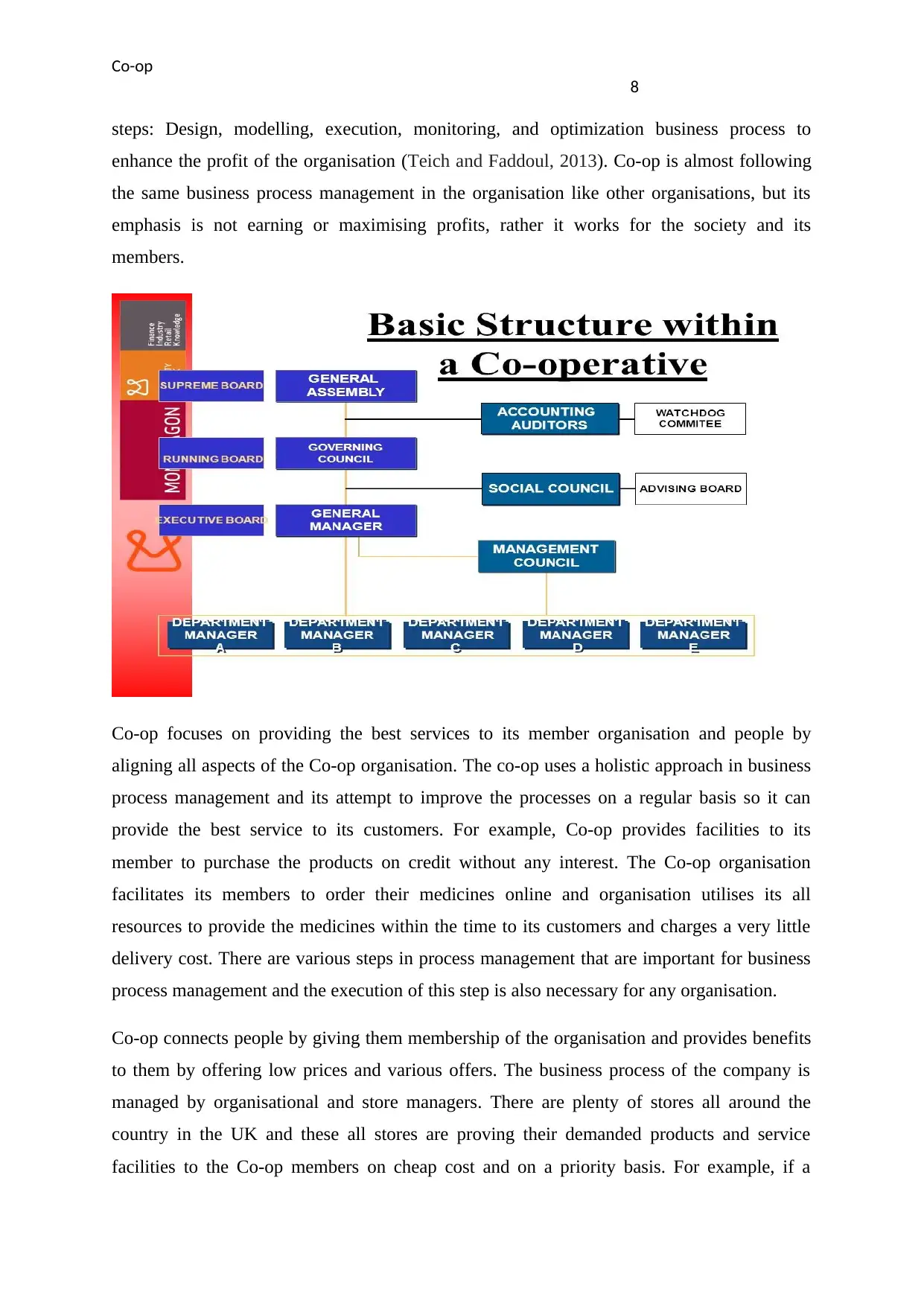
steps: Design, modelling, execution, monitoring, and optimization business process to
enhance the profit of the organisation (Teich and Faddoul, 2013). Co-op is almost following
the same business process management in the organisation like other organisations, but its
emphasis is not earning or maximising profits, rather it works for the society and its
members.
Co-op focuses on providing the best services to its member organisation and people by
aligning all aspects of the Co-op organisation. The co-op uses a holistic approach in business
process management and its attempt to improve the processes on a regular basis so it can
provide the best service to its customers. For example, Co-op provides facilities to its
member to purchase the products on credit without any interest. The Co-op organisation
facilitates its members to order their medicines online and organisation utilises its all
resources to provide the medicines within the time to its customers and charges a very little
delivery cost. There are various steps in process management that are important for business
process management and the execution of this step is also necessary for any organisation.
Co-op connects people by giving them membership of the organisation and provides benefits
to them by offering low prices and various offers. The business process of the company is
managed by organisational and store managers. There are plenty of stores all around the
country in the UK and these all stores are proving their demanded products and service
facilities to the Co-op members on cheap cost and on a priority basis. For example, if a
8
steps: Design, modelling, execution, monitoring, and optimization business process to
enhance the profit of the organisation (Teich and Faddoul, 2013). Co-op is almost following
the same business process management in the organisation like other organisations, but its
emphasis is not earning or maximising profits, rather it works for the society and its
members.
Co-op focuses on providing the best services to its member organisation and people by
aligning all aspects of the Co-op organisation. The co-op uses a holistic approach in business
process management and its attempt to improve the processes on a regular basis so it can
provide the best service to its customers. For example, Co-op provides facilities to its
member to purchase the products on credit without any interest. The Co-op organisation
facilitates its members to order their medicines online and organisation utilises its all
resources to provide the medicines within the time to its customers and charges a very little
delivery cost. There are various steps in process management that are important for business
process management and the execution of this step is also necessary for any organisation.
Co-op connects people by giving them membership of the organisation and provides benefits
to them by offering low prices and various offers. The business process of the company is
managed by organisational and store managers. There are plenty of stores all around the
country in the UK and these all stores are proving their demanded products and service
facilities to the Co-op members on cheap cost and on a priority basis. For example, if a
⊘ This is a preview!⊘
Do you want full access?
Subscribe today to unlock all pages.
Trusted by 1+ million students worldwide
Co-op
9
person wants to funeral plan then he/she should become a member of the organisation by
payment of one Euro. The Co-op provides benefits to the community as well as it provides
1% of its income to the community and spends it for their welfare. However, if the
organisation wants to introduce new product or services, the members of Co-op vote in
favour of the new service or products and then it is launched by the organisation. People
benefited from the Co-op must have a membership of the organisation to get benefit before
accessing the service of the organisation.
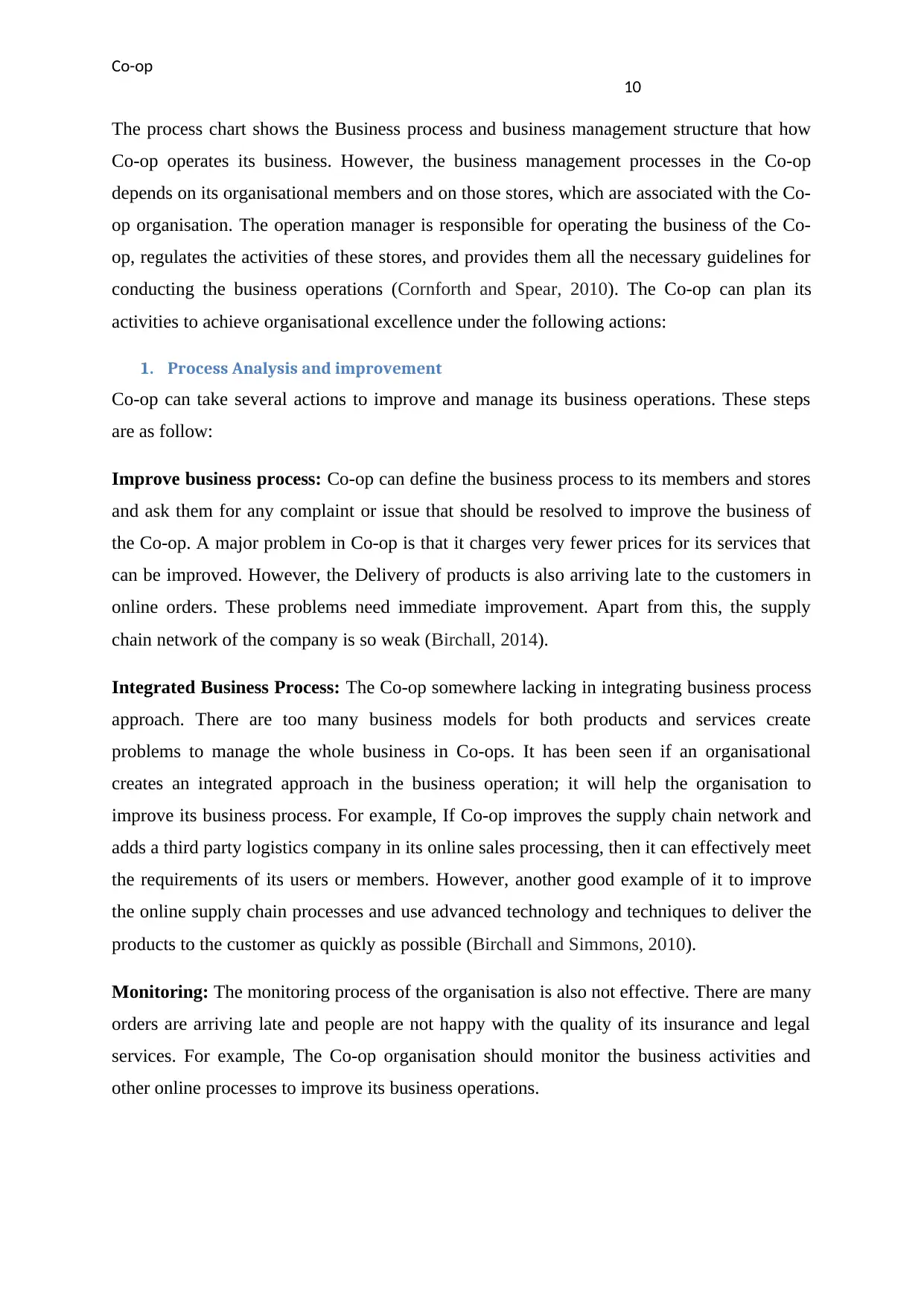
Process Map of the Co-op
Members
Store Manager
Member council
Board Members
General meeting of Members
Supervisory Boards
Executive Board
Chairman’s
Meeting
Food
Products
Health
products
Insurance
services Legal services
Members/Customers
Cooperative
Stores
Co-op Organisation
9
person wants to funeral plan then he/she should become a member of the organisation by
payment of one Euro. The Co-op provides benefits to the community as well as it provides
1% of its income to the community and spends it for their welfare. However, if the
organisation wants to introduce new product or services, the members of Co-op vote in
favour of the new service or products and then it is launched by the organisation. People
benefited from the Co-op must have a membership of the organisation to get benefit before
accessing the service of the organisation.
Process Map of the Co-op
Members
Store Manager
Member council
Board Members
General meeting of Members
Supervisory Boards
Executive Board
Chairman’s
Meeting
Food
Products
Health
products
Insurance
services Legal services
Members/Customers
Cooperative
Stores
Co-op Organisation
Paraphrase This Document
Need a fresh take? Get an instant paraphrase of this document with our AI Paraphraser
Co-op
10
The process chart shows the Business process and business management structure that how
Co-op operates its business. However, the business management processes in the Co-op
depends on its organisational members and on those stores, which are associated with the Co-
op organisation. The operation manager is responsible for operating the business of the Co-
op, regulates the activities of these stores, and provides them all the necessary guidelines for
conducting the business operations (Cornforth and Spear, 2010). The Co-op can plan its
activities to achieve organisational excellence under the following actions:
1. Process Analysis and improvement
Co-op can take several actions to improve and manage its business operations. These steps
are as follow:
Improve business process: Co-op can define the business process to its members and stores
and ask them for any complaint or issue that should be resolved to improve the business of
the Co-op. A major problem in Co-op is that it charges very fewer prices for its services that
can be improved. However, the Delivery of products is also arriving late to the customers in
online orders. These problems need immediate improvement. Apart from this, the supply
chain network of the company is so weak (Birchall, 2014).
Integrated Business Process: The Co-op somewhere lacking in integrating business process
approach. There are too many business models for both products and services create
problems to manage the whole business in Co-ops. It has been seen if an organisational
creates an integrated approach in the business operation; it will help the organisation to
improve its business process. For example, If Co-op improves the supply chain network and
adds a third party logistics company in its online sales processing, then it can effectively meet
the requirements of its users or members. However, another good example of it to improve
the online supply chain processes and use advanced technology and techniques to deliver the
products to the customer as quickly as possible (Birchall and Simmons, 2010).
Monitoring: The monitoring process of the organisation is also not effective. There are many
orders are arriving late and people are not happy with the quality of its insurance and legal
services. For example, The Co-op organisation should monitor the business activities and
other online processes to improve its business operations.
10
The process chart shows the Business process and business management structure that how
Co-op operates its business. However, the business management processes in the Co-op
depends on its organisational members and on those stores, which are associated with the Co-
op organisation. The operation manager is responsible for operating the business of the Co-
op, regulates the activities of these stores, and provides them all the necessary guidelines for
conducting the business operations (Cornforth and Spear, 2010). The Co-op can plan its
activities to achieve organisational excellence under the following actions:
1. Process Analysis and improvement
Co-op can take several actions to improve and manage its business operations. These steps
are as follow:
Improve business process: Co-op can define the business process to its members and stores
and ask them for any complaint or issue that should be resolved to improve the business of
the Co-op. A major problem in Co-op is that it charges very fewer prices for its services that
can be improved. However, the Delivery of products is also arriving late to the customers in
online orders. These problems need immediate improvement. Apart from this, the supply
chain network of the company is so weak (Birchall, 2014).
Integrated Business Process: The Co-op somewhere lacking in integrating business process
approach. There are too many business models for both products and services create
problems to manage the whole business in Co-ops. It has been seen if an organisational
creates an integrated approach in the business operation; it will help the organisation to
improve its business process. For example, If Co-op improves the supply chain network and
adds a third party logistics company in its online sales processing, then it can effectively meet
the requirements of its users or members. However, another good example of it to improve
the online supply chain processes and use advanced technology and techniques to deliver the
products to the customer as quickly as possible (Birchall and Simmons, 2010).
Monitoring: The monitoring process of the organisation is also not effective. There are many
orders are arriving late and people are not happy with the quality of its insurance and legal
services. For example, The Co-op organisation should monitor the business activities and
other online processes to improve its business operations.
Co-op
11
2. Customer Service Strategies
Customers are the key to every business organisations and their success. However, the
members of Co-op are also very important for the company. To improve the customer service
the Co-op should adopt various strategies (Mazzarol, Limnios, and Reboud, 2011). Happy
customers in the organisation build the credibility of the organisation. Thus, it is essential for
Co-op to care about their customers and adopt various strategies that help them to gain better
customer experience with Co-op. For example, the organisation can ask customer feedback
about the service they avail from Co-op stores and online orders. Connecting with members
and customers is a better option to design good customer service strategies (Hodge, Goforth
Ross, Joines, and Thoney, 2011). For example, the website of the Company can invite its
customers for providing feedback about the services. This can also be done through live chat,
online phone calls, and mobile apps.
3. Inventory Management
Co-op is dealing with foods and providing its products to the customer on cheap prices with
best quality products. It has been seen that the Inventory management system of the
organisation somewhere lies in the multi-retailer inventory control system (Singh, 2012). The
motivation of storekeepers, a better communication system, good facilities of storage of
products in the stores is some of the key factors in Inventory control in Co-op. However, the
use of technology like automatic control of technology on inventory control process can be
effective in such organisations. Apart from this, the Co-op should also provide information
about the availability of products on its website and mobile app. Thus, no customer or
member will suffer from the poor inventory control system (Behrouzi and Wong, 2011).
Apart from this, the central warehouse system of Co-op should be connected with true value
member vendors who supply the products to the customer on a regular basis. However, the
shipping cost is another problem for Co-op and it should be reduced by the organisation as it
operates its business on very less margin (Co-op, 2018). To reduce the shipping cost the Co-
op can store the products on a centralised location which should be accessible and on less
distance for the cooperative stores (Jussila, Goel, and Tuominen, 2012). The organisation can
also promote the combined buying power of members, which gives more benefits to the Co-
op. The cost of goods is the largest expense for the Co-op and for most of the retail stores of
Co-op. The cost of goods like foods and pizza almost covers more than 60% of store owners'
expense and if it will be minimised by the company and offer relatively less costly products
to its retail cooperative stores, then it will be good for the inventory management of the
11
2. Customer Service Strategies
Customers are the key to every business organisations and their success. However, the
members of Co-op are also very important for the company. To improve the customer service
the Co-op should adopt various strategies (Mazzarol, Limnios, and Reboud, 2011). Happy
customers in the organisation build the credibility of the organisation. Thus, it is essential for
Co-op to care about their customers and adopt various strategies that help them to gain better
customer experience with Co-op. For example, the organisation can ask customer feedback
about the service they avail from Co-op stores and online orders. Connecting with members
and customers is a better option to design good customer service strategies (Hodge, Goforth
Ross, Joines, and Thoney, 2011). For example, the website of the Company can invite its
customers for providing feedback about the services. This can also be done through live chat,
online phone calls, and mobile apps.
3. Inventory Management
Co-op is dealing with foods and providing its products to the customer on cheap prices with
best quality products. It has been seen that the Inventory management system of the
organisation somewhere lies in the multi-retailer inventory control system (Singh, 2012). The
motivation of storekeepers, a better communication system, good facilities of storage of
products in the stores is some of the key factors in Inventory control in Co-op. However, the
use of technology like automatic control of technology on inventory control process can be
effective in such organisations. Apart from this, the Co-op should also provide information
about the availability of products on its website and mobile app. Thus, no customer or
member will suffer from the poor inventory control system (Behrouzi and Wong, 2011).
Apart from this, the central warehouse system of Co-op should be connected with true value
member vendors who supply the products to the customer on a regular basis. However, the
shipping cost is another problem for Co-op and it should be reduced by the organisation as it
operates its business on very less margin (Co-op, 2018). To reduce the shipping cost the Co-
op can store the products on a centralised location which should be accessible and on less
distance for the cooperative stores (Jussila, Goel, and Tuominen, 2012). The organisation can
also promote the combined buying power of members, which gives more benefits to the Co-
op. The cost of goods is the largest expense for the Co-op and for most of the retail stores of
Co-op. The cost of goods like foods and pizza almost covers more than 60% of store owners'
expense and if it will be minimised by the company and offer relatively less costly products
to its retail cooperative stores, then it will be good for the inventory management of the
⊘ This is a preview!⊘
Do you want full access?
Subscribe today to unlock all pages.
Trusted by 1+ million students worldwide

1 out of 24


Related Documents


Your All-in-One AI-Powered Toolkit for Academic Success.
+13062052269
info@desklib.com
Available 24*7 on WhatsApp / Email
![[object Object]](/_next/static/media/star-bottom.7253800d.svg)
Unlock your academic potential
Copyright © 2020–2026 A2Z Services. All Rights Reserved. Developed and managed by ZUCOL.