Coaching, Mentoring, Teaching: Strategies for Individual Learners
VerifiedAdded on 2023/06/10
|20
|6143
|70
Report
AI Summary
This report examines the responsibilities and differences between coaching, mentoring, and teaching roles in supporting individual learners, focusing on strategies to meet diverse learning needs. It includes a reflective report justifying the selection of specific strategies for learners like Cassie and Aran, addressing issues such as dyslexia and substance abuse. The report also reviews resources for a multi-agency approach, factors influencing the referral process, and the emotional, intellectual, and social benefits of one-to-one support. Furthermore, it presents an action plan for self-improvement, evaluating personal strengths and areas for development in one-to-one teaching and learning situations, and planning opportunities to enhance these skills. The effectiveness of the author's practice is also evaluated, concluding with key insights and recommendations.
WORKING WITH
INDIVIDUAL LEARNERS
INDIVIDUAL LEARNERS

Paraphrase This Document
Need a fresh take? Get an instant paraphrase of this document with our AI Paraphraser
TABLE OF CONTENTS
INTRODUCTION...........................................................................................................................3
MAIN BODY..................................................................................................................................3
Task 1..........................................................................................................................................3
Responsibility of a coach, mentor and teacher in relation to working with individual students. 3
Responsibility of a coach...........................................................................................................3
Difference between the coaching, mentoring and teaching roles in relation to working with....4
individual learner.........................................................................................................................4
Effectiveness of coaching, mentoring and teaching roles in meeting the individual learning
needs............................................................................................................................................6
TASK – 2(REFLECTIVE REPORT)..............................................................................................7
2.1 Justifyingtheselectionofstrategies for meeting the needs of individuallearners....................7
3.1 Reviewing the resources needed for an effective multi-agency approach.............................8
3.2 Factors influencing the referral process.................................................................................9
4.1 Reviewing the processes involved in one-to-one coaching, mentoring and teaching in
relation to emotional, intellectual and social benefits for students............................................10
TASK – 3(ACTION PLAN& REFLECTIVE REPORT).............................................................11
5.2 Determine own strengths and areas for improvement and devising an action plan............11
5.3Planning opportunities for improving own skills in relation to one-to-one teaching and
learning situations......................................................................................................................13
5.1 Evaluating the effectiveness of own practice in relation to one-to-one teaching and
learning situations......................................................................................................................14
CONCLUSION..............................................................................................................................16
REFERENCES................................................................................................................................1
INTRODUCTION...........................................................................................................................3
MAIN BODY..................................................................................................................................3
Task 1..........................................................................................................................................3
Responsibility of a coach, mentor and teacher in relation to working with individual students. 3
Responsibility of a coach...........................................................................................................3
Difference between the coaching, mentoring and teaching roles in relation to working with....4
individual learner.........................................................................................................................4
Effectiveness of coaching, mentoring and teaching roles in meeting the individual learning
needs............................................................................................................................................6
TASK – 2(REFLECTIVE REPORT)..............................................................................................7
2.1 Justifyingtheselectionofstrategies for meeting the needs of individuallearners....................7
3.1 Reviewing the resources needed for an effective multi-agency approach.............................8
3.2 Factors influencing the referral process.................................................................................9
4.1 Reviewing the processes involved in one-to-one coaching, mentoring and teaching in
relation to emotional, intellectual and social benefits for students............................................10
TASK – 3(ACTION PLAN& REFLECTIVE REPORT).............................................................11
5.2 Determine own strengths and areas for improvement and devising an action plan............11
5.3Planning opportunities for improving own skills in relation to one-to-one teaching and
learning situations......................................................................................................................13
5.1 Evaluating the effectiveness of own practice in relation to one-to-one teaching and
learning situations......................................................................................................................14
CONCLUSION..............................................................................................................................16
REFERENCES................................................................................................................................1
INTRODUCTION
Every individual or student at some point of time need guidance, suggestions that are needed
due to some problem in personal or professional life (Guijarro, 2020). The mentor, coach or tutor
are the once who helped an individual and students for overcoming from all the difficult situation
to be successful in their personal and professional life by developing their skills for doing things
properly. This report is all about developing skills in various learner with the help of tutor or
mentor and their responsibilities towards the individual. This report also include the difference
between coaching, mentoring, teaching and their effectiveness. Furthermore, selection of
strategies to meet the needs of individual learner and resources required for an effective multi-
agency approach. Moreover the factors that influence the referral process or skills which are
required to development of individual learner skills. Lastly, it will include an action plan which
enables the own strength and areas of improvements and its effectiveness.
MAIN BODY
Task 1
AC 1.1
Responsibility of a coach, mentor and teacher in relation to working with individual students
Every individual learner need different type of methods for solving their own problems so
this three are using different techniques to different individual learner to develop their skills in
doing the task L2 Programme the responsibilities of them are:
Responsibility of a coach
Coach is the teacher or instructor of the team or the students to teach and guide them
various rules and duties of how to do the things correctly and efficiently (Peiser, 2018). He is the
only member who arranges or plan various activities to make its team learn things easily and do
the task easily. From the above case studies the Coach of L2 Programme is teaching various skill
to the individual learner developing their personal or professional skills. The Coach is personally
encouraging the Cassie, Aran, Lissa by teaching them correct rules or life and motivating them
by developing their old skills or doing the task with full efficiency. The coach is responsible for
Every individual or student at some point of time need guidance, suggestions that are needed
due to some problem in personal or professional life (Guijarro, 2020). The mentor, coach or tutor
are the once who helped an individual and students for overcoming from all the difficult situation
to be successful in their personal and professional life by developing their skills for doing things
properly. This report is all about developing skills in various learner with the help of tutor or
mentor and their responsibilities towards the individual. This report also include the difference
between coaching, mentoring, teaching and their effectiveness. Furthermore, selection of
strategies to meet the needs of individual learner and resources required for an effective multi-
agency approach. Moreover the factors that influence the referral process or skills which are
required to development of individual learner skills. Lastly, it will include an action plan which
enables the own strength and areas of improvements and its effectiveness.
MAIN BODY
Task 1
AC 1.1
Responsibility of a coach, mentor and teacher in relation to working with individual students
Every individual learner need different type of methods for solving their own problems so
this three are using different techniques to different individual learner to develop their skills in
doing the task L2 Programme the responsibilities of them are:
Responsibility of a coach
Coach is the teacher or instructor of the team or the students to teach and guide them
various rules and duties of how to do the things correctly and efficiently (Peiser, 2018). He is the
only member who arranges or plan various activities to make its team learn things easily and do
the task easily. From the above case studies the Coach of L2 Programme is teaching various skill
to the individual learner developing their personal or professional skills. The Coach is personally
encouraging the Cassie, Aran, Lissa by teaching them correct rules or life and motivating them
by developing their old skills or doing the task with full efficiency. The coach is responsible for
⊘ This is a preview!⊘
Do you want full access?
Subscribe today to unlock all pages.

Trusted by 1+ million students worldwide
arranging those activities which are suitable for work and the learner feel encouraged to do the
task.
Responsibility of Mentor
The Mentor is the one who give advises and motivation for doing the task with full
efforts and individual for setting their goals and developing their skills by communicating with
them about their problems and giving them advices how to solve that problem (Lewandowska,
2020). The name Cassie, Aram, Lissa is suffering from their personal problems due to personal
issues the main responsibility of the Mentor to guide them properly to give direction to their
individual life on right track. The Mentor of this team is motivating the team members due to
their personal issues so that they work with more efforts by using various motivational
techniques. The most important responsibility of Mentor is to understand the learner ability or
efficiency of doing the task properly so that he/she can make plans to achieve those objectives.
Responsibility of Teacher
The Teacher has big role in every individual student life from the beginning to the end the
teachers are the only one who guides the student and educate them so that they can face the
world or understand the world properly by giving them all kind of knowledge (Watling, 2019).
In this report the teacher has main role on every individual learner like they are teaching them
the right lessons of life by motivating them and increasing their morale and educating the things
how to do the task with full efficiency etc. Lastly, the main responsibility of the teacher is to
listen to each individual problems and find ways and give solutions to them to overcome from
those problems.
AC 1.2
Difference between the coaching, mentoring and teaching roles in relation to working with
individual learner
The three roles has same number of roles and duties with little difference in their activities
and every role has same importance in the working of the individual learner. Coaching is all
about teaching the things to the individual to improve its efficiency and effectively or increasing
the skills (Valanci-Aroesty, 2020). The Coach of L2 Programme is teaching all the individual
learner with cultural differences by understanding and observing their performances and
task.
Responsibility of Mentor
The Mentor is the one who give advises and motivation for doing the task with full
efforts and individual for setting their goals and developing their skills by communicating with
them about their problems and giving them advices how to solve that problem (Lewandowska,
2020). The name Cassie, Aram, Lissa is suffering from their personal problems due to personal
issues the main responsibility of the Mentor to guide them properly to give direction to their
individual life on right track. The Mentor of this team is motivating the team members due to
their personal issues so that they work with more efforts by using various motivational
techniques. The most important responsibility of Mentor is to understand the learner ability or
efficiency of doing the task properly so that he/she can make plans to achieve those objectives.
Responsibility of Teacher
The Teacher has big role in every individual student life from the beginning to the end the
teachers are the only one who guides the student and educate them so that they can face the
world or understand the world properly by giving them all kind of knowledge (Watling, 2019).
In this report the teacher has main role on every individual learner like they are teaching them
the right lessons of life by motivating them and increasing their morale and educating the things
how to do the task with full efficiency etc. Lastly, the main responsibility of the teacher is to
listen to each individual problems and find ways and give solutions to them to overcome from
those problems.
AC 1.2
Difference between the coaching, mentoring and teaching roles in relation to working with
individual learner
The three roles has same number of roles and duties with little difference in their activities
and every role has same importance in the working of the individual learner. Coaching is all
about teaching the things to the individual to improve its efficiency and effectively or increasing
the skills (Valanci-Aroesty, 2020). The Coach of L2 Programme is teaching all the individual
learner with cultural differences by understanding and observing their performances and
Paraphrase This Document
Need a fresh take? Get an instant paraphrase of this document with our AI Paraphraser
improving their weak skill and making them experts in those area. Coaching involves
punishments also due to not giving their best in the performances or strictly teaching them the
right way to do the task. Coaching end when an individual does not reach the peak point and
dream goals. The coach of this team is developing each and every one skill by observing them
and teaching the to put their personal issues aside when doing the work of professional field
(Scerri, 2020). Cassie is one of the learner which has the ability to do the task with 100%
accuracy but due to some personal reason she did not able to do the task properly the Coach of
the team is giving her full training and giving all the guidance for realising its full potential.
Whereas, Mentoring involves mental process in which the mentor is emotionally and
mentally give guidance and advices to the learner for doing the task without any hesitation
(Baltgailis, 2019). The Mentor treat his/her team as friend, teacher etc when needed because
mentoring involves developing the individual personally and professionally by improving their
personal and professional skill efficiently. Due to more knowledge by the mentor he/she give all
the knowledge which he/she having and try make the best version of the learner. The Mentor of
the team L2 Programme is listening to every individual problems like Aran is one of the team
member who selling drugs and depressed due its family expectations so the mentor of Aran is
teaching and motivating them to remove all this bad habits and encouraging him to increase his
skills by increasing its morale working with him and increasing his confidence with compliments
and other advises to achieve its personal and professional goals.
Teaching is a broad term and involves both mentoring and coaching it is whole process of
developing the individual or students to achieve its dreams. Teaching involves developing the
overall skills of an individual for efficiency in their work( Leinhardt, 2019). The Teachers of the
team L2 Programme is dealing with different members and every one is struggling from their
personal life issues due cultural differences and every individual need different techniques or
methods by the teacher to develop their skills. Every Individual learner is suffering from
different personal issues like Lissa who is bored of the sessions and asked for more additional
activities. The teacher of this team is providing all the entertaining activities so that every
individual enjoys their work while doing the task and will not get bored by arranging and
teaching in different ways and methods to increase every individual performances.
AC 1.3
punishments also due to not giving their best in the performances or strictly teaching them the
right way to do the task. Coaching end when an individual does not reach the peak point and
dream goals. The coach of this team is developing each and every one skill by observing them
and teaching the to put their personal issues aside when doing the work of professional field
(Scerri, 2020). Cassie is one of the learner which has the ability to do the task with 100%
accuracy but due to some personal reason she did not able to do the task properly the Coach of
the team is giving her full training and giving all the guidance for realising its full potential.
Whereas, Mentoring involves mental process in which the mentor is emotionally and
mentally give guidance and advices to the learner for doing the task without any hesitation
(Baltgailis, 2019). The Mentor treat his/her team as friend, teacher etc when needed because
mentoring involves developing the individual personally and professionally by improving their
personal and professional skill efficiently. Due to more knowledge by the mentor he/she give all
the knowledge which he/she having and try make the best version of the learner. The Mentor of
the team L2 Programme is listening to every individual problems like Aran is one of the team
member who selling drugs and depressed due its family expectations so the mentor of Aran is
teaching and motivating them to remove all this bad habits and encouraging him to increase his
skills by increasing its morale working with him and increasing his confidence with compliments
and other advises to achieve its personal and professional goals.
Teaching is a broad term and involves both mentoring and coaching it is whole process of
developing the individual or students to achieve its dreams. Teaching involves developing the
overall skills of an individual for efficiency in their work( Leinhardt, 2019). The Teachers of the
team L2 Programme is dealing with different members and every one is struggling from their
personal life issues due cultural differences and every individual need different techniques or
methods by the teacher to develop their skills. Every Individual learner is suffering from
different personal issues like Lissa who is bored of the sessions and asked for more additional
activities. The teacher of this team is providing all the entertaining activities so that every
individual enjoys their work while doing the task and will not get bored by arranging and
teaching in different ways and methods to increase every individual performances.
AC 1.3
Effectiveness of coaching, mentoring and teaching roles in meeting the individual learning needs
Coaching
Coaching helps in meeting individual goals by helping them in facing difficulties in work
because due to less knowledge and experience people faces huge problems in attaining the
efficiency in the work. Cassie and Aran are facing problems due to their personal life so with
effective coaching they able to work with full efficiency by proper guidance and
encouragements. Effective coaching increases the focus of the learner by ignoring all the
personal problems and increase the efficiency in professional work. The coach of this team
increase the critical thinking skill of all the learner or problem solving skill so that they can
manage their personal and professional problems efficiently. Coaching increases the
encouragement of the individual learner.
Mentoring
Effective mentoring increases the morale of the individual of doing the work with full
satisfaction. Mentor of this team is motivating and encouraging the learner for developing their
personal skill like increasing their confidence, removing their fear and making them feel safe in
every situations. Mentor also increased the professional skills of each learner by rewarding
recognising the individual for good accuracy so that they work more hard towards the goals. The
Mentors are behaving with them as their friend so that the learner can share their problems or
personal life and take advices from the mentors for efficiency in work. The Mentors of L2
Programme are guiding the learner for overcoming from all their family and personal issues with
mental stability.
Teaching
Effective teaching decides the students carriers and efficiency like it involves all the
functions like developing the skills of the individual learner. Teaching involves increasing the
quality of life of the individual with different methods applied on each individuals due to cultural
differences (Boscardin, 2018). The teachers of L2 Programme is applying various methods of
teaching and developing various activities to make their learner enjoy their task and achieve their
target goals efficiently. The teachers of L2 Programme is improving each individual by applying
various methods and measuring and observing various methods on each individual. Selecting the
best method which gives good results and best efficiency. Cassie, Aran, Lissa having their
Coaching
Coaching helps in meeting individual goals by helping them in facing difficulties in work
because due to less knowledge and experience people faces huge problems in attaining the
efficiency in the work. Cassie and Aran are facing problems due to their personal life so with
effective coaching they able to work with full efficiency by proper guidance and
encouragements. Effective coaching increases the focus of the learner by ignoring all the
personal problems and increase the efficiency in professional work. The coach of this team
increase the critical thinking skill of all the learner or problem solving skill so that they can
manage their personal and professional problems efficiently. Coaching increases the
encouragement of the individual learner.
Mentoring
Effective mentoring increases the morale of the individual of doing the work with full
satisfaction. Mentor of this team is motivating and encouraging the learner for developing their
personal skill like increasing their confidence, removing their fear and making them feel safe in
every situations. Mentor also increased the professional skills of each learner by rewarding
recognising the individual for good accuracy so that they work more hard towards the goals. The
Mentors are behaving with them as their friend so that the learner can share their problems or
personal life and take advices from the mentors for efficiency in work. The Mentors of L2
Programme are guiding the learner for overcoming from all their family and personal issues with
mental stability.
Teaching
Effective teaching decides the students carriers and efficiency like it involves all the
functions like developing the skills of the individual learner. Teaching involves increasing the
quality of life of the individual with different methods applied on each individuals due to cultural
differences (Boscardin, 2018). The teachers of L2 Programme is applying various methods of
teaching and developing various activities to make their learner enjoy their task and achieve their
target goals efficiently. The teachers of L2 Programme is improving each individual by applying
various methods and measuring and observing various methods on each individual. Selecting the
best method which gives good results and best efficiency. Cassie, Aran, Lissa having their
⊘ This is a preview!⊘
Do you want full access?
Subscribe today to unlock all pages.
Trusted by 1+ million students worldwide
personal problems and their problems affecting the accuracy of work with effective teaching they
are able to manage their problems and doing the task with full efforts.
TASK – 2(REFLECTIVE REPORT)
2.1 Justifyingtheselectionofstrategies for meeting the needs of individuallearners
As per the case study, there are two learners that is Cassie and Aran whose attendance
level are not up the required standard. Both of them are addicted to alcohol as they are having
some personal issues. Cassie lost her mother and thus, she is depressed and Aran has joined a
gang so started using drugs. Cassie is also suffering from dyslexia which is a type of a learning
disorder wherein she finds it difficult to read, relating with the letters, words and sounds
(Handler and Walter, 2018). Aran does not concentrate as he is toxic all the time. Based on the
needs of these two individual learners there are certain strategies which I think can meet their
requirements and these are as follows:
One to one discussion – On to one discussion are considered as very crucial approach for
understanding the requirements and issues of the learners as it involves constructive
criticism. It is crucial that the teacher should impartially talk in regards with the issues
being faced by Aran and Cassie directly and invite both of them to express their opinions
as well (Gable, 2020). Furthermore, the most crucial thing to do is moving ahead. A
teacher should not focus on what they have already did rather he or she should emphasize
on what they will be going to do in the near future. Encouraging and motivating them to
come up with the solutions is the main aim of this one-to-one discussion.
Encouraging students to explore issues – It is important on the part of the teachers and
coaches to make sure to both of their individual learners that they are reliable and Cassie
and Aran can recognize the support of the tutor. Most of the time, students consider
coaching as a punishment and thus, it is crucial that the teacher should focus on making
such environment that the learners feel that teachers are boosting their performance and
confidence level. A teacher must encourage the learners to share their issues and
feedbacks.
Demonstration – It is being regarded as another important approach through which the
needs of the individual learners being identified can be fulfilled. Demonstration involves
outlining the professional coaching approach being used by the teacher or coach wherein
are able to manage their problems and doing the task with full efforts.
TASK – 2(REFLECTIVE REPORT)
2.1 Justifyingtheselectionofstrategies for meeting the needs of individuallearners
As per the case study, there are two learners that is Cassie and Aran whose attendance
level are not up the required standard. Both of them are addicted to alcohol as they are having
some personal issues. Cassie lost her mother and thus, she is depressed and Aran has joined a
gang so started using drugs. Cassie is also suffering from dyslexia which is a type of a learning
disorder wherein she finds it difficult to read, relating with the letters, words and sounds
(Handler and Walter, 2018). Aran does not concentrate as he is toxic all the time. Based on the
needs of these two individual learners there are certain strategies which I think can meet their
requirements and these are as follows:
One to one discussion – On to one discussion are considered as very crucial approach for
understanding the requirements and issues of the learners as it involves constructive
criticism. It is crucial that the teacher should impartially talk in regards with the issues
being faced by Aran and Cassie directly and invite both of them to express their opinions
as well (Gable, 2020). Furthermore, the most crucial thing to do is moving ahead. A
teacher should not focus on what they have already did rather he or she should emphasize
on what they will be going to do in the near future. Encouraging and motivating them to
come up with the solutions is the main aim of this one-to-one discussion.
Encouraging students to explore issues – It is important on the part of the teachers and
coaches to make sure to both of their individual learners that they are reliable and Cassie
and Aran can recognize the support of the tutor. Most of the time, students consider
coaching as a punishment and thus, it is crucial that the teacher should focus on making
such environment that the learners feel that teachers are boosting their performance and
confidence level. A teacher must encourage the learners to share their issues and
feedbacks.
Demonstration – It is being regarded as another important approach through which the
needs of the individual learners being identified can be fulfilled. Demonstration involves
outlining the professional coaching approach being used by the teacher or coach wherein
Paraphrase This Document
Need a fresh take? Get an instant paraphrase of this document with our AI Paraphraser
they give demo or carry out a particular activity for better understanding of the learners
(Killion, Bryan and Clifton, 2020). It is being regarded as the best method when students
find it difficult in connecting with their theoretical brief, as in the case of Cassie.
Coaching–This is defined as the strategy of supporting the learners in bringing out what
they already have or know. Coaches helps the learners in changing without dictating the
change themselves. As in the current case, both Cassie and Aran need good advice and
emotional support from the coaches and teachers. They need knowledge about the ways
of reacting the situation they both are coming across.
3.1 Reviewing the resources needed for an effective multi-agency approach
For an effective multi agency approach, there are certain resources which are being
required and review of some of them is being done below:
Identification of own barriers or limitations–There are different barriers that might have a
great impact on coaching and thus, it is important to determine the own obstacles and
limitations. As per the given case study, Aran, Cassie and Lissa have lost interest in the
lectures and are not able to concentrate from some or the other reasons. Their mood is
quite bad in the classroom and even they are not attentive. Aran is toxic and Cassie
consumes lot of alcohol. Overall, it can be said that they are not positive and inspired
enough (Slavin, 2019).
Resources obtainable for special learning needs – Maintenance of healthy combination
of order as well as unstructured process is very crucial for the learners with special
requirements such as Cassie who is suffering from dyslexia. For illustration, in case of
Cassie, it is important that the teacher or the coach must place something explicitly
named on the table. Further, the teacher can also make use of checklists for motivating
the learners for keeping their books sorted. He or she can teach them the ways in which
they can do this by their own. Reading pens, portable scanning and gearing instructions
can be given by teachers for students with special requirements and learning disabilities.
Provision of specialist counselling – For the purpose of motivating these individuals as
identified in the case, advice, information and assistance is very essential for exploring
and enhancing their psychological as well as vocational capabilities. Through this, they
will be able to achieve their optimum degree of personal satisfaction along with social
expediency (Groutand Long,2019). The main ideology behind specialists counselling is
(Killion, Bryan and Clifton, 2020). It is being regarded as the best method when students
find it difficult in connecting with their theoretical brief, as in the case of Cassie.
Coaching–This is defined as the strategy of supporting the learners in bringing out what
they already have or know. Coaches helps the learners in changing without dictating the
change themselves. As in the current case, both Cassie and Aran need good advice and
emotional support from the coaches and teachers. They need knowledge about the ways
of reacting the situation they both are coming across.
3.1 Reviewing the resources needed for an effective multi-agency approach
For an effective multi agency approach, there are certain resources which are being
required and review of some of them is being done below:
Identification of own barriers or limitations–There are different barriers that might have a
great impact on coaching and thus, it is important to determine the own obstacles and
limitations. As per the given case study, Aran, Cassie and Lissa have lost interest in the
lectures and are not able to concentrate from some or the other reasons. Their mood is
quite bad in the classroom and even they are not attentive. Aran is toxic and Cassie
consumes lot of alcohol. Overall, it can be said that they are not positive and inspired
enough (Slavin, 2019).
Resources obtainable for special learning needs – Maintenance of healthy combination
of order as well as unstructured process is very crucial for the learners with special
requirements such as Cassie who is suffering from dyslexia. For illustration, in case of
Cassie, it is important that the teacher or the coach must place something explicitly
named on the table. Further, the teacher can also make use of checklists for motivating
the learners for keeping their books sorted. He or she can teach them the ways in which
they can do this by their own. Reading pens, portable scanning and gearing instructions
can be given by teachers for students with special requirements and learning disabilities.
Provision of specialist counselling – For the purpose of motivating these individuals as
identified in the case, advice, information and assistance is very essential for exploring
and enhancing their psychological as well as vocational capabilities. Through this, they
will be able to achieve their optimum degree of personal satisfaction along with social
expediency (Groutand Long,2019). The main ideology behind specialists counselling is
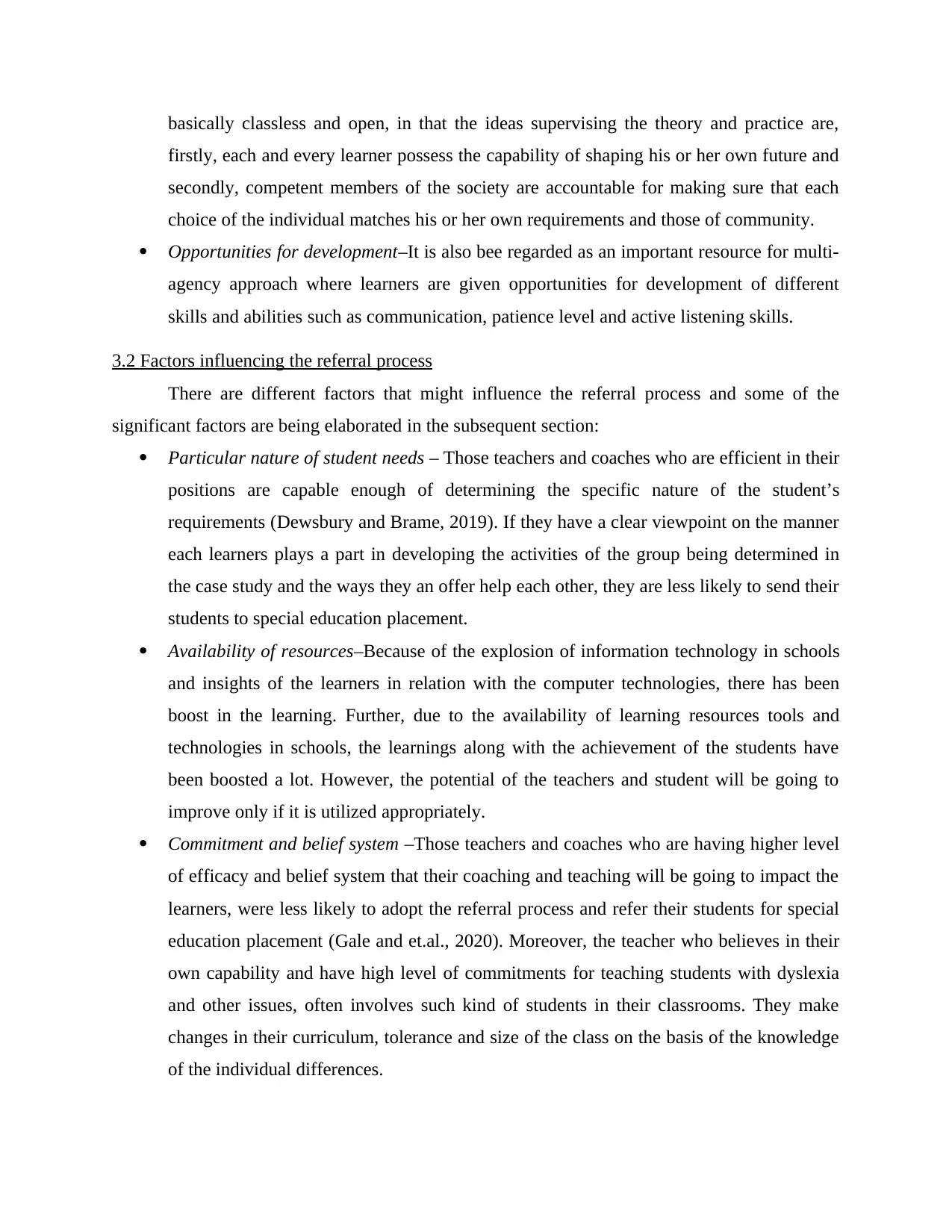
basically classless and open, in that the ideas supervising the theory and practice are,
firstly, each and every learner possess the capability of shaping his or her own future and
secondly, competent members of the society are accountable for making sure that each
choice of the individual matches his or her own requirements and those of community.
Opportunities for development–It is also bee regarded as an important resource for multi-
agency approach where learners are given opportunities for development of different
skills and abilities such as communication, patience level and active listening skills.
3.2 Factors influencing the referral process
There are different factors that might influence the referral process and some of the
significant factors are being elaborated in the subsequent section:
Particular nature of student needs – Those teachers and coaches who are efficient in their
positions are capable enough of determining the specific nature of the student’s
requirements (Dewsbury and Brame, 2019). If they have a clear viewpoint on the manner
each learners plays a part in developing the activities of the group being determined in
the case study and the ways they an offer help each other, they are less likely to send their
students to special education placement.
Availability of resources–Because of the explosion of information technology in schools
and insights of the learners in relation with the computer technologies, there has been
boost in the learning. Further, due to the availability of learning resources tools and
technologies in schools, the learnings along with the achievement of the students have
been boosted a lot. However, the potential of the teachers and student will be going to
improve only if it is utilized appropriately.
Commitment and belief system –Those teachers and coaches who are having higher level
of efficacy and belief system that their coaching and teaching will be going to impact the
learners, were less likely to adopt the referral process and refer their students for special
education placement (Gale and et.al., 2020). Moreover, the teacher who believes in their
own capability and have high level of commitments for teaching students with dyslexia
and other issues, often involves such kind of students in their classrooms. They make
changes in their curriculum, tolerance and size of the class on the basis of the knowledge
of the individual differences.
firstly, each and every learner possess the capability of shaping his or her own future and
secondly, competent members of the society are accountable for making sure that each
choice of the individual matches his or her own requirements and those of community.
Opportunities for development–It is also bee regarded as an important resource for multi-
agency approach where learners are given opportunities for development of different
skills and abilities such as communication, patience level and active listening skills.
3.2 Factors influencing the referral process
There are different factors that might influence the referral process and some of the
significant factors are being elaborated in the subsequent section:
Particular nature of student needs – Those teachers and coaches who are efficient in their
positions are capable enough of determining the specific nature of the student’s
requirements (Dewsbury and Brame, 2019). If they have a clear viewpoint on the manner
each learners plays a part in developing the activities of the group being determined in
the case study and the ways they an offer help each other, they are less likely to send their
students to special education placement.
Availability of resources–Because of the explosion of information technology in schools
and insights of the learners in relation with the computer technologies, there has been
boost in the learning. Further, due to the availability of learning resources tools and
technologies in schools, the learnings along with the achievement of the students have
been boosted a lot. However, the potential of the teachers and student will be going to
improve only if it is utilized appropriately.
Commitment and belief system –Those teachers and coaches who are having higher level
of efficacy and belief system that their coaching and teaching will be going to impact the
learners, were less likely to adopt the referral process and refer their students for special
education placement (Gale and et.al., 2020). Moreover, the teacher who believes in their
own capability and have high level of commitments for teaching students with dyslexia
and other issues, often involves such kind of students in their classrooms. They make
changes in their curriculum, tolerance and size of the class on the basis of the knowledge
of the individual differences.
⊘ This is a preview!⊘
Do you want full access?
Subscribe today to unlock all pages.
Trusted by 1+ million students worldwide
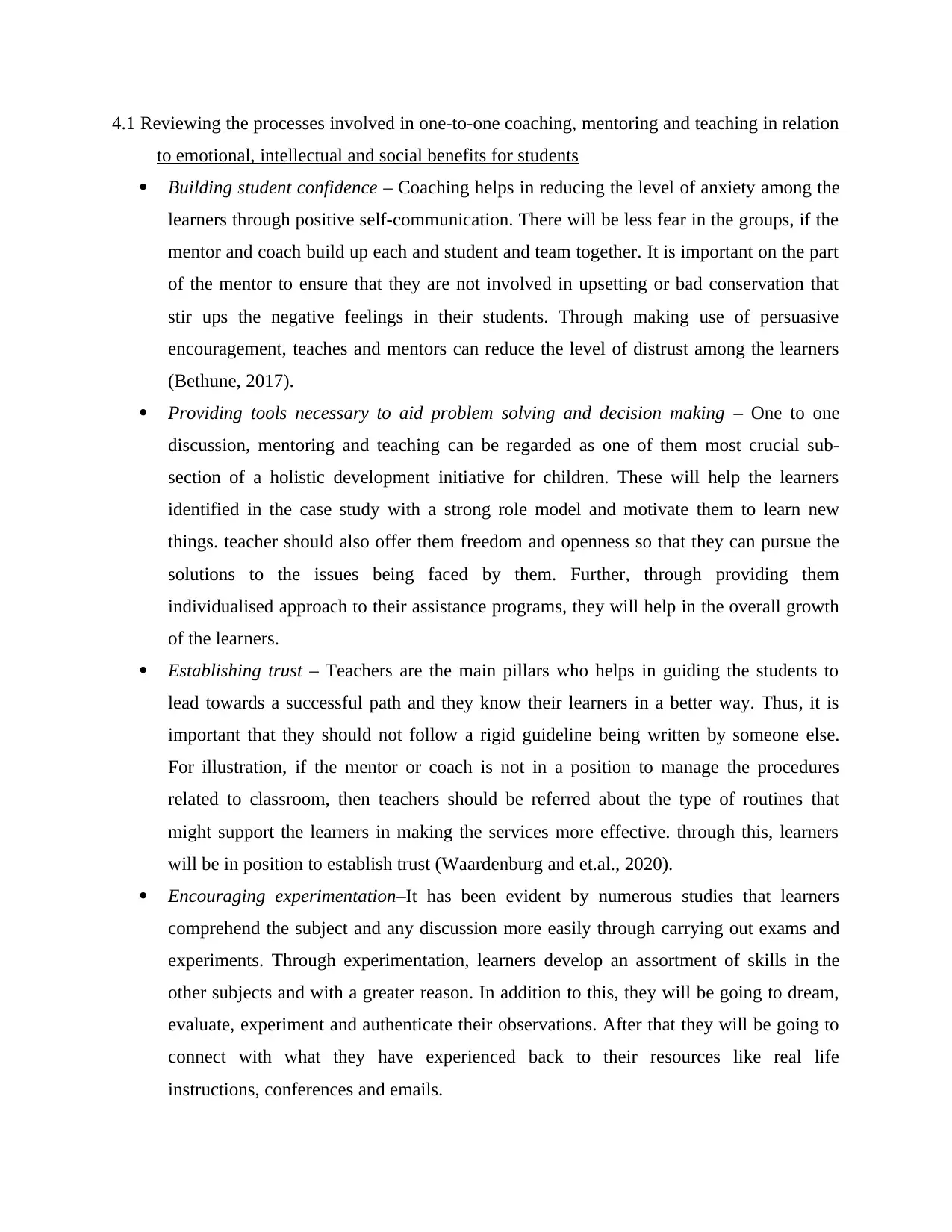
4.1 Reviewing the processes involved in one-to-one coaching, mentoring and teaching in relation
to emotional, intellectual and social benefits for students
Building student confidence – Coaching helps in reducing the level of anxiety among the
learners through positive self-communication. There will be less fear in the groups, if the
mentor and coach build up each and student and team together. It is important on the part
of the mentor to ensure that they are not involved in upsetting or bad conservation that
stir ups the negative feelings in their students. Through making use of persuasive
encouragement, teaches and mentors can reduce the level of distrust among the learners
(Bethune, 2017).
Providing tools necessary to aid problem solving and decision making – One to one
discussion, mentoring and teaching can be regarded as one of them most crucial sub-
section of a holistic development initiative for children. These will help the learners
identified in the case study with a strong role model and motivate them to learn new
things. teacher should also offer them freedom and openness so that they can pursue the
solutions to the issues being faced by them. Further, through providing them
individualised approach to their assistance programs, they will help in the overall growth
of the learners.
Establishing trust – Teachers are the main pillars who helps in guiding the students to
lead towards a successful path and they know their learners in a better way. Thus, it is
important that they should not follow a rigid guideline being written by someone else.
For illustration, if the mentor or coach is not in a position to manage the procedures
related to classroom, then teachers should be referred about the type of routines that
might support the learners in making the services more effective. through this, learners
will be in position to establish trust (Waardenburg and et.al., 2020).
Encouraging experimentation–It has been evident by numerous studies that learners
comprehend the subject and any discussion more easily through carrying out exams and
experiments. Through experimentation, learners develop an assortment of skills in the
other subjects and with a greater reason. In addition to this, they will be going to dream,
evaluate, experiment and authenticate their observations. After that they will be going to
connect with what they have experienced back to their resources like real life
instructions, conferences and emails.
to emotional, intellectual and social benefits for students
Building student confidence – Coaching helps in reducing the level of anxiety among the
learners through positive self-communication. There will be less fear in the groups, if the
mentor and coach build up each and student and team together. It is important on the part
of the mentor to ensure that they are not involved in upsetting or bad conservation that
stir ups the negative feelings in their students. Through making use of persuasive
encouragement, teaches and mentors can reduce the level of distrust among the learners
(Bethune, 2017).
Providing tools necessary to aid problem solving and decision making – One to one
discussion, mentoring and teaching can be regarded as one of them most crucial sub-
section of a holistic development initiative for children. These will help the learners
identified in the case study with a strong role model and motivate them to learn new
things. teacher should also offer them freedom and openness so that they can pursue the
solutions to the issues being faced by them. Further, through providing them
individualised approach to their assistance programs, they will help in the overall growth
of the learners.
Establishing trust – Teachers are the main pillars who helps in guiding the students to
lead towards a successful path and they know their learners in a better way. Thus, it is
important that they should not follow a rigid guideline being written by someone else.
For illustration, if the mentor or coach is not in a position to manage the procedures
related to classroom, then teachers should be referred about the type of routines that
might support the learners in making the services more effective. through this, learners
will be in position to establish trust (Waardenburg and et.al., 2020).
Encouraging experimentation–It has been evident by numerous studies that learners
comprehend the subject and any discussion more easily through carrying out exams and
experiments. Through experimentation, learners develop an assortment of skills in the
other subjects and with a greater reason. In addition to this, they will be going to dream,
evaluate, experiment and authenticate their observations. After that they will be going to
connect with what they have experienced back to their resources like real life
instructions, conferences and emails.
Paraphrase This Document
Need a fresh take? Get an instant paraphrase of this document with our AI Paraphraser
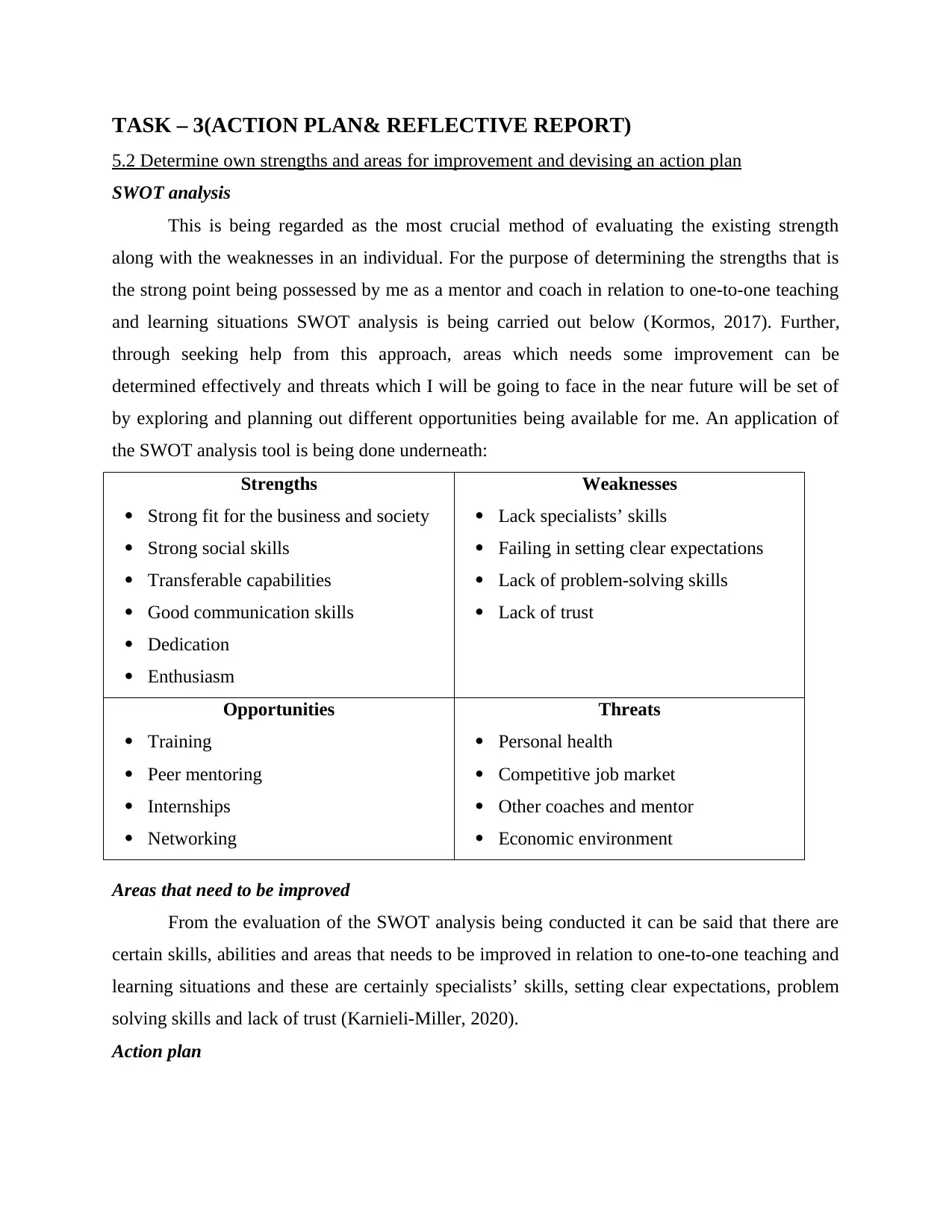
TASK – 3(ACTION PLAN& REFLECTIVE REPORT)
5.2 Determine own strengths and areas for improvement and devising an action plan
SWOT analysis
This is being regarded as the most crucial method of evaluating the existing strength
along with the weaknesses in an individual. For the purpose of determining the strengths that is
the strong point being possessed by me as a mentor and coach in relation to one-to-one teaching
and learning situations SWOT analysis is being carried out below (Kormos, 2017). Further,
through seeking help from this approach, areas which needs some improvement can be
determined effectively and threats which I will be going to face in the near future will be set of
by exploring and planning out different opportunities being available for me. An application of
the SWOT analysis tool is being done underneath:
Strengths
Strong fit for the business and society
Strong social skills
Transferable capabilities
Good communication skills
Dedication
Enthusiasm
Weaknesses
Lack specialists’ skills
Failing in setting clear expectations
Lack of problem-solving skills
Lack of trust
Opportunities
Training
Peer mentoring
Internships
Networking
Threats
Personal health
Competitive job market
Other coaches and mentor
Economic environment
Areas that need to be improved
From the evaluation of the SWOT analysis being conducted it can be said that there are
certain skills, abilities and areas that needs to be improved in relation to one-to-one teaching and
learning situations and these are certainly specialists’ skills, setting clear expectations, problem
solving skills and lack of trust (Karnieli-Miller, 2020).
Action plan
5.2 Determine own strengths and areas for improvement and devising an action plan
SWOT analysis
This is being regarded as the most crucial method of evaluating the existing strength
along with the weaknesses in an individual. For the purpose of determining the strengths that is
the strong point being possessed by me as a mentor and coach in relation to one-to-one teaching
and learning situations SWOT analysis is being carried out below (Kormos, 2017). Further,
through seeking help from this approach, areas which needs some improvement can be
determined effectively and threats which I will be going to face in the near future will be set of
by exploring and planning out different opportunities being available for me. An application of
the SWOT analysis tool is being done underneath:
Strengths
Strong fit for the business and society
Strong social skills
Transferable capabilities
Good communication skills
Dedication
Enthusiasm
Weaknesses
Lack specialists’ skills
Failing in setting clear expectations
Lack of problem-solving skills
Lack of trust
Opportunities
Training
Peer mentoring
Internships
Networking
Threats
Personal health
Competitive job market
Other coaches and mentor
Economic environment
Areas that need to be improved
From the evaluation of the SWOT analysis being conducted it can be said that there are
certain skills, abilities and areas that needs to be improved in relation to one-to-one teaching and
learning situations and these are certainly specialists’ skills, setting clear expectations, problem
solving skills and lack of trust (Karnieli-Miller, 2020).
Action plan
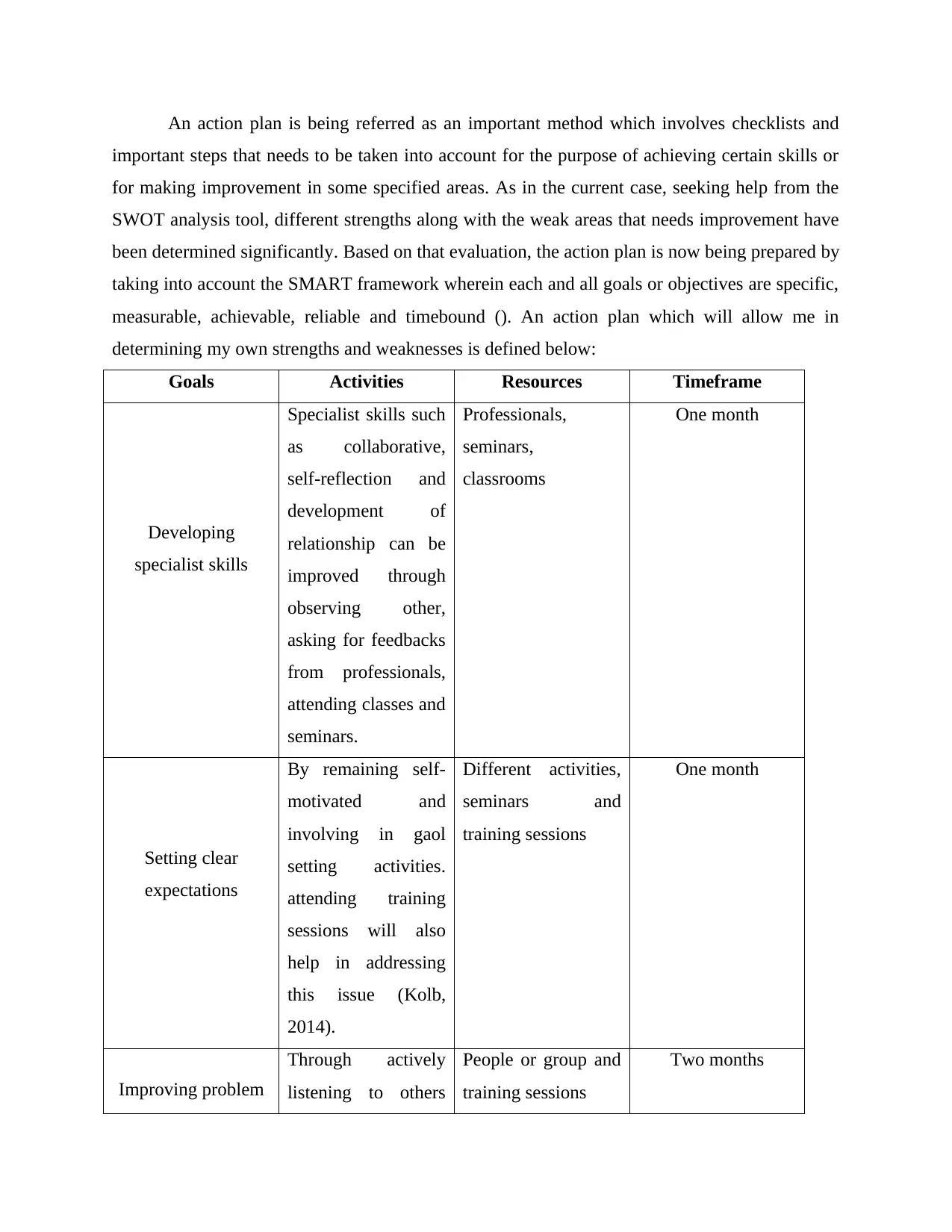
An action plan is being referred as an important method which involves checklists and
important steps that needs to be taken into account for the purpose of achieving certain skills or
for making improvement in some specified areas. As in the current case, seeking help from the
SWOT analysis tool, different strengths along with the weak areas that needs improvement have
been determined significantly. Based on that evaluation, the action plan is now being prepared by
taking into account the SMART framework wherein each and all goals or objectives are specific,
measurable, achievable, reliable and timebound (). An action plan which will allow me in
determining my own strengths and weaknesses is defined below:
Goals Activities Resources Timeframe
Developing
specialist skills
Specialist skills such
as collaborative,
self-reflection and
development of
relationship can be
improved through
observing other,
asking for feedbacks
from professionals,
attending classes and
seminars.
Professionals,
seminars,
classrooms
One month
Setting clear
expectations
By remaining self-
motivated and
involving in gaol
setting activities.
attending training
sessions will also
help in addressing
this issue (Kolb,
2014).
Different activities,
seminars and
training sessions
One month
Improving problem
Through actively
listening to others
People or group and
training sessions
Two months
important steps that needs to be taken into account for the purpose of achieving certain skills or
for making improvement in some specified areas. As in the current case, seeking help from the
SWOT analysis tool, different strengths along with the weak areas that needs improvement have
been determined significantly. Based on that evaluation, the action plan is now being prepared by
taking into account the SMART framework wherein each and all goals or objectives are specific,
measurable, achievable, reliable and timebound (). An action plan which will allow me in
determining my own strengths and weaknesses is defined below:
Goals Activities Resources Timeframe
Developing
specialist skills
Specialist skills such
as collaborative,
self-reflection and
development of
relationship can be
improved through
observing other,
asking for feedbacks
from professionals,
attending classes and
seminars.
Professionals,
seminars,
classrooms
One month
Setting clear
expectations
By remaining self-
motivated and
involving in gaol
setting activities.
attending training
sessions will also
help in addressing
this issue (Kolb,
2014).
Different activities,
seminars and
training sessions
One month
Improving problem
Through actively
listening to others
People or group and
training sessions
Two months
⊘ This is a preview!⊘
Do you want full access?
Subscribe today to unlock all pages.
Trusted by 1+ million students worldwide

1 out of 20


Related Documents


Your All-in-One AI-Powered Toolkit for Academic Success.
+13062052269
info@desklib.com
Available 24*7 on WhatsApp / Email
![[object Object]](/_next/static/media/star-bottom.7253800d.svg)
Unlock your academic potential
Copyright © 2020–2026 A2Z Services. All Rights Reserved. Developed and managed by ZUCOL.