Dissertation on Coaching and Mentoring: Workforce Productivity Impact
VerifiedAdded on 2023/06/18
|73
|21176
|424
Thesis and Dissertation
AI Summary
This dissertation investigates the impact of coaching and mentoring programs on workforce productivity, focusing on their introduction and implementation within a local government council. The study compares traditional and e-coaching/e-mentoring approaches, addresses challenges associated with these interventions, and employs a mixed-methods research methodology, including thematic analysis of interview data. Key findings highlight the positive effects of coaching and mentoring on employee morale, skills development, and overall service delivery. The research also acknowledges limitations and suggests future implications for enhancing human resource practices in similar organizations. The dissertation concludes by emphasizing the importance of tailored coaching and mentoring strategies to improve workforce competence and organizational performance.
Dissertation on Coaching and Mentoring 1
Coaching and Mentoring Impact on Workforce Productivity to Introduce and Implement
Coaching and Mentoring to a Local Government Council
B804 Dissertation (HRM) TMA1
Coaching and Mentoring Impact on Workforce Productivity to Introduce and Implement
Coaching and Mentoring to a Local Government Council
B804 Dissertation (HRM) TMA1

Paraphrase This Document
Need a fresh take? Get an instant paraphrase of this document with our AI Paraphraser
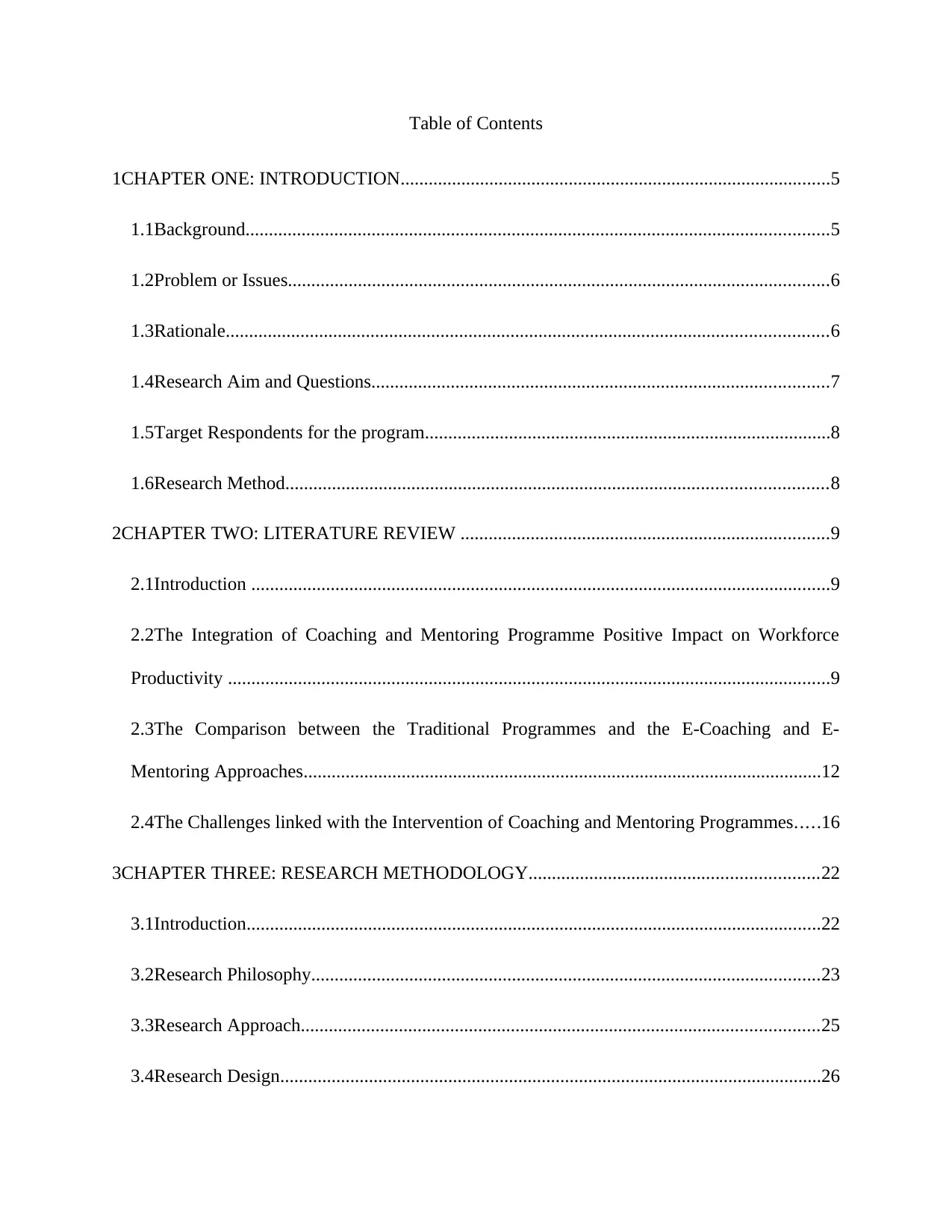
Table of Contents
1CHAPTER ONE: INTRODUCTION............................................................................................5
1.1Background.............................................................................................................................5
1.2Problem or Issues....................................................................................................................6
1.3Rationale.................................................................................................................................6
1.4Research Aim and Questions..................................................................................................7
1.5Target Respondents for the program.......................................................................................8
1.6Research Method....................................................................................................................8
2CHAPTER TWO: LITERATURE REVIEW ...............................................................................9
2.1Introduction ............................................................................................................................9
2.2The Integration of Coaching and Mentoring Programme Positive Impact on Workforce
Productivity .................................................................................................................................9
2.3The Comparison between the Traditional Programmes and the E-Coaching and E-
Mentoring Approaches...............................................................................................................12
2.4The Challenges linked with the Intervention of Coaching and Mentoring Programmes.....16
3CHAPTER THREE: RESEARCH METHODOLOGY..............................................................22
3.1Introduction...........................................................................................................................22
3.2Research Philosophy.............................................................................................................23
3.3Research Approach...............................................................................................................25
3.4Research Design....................................................................................................................26
1CHAPTER ONE: INTRODUCTION............................................................................................5
1.1Background.............................................................................................................................5
1.2Problem or Issues....................................................................................................................6
1.3Rationale.................................................................................................................................6
1.4Research Aim and Questions..................................................................................................7
1.5Target Respondents for the program.......................................................................................8
1.6Research Method....................................................................................................................8
2CHAPTER TWO: LITERATURE REVIEW ...............................................................................9
2.1Introduction ............................................................................................................................9
2.2The Integration of Coaching and Mentoring Programme Positive Impact on Workforce
Productivity .................................................................................................................................9
2.3The Comparison between the Traditional Programmes and the E-Coaching and E-
Mentoring Approaches...............................................................................................................12
2.4The Challenges linked with the Intervention of Coaching and Mentoring Programmes.....16
3CHAPTER THREE: RESEARCH METHODOLOGY..............................................................22
3.1Introduction...........................................................................................................................22
3.2Research Philosophy.............................................................................................................23
3.3Research Approach...............................................................................................................25
3.4Research Design....................................................................................................................26
Dissertation on Coaching and Mentoring 3
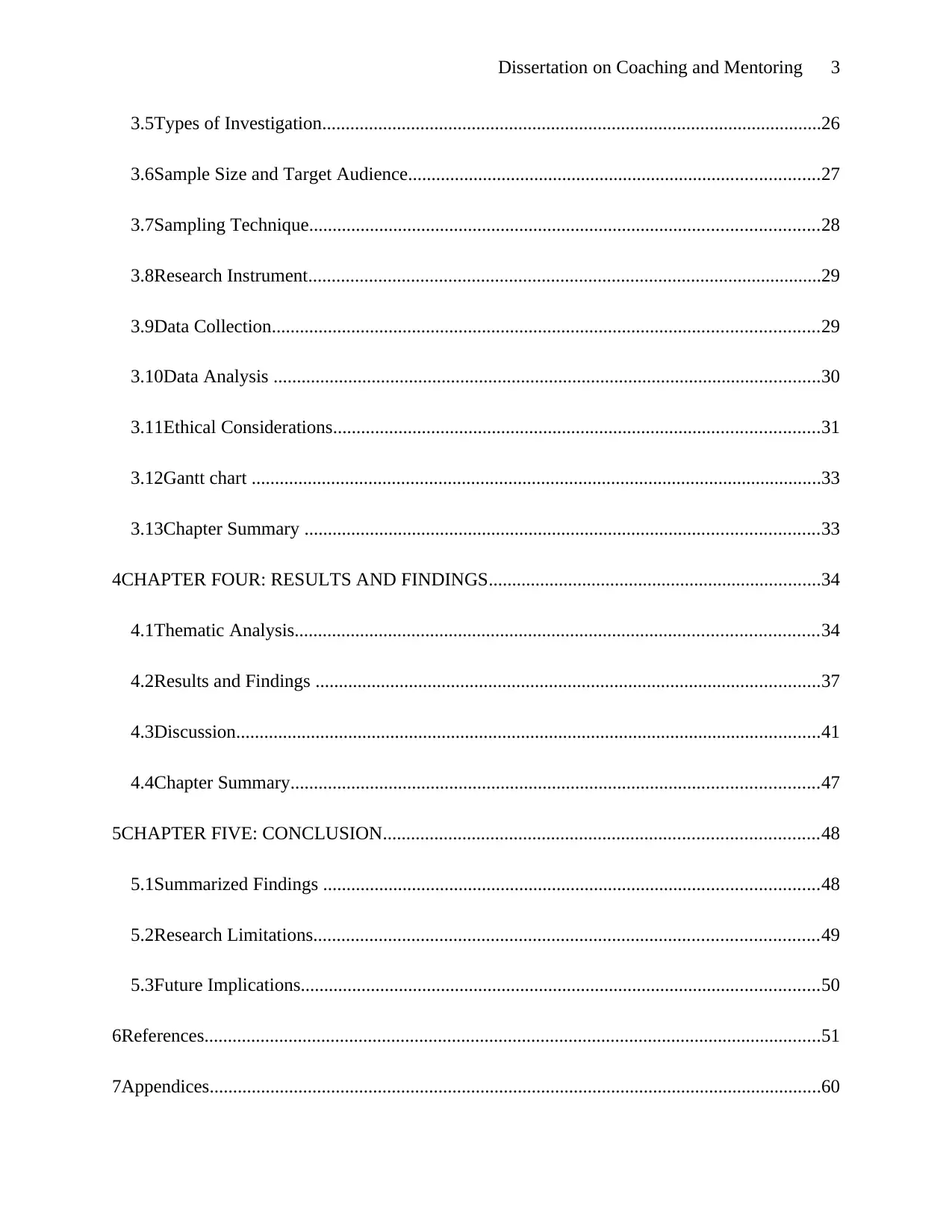
3.5Types of Investigation...........................................................................................................26
3.6Sample Size and Target Audience........................................................................................27
3.7Sampling Technique.............................................................................................................28
3.8Research Instrument..............................................................................................................29
3.9Data Collection.....................................................................................................................29
3.10Data Analysis .....................................................................................................................30
3.11Ethical Considerations........................................................................................................31
3.12Gantt chart ..........................................................................................................................33
3.13Chapter Summary ..............................................................................................................33
4CHAPTER FOUR: RESULTS AND FINDINGS.......................................................................34
4.1Thematic Analysis................................................................................................................34
4.2Results and Findings ............................................................................................................37
4.3Discussion.............................................................................................................................41
4.4Chapter Summary.................................................................................................................47
5CHAPTER FIVE: CONCLUSION.............................................................................................48
5.1Summarized Findings ..........................................................................................................48
5.2Research Limitations............................................................................................................49
5.3Future Implications...............................................................................................................50
6References....................................................................................................................................51
7Appendices...................................................................................................................................60
3.5Types of Investigation...........................................................................................................26
3.6Sample Size and Target Audience........................................................................................27
3.7Sampling Technique.............................................................................................................28
3.8Research Instrument..............................................................................................................29
3.9Data Collection.....................................................................................................................29
3.10Data Analysis .....................................................................................................................30
3.11Ethical Considerations........................................................................................................31
3.12Gantt chart ..........................................................................................................................33
3.13Chapter Summary ..............................................................................................................33
4CHAPTER FOUR: RESULTS AND FINDINGS.......................................................................34
4.1Thematic Analysis................................................................................................................34
4.2Results and Findings ............................................................................................................37
4.3Discussion.............................................................................................................................41
4.4Chapter Summary.................................................................................................................47
5CHAPTER FIVE: CONCLUSION.............................................................................................48
5.1Summarized Findings ..........................................................................................................48
5.2Research Limitations............................................................................................................49
5.3Future Implications...............................................................................................................50
6References....................................................................................................................................51
7Appendices...................................................................................................................................60
⊘ This is a preview!⊘
Do you want full access?
Subscribe today to unlock all pages.

Trusted by 1+ million students worldwide

7.1Appendix A – Interview Questionnaire ...............................................................................60
7.2Appendix B – Key Notes to the Research Study..................................................................60
7.2Appendix B – Key Notes to the Research Study..................................................................60
Paraphrase This Document
Need a fresh take? Get an instant paraphrase of this document with our AI Paraphraser
Dissertation on Coaching and Mentoring 5
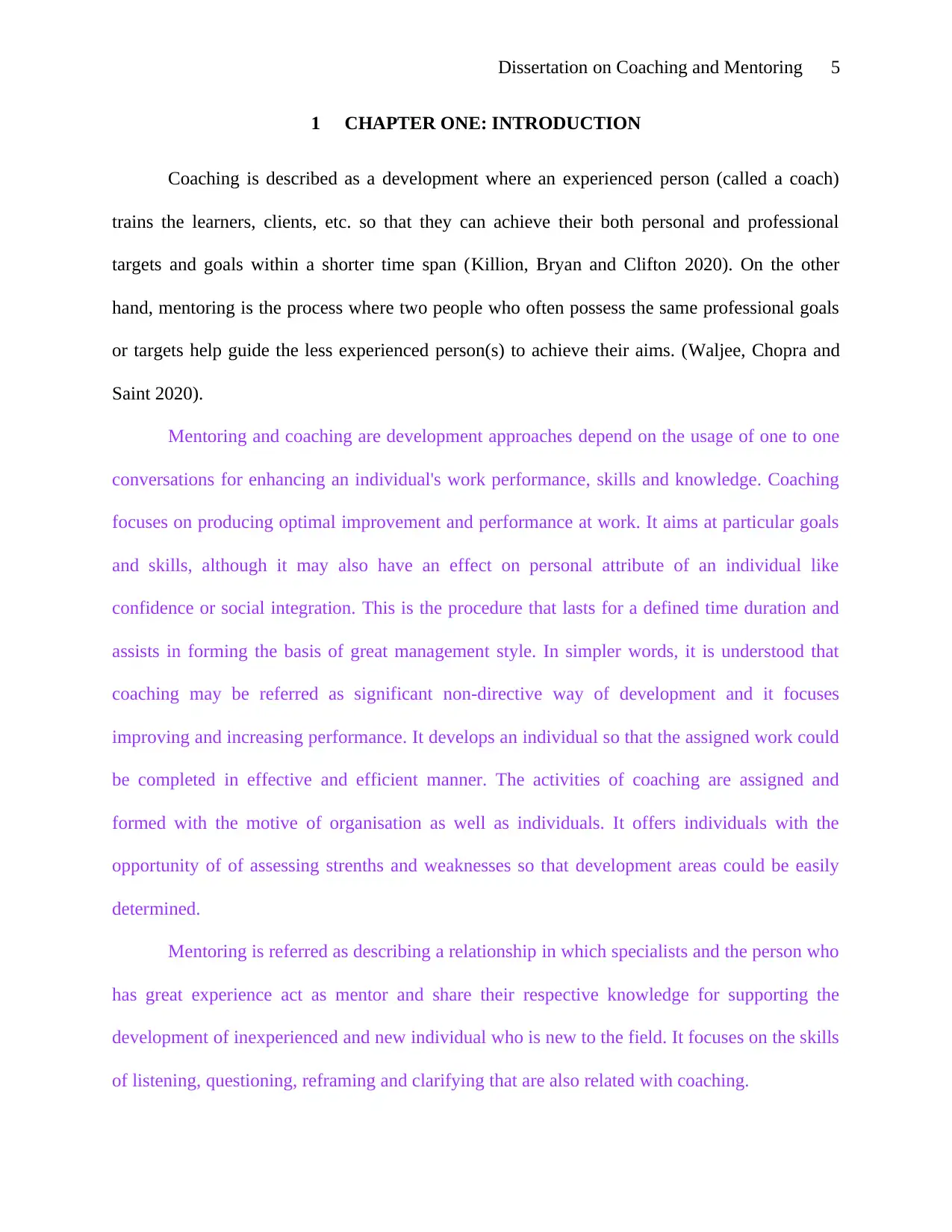
1 CHAPTER ONE: INTRODUCTION
Coaching is described as a development where an experienced person (called a coach)
trains the learners, clients, etc. so that they can achieve their both personal and professional
targets and goals within a shorter time span (Killion, Bryan and Clifton 2020). On the other
hand, mentoring is the process where two people who often possess the same professional goals
or targets help guide the less experienced person(s) to achieve their aims. (Waljee, Chopra and
Saint 2020).
Mentoring and coaching are development approaches depend on the usage of one to one
conversations for enhancing an individual's work performance, skills and knowledge. Coaching
focuses on producing optimal improvement and performance at work. It aims at particular goals
and skills, although it may also have an effect on personal attribute of an individual like
confidence or social integration. This is the procedure that lasts for a defined time duration and
assists in forming the basis of great management style. In simpler words, it is understood that
coaching may be referred as significant non-directive way of development and it focuses
improving and increasing performance. It develops an individual so that the assigned work could
be completed in effective and efficient manner. The activities of coaching are assigned and
formed with the motive of organisation as well as individuals. It offers individuals with the
opportunity of of assessing strenths and weaknesses so that development areas could be easily
determined.
Mentoring is referred as describing a relationship in which specialists and the person who
has great experience act as mentor and share their respective knowledge for supporting the
development of inexperienced and new individual who is new to the field. It focuses on the skills
of listening, questioning, reframing and clarifying that are also related with coaching.
1 CHAPTER ONE: INTRODUCTION
Coaching is described as a development where an experienced person (called a coach)
trains the learners, clients, etc. so that they can achieve their both personal and professional
targets and goals within a shorter time span (Killion, Bryan and Clifton 2020). On the other
hand, mentoring is the process where two people who often possess the same professional goals
or targets help guide the less experienced person(s) to achieve their aims. (Waljee, Chopra and
Saint 2020).
Mentoring and coaching are development approaches depend on the usage of one to one
conversations for enhancing an individual's work performance, skills and knowledge. Coaching
focuses on producing optimal improvement and performance at work. It aims at particular goals
and skills, although it may also have an effect on personal attribute of an individual like
confidence or social integration. This is the procedure that lasts for a defined time duration and
assists in forming the basis of great management style. In simpler words, it is understood that
coaching may be referred as significant non-directive way of development and it focuses
improving and increasing performance. It develops an individual so that the assigned work could
be completed in effective and efficient manner. The activities of coaching are assigned and
formed with the motive of organisation as well as individuals. It offers individuals with the
opportunity of of assessing strenths and weaknesses so that development areas could be easily
determined.
Mentoring is referred as describing a relationship in which specialists and the person who
has great experience act as mentor and share their respective knowledge for supporting the
development of inexperienced and new individual who is new to the field. It focuses on the skills
of listening, questioning, reframing and clarifying that are also related with coaching.
Dissertation on Coaching and Mentoring 6
It is identified that coaching is more likely to be short term from 6 months to 1 year with
a prticular outcome in mind. Some coaching relationships could be of longer duration based
upon objectives achieved and wants to achieve. On the other hand, relatioship of mentoring is of
long term which lasts a year or two and in some cases more than two years. Coaching could be
referred as more performance driven that is specifically designed for improving on the job
performance of professionals whereas mentoring is focussed towards development, it just not
only focuses current job function of professionals but focuses on overall career development of
an individual.
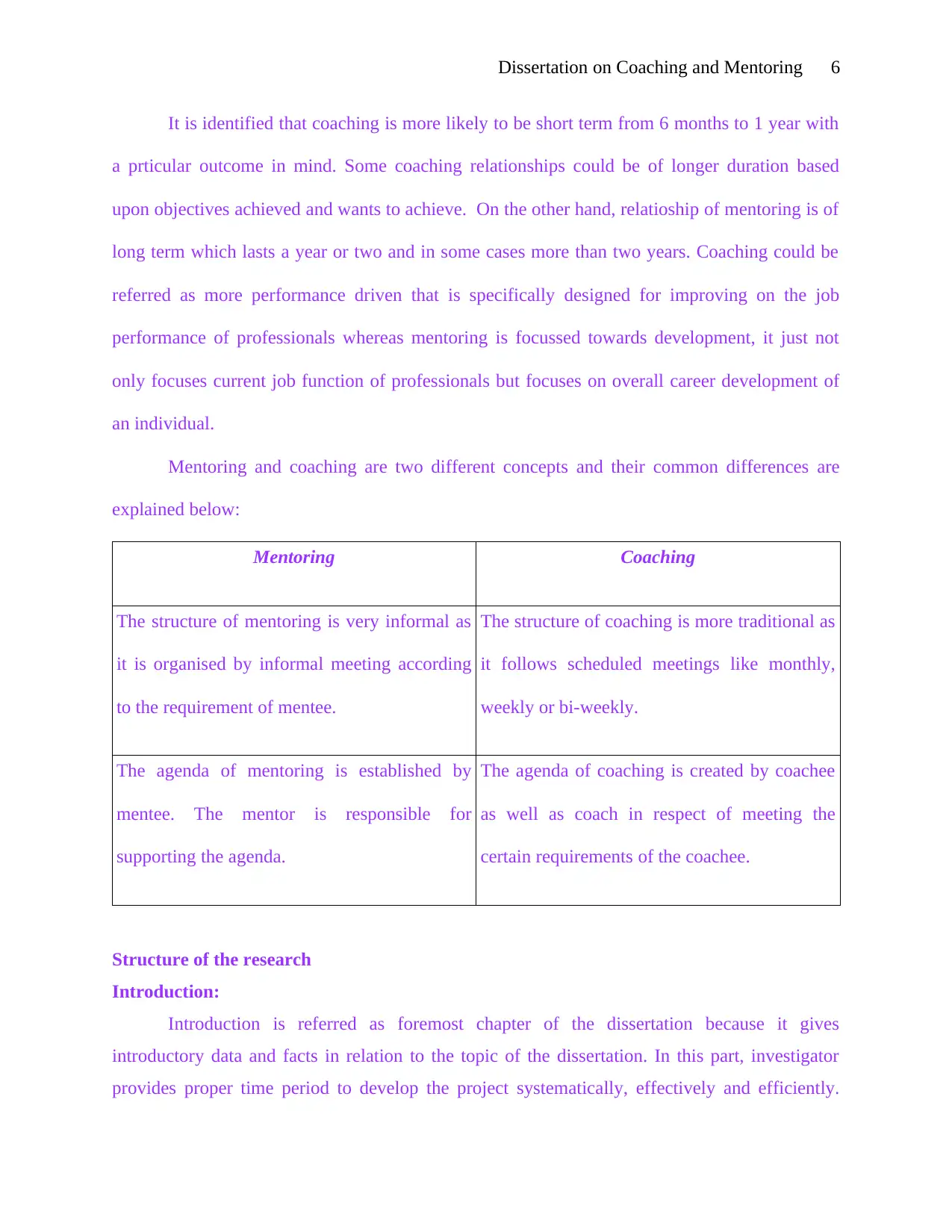
Mentoring and coaching are two different concepts and their common differences are
explained below:
Mentoring Coaching
The structure of mentoring is very informal as
it is organised by informal meeting according
to the requirement of mentee.
The structure of coaching is more traditional as
it follows scheduled meetings like monthly,
weekly or bi-weekly.
The agenda of mentoring is established by
mentee. The mentor is responsible for
supporting the agenda.
The agenda of coaching is created by coachee
as well as coach in respect of meeting the
certain requirements of the coachee.
Structure of the research
Introduction:
Introduction is referred as foremost chapter of the dissertation because it gives
introductory data and facts in relation to the topic of the dissertation. In this part, investigator
provides proper time period to develop the project systematically, effectively and efficiently.
It is identified that coaching is more likely to be short term from 6 months to 1 year with
a prticular outcome in mind. Some coaching relationships could be of longer duration based
upon objectives achieved and wants to achieve. On the other hand, relatioship of mentoring is of
long term which lasts a year or two and in some cases more than two years. Coaching could be
referred as more performance driven that is specifically designed for improving on the job
performance of professionals whereas mentoring is focussed towards development, it just not
only focuses current job function of professionals but focuses on overall career development of
an individual.
Mentoring and coaching are two different concepts and their common differences are
explained below:
Mentoring Coaching
The structure of mentoring is very informal as
it is organised by informal meeting according
to the requirement of mentee.
The structure of coaching is more traditional as
it follows scheduled meetings like monthly,
weekly or bi-weekly.
The agenda of mentoring is established by
mentee. The mentor is responsible for
supporting the agenda.
The agenda of coaching is created by coachee
as well as coach in respect of meeting the
certain requirements of the coachee.
Structure of the research
Introduction:
Introduction is referred as foremost chapter of the dissertation because it gives
introductory data and facts in relation to the topic of the dissertation. In this part, investigator
provides proper time period to develop the project systematically, effectively and efficiently.
⊘ This is a preview!⊘
Do you want full access?
Subscribe today to unlock all pages.
Trusted by 1+ million students worldwide
Dissertation on Coaching and Mentoring 7
Introduction is the face of the dissertation because it is the first section that is read by the reader.
It is important for binding whole data and information represented in the dissertation report from
the section of introduction because it provides impressive start as it would create great
impression in the reader's mind for the generated report.
Literature review:
Literature review is defined as second chapter for the dissertation project. In this
researcher has aimed towards addressing questions of the dissertation through journal articles.
The collected data by articles are shown in own words so that pre-defined objectives can be
easily attained. This specific section considers techniques of secondary data collection method to
collect apt fact and information related to the topic. This section involves data that is already
published by different authors and writers. This section also involves review of journals, articles
and books, newspapers, magazines, websites of organisations because all these sources have
great piece of information for achieving the pre-defined objectives of dissertation report in
systematic manner. Literature review always has great contribution in the research because it
provides great clarification about the study. It is one of the information holding and significant
sections of the dissertation as it provides great learning to researcher as well as reader.
Methodology:
This is the third important chapter of the dissertation, it is considered for presenting all
the material information and facts in the given report. The major purpose of the present chapter
in the dissertation is confirming the relevancy and authenticity of the research study. In the given
context, primary as well as secondary research method are being taken into consideration. It
includes appropriate data in relation to methodology and the examination that could be validated.
This chapter gives different methodologies that facilitate in gathering and analysing apt
information for meeting objectives of the investigation without taking longer period of time. The
current investigation is based upon quantitative research that focuses on collection of statistical
in relation to the topic of dissertation report.
Results & Findings:
Results & Findings is the fourth chapter of investigation that covers research findings and
data interpretation. Basically, it is the summary of research findings and data interpretation. It is
the section that covers all material and statistical data and facts with pre-determined questions of
investigation with research objectives and aim. Hence, this section in the whole investigation is
Introduction is the face of the dissertation because it is the first section that is read by the reader.
It is important for binding whole data and information represented in the dissertation report from
the section of introduction because it provides impressive start as it would create great
impression in the reader's mind for the generated report.
Literature review:
Literature review is defined as second chapter for the dissertation project. In this
researcher has aimed towards addressing questions of the dissertation through journal articles.
The collected data by articles are shown in own words so that pre-defined objectives can be
easily attained. This specific section considers techniques of secondary data collection method to
collect apt fact and information related to the topic. This section involves data that is already
published by different authors and writers. This section also involves review of journals, articles
and books, newspapers, magazines, websites of organisations because all these sources have
great piece of information for achieving the pre-defined objectives of dissertation report in
systematic manner. Literature review always has great contribution in the research because it
provides great clarification about the study. It is one of the information holding and significant
sections of the dissertation as it provides great learning to researcher as well as reader.
Methodology:
This is the third important chapter of the dissertation, it is considered for presenting all
the material information and facts in the given report. The major purpose of the present chapter
in the dissertation is confirming the relevancy and authenticity of the research study. In the given
context, primary as well as secondary research method are being taken into consideration. It
includes appropriate data in relation to methodology and the examination that could be validated.
This chapter gives different methodologies that facilitate in gathering and analysing apt
information for meeting objectives of the investigation without taking longer period of time. The
current investigation is based upon quantitative research that focuses on collection of statistical
in relation to the topic of dissertation report.
Results & Findings:
Results & Findings is the fourth chapter of investigation that covers research findings and
data interpretation. Basically, it is the summary of research findings and data interpretation. It is
the section that covers all material and statistical data and facts with pre-determined questions of
investigation with research objectives and aim. Hence, this section in the whole investigation is
Paraphrase This Document
Need a fresh take? Get an instant paraphrase of this document with our AI Paraphraser
Dissertation on Coaching and Mentoring 8
significant because reader could easily analyse all the related information and facts presented in
the dissertation.
Discussion, conclusion and recommendations:
It is the last chapter of the dissertation report, in the discussion chapter data collected
through primary and secondary resources are being discussed and analysed. This discussion
chapter gives the whole synthesis of gathered data through primary as well as secondary sources.
After that there is conclusion chapter that includes summary of the whole collected information
in proper and systematic manner. After giving summary of whole investigation recommendations
are involved so that problems faced within the study can be resolved or mitigated completed. It is
significant to complete the whole dissertation report systematically and properly.
1.1 Background
In November 2018, I had the opportunity to travel on a family vacation to a city in Nigeria,
Ibadan, Oyo state, where I was born and decided to use the opportunity to walk into a local
government council office to obtain my birth certificate as I did not remember getting one in the
past. When I got to the office, I was directed to the help desk and eventually sat to be called
upon. It later dawned on me I had spent a better part of the day waiting to be attended to, despite
inquiring from the help desk when I got there earlier. I saw a staff member grumpily walk past
me to take a cigarette break; I ran after him to ask if he could assist me. I humbly greeted him
and requested I have a word with him; he responded then we got talking. He probably figured I
was not from his locality because of my British accent; he hesitated until I told him my mission
there. The outcome of our chat got me a seat in the duty manager’s office; while discussing with
her, I dared to ask to be allowed to engage their HR department to make the council function to
its full potential.
In February of last year, I discussed with the head HR department if I could do my dissertation
on implementing the coaching and mentoring process in the institution, and he said they would
be more than happy to help and assist with everything I need towards this. The entire case
significant because reader could easily analyse all the related information and facts presented in
the dissertation.
Discussion, conclusion and recommendations:
It is the last chapter of the dissertation report, in the discussion chapter data collected
through primary and secondary resources are being discussed and analysed. This discussion
chapter gives the whole synthesis of gathered data through primary as well as secondary sources.
After that there is conclusion chapter that includes summary of the whole collected information
in proper and systematic manner. After giving summary of whole investigation recommendations
are involved so that problems faced within the study can be resolved or mitigated completed. It is
significant to complete the whole dissertation report systematically and properly.
1.1 Background
In November 2018, I had the opportunity to travel on a family vacation to a city in Nigeria,
Ibadan, Oyo state, where I was born and decided to use the opportunity to walk into a local
government council office to obtain my birth certificate as I did not remember getting one in the
past. When I got to the office, I was directed to the help desk and eventually sat to be called
upon. It later dawned on me I had spent a better part of the day waiting to be attended to, despite
inquiring from the help desk when I got there earlier. I saw a staff member grumpily walk past
me to take a cigarette break; I ran after him to ask if he could assist me. I humbly greeted him
and requested I have a word with him; he responded then we got talking. He probably figured I
was not from his locality because of my British accent; he hesitated until I told him my mission
there. The outcome of our chat got me a seat in the duty manager’s office; while discussing with
her, I dared to ask to be allowed to engage their HR department to make the council function to
its full potential.
In February of last year, I discussed with the head HR department if I could do my dissertation
on implementing the coaching and mentoring process in the institution, and he said they would
be more than happy to help and assist with everything I need towards this. The entire case
Dissertation on Coaching and Mentoring 9
reflects the importance of mentoring while highlighting issues the behaviour has exhibited in
terms of engagement as the usage of the right-mentoring method would have mitigated the issue,
and more importantly, it would have resulted in the development of the right-engaging
behaviour. This research aims to address how mentoring and coaching can be beneficial in
improving workforce competence in this regard.
1.2 Problem or Issues
The importance and implementation of the coaching and mentoring programmes within the
institution's framework provides civic service to the community in the state. The staff may face
challenges regarding the output of service delivery from both walk-in clients and other staff due
to low self-esteem and dampened general work morale. For example, a study conducted by Oku
et al. (2017) indicated that staff members often feel discouraged when they experience poor
behaviour from their mentors as their opinions is discarded and devalued. That is possible with
the help of specifically skilled professionals who will talk and air their opinion and voices like
coaches and/or mentors.
1.3 Rationale
These problems require to be addressed effectively and professionally for staff to overcome the
problem and their overall service output to be positively impacted. This will also have a ripple
effect on other stakeholders, i.e., the walk-in clients and the community. As the institution deals
directly in civic service, the ground workers must have the professional expertise and sense of
belonging like the other parastatals within the government that deals on a day-to-day with clients
and are up to the task because their morale is high, and they are well-coached to manage the
nature of the job.
reflects the importance of mentoring while highlighting issues the behaviour has exhibited in
terms of engagement as the usage of the right-mentoring method would have mitigated the issue,
and more importantly, it would have resulted in the development of the right-engaging
behaviour. This research aims to address how mentoring and coaching can be beneficial in
improving workforce competence in this regard.
1.2 Problem or Issues
The importance and implementation of the coaching and mentoring programmes within the
institution's framework provides civic service to the community in the state. The staff may face
challenges regarding the output of service delivery from both walk-in clients and other staff due
to low self-esteem and dampened general work morale. For example, a study conducted by Oku
et al. (2017) indicated that staff members often feel discouraged when they experience poor
behaviour from their mentors as their opinions is discarded and devalued. That is possible with
the help of specifically skilled professionals who will talk and air their opinion and voices like
coaches and/or mentors.
1.3 Rationale
These problems require to be addressed effectively and professionally for staff to overcome the
problem and their overall service output to be positively impacted. This will also have a ripple
effect on other stakeholders, i.e., the walk-in clients and the community. As the institution deals
directly in civic service, the ground workers must have the professional expertise and sense of
belonging like the other parastatals within the government that deals on a day-to-day with clients
and are up to the task because their morale is high, and they are well-coached to manage the
nature of the job.
⊘ This is a preview!⊘
Do you want full access?
Subscribe today to unlock all pages.
Trusted by 1+ million students worldwide
Dissertation on Coaching and Mentoring 10
On the other hand, human-resource-related issues are prevalent in the Nigerian sector as
individuals from the average-income class are often demotivated and devalued. Civil Servants
tend to experience broader HR issues, and thus it demotivates them to carry their duties
righteously (Aworh, et al., 2013). The respective statement can be further approved by reviewing
the example where several complaints by some ground staff are made as they do not understand
how their predecessors handled the stress of the job that had been out in the open, which means
some of the older and experienced employees need to re-train the new ones.
With the current situation of the global pandemic (Covid19), e-coaching and e-mentoring are
new dimensions taken by the professional bodies to help support organisations and institutions
maintain these services' delivery when needed. Every session remains discreet and professional
and helps the staff member that is shy or not comfortable to speak publicly voice out issues that
are affecting their productivity.
Coaching is set to help in various aspects, i.e., it helps increase work /job satisfaction positively,
it helps to enhance skill in problem analysis and strategic thinking respectively, increases
employee’s self-confidence, and promotes career growth amongst. (Aworh, et al., 2013).
Mentoring programmes are set to help develop diverse areas in an organisation, i.e., the
experienced staff provides knowledge to the inexperienced staff, while the improved junior staff
encourages the newly joined staff who in turn gains recognition at the workplace, etc.
1.4 Research Aim and Questions
The preliminary questions are crucial for the development and compilation of any research as it
is the report/feedback that points to the path of the research. The preliminary question will help
acquire the target within the specific timeline and tackle the low morale and self-esteem that
affect their service productivity.
On the other hand, human-resource-related issues are prevalent in the Nigerian sector as
individuals from the average-income class are often demotivated and devalued. Civil Servants
tend to experience broader HR issues, and thus it demotivates them to carry their duties
righteously (Aworh, et al., 2013). The respective statement can be further approved by reviewing
the example where several complaints by some ground staff are made as they do not understand
how their predecessors handled the stress of the job that had been out in the open, which means
some of the older and experienced employees need to re-train the new ones.
With the current situation of the global pandemic (Covid19), e-coaching and e-mentoring are
new dimensions taken by the professional bodies to help support organisations and institutions
maintain these services' delivery when needed. Every session remains discreet and professional
and helps the staff member that is shy or not comfortable to speak publicly voice out issues that
are affecting their productivity.
Coaching is set to help in various aspects, i.e., it helps increase work /job satisfaction positively,
it helps to enhance skill in problem analysis and strategic thinking respectively, increases
employee’s self-confidence, and promotes career growth amongst. (Aworh, et al., 2013).
Mentoring programmes are set to help develop diverse areas in an organisation, i.e., the
experienced staff provides knowledge to the inexperienced staff, while the improved junior staff
encourages the newly joined staff who in turn gains recognition at the workplace, etc.
1.4 Research Aim and Questions
The preliminary questions are crucial for the development and compilation of any research as it
is the report/feedback that points to the path of the research. The preliminary question will help
acquire the target within the specific timeline and tackle the low morale and self-esteem that
affect their service productivity.
Paraphrase This Document
Need a fresh take? Get an instant paraphrase of this document with our AI Paraphraser
Dissertation on Coaching and Mentoring 11
The preliminary question that requires consideration is:
Would the introduction of a coaching and mentoring programme positively benefit the
output of the workforce?
1.5 Target Respondents for the program
The institution has various employee/cadre levels and graded by their level of qualification and
longevity at work. This research will focus on a targeted category of employees because of the
volume of staff. Target respondents are.
New entrant [level 1-4]
Mid-level employees [level 5-9] and some senior manager
Senior employees [level 10-14]
leaving the directors to other programmes of development)
1.6 Research Method
The research methods I have chosen to deliver this project are based on qualitative interviews.
Interviews will be conducted with four managers to assess their opinion on the importance of
mentoring and coaching to improve workers' performance. Moreover, the questionnaires for the
interview will be sent via email. However, significant consideration will be given to ethical
values by ensuring that consent from each manager is taken before conducting the interviews.
The preliminary question that requires consideration is:
Would the introduction of a coaching and mentoring programme positively benefit the
output of the workforce?
1.5 Target Respondents for the program
The institution has various employee/cadre levels and graded by their level of qualification and
longevity at work. This research will focus on a targeted category of employees because of the
volume of staff. Target respondents are.
New entrant [level 1-4]
Mid-level employees [level 5-9] and some senior manager
Senior employees [level 10-14]
leaving the directors to other programmes of development)
1.6 Research Method
The research methods I have chosen to deliver this project are based on qualitative interviews.
Interviews will be conducted with four managers to assess their opinion on the importance of
mentoring and coaching to improve workers' performance. Moreover, the questionnaires for the
interview will be sent via email. However, significant consideration will be given to ethical
values by ensuring that consent from each manager is taken before conducting the interviews.
Dissertation on Coaching and Mentoring 12
2 CHAPTER TWO: LITERATURE REVIEW
2.1 Introduction
Literature review is described as the chapter that takes assistance of secondary sources
such as books, newspapers, articles, journals, websites, already filled surveys, interview etc. All
these sources effective in gathering relevant information so that objectives and questions of the
dissertation could be easily attained and achieved. Literature review is the section that holds
appropriate data to meet objectives in systematic manner.
In the present dissertation, relevant and reliable information has been collected about the
coaching and mentoring on productivity of workforce. With the assistance of secondary sources
valid data is taken out so that proper comparison between E-coaching and E-monitoring
approaches and traditional programmes. It is determined that coaching and monitoring is
significant because it assists in increasing and improving the knowledge and skills so that
assigned activities and tasks could be easily attained.
In this there are certain themes that are required to be met so that defined objectives and
goals could be attained. The following themes are targeted to achieve in the literature review.
◦ Integration of Coaching and Mentoring Programme Positive Impact on Workforce
Productivity
◦ Challenges linked with the Intervention of Coaching and Mentoring Programmes
◦ Comparison between the Traditional Programmes and the E-Coaching and E-
Mentoring Approaches
2 CHAPTER TWO: LITERATURE REVIEW
2.1 Introduction
Literature review is described as the chapter that takes assistance of secondary sources
such as books, newspapers, articles, journals, websites, already filled surveys, interview etc. All
these sources effective in gathering relevant information so that objectives and questions of the
dissertation could be easily attained and achieved. Literature review is the section that holds
appropriate data to meet objectives in systematic manner.
In the present dissertation, relevant and reliable information has been collected about the
coaching and mentoring on productivity of workforce. With the assistance of secondary sources
valid data is taken out so that proper comparison between E-coaching and E-monitoring
approaches and traditional programmes. It is determined that coaching and monitoring is
significant because it assists in increasing and improving the knowledge and skills so that
assigned activities and tasks could be easily attained.
In this there are certain themes that are required to be met so that defined objectives and
goals could be attained. The following themes are targeted to achieve in the literature review.
◦ Integration of Coaching and Mentoring Programme Positive Impact on Workforce
Productivity
◦ Challenges linked with the Intervention of Coaching and Mentoring Programmes
◦ Comparison between the Traditional Programmes and the E-Coaching and E-
Mentoring Approaches
⊘ This is a preview!⊘
Do you want full access?
Subscribe today to unlock all pages.
Trusted by 1+ million students worldwide

1 out of 73


Related Documents


Your All-in-One AI-Powered Toolkit for Academic Success.
+13062052269
info@desklib.com
Available 24*7 on WhatsApp / Email
![[object Object]](/_next/static/media/star-bottom.7253800d.svg)
Unlock your academic potential
Copyright © 2020–2026 A2Z Services. All Rights Reserved. Developed and managed by ZUCOL.