Coca-Cola Brand Management: Brand Equity, Strategy and Portfolio
VerifiedAdded on 2024/06/28
|21
|5392
|352
Report
AI Summary
This report provides an analysis of Coca-Cola's brand management strategies, focusing on brand equity, brand value, and brand positioning. It explores the interrelation between branding and marketing, highlighting the importance of branding for creating product preference, increasing brand value, and generating revenue. The report discusses the application of models like Keller's Brand Equity Model and the AAKER model to assess Coca-Cola's brand equity, brand loyalty, brand awareness, perceived quality, and brand associations. It also examines Coca-Cola's brand portfolio strategy, including its diverse range of products, and offers recommendations for enhancing brand equity and competitive advantage through improved communication, ethical decision-making, and leveraging digital technologies. The report further analyzes Coca-Cola’s portfolio management, brand hierarchy and equity management.

Paraphrase This Document
Need a fresh take? Get an instant paraphrase of this document with our AI Paraphraser
INTRODUCTION
In general, brand management refers to the function that utilizes different techniques in order to
enhance the perceived value of brand or product line (Rosenbaum-Elliott et al., 2015). More
effective brand management is essential for the organizations because it builds loyal consumers
and enable price to go up via strong awareness of brand positive band of association
(Rosenbaum-Elliott et al., 2015). However it is important to have comprehensive understanding
of overall vision of the organization, target market and strategic planning to develop a strategic
plan for gaining brand value and maintaining brand equity (Rosenbaum-Elliott et al., 2015).
This report is based on the brand management approaches and aspects ofof the organizations
coca cola. Coca-Cola Company is one of most famous organizations across the globe which is
famous for their carbonated soft drink brad Coke or Coca-Cola (Irefin and Mechanic, 2014). The
organization manufactures concentrate which is sold to the consumers and Coca-Cola bottlers in
the world. The organization was established before more than 100 years and as of now the
organization is operating in more than 200 countries across the globe. Different products of the
organization include Coca-Cola Vanilla, Coca-Cola cherry, Coca-Cola zero sugar and caffeine
free coke (Irefin and Mechanic, 2014).
In general, brand management refers to the function that utilizes different techniques in order to
enhance the perceived value of brand or product line (Rosenbaum-Elliott et al., 2015). More
effective brand management is essential for the organizations because it builds loyal consumers
and enable price to go up via strong awareness of brand positive band of association
(Rosenbaum-Elliott et al., 2015). However it is important to have comprehensive understanding
of overall vision of the organization, target market and strategic planning to develop a strategic
plan for gaining brand value and maintaining brand equity (Rosenbaum-Elliott et al., 2015).
This report is based on the brand management approaches and aspects ofof the organizations
coca cola. Coca-Cola Company is one of most famous organizations across the globe which is
famous for their carbonated soft drink brad Coke or Coca-Cola (Irefin and Mechanic, 2014). The
organization manufactures concentrate which is sold to the consumers and Coca-Cola bottlers in
the world. The organization was established before more than 100 years and as of now the
organization is operating in more than 200 countries across the globe. Different products of the
organization include Coca-Cola Vanilla, Coca-Cola cherry, Coca-Cola zero sugar and caffeine
free coke (Irefin and Mechanic, 2014).
LO 1
Brand and marketing are interrelated with each other and the integration of both the things is
helpful to the organizations to enhance brand’s image in the industry and market (Keller et al.,
2011). The importance of branding as a marketing tool is defined below:
The branding is helpful for creating the preference for the products and services offered
to the consumers
Branding helps in increasing the brand value which in turns enrich the productivity and
people associate with the brand like this (Keller et al., 2011)
Branding also helps in creating value for the organizations which in turn helps in the
survival in the market place
In addition to this, branding is very much helpful in generating revenues and mare share
along with the profits for organization (Keller et al., 2011)
Organization like Coca-Cola could also use the concept of brand pyramid in order to enrich the
brand value. The brand pyramid is use for define the essence of the brand and it is used in order
to create marketing and promotional strategies for the company along with communicating to the
same to the consumers (Kapferer, 2012). In addition to this, this model helps in identifying
different steps and examining development of loyalty of the commoners to the brand and
different products. Moreover, this pyramid is very much effective and structured in a way that
helps in implementing communication strategy that actually creates brand value in the market
(Kapferer, 2012).
Moreover, branding is very much helpful and provides several benefits to the organizations along
with the intermediaries and consumers. It is very much convenient for the consumers of Coca-
Cola to find products in the market easily which is done by effective brand recognition (Keller et
al., 2011). The Coca-Cola spends a lot for the branding in the market which is the key secret of
the success of the organization.
Brand is one of the key element tools in the context of marketing and Coca-Cola which is having
effective brand recognition in the mind of consumers via their tagline “Taste the feeling”. Brand
management or managing a brand is very much important and it requires basic knowledge of
major elements of brand which measure and define the brand (Barrow and Mosley, 2011).
Brand and marketing are interrelated with each other and the integration of both the things is
helpful to the organizations to enhance brand’s image in the industry and market (Keller et al.,
2011). The importance of branding as a marketing tool is defined below:
The branding is helpful for creating the preference for the products and services offered
to the consumers
Branding helps in increasing the brand value which in turns enrich the productivity and
people associate with the brand like this (Keller et al., 2011)
Branding also helps in creating value for the organizations which in turn helps in the
survival in the market place
In addition to this, branding is very much helpful in generating revenues and mare share
along with the profits for organization (Keller et al., 2011)
Organization like Coca-Cola could also use the concept of brand pyramid in order to enrich the
brand value. The brand pyramid is use for define the essence of the brand and it is used in order
to create marketing and promotional strategies for the company along with communicating to the
same to the consumers (Kapferer, 2012). In addition to this, this model helps in identifying
different steps and examining development of loyalty of the commoners to the brand and
different products. Moreover, this pyramid is very much effective and structured in a way that
helps in implementing communication strategy that actually creates brand value in the market
(Kapferer, 2012).
Moreover, branding is very much helpful and provides several benefits to the organizations along
with the intermediaries and consumers. It is very much convenient for the consumers of Coca-
Cola to find products in the market easily which is done by effective brand recognition (Keller et
al., 2011). The Coca-Cola spends a lot for the branding in the market which is the key secret of
the success of the organization.
Brand is one of the key element tools in the context of marketing and Coca-Cola which is having
effective brand recognition in the mind of consumers via their tagline “Taste the feeling”. Brand
management or managing a brand is very much important and it requires basic knowledge of
major elements of brand which measure and define the brand (Barrow and Mosley, 2011).
⊘ This is a preview!⊘
Do you want full access?
Subscribe today to unlock all pages.

Trusted by 1+ million students worldwide
Managing a brand, initially it is important to perform evaluation of brand equity, brand
positioning and brand value, so whenever it comes to the brand monument these factors are
analyzed with the help of models and theories (Barrow and Mosley, 2011).
Brand equity
In general, it is defined as the commercial value by which consumers’ perception towards the
brand name of partial goods or services is derived. To understand the brand equity Keller has
given one of the most successful model “Keller Brand Equity Model” to measure and manage
the brand equity (Keller et al., 2011). This model consists of four major steps brand identity,
brand meaning, brand response and brand resonance. With the help of these four steps Coca-Cola
could analyze the loophole in current practices or in products.
Brand value
Brand value refers to the net present value of the projected future cash flows which is attributed
to the particular brand. Coca-Cola has made an impressive influence in the market in terms of
brand value and people prefer this drink more (Keller et al., 2011).
Brand positioning
In general term, brand positioning is process of reason of customers for purchasing the brand of
the organization in preference of others. Brand positioning would be understood easily with the
help of PASP model which helps in the process of brand pointing in four different strategic
ways. These four ways include P (Purpose Based Postponing), A (Ambition Based Positioning),
S (Strategy Based Postponing) and P (Proposition Based Positioning) (Heding et al., 2015).
As mentioned above, brand equity refers to the commercial value by which consumers’
perception towards the brand name of partial goods or services is derived. It could be understood
effectively by AAKER model in terms of Coca-Cola. AAKER model is the amalgamation of the
brand loyalty, brand awareness and associations (Fayrene and Lee, 2011). This mode consists of
five elements: brand loyalty, brand awareness, perceived quality, brand associations and other
proprietary.
positioning and brand value, so whenever it comes to the brand monument these factors are
analyzed with the help of models and theories (Barrow and Mosley, 2011).
Brand equity
In general, it is defined as the commercial value by which consumers’ perception towards the
brand name of partial goods or services is derived. To understand the brand equity Keller has
given one of the most successful model “Keller Brand Equity Model” to measure and manage
the brand equity (Keller et al., 2011). This model consists of four major steps brand identity,
brand meaning, brand response and brand resonance. With the help of these four steps Coca-Cola
could analyze the loophole in current practices or in products.
Brand value
Brand value refers to the net present value of the projected future cash flows which is attributed
to the particular brand. Coca-Cola has made an impressive influence in the market in terms of
brand value and people prefer this drink more (Keller et al., 2011).
Brand positioning
In general term, brand positioning is process of reason of customers for purchasing the brand of
the organization in preference of others. Brand positioning would be understood easily with the
help of PASP model which helps in the process of brand pointing in four different strategic
ways. These four ways include P (Purpose Based Postponing), A (Ambition Based Positioning),
S (Strategy Based Postponing) and P (Proposition Based Positioning) (Heding et al., 2015).
As mentioned above, brand equity refers to the commercial value by which consumers’
perception towards the brand name of partial goods or services is derived. It could be understood
effectively by AAKER model in terms of Coca-Cola. AAKER model is the amalgamation of the
brand loyalty, brand awareness and associations (Fayrene and Lee, 2011). This mode consists of
five elements: brand loyalty, brand awareness, perceived quality, brand associations and other
proprietary.
Paraphrase This Document
Need a fresh take? Get an instant paraphrase of this document with our AI Paraphraser
Initially, brand loyalty is considered for the organizations like Coca-Cola because high brand
loyalty could help the company in lessening the marketing efforts. Coca-Cola is having high
brand loyalty as consumers are highly addicted towards the products of the company (Fayrene
and Lee, 2011). Secondly, brand awareness is one of the important factors of the model which
represents the extent to which brand is known to the consumers (Fayrene and Lee, 2011). Brand
awareness is all about positive perceptions and attitude of consumers towards the brand and
Coca-Cola is having effective goodwill in the market thus the brand awareness is exceptional for
the organization.
Further brand associations refer to the associations which are trigged by the brand or
organization with the help of different medium so the brand could be recalled in the mind of
consumers (Taleghani and Almasi, 2011). Coca-Cola invests a lot in to build a strong brand
association and the sales are double on different occasions due to the same factor. In terms of
perceived quality Coca-Cola has managed its image in a nicer way because this brand is
considered for providing good quality soft drink in the global market (Glińska and Gorbaniuk,
2016). So the perceived quality could be considered as the success factor for the organization
across the globe (Taleghani and Almasi, 2011). Lastly the other proprietary includes assets such
as relations with trade partners, intellectual property rights and patents. It is said the higher
accumulation of property leads to competitive advantage.
Further, as the brand management analyst the key focus of the strategies is to develop techniques
that helps in increasing the brand equity of the organization without compromising the reputation
of the brand in the market. Initially, in terms of brand strategy, Coca-Cola has effective brand
recognition among consumers but the organization should produce and provide high quality in
order to represent higher brand value among consumers (Hanna and Rowley, 2011). Secondly, in
terms of brand awareness Coca-Cola is availing benefits of all the available mediums in the
market so the organization could enhance the constant only. The organization should identify and
introduce new ways to promote and showcase the products of the company in the marketplace
(Hanna and Rowley, 2011).
Further, a proper communication is essential for the success of the company and products in the
market because it is the only way which could enhance the brand equity. In terms of Coca-Cola
there are several determinants such as legal issues, finical issues and more that need to be
loyalty could help the company in lessening the marketing efforts. Coca-Cola is having high
brand loyalty as consumers are highly addicted towards the products of the company (Fayrene
and Lee, 2011). Secondly, brand awareness is one of the important factors of the model which
represents the extent to which brand is known to the consumers (Fayrene and Lee, 2011). Brand
awareness is all about positive perceptions and attitude of consumers towards the brand and
Coca-Cola is having effective goodwill in the market thus the brand awareness is exceptional for
the organization.
Further brand associations refer to the associations which are trigged by the brand or
organization with the help of different medium so the brand could be recalled in the mind of
consumers (Taleghani and Almasi, 2011). Coca-Cola invests a lot in to build a strong brand
association and the sales are double on different occasions due to the same factor. In terms of
perceived quality Coca-Cola has managed its image in a nicer way because this brand is
considered for providing good quality soft drink in the global market (Glińska and Gorbaniuk,
2016). So the perceived quality could be considered as the success factor for the organization
across the globe (Taleghani and Almasi, 2011). Lastly the other proprietary includes assets such
as relations with trade partners, intellectual property rights and patents. It is said the higher
accumulation of property leads to competitive advantage.
Further, as the brand management analyst the key focus of the strategies is to develop techniques
that helps in increasing the brand equity of the organization without compromising the reputation
of the brand in the market. Initially, in terms of brand strategy, Coca-Cola has effective brand
recognition among consumers but the organization should produce and provide high quality in
order to represent higher brand value among consumers (Hanna and Rowley, 2011). Secondly, in
terms of brand awareness Coca-Cola is availing benefits of all the available mediums in the
market so the organization could enhance the constant only. The organization should identify and
introduce new ways to promote and showcase the products of the company in the marketplace
(Hanna and Rowley, 2011).
Further, a proper communication is essential for the success of the company and products in the
market because it is the only way which could enhance the brand equity. In terms of Coca-Cola
there are several determinants such as legal issues, finical issues and more that need to be
resolved to enhance the communication in the market (Smith et al., 2010). In addition to this,
organization could use latest form of theologies to enhance the communication strategy of the
organization in global as well as domestic market. Furthermore, the factor or strategy that helps
in gaining and creating competitive advantage in global market is reputation so organizations
should take effective decision so the reputation of the organization isn’t affected (Smith et al.,
2010). The employees should be train enough to handle situation because those the point of
contact and also the strategies of the organization should not appreciate any kind of
discrimination and inequality with the content or any other form of communication (Tsimonis
and Dimitriadis, 2014). Lastly, the decision making process of the organization should be more
effective and efficient especially on legal and ethical matters across the globe because the bran or
origination operates in legal manner attracts and retain more consumers in the market than the
competitor firms.
The aforementioned models or tools are very much effective in context of the Coca-Cola across
the globe. In an origination such as Coca-Cola which is one of the most famous and
multinational organization, it is very much important to maintain the brand image (Kunerth and
Mosley, 2011). The market position and reputation of the organization or brand decides the
profits of the organizations and also the more consumers get attracted towards the organizations
that provide quality and effective services (Batey, 2012). There are several theories and models
equipped for upgrading the position of the organization; Coca-Cola is continuously working
towards the betterment of the society which in turn extends the profits of the organizations. The
most difficult part of marketing is majorly connected with the consumers and having their bad
reviews and criticism about the products and that is the thing that Coca-Cola has done in a
smother way (Batey, 2012).
Coca-Cola is at the option when it has already touched several milestones and has become one of
the best multinational organizations in the world, the organization should need to make sense of
collecting individuals they were producing content for (Kunerth and Mosley, 2011). There are
four recommendations that could be used by Coca-Cola to build a more effective and better
brand:
The organization should not limit the encouraging means to web based technologies
organization could use latest form of theologies to enhance the communication strategy of the
organization in global as well as domestic market. Furthermore, the factor or strategy that helps
in gaining and creating competitive advantage in global market is reputation so organizations
should take effective decision so the reputation of the organization isn’t affected (Smith et al.,
2010). The employees should be train enough to handle situation because those the point of
contact and also the strategies of the organization should not appreciate any kind of
discrimination and inequality with the content or any other form of communication (Tsimonis
and Dimitriadis, 2014). Lastly, the decision making process of the organization should be more
effective and efficient especially on legal and ethical matters across the globe because the bran or
origination operates in legal manner attracts and retain more consumers in the market than the
competitor firms.
The aforementioned models or tools are very much effective in context of the Coca-Cola across
the globe. In an origination such as Coca-Cola which is one of the most famous and
multinational organization, it is very much important to maintain the brand image (Kunerth and
Mosley, 2011). The market position and reputation of the organization or brand decides the
profits of the organizations and also the more consumers get attracted towards the organizations
that provide quality and effective services (Batey, 2012). There are several theories and models
equipped for upgrading the position of the organization; Coca-Cola is continuously working
towards the betterment of the society which in turn extends the profits of the organizations. The
most difficult part of marketing is majorly connected with the consumers and having their bad
reviews and criticism about the products and that is the thing that Coca-Cola has done in a
smother way (Batey, 2012).
Coca-Cola is at the option when it has already touched several milestones and has become one of
the best multinational organizations in the world, the organization should need to make sense of
collecting individuals they were producing content for (Kunerth and Mosley, 2011). There are
four recommendations that could be used by Coca-Cola to build a more effective and better
brand:
The organization should not limit the encouraging means to web based technologies
⊘ This is a preview!⊘
Do you want full access?
Subscribe today to unlock all pages.
Trusted by 1+ million students worldwide
The organization should have more effective and honest information about the client
and consumers to make more relevant content for them (Keller et al., 2011)
The organization should focus on making great substance (Keller et al., 2011)
The organization should be more open to the societies under which they are operating
and consumers to make more relevant content for them (Keller et al., 2011)
The organization should focus on making great substance (Keller et al., 2011)
The organization should be more open to the societies under which they are operating
Paraphrase This Document
Need a fresh take? Get an instant paraphrase of this document with our AI Paraphraser
LO2
Coca-Cola is a company which is serving is customers with carbonated soft drinks from more
than 127 years and formed in the year 1892 on January 29th. It is a multinational company which
has headquarters in Atlanta, Georgia, and the United States. There are around 62600 employees
working in the company in different parts of the world. The company is a well-known brand
which is offering a huge variety of soft drinks, health drinks, water, and other carbonated drinks.
ANALYZING DIFFERENT STRATEGIES OF PORTFOLIO MANAGEMENT, BRAND
HIERARCHY, AND EQUITY MANAGEMENT
Brand portfolio is a market strategy which is used by the company for keeping its brands under
one umbrella (Robertson, 2019). The brand portfolio helps the company in competing
successfully in the market with the help of different product lines. The size of the brand portfolio
may differ from industry to industry and businesses to businesses according to the nature of the
company.
Brand portfolio strategy of Coca-Cola
Coca-Cola is a large and popular brand company which has introduced many successful brands
under its name. Many brands such as diet coke, Fanta, sprite, Georgia, Honest, Minute Maid,
Surge, Zico, Costa, Kinley, Dasani, etc. are introduced by the Coca-Cola Company as its brand
portfolio strategy. The company has introduced another range of health drinks as a part of its
brand portfolio strategy to cater to the needs and demands of customers of all types. Coca-Cola
offers around 80 different drinks which are offered under 20 different brands of the company all
over the world with different variants and flavors. This products and brand range of Coca-Cola
include waters, herbal teas, still drinks, sports drinks, juice drinks, colas, and a drink range of
sparkling (Coca-Cola, 2019).
BRAND MANAGEMENT HIERARCHY WITHIN COCA-COLA PORTFOLIO
Brand hierarchy is a branding strategy of the company where similar and common nature
products are displayed together by the business management. There are different ways in which
the company can use the method of brand hierarchy for defining it's brand's elements and level of
Coca-Cola is a company which is serving is customers with carbonated soft drinks from more
than 127 years and formed in the year 1892 on January 29th. It is a multinational company which
has headquarters in Atlanta, Georgia, and the United States. There are around 62600 employees
working in the company in different parts of the world. The company is a well-known brand
which is offering a huge variety of soft drinks, health drinks, water, and other carbonated drinks.
ANALYZING DIFFERENT STRATEGIES OF PORTFOLIO MANAGEMENT, BRAND
HIERARCHY, AND EQUITY MANAGEMENT
Brand portfolio is a market strategy which is used by the company for keeping its brands under
one umbrella (Robertson, 2019). The brand portfolio helps the company in competing
successfully in the market with the help of different product lines. The size of the brand portfolio
may differ from industry to industry and businesses to businesses according to the nature of the
company.
Brand portfolio strategy of Coca-Cola
Coca-Cola is a large and popular brand company which has introduced many successful brands
under its name. Many brands such as diet coke, Fanta, sprite, Georgia, Honest, Minute Maid,
Surge, Zico, Costa, Kinley, Dasani, etc. are introduced by the Coca-Cola Company as its brand
portfolio strategy. The company has introduced another range of health drinks as a part of its
brand portfolio strategy to cater to the needs and demands of customers of all types. Coca-Cola
offers around 80 different drinks which are offered under 20 different brands of the company all
over the world with different variants and flavors. This products and brand range of Coca-Cola
include waters, herbal teas, still drinks, sports drinks, juice drinks, colas, and a drink range of
sparkling (Coca-Cola, 2019).
BRAND MANAGEMENT HIERARCHY WITHIN COCA-COLA PORTFOLIO
Brand hierarchy is a branding strategy of the company where similar and common nature
products are displayed together by the business management. There are different ways in which
the company can use the method of brand hierarchy for defining it's brand's elements and level of
brand hierarchy which include family brand, modifier, individual brand, corporate or company
brand, etc.
House of the brands model
The house of brands model is the method where the company expands its business operations
with the help of other different brands which are promoted as a separate brand of the company.
The house of a brand is a home or common group for the different brands of the company which
are promoted in their own separate brand name.
Hybrid brand model
The hybrid brand model is the model where the company uses the combination of both the
branded house model and the house of the brand model. This model is used by the company with
a motive to increase its market share in the industry and diversify its business operations
successfully in the market (Dahl, 2016).
Coca-Cola Hybrid brand model
Coca-Cola has used the method of a hybrid brand model for promoting its products under
different brands. Coca-Cola has used the technique of the house of brands model for promoting
its different category of products and brands such as diet coke, Fanta, sprite, Georgia, Honest,
Minute Maid, Surge, Zico, Costa, Kinley, Dasani, etc. The Coca-Cola Company has used the
method of the branded house for its brands like Coca-Cola diet coke, Coca-Cola black cherry
vanilla, Coca-Cola C2, Coca-Cola Citra, Coca-Cola Clear, Coca-Cola Life, Coca-Cola Light,
Coca-Cola Raspberry, etc. (Lucas, 2015).
BRAND EQUITY MANAGEMENT OF COCA-COLA
Coca-Cola is a successful drink manufacturing company which is continuously maintaining its
brand equity over a period of time. The company is retaining the brand equity by shifting the
image of its brand from the sugary carbonated drinks and beverages to the healthier version of
drinks. Coca-Cola is successfully doing so by modifying its products and services according to
the needs and taste of the customers by making continuous changes in the drink products.
STRATEGIES USED FOR MANAGING THE EQUITY OF THE BRANDS
brand, etc.
House of the brands model
The house of brands model is the method where the company expands its business operations
with the help of other different brands which are promoted as a separate brand of the company.
The house of a brand is a home or common group for the different brands of the company which
are promoted in their own separate brand name.
Hybrid brand model
The hybrid brand model is the model where the company uses the combination of both the
branded house model and the house of the brand model. This model is used by the company with
a motive to increase its market share in the industry and diversify its business operations
successfully in the market (Dahl, 2016).
Coca-Cola Hybrid brand model
Coca-Cola has used the method of a hybrid brand model for promoting its products under
different brands. Coca-Cola has used the technique of the house of brands model for promoting
its different category of products and brands such as diet coke, Fanta, sprite, Georgia, Honest,
Minute Maid, Surge, Zico, Costa, Kinley, Dasani, etc. The Coca-Cola Company has used the
method of the branded house for its brands like Coca-Cola diet coke, Coca-Cola black cherry
vanilla, Coca-Cola C2, Coca-Cola Citra, Coca-Cola Clear, Coca-Cola Life, Coca-Cola Light,
Coca-Cola Raspberry, etc. (Lucas, 2015).
BRAND EQUITY MANAGEMENT OF COCA-COLA
Coca-Cola is a successful drink manufacturing company which is continuously maintaining its
brand equity over a period of time. The company is retaining the brand equity by shifting the
image of its brand from the sugary carbonated drinks and beverages to the healthier version of
drinks. Coca-Cola is successfully doing so by modifying its products and services according to
the needs and taste of the customers by making continuous changes in the drink products.
STRATEGIES USED FOR MANAGING THE EQUITY OF THE BRANDS
⊘ This is a preview!⊘
Do you want full access?
Subscribe today to unlock all pages.
Trusted by 1+ million students worldwide
The strategies used by Coca-Cola Company managing the brand equity over the period of time
on a long term basis include effective communication and maintenance of a healthy and strong
relationship with the customers. The company asked continuously for the feedback of its
customers which help the company in gaining competitive advantage in the market and increased
its brand equity. The main aim of the Coca-Cola Company is to develop an emotional connection
with the customers for managing brand equity of its various brands.
on a long term basis include effective communication and maintenance of a healthy and strong
relationship with the customers. The company asked continuously for the feedback of its
customers which help the company in gaining competitive advantage in the market and increased
its brand equity. The main aim of the Coca-Cola Company is to develop an emotional connection
with the customers for managing brand equity of its various brands.
Paraphrase This Document
Need a fresh take? Get an instant paraphrase of this document with our AI Paraphraser
LO3
Minute Maid is the beverage line of product brand of Coca Cola which serves its customers with
lemonade and orange juice which was founded in the year 1945 and serving the customer from
more than 74 years.
BRAND EXTENSION AND LINE EXTENSION
They are the methods of brand expansion chosen by the company for delivering high-class
service to the customers and to provide a wide variety of options in the range of the products of
the company.
Line Extension
A line extension is the marketing tool which uses the established brand name of the existing
successful brand for marketing its new product in the same product category (Anzalone, 2019). It
is a very useful tool for the company where the new products of the company can be easily
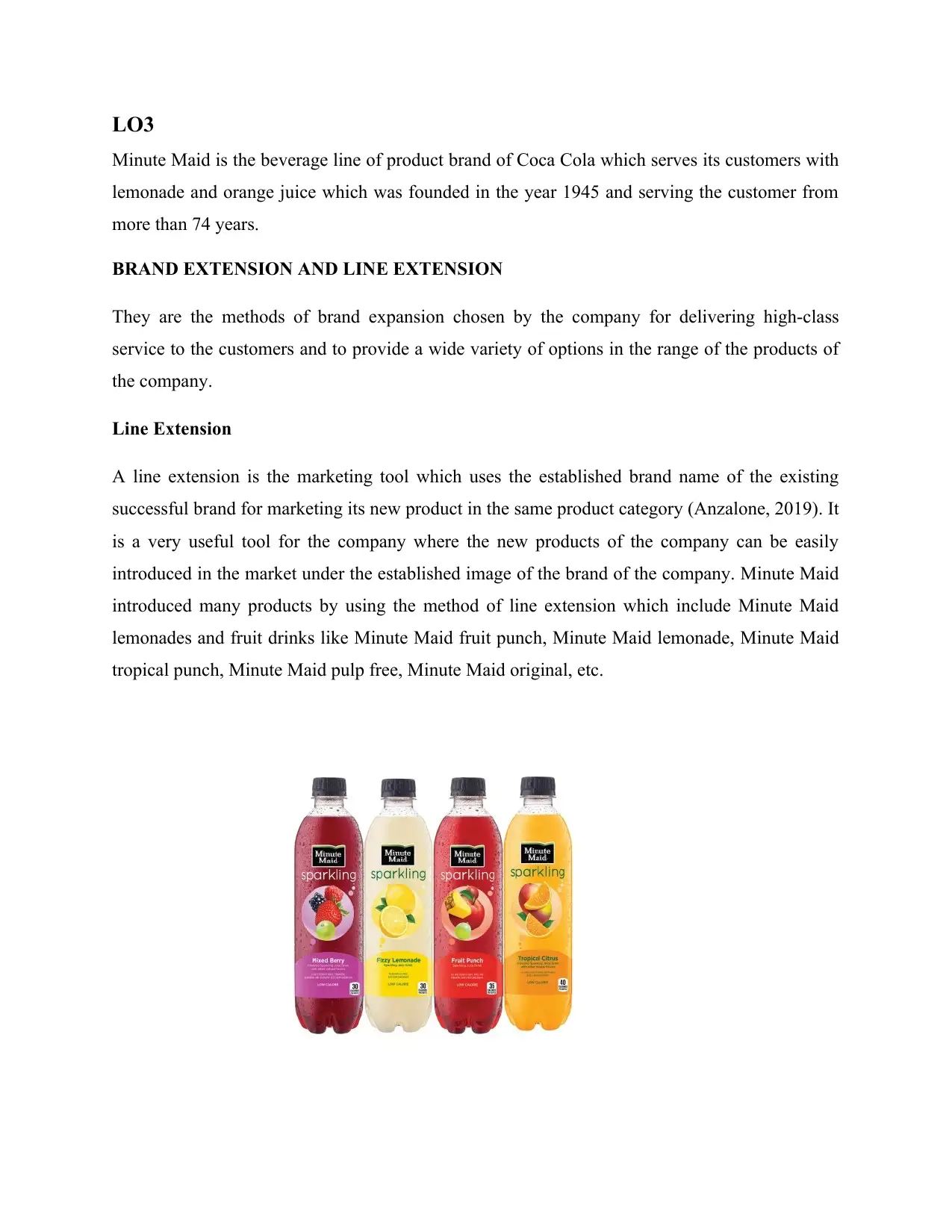
introduced in the market under the established image of the brand of the company. Minute Maid
introduced many products by using the method of line extension which include Minute Maid
lemonades and fruit drinks like Minute Maid fruit punch, Minute Maid lemonade, Minute Maid
tropical punch, Minute Maid pulp free, Minute Maid original, etc.
Minute Maid is the beverage line of product brand of Coca Cola which serves its customers with
lemonade and orange juice which was founded in the year 1945 and serving the customer from
more than 74 years.
BRAND EXTENSION AND LINE EXTENSION
They are the methods of brand expansion chosen by the company for delivering high-class
service to the customers and to provide a wide variety of options in the range of the products of
the company.
Line Extension
A line extension is the marketing tool which uses the established brand name of the existing
successful brand for marketing its new product in the same product category (Anzalone, 2019). It
is a very useful tool for the company where the new products of the company can be easily
introduced in the market under the established image of the brand of the company. Minute Maid
introduced many products by using the method of line extension which include Minute Maid
lemonades and fruit drinks like Minute Maid fruit punch, Minute Maid lemonade, Minute Maid
tropical punch, Minute Maid pulp free, Minute Maid original, etc.
Brand Extension
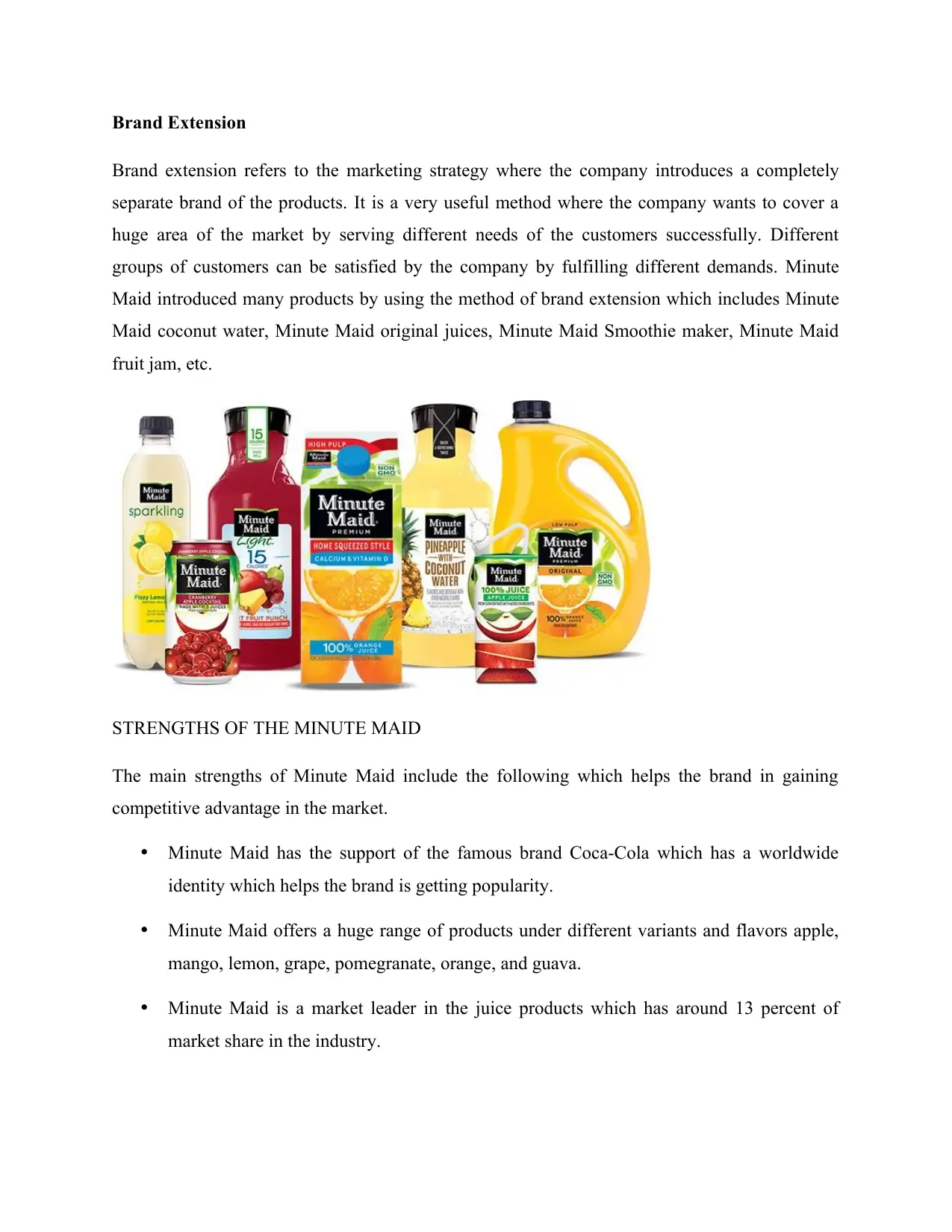
Brand extension refers to the marketing strategy where the company introduces a completely
separate brand of the products. It is a very useful method where the company wants to cover a
huge area of the market by serving different needs of the customers successfully. Different
groups of customers can be satisfied by the company by fulfilling different demands. Minute
Maid introduced many products by using the method of brand extension which includes Minute
Maid coconut water, Minute Maid original juices, Minute Maid Smoothie maker, Minute Maid
fruit jam, etc.
STRENGTHS OF THE MINUTE MAID
The main strengths of Minute Maid include the following which helps the brand in gaining
competitive advantage in the market.
Minute Maid has the support of the famous brand Coca-Cola which has a worldwide
identity which helps the brand is getting popularity.
Minute Maid offers a huge range of products under different variants and flavors apple,
mango, lemon, grape, pomegranate, orange, and guava.
Minute Maid is a market leader in the juice products which has around 13 percent of
market share in the industry.
Brand extension refers to the marketing strategy where the company introduces a completely
separate brand of the products. It is a very useful method where the company wants to cover a
huge area of the market by serving different needs of the customers successfully. Different
groups of customers can be satisfied by the company by fulfilling different demands. Minute
Maid introduced many products by using the method of brand extension which includes Minute
Maid coconut water, Minute Maid original juices, Minute Maid Smoothie maker, Minute Maid
fruit jam, etc.
STRENGTHS OF THE MINUTE MAID
The main strengths of Minute Maid include the following which helps the brand in gaining
competitive advantage in the market.
Minute Maid has the support of the famous brand Coca-Cola which has a worldwide
identity which helps the brand is getting popularity.
Minute Maid offers a huge range of products under different variants and flavors apple,
mango, lemon, grape, pomegranate, orange, and guava.
Minute Maid is a market leader in the juice products which has around 13 percent of
market share in the industry.
⊘ This is a preview!⊘
Do you want full access?
Subscribe today to unlock all pages.
Trusted by 1+ million students worldwide

1 out of 21


Related Documents


Your All-in-One AI-Powered Toolkit for Academic Success.
+13062052269
info@desklib.com
Available 24*7 on WhatsApp / Email
![[object Object]](/_next/static/media/star-bottom.7253800d.svg)
Unlock your academic potential
Copyright © 2020–2026 A2Z Services. All Rights Reserved. Developed and managed by ZUCOL.