Coca Cola: Analysis of Structure, Leadership, HR, and Development
VerifiedAdded on 2023/06/13
|20
|6694
|368
Report
AI Summary
This report provides an analysis of Coca Cola's organizational structure, leadership approaches, and organizational behavior, focusing on how these elements contribute to the company's overall effectiveness. It evaluates Coca Cola's global matrix structure, highlighting its impact on efficiency and revenue generation. The report also discusses the laissez-faire leadership style practiced within the company and its effects on employee motivation and innovation. Furthermore, it examines Handy's Cultural Dimensions theory in relation to Coca Cola's organizational culture. The report then critically analyzes organizational change within Coca Cola, emphasizing the role of HR strategies in supporting transitions. Finally, it includes a discussion of personal development plans and their influence on employability, alongside an evaluation of preferred learning methods. This report provides insights into how Coca Cola manages its structure, leadership, and human resources to achieve its business objectives, with a focus on change management and employee development.
PERSONAL AND
BUSINESS
TRANSFORMATION
BUSINESS
TRANSFORMATION

Paraphrase This Document
Need a fresh take? Get an instant paraphrase of this document with our AI Paraphraser

Contents
INTRODUCTION...........................................................................................................................3
1. Assess and evaluate the organisation’s structure, approaches to leadership and one dominant
organisational behaviour theory in your chosen organisation....................................................3
2. Critically analyse and evaluate the above in relation to change within the organisation and
explain how HR strategies can support the transition..................................................................7
3. Create a personal development plan based on your following 12 month’s development.
Explain how your personal development objectives influence employability within the
workplace and wider society. ....................................................................................................11
4. Demonstrate a critical awareness of your own preferred method of learning and how you
interact with others.....................................................................................................................16
REFERENCES..............................................................................................................................18
Books and Journals:...................................................................................................................18
INTRODUCTION...........................................................................................................................3
1. Assess and evaluate the organisation’s structure, approaches to leadership and one dominant
organisational behaviour theory in your chosen organisation....................................................3
2. Critically analyse and evaluate the above in relation to change within the organisation and
explain how HR strategies can support the transition..................................................................7
3. Create a personal development plan based on your following 12 month’s development.
Explain how your personal development objectives influence employability within the
workplace and wider society. ....................................................................................................11
4. Demonstrate a critical awareness of your own preferred method of learning and how you
interact with others.....................................................................................................................16
REFERENCES..............................................................................................................................18
Books and Journals:...................................................................................................................18

⊘ This is a preview!⊘
Do you want full access?
Subscribe today to unlock all pages.

Trusted by 1+ million students worldwide
INTRODUCTION
The nature of business environment is dynamic and keeps on changing. There is need of
evaluating the opportunities in the market and grab them to operate effectively (Fernández-
Rovira and et.al., 2021). This report is based on Coca Cola. It is an American multinational
beverage corporation that has its headquarters in Georgia. The company was established by Dr.
John S. Pemberton in 1886. There is discussion related to the organisational structure followed
by the company so that company is able to carry on the operations effectively. The evaluation
related to leadership style being followed by the company that helps to lead the employees. The
organisational behaviour of the company is also examined in the report. The role of HR
strategies in regard to managing the change in the organisation is also mentioned. Personal
development plan helps them to achieve the goals and objectives with the appropriate actions. In
the end of this report, there is evaluation of the preferred learning style so that the work is done
properly.
1. Assess and evaluate the organisation’s structure, approaches to leadership and one dominant
organisational behaviour theory in your chosen organisation.
Organisational structure
The nature of business environment is dynamic and keeps on changing. There is need of
evaluating the opportunities in the market and grab them to operate effectively (Fernández-
Rovira and et.al., 2021). This report is based on Coca Cola. It is an American multinational
beverage corporation that has its headquarters in Georgia. The company was established by Dr.
John S. Pemberton in 1886. There is discussion related to the organisational structure followed
by the company so that company is able to carry on the operations effectively. The evaluation
related to leadership style being followed by the company that helps to lead the employees. The
organisational behaviour of the company is also examined in the report. The role of HR
strategies in regard to managing the change in the organisation is also mentioned. Personal
development plan helps them to achieve the goals and objectives with the appropriate actions. In
the end of this report, there is evaluation of the preferred learning style so that the work is done
properly.
1. Assess and evaluate the organisation’s structure, approaches to leadership and one dominant
organisational behaviour theory in your chosen organisation.
Organisational structure
Paraphrase This Document
Need a fresh take? Get an instant paraphrase of this document with our AI Paraphraser
Coca Cola is a beverage company which provides the sugary drinks to its customers in
the market. The company was invented by John Stith Pemberton. An organisational structure is
important that outlines several activities which are directed and performed in the organisation.
The main motive of this structure is to carry out different operations effectively in the
organisation. On the other hand, organisational structure helps the company to achieve goals and
objectives in the market. Structured organisation performs better in every way. The company
follows organisational structure to formulate a strategic plan and works towards that to attain the
future objectives and growth. There are different subdivision in the chart. It helps the
organisation to authorise the power at different levels of management effectively in the
workplace.
Coca Cola company is following Global Matrix organisational Structure which helps the
company to become effective and generate mire revenues in the market.
Global Matrix organisational Structure - It involves various horizontal and vertical
features which helps to create a flow in the organisation (Ruggunan and Spiller, 2018). In a
matrix organisation there are different departments of each activities which helps the
organisation to become more efficient in the market. Coca Cola company use this strategy to
basically merge the product groups with geographic units. The company 's product mangers are
responsible in terms of manufacturing and distribution of their products. The main focus is to
attract different customers in the market. This structure enhance the working style of the Coca
Cola Company in an effective way.
Leadership
Every company whether it is small or big, needs a good leader who can lead the
operations of a company in a successful way. Good leaders are the vital part of the organisation
which has direct relation with the growth of the business. Leadership theories are the
explanations of how and why certain people become leaders in the organisation. This focuses on
the qualities and behaviour that people can adopt to increase their leadership qualities (Kirchmer,
2021). As a leader one should have the great self-organisational skills, strong ethics and high
moral standards and efficient learner. These are the most important traits that leader should carry
to lead the organisation. In relation to Coca Cola, the leader of the company follows laissez-
faire. It helps the them to achieve their Key business indicators in effective manner. There is no
pressure exerted by the managers and directors of the company. It is seen that the employees are
the market. The company was invented by John Stith Pemberton. An organisational structure is
important that outlines several activities which are directed and performed in the organisation.
The main motive of this structure is to carry out different operations effectively in the
organisation. On the other hand, organisational structure helps the company to achieve goals and
objectives in the market. Structured organisation performs better in every way. The company
follows organisational structure to formulate a strategic plan and works towards that to attain the
future objectives and growth. There are different subdivision in the chart. It helps the
organisation to authorise the power at different levels of management effectively in the
workplace.
Coca Cola company is following Global Matrix organisational Structure which helps the
company to become effective and generate mire revenues in the market.
Global Matrix organisational Structure - It involves various horizontal and vertical
features which helps to create a flow in the organisation (Ruggunan and Spiller, 2018). In a
matrix organisation there are different departments of each activities which helps the
organisation to become more efficient in the market. Coca Cola company use this strategy to
basically merge the product groups with geographic units. The company 's product mangers are
responsible in terms of manufacturing and distribution of their products. The main focus is to
attract different customers in the market. This structure enhance the working style of the Coca
Cola Company in an effective way.
Leadership
Every company whether it is small or big, needs a good leader who can lead the
operations of a company in a successful way. Good leaders are the vital part of the organisation
which has direct relation with the growth of the business. Leadership theories are the
explanations of how and why certain people become leaders in the organisation. This focuses on
the qualities and behaviour that people can adopt to increase their leadership qualities (Kirchmer,
2021). As a leader one should have the great self-organisational skills, strong ethics and high
moral standards and efficient learner. These are the most important traits that leader should carry
to lead the organisation. In relation to Coca Cola, the leader of the company follows laissez-
faire. It helps the them to achieve their Key business indicators in effective manner. There is no
pressure exerted by the managers and directors of the company. It is seen that the employees are
independent and that helps Coca cola to have more productive and innovative employees. It is
also called hands off approach. It keeps the employees motivated and they are able to carry on
their overall work in effective manner.
Organisation behaviours
It can be understood as the behaviour of the employees who are working in the
organisation. All the employees working in the company are different from one another. There is
need of understanding the nature of employees so that they can be motivated to work (Schallmo
and Williams, 2018). By providing effective culture to the employees their productivity can be
enhanced. There is direct impact of culture on the behaviour of the employees.
Handy Cultural Dimensions
In this theory the organisation come together an work towards a similar goals and
objectives. It is essential for employees to work effectively and give their best. In order to
achieve the preferred objectives (Strutynska and et.al., 2019). On the other different organisation
has certain set of values and guidelines to work efficiently. There are several models in the
theory:
Power – In this step the power remains in hand of few peoples who are superior. They can
control the organisation. Some individuals enjoy in their workplace. Coca Cola company power
recites in the hand of multiple individuals.
Task Culture – In this the organisation form a team to achieve certain goals and objectives in
the organisation. Coca cola has different experience teams. In order to achieve different goals
and objectives.
Person Culture – In this model there are certain employees who have a feeling that they are
more important and valuable. Rather than the whole organisation. Coca Cola Company
employees only work towards the organisation goals.
Role culture – In this model every individual of the organisation are divided into doing certain
tasks and responsibilities. In this culture the employees are divided according to the
qualifications and specialization. Coca Cola company has different talented candidates which are
doing their job effectively.
Organisational management is the process of ensuring that the message a person truly wishes to
communicate is received and understood by the people with whom they wish to speak. Changing
how others interpret what others say about a person entails influencing how others understand
also called hands off approach. It keeps the employees motivated and they are able to carry on
their overall work in effective manner.
Organisation behaviours
It can be understood as the behaviour of the employees who are working in the
organisation. All the employees working in the company are different from one another. There is
need of understanding the nature of employees so that they can be motivated to work (Schallmo
and Williams, 2018). By providing effective culture to the employees their productivity can be
enhanced. There is direct impact of culture on the behaviour of the employees.
Handy Cultural Dimensions
In this theory the organisation come together an work towards a similar goals and
objectives. It is essential for employees to work effectively and give their best. In order to
achieve the preferred objectives (Strutynska and et.al., 2019). On the other different organisation
has certain set of values and guidelines to work efficiently. There are several models in the
theory:
Power – In this step the power remains in hand of few peoples who are superior. They can
control the organisation. Some individuals enjoy in their workplace. Coca Cola company power
recites in the hand of multiple individuals.
Task Culture – In this the organisation form a team to achieve certain goals and objectives in
the organisation. Coca cola has different experience teams. In order to achieve different goals
and objectives.
Person Culture – In this model there are certain employees who have a feeling that they are
more important and valuable. Rather than the whole organisation. Coca Cola Company
employees only work towards the organisation goals.
Role culture – In this model every individual of the organisation are divided into doing certain
tasks and responsibilities. In this culture the employees are divided according to the
qualifications and specialization. Coca Cola company has different talented candidates which are
doing their job effectively.
Organisational management is the process of ensuring that the message a person truly wishes to
communicate is received and understood by the people with whom they wish to speak. Changing
how others interpret what others say about a person entails influencing how others understand
⊘ This is a preview!⊘
Do you want full access?
Subscribe today to unlock all pages.
Trusted by 1+ million students worldwide
what others say about them. Top management who want to write things down when talking to
other people and occasions at work must focus on perception. Perception is also important
because it provides more than goal output; it consumes the observer and creates a new world that
is bolstered by previous experiences. In a remote workplace, it's difficult to tell the difference
between people who produce the same results but have vastly different behavioural traits like
leadership, interpersonal skills, empathy, and understanding. Process rigidity may be a
component of outcome-oriented compensation schemes, which can frustrate more talented
employees who thrive in complex and uncertain work environments. Employees dissatisfied with
their monotonous, remote jobs may seek employment with competitors whose cultures
encourage risk-taking and failure. People may reflect on and evaluate events in their lives. They
do this by recalling a rumoured occurrence in order to learn more about it. When people recall
events on a regular basis, they can improve their recall accuracy. They may also notice that their
ability to recall memories changes over time. Some aspects of their memories may be altered as a
result of their recollection. People of all backgrounds eventually use perception to assign
meaning to information and events in their lives. Each person has their own unique experiences.
Task-Oriented Functions - These functions are concerned with providing solutions to problems
that groups encounter while performing tasks and activities. To put it another way, leaders who
exhibit this behaviour always prioritise the work task at hand. They are constantly concerned
with maximising resource utilisation in order to improve performance. They place less emphasis
on interpersonal relationships within the company.
People-Oriented Functions - These are behaviours that involve resolving conflicts and ensuring
that members of the group feel valued. Leaders who exhibit this behaviour put a greater
emphasis on their relationships with their subordinates. They link a person's quality to the degree
of their superiors' relationships. Leaders must consult with their followers on a regular basis, and
they must do so in a timely manner. A person who is capable of doing both jobs well is a good
leader. Leadership, according to this viewpoint, entails a relationship between a leader and his
followers. The most important factor in this relationship is the leader's behaviour toward
subordinates. Coworkers' morale, confidence, and team spirit are all boosted by good leadership
behaviour. Poor behaviour, on the other hand, will result in his dismissal as a leader. In other
words, a great manager is simply someone who takes actions that help the group achieve its
objectives. Behavioural leadership aids organisations in comprehending the nature of their
other people and occasions at work must focus on perception. Perception is also important
because it provides more than goal output; it consumes the observer and creates a new world that
is bolstered by previous experiences. In a remote workplace, it's difficult to tell the difference
between people who produce the same results but have vastly different behavioural traits like
leadership, interpersonal skills, empathy, and understanding. Process rigidity may be a
component of outcome-oriented compensation schemes, which can frustrate more talented
employees who thrive in complex and uncertain work environments. Employees dissatisfied with
their monotonous, remote jobs may seek employment with competitors whose cultures
encourage risk-taking and failure. People may reflect on and evaluate events in their lives. They
do this by recalling a rumoured occurrence in order to learn more about it. When people recall
events on a regular basis, they can improve their recall accuracy. They may also notice that their
ability to recall memories changes over time. Some aspects of their memories may be altered as a
result of their recollection. People of all backgrounds eventually use perception to assign
meaning to information and events in their lives. Each person has their own unique experiences.
Task-Oriented Functions - These functions are concerned with providing solutions to problems
that groups encounter while performing tasks and activities. To put it another way, leaders who
exhibit this behaviour always prioritise the work task at hand. They are constantly concerned
with maximising resource utilisation in order to improve performance. They place less emphasis
on interpersonal relationships within the company.
People-Oriented Functions - These are behaviours that involve resolving conflicts and ensuring
that members of the group feel valued. Leaders who exhibit this behaviour put a greater
emphasis on their relationships with their subordinates. They link a person's quality to the degree
of their superiors' relationships. Leaders must consult with their followers on a regular basis, and
they must do so in a timely manner. A person who is capable of doing both jobs well is a good
leader. Leadership, according to this viewpoint, entails a relationship between a leader and his
followers. The most important factor in this relationship is the leader's behaviour toward
subordinates. Coworkers' morale, confidence, and team spirit are all boosted by good leadership
behaviour. Poor behaviour, on the other hand, will result in his dismissal as a leader. In other
words, a great manager is simply someone who takes actions that help the group achieve its
objectives. Behavioural leadership aids organisations in comprehending the nature of their
Paraphrase This Document
Need a fresh take? Get an instant paraphrase of this document with our AI Paraphraser
employees and motivating them to achieve organisational goals. When employee behaviour and
attitude are positive, it is simple to manage the company's operations and activities. A reward
given in exchange for good behaviour is known as positive reinforcement. The incentive should
be set up in such a way that it encourages desirable behaviour and makes it more likely that it
will be repeated in the future. Positive reinforcement can take the form of primary or secondary
reinforcement. Primary reinforcements included food, clothing, and habitat, all of which had
immediate positive consequences. Secondary reinforcers have advantages as well, but they mean
different things to different people. Money is the most effective form of positive reinforcement
because it can be used to purchase basic reinforcers like food. Secondary incentives include
things like involvement, advancement, recognition, and praise. A few conditions must be met for
praise and encouragement to be effective. Rejection behaviour accounts for a large portion of our
society's lawful behaviour. When combined with positive reinforcement for acceptable
behaviour, the effect can be particularly powerful. The prize must be commensurate with the
level of achievement. To put it another way, the monetary reward must be proportional to the
behaviour. The timing of the award is also important. This is referred to as the "quick feedback"
concept. It will have a greater impact if the reinforcement is given soon after the behaviour has
occurred. The less time it takes to reward the desired behaviour, the less effective the award will
be as a positive reinforcer. Because everyone has different reasons for performing well, the
award should be tailored to the employees' needs. Managers must either design a reward system
that is appropriate for all members of their organisation or create one that is not.
2. Critically analyse and evaluate the above in relation to change within the organisation and
explain how HR strategies can support the transition
Organizational change consists of actions undertaken by the company or industry to adjust a
major aspect of its operations, such as its culture, underlying technologies or infrastructure, or
mental structures. Organizational change management is the process of effectively utilizing
change to achieve the proper, and it usually composed of three stages: planning, deployment, and
follow-up. The term "organisational change" is a broad one. A significant shift in a company's
direction is an example of sweeping change. Other changes are less dramatic, focusing on a
single aspect of a company. It's helpful to think of change in terms of a spectrum. On the one
hand, there's adaptive change, which refers to those small iterations. On the other hand, there's
transformational change, which aims for major changes. Adaptive changes are small, incremental
attitude are positive, it is simple to manage the company's operations and activities. A reward
given in exchange for good behaviour is known as positive reinforcement. The incentive should
be set up in such a way that it encourages desirable behaviour and makes it more likely that it
will be repeated in the future. Positive reinforcement can take the form of primary or secondary
reinforcement. Primary reinforcements included food, clothing, and habitat, all of which had
immediate positive consequences. Secondary reinforcers have advantages as well, but they mean
different things to different people. Money is the most effective form of positive reinforcement
because it can be used to purchase basic reinforcers like food. Secondary incentives include
things like involvement, advancement, recognition, and praise. A few conditions must be met for
praise and encouragement to be effective. Rejection behaviour accounts for a large portion of our
society's lawful behaviour. When combined with positive reinforcement for acceptable
behaviour, the effect can be particularly powerful. The prize must be commensurate with the
level of achievement. To put it another way, the monetary reward must be proportional to the
behaviour. The timing of the award is also important. This is referred to as the "quick feedback"
concept. It will have a greater impact if the reinforcement is given soon after the behaviour has
occurred. The less time it takes to reward the desired behaviour, the less effective the award will
be as a positive reinforcer. Because everyone has different reasons for performing well, the
award should be tailored to the employees' needs. Managers must either design a reward system
that is appropriate for all members of their organisation or create one that is not.
2. Critically analyse and evaluate the above in relation to change within the organisation and
explain how HR strategies can support the transition
Organizational change consists of actions undertaken by the company or industry to adjust a
major aspect of its operations, such as its culture, underlying technologies or infrastructure, or
mental structures. Organizational change management is the process of effectively utilizing
change to achieve the proper, and it usually composed of three stages: planning, deployment, and
follow-up. The term "organisational change" is a broad one. A significant shift in a company's
direction is an example of sweeping change. Other changes are less dramatic, focusing on a
single aspect of a company. It's helpful to think of change in terms of a spectrum. On the one
hand, there's adaptive change, which refers to those small iterations. On the other hand, there's
transformational change, which aims for major changes. Adaptive changes are small, incremental
changes that organisations make to address changing needs. These are usually minor tweaks and
adjustments that managers fine-tune and implement in order to carry out business strategies.
Leadership may add, remove, or refine processes at any time during the process. Adaptive
changes are smaller in scale and scope than transformational changes. They frequently entail
changes in mission and strategy, company or team structure, people and organisational
performance, or business processes all at the same time. Because of their size, these changes can
take a long time and a lot of effort to implement. Transformational changes are frequently
pursued in response to external forces, such as the emergence of a disruptive new competitor or
issues affecting a company's supply chain, though this is not always the case. For businesses to
succeed and grow, they must undergo organisational change. Managing change is responsible for
the successful adoption and implementation of shift. It enables employees to comprehend the
shift, commit to it, and work efficiently during it. Change management is a leadership
competency for enabling change within an organisation at the organisational level. It's also a
strategic capability aimed at improving the organization's change capacity and responsiveness.
For senior executives, change management competency entails being able to lead change for the
organisation, which includes being an effective sponsor of change and demonstrating personal
and organisational commitment to the change. Competency relates to effectively coaching direct
reports through their change journeys for people managers working with front-line employees.
Although competency varies depending on your relationship to change, organisations that
develop change management competencies throughout their ranks are more effective and
successful.
Company transitions can be rocky and costly in addition to time and resources if effective
organisational change process is not implemented. They can also result in employee team spirit
and the growth of competent skills. In the end, a lack of adequate project management can lead
to a failure of the organisation. Every employee in an organisation plays a different role in
assisting with change. While many employees may complete highly detailed work, senior
executives with more experience may have different objectives. Even within management, there
are differences in the tasks that leaders and managers perform. Leaders, for example, must be
courageous in their risk-taking. They must consider the big picture and communicate high-level
change to the company, explaining why it is taking place and motivating employees to help with
the transition. To be a successful leader, you must be perceptive and know who to entrust with
adjustments that managers fine-tune and implement in order to carry out business strategies.
Leadership may add, remove, or refine processes at any time during the process. Adaptive
changes are smaller in scale and scope than transformational changes. They frequently entail
changes in mission and strategy, company or team structure, people and organisational
performance, or business processes all at the same time. Because of their size, these changes can
take a long time and a lot of effort to implement. Transformational changes are frequently
pursued in response to external forces, such as the emergence of a disruptive new competitor or
issues affecting a company's supply chain, though this is not always the case. For businesses to
succeed and grow, they must undergo organisational change. Managing change is responsible for
the successful adoption and implementation of shift. It enables employees to comprehend the
shift, commit to it, and work efficiently during it. Change management is a leadership
competency for enabling change within an organisation at the organisational level. It's also a
strategic capability aimed at improving the organization's change capacity and responsiveness.
For senior executives, change management competency entails being able to lead change for the
organisation, which includes being an effective sponsor of change and demonstrating personal
and organisational commitment to the change. Competency relates to effectively coaching direct
reports through their change journeys for people managers working with front-line employees.
Although competency varies depending on your relationship to change, organisations that
develop change management competencies throughout their ranks are more effective and
successful.
Company transitions can be rocky and costly in addition to time and resources if effective
organisational change process is not implemented. They can also result in employee team spirit
and the growth of competent skills. In the end, a lack of adequate project management can lead
to a failure of the organisation. Every employee in an organisation plays a different role in
assisting with change. While many employees may complete highly detailed work, senior
executives with more experience may have different objectives. Even within management, there
are differences in the tasks that leaders and managers perform. Leaders, for example, must be
courageous in their risk-taking. They must consider the big picture and communicate high-level
change to the company, explaining why it is taking place and motivating employees to help with
the transition. To be a successful leader, you must be perceptive and know who to entrust with
⊘ This is a preview!⊘
Do you want full access?
Subscribe today to unlock all pages.
Trusted by 1+ million students worldwide
implementing change. Managers are more focused on making successful business transitions.
They concentrate on bringing about change by determining the discrete steps that must be taken
and their order. Managers are also in charge of allocating resources, such as personnel, and
deciding how success will be measured. Leaders should ideally be managers as well, but it is a
manager's primary responsibility to know how to design, direct, and shape change processes.
• Change leader/owner, taking full responsibility for their own change project's planning and
implementation. An HR director transforming all or part of the HR function is the most extreme
example, but it may also be on a smaller level, such as a team reshaping or the creation of a new
web service service.
• Change advisor, assisting customer in the implementation of change while challenging and
guiding them to ensure success. This is often the responsibility of the HR strategic partner, such
as in the realignment of the sales team, or the HR director in the case of a large-scale change
initiatives.
• A change participant is someone who is a part of a modification that has an impact on them as
for myself. Any HR practitioner in this involvement can use their understanding of change to set
there own aspirations for the process, troubleshoot issues, and understand and manage their own
and others' reactions to events. Understanding the architecture of positive outcome is the first
step toward mastery: having a clear understanding of all the parts required for a successful
process
• Change educator, bringing specialist knowledge and expertise to clients to help them better
understand the structures and practices of change management. This is usually the responsibility
of experts in the field, and it may entail holding training courses, constructing effective tools, or
making other resources, such as learning books or conceptual perspectives, available.
HR practitioners can ensure that the following four primary architectural components of change
are understood, tested, and satisfied to ensure a meaningful and long-term impact on the
organisation and its performance: Although all four components are critical, they do not always
receive equal attention from change designers and implementers. In today's fast-paced world,
taking action often takes precedence over careful and thoughtful planning. When challenged to
expose and re-examine their reasoning, decision-makers can become apprehensive.
Leaders frequently think they can push their strategies though the regardless of previous
failures, and prefer to push forward rather than investigate and anticipate conceivable resistance,
They concentrate on bringing about change by determining the discrete steps that must be taken
and their order. Managers are also in charge of allocating resources, such as personnel, and
deciding how success will be measured. Leaders should ideally be managers as well, but it is a
manager's primary responsibility to know how to design, direct, and shape change processes.
• Change leader/owner, taking full responsibility for their own change project's planning and
implementation. An HR director transforming all or part of the HR function is the most extreme
example, but it may also be on a smaller level, such as a team reshaping or the creation of a new
web service service.
• Change advisor, assisting customer in the implementation of change while challenging and
guiding them to ensure success. This is often the responsibility of the HR strategic partner, such
as in the realignment of the sales team, or the HR director in the case of a large-scale change
initiatives.
• A change participant is someone who is a part of a modification that has an impact on them as
for myself. Any HR practitioner in this involvement can use their understanding of change to set
there own aspirations for the process, troubleshoot issues, and understand and manage their own
and others' reactions to events. Understanding the architecture of positive outcome is the first
step toward mastery: having a clear understanding of all the parts required for a successful
process
• Change educator, bringing specialist knowledge and expertise to clients to help them better
understand the structures and practices of change management. This is usually the responsibility
of experts in the field, and it may entail holding training courses, constructing effective tools, or
making other resources, such as learning books or conceptual perspectives, available.
HR practitioners can ensure that the following four primary architectural components of change
are understood, tested, and satisfied to ensure a meaningful and long-term impact on the
organisation and its performance: Although all four components are critical, they do not always
receive equal attention from change designers and implementers. In today's fast-paced world,
taking action often takes precedence over careful and thoughtful planning. When challenged to
expose and re-examine their reasoning, decision-makers can become apprehensive.
Leaders frequently think they can push their strategies though the regardless of previous
failures, and prefer to push forward rather than investigate and anticipate conceivable resistance,
Paraphrase This Document
Need a fresh take? Get an instant paraphrase of this document with our AI Paraphraser
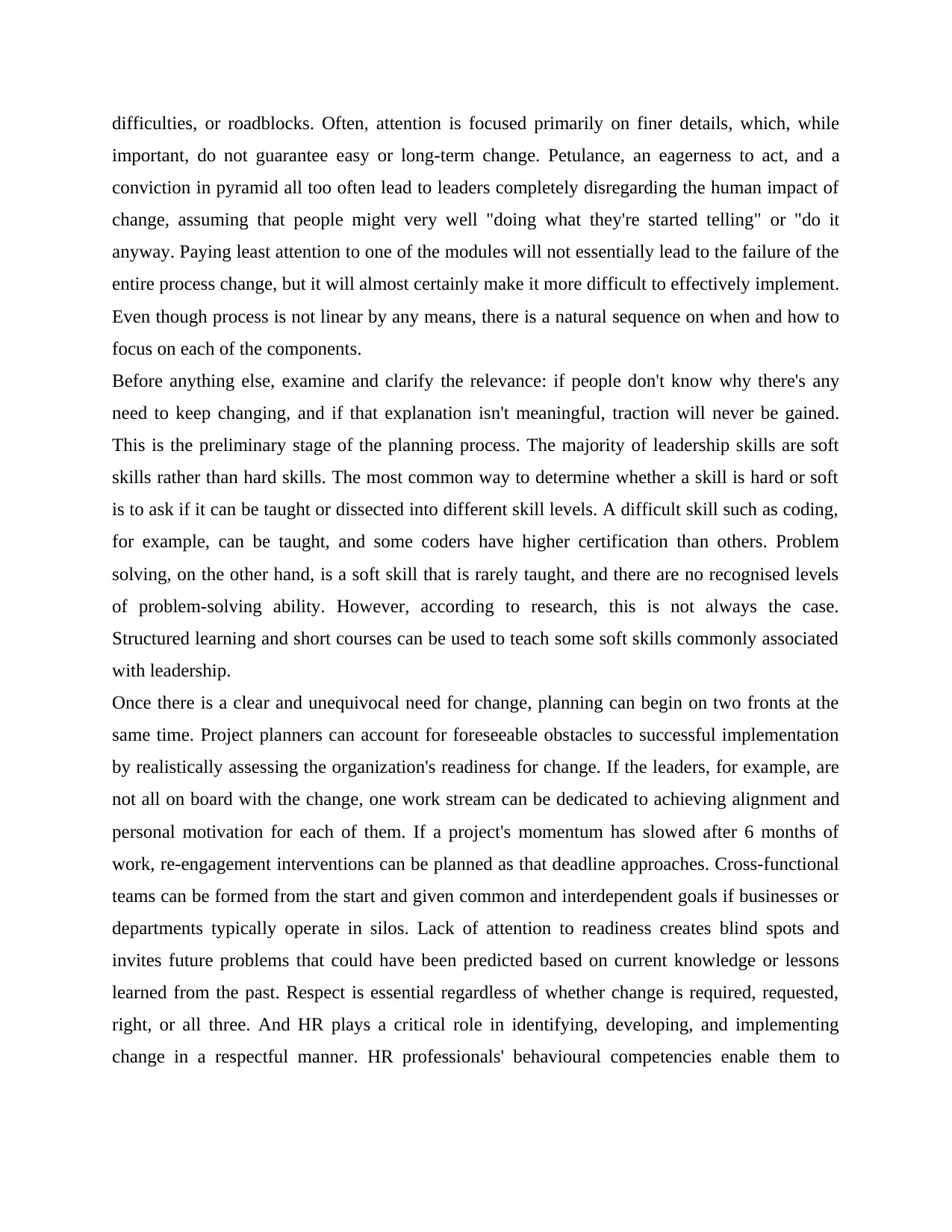
difficulties, or roadblocks. Often, attention is focused primarily on finer details, which, while
important, do not guarantee easy or long-term change. Petulance, an eagerness to act, and a
conviction in pyramid all too often lead to leaders completely disregarding the human impact of
change, assuming that people might very well "doing what they're started telling" or "do it
anyway. Paying least attention to one of the modules will not essentially lead to the failure of the
entire process change, but it will almost certainly make it more difficult to effectively implement.
Even though process is not linear by any means, there is a natural sequence on when and how to
focus on each of the components.
Before anything else, examine and clarify the relevance: if people don't know why there's any
need to keep changing, and if that explanation isn't meaningful, traction will never be gained.
This is the preliminary stage of the planning process. The majority of leadership skills are soft
skills rather than hard skills. The most common way to determine whether a skill is hard or soft
is to ask if it can be taught or dissected into different skill levels. A difficult skill such as coding,
for example, can be taught, and some coders have higher certification than others. Problem
solving, on the other hand, is a soft skill that is rarely taught, and there are no recognised levels
of problem-solving ability. However, according to research, this is not always the case.
Structured learning and short courses can be used to teach some soft skills commonly associated
with leadership.
Once there is a clear and unequivocal need for change, planning can begin on two fronts at the
same time. Project planners can account for foreseeable obstacles to successful implementation
by realistically assessing the organization's readiness for change. If the leaders, for example, are
not all on board with the change, one work stream can be dedicated to achieving alignment and
personal motivation for each of them. If a project's momentum has slowed after 6 months of
work, re-engagement interventions can be planned as that deadline approaches. Cross-functional
teams can be formed from the start and given common and interdependent goals if businesses or
departments typically operate in silos. Lack of attention to readiness creates blind spots and
invites future problems that could have been predicted based on current knowledge or lessons
learned from the past. Respect is essential regardless of whether change is required, requested,
right, or all three. And HR plays a critical role in identifying, developing, and implementing
change in a respectful manner. HR professionals' behavioural competencies enable them to
important, do not guarantee easy or long-term change. Petulance, an eagerness to act, and a
conviction in pyramid all too often lead to leaders completely disregarding the human impact of
change, assuming that people might very well "doing what they're started telling" or "do it
anyway. Paying least attention to one of the modules will not essentially lead to the failure of the
entire process change, but it will almost certainly make it more difficult to effectively implement.
Even though process is not linear by any means, there is a natural sequence on when and how to
focus on each of the components.
Before anything else, examine and clarify the relevance: if people don't know why there's any
need to keep changing, and if that explanation isn't meaningful, traction will never be gained.
This is the preliminary stage of the planning process. The majority of leadership skills are soft
skills rather than hard skills. The most common way to determine whether a skill is hard or soft
is to ask if it can be taught or dissected into different skill levels. A difficult skill such as coding,
for example, can be taught, and some coders have higher certification than others. Problem
solving, on the other hand, is a soft skill that is rarely taught, and there are no recognised levels
of problem-solving ability. However, according to research, this is not always the case.
Structured learning and short courses can be used to teach some soft skills commonly associated
with leadership.
Once there is a clear and unequivocal need for change, planning can begin on two fronts at the
same time. Project planners can account for foreseeable obstacles to successful implementation
by realistically assessing the organization's readiness for change. If the leaders, for example, are
not all on board with the change, one work stream can be dedicated to achieving alignment and
personal motivation for each of them. If a project's momentum has slowed after 6 months of
work, re-engagement interventions can be planned as that deadline approaches. Cross-functional
teams can be formed from the start and given common and interdependent goals if businesses or
departments typically operate in silos. Lack of attention to readiness creates blind spots and
invites future problems that could have been predicted based on current knowledge or lessons
learned from the past. Respect is essential regardless of whether change is required, requested,
right, or all three. And HR plays a critical role in identifying, developing, and implementing
change in a respectful manner. HR professionals' behavioural competencies enable them to
engage employees in the needed change through things like relationship management, critical
evaluation, consultation, leadership, and navigation.
It has been said that management is responsible for enabling and facilitating change. In the case
of HR, the role must be that of a change agent—not just a conduit for change, but one who plans
the appropriate changes in collaboration with other executives and senior leaders. It's all about
change.
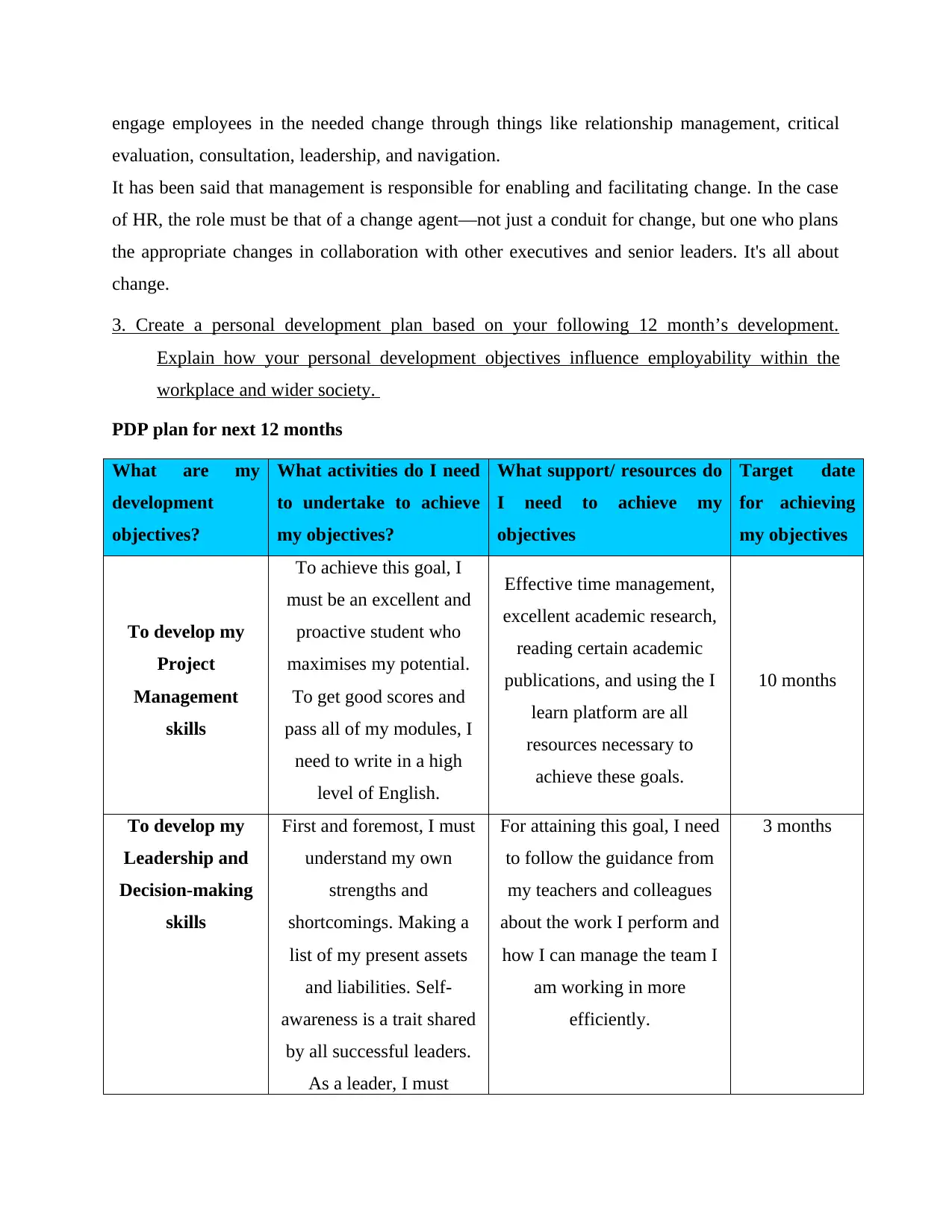
3. Create a personal development plan based on your following 12 month’s development.
Explain how your personal development objectives influence employability within the
workplace and wider society.
PDP plan for next 12 months
What are my
development
objectives?
What activities do I need
to undertake to achieve
my objectives?
What support/ resources do
I need to achieve my
objectives
Target date
for achieving
my objectives
To develop my
Project
Management
skills
To achieve this goal, I
must be an excellent and
proactive student who
maximises my potential.
To get good scores and
pass all of my modules, I
need to write in a high
level of English.
Effective time management,
excellent academic research,
reading certain academic
publications, and using the I
learn platform are all
resources necessary to
achieve these goals.
10 months
To develop my
Leadership and
Decision-making
skills
First and foremost, I must
understand my own
strengths and
shortcomings. Making a
list of my present assets
and liabilities. Self-
awareness is a trait shared
by all successful leaders.
As a leader, I must
For attaining this goal, I need
to follow the guidance from
my teachers and colleagues
about the work I perform and
how I can manage the team I
am working in more
efficiently.
3 months
evaluation, consultation, leadership, and navigation.
It has been said that management is responsible for enabling and facilitating change. In the case
of HR, the role must be that of a change agent—not just a conduit for change, but one who plans
the appropriate changes in collaboration with other executives and senior leaders. It's all about
change.
3. Create a personal development plan based on your following 12 month’s development.
Explain how your personal development objectives influence employability within the
workplace and wider society.
PDP plan for next 12 months
What are my
development
objectives?
What activities do I need
to undertake to achieve
my objectives?
What support/ resources do
I need to achieve my
objectives
Target date
for achieving
my objectives
To develop my
Project
Management
skills
To achieve this goal, I
must be an excellent and
proactive student who
maximises my potential.
To get good scores and
pass all of my modules, I
need to write in a high
level of English.
Effective time management,
excellent academic research,
reading certain academic
publications, and using the I
learn platform are all
resources necessary to
achieve these goals.
10 months
To develop my
Leadership and
Decision-making
skills
First and foremost, I must
understand my own
strengths and
shortcomings. Making a
list of my present assets
and liabilities. Self-
awareness is a trait shared
by all successful leaders.
As a leader, I must
For attaining this goal, I need
to follow the guidance from
my teachers and colleagues
about the work I perform and
how I can manage the team I
am working in more
efficiently.
3 months
⊘ This is a preview!⊘
Do you want full access?
Subscribe today to unlock all pages.
Trusted by 1+ million students worldwide

1 out of 20


Related Documents


Your All-in-One AI-Powered Toolkit for Academic Success.
+13062052269
info@desklib.com
Available 24*7 on WhatsApp / Email
![[object Object]](/_next/static/media/star-bottom.7253800d.svg)
Unlock your academic potential
Copyright © 2020–2026 A2Z Services. All Rights Reserved. Developed and managed by ZUCOL.