Business Ethics Report: Analysis of Coca-Cola and Tobacco Industries
VerifiedAdded on 2023/01/23
|13
|3872
|40
Report
AI Summary
This report analyzes business ethics through two case studies: Coca-Cola's handling of public concerns regarding water usage and contamination, and the tobacco industry's impact on public health and advertising regulations. The report explores the 'performance-expectations gap' in the Coca-Cola case, stakeholder concerns, and the application of the strategic radar screen model. It evaluates Coca-Cola's response to the public issue and discusses the role of government and stakeholders in addressing the tobacco industry's challenges, including advertising bans. The report further examines stakeholder roles, personal perspectives, and the perspective of a tobacco industry executive, providing a comprehensive overview of ethical considerations within these industries. The document, contributed by a student, is available on Desklib, a platform offering AI-powered study tools.
Running head: BUSINESS ETHICS 1
Business Ethics
Student’s Name
Institution Affiliation
Date
Business Ethics
Student’s Name
Institution Affiliation
Date

Paraphrase This Document
Need a fresh take? Get an instant paraphrase of this document with our AI Paraphraser
BUSINESS ETHICS 2
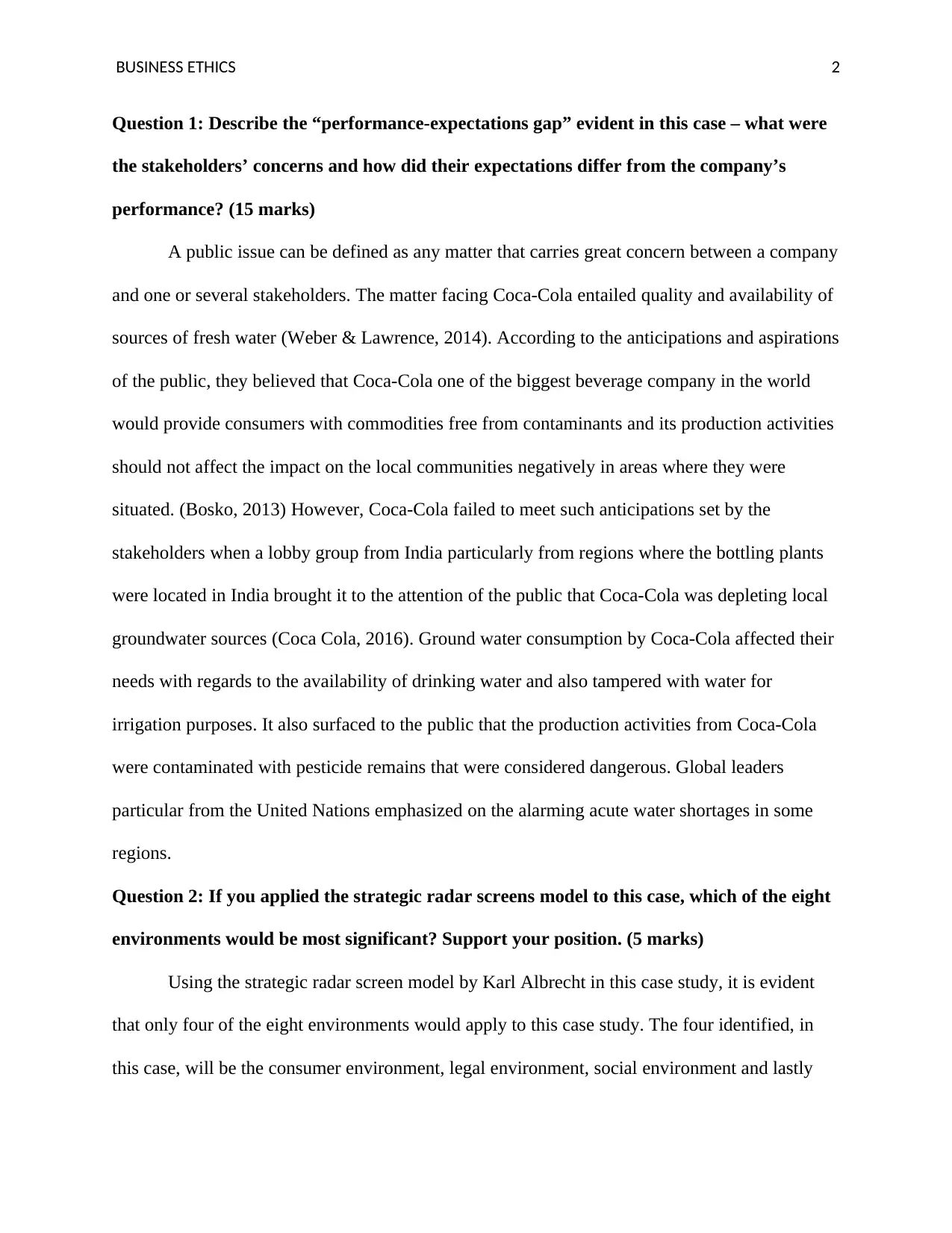
Question 1: Describe the “performance-expectations gap” evident in this case – what were
the stakeholders’ concerns and how did their expectations differ from the company’s
performance? (15 marks)
A public issue can be defined as any matter that carries great concern between a company
and one or several stakeholders. The matter facing Coca-Cola entailed quality and availability of
sources of fresh water (Weber & Lawrence, 2014). According to the anticipations and aspirations
of the public, they believed that Coca-Cola one of the biggest beverage company in the world
would provide consumers with commodities free from contaminants and its production activities
should not affect the impact on the local communities negatively in areas where they were
situated. (Bosko, 2013) However, Coca-Cola failed to meet such anticipations set by the
stakeholders when a lobby group from India particularly from regions where the bottling plants
were located in India brought it to the attention of the public that Coca-Cola was depleting local
groundwater sources (Coca Cola, 2016). Ground water consumption by Coca-Cola affected their
needs with regards to the availability of drinking water and also tampered with water for
irrigation purposes. It also surfaced to the public that the production activities from Coca-Cola
were contaminated with pesticide remains that were considered dangerous. Global leaders
particular from the United Nations emphasized on the alarming acute water shortages in some
regions.
Question 2: If you applied the strategic radar screens model to this case, which of the eight
environments would be most significant? Support your position. (5 marks)
Using the strategic radar screen model by Karl Albrecht in this case study, it is evident
that only four of the eight environments would apply to this case study. The four identified, in
this case, will be the consumer environment, legal environment, social environment and lastly
Question 1: Describe the “performance-expectations gap” evident in this case – what were
the stakeholders’ concerns and how did their expectations differ from the company’s
performance? (15 marks)
A public issue can be defined as any matter that carries great concern between a company
and one or several stakeholders. The matter facing Coca-Cola entailed quality and availability of
sources of fresh water (Weber & Lawrence, 2014). According to the anticipations and aspirations
of the public, they believed that Coca-Cola one of the biggest beverage company in the world
would provide consumers with commodities free from contaminants and its production activities
should not affect the impact on the local communities negatively in areas where they were
situated. (Bosko, 2013) However, Coca-Cola failed to meet such anticipations set by the
stakeholders when a lobby group from India particularly from regions where the bottling plants
were located in India brought it to the attention of the public that Coca-Cola was depleting local
groundwater sources (Coca Cola, 2016). Ground water consumption by Coca-Cola affected their
needs with regards to the availability of drinking water and also tampered with water for
irrigation purposes. It also surfaced to the public that the production activities from Coca-Cola
were contaminated with pesticide remains that were considered dangerous. Global leaders
particular from the United Nations emphasized on the alarming acute water shortages in some
regions.
Question 2: If you applied the strategic radar screens model to this case, which of the eight
environments would be most significant? Support your position. (5 marks)
Using the strategic radar screen model by Karl Albrecht in this case study, it is evident
that only four of the eight environments would apply to this case study. The four identified, in
this case, will be the consumer environment, legal environment, social environment and lastly
BUSINESS ETHICS 3
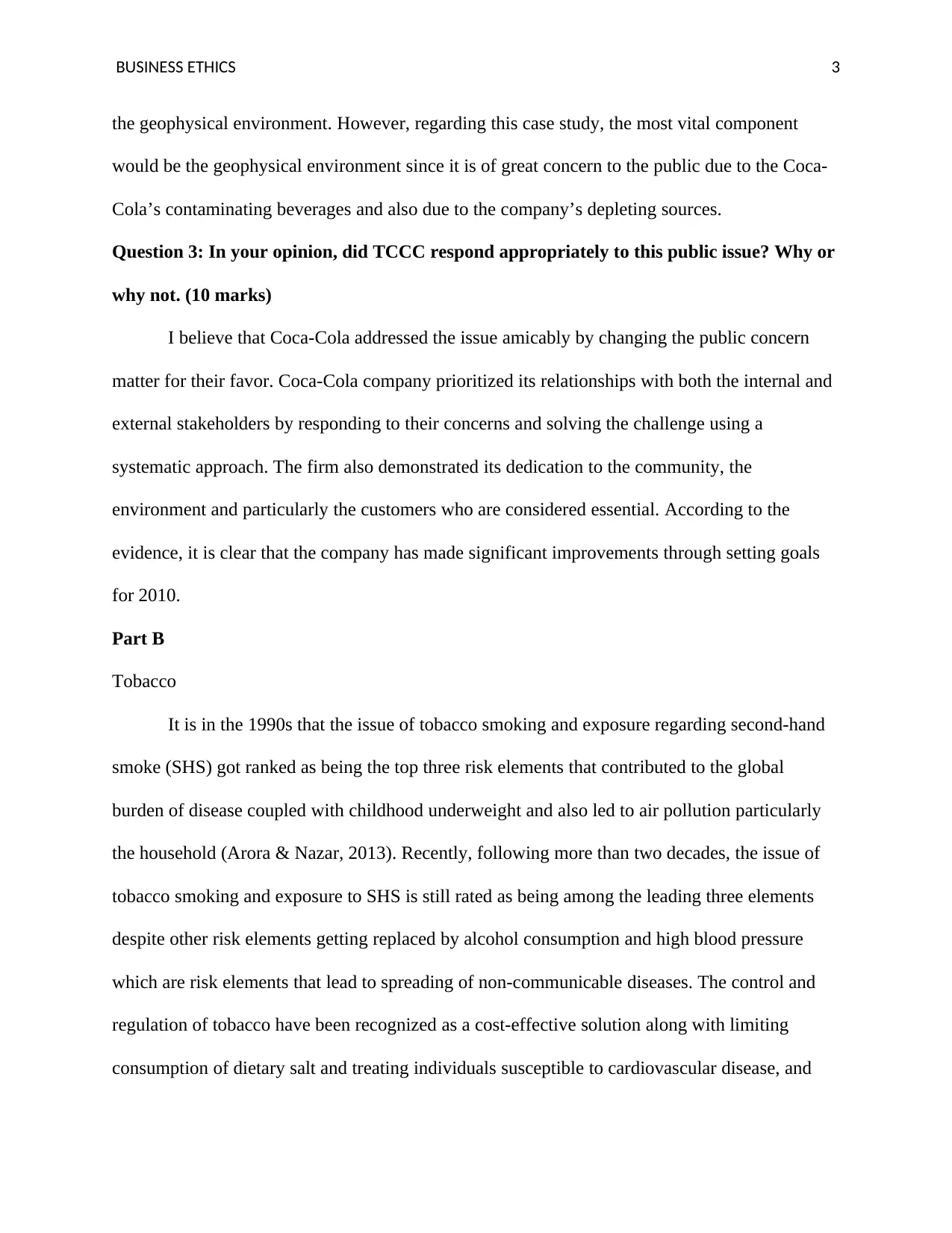
the geophysical environment. However, regarding this case study, the most vital component
would be the geophysical environment since it is of great concern to the public due to the Coca-
Cola’s contaminating beverages and also due to the company’s depleting sources.
Question 3: In your opinion, did TCCC respond appropriately to this public issue? Why or
why not. (10 marks)
I believe that Coca-Cola addressed the issue amicably by changing the public concern
matter for their favor. Coca-Cola company prioritized its relationships with both the internal and
external stakeholders by responding to their concerns and solving the challenge using a
systematic approach. The firm also demonstrated its dedication to the community, the
environment and particularly the customers who are considered essential. According to the
evidence, it is clear that the company has made significant improvements through setting goals
for 2010.
Part B
Tobacco
It is in the 1990s that the issue of tobacco smoking and exposure regarding second-hand
smoke (SHS) got ranked as being the top three risk elements that contributed to the global
burden of disease coupled with childhood underweight and also led to air pollution particularly
the household (Arora & Nazar, 2013). Recently, following more than two decades, the issue of
tobacco smoking and exposure to SHS is still rated as being among the leading three elements
despite other risk elements getting replaced by alcohol consumption and high blood pressure
which are risk elements that lead to spreading of non-communicable diseases. The control and
regulation of tobacco have been recognized as a cost-effective solution along with limiting
consumption of dietary salt and treating individuals susceptible to cardiovascular disease, and
the geophysical environment. However, regarding this case study, the most vital component
would be the geophysical environment since it is of great concern to the public due to the Coca-
Cola’s contaminating beverages and also due to the company’s depleting sources.
Question 3: In your opinion, did TCCC respond appropriately to this public issue? Why or
why not. (10 marks)
I believe that Coca-Cola addressed the issue amicably by changing the public concern
matter for their favor. Coca-Cola company prioritized its relationships with both the internal and
external stakeholders by responding to their concerns and solving the challenge using a
systematic approach. The firm also demonstrated its dedication to the community, the
environment and particularly the customers who are considered essential. According to the
evidence, it is clear that the company has made significant improvements through setting goals
for 2010.
Part B
Tobacco
It is in the 1990s that the issue of tobacco smoking and exposure regarding second-hand
smoke (SHS) got ranked as being the top three risk elements that contributed to the global
burden of disease coupled with childhood underweight and also led to air pollution particularly
the household (Arora & Nazar, 2013). Recently, following more than two decades, the issue of
tobacco smoking and exposure to SHS is still rated as being among the leading three elements
despite other risk elements getting replaced by alcohol consumption and high blood pressure
which are risk elements that lead to spreading of non-communicable diseases. The control and
regulation of tobacco have been recognized as a cost-effective solution along with limiting
consumption of dietary salt and treating individuals susceptible to cardiovascular disease, and
⊘ This is a preview!⊘
Do you want full access?
Subscribe today to unlock all pages.

Trusted by 1+ million students worldwide
BUSINESS ETHICS 4
this can help in attaining the international target of 25% reduction in non-communicable disease
associated mortality by 2025.
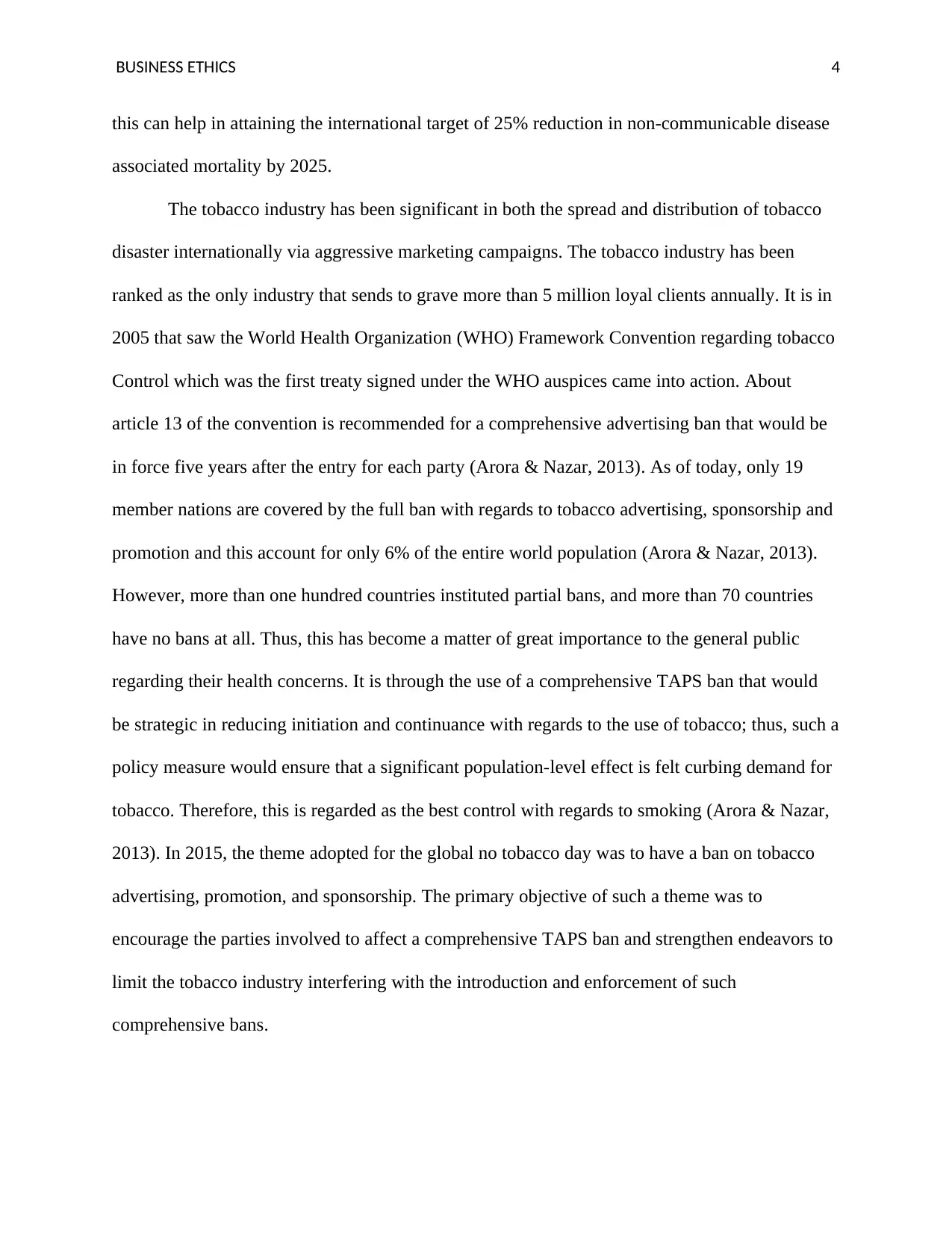
The tobacco industry has been significant in both the spread and distribution of tobacco
disaster internationally via aggressive marketing campaigns. The tobacco industry has been
ranked as the only industry that sends to grave more than 5 million loyal clients annually. It is in
2005 that saw the World Health Organization (WHO) Framework Convention regarding tobacco
Control which was the first treaty signed under the WHO auspices came into action. About
article 13 of the convention is recommended for a comprehensive advertising ban that would be
in force five years after the entry for each party (Arora & Nazar, 2013). As of today, only 19
member nations are covered by the full ban with regards to tobacco advertising, sponsorship and
promotion and this account for only 6% of the entire world population (Arora & Nazar, 2013).
However, more than one hundred countries instituted partial bans, and more than 70 countries
have no bans at all. Thus, this has become a matter of great importance to the general public
regarding their health concerns. It is through the use of a comprehensive TAPS ban that would
be strategic in reducing initiation and continuance with regards to the use of tobacco; thus, such a
policy measure would ensure that a significant population-level effect is felt curbing demand for
tobacco. Therefore, this is regarded as the best control with regards to smoking (Arora & Nazar,
2013). In 2015, the theme adopted for the global no tobacco day was to have a ban on tobacco
advertising, promotion, and sponsorship. The primary objective of such a theme was to
encourage the parties involved to affect a comprehensive TAPS ban and strengthen endeavors to
limit the tobacco industry interfering with the introduction and enforcement of such
comprehensive bans.
this can help in attaining the international target of 25% reduction in non-communicable disease
associated mortality by 2025.
The tobacco industry has been significant in both the spread and distribution of tobacco
disaster internationally via aggressive marketing campaigns. The tobacco industry has been
ranked as the only industry that sends to grave more than 5 million loyal clients annually. It is in
2005 that saw the World Health Organization (WHO) Framework Convention regarding tobacco
Control which was the first treaty signed under the WHO auspices came into action. About
article 13 of the convention is recommended for a comprehensive advertising ban that would be
in force five years after the entry for each party (Arora & Nazar, 2013). As of today, only 19
member nations are covered by the full ban with regards to tobacco advertising, sponsorship and
promotion and this account for only 6% of the entire world population (Arora & Nazar, 2013).
However, more than one hundred countries instituted partial bans, and more than 70 countries
have no bans at all. Thus, this has become a matter of great importance to the general public
regarding their health concerns. It is through the use of a comprehensive TAPS ban that would
be strategic in reducing initiation and continuance with regards to the use of tobacco; thus, such a
policy measure would ensure that a significant population-level effect is felt curbing demand for
tobacco. Therefore, this is regarded as the best control with regards to smoking (Arora & Nazar,
2013). In 2015, the theme adopted for the global no tobacco day was to have a ban on tobacco
advertising, promotion, and sponsorship. The primary objective of such a theme was to
encourage the parties involved to affect a comprehensive TAPS ban and strengthen endeavors to
limit the tobacco industry interfering with the introduction and enforcement of such
comprehensive bans.
Paraphrase This Document
Need a fresh take? Get an instant paraphrase of this document with our AI Paraphraser
BUSINESS ETHICS 5
Section 1. Context: Introduce the issue(s) you have selected and list primary and secondary
stakeholders influencing or influenced by this issue(s). Be specific in naming individuals,
groups, associations, and government bodies and describe these stakeholders' roles. (15
marks)
The health hazards associated with smoking are not yet apparent. However, there has
been substantial scientific evidence pointing that smokers usually have a shorter life span
compared to the non-smokers. Cigarette smoking is associated with lung and cardiovascular
ailments. The shocking thing is the scathing impact of smoking on non-smokers. Passive
smoking becomes unmanageable when it occurs in public places where people cannot control it.
The tobacco industry has been in the limelight particularly among media houses due to its
association of causing many diseases such as lung cancer. Smoking cigarette has been known for
causing lung cancer which is life and death experience. The primary stakeholders are tobacco
businesses, stores that advertise and sell cigarettes and consumers of tobacco. On the other hand,
secondary stakeholders involve secondary smokers, third-hand smokers, state-funded regulatory
agencies, media, and rival companies.
Tobacco industries belong to the category of primary stakeholders since the gain profits
from selling cigarettes. One of the primary roles is to ensure they accrue earnings for the sake of
the company and maximize shareholders’ equity. However, such companies have corporate
social responsibility; for instance, the companies have to remind their customers of the risks
associated with consuming tobacco. It is also the responsibility of a company to create value for
its staff.
The introduction of a ban will affect customers who are frequent smokers as they have to
find the designated smoking region to have a single cigarette (ASH, 2013). The smoking habits
Section 1. Context: Introduce the issue(s) you have selected and list primary and secondary
stakeholders influencing or influenced by this issue(s). Be specific in naming individuals,
groups, associations, and government bodies and describe these stakeholders' roles. (15
marks)
The health hazards associated with smoking are not yet apparent. However, there has
been substantial scientific evidence pointing that smokers usually have a shorter life span
compared to the non-smokers. Cigarette smoking is associated with lung and cardiovascular
ailments. The shocking thing is the scathing impact of smoking on non-smokers. Passive
smoking becomes unmanageable when it occurs in public places where people cannot control it.
The tobacco industry has been in the limelight particularly among media houses due to its
association of causing many diseases such as lung cancer. Smoking cigarette has been known for
causing lung cancer which is life and death experience. The primary stakeholders are tobacco
businesses, stores that advertise and sell cigarettes and consumers of tobacco. On the other hand,
secondary stakeholders involve secondary smokers, third-hand smokers, state-funded regulatory
agencies, media, and rival companies.
Tobacco industries belong to the category of primary stakeholders since the gain profits
from selling cigarettes. One of the primary roles is to ensure they accrue earnings for the sake of
the company and maximize shareholders’ equity. However, such companies have corporate
social responsibility; for instance, the companies have to remind their customers of the risks
associated with consuming tobacco. It is also the responsibility of a company to create value for
its staff.
The introduction of a ban will affect customers who are frequent smokers as they have to
find the designated smoking region to have a single cigarette (ASH, 2013). The smoking habits
BUSINESS ETHICS 6
will thus be affected in two ways. One is that smokers may forego the hustle of finding the
designated smoking hub which will reduce the frequency of smoking. This will have a
considerable impact on reducing the number of cigarettes thus reducing the money spent on
cigarettes.
The cigarette manufacturing entities will be hit the hardest with the ban as the demand will drop
thus reduce the revenues from cigarettes. However, to show their support with regards to ethics,
they will promote the ban in public places mainly on the cigarette packets.
For the secondary stakeholders, they involve the government, the public, and the non-
smokers. The government is tasked with making policies for its citizens, and the citizens become
victims of either the positive or negative results of such policies.
The general public refers to the people whom the ban has been effected for, and many people are
cigarette customers. However, in this group, there is the non-smoker segment who are impacted
negatively by passive smokers.
Section 2. What does this mean to my family? Identify your stakeholder role(s) in relation
to the tobacco industry and cigarette smoking in our society. Describe the biases,
perspectives, or experiences that may influence your position on this public issue. (10
marks)
Being a staunch supporter of individualism and individual choices makes me have an
independent mind. However, I adore such decisions to the point where they do not cross the line
by interfering with other people’s private space. Smoking in public interferes with other people
personal space. Many people are reported to have respiratory problems and others have lung
issues and inhaling such smoke via passive smoking is fatal for such people. Smoking could also
cause other diseases such as bronchitis, asthma, and cardiovascular ailments. In the case of non-
will thus be affected in two ways. One is that smokers may forego the hustle of finding the
designated smoking hub which will reduce the frequency of smoking. This will have a
considerable impact on reducing the number of cigarettes thus reducing the money spent on
cigarettes.
The cigarette manufacturing entities will be hit the hardest with the ban as the demand will drop
thus reduce the revenues from cigarettes. However, to show their support with regards to ethics,
they will promote the ban in public places mainly on the cigarette packets.
For the secondary stakeholders, they involve the government, the public, and the non-
smokers. The government is tasked with making policies for its citizens, and the citizens become
victims of either the positive or negative results of such policies.
The general public refers to the people whom the ban has been effected for, and many people are
cigarette customers. However, in this group, there is the non-smoker segment who are impacted
negatively by passive smokers.
Section 2. What does this mean to my family? Identify your stakeholder role(s) in relation
to the tobacco industry and cigarette smoking in our society. Describe the biases,
perspectives, or experiences that may influence your position on this public issue. (10
marks)
Being a staunch supporter of individualism and individual choices makes me have an
independent mind. However, I adore such decisions to the point where they do not cross the line
by interfering with other people’s private space. Smoking in public interferes with other people
personal space. Many people are reported to have respiratory problems and others have lung
issues and inhaling such smoke via passive smoking is fatal for such people. Smoking could also
cause other diseases such as bronchitis, asthma, and cardiovascular ailments. In the case of non-
⊘ This is a preview!⊘
Do you want full access?
Subscribe today to unlock all pages.
Trusted by 1+ million students worldwide
BUSINESS ETHICS 7
smokers who get exposed to cigarette smoke in places of work, they have an increased risk of
about 16% of contracting lung cancer.
Also, public smoking adds smoke to the atmosphere leading to increased levels of air
pollution. According to my location, smoke from a cigarette is a small percentage of the gross air
pollution caused. However, I am incredibly conscious about this matter since where I come from,
and air particulate matter is about seven times the acceptable limit. It is approximated that
annually more than 1 million people die due to air pollution in India. Air pollution has been
ranked as the fifth killer, and from the perspective of someone who cares about having a family,
it worries me when I think about my family.
Section 3. What does this mean to my company?: Imagine yourself as a tobacco industry executive
and describe management of the public issue(s) from this perspective. (15 marks)
Acting in the capacity of an executive in the tobacco industry, it would be crucial to
begin from conducting an environmental analysis regarding the matter of smoking in public
places. It would be essential to gather data regarding consumer habits, policies adopted by
competitors, economic aspects surrounding the issue at hand, legal frameworks, social
environment, and political aspects.
The next step would entail recognizing the issue and analyzing it, developing other
options, taking corrective actions and examining the outcome. Such processes can primarily be
enhanced by stakeholder commitments, stakeholder conversation, and networks. Thus, like a
tobacco company, it would be primarily be focused on both the consumers and the state. Since
the ultimate power lies with the government as it enforces the ban regarding this issue, it would
be imperative to partner with the government regarding the cause and help the government in
implementing the new ban. For instance, the possibility of having a disclaimer in the cigarette
packet asserting that it is irresponsible and illegal for people to smoke in public places would
smokers who get exposed to cigarette smoke in places of work, they have an increased risk of
about 16% of contracting lung cancer.
Also, public smoking adds smoke to the atmosphere leading to increased levels of air
pollution. According to my location, smoke from a cigarette is a small percentage of the gross air
pollution caused. However, I am incredibly conscious about this matter since where I come from,
and air particulate matter is about seven times the acceptable limit. It is approximated that
annually more than 1 million people die due to air pollution in India. Air pollution has been
ranked as the fifth killer, and from the perspective of someone who cares about having a family,
it worries me when I think about my family.
Section 3. What does this mean to my company?: Imagine yourself as a tobacco industry executive
and describe management of the public issue(s) from this perspective. (15 marks)
Acting in the capacity of an executive in the tobacco industry, it would be crucial to
begin from conducting an environmental analysis regarding the matter of smoking in public
places. It would be essential to gather data regarding consumer habits, policies adopted by
competitors, economic aspects surrounding the issue at hand, legal frameworks, social
environment, and political aspects.
The next step would entail recognizing the issue and analyzing it, developing other
options, taking corrective actions and examining the outcome. Such processes can primarily be
enhanced by stakeholder commitments, stakeholder conversation, and networks. Thus, like a
tobacco company, it would be primarily be focused on both the consumers and the state. Since
the ultimate power lies with the government as it enforces the ban regarding this issue, it would
be imperative to partner with the government regarding the cause and help the government in
implementing the new ban. For instance, the possibility of having a disclaimer in the cigarette
packet asserting that it is irresponsible and illegal for people to smoke in public places would
Paraphrase This Document
Need a fresh take? Get an instant paraphrase of this document with our AI Paraphraser
BUSINESS ETHICS 8
have a significant impact in enforcing the ban and the concept behind public smoking. Also,
partnering with several groups that back the ban or sponsor the construction of public smoking
zones could be of great help in curbing public smoking.
Such stakeholder networks and conversations are imperative from two perspectives.
Based on the ethical approach, it is not only the best but also the ethical to do for the community
in general. Based on the view of a business, it accords the brand a sense of value regarding
sensitivity towards pressing social matters. It conveys a robust message regarding the company
being sensitive to the welfare of non-smokers and society as a whole. Thus, when consumers
read the disclaimer on the cigarette packet, they realize that the company does not support the
misuse of cigarette as their product and that it is fine if they smoke cigarettes in safe
environments where other people are not harmed.
Section 4. What does this mean to my country?: Discuss the role(s) of government in this issue(s) and
how it is influencing both the industry and the public. (15 marks)
The government is mandated and obliged to protect and take great care of its citizens.
Using the report developed in 2009 by the International Agency for Research on Cancer asserted
that there is a shred of robust evidence particularly with reference to the second highest level of
substantial evidence as per the rating scale of the report that the implementation of laws
regarding smoke free leads to a decline with regards to a heart disease morbidity (National
Toxicology Program, 2016). However as of 2010, in another report, it was concluded that there
was a direct relationship that existed between smoke-free legislation and decreased in acute
coronary situations through the report failed to estimate the impacts of such a relationship. As of
2010, based on the Cochrane review that entailed 12 studies, it revealed substantial evidence in
the number of cases admitted for cardiac arrests with the establishment of smoke-free legislation.
In another meta-analysis that comprised of 17 studies in relation to the impact of smoke free
have a significant impact in enforcing the ban and the concept behind public smoking. Also,
partnering with several groups that back the ban or sponsor the construction of public smoking
zones could be of great help in curbing public smoking.
Such stakeholder networks and conversations are imperative from two perspectives.
Based on the ethical approach, it is not only the best but also the ethical to do for the community
in general. Based on the view of a business, it accords the brand a sense of value regarding
sensitivity towards pressing social matters. It conveys a robust message regarding the company
being sensitive to the welfare of non-smokers and society as a whole. Thus, when consumers
read the disclaimer on the cigarette packet, they realize that the company does not support the
misuse of cigarette as their product and that it is fine if they smoke cigarettes in safe
environments where other people are not harmed.
Section 4. What does this mean to my country?: Discuss the role(s) of government in this issue(s) and
how it is influencing both the industry and the public. (15 marks)
The government is mandated and obliged to protect and take great care of its citizens.
Using the report developed in 2009 by the International Agency for Research on Cancer asserted
that there is a shred of robust evidence particularly with reference to the second highest level of
substantial evidence as per the rating scale of the report that the implementation of laws
regarding smoke free leads to a decline with regards to a heart disease morbidity (National
Toxicology Program, 2016). However as of 2010, in another report, it was concluded that there
was a direct relationship that existed between smoke-free legislation and decreased in acute
coronary situations through the report failed to estimate the impacts of such a relationship. As of
2010, based on the Cochrane review that entailed 12 studies, it revealed substantial evidence in
the number of cases admitted for cardiac arrests with the establishment of smoke-free legislation.
In another meta-analysis that comprised of 17 studies in relation to the impact of smoke free
BUSINESS ETHICS 9
legislation regarding acute coronary cases it reported a pooled approximation of relative risk of
about 0.9 and asserted that substantial evidence is real that supports the reduction in the number
of coronary cases with the imposition of smoke free legislation with the impact increasing over
time (Bayer & Bachynski, 2013).
Through the banning of smoking in public places, the state is imposing a compulsory
health regulation on the tobacco industry and limiting its room for abuse. The ban represents
government’s courageous statement conveying an important message that it will not compromise
the health of its people for profit motives. Thus, the government will impact the tobacco industry
by affecting such businesses. However, the government will encourage such companies to
promote the need to make well-informed options among their customers. However, such a
decision by the government will impact the public in two primary ways (American College of
Cardiology, 2009). It will be beneficial on the side of non-smokers who abhor smoke through
passive smoking for parents with infants who are thrilled by the thought of taking them out to
public parks due to smoke or old people who have lung problems or individuals who have
respiratory issues.
The government may also develop a fact sheet and provide it to the public to enable
people to understand the logic behind such a ban. Such legislation may be imperative in reducing
the costs associated with health care and encourage a healthy lifestyle for people in any
particular country. For instance, in the U.S., it is reported that there are more than 350
jurisdictions that have successfully managed to prohibit smoking in outdoor zones for example in
the beaches, parks, and playgrounds, in waiting for queues without experiencing legal problems
and problems with enforcing such laws.
legislation regarding acute coronary cases it reported a pooled approximation of relative risk of
about 0.9 and asserted that substantial evidence is real that supports the reduction in the number
of coronary cases with the imposition of smoke free legislation with the impact increasing over
time (Bayer & Bachynski, 2013).
Through the banning of smoking in public places, the state is imposing a compulsory
health regulation on the tobacco industry and limiting its room for abuse. The ban represents
government’s courageous statement conveying an important message that it will not compromise
the health of its people for profit motives. Thus, the government will impact the tobacco industry
by affecting such businesses. However, the government will encourage such companies to
promote the need to make well-informed options among their customers. However, such a
decision by the government will impact the public in two primary ways (American College of
Cardiology, 2009). It will be beneficial on the side of non-smokers who abhor smoke through
passive smoking for parents with infants who are thrilled by the thought of taking them out to
public parks due to smoke or old people who have lung problems or individuals who have
respiratory issues.
The government may also develop a fact sheet and provide it to the public to enable
people to understand the logic behind such a ban. Such legislation may be imperative in reducing
the costs associated with health care and encourage a healthy lifestyle for people in any
particular country. For instance, in the U.S., it is reported that there are more than 350
jurisdictions that have successfully managed to prohibit smoking in outdoor zones for example in
the beaches, parks, and playgrounds, in waiting for queues without experiencing legal problems
and problems with enforcing such laws.
⊘ This is a preview!⊘
Do you want full access?
Subscribe today to unlock all pages.
Trusted by 1+ million students worldwide
BUSINESS ETHICS 10
In 2014, it was reported that 18% of Canadians were involved in smoking. In a country
such as Canada, smoking is illegal particularly in indoor public places and workplaces such as
the restaurants, pubs, and casinos by the federal government and in all territories and provinces
(CDC, 2018). However, despite the separate establishment of laws adopted by each jurisdiction,
bills banning smoking in each of these jurisdictions is identical in most of the parts of the
country.
In countries where the youth have become primary targets of tobacco companies which aim for
their interest to increase their profitability and revenues while risking public health require
stringent measures. The corrupt individuals in power positions that support public smoking
should be ousted out of power. The government has to impose heavy taxes on tobacco-related
products and the taxes collected from tobacco products should be invested in anti-smoking
initiatives to raise youth awareness about smoking in public.
Section 5. Media impact: Describe the media's role in this issue(s) and the perspective it is presenting
to the public. Discuss industry-sponsored media communications, as well as government
communications and reporting in the popular press. Cite specific examples, using references. (15
marks)
Media has been attributed to paying a crucial role in society. Due to modernization
associated with media, it transcends the television, radio and even newspapers. Media has
adopted new platforms such as the internet through social media and blogs. The media plays a
vital role in driving awareness related to health issues. In the past years, it was noted how media
had been instrumental in increasing the adverse effects of the tobacco industry (WHO, 2013).
The advertisement experts develop the same nature of advertisement repeatedly. It is unfortunate
that there very few people who work in the field of public awareness (Neupane, 2018). There is a
promotion of smoking and drinking as rising trends in various television programs and movies as
being fashionable. In another report, it was absurd how tobacco companies had deliberately
In 2014, it was reported that 18% of Canadians were involved in smoking. In a country
such as Canada, smoking is illegal particularly in indoor public places and workplaces such as
the restaurants, pubs, and casinos by the federal government and in all territories and provinces
(CDC, 2018). However, despite the separate establishment of laws adopted by each jurisdiction,
bills banning smoking in each of these jurisdictions is identical in most of the parts of the
country.
In countries where the youth have become primary targets of tobacco companies which aim for
their interest to increase their profitability and revenues while risking public health require
stringent measures. The corrupt individuals in power positions that support public smoking
should be ousted out of power. The government has to impose heavy taxes on tobacco-related
products and the taxes collected from tobacco products should be invested in anti-smoking
initiatives to raise youth awareness about smoking in public.
Section 5. Media impact: Describe the media's role in this issue(s) and the perspective it is presenting
to the public. Discuss industry-sponsored media communications, as well as government
communications and reporting in the popular press. Cite specific examples, using references. (15
marks)
Media has been attributed to paying a crucial role in society. Due to modernization
associated with media, it transcends the television, radio and even newspapers. Media has
adopted new platforms such as the internet through social media and blogs. The media plays a
vital role in driving awareness related to health issues. In the past years, it was noted how media
had been instrumental in increasing the adverse effects of the tobacco industry (WHO, 2013).
The advertisement experts develop the same nature of advertisement repeatedly. It is unfortunate
that there very few people who work in the field of public awareness (Neupane, 2018). There is a
promotion of smoking and drinking as rising trends in various television programs and movies as
being fashionable. In another report, it was absurd how tobacco companies had deliberately
Paraphrase This Document
Need a fresh take? Get an instant paraphrase of this document with our AI Paraphraser
BUSINESS ETHICS 11
designed cigarettes to make smoking of tobacco appear smoother and less harsh, and this
appealed to new users particularly the kids and aimed at developing and sustaining addiction to
nicotine. Surprisingly, the tobacco companies make such amendments without taking note of the
implications that their companies would have for the health of the public, and this has led to the
increase in the number of individuals developing the risk of having lung cancer. Contrary, the
tobacco companies have made hefty investments in advertising their tobacco products
(Fernandez, 2016). As observed, such advertisements can lure their target customers to venture
in smoking specifically when such promotions are created with their basis lying on movies and
lifestyles.
Media plays a vital role in influencing public opinion. This entails all media platforms
such as information channels, radio advertisements, television programs, and movies. Instances
of having a problem in the eye of the public lead to several stakeholders trying to shift public
opinion to favor them using the said media (Atusingwize, Lewis, & Langley, 2015). For
example, a cigarette company may initiate a commercial with a Hollywood actor who is famous
on the verge of smoking in an area designated as a public area. This may translate to be one of
the images of the style among the youths and other people in the society due to the referent spark
that celebrities have when it comes to advertisement campaigns.
How a policy gets reported contributes significantly to how people perceive such
information. For instance, a private media channel possessed by the group of cigarette companies
will convey a negative message that shows the negative impact of such a policy. However, for a
government-sponsored channel, it will communicate the positive aspects of such a policy to win
public opinion on their side.
designed cigarettes to make smoking of tobacco appear smoother and less harsh, and this
appealed to new users particularly the kids and aimed at developing and sustaining addiction to
nicotine. Surprisingly, the tobacco companies make such amendments without taking note of the
implications that their companies would have for the health of the public, and this has led to the
increase in the number of individuals developing the risk of having lung cancer. Contrary, the
tobacco companies have made hefty investments in advertising their tobacco products
(Fernandez, 2016). As observed, such advertisements can lure their target customers to venture
in smoking specifically when such promotions are created with their basis lying on movies and
lifestyles.
Media plays a vital role in influencing public opinion. This entails all media platforms
such as information channels, radio advertisements, television programs, and movies. Instances
of having a problem in the eye of the public lead to several stakeholders trying to shift public
opinion to favor them using the said media (Atusingwize, Lewis, & Langley, 2015). For
example, a cigarette company may initiate a commercial with a Hollywood actor who is famous
on the verge of smoking in an area designated as a public area. This may translate to be one of
the images of the style among the youths and other people in the society due to the referent spark
that celebrities have when it comes to advertisement campaigns.
How a policy gets reported contributes significantly to how people perceive such
information. For instance, a private media channel possessed by the group of cigarette companies
will convey a negative message that shows the negative impact of such a policy. However, for a
government-sponsored channel, it will communicate the positive aspects of such a policy to win
public opinion on their side.
BUSINESS ETHICS 12
References
American College of Cardiology. (2009, September 22). Banning Smoking In Public Places And
Workplaces Is Good For The Heart, Study Finds. Retrieved from Science Daily:
https://www.sciencedaily.com/releases/2009/09/090921173121.htm
Arora, M., & Nazar, G. P. (2013). Prohibiting tobacco advertising, promotions & sponsorships:
Tobacco control best buy. Indian Journal of Medical Research, 137(5), 867-870.
ASH. (2013). Reasons for Banning Smoking in Certain Public Outdoor areas. Retrieved from
Michigan.gov:
https://www.michigan.gov/documents/mdch/2_Reasons_outdoors_382580_7.pdf
Atusingwize, E., Lewis, S., & Langley, T. (2015). Economic evaluations of tobacco control mass
media campaigns. 24(4), 320-327. Retrieved from A systematic review. Tobacco Control.
Bayer, R., & Bachynski, K. E. (2013). Banning Smoking In Parks And On Beaches: Science,
Policy, And The Politics Of Denormalization. Health Affairs, 32(7), 432-440. Retrieved
from Health Affairs.
Bosko, D. (2013, September 18). Coca- Cola's Water Neutrality Initiative. Retrieved from
Prezzi: https://prezi.com/3c54nclxtgyw/coca-colas-water-neutrality-initiative/
CDC. (2018, January 17). Smoke free Policies Improve Health. Retrieved from Smoking and
Tobacco Use:
https://www.cdc.gov/tobacco/data_statistics/fact_sheets/secondhand_smoke/protection/
improve_health/
References
American College of Cardiology. (2009, September 22). Banning Smoking In Public Places And
Workplaces Is Good For The Heart, Study Finds. Retrieved from Science Daily:
https://www.sciencedaily.com/releases/2009/09/090921173121.htm
Arora, M., & Nazar, G. P. (2013). Prohibiting tobacco advertising, promotions & sponsorships:
Tobacco control best buy. Indian Journal of Medical Research, 137(5), 867-870.
ASH. (2013). Reasons for Banning Smoking in Certain Public Outdoor areas. Retrieved from
Michigan.gov:
https://www.michigan.gov/documents/mdch/2_Reasons_outdoors_382580_7.pdf
Atusingwize, E., Lewis, S., & Langley, T. (2015). Economic evaluations of tobacco control mass
media campaigns. 24(4), 320-327. Retrieved from A systematic review. Tobacco Control.
Bayer, R., & Bachynski, K. E. (2013). Banning Smoking In Parks And On Beaches: Science,
Policy, And The Politics Of Denormalization. Health Affairs, 32(7), 432-440. Retrieved
from Health Affairs.
Bosko, D. (2013, September 18). Coca- Cola's Water Neutrality Initiative. Retrieved from
Prezzi: https://prezi.com/3c54nclxtgyw/coca-colas-water-neutrality-initiative/
CDC. (2018, January 17). Smoke free Policies Improve Health. Retrieved from Smoking and
Tobacco Use:
https://www.cdc.gov/tobacco/data_statistics/fact_sheets/secondhand_smoke/protection/
improve_health/
⊘ This is a preview!⊘
Do you want full access?
Subscribe today to unlock all pages.
Trusted by 1+ million students worldwide

1 out of 13


Your All-in-One AI-Powered Toolkit for Academic Success.
+13062052269
info@desklib.com
Available 24*7 on WhatsApp / Email
![[object Object]](/_next/static/media/star-bottom.7253800d.svg)
Unlock your academic potential
Copyright © 2020–2026 A2Z Services. All Rights Reserved. Developed and managed by ZUCOL.