Critical Analysis: Vaccination Strategies for Childhood Immunization
VerifiedAdded on 2023/01/19
|17
|4616
|97
Report
AI Summary
This report provides a critical analysis of various strategies to improve childhood vaccination rates. It examines six articles focusing on parental attitudes, barriers to vaccination, and different intervention strategies. The report utilizes the articles to analyze three key themes: parental attitudes toward child vaccination, barriers to childhood vaccination, and effective strategies for increasing vaccination rates. The analysis includes detailed appendices with APA citations, research hypotheses, study designs, outcome variables, exposure considerations, methods of analysis, potential biases, and interpretations of results for each article. The report highlights the importance of understanding parental perspectives, addressing vaccine hesitancy, and employing effective communication and support to improve vaccination coverage. The conclusion emphasizes the need for healthcare providers to understand individual parental issues and provide the necessary support to improve vaccination rates.
CRITICAL ANALYSIS-
COERCIVE V/S
SUPPORTIVE
STRATEGIES TO
IMPROVE VACCINATION
RATES
COERCIVE V/S
SUPPORTIVE
STRATEGIES TO
IMPROVE VACCINATION
RATES

Paraphrase This Document
Need a fresh take? Get an instant paraphrase of this document with our AI Paraphraser
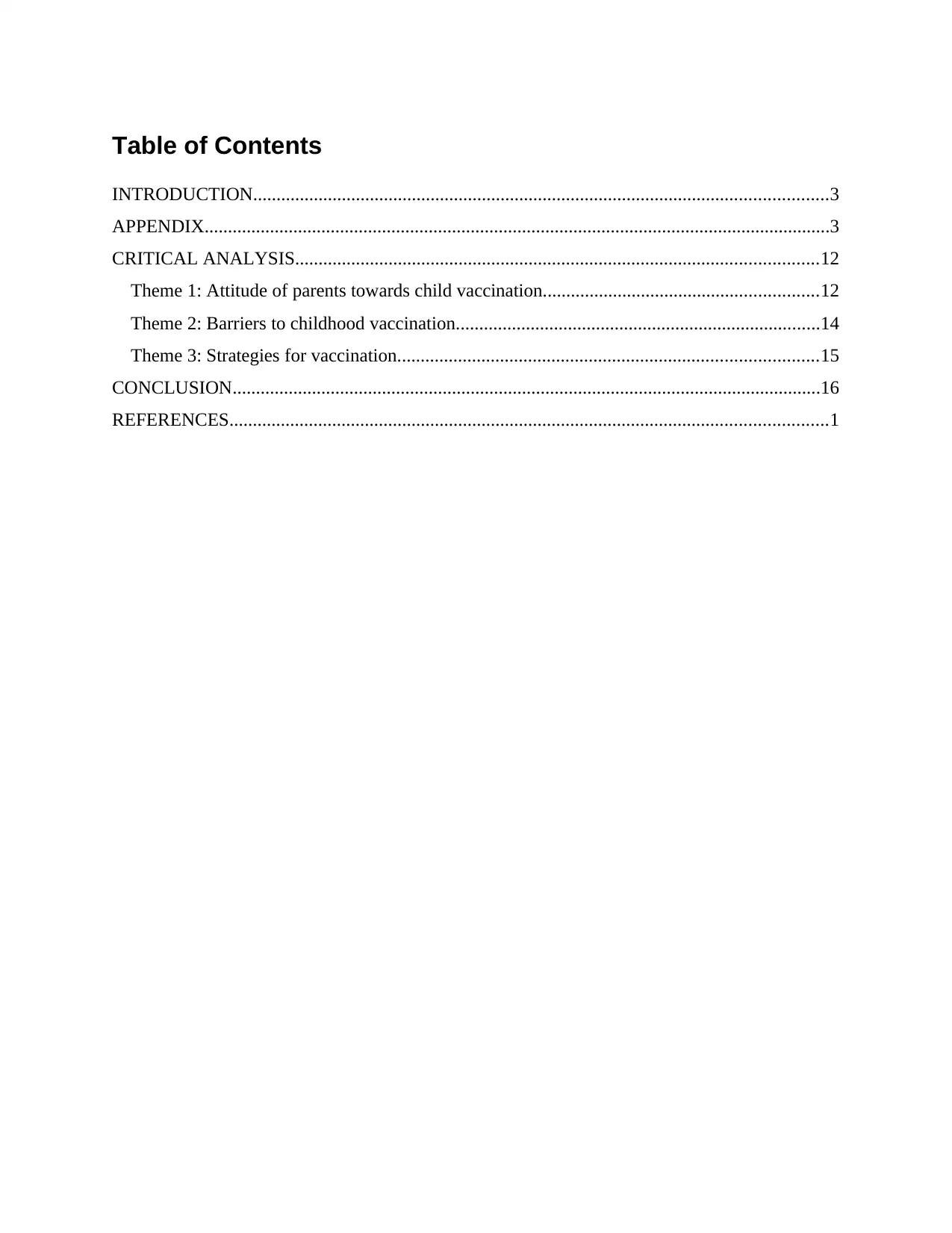
Table of Contents
INTRODUCTION...........................................................................................................................3
APPENDIX......................................................................................................................................3
CRITICAL ANALYSIS................................................................................................................12
Theme 1: Attitude of parents towards child vaccination...........................................................12
Theme 2: Barriers to childhood vaccination..............................................................................14
Theme 3: Strategies for vaccination..........................................................................................15
CONCLUSION..............................................................................................................................16
REFERENCES................................................................................................................................1
INTRODUCTION...........................................................................................................................3
APPENDIX......................................................................................................................................3
CRITICAL ANALYSIS................................................................................................................12
Theme 1: Attitude of parents towards child vaccination...........................................................12
Theme 2: Barriers to childhood vaccination..............................................................................14
Theme 3: Strategies for vaccination..........................................................................................15
CONCLUSION..............................................................................................................................16
REFERENCES................................................................................................................................1
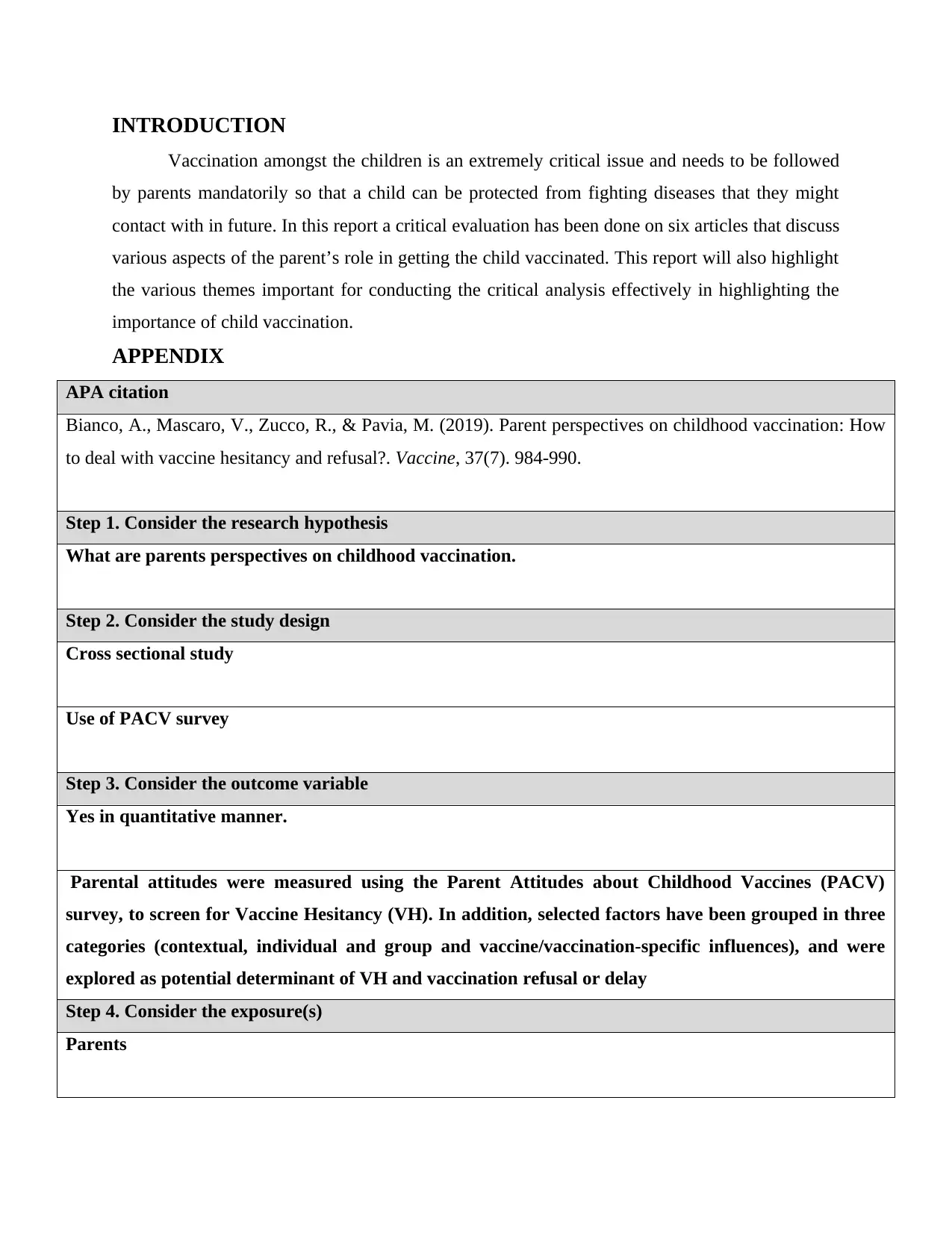
INTRODUCTION
Vaccination amongst the children is an extremely critical issue and needs to be followed
by parents mandatorily so that a child can be protected from fighting diseases that they might
contact with in future. In this report a critical evaluation has been done on six articles that discuss
various aspects of the parent’s role in getting the child vaccinated. This report will also highlight
the various themes important for conducting the critical analysis effectively in highlighting the
importance of child vaccination.
APPENDIX
APA citation
Bianco, A., Mascaro, V., Zucco, R., & Pavia, M. (2019). Parent perspectives on childhood vaccination: How
to deal with vaccine hesitancy and refusal?. Vaccine, 37(7). 984-990.
Step 1. Consider the research hypothesis
What are parents perspectives on childhood vaccination.
Step 2. Consider the study design
Cross sectional study
Use of PACV survey
Step 3. Consider the outcome variable
Yes in quantitative manner.
Parental attitudes were measured using the Parent Attitudes about Childhood Vaccines (PACV)
survey, to screen for Vaccine Hesitancy (VH). In addition, selected factors have been grouped in three
categories (contextual, individual and group and vaccine/vaccination-specific influences), and were
explored as potential determinant of VH and vaccination refusal or delay
Step 4. Consider the exposure(s)
Parents
Vaccination amongst the children is an extremely critical issue and needs to be followed
by parents mandatorily so that a child can be protected from fighting diseases that they might
contact with in future. In this report a critical evaluation has been done on six articles that discuss
various aspects of the parent’s role in getting the child vaccinated. This report will also highlight
the various themes important for conducting the critical analysis effectively in highlighting the
importance of child vaccination.
APPENDIX
APA citation
Bianco, A., Mascaro, V., Zucco, R., & Pavia, M. (2019). Parent perspectives on childhood vaccination: How
to deal with vaccine hesitancy and refusal?. Vaccine, 37(7). 984-990.
Step 1. Consider the research hypothesis
What are parents perspectives on childhood vaccination.
Step 2. Consider the study design
Cross sectional study
Use of PACV survey
Step 3. Consider the outcome variable
Yes in quantitative manner.
Parental attitudes were measured using the Parent Attitudes about Childhood Vaccines (PACV)
survey, to screen for Vaccine Hesitancy (VH). In addition, selected factors have been grouped in three
categories (contextual, individual and group and vaccine/vaccination-specific influences), and were
explored as potential determinant of VH and vaccination refusal or delay
Step 4. Consider the exposure(s)
Parents
⊘ This is a preview!⊘
Do you want full access?
Subscribe today to unlock all pages.

Trusted by 1+ million students worldwide
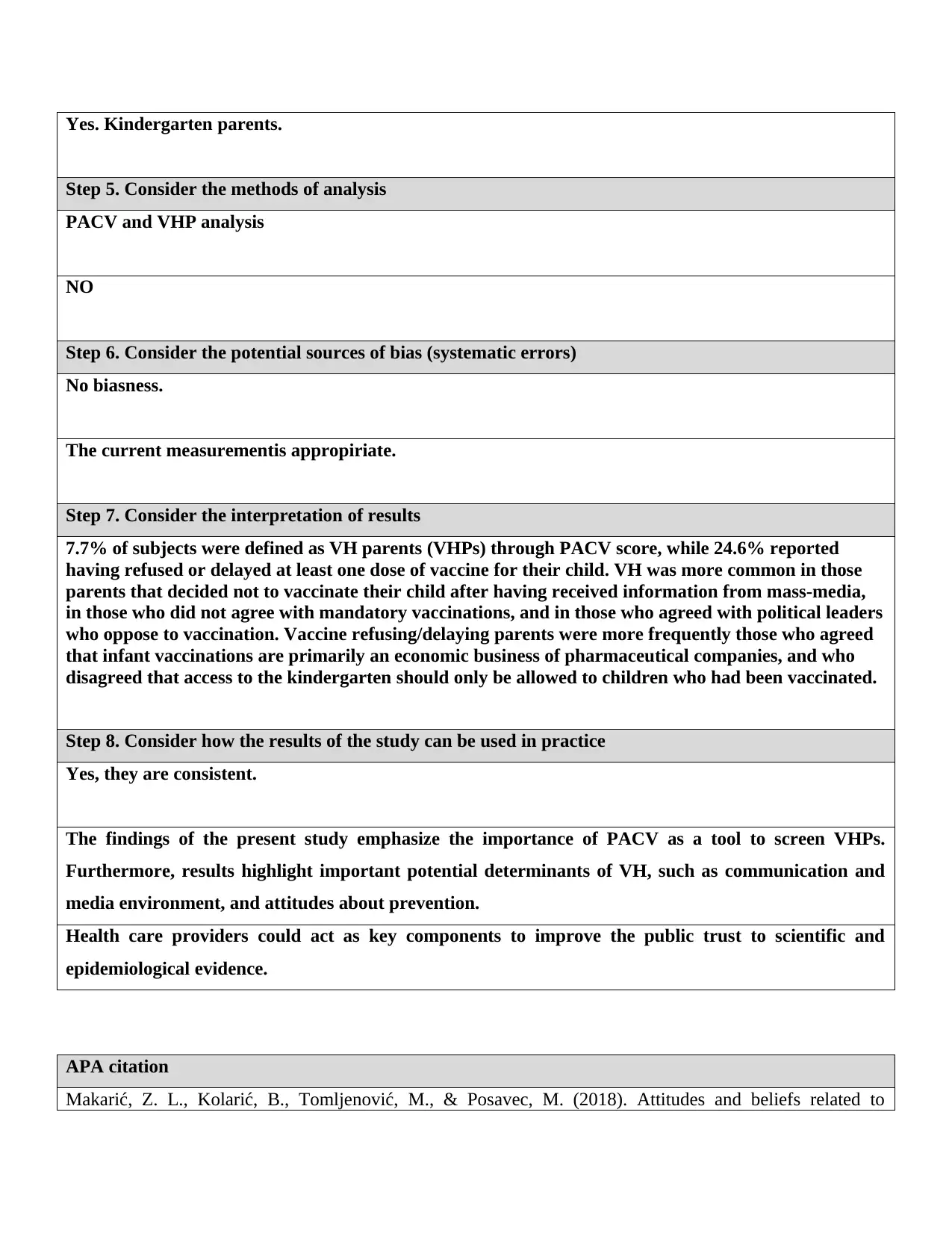
Yes. Kindergarten parents.
Step 5. Consider the methods of analysis
PACV and VHP analysis
NO
Step 6. Consider the potential sources of bias (systematic errors)
No biasness.
The current measurementis appropiriate.
Step 7. Consider the interpretation of results
7.7% of subjects were defined as VH parents (VHPs) through PACV score, while 24.6% reported
having refused or delayed at least one dose of vaccine for their child. VH was more common in those
parents that decided not to vaccinate their child after having received information from mass-media,
in those who did not agree with mandatory vaccinations, and in those who agreed with political leaders
who oppose to vaccination. Vaccine refusing/delaying parents were more frequently those who agreed
that infant vaccinations are primarily an economic business of pharmaceutical companies, and who
disagreed that access to the kindergarten should only be allowed to children who had been vaccinated.
Step 8. Consider how the results of the study can be used in practice
Yes, they are consistent.
The findings of the present study emphasize the importance of PACV as a tool to screen VHPs.
Furthermore, results highlight important potential determinants of VH, such as communication and
media environment, and attitudes about prevention.
Health care providers could act as key components to improve the public trust to scientific and
epidemiological evidence.
APA citation
Makarić, Z. L., Kolarić, B., Tomljenović, M., & Posavec, M. (2018). Attitudes and beliefs related to
Step 5. Consider the methods of analysis
PACV and VHP analysis
NO
Step 6. Consider the potential sources of bias (systematic errors)
No biasness.
The current measurementis appropiriate.
Step 7. Consider the interpretation of results
7.7% of subjects were defined as VH parents (VHPs) through PACV score, while 24.6% reported
having refused or delayed at least one dose of vaccine for their child. VH was more common in those
parents that decided not to vaccinate their child after having received information from mass-media,
in those who did not agree with mandatory vaccinations, and in those who agreed with political leaders
who oppose to vaccination. Vaccine refusing/delaying parents were more frequently those who agreed
that infant vaccinations are primarily an economic business of pharmaceutical companies, and who
disagreed that access to the kindergarten should only be allowed to children who had been vaccinated.
Step 8. Consider how the results of the study can be used in practice
Yes, they are consistent.
The findings of the present study emphasize the importance of PACV as a tool to screen VHPs.
Furthermore, results highlight important potential determinants of VH, such as communication and
media environment, and attitudes about prevention.
Health care providers could act as key components to improve the public trust to scientific and
epidemiological evidence.
APA citation
Makarić, Z. L., Kolarić, B., Tomljenović, M., & Posavec, M. (2018). Attitudes and beliefs related to
Paraphrase This Document
Need a fresh take? Get an instant paraphrase of this document with our AI Paraphraser
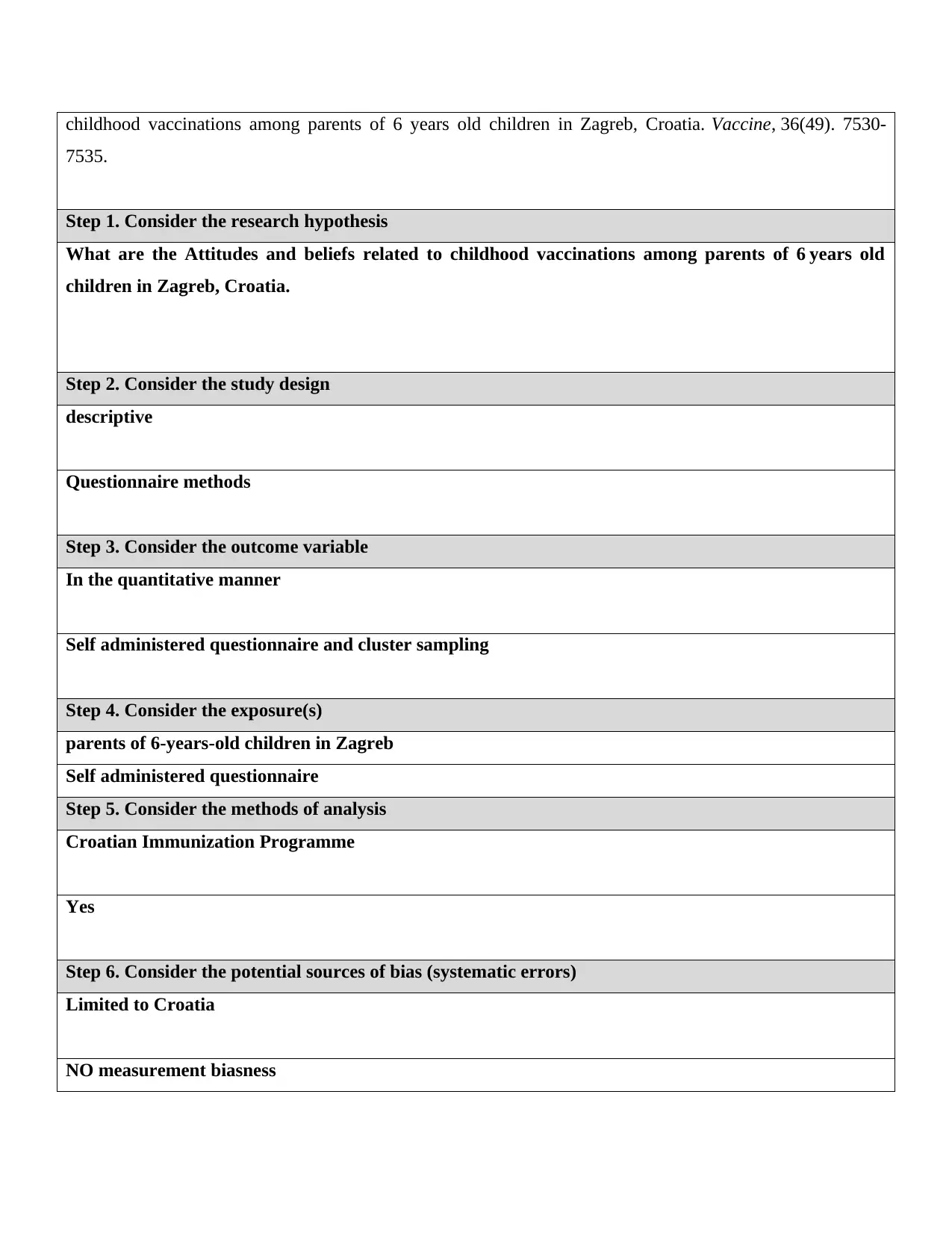
childhood vaccinations among parents of 6 years old children in Zagreb, Croatia. Vaccine, 36(49). 7530-
7535.
Step 1. Consider the research hypothesis
What are the Attitudes and beliefs related to childhood vaccinations among parents of 6 years old
children in Zagreb, Croatia.
Step 2. Consider the study design
descriptive
Questionnaire methods
Step 3. Consider the outcome variable
In the quantitative manner
Self administered questionnaire and cluster sampling
Step 4. Consider the exposure(s)
parents of 6-years-old children in Zagreb
Self administered questionnaire
Step 5. Consider the methods of analysis
Croatian Immunization Programme
Yes
Step 6. Consider the potential sources of bias (systematic errors)
Limited to Croatia
NO measurement biasness
7535.
Step 1. Consider the research hypothesis
What are the Attitudes and beliefs related to childhood vaccinations among parents of 6 years old
children in Zagreb, Croatia.
Step 2. Consider the study design
descriptive
Questionnaire methods
Step 3. Consider the outcome variable
In the quantitative manner
Self administered questionnaire and cluster sampling
Step 4. Consider the exposure(s)
parents of 6-years-old children in Zagreb
Self administered questionnaire
Step 5. Consider the methods of analysis
Croatian Immunization Programme
Yes
Step 6. Consider the potential sources of bias (systematic errors)
Limited to Croatia
NO measurement biasness
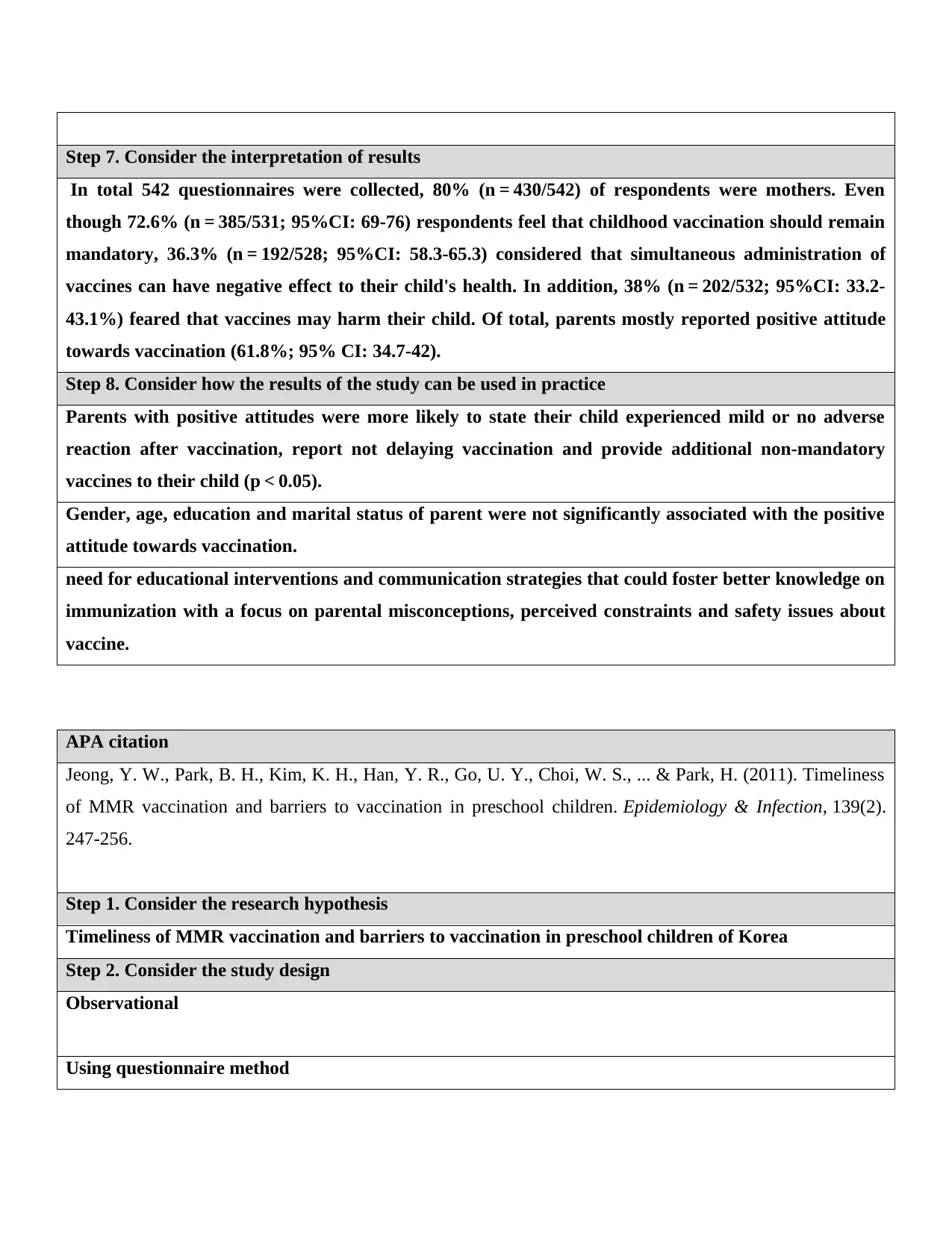
Step 7. Consider the interpretation of results
In total 542 questionnaires were collected, 80% (n = 430/542) of respondents were mothers. Even
though 72.6% (n = 385/531; 95%CI: 69-76) respondents feel that childhood vaccination should remain
mandatory, 36.3% (n = 192/528; 95%CI: 58.3-65.3) considered that simultaneous administration of
vaccines can have negative effect to their child's health. In addition, 38% (n = 202/532; 95%CI: 33.2-
43.1%) feared that vaccines may harm their child. Of total, parents mostly reported positive attitude
towards vaccination (61.8%; 95% CI: 34.7-42).
Step 8. Consider how the results of the study can be used in practice
Parents with positive attitudes were more likely to state their child experienced mild or no adverse
reaction after vaccination, report not delaying vaccination and provide additional non-mandatory
vaccines to their child (p < 0.05).
Gender, age, education and marital status of parent were not significantly associated with the positive
attitude towards vaccination.
need for educational interventions and communication strategies that could foster better knowledge on
immunization with a focus on parental misconceptions, perceived constraints and safety issues about
vaccine.
APA citation
Jeong, Y. W., Park, B. H., Kim, K. H., Han, Y. R., Go, U. Y., Choi, W. S., ... & Park, H. (2011). Timeliness
of MMR vaccination and barriers to vaccination in preschool children. Epidemiology & Infection, 139(2).
247-256.
Step 1. Consider the research hypothesis
Timeliness of MMR vaccination and barriers to vaccination in preschool children of Korea
Step 2. Consider the study design
Observational
Using questionnaire method
In total 542 questionnaires were collected, 80% (n = 430/542) of respondents were mothers. Even
though 72.6% (n = 385/531; 95%CI: 69-76) respondents feel that childhood vaccination should remain
mandatory, 36.3% (n = 192/528; 95%CI: 58.3-65.3) considered that simultaneous administration of
vaccines can have negative effect to their child's health. In addition, 38% (n = 202/532; 95%CI: 33.2-
43.1%) feared that vaccines may harm their child. Of total, parents mostly reported positive attitude
towards vaccination (61.8%; 95% CI: 34.7-42).
Step 8. Consider how the results of the study can be used in practice
Parents with positive attitudes were more likely to state their child experienced mild or no adverse
reaction after vaccination, report not delaying vaccination and provide additional non-mandatory
vaccines to their child (p < 0.05).
Gender, age, education and marital status of parent were not significantly associated with the positive
attitude towards vaccination.
need for educational interventions and communication strategies that could foster better knowledge on
immunization with a focus on parental misconceptions, perceived constraints and safety issues about
vaccine.
APA citation
Jeong, Y. W., Park, B. H., Kim, K. H., Han, Y. R., Go, U. Y., Choi, W. S., ... & Park, H. (2011). Timeliness
of MMR vaccination and barriers to vaccination in preschool children. Epidemiology & Infection, 139(2).
247-256.
Step 1. Consider the research hypothesis
Timeliness of MMR vaccination and barriers to vaccination in preschool children of Korea
Step 2. Consider the study design
Observational
Using questionnaire method
⊘ This is a preview!⊘
Do you want full access?
Subscribe today to unlock all pages.
Trusted by 1+ million students worldwide
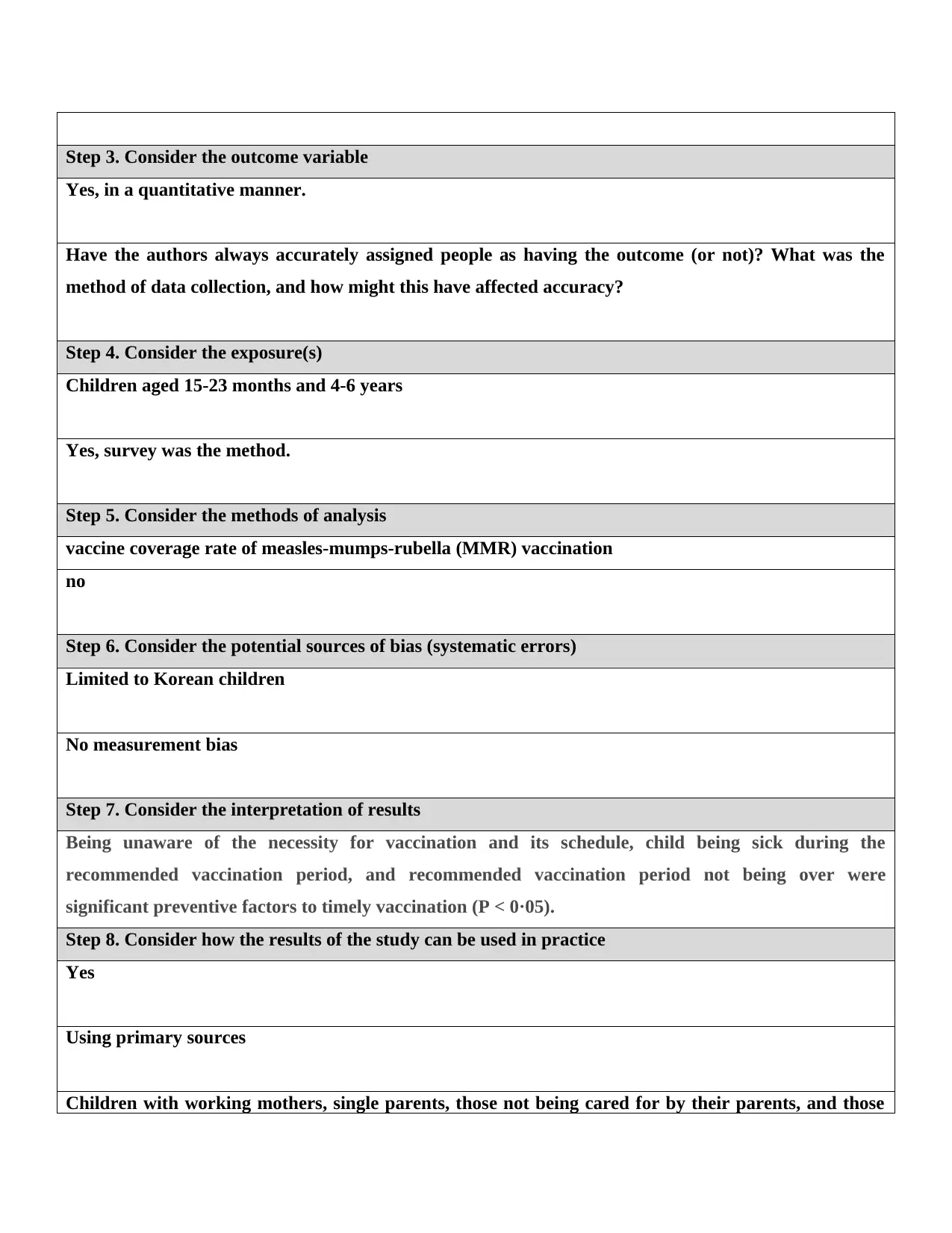
Step 3. Consider the outcome variable
Yes, in a quantitative manner.
Have the authors always accurately assigned people as having the outcome (or not)? What was the
method of data collection, and how might this have affected accuracy?
Step 4. Consider the exposure(s)
Children aged 15-23 months and 4-6 years
Yes, survey was the method.
Step 5. Consider the methods of analysis
vaccine coverage rate of measles-mumps-rubella (MMR) vaccination
no
Step 6. Consider the potential sources of bias (systematic errors)
Limited to Korean children
No measurement bias
Step 7. Consider the interpretation of results
Being unaware of the necessity for vaccination and its schedule, child being sick during the
recommended vaccination period, and recommended vaccination period not being over were
significant preventive factors to timely vaccination (P < 0·05).
Step 8. Consider how the results of the study can be used in practice
Yes
Using primary sources
Children with working mothers, single parents, those not being cared for by their parents, and those
Yes, in a quantitative manner.
Have the authors always accurately assigned people as having the outcome (or not)? What was the
method of data collection, and how might this have affected accuracy?
Step 4. Consider the exposure(s)
Children aged 15-23 months and 4-6 years
Yes, survey was the method.
Step 5. Consider the methods of analysis
vaccine coverage rate of measles-mumps-rubella (MMR) vaccination
no
Step 6. Consider the potential sources of bias (systematic errors)
Limited to Korean children
No measurement bias
Step 7. Consider the interpretation of results
Being unaware of the necessity for vaccination and its schedule, child being sick during the
recommended vaccination period, and recommended vaccination period not being over were
significant preventive factors to timely vaccination (P < 0·05).
Step 8. Consider how the results of the study can be used in practice
Yes
Using primary sources
Children with working mothers, single parents, those not being cared for by their parents, and those
Paraphrase This Document
Need a fresh take? Get an instant paraphrase of this document with our AI Paraphraser
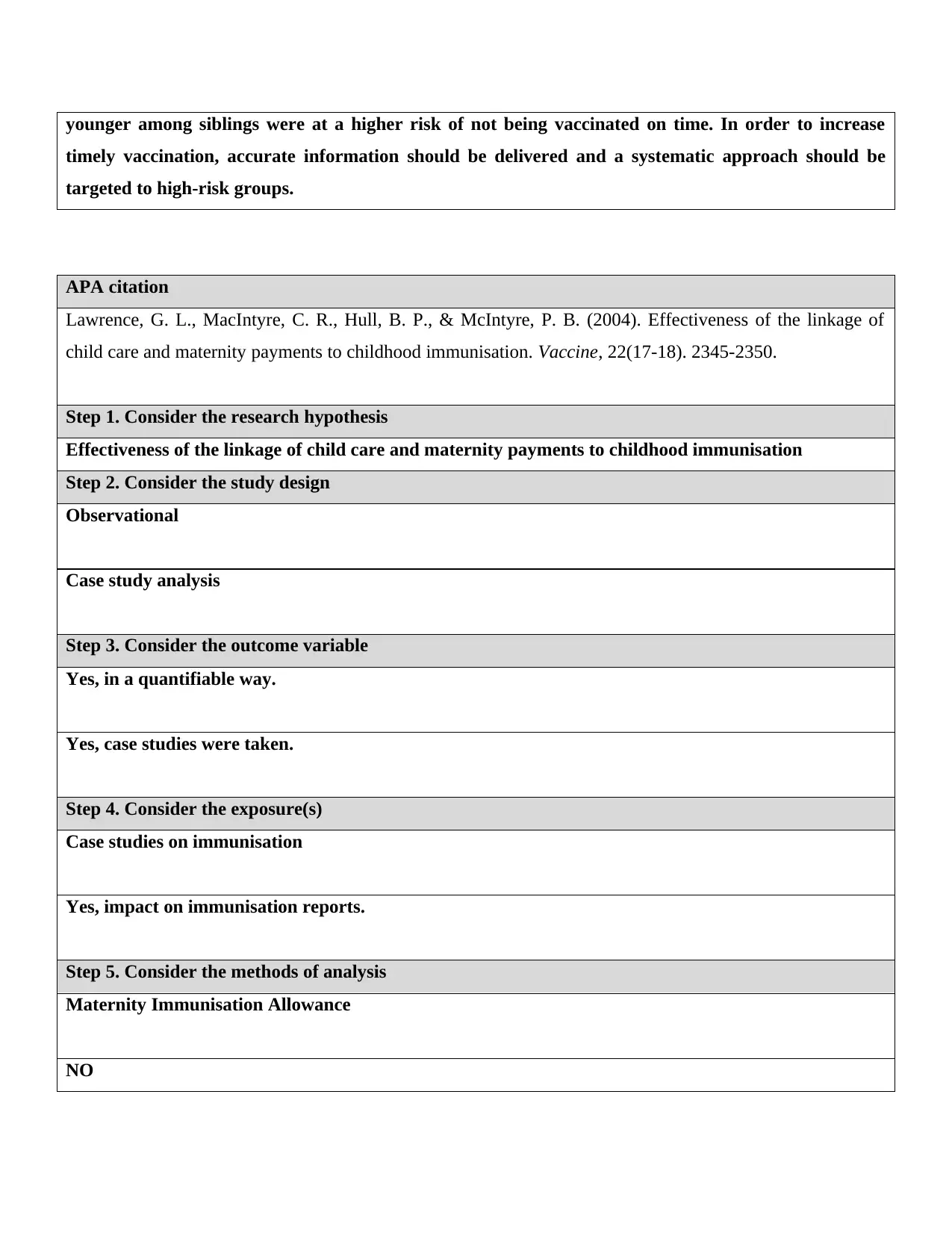
younger among siblings were at a higher risk of not being vaccinated on time. In order to increase
timely vaccination, accurate information should be delivered and a systematic approach should be
targeted to high-risk groups.
APA citation
Lawrence, G. L., MacIntyre, C. R., Hull, B. P., & McIntyre, P. B. (2004). Effectiveness of the linkage of
child care and maternity payments to childhood immunisation. Vaccine, 22(17-18). 2345-2350.
Step 1. Consider the research hypothesis
Effectiveness of the linkage of child care and maternity payments to childhood immunisation
Step 2. Consider the study design
Observational
Case study analysis
Step 3. Consider the outcome variable
Yes, in a quantifiable way.
Yes, case studies were taken.
Step 4. Consider the exposure(s)
Case studies on immunisation
Yes, impact on immunisation reports.
Step 5. Consider the methods of analysis
Maternity Immunisation Allowance
NO
timely vaccination, accurate information should be delivered and a systematic approach should be
targeted to high-risk groups.
APA citation
Lawrence, G. L., MacIntyre, C. R., Hull, B. P., & McIntyre, P. B. (2004). Effectiveness of the linkage of
child care and maternity payments to childhood immunisation. Vaccine, 22(17-18). 2345-2350.
Step 1. Consider the research hypothesis
Effectiveness of the linkage of child care and maternity payments to childhood immunisation
Step 2. Consider the study design
Observational
Case study analysis
Step 3. Consider the outcome variable
Yes, in a quantifiable way.
Yes, case studies were taken.
Step 4. Consider the exposure(s)
Case studies on immunisation
Yes, impact on immunisation reports.
Step 5. Consider the methods of analysis
Maternity Immunisation Allowance
NO
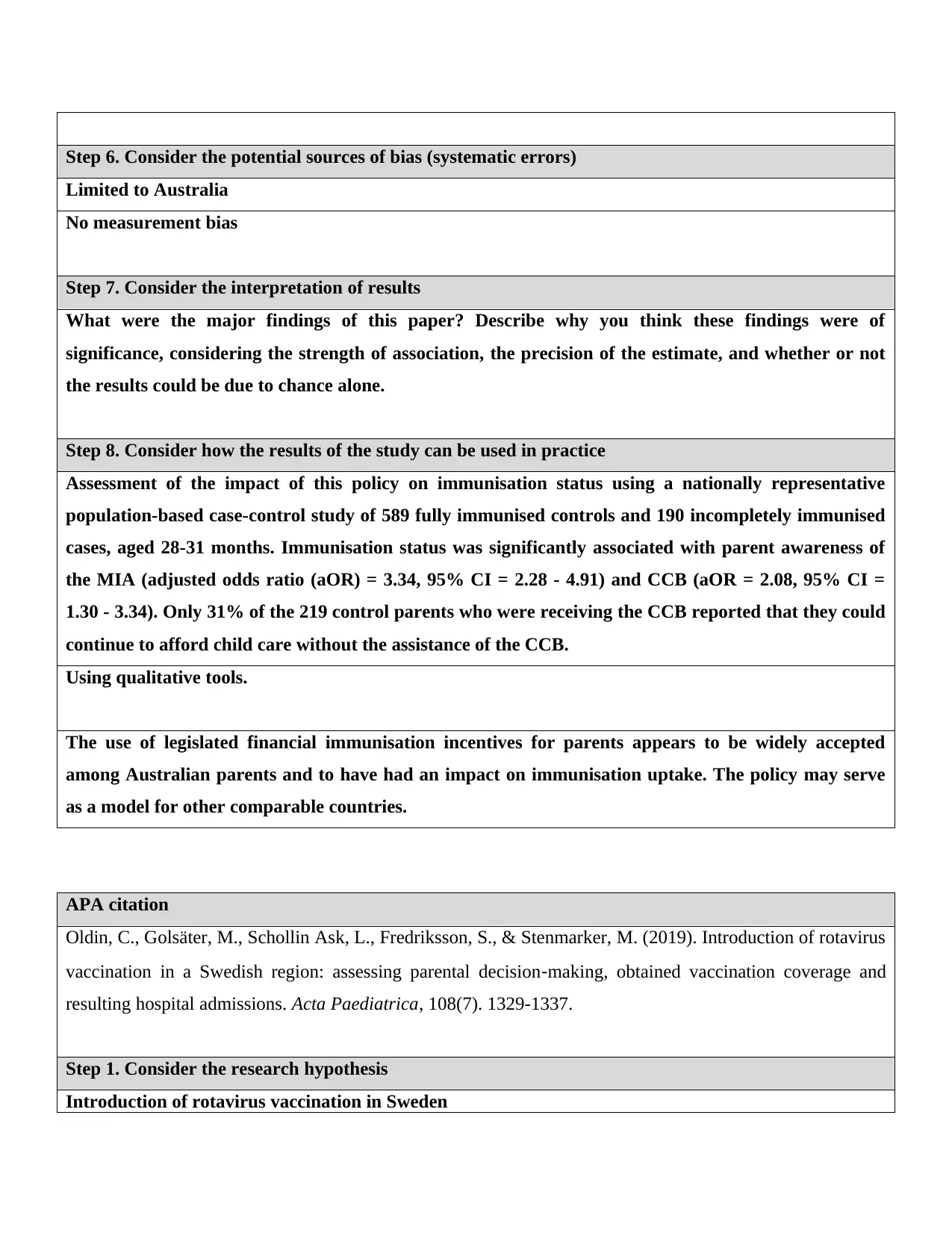
Step 6. Consider the potential sources of bias (systematic errors)
Limited to Australia
No measurement bias
Step 7. Consider the interpretation of results
What were the major findings of this paper? Describe why you think these findings were of
significance, considering the strength of association, the precision of the estimate, and whether or not
the results could be due to chance alone.
Step 8. Consider how the results of the study can be used in practice
Assessment of the impact of this policy on immunisation status using a nationally representative
population-based case-control study of 589 fully immunised controls and 190 incompletely immunised
cases, aged 28-31 months. Immunisation status was significantly associated with parent awareness of
the MIA (adjusted odds ratio (aOR) = 3.34, 95% CI = 2.28 - 4.91) and CCB (aOR = 2.08, 95% CI =
1.30 - 3.34). Only 31% of the 219 control parents who were receiving the CCB reported that they could
continue to afford child care without the assistance of the CCB.
Using qualitative tools.
The use of legislated financial immunisation incentives for parents appears to be widely accepted
among Australian parents and to have had an impact on immunisation uptake. The policy may serve
as a model for other comparable countries.
APA citation
Oldin, C., Golsäter, M., Schollin Ask, L., Fredriksson, S., & Stenmarker, M. (2019). Introduction of rotavirus
vaccination in a Swedish region: assessing parental decision‐making, obtained vaccination coverage and
resulting hospital admissions. Acta Paediatrica, 108(7). 1329-1337.
Step 1. Consider the research hypothesis
Introduction of rotavirus vaccination in Sweden
Limited to Australia
No measurement bias
Step 7. Consider the interpretation of results
What were the major findings of this paper? Describe why you think these findings were of
significance, considering the strength of association, the precision of the estimate, and whether or not
the results could be due to chance alone.
Step 8. Consider how the results of the study can be used in practice
Assessment of the impact of this policy on immunisation status using a nationally representative
population-based case-control study of 589 fully immunised controls and 190 incompletely immunised
cases, aged 28-31 months. Immunisation status was significantly associated with parent awareness of
the MIA (adjusted odds ratio (aOR) = 3.34, 95% CI = 2.28 - 4.91) and CCB (aOR = 2.08, 95% CI =
1.30 - 3.34). Only 31% of the 219 control parents who were receiving the CCB reported that they could
continue to afford child care without the assistance of the CCB.
Using qualitative tools.
The use of legislated financial immunisation incentives for parents appears to be widely accepted
among Australian parents and to have had an impact on immunisation uptake. The policy may serve
as a model for other comparable countries.
APA citation
Oldin, C., Golsäter, M., Schollin Ask, L., Fredriksson, S., & Stenmarker, M. (2019). Introduction of rotavirus
vaccination in a Swedish region: assessing parental decision‐making, obtained vaccination coverage and
resulting hospital admissions. Acta Paediatrica, 108(7). 1329-1337.
Step 1. Consider the research hypothesis
Introduction of rotavirus vaccination in Sweden
⊘ This is a preview!⊘
Do you want full access?
Subscribe today to unlock all pages.
Trusted by 1+ million students worldwide
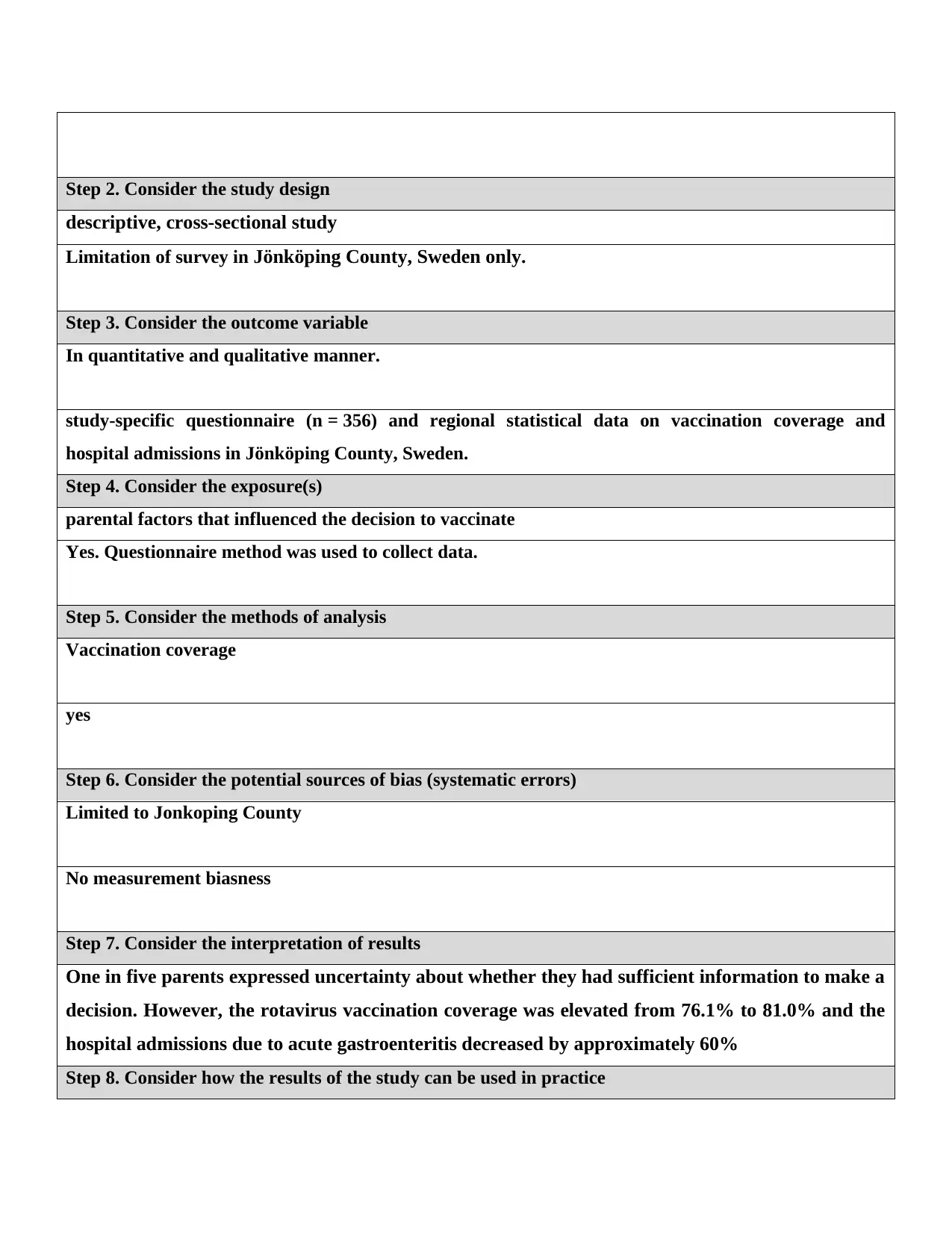
Step 2. Consider the study design
descriptive, cross-sectional study
Limitation of survey in Jönköping County, Sweden only.
Step 3. Consider the outcome variable
In quantitative and qualitative manner.
study-specific questionnaire (n = 356) and regional statistical data on vaccination coverage and
hospital admissions in Jönköping County, Sweden.
Step 4. Consider the exposure(s)
parental factors that influenced the decision to vaccinate
Yes. Questionnaire method was used to collect data.
Step 5. Consider the methods of analysis
Vaccination coverage
yes
Step 6. Consider the potential sources of bias (systematic errors)
Limited to Jonkoping County
No measurement biasness
Step 7. Consider the interpretation of results
One in five parents expressed uncertainty about whether they had sufficient information to make a
decision. However, the rotavirus vaccination coverage was elevated from 76.1% to 81.0% and the
hospital admissions due to acute gastroenteritis decreased by approximately 60%
Step 8. Consider how the results of the study can be used in practice
descriptive, cross-sectional study
Limitation of survey in Jönköping County, Sweden only.
Step 3. Consider the outcome variable
In quantitative and qualitative manner.
study-specific questionnaire (n = 356) and regional statistical data on vaccination coverage and
hospital admissions in Jönköping County, Sweden.
Step 4. Consider the exposure(s)
parental factors that influenced the decision to vaccinate
Yes. Questionnaire method was used to collect data.
Step 5. Consider the methods of analysis
Vaccination coverage
yes
Step 6. Consider the potential sources of bias (systematic errors)
Limited to Jonkoping County
No measurement biasness
Step 7. Consider the interpretation of results
One in five parents expressed uncertainty about whether they had sufficient information to make a
decision. However, the rotavirus vaccination coverage was elevated from 76.1% to 81.0% and the
hospital admissions due to acute gastroenteritis decreased by approximately 60%
Step 8. Consider how the results of the study can be used in practice
Paraphrase This Document
Need a fresh take? Get an instant paraphrase of this document with our AI Paraphraser
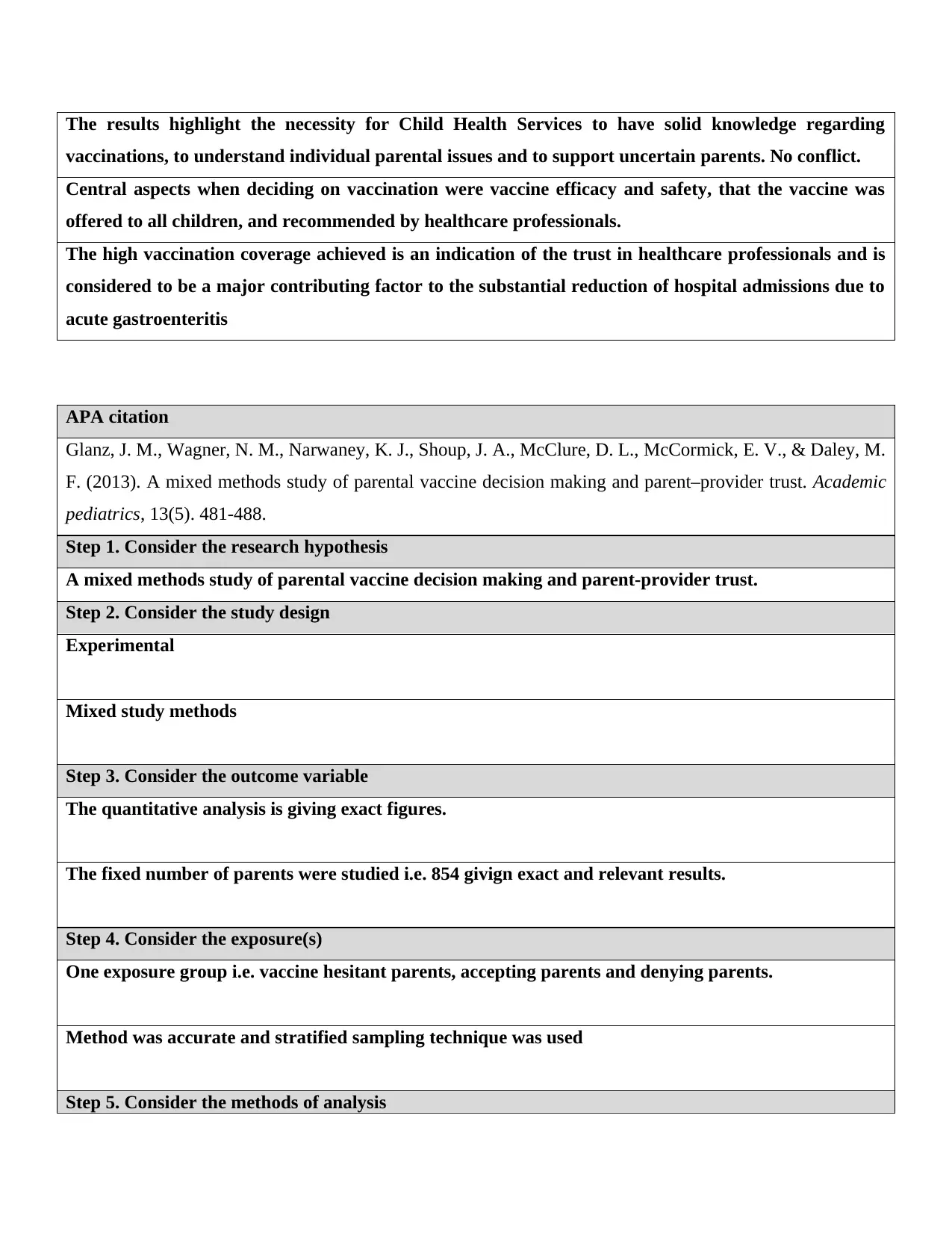
The results highlight the necessity for Child Health Services to have solid knowledge regarding
vaccinations, to understand individual parental issues and to support uncertain parents. No conflict.
Central aspects when deciding on vaccination were vaccine efficacy and safety, that the vaccine was
offered to all children, and recommended by healthcare professionals.
The high vaccination coverage achieved is an indication of the trust in healthcare professionals and is
considered to be a major contributing factor to the substantial reduction of hospital admissions due to
acute gastroenteritis
APA citation
Glanz, J. M., Wagner, N. M., Narwaney, K. J., Shoup, J. A., McClure, D. L., McCormick, E. V., & Daley, M.
F. (2013). A mixed methods study of parental vaccine decision making and parent–provider trust. Academic
pediatrics, 13(5). 481-488.
Step 1. Consider the research hypothesis
A mixed methods study of parental vaccine decision making and parent-provider trust.
Step 2. Consider the study design
Experimental
Mixed study methods
Step 3. Consider the outcome variable
The quantitative analysis is giving exact figures.
The fixed number of parents were studied i.e. 854 givign exact and relevant results.
Step 4. Consider the exposure(s)
One exposure group i.e. vaccine hesitant parents, accepting parents and denying parents.
Method was accurate and stratified sampling technique was used
Step 5. Consider the methods of analysis
vaccinations, to understand individual parental issues and to support uncertain parents. No conflict.
Central aspects when deciding on vaccination were vaccine efficacy and safety, that the vaccine was
offered to all children, and recommended by healthcare professionals.
The high vaccination coverage achieved is an indication of the trust in healthcare professionals and is
considered to be a major contributing factor to the substantial reduction of hospital admissions due to
acute gastroenteritis
APA citation
Glanz, J. M., Wagner, N. M., Narwaney, K. J., Shoup, J. A., McClure, D. L., McCormick, E. V., & Daley, M.
F. (2013). A mixed methods study of parental vaccine decision making and parent–provider trust. Academic
pediatrics, 13(5). 481-488.
Step 1. Consider the research hypothesis
A mixed methods study of parental vaccine decision making and parent-provider trust.
Step 2. Consider the study design
Experimental
Mixed study methods
Step 3. Consider the outcome variable
The quantitative analysis is giving exact figures.
The fixed number of parents were studied i.e. 854 givign exact and relevant results.
Step 4. Consider the exposure(s)
One exposure group i.e. vaccine hesitant parents, accepting parents and denying parents.
Method was accurate and stratified sampling technique was used
Step 5. Consider the methods of analysis
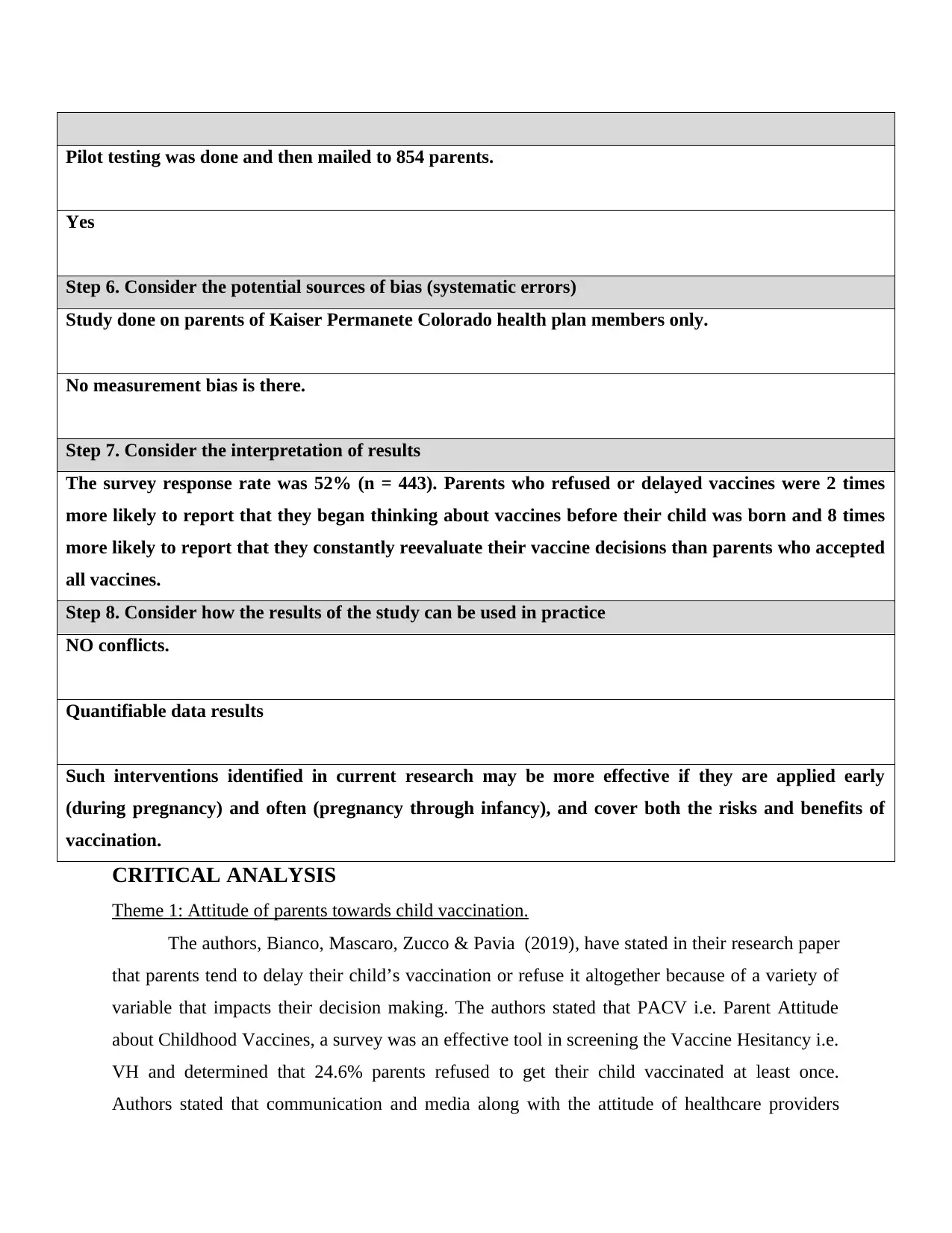
Pilot testing was done and then mailed to 854 parents.
Yes
Step 6. Consider the potential sources of bias (systematic errors)
Study done on parents of Kaiser Permanete Colorado health plan members only.
No measurement bias is there.
Step 7. Consider the interpretation of results
The survey response rate was 52% (n = 443). Parents who refused or delayed vaccines were 2 times
more likely to report that they began thinking about vaccines before their child was born and 8 times
more likely to report that they constantly reevaluate their vaccine decisions than parents who accepted
all vaccines.
Step 8. Consider how the results of the study can be used in practice
NO conflicts.
Quantifiable data results
Such interventions identified in current research may be more effective if they are applied early
(during pregnancy) and often (pregnancy through infancy), and cover both the risks and benefits of
vaccination.
CRITICAL ANALYSIS
Theme 1: Attitude of parents towards child vaccination.
The authors, Bianco, Mascaro, Zucco & Pavia (2019), have stated in their research paper
that parents tend to delay their child’s vaccination or refuse it altogether because of a variety of
variable that impacts their decision making. The authors stated that PACV i.e. Parent Attitude
about Childhood Vaccines, a survey was an effective tool in screening the Vaccine Hesitancy i.e.
VH and determined that 24.6% parents refused to get their child vaccinated at least once.
Authors stated that communication and media along with the attitude of healthcare providers
Yes
Step 6. Consider the potential sources of bias (systematic errors)
Study done on parents of Kaiser Permanete Colorado health plan members only.
No measurement bias is there.
Step 7. Consider the interpretation of results
The survey response rate was 52% (n = 443). Parents who refused or delayed vaccines were 2 times
more likely to report that they began thinking about vaccines before their child was born and 8 times
more likely to report that they constantly reevaluate their vaccine decisions than parents who accepted
all vaccines.
Step 8. Consider how the results of the study can be used in practice
NO conflicts.
Quantifiable data results
Such interventions identified in current research may be more effective if they are applied early
(during pregnancy) and often (pregnancy through infancy), and cover both the risks and benefits of
vaccination.
CRITICAL ANALYSIS
Theme 1: Attitude of parents towards child vaccination.
The authors, Bianco, Mascaro, Zucco & Pavia (2019), have stated in their research paper
that parents tend to delay their child’s vaccination or refuse it altogether because of a variety of
variable that impacts their decision making. The authors stated that PACV i.e. Parent Attitude
about Childhood Vaccines, a survey was an effective tool in screening the Vaccine Hesitancy i.e.
VH and determined that 24.6% parents refused to get their child vaccinated at least once.
Authors stated that communication and media along with the attitude of healthcare providers
⊘ This is a preview!⊘
Do you want full access?
Subscribe today to unlock all pages.
Trusted by 1+ million students worldwide

1 out of 17


Your All-in-One AI-Powered Toolkit for Academic Success.
+13062052269
info@desklib.com
Available 24*7 on WhatsApp / Email
![[object Object]](/_next/static/media/star-bottom.7253800d.svg)
Unlock your academic potential
Copyright © 2020–2026 A2Z Services. All Rights Reserved. Developed and managed by ZUCOL.