ACT507: Coffee Shop Business Plan, Financing, and Accounting Analysis

Verified

Added on  2020/04/07

|11
|2267
|46
Report
AI Summary
This report presents a comprehensive business plan for establishing a coffee shop, 'Chit-Chat Coffee Shop,' in Queensland, Australia. The plan includes an introduction to the coffee industry's growth in Australia, the legal form of the business (sole proprietorship), and the necessary licenses and permits. It details various financing options, such as venture capital and bank loans, along with the required documents for loan applications, including projected income statements and balance sheets. The report also outlines the accounting role in the newly established business, emphasizing its importance in financial resource management, pricing strategies, and financial reporting. Furthermore, it provides insights into the interpretation of financial statements through ratio analysis, horizontal analysis, and vertical analysis. Finally, it discusses management considerations for either retaining or distributing profits, crucial for maximizing firm value, especially for a start-up with a limited number of shareholders. The report incorporates relevant references to support its claims and analyses.

Document Page
ACT507
S2 2017
Assignment 1
1
tabler-icon-diamond-filled.svg

Paraphrase This Document

Need a fresh take? Get an instant paraphrase of this document with our AI Paraphraser
Document Page
Contents
1. Brief Introduction to Business.....................................................................................................3
2. Legal form of Business................................................................................................................3
3: Financing options available to finance the business....................................................................3
4: Documents to be submitted while applying for the bank Loan...................................................4
5. Accounting Role in Newly Established Business........................................................................6
6: Interpretation of the financial statements....................................................................................7
7. Management Considerations for either Retaining or Distributing Profits...................................8
References......................................................................................................................................10
2
Document Page
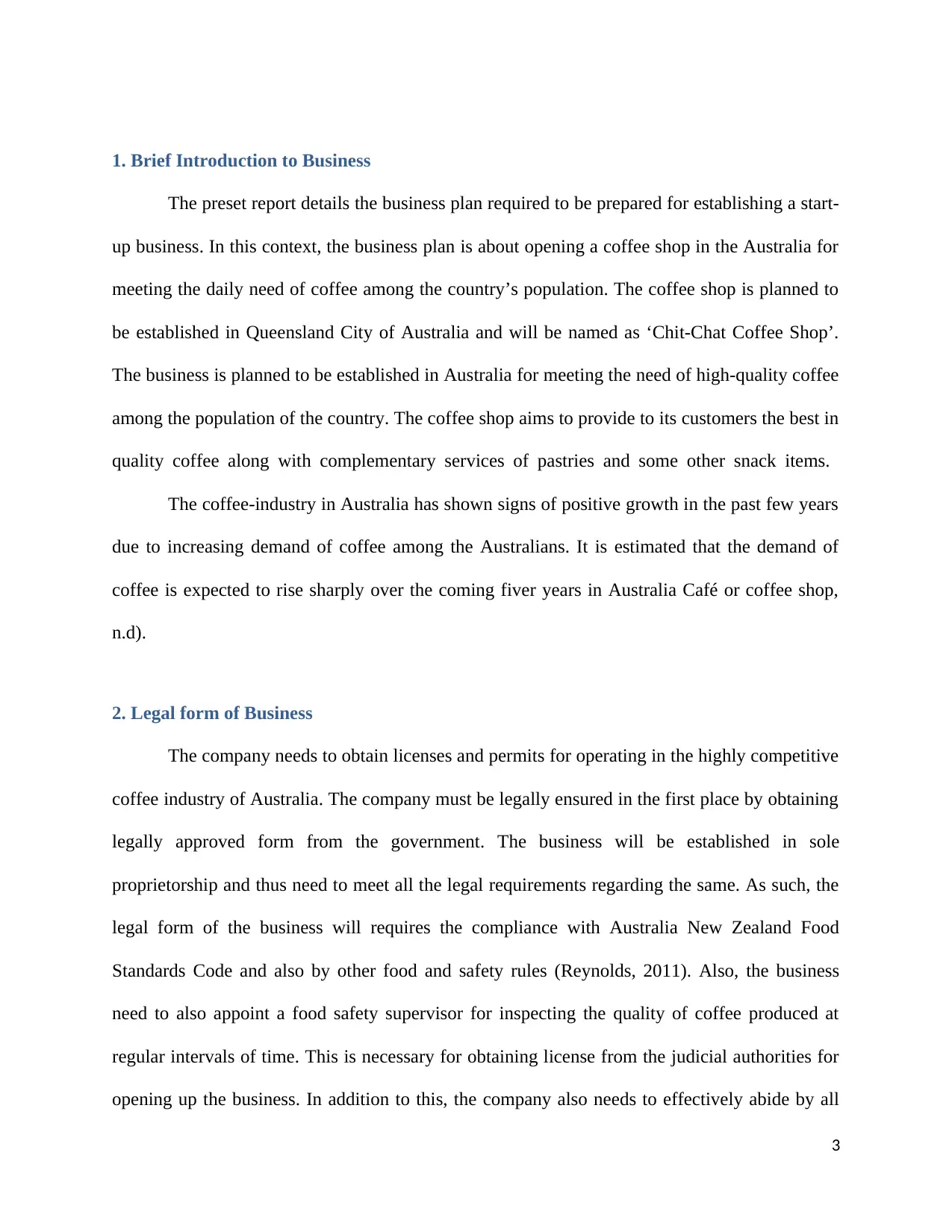
1. Brief Introduction to Business
The preset report details the business plan required to be prepared for establishing a start-
up business. In this context, the business plan is about opening a coffee shop in the Australia for
meeting the daily need of coffee among the country’s population. The coffee shop is planned to
be established in Queensland City of Australia and will be named as ‘Chit-Chat Coffee Shop’.
The business is planned to be established in Australia for meeting the need of high-quality coffee
among the population of the country. The coffee shop aims to provide to its customers the best in
quality coffee along with complementary services of pastries and some other snack items.
The coffee-industry in Australia has shown signs of positive growth in the past few years
due to increasing demand of coffee among the Australians. It is estimated that the demand of
coffee is expected to rise sharply over the coming fiver years in Australia Café or coffee shop,
n.d).
2. Legal form of Business
The company needs to obtain licenses and permits for operating in the highly competitive
coffee industry of Australia. The company must be legally ensured in the first place by obtaining
legally approved form from the government. The business will be established in sole
proprietorship and thus need to meet all the legal requirements regarding the same. As such, the
legal form of the business will requires the compliance with Australia New Zealand Food
Standards Code and also by other food and safety rules (Reynolds, 2011). Also, the business
need to also appoint a food safety supervisor for inspecting the quality of coffee produced at
regular intervals of time. This is necessary for obtaining license from the judicial authorities for
opening up the business. In addition to this, the company also needs to effectively abide by all
3
Document Page
the legal rules and legislations regarding the environment protection so that the operational
activities of the business do not deteriorate the environment in any way (Café or coffee shop,
n.d).
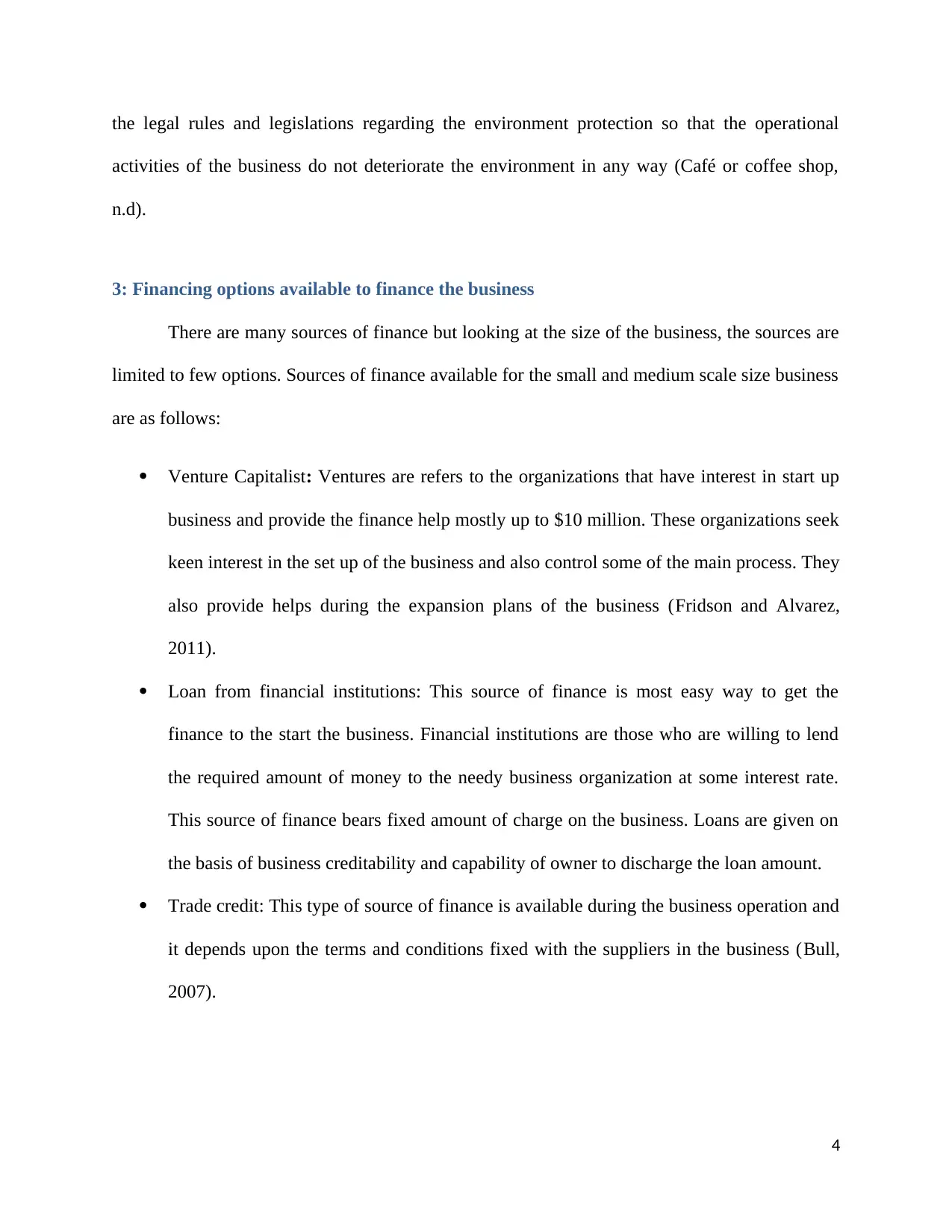
3: Financing options available to finance the business
There are many sources of finance but looking at the size of the business, the sources are
limited to few options. Sources of finance available for the small and medium scale size business
are as follows:
Venture Capitalist: Ventures are refers to the organizations that have interest in start up
business and provide the finance help mostly up to $10 million. These organizations seek
keen interest in the set up of the business and also control some of the main process. They
also provide helps during the expansion plans of the business (Fridson and Alvarez,
2011).
Loan from financial institutions: This source of finance is most easy way to get the
finance to the start the business. Financial institutions are those who are willing to lend
the required amount of money to the needy business organization at some interest rate.
This source of finance bears fixed amount of charge on the business. Loans are given on
the basis of business creditability and capability of owner to discharge the loan amount.
Trade credit: This type of source of finance is available during the business operation and
it depends upon the terms and conditions fixed with the suppliers in the business (Bull,
2007).
4
tabler-icon-diamond-filled.svg

Paraphrase This Document

Need a fresh take? Get an instant paraphrase of this document with our AI Paraphraser
Document Page
4: Documents to be submitted while applying for the bank Loan
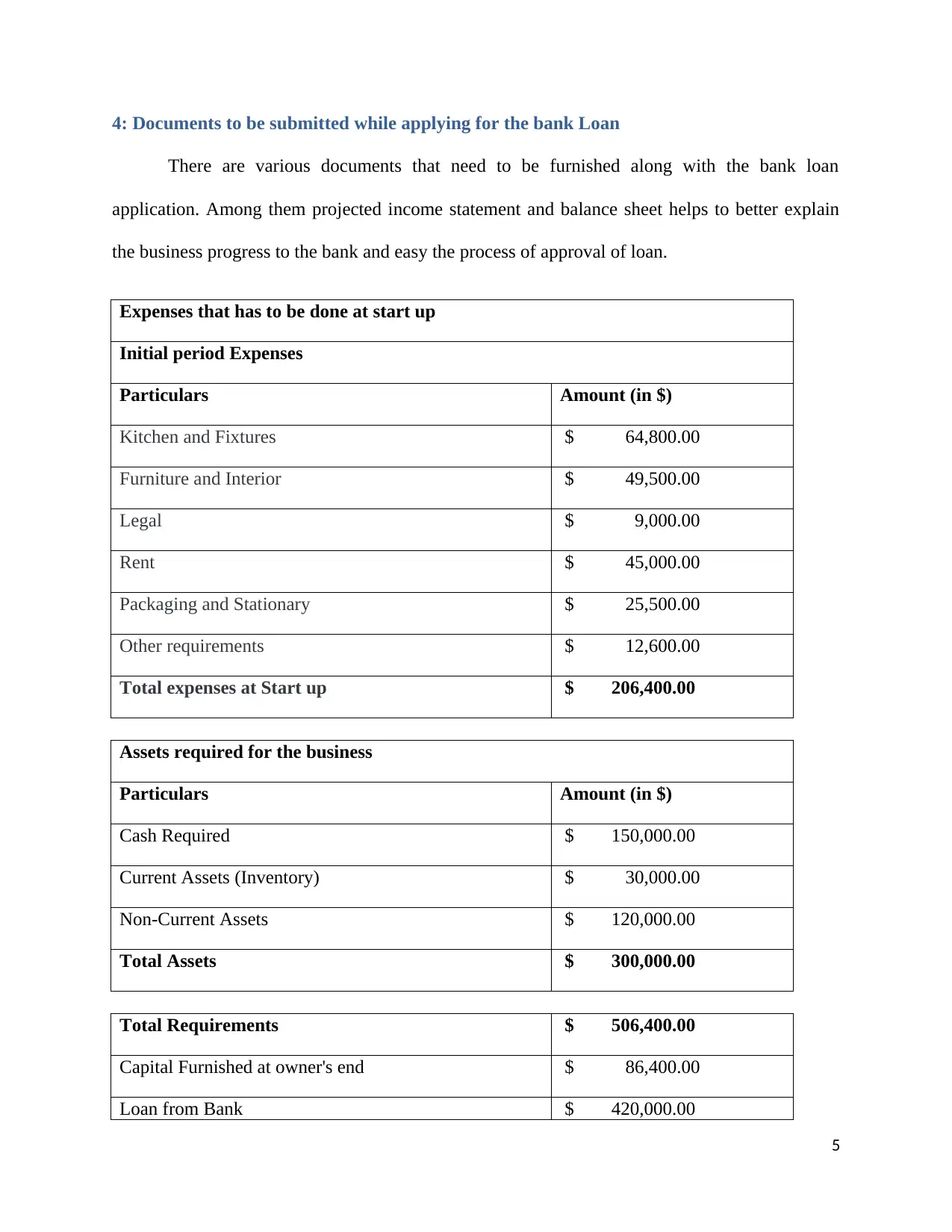
There are various documents that need to be furnished along with the bank loan
application. Among them projected income statement and balance sheet helps to better explain
the business progress to the bank and easy the process of approval of loan.
Expenses that has to be done at start up
Initial period Expenses
Particulars Amount (in $)
Kitchen and Fixtures $ 64,800.00
Furniture and Interior $ 49,500.00
Legal $ 9,000.00
Rent $ 45,000.00
Packaging and Stationary $ 25,500.00
Other requirements $ 12,600.00
Total expenses at Start up $ 206,400.00
Assets required for the business
Particulars Amount (in $)
Cash Required $ 150,000.00
Current Assets (Inventory) $ 30,000.00
Non-Current Assets $ 120,000.00
Total Assets $ 300,000.00
Total Requirements $ 506,400.00
Capital Furnished at owner's end $ 86,400.00
Loan from Bank $ 420,000.00
5
Document Page
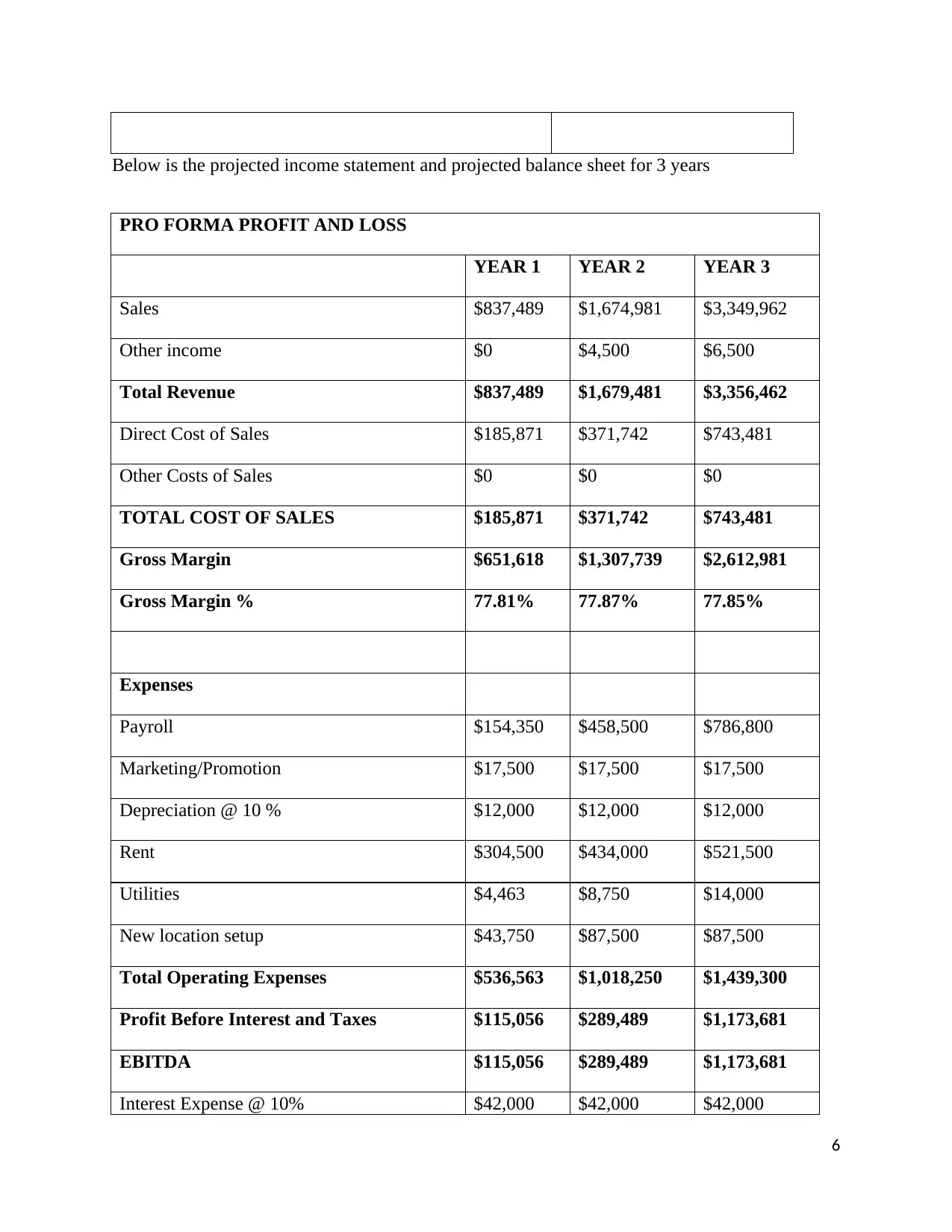
Below is the projected income statement and projected balance sheet for 3 years
PRO FORMA PROFIT AND LOSS
YEAR 1 YEAR 2 YEAR 3
Sales $837,489 $1,674,981 $3,349,962
Other income $0 $4,500 $6,500
Total Revenue $837,489 $1,679,481 $3,356,462
Direct Cost of Sales $185,871 $371,742 $743,481
Other Costs of Sales $0 $0 $0
TOTAL COST OF SALES $185,871 $371,742 $743,481
Gross Margin $651,618 $1,307,739 $2,612,981
Gross Margin % 77.81% 77.87% 77.85%
Expenses
Payroll $154,350 $458,500 $786,800
Marketing/Promotion $17,500 $17,500 $17,500
Depreciation @ 10 % $12,000 $12,000 $12,000
Rent $304,500 $434,000 $521,500
Utilities $4,463 $8,750 $14,000
New location setup $43,750 $87,500 $87,500
Total Operating Expenses $536,563 $1,018,250 $1,439,300
Profit Before Interest and Taxes $115,056 $289,489 $1,173,681
EBITDA $115,056 $289,489 $1,173,681
Interest Expense @ 10% $42,000 $42,000 $42,000
6
Document Page
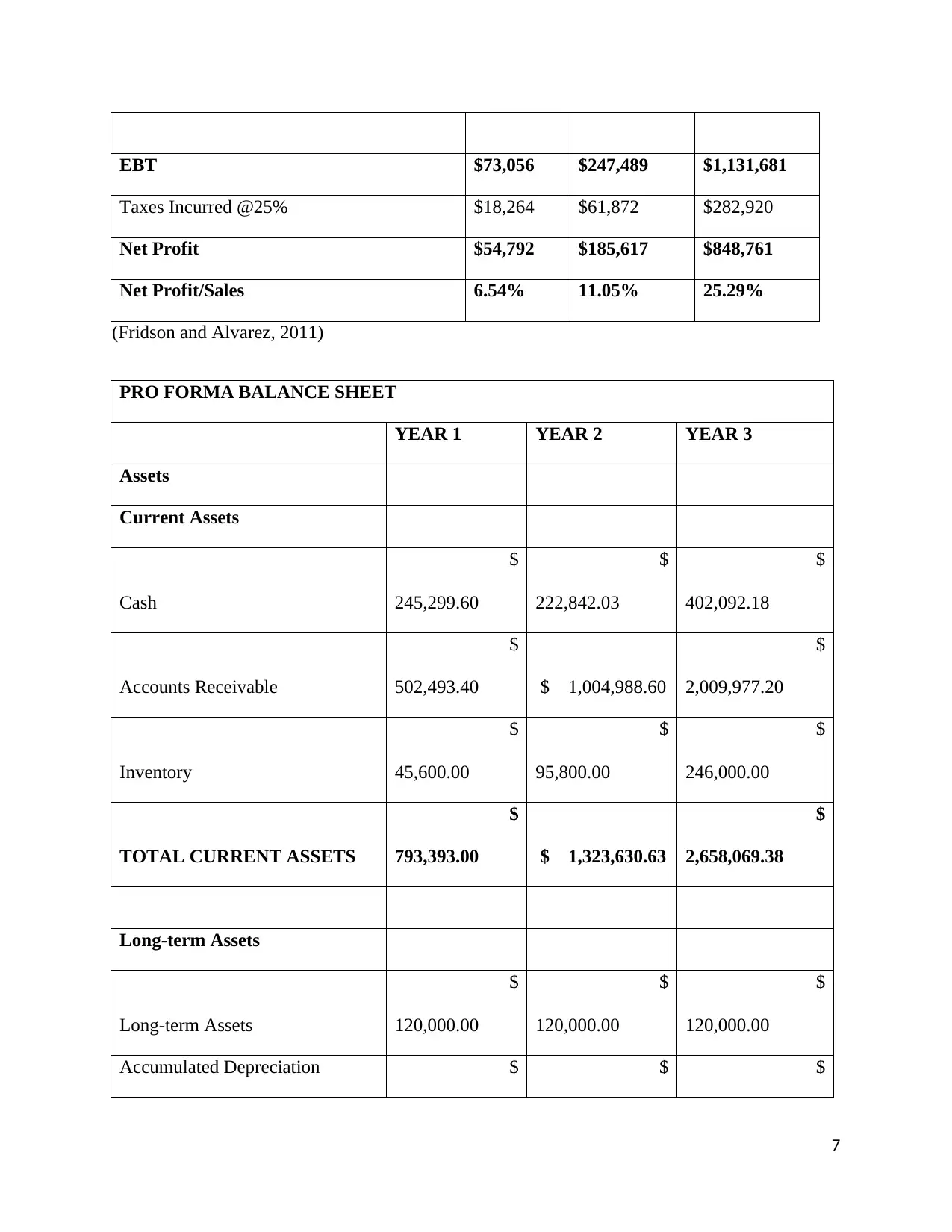
EBT $73,056 $247,489 $1,131,681
Taxes Incurred @25% $18,264 $61,872 $282,920
Net Profit $54,792 $185,617 $848,761
Net Profit/Sales 6.54% 11.05% 25.29%
(Fridson and Alvarez, 2011)
PRO FORMA BALANCE SHEET
YEAR 1 YEAR 2 YEAR 3
Assets
Current Assets
Cash
$
245,299.60
$
222,842.03
$
402,092.18
Accounts Receivable
$
502,493.40 $ 1,004,988.60
$
2,009,977.20
Inventory
$
45,600.00
$
95,800.00
$
246,000.00
TOTAL CURRENT ASSETS
$
793,393.00 $ 1,323,630.63
$
2,658,069.38
Long-term Assets
Long-term Assets
$
120,000.00
$
120,000.00
$
120,000.00
Accumulated Depreciation $ $ $
7
tabler-icon-diamond-filled.svg

Paraphrase This Document

Need a fresh take? Get an instant paraphrase of this document with our AI Paraphraser
Document Page
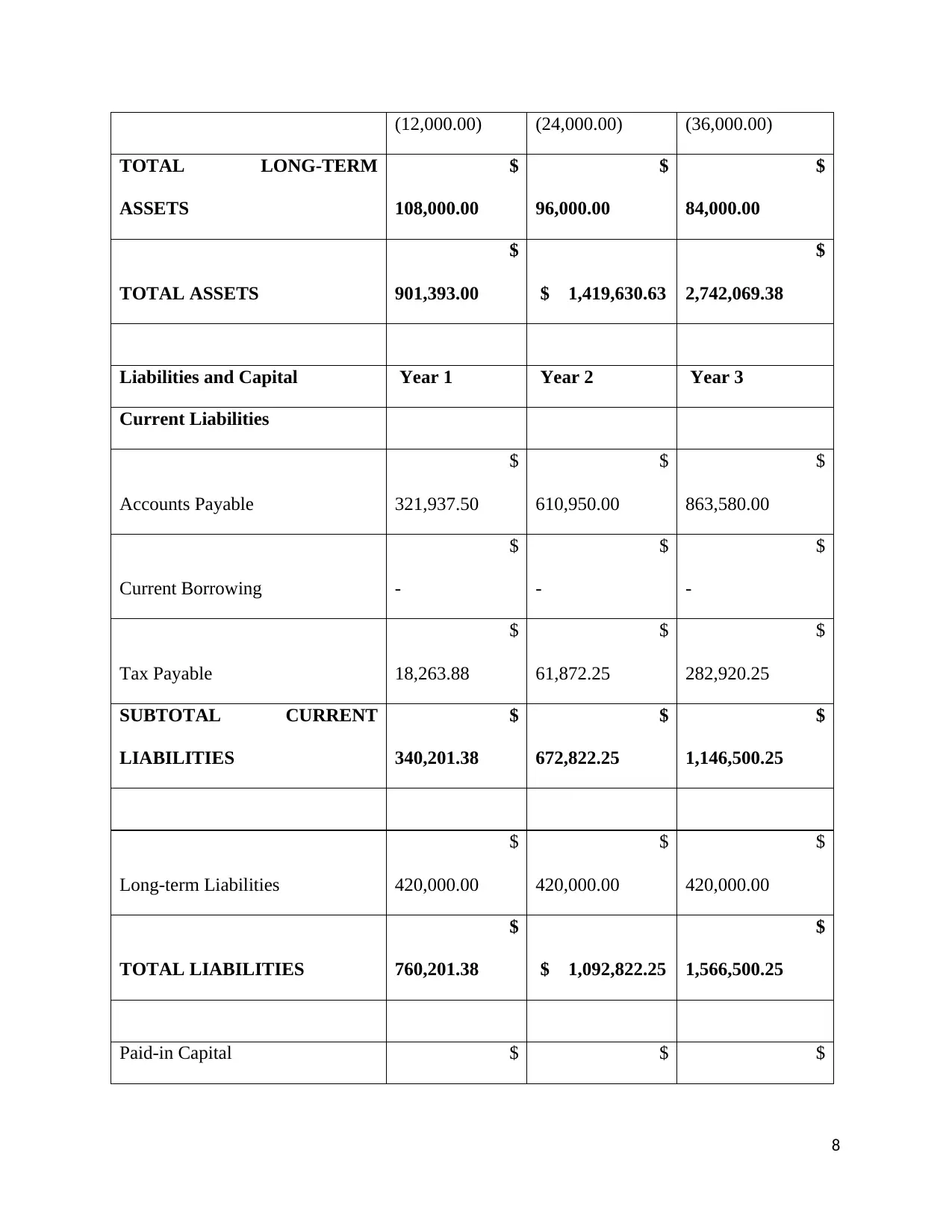
(12,000.00) (24,000.00) (36,000.00)
TOTAL LONG-TERM
ASSETS
$
108,000.00
$
96,000.00
$
84,000.00
TOTAL ASSETS
$
901,393.00 $ 1,419,630.63
$
2,742,069.38
Liabilities and Capital Year 1 Year 2 Year 3
Current Liabilities
Accounts Payable
$
321,937.50
$
610,950.00
$
863,580.00
Current Borrowing
$
-
$
-
$
-
Tax Payable
$
18,263.88
$
61,872.25
$
282,920.25
SUBTOTAL CURRENT
LIABILITIES
$
340,201.38
$
672,822.25
$
1,146,500.25
Long-term Liabilities
$
420,000.00
$
420,000.00
$
420,000.00
TOTAL LIABILITIES
$
760,201.38 $ 1,092,822.25
$
1,566,500.25
Paid-in Capital $ $ $
8
Document Page
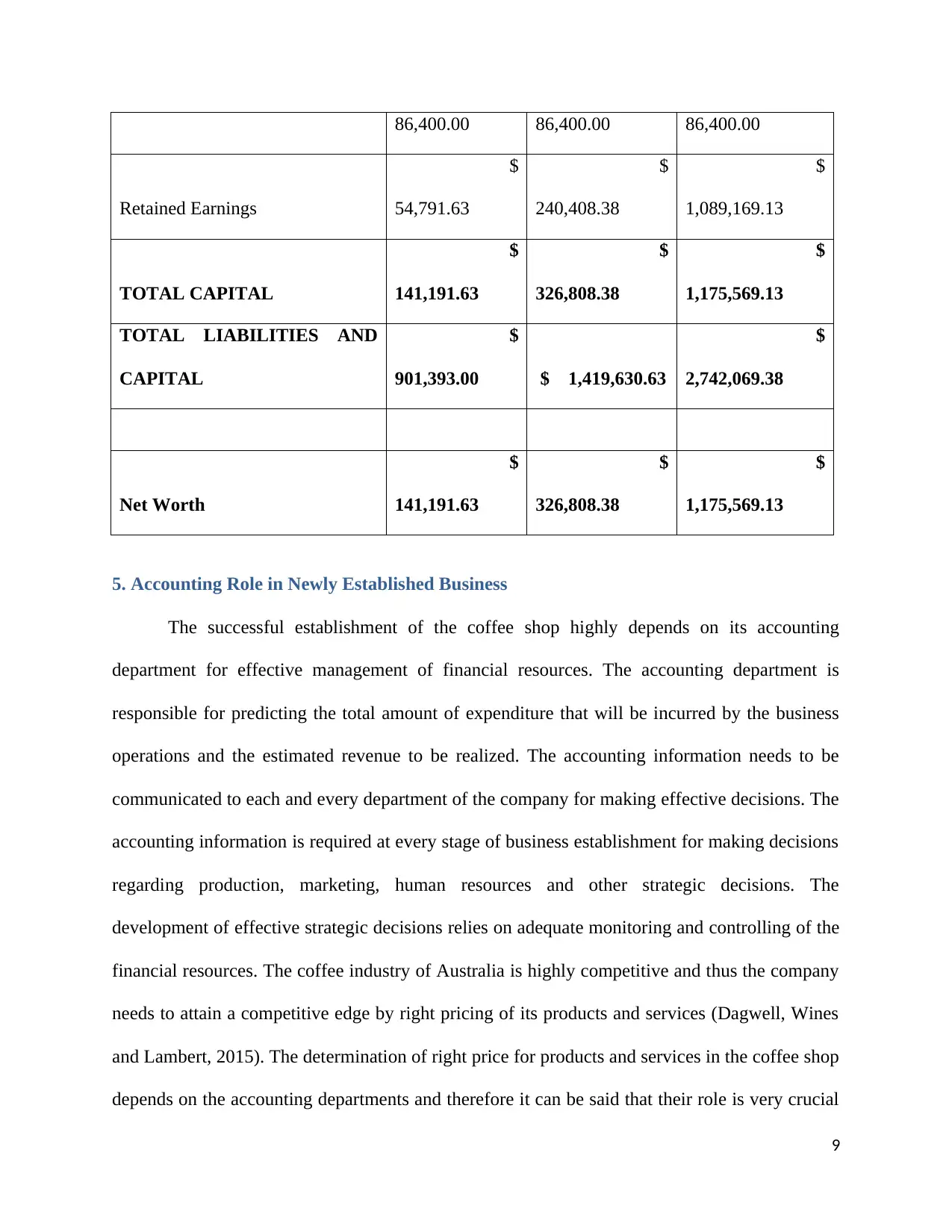
86,400.00 86,400.00 86,400.00
Retained Earnings
$
54,791.63
$
240,408.38
$
1,089,169.13
TOTAL CAPITAL
$
141,191.63
$
326,808.38
$
1,175,569.13
TOTAL LIABILITIES AND
CAPITAL
$
901,393.00 $ 1,419,630.63
$
2,742,069.38
Net Worth
$
141,191.63
$
326,808.38
$
1,175,569.13
5. Accounting Role in Newly Established Business
The successful establishment of the coffee shop highly depends on its accounting
department for effective management of financial resources. The accounting department is
responsible for predicting the total amount of expenditure that will be incurred by the business
operations and the estimated revenue to be realized. The accounting information needs to be
communicated to each and every department of the company for making effective decisions. The
accounting information is required at every stage of business establishment for making decisions
regarding production, marketing, human resources and other strategic decisions. The
development of effective strategic decisions relies on adequate monitoring and controlling of the
financial resources. The coffee industry of Australia is highly competitive and thus the company
needs to attain a competitive edge by right pricing of its products and services (Dagwell, Wines
and Lambert, 2015). The determination of right price for products and services in the coffee shop
depends on the accounting departments and therefore it can be said that their role is very crucial
9
Document Page
for the success of the company. The accounting process of the company will include
bookkeeping, determining the accounting methods for valuing the assets and liabilities,
managing all the financial resources, developing the financial results of the company and
disclosing them publically at the end of each reporting period. The accounting process will help
in developing proper financial plan for achieving the pre-determined business goals and
objectives.
The financial accounting involves the development of financial reports by the company
as pre the standard accounting principles and conventions. The general purpose financial
statements of the company includes balance sheet, income statement and the cash flows
statements that need to be developed by the company as per the financial accounting guidelines.
The development of financial reports is essential for the company to promote goodwill in the
market that will in strengthening of its brand image. In addition to this, the company needs to
adopt the managerial accounting practices for interpreting and analyzing the useful information
relating to income and expenses from the financial reports for making decisions regarding the
long-term growth and development (Press, 2015).
6: Interpretation of the financial statements
Analysis of financial statements provides the profitability performance of the company in
the current year and also compares with the previous years. Liquidity performance can also be
evaluated through use of financial statements analysis (Werner and Stoner, 2010). So it can be
said that analysis of financial statements is very useful to the managers due to its decision
usefulness in various categories of operation such as inventory control and sales volume control
etc. Different types of financial analysis are given as under:
10
tabler-icon-diamond-filled.svg

Paraphrase This Document

Need a fresh take? Get an instant paraphrase of this document with our AI Paraphraser
Document Page
Ratio analysis: In this analysis financial statements are evaluated through use of different
ratios such profitability ratios, liquidity ratio, capital structure ratio, and market
performance ratios. These ratios will provide the detail analysis of performance of the
financial statements in current years and also helps to compare with previous year
(Sagner, 2010).
Horizontal analysis: This analysis is also known as trend analysis as it calculates the
change in value of each item of financial statements corresponding to base year. It means
it provides percentage change in values of income statement and balance in the current
years as compare to previous years (Drake and Fabozzi, 2012).
Vertical Analysis: It is same as horizontal analysis but only difference is that it provides
percentage of each item in financial statements to their corresponding base values in the
same year. The base value of income statement is net revenue and in balance sheet it is
total assets or total of liabilities and capital.
7. Management Considerations for either Retaining or Distributing Profits
The decision regarding the retaining or profit distribution relies solely on the discretion
power of management. The management can decide to retain profit for maximizing the value of
the firms. This needs to be done by forecasting the future cash flows that are expected to be
realized by the business operations if it retains profit. The retained profit can be used as
operating capital in the next accounting cycle for realizing more gains. Thus, on the basis of
forecasted results, if there exists chances of realizing larger profits in the coming accounting
period by retaining profits rather than distribution then it should be retained. As the business is a
start-up, it has minimum number of shareholders and therefore the decision of profit retention is
less likely to impact the shareholder’s wealth. However, the mutual consent of all the
11
chevron_up_icon
1 out of 11
circle_padding
hide_on_mobile
zoom_out_icon
[object Object]