Effectiveness of CBT vs. Usual Care in Elderly Depression: Healthcare
VerifiedAdded on 2022/11/04
|32
|8653
|219
Report
AI Summary
This report presents a literature review investigating the effectiveness of Cognitive Behavioral Therapy (CBT) compared to usual care in treating depression among the elderly (75 years and older) residing in aged care facilities in Australia. The study aims to assess the impact of CBT on reducing depressive symptoms in this population. The methodology involves a systematic search of electronic databases (PubMed, PsychINFO, Web of Science) using relevant keywords and inclusion/exclusion criteria, guided by a PRISMA flow diagram. The findings indicate that CBT is an effective approach, with positive outcomes reported in various studies. The report discusses the background of depression among the elderly, the rationale for the study, gaps in existing knowledge, research questions, methods used, ethical considerations, and the significance of the research. Results from the literature search, quality assessments, and a discussion of the findings are also included. The conclusion highlights the potential of CBT to improve the quality of life for elderly individuals with depression in Australia.
Running head: Healthcare 1
Healthcare
by
Course:
Tutor:
University:
Department:
Date:
Healthcare
by
Course:
Tutor:
University:
Department:
Date:

Paraphrase This Document
Need a fresh take? Get an instant paraphrase of this document with our AI Paraphraser
Healthcare 2
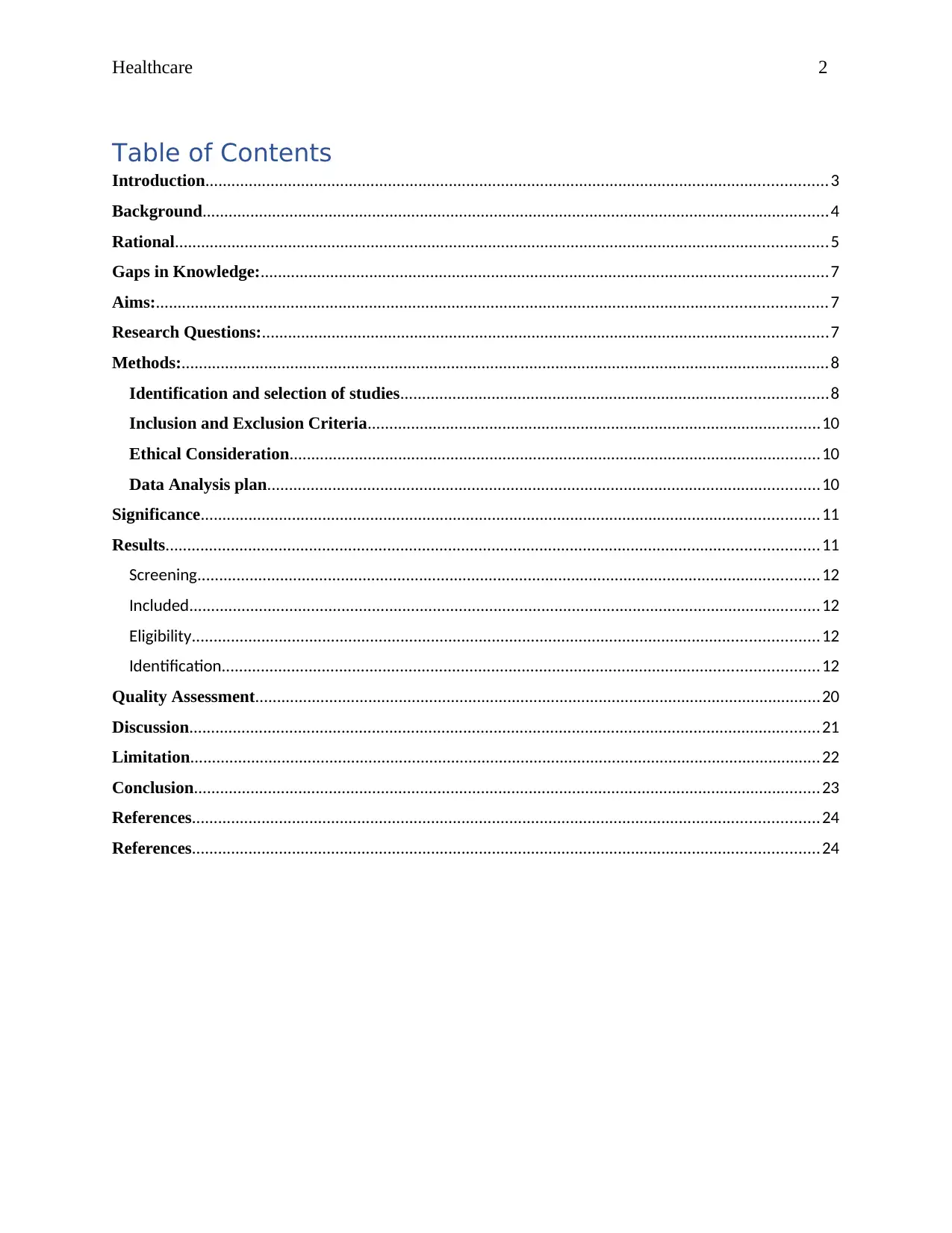
Table of Contents
Introduction...............................................................................................................................................3
Background................................................................................................................................................4
Rational......................................................................................................................................................5
Gaps in Knowledge:..................................................................................................................................7
Aims:..........................................................................................................................................................7
Research Questions:..................................................................................................................................7
Methods:.....................................................................................................................................................8
Identification and selection of studies..................................................................................................8
Inclusion and Exclusion Criteria........................................................................................................10
Ethical Consideration..........................................................................................................................10
Data Analysis plan...............................................................................................................................10
Significance..............................................................................................................................................11
Results......................................................................................................................................................11
Screening...............................................................................................................................................12
Included.................................................................................................................................................12
Eligibility................................................................................................................................................12
Identification.........................................................................................................................................12
Quality Assessment..................................................................................................................................20
Discussion.................................................................................................................................................21
Limitation.................................................................................................................................................22
Conclusion................................................................................................................................................23
References................................................................................................................................................24
References................................................................................................................................................24
Table of Contents
Introduction...............................................................................................................................................3
Background................................................................................................................................................4
Rational......................................................................................................................................................5
Gaps in Knowledge:..................................................................................................................................7
Aims:..........................................................................................................................................................7
Research Questions:..................................................................................................................................7
Methods:.....................................................................................................................................................8
Identification and selection of studies..................................................................................................8
Inclusion and Exclusion Criteria........................................................................................................10
Ethical Consideration..........................................................................................................................10
Data Analysis plan...............................................................................................................................10
Significance..............................................................................................................................................11
Results......................................................................................................................................................11
Screening...............................................................................................................................................12
Included.................................................................................................................................................12
Eligibility................................................................................................................................................12
Identification.........................................................................................................................................12
Quality Assessment..................................................................................................................................20
Discussion.................................................................................................................................................21
Limitation.................................................................................................................................................22
Conclusion................................................................................................................................................23
References................................................................................................................................................24
References................................................................................................................................................24
Healthcare 3
Abstract
Background
Australia is a developed country with an advanced healthcare system but there are still multiple
cases of depression. Australia is characteristic of an ageing population and high number of
residential age care places. Moreover, the elderly is significantly affected by depression (AIHW.,
2013).
Aim
To ascertain the effectiveness of Cognitive Behavioral Therapy compared with usual care in
Depression among the Elderly in Age care aged 75 years and above in Australia.
Methodology
This was a literature review of relevant literature on effectiveness of CBT compared with usual
care in treating depression in elderly aged 75 years and above in Australia. The researcher
conducted a literature search on electronic databases using appropriate key terms and an
inclusion criterion. The extracted data was recorded, analyzed and presented under appropriate
themes. A PRISMA flow diagram was used as a guide in the selection and analysis of articles
Results
90 studies were generated from PubMed, PsychINFO and Web of Science databases and 55
articles were excluded because they were irrelevant articles after analyzing the titles and
abstracts, 15 for having an inappropriate population, and 8 for having an intervention not of
interest. The remaining with 12 which were analysed. There was a consensus across all the
studies that CBT was an effective approach in treating depression. Patients who had undergone
CBT reported positive significant association. Moreover, CBT was culturally adaptable thus
making it to become widely accepted globally. The intervention was found to be much more
effective than the usual methods due to its lack of side effects.
Conclusion
The major outcome of this review is that CBT is effective in treating depression among the
elderly of Australia and of other cultures as well. The increasing population of the elderly in
Abstract
Background
Australia is a developed country with an advanced healthcare system but there are still multiple
cases of depression. Australia is characteristic of an ageing population and high number of
residential age care places. Moreover, the elderly is significantly affected by depression (AIHW.,
2013).
Aim
To ascertain the effectiveness of Cognitive Behavioral Therapy compared with usual care in
Depression among the Elderly in Age care aged 75 years and above in Australia.
Methodology
This was a literature review of relevant literature on effectiveness of CBT compared with usual
care in treating depression in elderly aged 75 years and above in Australia. The researcher
conducted a literature search on electronic databases using appropriate key terms and an
inclusion criterion. The extracted data was recorded, analyzed and presented under appropriate
themes. A PRISMA flow diagram was used as a guide in the selection and analysis of articles
Results
90 studies were generated from PubMed, PsychINFO and Web of Science databases and 55
articles were excluded because they were irrelevant articles after analyzing the titles and
abstracts, 15 for having an inappropriate population, and 8 for having an intervention not of
interest. The remaining with 12 which were analysed. There was a consensus across all the
studies that CBT was an effective approach in treating depression. Patients who had undergone
CBT reported positive significant association. Moreover, CBT was culturally adaptable thus
making it to become widely accepted globally. The intervention was found to be much more
effective than the usual methods due to its lack of side effects.
Conclusion
The major outcome of this review is that CBT is effective in treating depression among the
elderly of Australia and of other cultures as well. The increasing population of the elderly in
⊘ This is a preview!⊘
Do you want full access?
Subscribe today to unlock all pages.

Trusted by 1+ million students worldwide
Healthcare 4
Australia requires an urgent use of CBT to help improve the quality of life and reduce its
prevalence
Australia requires an urgent use of CBT to help improve the quality of life and reduce its
prevalence
Paraphrase This Document
Need a fresh take? Get an instant paraphrase of this document with our AI Paraphraser
Healthcare 5
Effectiveness of cognitive Behavioral Therapy compared with usual care in
the elderly aged 75 years and older with Depression living in the aged care in
Australia.
Introduction
Depression is often a chronic disease that leads to disability especially among the elderly
with over 74% of patients experiencing recurring depression 12 months after detection (World
Health Organization, 2012). The elderly are the most affected group by major depression (MD)
or major depressive disorder (MDD) with an incidence of 7% among the aged and 1.6% cases of
severe disability among those aged sixty years and above (Institute for Health Metrics and
Evaluation, 2010). Studies have shown that untreated depression leads to physical and social
impairment and lastly to morbidity; all which have a socioeconomic burden (Gould, Coulson, &
Howard, 2012). Approximately 1 million depressive people commit suicide each year on a
global scale (WHO, 2012). Estimates of an increasingly ageing population in developed
countries is an indication of a possible increase in the demand for treatments and therapies that
deal with the unique needs of the elderly.
Due to the magnitude of depressive disorder among the elderly, multiple treatment
options exist such as usual care and physiological therapies such as CBT, electroconvulsive
therapy, and behavioral activation among others (Gold et al., 2017). Most of the existing
treatment methods of depression have been examined for their effectiveness. For instance, the
usual care is effective in reducing the suicide rates in most the countries (Rihmer & Gonda,
2011). Over 50% of patients with depressive symptoms have been found to positively respond to
the usual care (Gold et al., 2017). However, some researcher opines that the use of
Effectiveness of cognitive Behavioral Therapy compared with usual care in
the elderly aged 75 years and older with Depression living in the aged care in
Australia.
Introduction
Depression is often a chronic disease that leads to disability especially among the elderly
with over 74% of patients experiencing recurring depression 12 months after detection (World
Health Organization, 2012). The elderly are the most affected group by major depression (MD)
or major depressive disorder (MDD) with an incidence of 7% among the aged and 1.6% cases of
severe disability among those aged sixty years and above (Institute for Health Metrics and
Evaluation, 2010). Studies have shown that untreated depression leads to physical and social
impairment and lastly to morbidity; all which have a socioeconomic burden (Gould, Coulson, &
Howard, 2012). Approximately 1 million depressive people commit suicide each year on a
global scale (WHO, 2012). Estimates of an increasingly ageing population in developed
countries is an indication of a possible increase in the demand for treatments and therapies that
deal with the unique needs of the elderly.
Due to the magnitude of depressive disorder among the elderly, multiple treatment
options exist such as usual care and physiological therapies such as CBT, electroconvulsive
therapy, and behavioral activation among others (Gold et al., 2017). Most of the existing
treatment methods of depression have been examined for their effectiveness. For instance, the
usual care is effective in reducing the suicide rates in most the countries (Rihmer & Gonda,
2011). Over 50% of patients with depressive symptoms have been found to positively respond to
the usual care (Gold et al., 2017). However, some researcher opines that the use of
Healthcare 6
antidepressants in usual care by the elderly leads to cardiovascular side effects thus making them
inappropriate for them (Kennedy, 2013). Psychological therapies such as Cognitive behavioral
therapy are the most effective in alleviating depression symptoms in all ages. Kivi et al. (2014)
examined the effectiveness of CBT and usual care. The study found out that 56% of the patients
who received CBT and completed all the treatment modules had experienced low depressive
symptoms. There are no known adverse effects in the use of CBT as opposed usual care.
Moreover, there is a dearth of information on the effectiveness of CBT in treating depression
among the elderly in the context of Australia. This study purposes to assess the effectiveness of
behavioral therapy compared with usual care in Depression among the Elderly in Age care aged
75 years and above in Australia. A critical review of relevant literature will be carried out using a
Prisma flow diagram and an analysis conducted using a thematic approach and the results
presented.
Background
Australia is a developed country with an advanced healthcare system but there are still
multiple cases of depression. The findings of epidemiological studies suggest an increased rate of
mental disorders among teenagers and older people. Generally, the incidence of mental disorders
decreases significantly with the increase in age, however, this relationship is converse in the case
of elderly people with most older people experiencing acute psychological stress (ABS, 2012).
According to the Australian Institute of Health and Welfare carried out in 2007, Australians aged
25-34 years have the highest levels of mental illnesses (24%) and those aged 75-85 years have a
prevalence of only 6% (AIHW, 2015). According to Courtin and Knapp (2017), about 10-15% if
older Australian who reside in the community exhibit depressive symptoms. Nevertheless, some
studies have indicated that some sub-groups of the elderly population are more vulnerable to
antidepressants in usual care by the elderly leads to cardiovascular side effects thus making them
inappropriate for them (Kennedy, 2013). Psychological therapies such as Cognitive behavioral
therapy are the most effective in alleviating depression symptoms in all ages. Kivi et al. (2014)
examined the effectiveness of CBT and usual care. The study found out that 56% of the patients
who received CBT and completed all the treatment modules had experienced low depressive
symptoms. There are no known adverse effects in the use of CBT as opposed usual care.
Moreover, there is a dearth of information on the effectiveness of CBT in treating depression
among the elderly in the context of Australia. This study purposes to assess the effectiveness of
behavioral therapy compared with usual care in Depression among the Elderly in Age care aged
75 years and above in Australia. A critical review of relevant literature will be carried out using a
Prisma flow diagram and an analysis conducted using a thematic approach and the results
presented.
Background
Australia is a developed country with an advanced healthcare system but there are still
multiple cases of depression. The findings of epidemiological studies suggest an increased rate of
mental disorders among teenagers and older people. Generally, the incidence of mental disorders
decreases significantly with the increase in age, however, this relationship is converse in the case
of elderly people with most older people experiencing acute psychological stress (ABS, 2012).
According to the Australian Institute of Health and Welfare carried out in 2007, Australians aged
25-34 years have the highest levels of mental illnesses (24%) and those aged 75-85 years have a
prevalence of only 6% (AIHW, 2015). According to Courtin and Knapp (2017), about 10-15% if
older Australian who reside in the community exhibit depressive symptoms. Nevertheless, some
studies have indicated that some sub-groups of the elderly population are more vulnerable to
⊘ This is a preview!⊘
Do you want full access?
Subscribe today to unlock all pages.
Trusted by 1+ million students worldwide
Healthcare 7
depression. For instance, by 2012 over 50% of all permanent residents of aged care had mild,
average or severe depressive symptoms (AIHW, 2013).
CBT is believed to be the most effective and appropriate approach in the treatment of
depression among the elderly. Cognitive behavior therapy (CBT) is an objective intervention
founded on the fact that cognitions affect feelings and behaviors, and successive conduct and
feelings can affect cognitions. The practitioner assists patients to ascertain harmful thoughts,
feelings and conduct. There are two features of CBT: cognitive therapy and behavior therapy.
Behavior therapy is premised on the assumption that behavior is learned and thus can be
modified. Some behavioral procedures are contact, activity planning, relaxation, and behavior
change. On the other hand, cognitive therapy is premised on the supposition that worrying
feelings and restrictive conducts are due to wrong ways of thinking. Thus, CBT interventions
such as cognitive restructuring and individual instructional training are focused at substituting
harmful thoughts with much more beneficial thoughts, which are important in dealing with
worrying thoughts, feelings and conduct (Australian Psychological Society, 2010).
Age care is critical because the older folk are physically and mentally worn out and thus
unable to undertake general life duties, thus making them total dependents. This great burden of
care necessitates the need for aged care centres (AIHW., 2013). The increasing number of
residential aged care places is also an indication of the rise in the demand for quality care needs
of older people with depression.
Rational
depression. For instance, by 2012 over 50% of all permanent residents of aged care had mild,
average or severe depressive symptoms (AIHW, 2013).
CBT is believed to be the most effective and appropriate approach in the treatment of
depression among the elderly. Cognitive behavior therapy (CBT) is an objective intervention
founded on the fact that cognitions affect feelings and behaviors, and successive conduct and
feelings can affect cognitions. The practitioner assists patients to ascertain harmful thoughts,
feelings and conduct. There are two features of CBT: cognitive therapy and behavior therapy.
Behavior therapy is premised on the assumption that behavior is learned and thus can be
modified. Some behavioral procedures are contact, activity planning, relaxation, and behavior
change. On the other hand, cognitive therapy is premised on the supposition that worrying
feelings and restrictive conducts are due to wrong ways of thinking. Thus, CBT interventions
such as cognitive restructuring and individual instructional training are focused at substituting
harmful thoughts with much more beneficial thoughts, which are important in dealing with
worrying thoughts, feelings and conduct (Australian Psychological Society, 2010).
Age care is critical because the older folk are physically and mentally worn out and thus
unable to undertake general life duties, thus making them total dependents. This great burden of
care necessitates the need for aged care centres (AIHW., 2013). The increasing number of
residential aged care places is also an indication of the rise in the demand for quality care needs
of older people with depression.
Rational
Paraphrase This Document
Need a fresh take? Get an instant paraphrase of this document with our AI Paraphraser
Healthcare 8
The majority of the Australian population consists of older people. According to AIHW
(2015), 1 out 7 people were aged 65 years and above and are expected to live for an additional 20
years in the case of men and 22 years in the case of women. In other words, 15% of the
Australian population (3.8 million) were aged 65 years and above. This ratio is expected to grow
progressively in the future. The care needs for the elderly with depression are critical and require
special attention, hence the reason for the high number of residential aged care in Australia.
According to AIHW (2012), there were approximately 185,500 residential aged care centres
which are an increase by 2,600 centres in the previous year. Approximately 52% (85,200)
permanent residents reported cases of depression in 2011. The number of aged people increased
from 36% to 50%. The care needs for the elderly with depression varies depending on the level
of severity, environment among other factors. However, most of the elderly people admitted to
these care centres are diagnosed with varying depression levels. For instance, 45% of the patients
admitted to permanent aged care were diagnosed with depression, 13% had average symptoms
and 11% had server depressive symptoms (AIHW, 2013). Depression levels are on the increase
despite the existence of multiple treatment approaches such as the use of antidepressants and
psychological therapies.
The use of antidepressants has been examined and found to be relatively effective in
alleviating depression symptoms among the elderly in aged-care. Kivi et al. (2014) found out that
the use of gomelatine and alprazolam were effective in alleviating acute depression symptoms.
However, the unwillingness of the patients to take drugs in addition to side effects limited the
effectiveness of pharmacotherapy approach. There are no known adverse effects in the use of
CBT as opposed to antidepressants. However, the researcher is not aware of any study on the
effectiveness of CBT in aged care residents in Australia. This study purposes to assess the
The majority of the Australian population consists of older people. According to AIHW
(2015), 1 out 7 people were aged 65 years and above and are expected to live for an additional 20
years in the case of men and 22 years in the case of women. In other words, 15% of the
Australian population (3.8 million) were aged 65 years and above. This ratio is expected to grow
progressively in the future. The care needs for the elderly with depression are critical and require
special attention, hence the reason for the high number of residential aged care in Australia.
According to AIHW (2012), there were approximately 185,500 residential aged care centres
which are an increase by 2,600 centres in the previous year. Approximately 52% (85,200)
permanent residents reported cases of depression in 2011. The number of aged people increased
from 36% to 50%. The care needs for the elderly with depression varies depending on the level
of severity, environment among other factors. However, most of the elderly people admitted to
these care centres are diagnosed with varying depression levels. For instance, 45% of the patients
admitted to permanent aged care were diagnosed with depression, 13% had average symptoms
and 11% had server depressive symptoms (AIHW, 2013). Depression levels are on the increase
despite the existence of multiple treatment approaches such as the use of antidepressants and
psychological therapies.
The use of antidepressants has been examined and found to be relatively effective in
alleviating depression symptoms among the elderly in aged-care. Kivi et al. (2014) found out that
the use of gomelatine and alprazolam were effective in alleviating acute depression symptoms.
However, the unwillingness of the patients to take drugs in addition to side effects limited the
effectiveness of pharmacotherapy approach. There are no known adverse effects in the use of
CBT as opposed to antidepressants. However, the researcher is not aware of any study on the
effectiveness of CBT in aged care residents in Australia. This study purposes to assess the
Healthcare 9
effectiveness of cognitive behavioral therapy and usual care in Depression among the Elderly in
Age care aged 75 years and above in Australia.
Gaps in Knowledge:
Multiple studies have examined the use of alternative methods in the treatment of
depression among the elderly on a global scale. These treatment methods include psychosocial
interventions, antidepressants and somatic treatments. The efficacy of antidepressants as a
treatment method for depression vary depending on the age, and gender. Male patients with
depressive symptoms seem to have a lower rate to multiple antidepressants just like the elderly.
Moreover, antidepressants were found to have significant side effects on the elderly and require a
longer duration to respond positively (Linde et al., 2015).
Psychotherapeutic interventions such as CBT, interpersonal psychotherapy among others are
more effective in alleviating depressive symptoms and with no side effects. CBT is aimed to
identify maladaptive believe systems and improve the outcomes by focusing on behavioural
skills to overcome maladaptive conduct (Avasthi & Grover, 2018). Despite the existence of
literature on the effectiveness of different treatment options for depression, there is minimal
literature that focuses on the effectiveness of CBT in treating depression among the elderly in
Australia. It is this gap that the current review tends to fill.
Aims:
To ascertain the effectiveness of Cognitive Behavioral Therapy in Depression among the
Elderly in Age care aged 75 years and above in Australia.
Research Questions:
Is CBT compared with usual methods effective for treating depression among Elderly in
Age care aged 75 years and above in Australia?
effectiveness of cognitive behavioral therapy and usual care in Depression among the Elderly in
Age care aged 75 years and above in Australia.
Gaps in Knowledge:
Multiple studies have examined the use of alternative methods in the treatment of
depression among the elderly on a global scale. These treatment methods include psychosocial
interventions, antidepressants and somatic treatments. The efficacy of antidepressants as a
treatment method for depression vary depending on the age, and gender. Male patients with
depressive symptoms seem to have a lower rate to multiple antidepressants just like the elderly.
Moreover, antidepressants were found to have significant side effects on the elderly and require a
longer duration to respond positively (Linde et al., 2015).
Psychotherapeutic interventions such as CBT, interpersonal psychotherapy among others are
more effective in alleviating depressive symptoms and with no side effects. CBT is aimed to
identify maladaptive believe systems and improve the outcomes by focusing on behavioural
skills to overcome maladaptive conduct (Avasthi & Grover, 2018). Despite the existence of
literature on the effectiveness of different treatment options for depression, there is minimal
literature that focuses on the effectiveness of CBT in treating depression among the elderly in
Australia. It is this gap that the current review tends to fill.
Aims:
To ascertain the effectiveness of Cognitive Behavioral Therapy in Depression among the
Elderly in Age care aged 75 years and above in Australia.
Research Questions:
Is CBT compared with usual methods effective for treating depression among Elderly in
Age care aged 75 years and above in Australia?
⊘ This is a preview!⊘
Do you want full access?
Subscribe today to unlock all pages.
Trusted by 1+ million students worldwide
Healthcare 10
Methods:
Identification and selection of studies
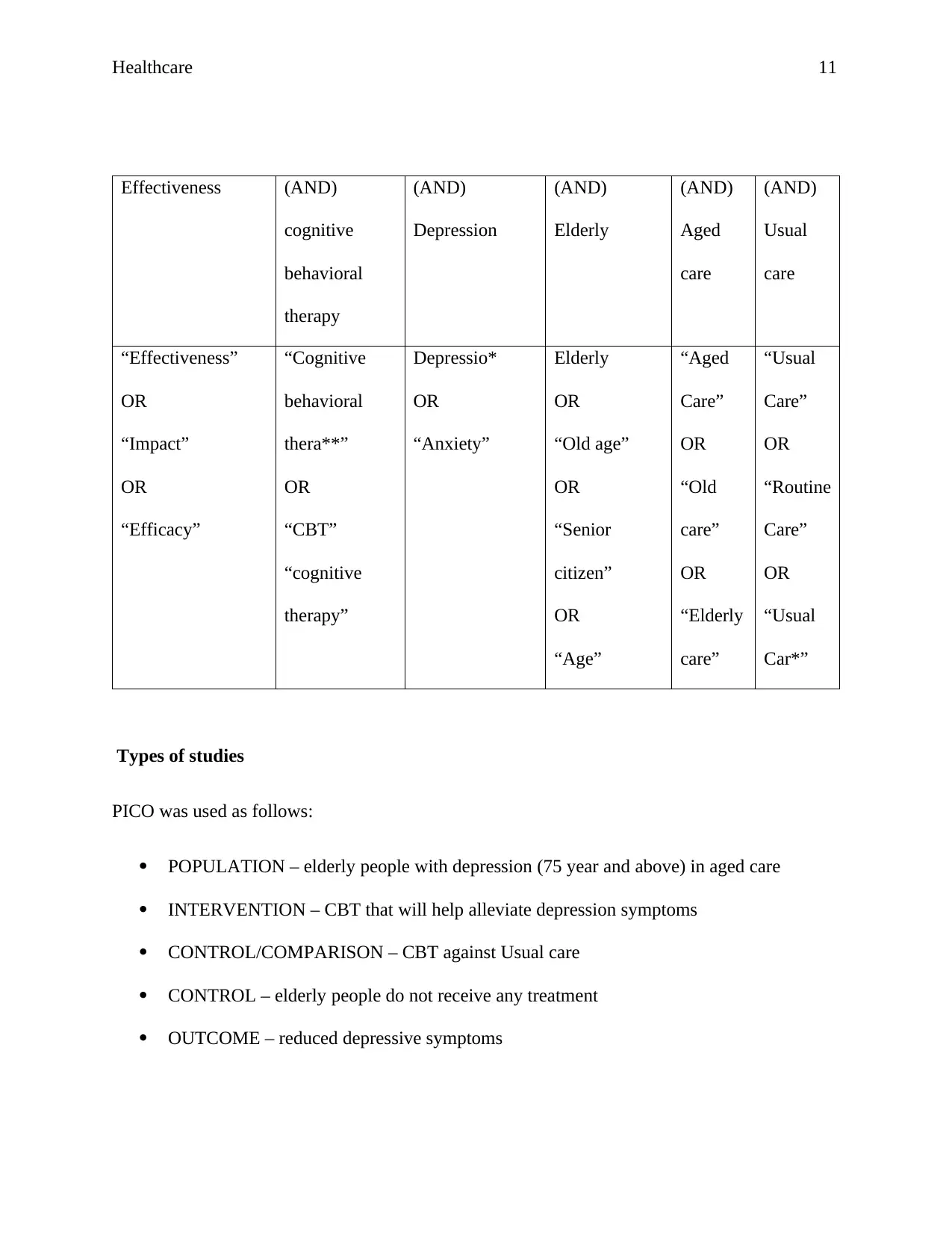
Electronic databases were searched for relevant studies including an evaluation of the
titles, and abstracts. The electronic databases include PubMed, PsychINFO and Web of Science.
The researcher combined the key terms indicative of cognitive-behavioral therapy and Australian
elderly with depressive symptoms. The specific keywords used include cognitive behavioral
therapy, depression, elderly. The search was carried out from July to August 2019. Some other
records were searched manually by checking the reference list of the studies included in the
review.
Methods:
Identification and selection of studies
Electronic databases were searched for relevant studies including an evaluation of the
titles, and abstracts. The electronic databases include PubMed, PsychINFO and Web of Science.
The researcher combined the key terms indicative of cognitive-behavioral therapy and Australian
elderly with depressive symptoms. The specific keywords used include cognitive behavioral
therapy, depression, elderly. The search was carried out from July to August 2019. Some other
records were searched manually by checking the reference list of the studies included in the
review.
Paraphrase This Document
Need a fresh take? Get an instant paraphrase of this document with our AI Paraphraser
Healthcare 11
Effectiveness (AND)
cognitive
behavioral
therapy
(AND)
Depression
(AND)
Elderly
(AND)
Aged
care
(AND)
Usual
care
“Effectiveness”
OR
“Impact”
OR
“Efficacy”
“Cognitive
behavioral
thera**”
OR
“CBT”
“cognitive
therapy”
Depressio*
OR
“Anxiety”
Elderly
OR
“Old age”
OR
“Senior
citizen”
OR
“Age”
“Aged
Care”
OR
“Old
care”
OR
“Elderly
care”
“Usual
Care”
OR
“Routine
Care”
OR
“Usual
Car*”
Types of studies
PICO was used as follows:
POPULATION – elderly people with depression (75 year and above) in aged care
INTERVENTION – CBT that will help alleviate depression symptoms
CONTROL/COMPARISON – CBT against Usual care
CONTROL – elderly people do not receive any treatment
OUTCOME – reduced depressive symptoms
Effectiveness (AND)
cognitive
behavioral
therapy
(AND)
Depression
(AND)
Elderly
(AND)
Aged
care
(AND)
Usual
care
“Effectiveness”
OR
“Impact”
OR
“Efficacy”
“Cognitive
behavioral
thera**”
OR
“CBT”
“cognitive
therapy”
Depressio*
OR
“Anxiety”
Elderly
OR
“Old age”
OR
“Senior
citizen”
OR
“Age”
“Aged
Care”
OR
“Old
care”
OR
“Elderly
care”
“Usual
Care”
OR
“Routine
Care”
OR
“Usual
Car*”
Types of studies
PICO was used as follows:
POPULATION – elderly people with depression (75 year and above) in aged care
INTERVENTION – CBT that will help alleviate depression symptoms
CONTROL/COMPARISON – CBT against Usual care
CONTROL – elderly people do not receive any treatment
OUTCOME – reduced depressive symptoms
Healthcare 12
Inclusion and Exclusion Criteria
The studies were viable for analysis if they were published within the last ten years,
examined the effectiveness of CBT, used a sample of Australian elders, included depression and
any other control condition.
Ethical Consideration
The study was submitted for review to the University’s ethical review committee. Since
the study did not directly deal with human subjects, it was exempted for detailed review. The
researcher did not have any conflict of interest to reveal for this study.
Data Analysis plan
The researcher extracted data from the studies included for analysis and was recorded and
ordered using Excel spreadsheets. The extracted data included a description of CBT, the mean
and sample size, the research design, the overall findings of the study. Both numerical and
thematic analysis was carried out to completion using the extracted data. Under the numerical
analysis, the number of studies searched and recorded were identified, the year of publication,
and the general nature of the study. The obtained data was used during thematic analysis to
ascertain the overall evidence of the effectiveness of CBT and to ascertain any knowledge gaps
based on the evidence. The studies were identified using unique numbers both in the numerical
and thematic analysis.
Inclusion and Exclusion Criteria
The studies were viable for analysis if they were published within the last ten years,
examined the effectiveness of CBT, used a sample of Australian elders, included depression and
any other control condition.
Ethical Consideration
The study was submitted for review to the University’s ethical review committee. Since
the study did not directly deal with human subjects, it was exempted for detailed review. The
researcher did not have any conflict of interest to reveal for this study.
Data Analysis plan
The researcher extracted data from the studies included for analysis and was recorded and
ordered using Excel spreadsheets. The extracted data included a description of CBT, the mean
and sample size, the research design, the overall findings of the study. Both numerical and
thematic analysis was carried out to completion using the extracted data. Under the numerical
analysis, the number of studies searched and recorded were identified, the year of publication,
and the general nature of the study. The obtained data was used during thematic analysis to
ascertain the overall evidence of the effectiveness of CBT and to ascertain any knowledge gaps
based on the evidence. The studies were identified using unique numbers both in the numerical
and thematic analysis.
⊘ This is a preview!⊘
Do you want full access?
Subscribe today to unlock all pages.
Trusted by 1+ million students worldwide

1 out of 32


Related Documents


Your All-in-One AI-Powered Toolkit for Academic Success.
+13062052269
info@desklib.com
Available 24*7 on WhatsApp / Email
![[object Object]](/_next/static/media/star-bottom.7253800d.svg)
Unlock your academic potential
Copyright © 2020–2026 A2Z Services. All Rights Reserved. Developed and managed by ZUCOL.