Decision and Risk Analysis: Cognitive and Motivational Biases Report
VerifiedAdded on 2022/10/15
|13
|2633
|351
Report
AI Summary
This report delves into the realm of cognitive and motivational biases, specifically their impact on decision-making and risk analysis within a project management context. It identifies various biases, such as anchoring, overconfidence, and others, explaining how they can skew analysis outcomes and hinder rational judgment. The report differentiates between biases that are difficult to correct and those that can be addressed through logical decomposition and de-biasing techniques. It provides guidance on how to mitigate these biases, offering practical strategies to enhance the accuracy and reliability of risk assessments and decision-making processes. Furthermore, it highlights biases that are less critical, as they can be corrected using logic or decomposing the elicitation. The report emphasizes the importance of recognizing and addressing these biases to improve the quality of decisions and ensure project success.
Running head : COGNITIVE AND MOTIVATIONAL BIASES IN DECISION AND RISK
ANALYSIS
Title : Cognitive and Motivational biases in decision and risk analysis
Name Of the student :
Name of the college:
Author Note
ANALYSIS
Title : Cognitive and Motivational biases in decision and risk analysis
Name Of the student :
Name of the college:
Author Note

Paraphrase This Document
Need a fresh take? Get an instant paraphrase of this document with our AI Paraphraser
1
COGNITIVE AND MOTIVATIONAL BIASES IN DECISION AND RISK ANALYSIS
Table of Contents
Introduction................................................................................................................................3
Discussion..................................................................................................................................3
Cognitive and motivational biases that are relevant for decision and risk analysis from a
project management perspective............................................................................................3
Guidance about de – biasing techniques and ways to overcome it............................................5
Biases that are less relevant because they can be corrected by using logic or decomposing the
elicitation....................................................................................................................................8
Conclusion................................................................................................................................11
References................................................................................................................................12
COGNITIVE AND MOTIVATIONAL BIASES IN DECISION AND RISK ANALYSIS
Table of Contents
Introduction................................................................................................................................3
Discussion..................................................................................................................................3
Cognitive and motivational biases that are relevant for decision and risk analysis from a
project management perspective............................................................................................3
Guidance about de – biasing techniques and ways to overcome it............................................5
Biases that are less relevant because they can be corrected by using logic or decomposing the
elicitation....................................................................................................................................8
Conclusion................................................................................................................................11
References................................................................................................................................12
2
COGNITIVE AND MOTIVATIONAL BIASES IN DECISION AND RISK ANALYSIS
Introduction
In the report the focus is on the prejudice that are applicable for risk analysis and
decision as they can manipulate the conclusion of an analysis to a great extent and are not
easy to rectify. Instances are the boldness prejudice while obtaining possibility
disseminations by the specialist in risk examination. When decision takers puts weights to
objectives in multicriteria decision analysis all prejudice becomes of same weight. On the
other side here are predispositions which are less important as these can be easily rectified in
the common responsibilities of obtaining inputs aimed at risk analysis in addition decision
making process. Instances are the ignoble rates neglect bias, which can be avoided by
obtaining base rate distinctly from probabilities, and the non regressiveness prejudice, that
can be evaded by obtaining measures, correlations and standard deviation in place of
provisional estimations. Meyer and Booker deliver an initial nomenclature of favoritisms that
contained intellectual and group burden prejudices. Von Winterfield pointed out many
intellectual favoritisms when explaining the impact of interactive research for pronouncement
analysis. Biases in multi attribute weight assessment is explained by Weber and Borcherding.
Inferences of prejudices for multicriteria pronouncement investigation modelling is explained
by Morton and Fasolo.
COGNITIVE AND MOTIVATIONAL BIASES IN DECISION AND RISK ANALYSIS
Introduction
In the report the focus is on the prejudice that are applicable for risk analysis and
decision as they can manipulate the conclusion of an analysis to a great extent and are not
easy to rectify. Instances are the boldness prejudice while obtaining possibility
disseminations by the specialist in risk examination. When decision takers puts weights to
objectives in multicriteria decision analysis all prejudice becomes of same weight. On the
other side here are predispositions which are less important as these can be easily rectified in
the common responsibilities of obtaining inputs aimed at risk analysis in addition decision
making process. Instances are the ignoble rates neglect bias, which can be avoided by
obtaining base rate distinctly from probabilities, and the non regressiveness prejudice, that
can be evaded by obtaining measures, correlations and standard deviation in place of
provisional estimations. Meyer and Booker deliver an initial nomenclature of favoritisms that
contained intellectual and group burden prejudices. Von Winterfield pointed out many
intellectual favoritisms when explaining the impact of interactive research for pronouncement
analysis. Biases in multi attribute weight assessment is explained by Weber and Borcherding.
Inferences of prejudices for multicriteria pronouncement investigation modelling is explained
by Morton and Fasolo.
⊘ This is a preview!⊘
Do you want full access?
Subscribe today to unlock all pages.

Trusted by 1+ million students worldwide
3
COGNITIVE AND MOTIVATIONAL BIASES IN DECISION AND RISK ANALYSIS
Discussion
Intellectual and motivational prejudices that are applicable for decision and risk
analysis from a project management perspective.
A cognitive bias is a methodical design of alteration from the rules and sensibility in
the ability to take considered decision or to come to sensible conclusion. Human beings
formulate their own subjective reality from their own regard and interpretation of the input
(Montibeller and Von Winterfeldt 2015). Researchers of behavioral decisions have
pinpointed many number of biases in the ability of the human to take decisions. Every human
being shows fluctuations from the normal rules of utility theory or probability. All the
behavioral research talks about cognitive biases. It deals with incorrect mental processes that
result in decision and judgment to breach generally acknowledged normative ideologies.
Motivational biases comprise sentient or intuitive manipulation of decisions and judgments
due to organizational context, social pressures and self – interest. Risk analysts and decision
makers use all these present favoritisms to reason aimed at the practice of demonstrating and
investigation apparatuses as these process can rectify human prejudice and mistakes in taking
pronouncement. But judgment in decision and risk modelling needs to be done by experts and
decision makers so that they worry about the biases that manipulate what to be taken into that
models that are intended to rectify them. For example, in a risk analysis model, when a
probability distribution is put as a input one needs to remember the overconfidence bias.
When determining probable effects of decision alternatives, individuals need to be worried
through the self – interest of the specialists, who might take interest in the consequence of the
investigation. A methodical variation among the fixed accurate response in a condemnatory
task, which is agreed by a proper normative regulation and the actual answer of the expert in
that task is called cognitive prejudice. Motivational prejudices are such issues in which
decisions are prejudiced by the attractiveness or non desire of significances, choices,
COGNITIVE AND MOTIVATIONAL BIASES IN DECISION AND RISK ANALYSIS
Discussion
Intellectual and motivational prejudices that are applicable for decision and risk
analysis from a project management perspective.
A cognitive bias is a methodical design of alteration from the rules and sensibility in
the ability to take considered decision or to come to sensible conclusion. Human beings
formulate their own subjective reality from their own regard and interpretation of the input
(Montibeller and Von Winterfeldt 2015). Researchers of behavioral decisions have
pinpointed many number of biases in the ability of the human to take decisions. Every human
being shows fluctuations from the normal rules of utility theory or probability. All the
behavioral research talks about cognitive biases. It deals with incorrect mental processes that
result in decision and judgment to breach generally acknowledged normative ideologies.
Motivational biases comprise sentient or intuitive manipulation of decisions and judgments
due to organizational context, social pressures and self – interest. Risk analysts and decision
makers use all these present favoritisms to reason aimed at the practice of demonstrating and
investigation apparatuses as these process can rectify human prejudice and mistakes in taking
pronouncement. But judgment in decision and risk modelling needs to be done by experts and
decision makers so that they worry about the biases that manipulate what to be taken into that
models that are intended to rectify them. For example, in a risk analysis model, when a
probability distribution is put as a input one needs to remember the overconfidence bias.
When determining probable effects of decision alternatives, individuals need to be worried
through the self – interest of the specialists, who might take interest in the consequence of the
investigation. A methodical variation among the fixed accurate response in a condemnatory
task, which is agreed by a proper normative regulation and the actual answer of the expert in
that task is called cognitive prejudice. Motivational prejudices are such issues in which
decisions are prejudiced by the attractiveness or non desire of significances, choices,
Paraphrase This Document
Need a fresh take? Get an instant paraphrase of this document with our AI Paraphraser
4
COGNITIVE AND MOTIVATIONAL BIASES IN DECISION AND RISK ANALYSIS
consequences and events. Less estimation of the expenses of a scheme to deliver additional
inexpensive offers and intentional endeavor of specialists to give positive predictions for a
favored outcome are examples of motivational prejudice. Motivational biases can be
unconscious (Van Buiten and Hartmann 2013). For example, when there is no outside
pressure, approximate time it consumes to finish a software project is frequently positive.
Guidance about de – biasing techniques and ways to overcome it.
Debiasing means the attempts to irradiate, or lessen, motivational and cognitive
prejudice. The nomenclature recommended by Arkes is handy for bearing in mind prejudice
and de – biasing methods. It categorize prejudice by their emotional origin. Strategy – based
(SB) mistakes happen when decision makers use a reasonable plan which is less than the
highest standard. Association – based (AB) mistakes be situated a result of instinctive
intellectual connotations. Wrong mapping between corporal incentives and psychological
replies leads to psychophysically – based (PB) errors. Using logical representations is an
actual way of correcting mistakes connected to SB type. Therefore, when SB sort mistakes
happen in pronouncement and risk examination that may be effortlessly modified. AB and SB
type of mistakes is problematic to correct.
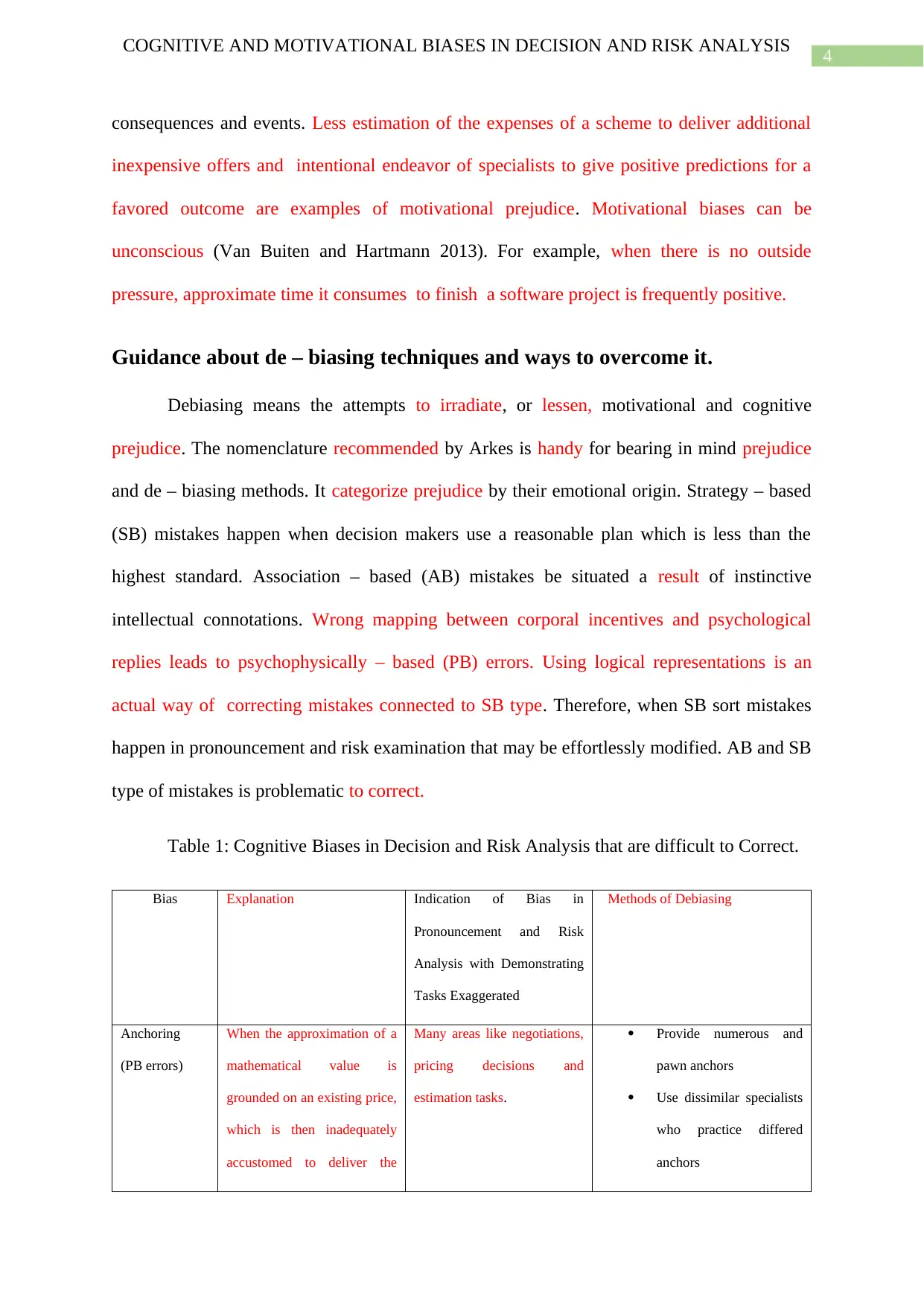
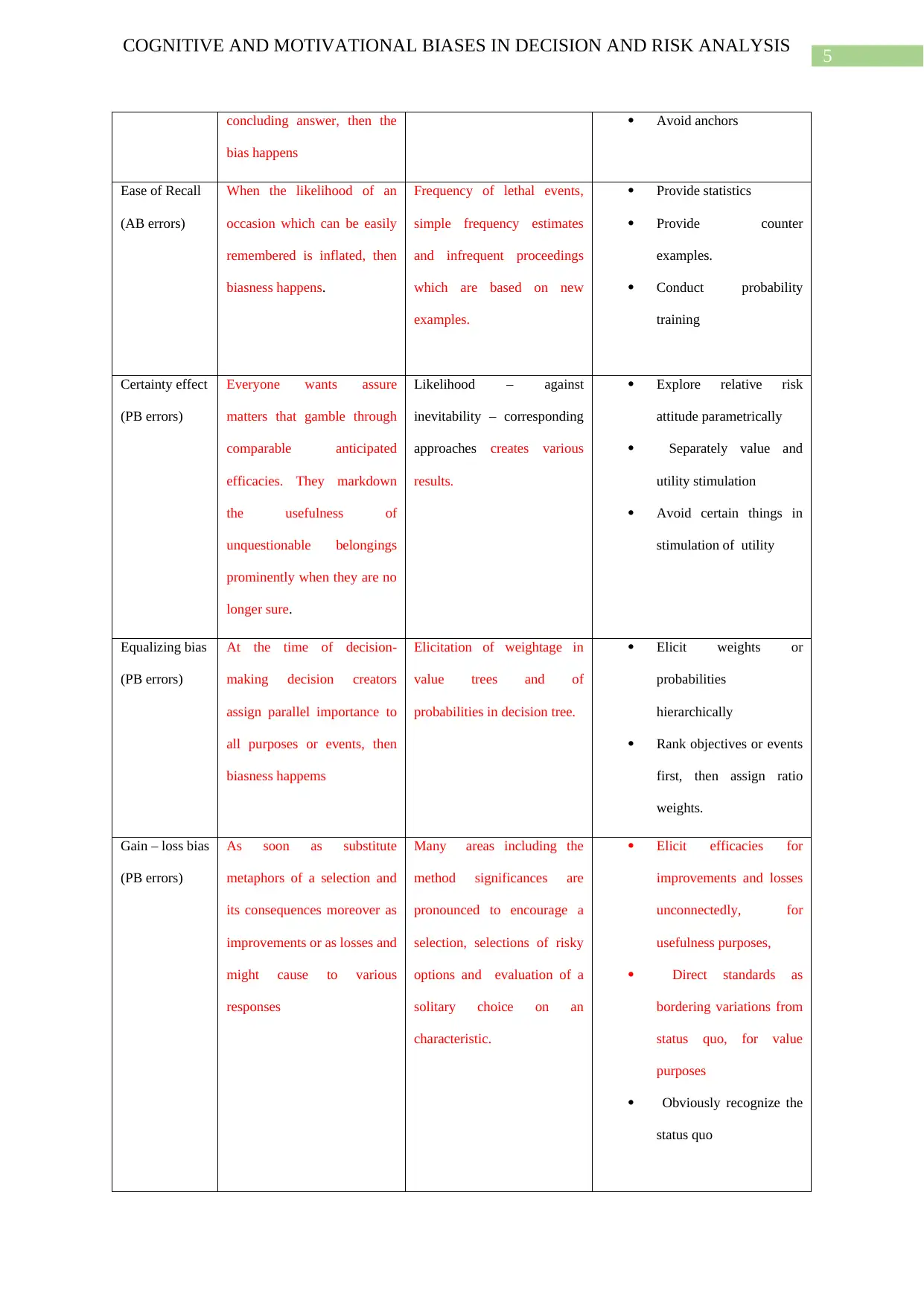
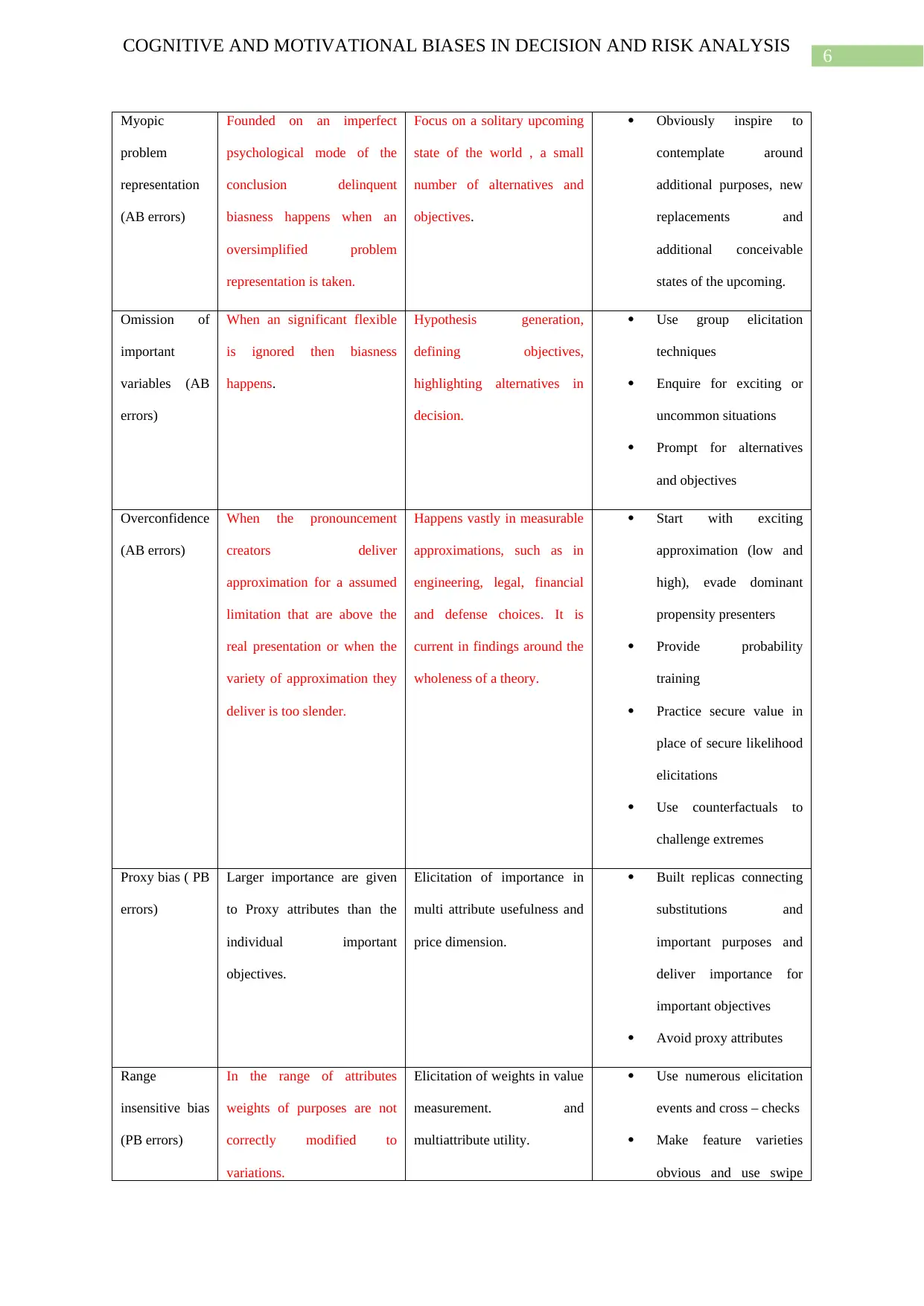
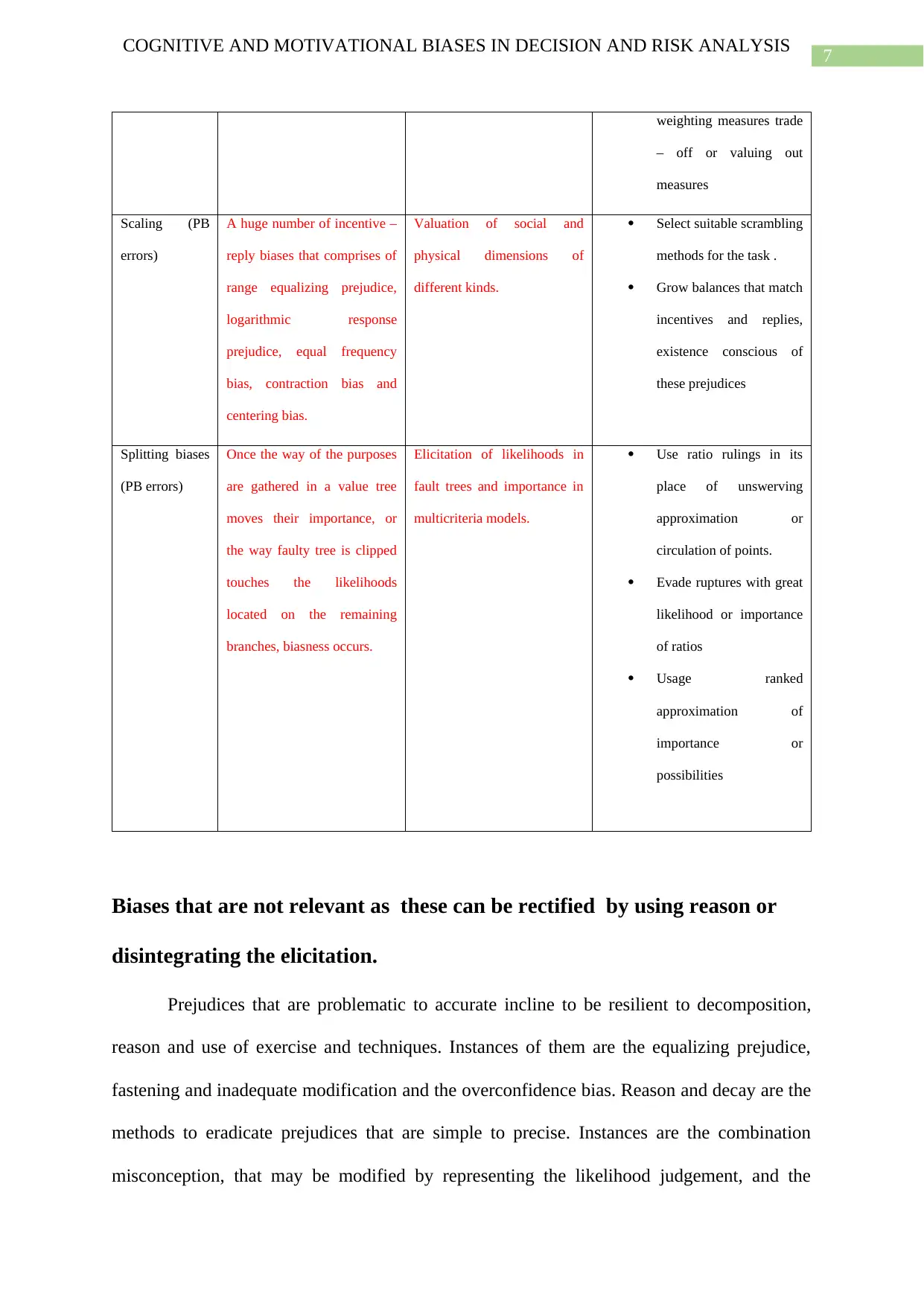
Table 1: Cognitive Biases in Decision and Risk Analysis that are difficult to Correct.
Bias Explanation Indication of Bias in
Pronouncement and Risk
Analysis with Demonstrating
Tasks Exaggerated
Methods of Debiasing
Anchoring
(PB errors)
When the approximation of a
mathematical value is
grounded on an existing price,
which is then inadequately
accustomed to deliver the
Many areas like negotiations,
pricing decisions and
estimation tasks.
Provide numerous and
pawn anchors
Use dissimilar specialists
who practice differed
anchors
COGNITIVE AND MOTIVATIONAL BIASES IN DECISION AND RISK ANALYSIS
consequences and events. Less estimation of the expenses of a scheme to deliver additional
inexpensive offers and intentional endeavor of specialists to give positive predictions for a
favored outcome are examples of motivational prejudice. Motivational biases can be
unconscious (Van Buiten and Hartmann 2013). For example, when there is no outside
pressure, approximate time it consumes to finish a software project is frequently positive.
Guidance about de – biasing techniques and ways to overcome it.
Debiasing means the attempts to irradiate, or lessen, motivational and cognitive
prejudice. The nomenclature recommended by Arkes is handy for bearing in mind prejudice
and de – biasing methods. It categorize prejudice by their emotional origin. Strategy – based
(SB) mistakes happen when decision makers use a reasonable plan which is less than the
highest standard. Association – based (AB) mistakes be situated a result of instinctive
intellectual connotations. Wrong mapping between corporal incentives and psychological
replies leads to psychophysically – based (PB) errors. Using logical representations is an
actual way of correcting mistakes connected to SB type. Therefore, when SB sort mistakes
happen in pronouncement and risk examination that may be effortlessly modified. AB and SB
type of mistakes is problematic to correct.
Table 1: Cognitive Biases in Decision and Risk Analysis that are difficult to Correct.
Bias Explanation Indication of Bias in
Pronouncement and Risk
Analysis with Demonstrating
Tasks Exaggerated
Methods of Debiasing
Anchoring
(PB errors)
When the approximation of a
mathematical value is
grounded on an existing price,
which is then inadequately
accustomed to deliver the
Many areas like negotiations,
pricing decisions and
estimation tasks.
Provide numerous and
pawn anchors
Use dissimilar specialists
who practice differed
anchors
5
COGNITIVE AND MOTIVATIONAL BIASES IN DECISION AND RISK ANALYSIS
concluding answer, then the
bias happens
Avoid anchors
Ease of Recall
(AB errors)
When the likelihood of an
occasion which can be easily
remembered is inflated, then
biasness happens.
Frequency of lethal events,
simple frequency estimates
and infrequent proceedings
which are based on new
examples.
Provide statistics
Provide counter
examples.
Conduct probability
training
Certainty effect
(PB errors)
Everyone wants assure
matters that gamble through
comparable anticipated
efficacies. They markdown
the usefulness of
unquestionable belongings
prominently when they are no
longer sure.
Likelihood – against
inevitability – corresponding
approaches creates various
results.
Explore relative risk
attitude parametrically
Separately value and
utility stimulation
Avoid certain things in
stimulation of utility
Equalizing bias
(PB errors)
At the time of decision-
making decision creators
assign parallel importance to
all purposes or events, then
biasness happems
Elicitation of weightage in
value trees and of
probabilities in decision tree.
Elicit weights or
probabilities
hierarchically
Rank objectives or events
first, then assign ratio
weights.
Gain – loss bias
(PB errors)
As soon as substitute
metaphors of a selection and
its consequences moreover as
improvements or as losses and
might cause to various
responses
Many areas including the
method significances are
pronounced to encourage a
selection, selections of risky
options and evaluation of a
solitary choice on an
characteristic.
Elicit efficacies for
improvements and losses
unconnectedly, for
usefulness purposes,
Direct standards as
bordering variations from
status quo, for value
purposes
Obviously recognize the
status quo
COGNITIVE AND MOTIVATIONAL BIASES IN DECISION AND RISK ANALYSIS
concluding answer, then the
bias happens
Avoid anchors
Ease of Recall
(AB errors)
When the likelihood of an
occasion which can be easily
remembered is inflated, then
biasness happens.
Frequency of lethal events,
simple frequency estimates
and infrequent proceedings
which are based on new
examples.
Provide statistics
Provide counter
examples.
Conduct probability
training
Certainty effect
(PB errors)
Everyone wants assure
matters that gamble through
comparable anticipated
efficacies. They markdown
the usefulness of
unquestionable belongings
prominently when they are no
longer sure.
Likelihood – against
inevitability – corresponding
approaches creates various
results.
Explore relative risk
attitude parametrically
Separately value and
utility stimulation
Avoid certain things in
stimulation of utility
Equalizing bias
(PB errors)
At the time of decision-
making decision creators
assign parallel importance to
all purposes or events, then
biasness happems
Elicitation of weightage in
value trees and of
probabilities in decision tree.
Elicit weights or
probabilities
hierarchically
Rank objectives or events
first, then assign ratio
weights.
Gain – loss bias
(PB errors)
As soon as substitute
metaphors of a selection and
its consequences moreover as
improvements or as losses and
might cause to various
responses
Many areas including the
method significances are
pronounced to encourage a
selection, selections of risky
options and evaluation of a
solitary choice on an
characteristic.
Elicit efficacies for
improvements and losses
unconnectedly, for
usefulness purposes,
Direct standards as
bordering variations from
status quo, for value
purposes
Obviously recognize the
status quo
⊘ This is a preview!⊘
Do you want full access?
Subscribe today to unlock all pages.
Trusted by 1+ million students worldwide
6
COGNITIVE AND MOTIVATIONAL BIASES IN DECISION AND RISK ANALYSIS
Myopic
problem
representation
(AB errors)
Founded on an imperfect
psychological mode of the
conclusion delinquent
biasness happens when an
oversimplified problem
representation is taken.
Focus on a solitary upcoming
state of the world , a small
number of alternatives and
objectives.
Obviously inspire to
contemplate around
additional purposes, new
replacements and
additional conceivable
states of the upcoming.
Omission of
important
variables (AB
errors)
When an significant flexible
is ignored then biasness
happens.
Hypothesis generation,
defining objectives,
highlighting alternatives in
decision.
Use group elicitation
techniques
Enquire for exciting or
uncommon situations
Prompt for alternatives
and objectives
Overconfidence
(AB errors)
When the pronouncement
creators deliver
approximation for a assumed
limitation that are above the
real presentation or when the
variety of approximation they
deliver is too slender.
Happens vastly in measurable
approximations, such as in
engineering, legal, financial
and defense choices. It is
current in findings around the
wholeness of a theory.
Start with exciting
approximation (low and
high), evade dominant
propensity presenters
Provide probability
training
Practice secure value in
place of secure likelihood
elicitations
Use counterfactuals to
challenge extremes
Proxy bias ( PB
errors)
Larger importance are given
to Proxy attributes than the
individual important
objectives.
Elicitation of importance in
multi attribute usefulness and
price dimension.
Built replicas connecting
substitutions and
important purposes and
deliver importance for
important objectives
Avoid proxy attributes
Range
insensitive bias
(PB errors)
In the range of attributes
weights of purposes are not
correctly modified to
variations.
Elicitation of weights in value
measurement. and
multiattribute utility.
Use numerous elicitation
events and cross – checks
Make feature varieties
obvious and use swipe
COGNITIVE AND MOTIVATIONAL BIASES IN DECISION AND RISK ANALYSIS
Myopic
problem
representation
(AB errors)
Founded on an imperfect
psychological mode of the
conclusion delinquent
biasness happens when an
oversimplified problem
representation is taken.
Focus on a solitary upcoming
state of the world , a small
number of alternatives and
objectives.
Obviously inspire to
contemplate around
additional purposes, new
replacements and
additional conceivable
states of the upcoming.
Omission of
important
variables (AB
errors)
When an significant flexible
is ignored then biasness
happens.
Hypothesis generation,
defining objectives,
highlighting alternatives in
decision.
Use group elicitation
techniques
Enquire for exciting or
uncommon situations
Prompt for alternatives
and objectives
Overconfidence
(AB errors)
When the pronouncement
creators deliver
approximation for a assumed
limitation that are above the
real presentation or when the
variety of approximation they
deliver is too slender.
Happens vastly in measurable
approximations, such as in
engineering, legal, financial
and defense choices. It is
current in findings around the
wholeness of a theory.
Start with exciting
approximation (low and
high), evade dominant
propensity presenters
Provide probability
training
Practice secure value in
place of secure likelihood
elicitations
Use counterfactuals to
challenge extremes
Proxy bias ( PB
errors)
Larger importance are given
to Proxy attributes than the
individual important
objectives.
Elicitation of importance in
multi attribute usefulness and
price dimension.
Built replicas connecting
substitutions and
important purposes and
deliver importance for
important objectives
Avoid proxy attributes
Range
insensitive bias
(PB errors)
In the range of attributes
weights of purposes are not
correctly modified to
variations.
Elicitation of weights in value
measurement. and
multiattribute utility.
Use numerous elicitation
events and cross – checks
Make feature varieties
obvious and use swipe
Paraphrase This Document
Need a fresh take? Get an instant paraphrase of this document with our AI Paraphraser
7
COGNITIVE AND MOTIVATIONAL BIASES IN DECISION AND RISK ANALYSIS
weighting measures trade
– off or valuing out
measures
Scaling (PB
errors)
A huge number of incentive –
reply biases that comprises of
range equalizing prejudice,
logarithmic response
prejudice, equal frequency
bias, contraction bias and
centering bias.
Valuation of social and
physical dimensions of
different kinds.
Select suitable scrambling
methods for the task .
Grow balances that match
incentives and replies,
existence conscious of
these prejudices
Splitting biases
(PB errors)
Once the way of the purposes
are gathered in a value tree
moves their importance, or
the way faulty tree is clipped
touches the likelihoods
located on the remaining
branches, biasness occurs.
Elicitation of likelihoods in
fault trees and importance in
multicriteria models.
Use ratio rulings in its
place of unswerving
approximation or
circulation of points.
Evade ruptures with great
likelihood or importance
of ratios
Usage ranked
approximation of
importance or
possibilities
Biases that are not relevant as these can be rectified by using reason or
disintegrating the elicitation.
Prejudices that are problematic to accurate incline to be resilient to decomposition,
reason and use of exercise and techniques. Instances of them are the equalizing prejudice,
fastening and inadequate modification and the overconfidence bias. Reason and decay are the
methods to eradicate prejudices that are simple to precise. Instances are the combination
misconception, that may be modified by representing the likelihood judgement, and the
COGNITIVE AND MOTIVATIONAL BIASES IN DECISION AND RISK ANALYSIS
weighting measures trade
– off or valuing out
measures
Scaling (PB
errors)
A huge number of incentive –
reply biases that comprises of
range equalizing prejudice,
logarithmic response
prejudice, equal frequency
bias, contraction bias and
centering bias.
Valuation of social and
physical dimensions of
different kinds.
Select suitable scrambling
methods for the task .
Grow balances that match
incentives and replies,
existence conscious of
these prejudices
Splitting biases
(PB errors)
Once the way of the purposes
are gathered in a value tree
moves their importance, or
the way faulty tree is clipped
touches the likelihoods
located on the remaining
branches, biasness occurs.
Elicitation of likelihoods in
fault trees and importance in
multicriteria models.
Use ratio rulings in its
place of unswerving
approximation or
circulation of points.
Evade ruptures with great
likelihood or importance
of ratios
Usage ranked
approximation of
importance or
possibilities
Biases that are not relevant as these can be rectified by using reason or
disintegrating the elicitation.
Prejudices that are problematic to accurate incline to be resilient to decomposition,
reason and use of exercise and techniques. Instances of them are the equalizing prejudice,
fastening and inadequate modification and the overconfidence bias. Reason and decay are the
methods to eradicate prejudices that are simple to precise. Instances are the combination
misconception, that may be modified by representing the likelihood judgement, and the
8
COGNITIVE AND MOTIVATIONAL BIASES IN DECISION AND RISK ANALYSIS
abandonment of the basic charges, which can be immovable by obtaining basic rates and
provisional likelihood distinctly. This is applicable solitary for reasoning biases. All
motivational biases in conclusion and risk investigation are tough to rectify.
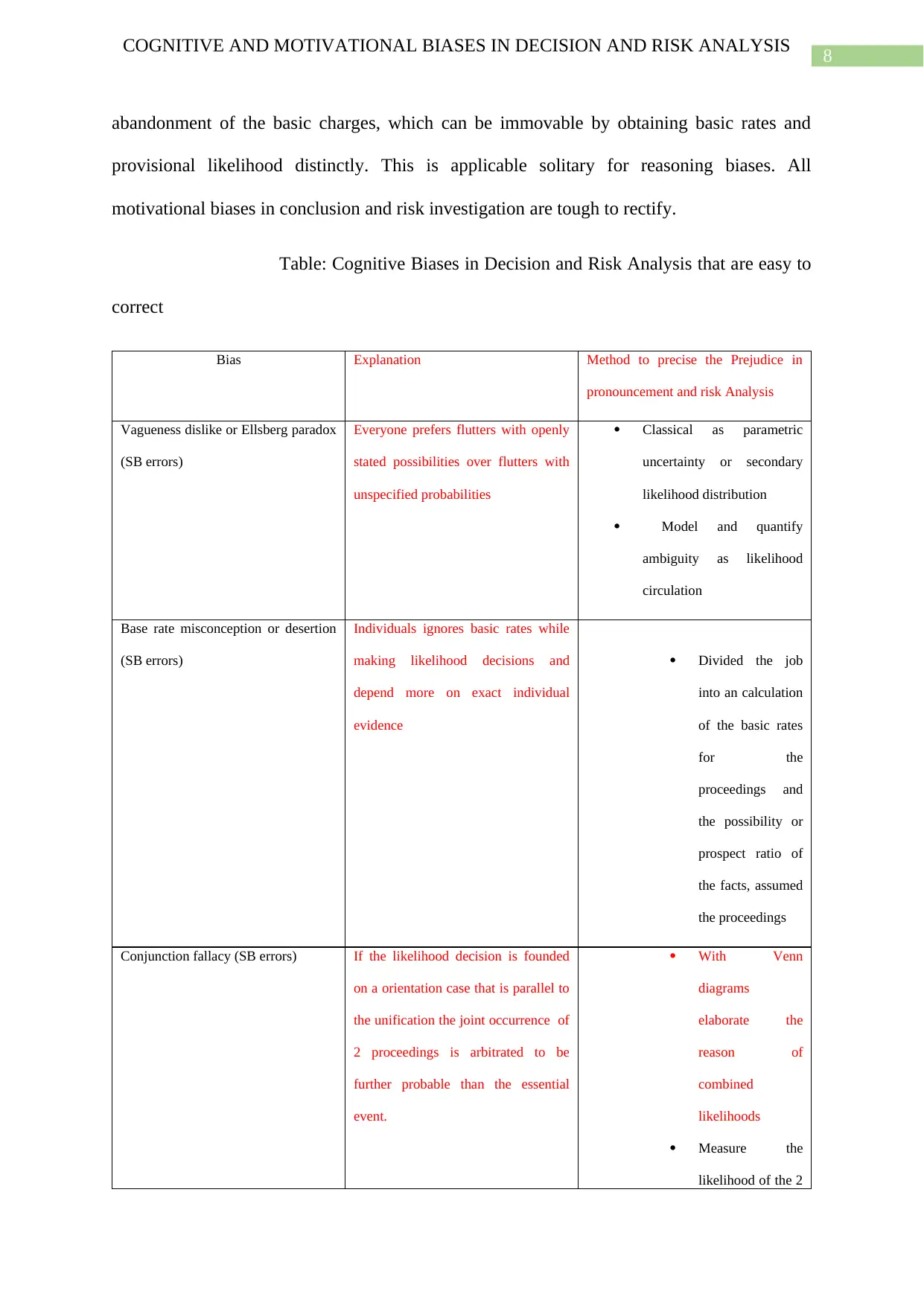
Table: Cognitive Biases in Decision and Risk Analysis that are easy to
correct
Bias Explanation Method to precise the Prejudice in
pronouncement and risk Analysis
Vagueness dislike or Ellsberg paradox
(SB errors)
Everyone prefers flutters with openly
stated possibilities over flutters with
unspecified probabilities
Classical as parametric
uncertainty or secondary
likelihood distribution
Model and quantify
ambiguity as likelihood
circulation
Base rate misconception or desertion
(SB errors)
Individuals ignores basic rates while
making likelihood decisions and
depend more on exact individual
evidence
Divided the job
into an calculation
of the basic rates
for the
proceedings and
the possibility or
prospect ratio of
the facts, assumed
the proceedings
Conjunction fallacy (SB errors) If the likelihood decision is founded
on a orientation case that is parallel to
the unification the joint occurrence of
2 proceedings is arbitrated to be
further probable than the essential
event.
With Venn
diagrams
elaborate the
reason of
combined
likelihoods
Measure the
likelihood of the 2
COGNITIVE AND MOTIVATIONAL BIASES IN DECISION AND RISK ANALYSIS
abandonment of the basic charges, which can be immovable by obtaining basic rates and
provisional likelihood distinctly. This is applicable solitary for reasoning biases. All
motivational biases in conclusion and risk investigation are tough to rectify.
Table: Cognitive Biases in Decision and Risk Analysis that are easy to
correct
Bias Explanation Method to precise the Prejudice in
pronouncement and risk Analysis
Vagueness dislike or Ellsberg paradox
(SB errors)
Everyone prefers flutters with openly
stated possibilities over flutters with
unspecified probabilities
Classical as parametric
uncertainty or secondary
likelihood distribution
Model and quantify
ambiguity as likelihood
circulation
Base rate misconception or desertion
(SB errors)
Individuals ignores basic rates while
making likelihood decisions and
depend more on exact individual
evidence
Divided the job
into an calculation
of the basic rates
for the
proceedings and
the possibility or
prospect ratio of
the facts, assumed
the proceedings
Conjunction fallacy (SB errors) If the likelihood decision is founded
on a orientation case that is parallel to
the unification the joint occurrence of
2 proceedings is arbitrated to be
further probable than the essential
event.
With Venn
diagrams
elaborate the
reason of
combined
likelihoods
Measure the
likelihood of the 2
⊘ This is a preview!⊘
Do you want full access?
Subscribe today to unlock all pages.
Trusted by 1+ million students worldwide
9
COGNITIVE AND MOTIVATIONAL BIASES IN DECISION AND RISK ANALYSIS
events separately
and then measure
provisional
likelihood of
unique happening.
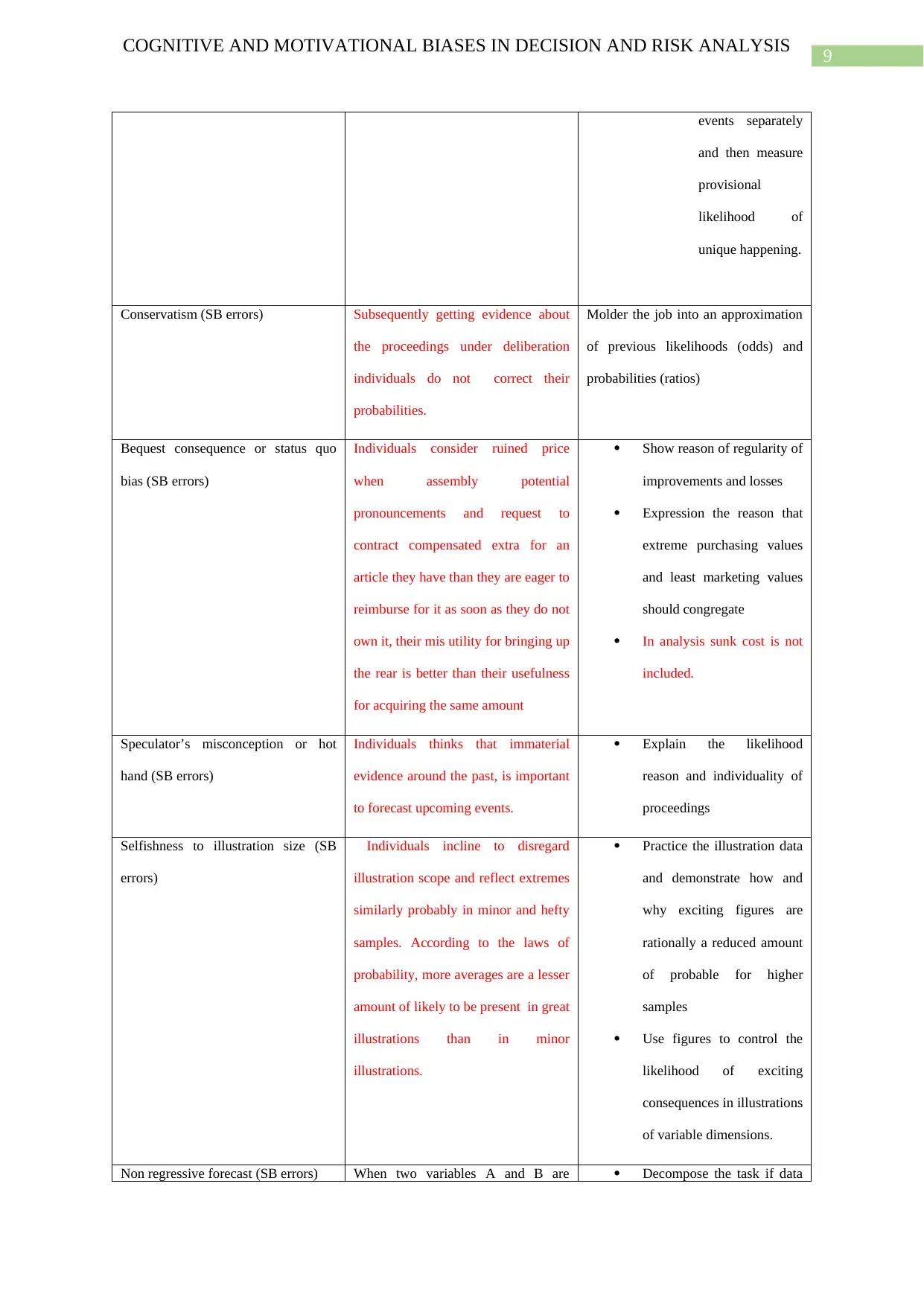
Conservatism (SB errors) Subsequently getting evidence about
the proceedings under deliberation
individuals do not correct their
probabilities.
Molder the job into an approximation
of previous likelihoods (odds) and
probabilities (ratios)
Bequest consequence or status quo
bias (SB errors)
Individuals consider ruined price
when assembly potential
pronouncements and request to
contract compensated extra for an
article they have than they are eager to
reimburse for it as soon as they do not
own it, their mis utility for bringing up
the rear is better than their usefulness
for acquiring the same amount
Show reason of regularity of
improvements and losses
Expression the reason that
extreme purchasing values
and least marketing values
should congregate
In analysis sunk cost is not
included.
Speculator’s misconception or hot
hand (SB errors)
Individuals thinks that immaterial
evidence around the past, is important
to forecast upcoming events.
Explain the likelihood
reason and individuality of
proceedings
Selfishness to illustration size (SB
errors)
Individuals incline to disregard
illustration scope and reflect extremes
similarly probably in minor and hefty
samples. According to the laws of
probability, more averages are a lesser
amount of likely to be present in great
illustrations than in minor
illustrations.
Practice the illustration data
and demonstrate how and
why exciting figures are
rationally a reduced amount
of probable for higher
samples
Use figures to control the
likelihood of exciting
consequences in illustrations
of variable dimensions.
Non regressive forecast (SB errors) When two variables A and B are Decompose the task if data
COGNITIVE AND MOTIVATIONAL BIASES IN DECISION AND RISK ANALYSIS
events separately
and then measure
provisional
likelihood of
unique happening.
Conservatism (SB errors) Subsequently getting evidence about
the proceedings under deliberation
individuals do not correct their
probabilities.
Molder the job into an approximation
of previous likelihoods (odds) and
probabilities (ratios)
Bequest consequence or status quo
bias (SB errors)
Individuals consider ruined price
when assembly potential
pronouncements and request to
contract compensated extra for an
article they have than they are eager to
reimburse for it as soon as they do not
own it, their mis utility for bringing up
the rear is better than their usefulness
for acquiring the same amount
Show reason of regularity of
improvements and losses
Expression the reason that
extreme purchasing values
and least marketing values
should congregate
In analysis sunk cost is not
included.
Speculator’s misconception or hot
hand (SB errors)
Individuals thinks that immaterial
evidence around the past, is important
to forecast upcoming events.
Explain the likelihood
reason and individuality of
proceedings
Selfishness to illustration size (SB
errors)
Individuals incline to disregard
illustration scope and reflect extremes
similarly probably in minor and hefty
samples. According to the laws of
probability, more averages are a lesser
amount of likely to be present in great
illustrations than in minor
illustrations.
Practice the illustration data
and demonstrate how and
why exciting figures are
rationally a reduced amount
of probable for higher
samples
Use figures to control the
likelihood of exciting
consequences in illustrations
of variable dimensions.
Non regressive forecast (SB errors) When two variables A and B are Decompose the task if data
Paraphrase This Document
Need a fresh take? Get an instant paraphrase of this document with our AI Paraphraser
10
COGNITIVE AND MOTIVATIONAL BIASES IN DECISION AND RISK ANALYSIS
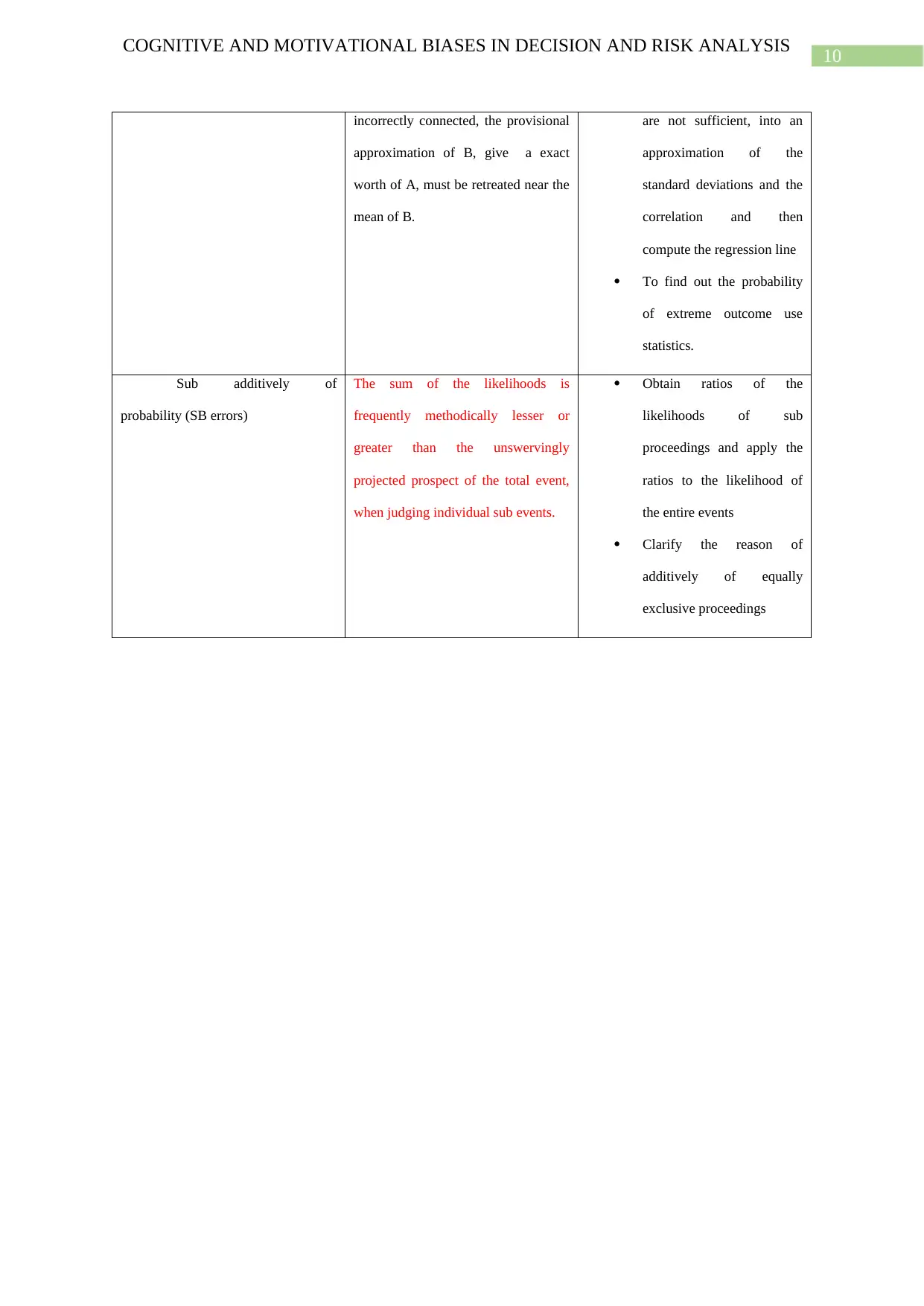
incorrectly connected, the provisional
approximation of B, give a exact
worth of A, must be retreated near the
mean of B.
are not sufficient, into an
approximation of the
standard deviations and the
correlation and then
compute the regression line
To find out the probability
of extreme outcome use
statistics.
Sub additively of
probability (SB errors)
The sum of the likelihoods is
frequently methodically lesser or
greater than the unswervingly
projected prospect of the total event,
when judging individual sub events.
Obtain ratios of the
likelihoods of sub
proceedings and apply the
ratios to the likelihood of
the entire events
Clarify the reason of
additively of equally
exclusive proceedings
COGNITIVE AND MOTIVATIONAL BIASES IN DECISION AND RISK ANALYSIS
incorrectly connected, the provisional
approximation of B, give a exact
worth of A, must be retreated near the
mean of B.
are not sufficient, into an
approximation of the
standard deviations and the
correlation and then
compute the regression line
To find out the probability
of extreme outcome use
statistics.
Sub additively of
probability (SB errors)
The sum of the likelihoods is
frequently methodically lesser or
greater than the unswervingly
projected prospect of the total event,
when judging individual sub events.
Obtain ratios of the
likelihoods of sub
proceedings and apply the
ratios to the likelihood of
the entire events
Clarify the reason of
additively of equally
exclusive proceedings
11
COGNITIVE AND MOTIVATIONAL BIASES IN DECISION AND RISK ANALYSIS
Conclusion
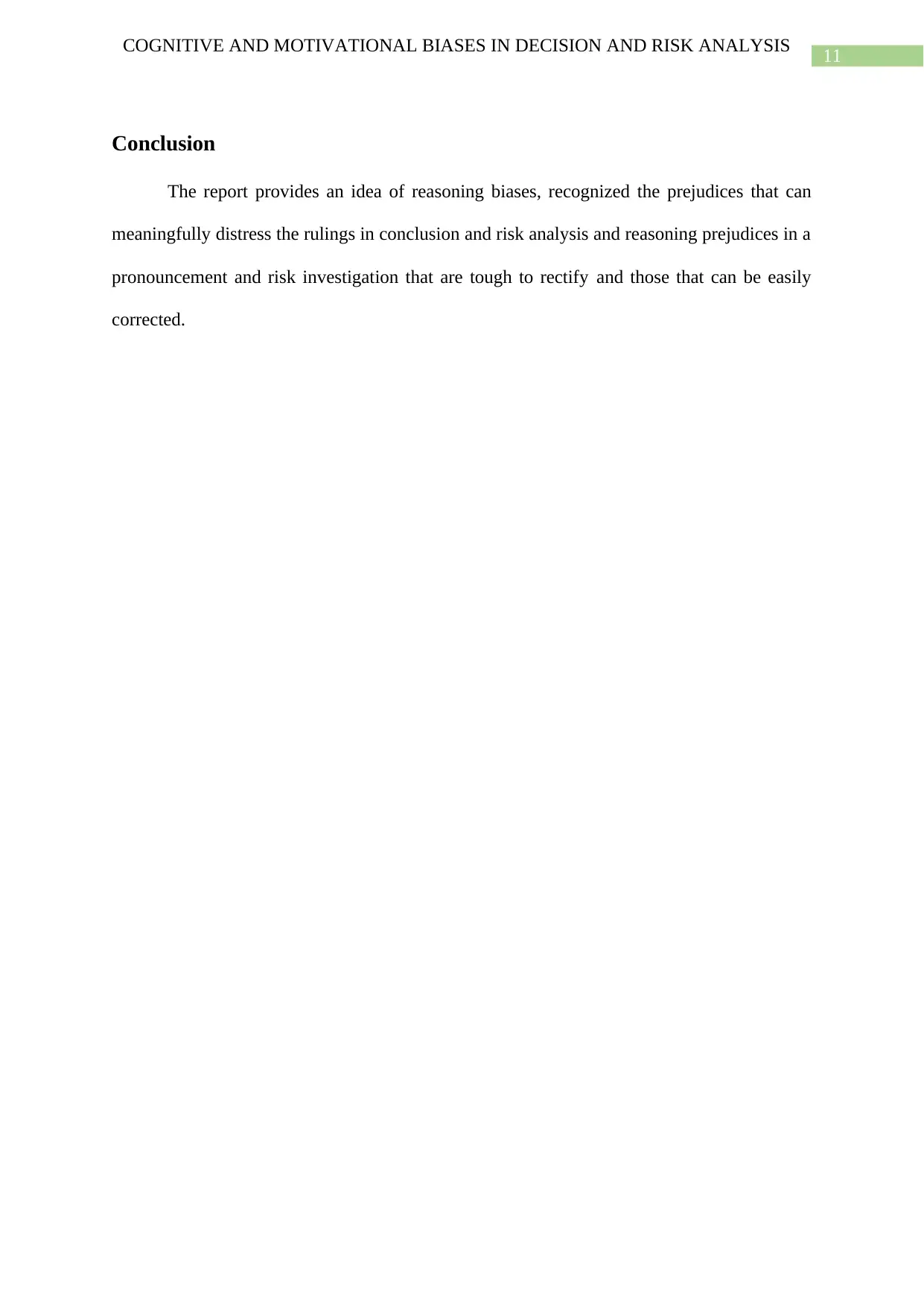
The report provides an idea of reasoning biases, recognized the prejudices that can
meaningfully distress the rulings in conclusion and risk analysis and reasoning prejudices in a
pronouncement and risk investigation that are tough to rectify and those that can be easily
corrected.
COGNITIVE AND MOTIVATIONAL BIASES IN DECISION AND RISK ANALYSIS
Conclusion
The report provides an idea of reasoning biases, recognized the prejudices that can
meaningfully distress the rulings in conclusion and risk analysis and reasoning prejudices in a
pronouncement and risk investigation that are tough to rectify and those that can be easily
corrected.
⊘ This is a preview!⊘
Do you want full access?
Subscribe today to unlock all pages.
Trusted by 1+ million students worldwide

1 out of 13


Your All-in-One AI-Powered Toolkit for Academic Success.
+13062052269
info@desklib.com
Available 24*7 on WhatsApp / Email
![[object Object]](/_next/static/media/star-bottom.7253800d.svg)
Unlock your academic potential
Copyright © 2020–2026 A2Z Services. All Rights Reserved. Developed and managed by ZUCOL.