Effects of Cognitive Styles on Vaccination Beliefs - Psychology Report

Verified

Added on  2023/06/03

|7
|1170
|450
Report
AI Summary
This psychology lab report investigates the influence of cognitive styles, specifically personal need for structure (PNS) and causal uncertainty (CUS), on beliefs and decisions regarding vaccinations. Conducted on first-year psychology students, the study utilized scales to measure PNS, CUS, and vaccination attitudes. The results revealed correlations between cognitive styles and vaccination beliefs, with higher PNS scores potentially linked to increased decision errors. The report discusses the findings, limitations, and implications for future research, emphasizing the importance of understanding individual differences in decision-making processes related to health behaviors. The study aims to contribute to the existing body of knowledge on the interplay of cognitive styles and health-related decisions.
Document Page
Running head: COGNITIVE STYLES IN PSYCHOLOGY. 1
COGNITIVE STYLES IN PSYCHOLOGY
Name
Instructor
Course code
Date
tabler-icon-diamond-filled.svg

Paraphrase This Document

Need a fresh take? Get an instant paraphrase of this document with our AI Paraphraser
Document Page
COGNITIVE STYLES IN PSYCHOLOGY. 2
Abstract
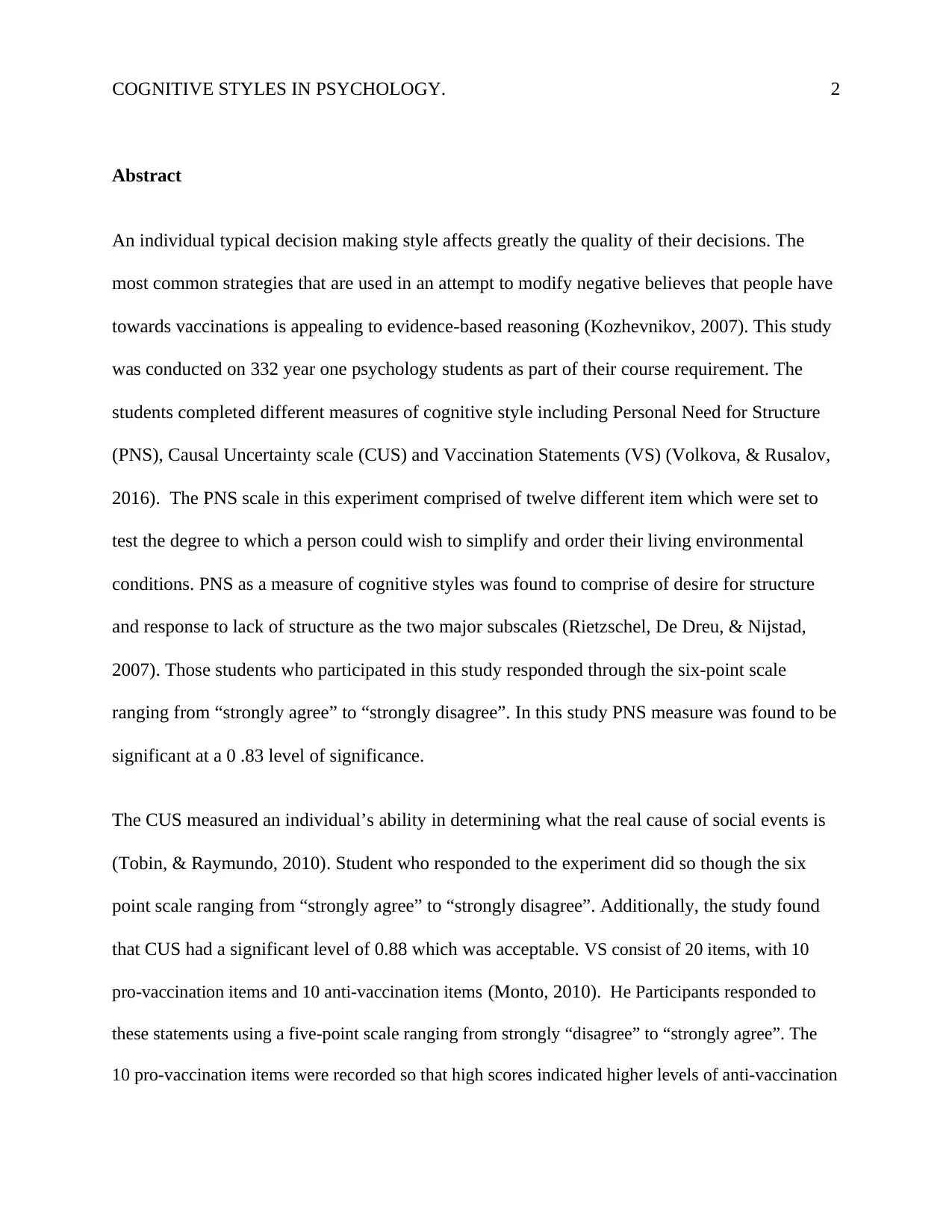
An individual typical decision making style affects greatly the quality of their decisions. The
most common strategies that are used in an attempt to modify negative believes that people have
towards vaccinations is appealing to evidence-based reasoning (Kozhevnikov, 2007). This study
was conducted on 332 year one psychology students as part of their course requirement. The
students completed different measures of cognitive style including Personal Need for Structure
(PNS), Causal Uncertainty scale (CUS) and Vaccination Statements (VS) (Volkova, & Rusalov,
2016). The PNS scale in this experiment comprised of twelve different item which were set to
test the degree to which a person could wish to simplify and order their living environmental
conditions. PNS as a measure of cognitive styles was found to comprise of desire for structure
and response to lack of structure as the two major subscales (Rietzschel, De Dreu, & Nijstad,
2007). Those students who participated in this study responded through the six-point scale
ranging from “strongly agree” to “strongly disagree”. In this study PNS measure was found to be
significant at a 0 .83 level of significance.
The CUS measured an individual’s ability in determining what the real cause of social events is
(Tobin, & Raymundo, 2010). Student who responded to the experiment did so though the six
point scale ranging from “strongly agree” to “strongly disagree”. Additionally, the study found
that CUS had a significant level of 0.88 which was acceptable. VS consist of 20 items, with 10
pro-vaccination items and 10 anti-vaccination items (Monto, 2010). He Participants responded to
these statements using a five-point scale ranging from strongly “disagree” to “strongly agree”. The
10 pro-vaccination items were recorded so that high scores indicated higher levels of anti-vaccination
Document Page
COGNITIVE STYLES IN PSYCHOLOGY. 3
attitudes and combined with the anti-vaccination attitudes. The study showed that VS was significant
at alpha level of 0.75.
Results
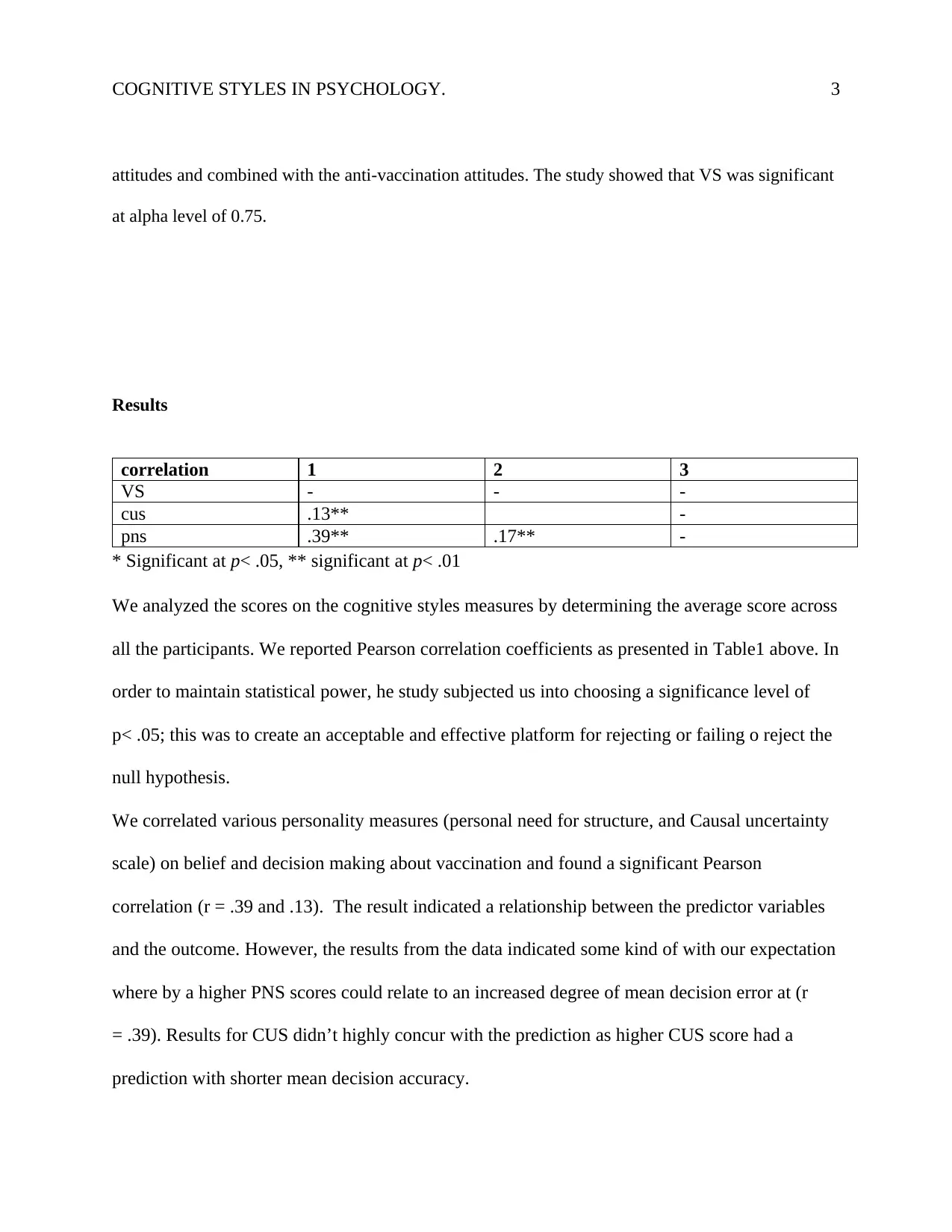
correlation 1 2 3
VS - - -
cus .13** -
pns .39** .17** -
* Significant at p< .05, ** significant at p< .01
We analyzed the scores on the cognitive styles measures by determining the average score across
all the participants. We reported Pearson correlation coefficients as presented in Table1 above. In
order to maintain statistical power, he study subjected us into choosing a significance level of
p< .05; this was to create an acceptable and effective platform for rejecting or failing o reject the
null hypothesis.
We correlated various personality measures (personal need for structure, and Causal uncertainty
scale) on belief and decision making about vaccination and found a significant Pearson
correlation (r = .39 and .13). The result indicated a relationship between the predictor variables
and the outcome. However, the results from the data indicated some kind of with our expectation
where by a higher PNS scores could relate to an increased degree of mean decision error at (r
= .39). Results for CUS didn’t highly concur with the prediction as higher CUS score had a
prediction with shorter mean decision accuracy.
Document Page
COGNITIVE STYLES IN PSYCHOLOGY. 4
Discussion
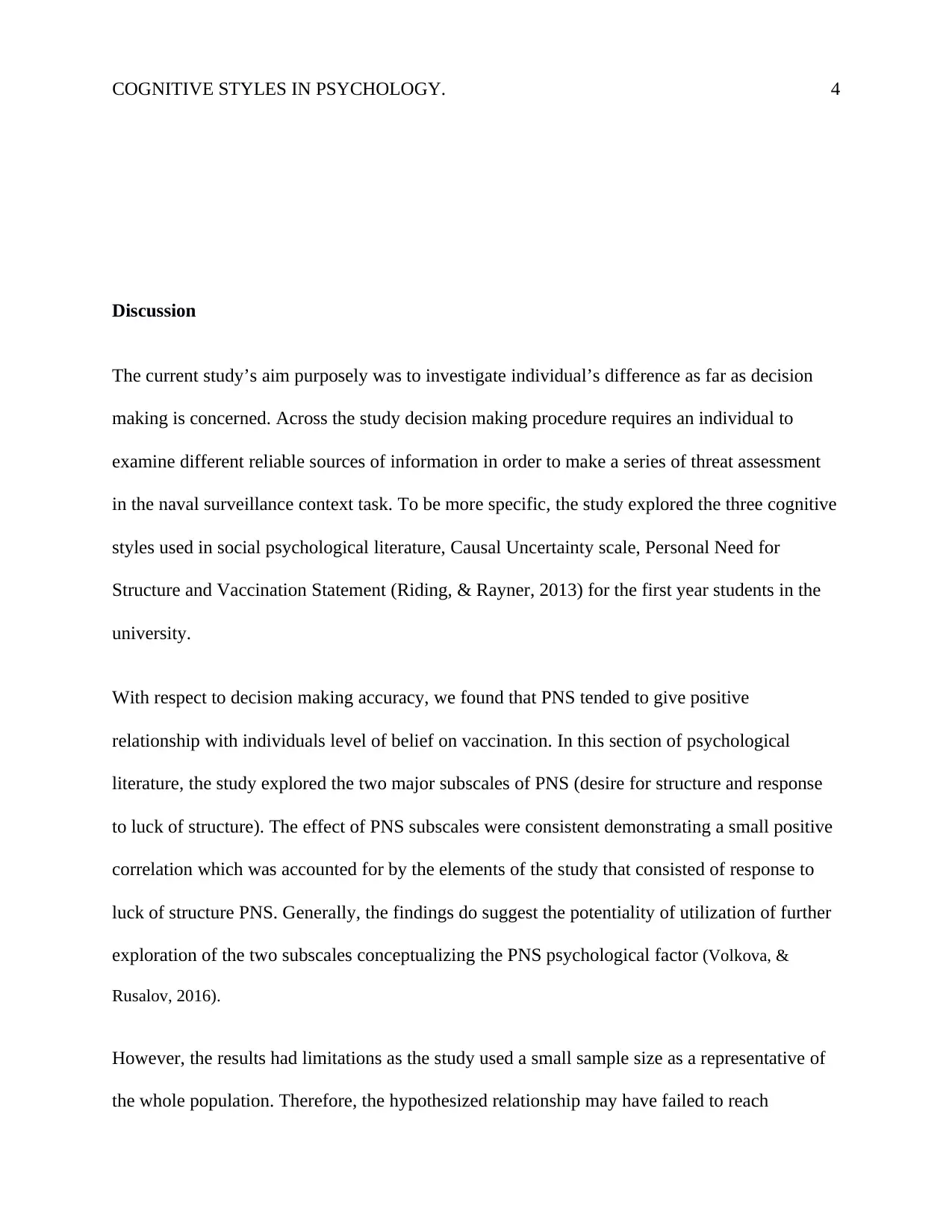
The current study’s aim purposely was to investigate individual’s difference as far as decision
making is concerned. Across the study decision making procedure requires an individual to
examine different reliable sources of information in order to make a series of threat assessment
in the naval surveillance context task. To be more specific, the study explored the three cognitive
styles used in social psychological literature, Causal Uncertainty scale, Personal Need for
Structure and Vaccination Statement (Riding, & Rayner, 2013) for the first year students in the
university.
With respect to decision making accuracy, we found that PNS tended to give positive
relationship with individuals level of belief on vaccination. In this section of psychological
literature, the study explored the two major subscales of PNS (desire for structure and response
to luck of structure). The effect of PNS subscales were consistent demonstrating a small positive
correlation which was accounted for by the elements of the study that consisted of response to
luck of structure PNS. Generally, the findings do suggest the potentiality of utilization of further
exploration of the two subscales conceptualizing the PNS psychological factor (Volkova, &
Rusalov, 2016).
However, the results had limitations as the study used a small sample size as a representative of
the whole population. Therefore, the hypothesized relationship may have failed to reach
tabler-icon-diamond-filled.svg

Paraphrase This Document

Need a fresh take? Get an instant paraphrase of this document with our AI Paraphraser
Document Page
COGNITIVE STYLES IN PSYCHOLOGY. 5
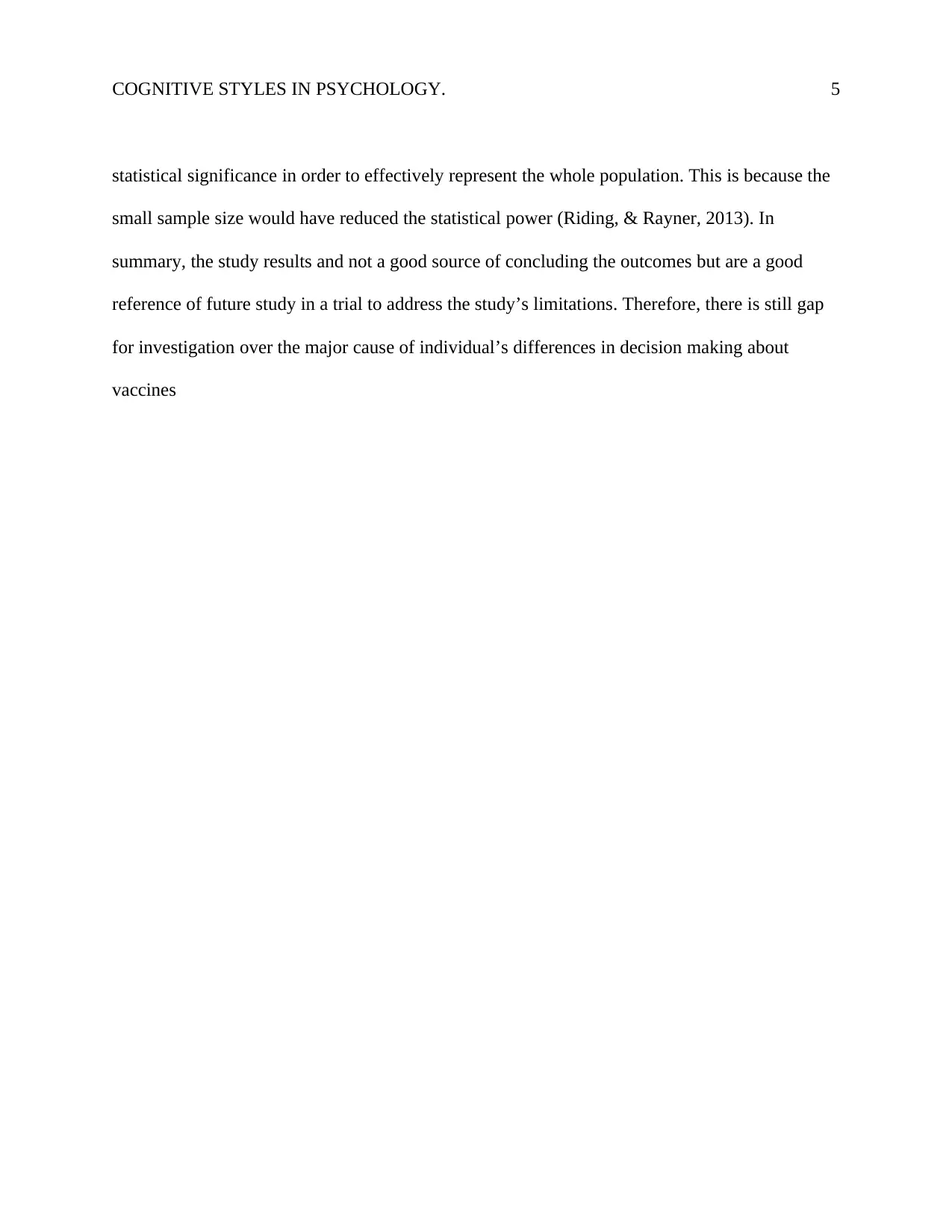
statistical significance in order to effectively represent the whole population. This is because the
small sample size would have reduced the statistical power (Riding, & Rayner, 2013). In
summary, the study results and not a good source of concluding the outcomes but are a good
reference of future study in a trial to address the study’s limitations. Therefore, there is still gap
for investigation over the major cause of individual’s differences in decision making about
vaccines
Document Page
COGNITIVE STYLES IN PSYCHOLOGY. 6
References
Kozhevnikov, M. (2007). Cognitive styles in the context of modern psychology: Toward an
integrated framework of cognitive style. Psychological bulletin, 133(3), 464.
Monto, A. S. (2010). Seasonal influenza and vaccination coverage. Vaccine, 28, D33-D44.
Riding, R., & Rayner, S. (2013). Cognitive styles and learning strategies: Understanding style
differences in learning and behavior. David Fulton Publishers.
Rietzschel, E. F., De Dreu, C. K., & Nijstad, B. A. (2007). Personal need for structure and
creative performance: The moderating influence of fear of invalidity. Personality and
Social Psychology Bulletin, 33(6), 855-866.
Tobin, S. J., & Raymundo, M. M. (2010). Causal uncertainty and psychological well-being: The
moderating role of accommodation (secondary control). Personality and Social
Psychology Bulletin, 36(3), 371-383
Volkova, E. V., & Rusalov, V. M. (2016). Cognitive styles and personality. Personality and
Individual Differences, 99, 266-271.
Document Page
COGNITIVE STYLES IN PSYCHOLOGY. 7
chevron_up_icon
1 out of 7
circle_padding
hide_on_mobile
zoom_out_icon
[object Object]