COIT20261 Network Routing and Switching: Assignment Solution 2018

Verified

Added on  2021/06/16

|6
|1762
|126
Homework Assignment
AI Summary
This document provides a comprehensive solution to a Network Routing and Switching assignment (COIT20261) from Term 1, 2018. The assignment covers key routing concepts, IPv4 fragmentation, and TCP congestion control mechanisms. The solution includes detailed answers to questions regarding next-hop addresses, interface selection, hop counts, and routing table completion. It also addresses IPv4 fragmentation calculations, including fragment sizes and offsets. Furthermore, it discusses TCP congestion control, comparing traditional methods with Google's BBR protocol, and explores the challenges of adopting new TCP/IP protocols. The document uses calculations and reasoning to support each answer, making it a valuable resource for understanding network routing and switching principles. This solved assignment is available on Desklib, a platform offering study tools for students.
Document Page
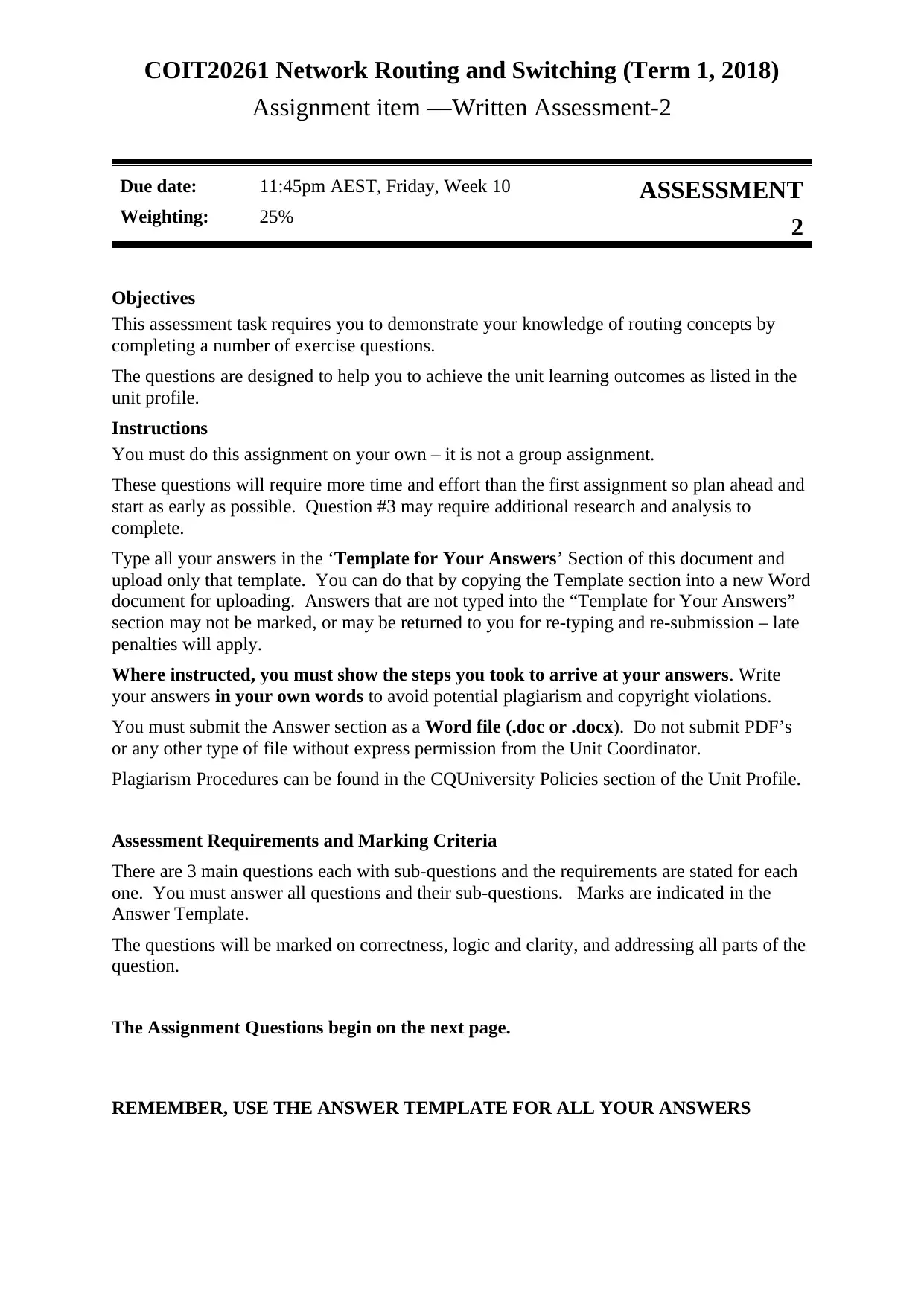
COIT20261 Network Routing and Switching (Term 1, 2018)
Assignment item —Written Assessment-2
Due date: 11:45pm AEST, Friday, Week 10 ASSESSMENT
Weighting: 25% 2
Objectives
This assessment task requires you to demonstrate your knowledge of routing concepts by
completing a number of exercise questions.
The questions are designed to help you to achieve the unit learning outcomes as listed in the
unit profile.
Instructions
You must do this assignment on your own – it is not a group assignment.
These questions will require more time and effort than the first assignment so plan ahead and
start as early as possible. Question #3 may require additional research and analysis to
complete.
Type all your answers in the ‘Template for Your Answers’ Section of this document and
upload only that template. You can do that by copying the Template section into a new Word
document for uploading. Answers that are not typed into the “Template for Your Answers”
section may not be marked, or may be returned to you for re-typing and re-submission – late
penalties will apply.
Where instructed, you must show the steps you took to arrive at your answers. Write
your answers in your own words to avoid potential plagiarism and copyright violations.
You must submit the Answer section as a Word file (.doc or .docx). Do not submit PDF’s
or any other type of file without express permission from the Unit Coordinator.
Plagiarism Procedures can be found in the CQUniversity Policies section of the Unit Profile.
Assessment Requirements and Marking Criteria
There are 3 main questions each with sub-questions and the requirements are stated for each
one. You must answer all questions and their sub-questions. Marks are indicated in the
Answer Template.
The questions will be marked on correctness, logic and clarity, and addressing all parts of the
question.
The Assignment Questions begin on the next page.
REMEMBER, USE THE ANSWER TEMPLATE FOR ALL YOUR ANSWERS
tabler-icon-diamond-filled.svg

Paraphrase This Document

Need a fresh take? Get an instant paraphrase of this document with our AI Paraphraser
Document Page
COIT20261 Network Routing and Switching (Term 1, 2018)
Assignment item —Written Assessment-2
Question 1 – Routing (10 marks)
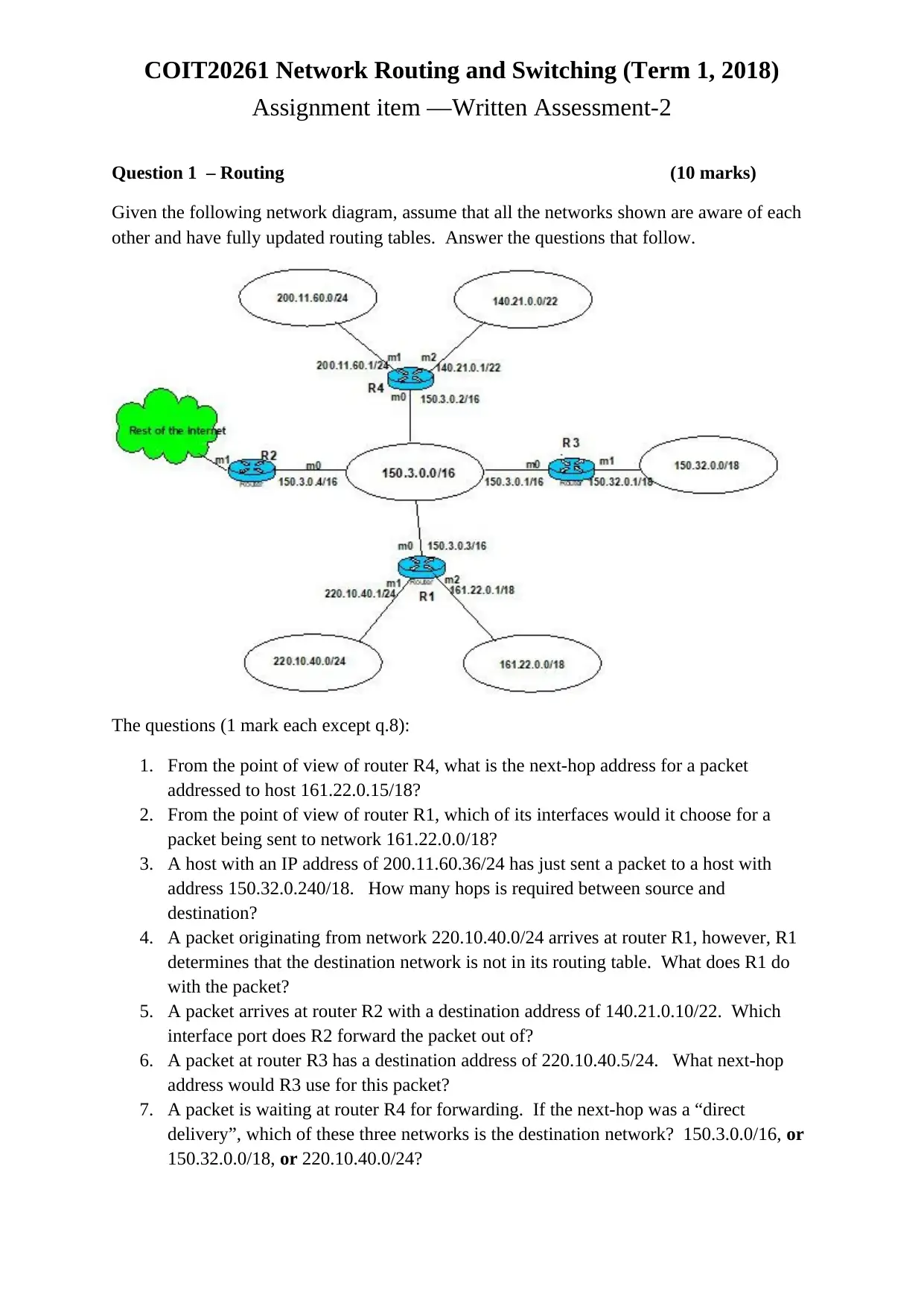
Given the following network diagram, assume that all the networks shown are aware of each
other and have fully updated routing tables. Answer the questions that follow.
The questions (1 mark each except q.8):
1. From the point of view of router R4, what is the next-hop address for a packet
addressed to host 161.22.0.15/18?
2. From the point of view of router R1, which of its interfaces would it choose for a
packet being sent to network 161.22.0.0/18?
3. A host with an IP address of 200.11.60.36/24 has just sent a packet to a host with
address 150.32.0.240/18. How many hops is required between source and
destination?
4. A packet originating from network 220.10.40.0/24 arrives at router R1, however, R1
determines that the destination network is not in its routing table. What does R1 do
with the packet?
5. A packet arrives at router R2 with a destination address of 140.21.0.10/22. Which
interface port does R2 forward the packet out of?
6. A packet at router R3 has a destination address of 220.10.40.5/24. What next-hop
address would R3 use for this packet?
7. A packet is waiting at router R4 for forwarding. If the next-hop was a “direct
delivery”, which of these three networks is the destination network? 150.3.0.0/16, or
150.32.0.0/18, or 220.10.40.0/24?
Document Page
COIT20261 Network Routing and Switching (Term 1, 2018)
Assignment item —Written Assessment-2
8. Complete the information in the routing table for router R2 as shown in the Answer
Template for networks 150.3.0.0/16, 150.32.0.0/18, and the Default network. Show
the masks in longest mask order using CIDR format (3 marks).
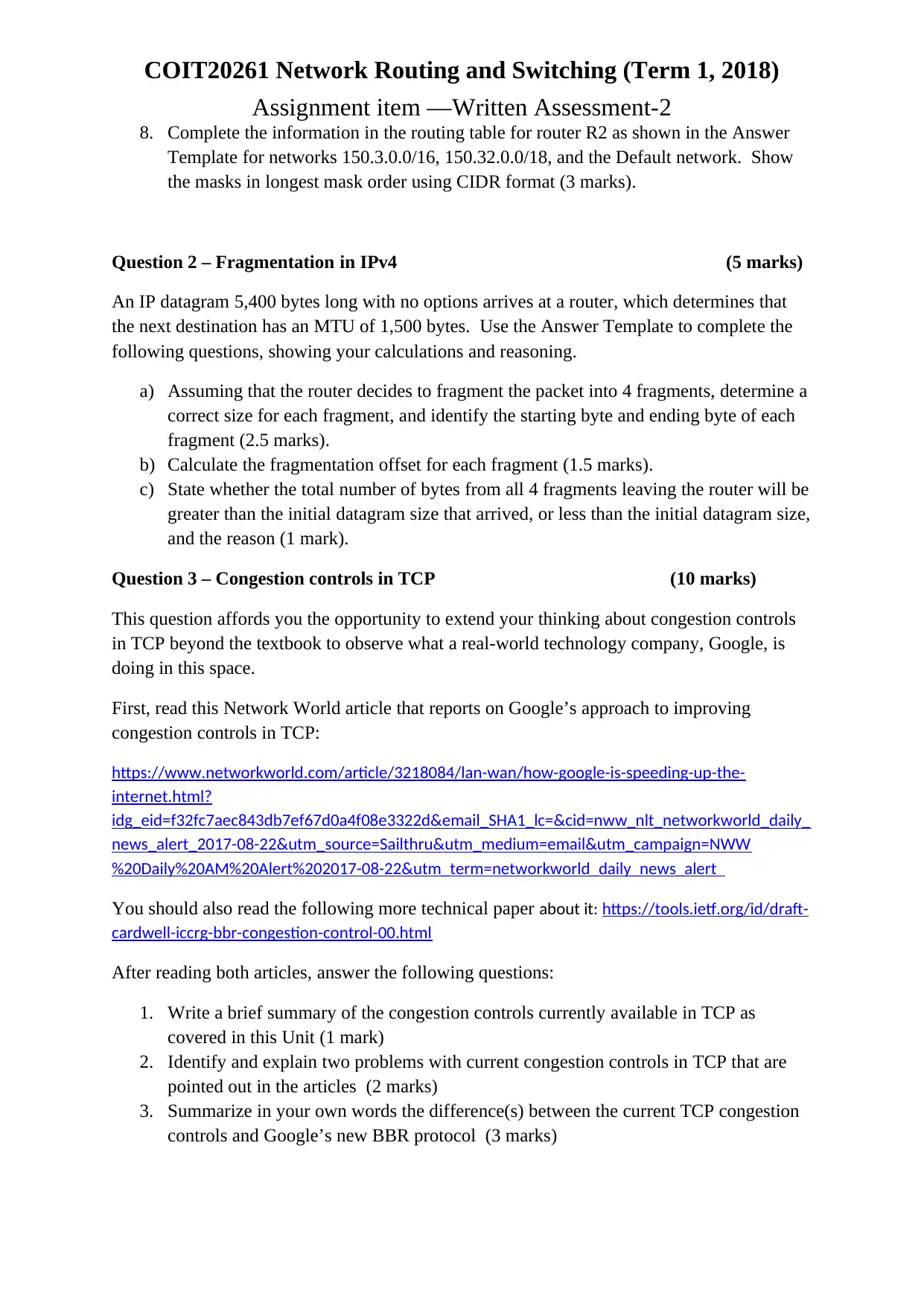
Question 2 – Fragmentation in IPv4 (5 marks)
An IP datagram 5,400 bytes long with no options arrives at a router, which determines that
the next destination has an MTU of 1,500 bytes. Use the Answer Template to complete the
following questions, showing your calculations and reasoning.
a) Assuming that the router decides to fragment the packet into 4 fragments, determine a
correct size for each fragment, and identify the starting byte and ending byte of each
fragment (2.5 marks).
b) Calculate the fragmentation offset for each fragment (1.5 marks).
c) State whether the total number of bytes from all 4 fragments leaving the router will be
greater than the initial datagram size that arrived, or less than the initial datagram size,
and the reason (1 mark).
Question 3 – Congestion controls in TCP (10 marks)
This question affords you the opportunity to extend your thinking about congestion controls
in TCP beyond the textbook to observe what a real-world technology company, Google, is
doing in this space.
First, read this Network World article that reports on Google’s approach to improving
congestion controls in TCP:
https://www.networkworld.com/article/3218084/lan-wan/how-google-is-speeding-up-the-
internet.html?
idg_eid=f32fc7aec843db7ef67d0a4f08e3322d&email_SHA1_lc=&cid=nww_nlt_networkworld_daily_
news_alert_2017-08-22&utm_source=Sailthru&utm_medium=email&utm_campaign=NWW
%20Daily%20AM%20Alert%202017-08-22&utm_term=networkworld_daily_news_alert
You should also read the following more technical paper about it: https://tools.ietf.org/id/draft-
cardwell-iccrg-bbr-congestion-control-00.html
After reading both articles, answer the following questions:
1. Write a brief summary of the congestion controls currently available in TCP as
covered in this Unit (1 mark)
2. Identify and explain two problems with current congestion controls in TCP that are
pointed out in the articles (2 marks)
3. Summarize in your own words the difference(s) between the current TCP congestion
controls and Google’s new BBR protocol (3 marks)
Document Page
COIT20261 Network Routing and Switching (Term 1, 2018)
Assignment item —Written Assessment-2
4. The Network World article points out that it is difficult to get a new protocol accepted
as a global standard for TCP/IP. Why do you think this is the case? Give carefully
thought out reasons for your answer. (4 marks)
Important: for every direct quotation you use from these two sources or any other source, you
must immediately, after the quote, provide your own explanation of the quotation (for example,
explain why are you quoting it, how does it help answer the question, how does it support what you
are saying?) – marks will be deducted for failure to do so. In addition, correct referencing
conventions must be used throughout your work using the Harvard referencing convention. Your
answers will be marked on clarity, logic, relevance, use of own words and fully addressing all parts of
each question.
Remember that quotations alone will not be accepted as your explanation of the questions.
Quotations can support your explanations, but you must still provide the explanations yourself.
Best way forward is to keep direct quotations to a minimum, and use your own words.
tabler-icon-diamond-filled.svg

Paraphrase This Document

Need a fresh take? Get an instant paraphrase of this document with our AI Paraphraser
Document Page
COIT20261 Network Routing and Switching (Term 1, 2018)
Assignment item —Written Assessment-2
TEMPLATE FOR YOUR ANSWERS
Type your answers in this section in the spaces provided. Spaces
can expand as you type.
First Name:_________________________ Last Name:____________________________
Student ID: __________________________
Question Number Mark
allocated
Marks
earned
Question 1: (10 marks)
1.
2.
3.
4.
5.
6.
7.
8.
161.22.0.0/18
150.3.0.0/16
4 hops
When the packets reaches to router R1 and it cannot find the host it not in
the routing table the router R1 will use the forwarding table to determine
its destination.
M2
Direct
220.10.40.0/24
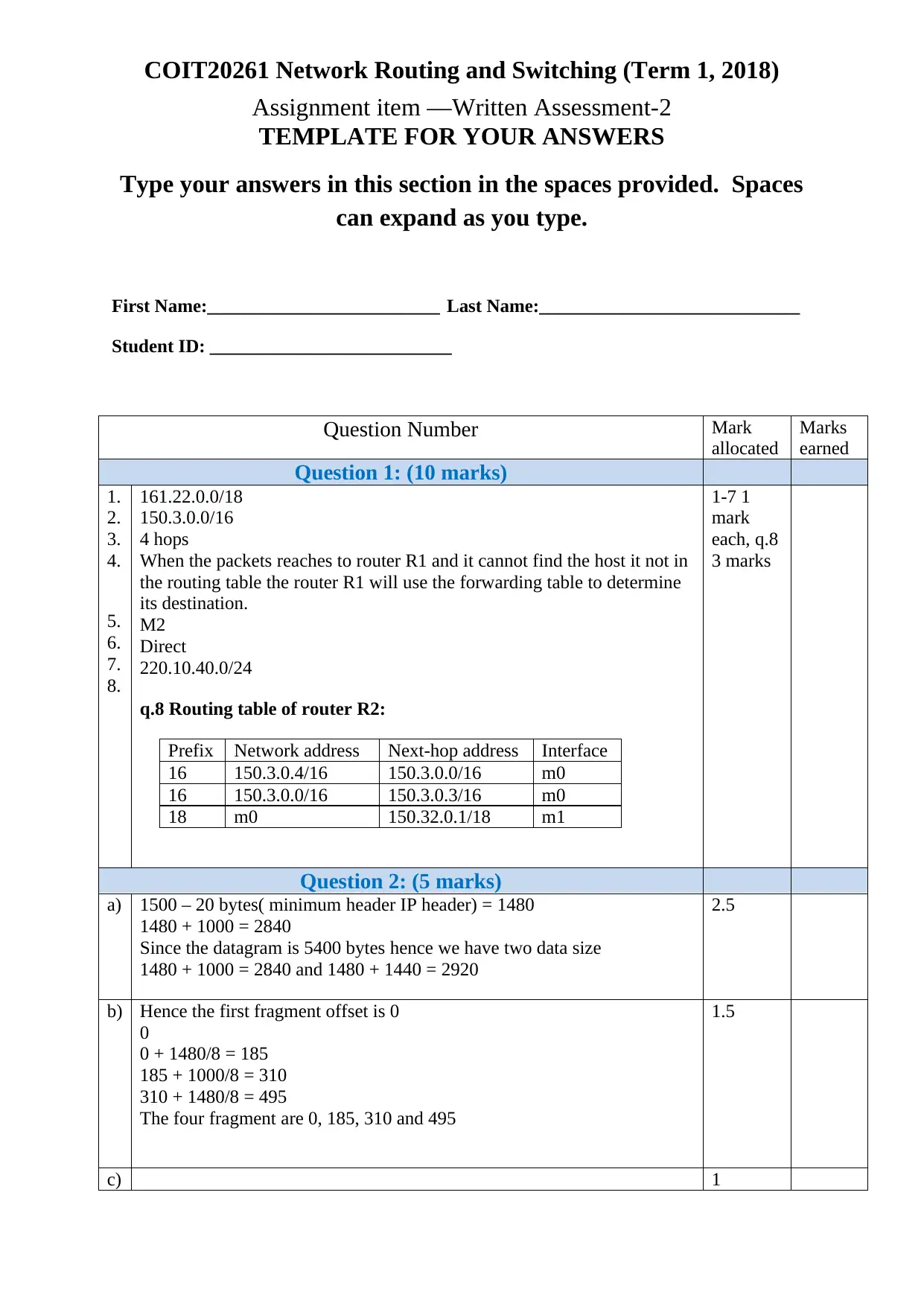
q.8 Routing table of router R2:
Prefix Network address Next-hop address Interface
16 150.3.0.4/16 150.3.0.0/16 m0
16 150.3.0.0/16 150.3.0.3/16 m0
18 m0 150.32.0.1/18 m1
1-7 1
mark
each, q.8
3 marks
Question 2: (5 marks)
a) 1500 – 20 bytes( minimum header IP header) = 1480
1480 + 1000 = 2840
Since the datagram is 5400 bytes hence we have two data size
1480 + 1000 = 2840 and 1480 + 1440 = 2920
2.5
b) Hence the first fragment offset is 0
0
0 + 1480/8 = 185
185 + 1000/8 = 310
310 + 1480/8 = 495
The four fragment are 0, 185, 310 and 495
1.5
c) 1
Document Page
COIT20261 Network Routing and Switching (Term 1, 2018)
Assignment item —Written Assessment-2
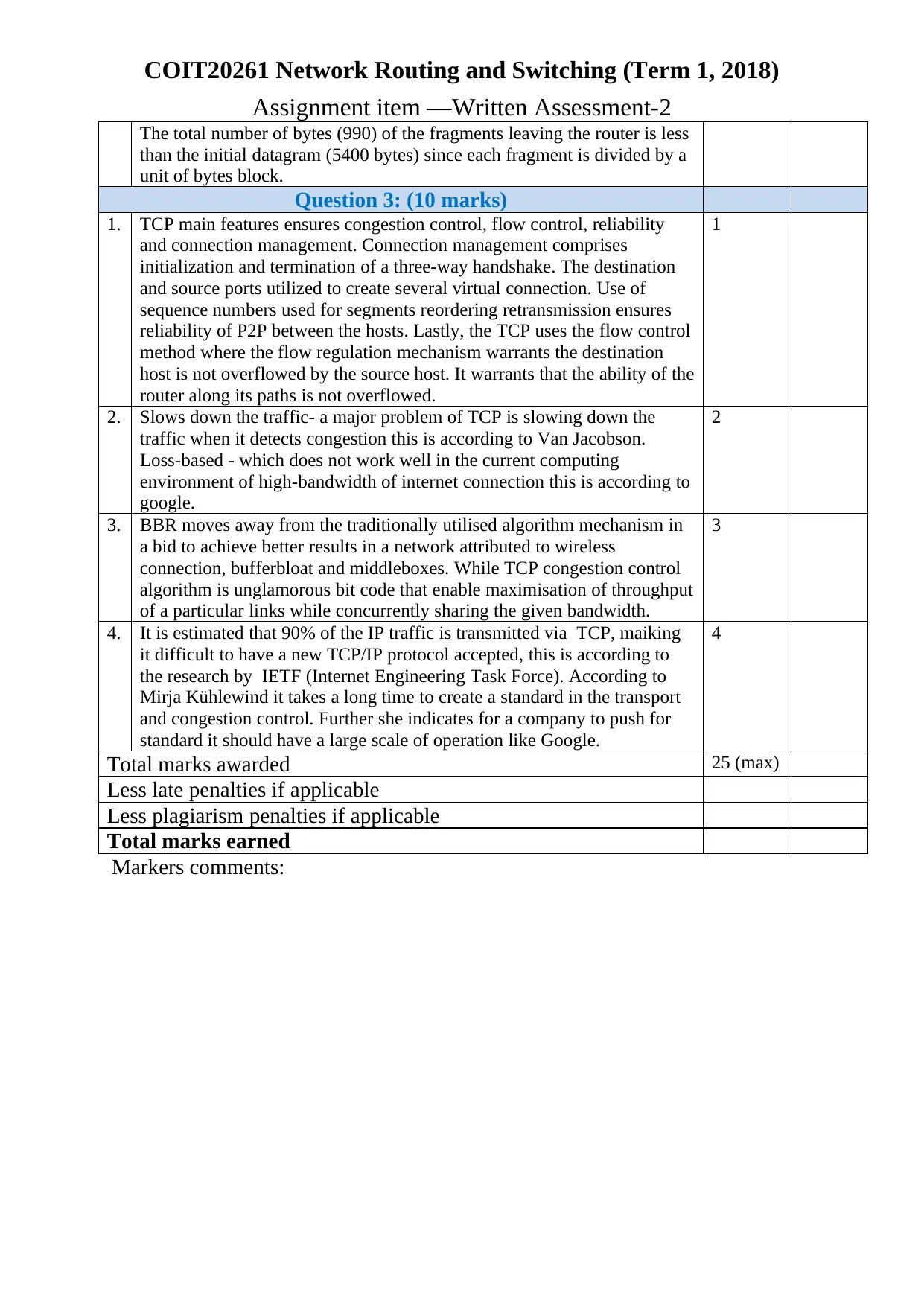
The total number of bytes (990) of the fragments leaving the router is less
than the initial datagram (5400 bytes) since each fragment is divided by a
unit of bytes block.
Question 3: (10 marks)
1. TCP main features ensures congestion control, flow control, reliability
and connection management. Connection management comprises
initialization and termination of a three-way handshake. The destination
and source ports utilized to create several virtual connection. Use of
sequence numbers used for segments reordering retransmission ensures
reliability of P2P between the hosts. Lastly, the TCP uses the flow control
method where the flow regulation mechanism warrants the destination
host is not overflowed by the source host. It warrants that the ability of the
router along its paths is not overflowed.
1
2. Slows down the traffic- a major problem of TCP is slowing down the
traffic when it detects congestion this is according to Van Jacobson.
Loss-based - which does not work well in the current computing
environment of high-bandwidth of internet connection this is according to
google.
2
3. BBR moves away from the traditionally utilised algorithm mechanism in
a bid to achieve better results in a network attributed to wireless
connection, bufferbloat and middleboxes. While TCP congestion control
algorithm is unglamorous bit code that enable maximisation of throughput
of a particular links while concurrently sharing the given bandwidth.
3
4. It is estimated that 90% of the IP traffic is transmitted via TCP, maiking
it difficult to have a new TCP/IP protocol accepted, this is according to
the research by IETF (Internet Engineering Task Force). According to
Mirja Kühlewind it takes a long time to create a standard in the transport
and congestion control. Further she indicates for a company to push for
standard it should have a large scale of operation like Google.
4
Total marks awarded 25 (max)
Less late penalties if applicable
Less plagiarism penalties if applicable
Total marks earned
Markers comments:
chevron_up_icon
1 out of 6
circle_padding
hide_on_mobile
zoom_out_icon
[object Object]