Evaluating the Branding Strategy of Coca-Cola's Coke Zero Brand
VerifiedAdded on 2023/04/21
|17
|3938
|469
Report
AI Summary
This report provides a comprehensive analysis of Coca-Cola's Coke Zero branding strategy, focusing on its brand identity, image, and brand identity prism. It explores conceptual models of brand strategy employed by Coca-Cola for Coke Zero, examining brand elements and marketing communication strategies. The report highlights Coke Zero's target consumer segment of health-conscious individuals and analyzes its competitive positioning against brands like Pepsi Max. It details the brand's design principles, logo usage, and application of brand standards, emphasizing consistency and authenticity in brand communication. The analysis draws upon various sources to provide a detailed understanding of Coke Zero's branding efforts and its success in the market.
Running head: BUSINESS MANAGEMENT
BUSINESS MANAGEMENT
Name of the Student:
Name of the University:
Author note:
BUSINESS MANAGEMENT
Name of the Student:
Name of the University:
Author note:

Paraphrase This Document
Need a fresh take? Get an instant paraphrase of this document with our AI Paraphraser
1BUSINESS MANAGEMENT
Executive Summary
Building a brand primarily stimulated by culture has been identified as a vital commitment to the
perception and likings of consumers in addition to company’s marketing strategies and perseverance that
produces elusive outputs which consist of superior customer satisfaction, concentrated price
understanding, fewer customer defections along with an increased percentage of business. Consumers in
recent times have value their relationships with their branded assets along with promotion agents and
which own and deal with the brand. Thus brand identity primarily needs to emphasize on factors related to
differentiation that offer sustainable competitive advantage to the company. As brand emerges as a vital
relationship between the brand and its buyers, strong brand has become invaluable as the struggle for
customers which eventually have been intensifying. The paper has offered has offered inclusive insights of
the branding strategy of Coca Cola’s premium brand Coke Zero and has focused on its brand identity,
image as well as brand identity prism. Additionally the paper has analysed conceptual models of brand
strategy related to Coke Zero.
Executive Summary
Building a brand primarily stimulated by culture has been identified as a vital commitment to the
perception and likings of consumers in addition to company’s marketing strategies and perseverance that
produces elusive outputs which consist of superior customer satisfaction, concentrated price
understanding, fewer customer defections along with an increased percentage of business. Consumers in
recent times have value their relationships with their branded assets along with promotion agents and
which own and deal with the brand. Thus brand identity primarily needs to emphasize on factors related to
differentiation that offer sustainable competitive advantage to the company. As brand emerges as a vital
relationship between the brand and its buyers, strong brand has become invaluable as the struggle for
customers which eventually have been intensifying. The paper has offered has offered inclusive insights of
the branding strategy of Coca Cola’s premium brand Coke Zero and has focused on its brand identity,
image as well as brand identity prism. Additionally the paper has analysed conceptual models of brand
strategy related to Coke Zero.
2BUSINESS MANAGEMENT
Table of Contents
Introduction.....................................................................................................................................................3
Discussion.......................................................................................................................................................4
Brand Elements...........................................................................................................................................4
Brand Strategy.............................................................................................................................................4
Marketing Communication.......................................................................................................................12
Conclusion....................................................................................................................................................13
Recommendations.........................................................................................................................................13
References.....................................................................................................................................................15
Table of Contents
Introduction.....................................................................................................................................................3
Discussion.......................................................................................................................................................4
Brand Elements...........................................................................................................................................4
Brand Strategy.............................................................................................................................................4
Marketing Communication.......................................................................................................................12
Conclusion....................................................................................................................................................13
Recommendations.........................................................................................................................................13
References.....................................................................................................................................................15
⊘ This is a preview!⊘
Do you want full access?
Subscribe today to unlock all pages.

Trusted by 1+ million students worldwide
3BUSINESS MANAGEMENT
Introduction
Branding has been identified as one of the vital aspects of any business being large or small retail
or business to business. It is highly imperative for companies to spend time in researching, defining and
establishing brand in the market they operate. Liu and Lopez (2016) have stated that effective brand
strategy offers companies with major edge in expanding competitive markets. Brand appears as a
relationship between a product and its customer. The Coca-Cola Company has emerged as the world's
largest beverage company, largest producer as well as serving as leading distributor and dealer of non-
alcoholic beverage concentrates along with syrups in the world. In the United Kingdom Coca Cola has
been identified as one of the largest corporations. The company has primarily gained reputation because of
its flagship product Coca-Cola. In addition to the company’s namesake brand, Coca-Cola beverage, Coca-
Cola in recent times has been offering approximately 400 brands in more than 200 countries and further
serves over 1.5 billion servings each day (Wang and Finn 2014). According to authors, Coca Cola being a
highly valuable brand with a strong global reach has been well –positioned in order to continue its
expansion even during turbulent economic times. The company’s long term targets primarily include
around 4-5% volume growth with over 7-9% operating income growth along with 8-10% revenue per
share growth which has been considered to be easily achievable. Blair and Chiou (2014) have anticipated
that Coca-Cola’s expanded distribution of Energy Brand's vitamin water as well as smart water, in
addition to its renowned brand Coke Zero has been expected to maintain its growth resulting to gain
competitive advantages in comparison to its competitors. The following paper will evaluate the branding
strategy of Coca Cola’s premium brand Coke Zero by focusing on its brand identity, image as well as
brand identity prism. Additionally the paper will analyse conceptual models of brand strategy related to
Coke Zero.
Introduction
Branding has been identified as one of the vital aspects of any business being large or small retail
or business to business. It is highly imperative for companies to spend time in researching, defining and
establishing brand in the market they operate. Liu and Lopez (2016) have stated that effective brand
strategy offers companies with major edge in expanding competitive markets. Brand appears as a
relationship between a product and its customer. The Coca-Cola Company has emerged as the world's
largest beverage company, largest producer as well as serving as leading distributor and dealer of non-
alcoholic beverage concentrates along with syrups in the world. In the United Kingdom Coca Cola has
been identified as one of the largest corporations. The company has primarily gained reputation because of
its flagship product Coca-Cola. In addition to the company’s namesake brand, Coca-Cola beverage, Coca-
Cola in recent times has been offering approximately 400 brands in more than 200 countries and further
serves over 1.5 billion servings each day (Wang and Finn 2014). According to authors, Coca Cola being a
highly valuable brand with a strong global reach has been well –positioned in order to continue its
expansion even during turbulent economic times. The company’s long term targets primarily include
around 4-5% volume growth with over 7-9% operating income growth along with 8-10% revenue per
share growth which has been considered to be easily achievable. Blair and Chiou (2014) have anticipated
that Coca-Cola’s expanded distribution of Energy Brand's vitamin water as well as smart water, in
addition to its renowned brand Coke Zero has been expected to maintain its growth resulting to gain
competitive advantages in comparison to its competitors. The following paper will evaluate the branding
strategy of Coca Cola’s premium brand Coke Zero by focusing on its brand identity, image as well as
brand identity prism. Additionally the paper will analyse conceptual models of brand strategy related to
Coke Zero.
Paraphrase This Document
Need a fresh take? Get an instant paraphrase of this document with our AI Paraphraser
4BUSINESS MANAGEMENT
Discussion
Brand Elements
Following to a series of branding failures in addition to a shift by customers advanced to bottled
water, health juices in addition to other newly introduced beverages, Coca Cola corporation has been
receiving considerable success with the launch of Coca-Cola Zero which a Zero calorie soda prepared
from the classified Coke formula along with a combination of synthetic sweeteners which enhances its
tastes and makes its flavour less astringent in comparison to Diet Coke. Reports of Wang and Finn (2014)
have noted that after the launch of Coke Zero since 2005, the brand has successfully sold over 100 million
piece cases with an business standard of quantity primarily containing around 25 eight-ounce bottles.
While that has been accounted as a small part of the revenue rate of Diet Coke or Coca-Cola Classic, Coke
Zero has emerged as Atlanta-based beverage giant's "most successful market launch (Coca-Cola zero
sugar 2019). Reports of Urde and Koch (2014) have stated that Coke Zero's success pursued with a launch
of another soft drink product know as C2 containing around about half the carbohydrates as well as
calories of Coca-Cola Classic and has been primarily targeted young health conscious consumers who do
not prefer the taste of Diet Coke and have been seeking unique taste of new beverage. However, with the
decline of C2 from several outlets in 2004, Coke's scientists efficiently invented a new and unique
combination of sweeteners which turns ice-cold Coke Zero drink almost identical from the authentic
product.
Brand Strategy
Conceptual Model in Establishing Brand of Coca Cola Zero
According to Kapferer (2012), brand recognition along with other responses have been primarily
formed by the gathering of experiences with the particular product or service, either through direct usage
Discussion
Brand Elements
Following to a series of branding failures in addition to a shift by customers advanced to bottled
water, health juices in addition to other newly introduced beverages, Coca Cola corporation has been
receiving considerable success with the launch of Coca-Cola Zero which a Zero calorie soda prepared
from the classified Coke formula along with a combination of synthetic sweeteners which enhances its
tastes and makes its flavour less astringent in comparison to Diet Coke. Reports of Wang and Finn (2014)
have noted that after the launch of Coke Zero since 2005, the brand has successfully sold over 100 million
piece cases with an business standard of quantity primarily containing around 25 eight-ounce bottles.
While that has been accounted as a small part of the revenue rate of Diet Coke or Coca-Cola Classic, Coke
Zero has emerged as Atlanta-based beverage giant's "most successful market launch (Coca-Cola zero
sugar 2019). Reports of Urde and Koch (2014) have stated that Coke Zero's success pursued with a launch
of another soft drink product know as C2 containing around about half the carbohydrates as well as
calories of Coca-Cola Classic and has been primarily targeted young health conscious consumers who do
not prefer the taste of Diet Coke and have been seeking unique taste of new beverage. However, with the
decline of C2 from several outlets in 2004, Coke's scientists efficiently invented a new and unique
combination of sweeteners which turns ice-cold Coke Zero drink almost identical from the authentic
product.
Brand Strategy
Conceptual Model in Establishing Brand of Coca Cola Zero
According to Kapferer (2012), brand recognition along with other responses have been primarily
formed by the gathering of experiences with the particular product or service, either through direct usage
5BUSINESS MANAGEMENT
or through the power of promotion, design in addition to media interpretation. Furthermore, a brand
currently has been considered as a medium for stakeholders by the means of which they can interact to
each other. Although several conceptual brands have been identified for brand building, authors have
created a brand uniqueness planning model essentially consisting three vital stages namely, strategic brand
analysis, and brand identity system along with brand identity implementation system.
Brand analysis- White, Oliffe and Bottorff (2014 have supposed the primary targeted consumer segment
for Coke Zero 375ml cans depends on fitness enthusiasts and health conscious 22-27-year-old health drink
consumers who identify themselves with health and fitness within the development stage. Delogu et al.
(2016) have revealed that considering the recent stage of the Coca Cola’s merchandise life cycle and that
Coke Zero 375ml cans have been positioned within current submarket of diet cola drink, it is necessary
that the brand being accessible is specifically personalized to a highly advanced market segment thus
being attained through the Coca Cola’s customer segment.
Competitors Analysis- According to Egol, Peterson and Stroh (2014), brand positioning fundamentally
refers to where a brand has been positioned in assessment to its competition and the way this positioning
by a product’s target market segments. Coke Zero has utilized target as well as positioning to appeal to its
target market segments of health conscious adults who show immense inclination towards health drinks.
Thus in order to establish a brand position of 375ml can of Coke Zero, estimation has been required to be
conducted to its major competitors such as can of Pepsi Max. Ubeja and Patel (2014) have noted that both
these health drink brands show resemblance with their similar taste and percentage of sugar content along
with similar consumer base. Even though Coke Zero comprises several indirect competitors ranging from
home brand health beverages, this brand under the Coca Cola trademark products aims to chase diverse
markets in order to strengthen its positioning (Kapferer 2012).
or through the power of promotion, design in addition to media interpretation. Furthermore, a brand
currently has been considered as a medium for stakeholders by the means of which they can interact to
each other. Although several conceptual brands have been identified for brand building, authors have
created a brand uniqueness planning model essentially consisting three vital stages namely, strategic brand
analysis, and brand identity system along with brand identity implementation system.
Brand analysis- White, Oliffe and Bottorff (2014 have supposed the primary targeted consumer segment
for Coke Zero 375ml cans depends on fitness enthusiasts and health conscious 22-27-year-old health drink
consumers who identify themselves with health and fitness within the development stage. Delogu et al.
(2016) have revealed that considering the recent stage of the Coca Cola’s merchandise life cycle and that
Coke Zero 375ml cans have been positioned within current submarket of diet cola drink, it is necessary
that the brand being accessible is specifically personalized to a highly advanced market segment thus
being attained through the Coca Cola’s customer segment.
Competitors Analysis- According to Egol, Peterson and Stroh (2014), brand positioning fundamentally
refers to where a brand has been positioned in assessment to its competition and the way this positioning
by a product’s target market segments. Coke Zero has utilized target as well as positioning to appeal to its
target market segments of health conscious adults who show immense inclination towards health drinks.
Thus in order to establish a brand position of 375ml can of Coke Zero, estimation has been required to be
conducted to its major competitors such as can of Pepsi Max. Ubeja and Patel (2014) have noted that both
these health drink brands show resemblance with their similar taste and percentage of sugar content along
with similar consumer base. Even though Coke Zero comprises several indirect competitors ranging from
home brand health beverages, this brand under the Coca Cola trademark products aims to chase diverse
markets in order to strengthen its positioning (Kapferer 2012).
⊘ This is a preview!⊘
Do you want full access?
Subscribe today to unlock all pages.
Trusted by 1+ million students worldwide
6BUSINESS MANAGEMENT
Coke Zero Brand Identity
The Coca Cola Zero Brand has been identified as a highly inextricable element of the Brand’s
equity and significantly influences the way consumers experience it. Wide ranging executions which use
Coca-Cola Zero have been identified as vital part of the Brand Identity as they focus on customers view
and connect with Coca-Cola Zero. Kapferer (2012) has stated system centric uniqueness and propose
standards as established element of the company’s inheritance and fundamental in structure strong
international brands. These standards sanction markets to emerge from universal rules as well as
principled in order to experience Brand Identity of Coke Zero across the world on a regular basis and
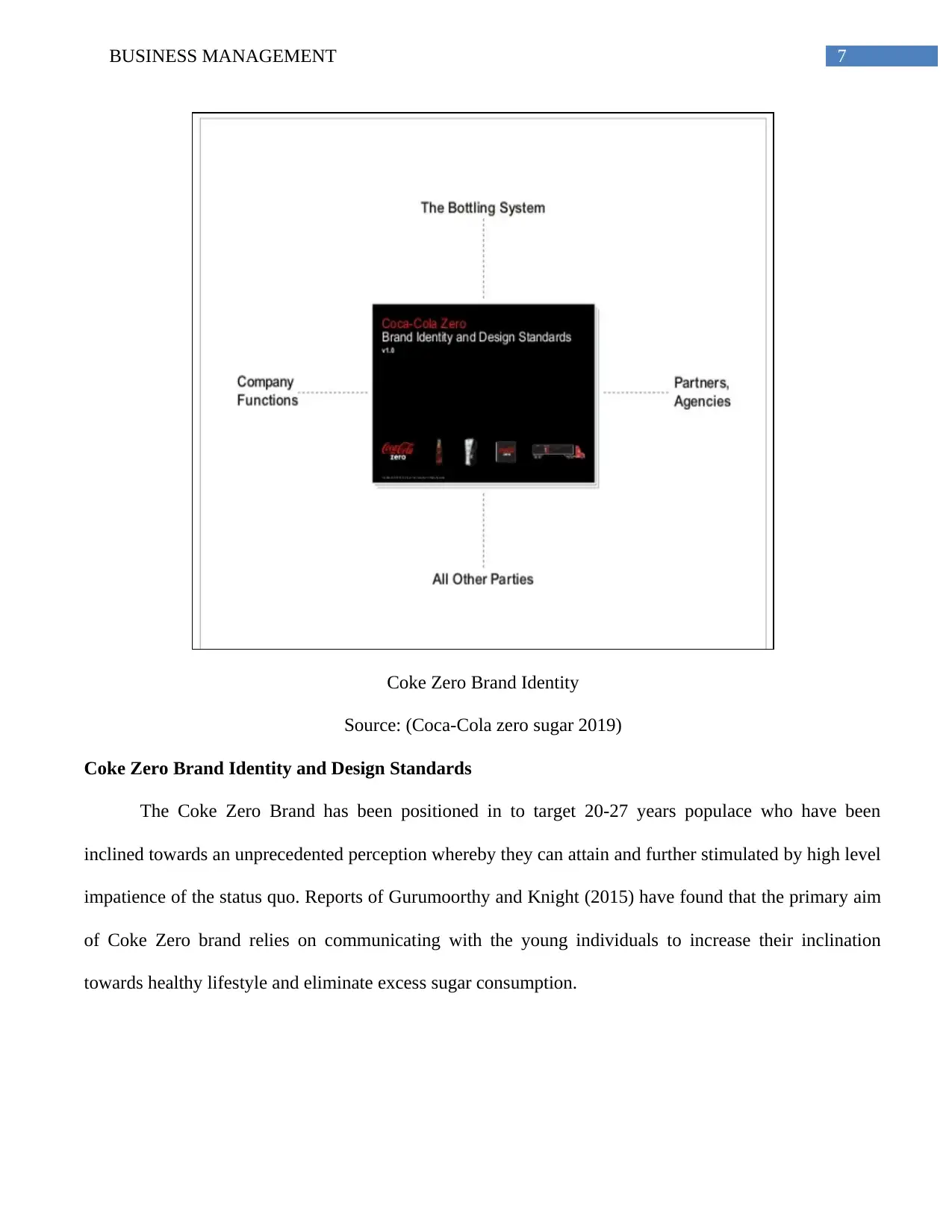
protected across at every touch point. Blair and Chiou (2014) have stated that the brand standards of Coke
Zero should be applied by Coca Cola as well as the bottling system along with associates engaged in any
Coca-Cola touch point. Additionally, Coca Cola must efficiently address local guideline for:
Compliance as well as local legal rules and regulations
Limited authorized support of all materials before introducing in the market
Proper arrangement of communication objectives for Coke Zero
Coke Zero Brand Identity
The Coca Cola Zero Brand has been identified as a highly inextricable element of the Brand’s
equity and significantly influences the way consumers experience it. Wide ranging executions which use
Coca-Cola Zero have been identified as vital part of the Brand Identity as they focus on customers view
and connect with Coca-Cola Zero. Kapferer (2012) has stated system centric uniqueness and propose
standards as established element of the company’s inheritance and fundamental in structure strong
international brands. These standards sanction markets to emerge from universal rules as well as
principled in order to experience Brand Identity of Coke Zero across the world on a regular basis and
protected across at every touch point. Blair and Chiou (2014) have stated that the brand standards of Coke
Zero should be applied by Coca Cola as well as the bottling system along with associates engaged in any
Coca-Cola touch point. Additionally, Coca Cola must efficiently address local guideline for:
Compliance as well as local legal rules and regulations
Limited authorized support of all materials before introducing in the market
Proper arrangement of communication objectives for Coke Zero
Paraphrase This Document
Need a fresh take? Get an instant paraphrase of this document with our AI Paraphraser
7BUSINESS MANAGEMENT
Coke Zero Brand Identity
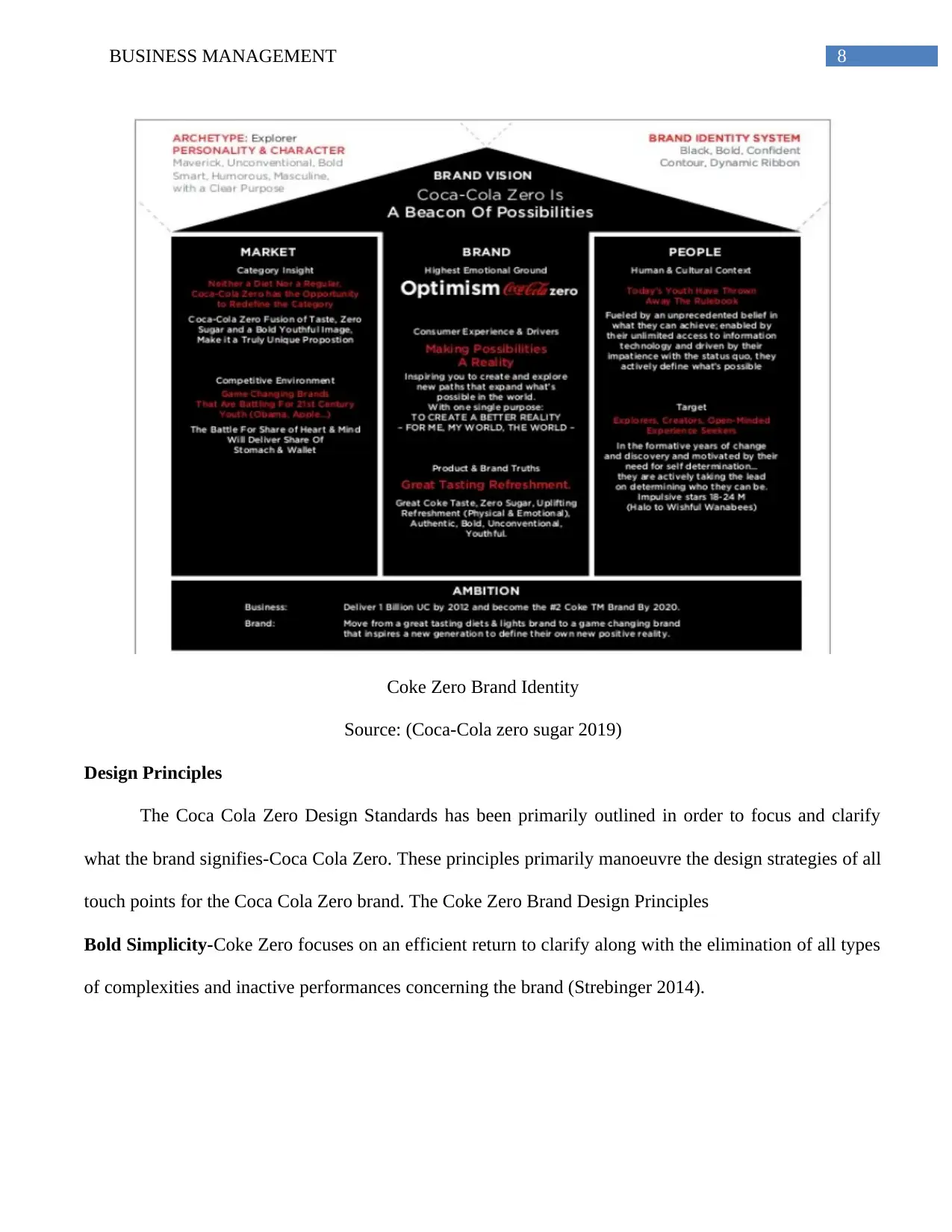
Source: (Coca-Cola zero sugar 2019)
Coke Zero Brand Identity and Design Standards
The Coke Zero Brand has been positioned in to target 20-27 years populace who have been
inclined towards an unprecedented perception whereby they can attain and further stimulated by high level
impatience of the status quo. Reports of Gurumoorthy and Knight (2015) have found that the primary aim
of Coke Zero brand relies on communicating with the young individuals to increase their inclination
towards healthy lifestyle and eliminate excess sugar consumption.
Coke Zero Brand Identity
Source: (Coca-Cola zero sugar 2019)
Coke Zero Brand Identity and Design Standards
The Coke Zero Brand has been positioned in to target 20-27 years populace who have been
inclined towards an unprecedented perception whereby they can attain and further stimulated by high level
impatience of the status quo. Reports of Gurumoorthy and Knight (2015) have found that the primary aim
of Coke Zero brand relies on communicating with the young individuals to increase their inclination
towards healthy lifestyle and eliminate excess sugar consumption.
8BUSINESS MANAGEMENT
Coke Zero Brand Identity
Source: (Coca-Cola zero sugar 2019)
Design Principles
The Coca Cola Zero Design Standards has been primarily outlined in order to focus and clarify
what the brand signifies-Coca Cola Zero. These principles primarily manoeuvre the design strategies of all
touch points for the Coca Cola Zero brand. The Coke Zero Brand Design Principles
Bold Simplicity-Coke Zero focuses on an efficient return to clarify along with the elimination of all types
of complexities and inactive performances concerning the brand (Strebinger 2014).
Coke Zero Brand Identity
Source: (Coca-Cola zero sugar 2019)
Design Principles
The Coca Cola Zero Design Standards has been primarily outlined in order to focus and clarify
what the brand signifies-Coca Cola Zero. These principles primarily manoeuvre the design strategies of all
touch points for the Coca Cola Zero brand. The Coke Zero Brand Design Principles
Bold Simplicity-Coke Zero focuses on an efficient return to clarify along with the elimination of all types
of complexities and inactive performances concerning the brand (Strebinger 2014).
⊘ This is a preview!⊘
Do you want full access?
Subscribe today to unlock all pages.
Trusted by 1+ million students worldwide
9BUSINESS MANAGEMENT
Innovative and Genuine- The Company primarily steered by self-determination, characterizes an
exceptional strategy in order to distinguish its unique branding strategy in order to achieve greater
destiny.
Own Black- At every touch point, Coca Cola primarily influence the bold and positive energy of Coca
Cola Zero Black across various countries of the world. In addition to this, Coca Cola will continue to
incorporate the thread of Red in all their branding strategies (Kapferer 2012).
Bold and Unexpected- Sunder, Kumar and Zhao (2016) have stated that Coke Zero proficiently displays
its individualist character in a volatile marketing journey of discovery. Reports of authors have revealed
about the possession of authorization by Coca Cola in order to explore newly developed branding
strategies and further expand potential growth.
Coca Cola Zero Logo
Reports of Su, Zhu and Gong (2017) have noted that Coke Zero Logo has been regarded as a
primary benefit has been purposed for Coca Cola Zero Brand moreover has been distinguished as a
preferred Logo to successfully represent its Brand. Spenciarian Script has been efficiently controlled over
the Coca Cola Brand which has been visually associated with the ‘Zero’ logo’ that has been planned to
signify the vibrant appearance and masculinity of the brand. Baah and Bohaker (2015) have mentioned
that such a design layout has formed a holistic image of the Coca Cola Zero Brand thus reflecting a
representation of the original Coca Cola Trademark.
However, the company must take into account that the Spenciarian Script which has been used for the
company Coca Cola Trademark must not be implemented for other branding strategies apart from
trademarks involving “Coca Cola’ and ‘Coke’ along with the trade identities of the Coca Cola Company,
its suppliers as well as its bottlers. Coca Company has been highly committed in applying the Coca Coca
Cola Zero logo in its most authentic form. The company can efficiently form proficient executions which
Innovative and Genuine- The Company primarily steered by self-determination, characterizes an
exceptional strategy in order to distinguish its unique branding strategy in order to achieve greater
destiny.
Own Black- At every touch point, Coca Cola primarily influence the bold and positive energy of Coca
Cola Zero Black across various countries of the world. In addition to this, Coca Cola will continue to
incorporate the thread of Red in all their branding strategies (Kapferer 2012).
Bold and Unexpected- Sunder, Kumar and Zhao (2016) have stated that Coke Zero proficiently displays
its individualist character in a volatile marketing journey of discovery. Reports of authors have revealed
about the possession of authorization by Coca Cola in order to explore newly developed branding
strategies and further expand potential growth.
Coca Cola Zero Logo
Reports of Su, Zhu and Gong (2017) have noted that Coke Zero Logo has been regarded as a
primary benefit has been purposed for Coca Cola Zero Brand moreover has been distinguished as a
preferred Logo to successfully represent its Brand. Spenciarian Script has been efficiently controlled over
the Coca Cola Brand which has been visually associated with the ‘Zero’ logo’ that has been planned to
signify the vibrant appearance and masculinity of the brand. Baah and Bohaker (2015) have mentioned
that such a design layout has formed a holistic image of the Coca Cola Zero Brand thus reflecting a
representation of the original Coca Cola Trademark.
However, the company must take into account that the Spenciarian Script which has been used for the
company Coca Cola Trademark must not be implemented for other branding strategies apart from
trademarks involving “Coca Cola’ and ‘Coke’ along with the trade identities of the Coca Cola Company,
its suppliers as well as its bottlers. Coca Company has been highly committed in applying the Coca Coca
Cola Zero logo in its most authentic form. The company can efficiently form proficient executions which
Paraphrase This Document
Need a fresh take? Get an instant paraphrase of this document with our AI Paraphraser
10BUSINESS MANAGEMENT
preserve its original and unique essence and significantly fashions a constant and exceptional approach for
the Coke Zero Brand.
Coca Cola Zero Logo
Source: (Coca-Cola zero sugar 2019)
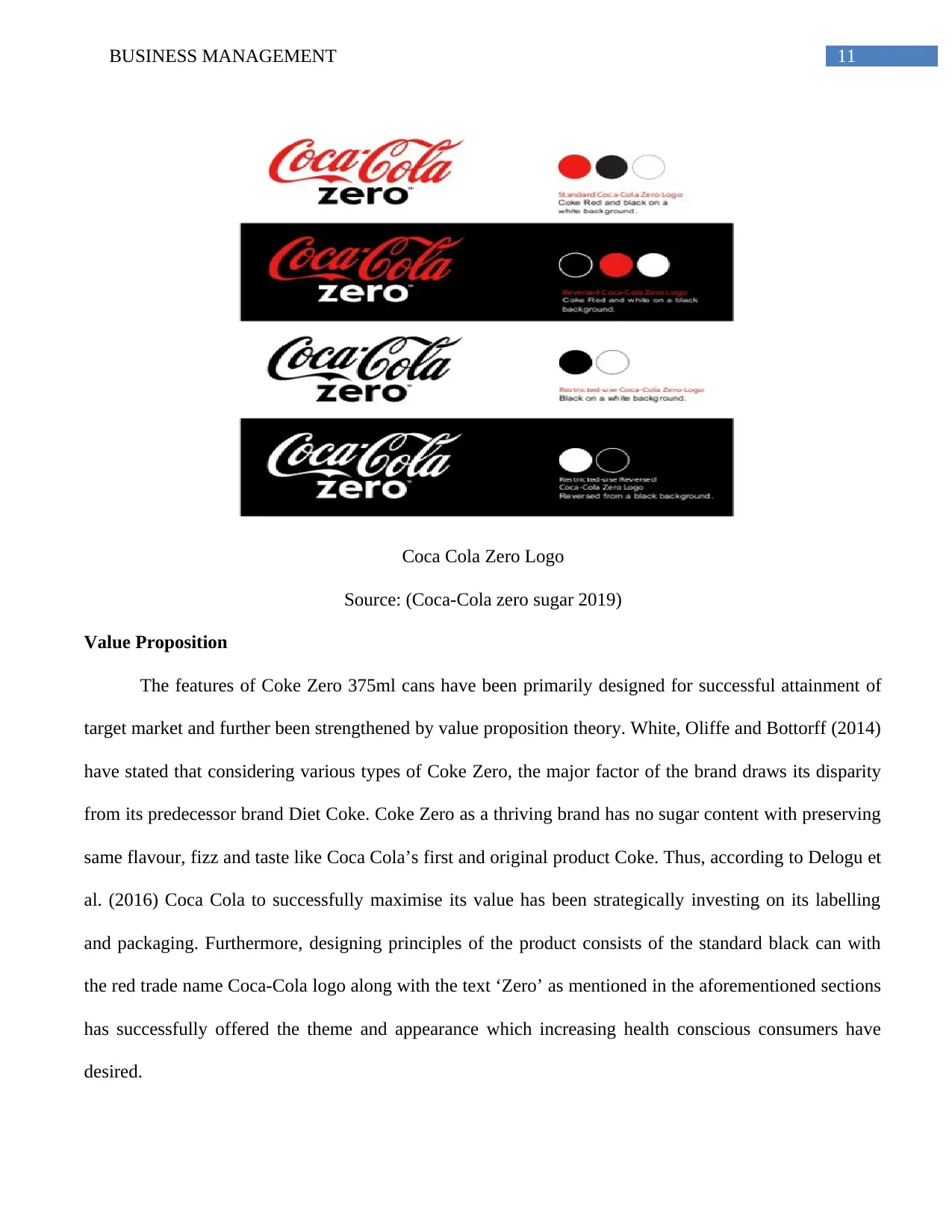
Colour implementation of the Coca-Cola Zero Logo primarily consists of the standard Logo on a white
backdrop in addition to the inverted Logo in Coke Red plus white on a black setting. However, according
of Gurumoorthy and Knight (2015), the Coca-Cola Zero Logo must be careful of not been revealed in
other colours even positioned within the brand colour palette. Furthermore, the Coca-Cola Zero Logo
must never be publicized on backgrounds (Kapferer 2012).
Exceptions
Reports of Urde and Koch (2014) have revealed that for media in which colour is not an alternative
for example, a black- and-white print advertisement, application of either the limited implementation of
Coca-Cola Zero Logo or the limited use invalidate Coca-Cola Zero Logo. However, for premiums,
architectural particulars or other relevance in which Coca-Cola Zero Logo has been imprinted, stamped,
sandblasted or spot varnished, the colour tends to appear as the substrate of the objects used.
preserve its original and unique essence and significantly fashions a constant and exceptional approach for
the Coke Zero Brand.
Coca Cola Zero Logo
Source: (Coca-Cola zero sugar 2019)
Colour implementation of the Coca-Cola Zero Logo primarily consists of the standard Logo on a white
backdrop in addition to the inverted Logo in Coke Red plus white on a black setting. However, according
of Gurumoorthy and Knight (2015), the Coca-Cola Zero Logo must be careful of not been revealed in
other colours even positioned within the brand colour palette. Furthermore, the Coca-Cola Zero Logo
must never be publicized on backgrounds (Kapferer 2012).
Exceptions
Reports of Urde and Koch (2014) have revealed that for media in which colour is not an alternative
for example, a black- and-white print advertisement, application of either the limited implementation of
Coca-Cola Zero Logo or the limited use invalidate Coca-Cola Zero Logo. However, for premiums,
architectural particulars or other relevance in which Coca-Cola Zero Logo has been imprinted, stamped,
sandblasted or spot varnished, the colour tends to appear as the substrate of the objects used.
11BUSINESS MANAGEMENT
Coca Cola Zero Logo
Source: (Coca-Cola zero sugar 2019)
Value Proposition
The features of Coke Zero 375ml cans have been primarily designed for successful attainment of
target market and further been strengthened by value proposition theory. White, Oliffe and Bottorff (2014)
have stated that considering various types of Coke Zero, the major factor of the brand draws its disparity
from its predecessor brand Diet Coke. Coke Zero as a thriving brand has no sugar content with preserving
same flavour, fizz and taste like Coca Cola’s first and original product Coke. Thus, according to Delogu et
al. (2016) Coca Cola to successfully maximise its value has been strategically investing on its labelling
and packaging. Furthermore, designing principles of the product consists of the standard black can with
the red trade name Coca-Cola logo along with the text ‘Zero’ as mentioned in the aforementioned sections
has successfully offered the theme and appearance which increasing health conscious consumers have
desired.
Coca Cola Zero Logo
Source: (Coca-Cola zero sugar 2019)
Value Proposition
The features of Coke Zero 375ml cans have been primarily designed for successful attainment of
target market and further been strengthened by value proposition theory. White, Oliffe and Bottorff (2014)
have stated that considering various types of Coke Zero, the major factor of the brand draws its disparity
from its predecessor brand Diet Coke. Coke Zero as a thriving brand has no sugar content with preserving
same flavour, fizz and taste like Coca Cola’s first and original product Coke. Thus, according to Delogu et
al. (2016) Coca Cola to successfully maximise its value has been strategically investing on its labelling
and packaging. Furthermore, designing principles of the product consists of the standard black can with
the red trade name Coca-Cola logo along with the text ‘Zero’ as mentioned in the aforementioned sections
has successfully offered the theme and appearance which increasing health conscious consumers have
desired.
⊘ This is a preview!⊘
Do you want full access?
Subscribe today to unlock all pages.
Trusted by 1+ million students worldwide

1 out of 17


Related Documents


Your All-in-One AI-Powered Toolkit for Academic Success.
+13062052269
info@desklib.com
Available 24*7 on WhatsApp / Email
![[object Object]](/_next/static/media/star-bottom.7253800d.svg)
Unlock your academic potential
Copyright © 2020–2026 A2Z Services. All Rights Reserved. Developed and managed by ZUCOL.