Comprehensive Marketing Report: Coke Zero's 8Ps and CSR in Australia
VerifiedAdded on 2021/06/17
|20
|4975
|58
Report
AI Summary
This report provides a comprehensive analysis of Coke Zero's marketing strategies in the Australian market. It begins with an introduction to Coke Zero's launch in Australia, including the initial negative reception of a TV advertisement and the subsequent withdrawal. The report then delves into the eight marketing mix elements (product, price, promotion, place, people, packaging, processes, and physical evidence) employed by Coca-Cola for Coke Zero, theoretically outlining each concept and then applying them to the product. It explores product positioning, branding, and packaging, including how Coke Zero targets its male demographic. The report also examines promotion strategies such as sales promotions and advertising across various media. Pricing strategies, including cost-based, competition-based, and psychological pricing, are thoroughly discussed. Distribution channels and physical evidence, including the product's packaging and the physical environment where it is sold, are also analyzed. Furthermore, the report addresses Coca-Cola's corporate social responsibility (CSR) initiatives, partnership, and their impact on the brand's marketing efforts. Finally, the report briefly touches upon some conflicts faced by Coca-Cola, providing a holistic view of Coke Zero's marketing approach.
Running Head: MARKETING MANAGEMNT 1
MARKETING MANAGEMENT
Name
Institutional Affiliation
MARKETING MANAGEMENT
Name
Institutional Affiliation

Paraphrase This Document
Need a fresh take? Get an instant paraphrase of this document with our AI Paraphraser
MARKETING MANAGEMENT 2
1. Introduction
Coca-Cola first launched its coke zero in Australia in 2006. The coke zero was launched
with a TV ad that was received negatively lasting for only a month and a half when it was
withdrawn due to complaints that it was a model of bad behaviour (Cox, 2009). The ad was
removed from the TVs completely and does not appear on Australia online today (Lambooy,
2011). The eight marketing mix used by the Coca-Cola Company in its Coke Zero are price,
product, promotion, people, place, packaging, processes and physical evidence (Lambooy,
2011). The direct Coca-Cola zero competitors are the soft drinks and energy drinks (Uddin,
2011). They include Pepsi which just like Coke Zero has powerful marketing and sales policies
making the two fight tooth to nail. The two has a wide distribution and share the highest market
share despite the country being sold (Trudel& Argo, 2013). The ads on each of these brands
show heightened rivalry between the two. Coke Zero is a male drink while women would prefer
using Coke Diet. This report will focus on Coke Zero in Australia and give recommendations on
the same brand.
Outline and describe the 8 marketing mix concepts theoretically and apply the components to
one of your products offerings
Product
In the marketing mix, the product is categorised into two aspects which are core product
and known to be the benefits offered by the products to its consumers. The additional features
such like branding, positioning and packaging also are the benefit a customer receives from the
product (Thain& Bradley, 2012). Product positioning refers to as a form of marketing presenting
1. Introduction
Coca-Cola first launched its coke zero in Australia in 2006. The coke zero was launched
with a TV ad that was received negatively lasting for only a month and a half when it was
withdrawn due to complaints that it was a model of bad behaviour (Cox, 2009). The ad was
removed from the TVs completely and does not appear on Australia online today (Lambooy,
2011). The eight marketing mix used by the Coca-Cola Company in its Coke Zero are price,
product, promotion, people, place, packaging, processes and physical evidence (Lambooy,
2011). The direct Coca-Cola zero competitors are the soft drinks and energy drinks (Uddin,
2011). They include Pepsi which just like Coke Zero has powerful marketing and sales policies
making the two fight tooth to nail. The two has a wide distribution and share the highest market
share despite the country being sold (Trudel& Argo, 2013). The ads on each of these brands
show heightened rivalry between the two. Coke Zero is a male drink while women would prefer
using Coke Diet. This report will focus on Coke Zero in Australia and give recommendations on
the same brand.
Outline and describe the 8 marketing mix concepts theoretically and apply the components to
one of your products offerings
Product
In the marketing mix, the product is categorised into two aspects which are core product
and known to be the benefits offered by the products to its consumers. The additional features
such like branding, positioning and packaging also are the benefit a customer receives from the
product (Thain& Bradley, 2012). Product positioning refers to as a form of marketing presenting
MARKETING MANAGEMENT 3
the benefit of that particular product to the customer in target (Trudel& Argo, 2013). Focus
groups and researches help to know which features would be more appealing to the target
audience.
Branding is the other feature used on products to help differentiate the product from those
of competitors. Brand is identifiable through its products’ logo and name (Lam et al., 2013). For
instance, Coke Zero has an original logo with features in red Coca-Cola’s logo positioned on a
black background, and Zero appears written underneath lower case (Davis, 2017). Coke zero has
a high standard and quality as it mother company Coke Zero Company would give it the highest
attention (Davis, 2017). Customers buy this product due to a high quality and high standards
from the Coke Zero Company previous products.
The third feature of a product advantageous to a target customer is packaging. It is useful
in targeting a market through informing and promoting the existence of the products to the
customers (Nobel, 2013). Coke Zero was designed to attract young men with its classy
packaging with red and black to which men would not see anything ‘girlish’ in it (Nobel, 2013).
This product has a helpline for complaints which dissatisfied customers may use to give
feedback on features they don’t like add something to it.
Coke’s products also appear in varieties for the customer conviction that it caters for their
needs. And these varieties include: product size, for example, Coca-Cola Zero Can 375ml, Coca
Cola Zero Bottle 2L etc. (Trudel& Argo, 2013).
Promotion
Promotion is simply a design creating awareness of the product existence, its benefits and
telling prospective customers where they can get it from. Promotion also aims at persuading
the benefit of that particular product to the customer in target (Trudel& Argo, 2013). Focus
groups and researches help to know which features would be more appealing to the target
audience.
Branding is the other feature used on products to help differentiate the product from those
of competitors. Brand is identifiable through its products’ logo and name (Lam et al., 2013). For
instance, Coke Zero has an original logo with features in red Coca-Cola’s logo positioned on a
black background, and Zero appears written underneath lower case (Davis, 2017). Coke zero has
a high standard and quality as it mother company Coke Zero Company would give it the highest
attention (Davis, 2017). Customers buy this product due to a high quality and high standards
from the Coke Zero Company previous products.
The third feature of a product advantageous to a target customer is packaging. It is useful
in targeting a market through informing and promoting the existence of the products to the
customers (Nobel, 2013). Coke Zero was designed to attract young men with its classy
packaging with red and black to which men would not see anything ‘girlish’ in it (Nobel, 2013).
This product has a helpline for complaints which dissatisfied customers may use to give
feedback on features they don’t like add something to it.
Coke’s products also appear in varieties for the customer conviction that it caters for their
needs. And these varieties include: product size, for example, Coca-Cola Zero Can 375ml, Coca
Cola Zero Bottle 2L etc. (Trudel& Argo, 2013).
Promotion
Promotion is simply a design creating awareness of the product existence, its benefits and
telling prospective customers where they can get it from. Promotion also aims at persuading
⊘ This is a preview!⊘
Do you want full access?
Subscribe today to unlock all pages.

Trusted by 1+ million students worldwide
MARKETING MANAGEMENT 4
customers to try the new product or continue using the existing company’s products (Thain&
Bradley, 2012). Promotion in marketing mix used by Coke Zero includes Sales promotion which
is the process of persuading the potential customers to buy a product(s). This is a short-term
design a company uses to increase sales.
Advertising is the most expensive but the best in increasing sales through reminding
customers of the product's existence. It is a means of communication designed to persuade
customers in buying the products (Drewniany, &Jewler, 2013). Coke Zero uses various types of
advertising to promote its product, and they are Television, radio, newspaper advertisement,
internet and billboards (Drewniany&Jewler, 2013). These types of advertisement are meant to
portray Coke Zero image positively in public.
People
Below the line promotion is another form of advertising which Coke used in the past in
first days of Coke Zero entry into the market. Coca-Cola offered four million free samples within
four weeks to promote coke zero which was an expensive way of winning new and already
existing customers(Hua et al., 2017).
Pricing
The demand and supply of products highly depend on this important aspect of market
mix. The price of a product influences consumer’s decision to purchase or not. It also determines
the profit the company will make as well as the number of sales in the company (Thain&
Bradley, 2012). Coke Zero, for this reason, has prices suited to all types of their customers.
There are methods which determine the price of a product, and they are cost and competition
based.
customers to try the new product or continue using the existing company’s products (Thain&
Bradley, 2012). Promotion in marketing mix used by Coke Zero includes Sales promotion which
is the process of persuading the potential customers to buy a product(s). This is a short-term
design a company uses to increase sales.
Advertising is the most expensive but the best in increasing sales through reminding
customers of the product's existence. It is a means of communication designed to persuade
customers in buying the products (Drewniany, &Jewler, 2013). Coke Zero uses various types of
advertising to promote its product, and they are Television, radio, newspaper advertisement,
internet and billboards (Drewniany&Jewler, 2013). These types of advertisement are meant to
portray Coke Zero image positively in public.
People
Below the line promotion is another form of advertising which Coke used in the past in
first days of Coke Zero entry into the market. Coca-Cola offered four million free samples within
four weeks to promote coke zero which was an expensive way of winning new and already
existing customers(Hua et al., 2017).
Pricing
The demand and supply of products highly depend on this important aspect of market
mix. The price of a product influences consumer’s decision to purchase or not. It also determines
the profit the company will make as well as the number of sales in the company (Thain&
Bradley, 2012). Coke Zero, for this reason, has prices suited to all types of their customers.
There are methods which determine the price of a product, and they are cost and competition
based.
Paraphrase This Document
Need a fresh take? Get an instant paraphrase of this document with our AI Paraphraser
MARKETING MANAGEMENT 5
Coca-Cola applies psychological pricing strategy where they lower amount in ones or
decimal point e.g. from $2.60-2.59 and make client think the price is below, promotional pricing
strategy, Segment pricing strategy and discriminatory pricing strategy(Esteves, R. B. (2009),
when customers are paying for the product(Luis Méndez, Oubina, & Rubio, 2011). Promotion of
the product, advertising and transportation are all inclusive in the final price in Coke Zero.
Competition based pricing method looks at Coca-Cola’s product competitor(Taylor,
Satija, Khurana, Singh, & Ebrahim, 2011). Pepsi has ever been the main competitor of Coke
Zero though Coke Zero came later and the competition. Pepsi price has been used by Coca-Cola
to determine its Coke Zero prices.
Pricing policies
Increased demand in Coke Zero has enabled Coca-Cola to determine a readily and honest
prices accepted by all its customers. Coke Zero is always aware of the importance of pricing as it
determines the amount of sales and profits it makes. Coke tries to set a price acceptable by all as
well as making sure profits will not be affected(Strebinger, 2014).
Coke Zero also used penetration pricing strategy through setting extreme lower prices for
their products compared to those of competitor Pepsi Max to gain market share. Price point
strategy was/is also used by Coke Zero to make customers aware of their products’ prices and
even today.
Product size has also been used to determine the price of the Coke Zero product. For
instance, depending on the size as follows Coke sells each size at its price. Coca Cola Zero Can
375mlCoca Cola Zero Can 375ml 1.08, Coca Cola Zero Bottle 600mlCoca Cola Zero Bottle
Coca-Cola applies psychological pricing strategy where they lower amount in ones or
decimal point e.g. from $2.60-2.59 and make client think the price is below, promotional pricing
strategy, Segment pricing strategy and discriminatory pricing strategy(Esteves, R. B. (2009),
when customers are paying for the product(Luis Méndez, Oubina, & Rubio, 2011). Promotion of
the product, advertising and transportation are all inclusive in the final price in Coke Zero.
Competition based pricing method looks at Coca-Cola’s product competitor(Taylor,
Satija, Khurana, Singh, & Ebrahim, 2011). Pepsi has ever been the main competitor of Coke
Zero though Coke Zero came later and the competition. Pepsi price has been used by Coca-Cola
to determine its Coke Zero prices.
Pricing policies
Increased demand in Coke Zero has enabled Coca-Cola to determine a readily and honest
prices accepted by all its customers. Coke Zero is always aware of the importance of pricing as it
determines the amount of sales and profits it makes. Coke tries to set a price acceptable by all as
well as making sure profits will not be affected(Strebinger, 2014).
Coke Zero also used penetration pricing strategy through setting extreme lower prices for
their products compared to those of competitor Pepsi Max to gain market share. Price point
strategy was/is also used by Coke Zero to make customers aware of their products’ prices and
even today.
Product size has also been used to determine the price of the Coke Zero product. For
instance, depending on the size as follows Coke sells each size at its price. Coca Cola Zero Can
375mlCoca Cola Zero Can 375ml 1.08, Coca Cola Zero Bottle 600mlCoca Cola Zero Bottle
MARKETING MANAGEMENT 6
600ml 3.67, Coca Cola Zero Bottle 1.25LCoca Cola Zero Bottle 1.25L 2.68, Coca Cola Zero
Bottle 2L, Coca Cola Zero Bottle 2L 3.90 etc.
Place
Place is the distribution and the way of distribution of products to the market. Coke Zero
has been made available worldwide due to it belonging to Coca-Cola Company. The
intermediaries are used in the distribution of products to different places to link the product and
the final customer (Thain& Bradley, 2012). Products reach final customers through various
distribution channels (Strebinger, 2014).
The channels which are mostly used by Coke Zero to reach customers are producer to
consumer, producer to retailer to consumer and producer to wholesaler to retailer to consumer
(Noel, 2009). Coke zero minimises its cost of production while maximising sales through the use
of intermediaries (Cox, 2009). With intermediaries, Coke Zero has been made available in shops,
petrol stations, gym places, etc. which Coca-Cola itself would not be able to do as it cannot
operate small shops (Thain& Bradley, 2012).
Physical evidence
Physical evidence is a marketing mix. Physical evidence means, that product which
customer can evaluate and assess through touching or seeing so that they can buy it. Physical
evidence can only be limited to product and not applicable in service. Coke Zero is packed in a
can which helps customers to evaluate it before they make decision to buy as a result of how they
get attracted(Noel, 2009). Physical evidence in Coke Zero is presented through: physical
environment- where the customer would go and get to buy and drink the product(Strebinger,
2014). Ambient condition is comprised of temperature, smell and sound, color, music and
600ml 3.67, Coca Cola Zero Bottle 1.25LCoca Cola Zero Bottle 1.25L 2.68, Coca Cola Zero
Bottle 2L, Coca Cola Zero Bottle 2L 3.90 etc.
Place
Place is the distribution and the way of distribution of products to the market. Coke Zero
has been made available worldwide due to it belonging to Coca-Cola Company. The
intermediaries are used in the distribution of products to different places to link the product and
the final customer (Thain& Bradley, 2012). Products reach final customers through various
distribution channels (Strebinger, 2014).
The channels which are mostly used by Coke Zero to reach customers are producer to
consumer, producer to retailer to consumer and producer to wholesaler to retailer to consumer
(Noel, 2009). Coke zero minimises its cost of production while maximising sales through the use
of intermediaries (Cox, 2009). With intermediaries, Coke Zero has been made available in shops,
petrol stations, gym places, etc. which Coca-Cola itself would not be able to do as it cannot
operate small shops (Thain& Bradley, 2012).
Physical evidence
Physical evidence is a marketing mix. Physical evidence means, that product which
customer can evaluate and assess through touching or seeing so that they can buy it. Physical
evidence can only be limited to product and not applicable in service. Coke Zero is packed in a
can which helps customers to evaluate it before they make decision to buy as a result of how they
get attracted(Noel, 2009). Physical evidence in Coke Zero is presented through: physical
environment- where the customer would go and get to buy and drink the product(Strebinger,
2014). Ambient condition is comprised of temperature, smell and sound, color, music and
⊘ This is a preview!⊘
Do you want full access?
Subscribe today to unlock all pages.
Trusted by 1+ million students worldwide
MARKETING MANAGEMENT 7
noise(Strebinger, 2014). The Coke zero ambient condition isits color(Muller, & Shachar, 2009).
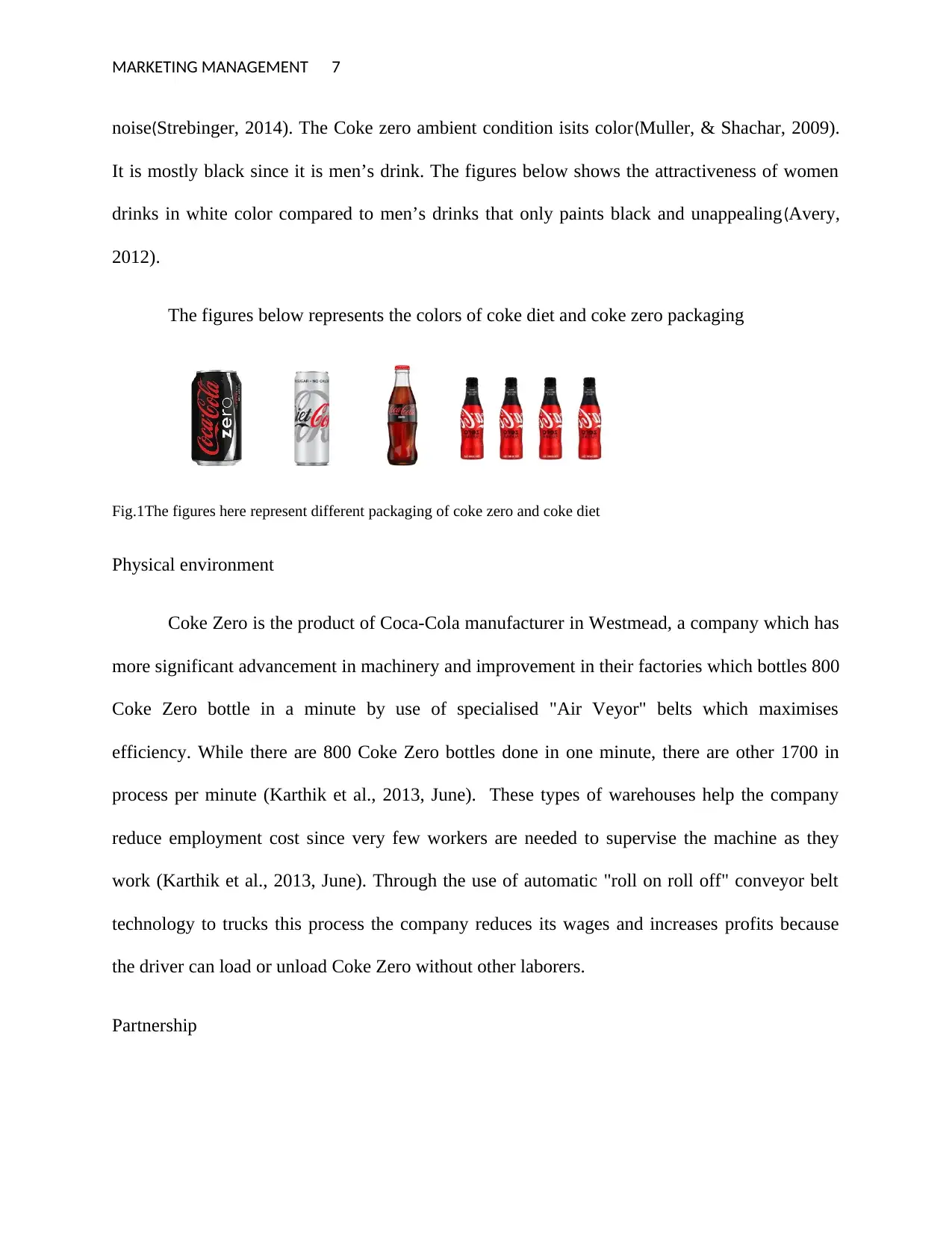
It is mostly black since it is men’s drink. The figures below shows the attractiveness of women
drinks in white color compared to men’s drinks that only paints black and unappealing(Avery,
2012).
The figures below represents the colors of coke diet and coke zero packaging
Fig.1The figures here represent different packaging of coke zero and coke diet
Physical environment
Coke Zero is the product of Coca-Cola manufacturer in Westmead, a company which has
more significant advancement in machinery and improvement in their factories which bottles 800
Coke Zero bottle in a minute by use of specialised "Air Veyor" belts which maximises
efficiency. While there are 800 Coke Zero bottles done in one minute, there are other 1700 in
process per minute (Karthik et al., 2013, June). These types of warehouses help the company
reduce employment cost since very few workers are needed to supervise the machine as they
work (Karthik et al., 2013, June). Through the use of automatic "roll on roll off" conveyor belt
technology to trucks this process the company reduces its wages and increases profits because
the driver can load or unload Coke Zero without other laborers.
Partnership
noise(Strebinger, 2014). The Coke zero ambient condition isits color(Muller, & Shachar, 2009).
It is mostly black since it is men’s drink. The figures below shows the attractiveness of women
drinks in white color compared to men’s drinks that only paints black and unappealing(Avery,
2012).
The figures below represents the colors of coke diet and coke zero packaging
Fig.1The figures here represent different packaging of coke zero and coke diet
Physical environment
Coke Zero is the product of Coca-Cola manufacturer in Westmead, a company which has
more significant advancement in machinery and improvement in their factories which bottles 800
Coke Zero bottle in a minute by use of specialised "Air Veyor" belts which maximises
efficiency. While there are 800 Coke Zero bottles done in one minute, there are other 1700 in
process per minute (Karthik et al., 2013, June). These types of warehouses help the company
reduce employment cost since very few workers are needed to supervise the machine as they
work (Karthik et al., 2013, June). Through the use of automatic "roll on roll off" conveyor belt
technology to trucks this process the company reduces its wages and increases profits because
the driver can load or unload Coke Zero without other laborers.
Partnership
Paraphrase This Document
Need a fresh take? Get an instant paraphrase of this document with our AI Paraphraser
MARKETING MANAGEMENT 8
Partnership is as good as other marketing strategies Coca-Cola uses to increase their
competitive advantage in the local and global market. The need for Coca-Cola to exercise
corporate social responsibility has made it partner with a number of other organisations to help
give back to society and the planet(Panzavolta, 2016). The Company believes that partnership
helps it achieve what they cannot achieve singly(Noel, 2009). In Australia for instance, Coca-
Cola partners with “The Song Room”, an Australian leading education arts provider. “When I
first came across the Coca-Cola Australia Foundation and its grant opportunities what really
resonated with me was their mission: to inspire moments of happiness in the lives of young
adults,” Caroline said. “It aligns perfectly with the work of The Song Room – it’s what we’re all
about.”(Panzavolta, 2016).
Effects of Corporate social responsibility of Coke Zero on marketing criteria
Coca-Cola serves over 200 territories and countries worldwide, and they practice
corporate social responsibility in each of them. Coke CSR activities are meant to establish
sustainable communities. The company spends its 1% of the operating income to various
initiatives, programs and causes (Lambooy, 2011). For example, in 2014 Coca-Cola gave $126
million which was equivalent to 1.3% of their operating income (Social, & as a Global, 2014).
The money was used to invest in women’s empowerment, education, water stewardship
programs, humanitarian and disaster relief programs, active and healthy living initiatives etc.
(Lambooy, 2011).
The important aspect of CSR can be traced back to 1960s (Stores &Carryouts, 2016).
Carroll’s 1991 idea of CSR multi-layered into four interrelated viewpoints which were
comprised of: economic, legal, ethical, and philanthropic responsibilities.
Partnership is as good as other marketing strategies Coca-Cola uses to increase their
competitive advantage in the local and global market. The need for Coca-Cola to exercise
corporate social responsibility has made it partner with a number of other organisations to help
give back to society and the planet(Panzavolta, 2016). The Company believes that partnership
helps it achieve what they cannot achieve singly(Noel, 2009). In Australia for instance, Coca-
Cola partners with “The Song Room”, an Australian leading education arts provider. “When I
first came across the Coca-Cola Australia Foundation and its grant opportunities what really
resonated with me was their mission: to inspire moments of happiness in the lives of young
adults,” Caroline said. “It aligns perfectly with the work of The Song Room – it’s what we’re all
about.”(Panzavolta, 2016).
Effects of Corporate social responsibility of Coke Zero on marketing criteria
Coca-Cola serves over 200 territories and countries worldwide, and they practice
corporate social responsibility in each of them. Coke CSR activities are meant to establish
sustainable communities. The company spends its 1% of the operating income to various
initiatives, programs and causes (Lambooy, 2011). For example, in 2014 Coca-Cola gave $126
million which was equivalent to 1.3% of their operating income (Social, & as a Global, 2014).
The money was used to invest in women’s empowerment, education, water stewardship
programs, humanitarian and disaster relief programs, active and healthy living initiatives etc.
(Lambooy, 2011).
The important aspect of CSR can be traced back to 1960s (Stores &Carryouts, 2016).
Carroll’s 1991 idea of CSR multi-layered into four interrelated viewpoints which were
comprised of: economic, legal, ethical, and philanthropic responsibilities.
MARKETING MANAGEMENT 9
He stated that primary goals of CSR is to help business increase profits and by providing
goods and services and all the other three viewpoints lies behind this viewpoint(Social, & as a
Global, 2014). The second point comprises of legal responsibility a company has on the society
(Liu, Lopez & Zhu, 2014). Ethical responsibility has not been categorised into the law only the
company is expected to do the right thing reasonably. The year 2000 was multinational’s
operations begun to be investigated by the sections of society which made CSR even more
complex and source of many companies decision making (Gardner, Dukes III, & Patel, 2014).
Environmental issues, campaigns, scandals etc. that was reported by the said investigations saw a
lot of undesirable media attention, which brings questions whether the companies would adopt
CSR to repair damage caused by negative publicity (Noel, 2009).
Coca-Cola’s conflicts
An Indian NGO reported the presence of pesticides exceeding European standard in
Coca-Cola in the year 2003 and asked the government to enforce water standards, and the report
gained a lot of media coverage and public attention which in turn dropped the company’s
revenues. Coca-Cola, in addition, was reported to have polluted water sources, extract a large
amount of groundwater, and containing unacceptable levels of pesticides (Pourrezaei et al.,
2014).
The release of 2003 CSE report, led to Coca-Cola losing the consumer trust and
reputation as it went through a most extended legal process (Gardner, Dukes III, & Patel, 2014).
This led to drop by 40% sales in India and a total annual decline of 15% in sales compared to the
previous year which had reported a growth of between 25-30% in sales (Dutta, 2012). The
company was very as not interested in peoples’ health welfare rather than just making profit
He stated that primary goals of CSR is to help business increase profits and by providing
goods and services and all the other three viewpoints lies behind this viewpoint(Social, & as a
Global, 2014). The second point comprises of legal responsibility a company has on the society
(Liu, Lopez & Zhu, 2014). Ethical responsibility has not been categorised into the law only the
company is expected to do the right thing reasonably. The year 2000 was multinational’s
operations begun to be investigated by the sections of society which made CSR even more
complex and source of many companies decision making (Gardner, Dukes III, & Patel, 2014).
Environmental issues, campaigns, scandals etc. that was reported by the said investigations saw a
lot of undesirable media attention, which brings questions whether the companies would adopt
CSR to repair damage caused by negative publicity (Noel, 2009).
Coca-Cola’s conflicts
An Indian NGO reported the presence of pesticides exceeding European standard in
Coca-Cola in the year 2003 and asked the government to enforce water standards, and the report
gained a lot of media coverage and public attention which in turn dropped the company’s
revenues. Coca-Cola, in addition, was reported to have polluted water sources, extract a large
amount of groundwater, and containing unacceptable levels of pesticides (Pourrezaei et al.,
2014).
The release of 2003 CSE report, led to Coca-Cola losing the consumer trust and
reputation as it went through a most extended legal process (Gardner, Dukes III, & Patel, 2014).
This led to drop by 40% sales in India and a total annual decline of 15% in sales compared to the
previous year which had reported a growth of between 25-30% in sales (Dutta, 2012). The
company was very as not interested in peoples’ health welfare rather than just making profit
⊘ This is a preview!⊘
Do you want full access?
Subscribe today to unlock all pages.
Trusted by 1+ million students worldwide
MARKETING MANAGEMENT 10
(Liu, Lopez & Zhu, 2014). Due to the repeated publications, the attention caught consumers in
the US where the students protested of using Coca-Cola products in 10 universities.
From this explanation, Coca-Cola would try to rebuild its name again through the
adoption of CSR. The company would later come up with strategic philanthropy to get intangible
paybacks in terms of brand awareness and improved social capital translating into huge profits
which is against the principles of CSR (Stores &Carryouts, 2016). Philanthropic or charitable
CSR is typically cost the company incurs as it tries to prove to the society of its priority in
charitable work (Barnea& Rubin, 2010). The primary goal of CSR is that Company’s managers
are purely not tied to the business as they practice the charitable work (Sarich, Zaman&Misra).
This means that the sole goal of corporate social responsibility is not intended to increase profits
rather than improving peoples’ lives.
Good understanding of CSR is only when the company comes with voluntary CSR with
good intents and not making profit. Social pressures at times have led Coca-Cola breach this
philosophy to practice CSR instead of doing it willingly (Barnea& Rubin, 2010). For instance,
activist, civil, social organisation and journalists pressure Coca-Cola to try and improve the
environment or have social consequences (Stores &Carryouts, 2016). After companies have been
fined or penalised for malpractices, they launch philanthropic campaigns to repair their
reputation (Stores &Carryouts, 2016). In conclusion, the CSR is practised in two ways reactive
and active practices (Boelsen-Robinson, Backholer&Peeters, 2015). In active practice, the
company CSR practice is tied on value and purpose of the people while reactive will only be a
response meant to silence protesting voices.
(Liu, Lopez & Zhu, 2014). Due to the repeated publications, the attention caught consumers in
the US where the students protested of using Coca-Cola products in 10 universities.
From this explanation, Coca-Cola would try to rebuild its name again through the
adoption of CSR. The company would later come up with strategic philanthropy to get intangible
paybacks in terms of brand awareness and improved social capital translating into huge profits
which is against the principles of CSR (Stores &Carryouts, 2016). Philanthropic or charitable
CSR is typically cost the company incurs as it tries to prove to the society of its priority in
charitable work (Barnea& Rubin, 2010). The primary goal of CSR is that Company’s managers
are purely not tied to the business as they practice the charitable work (Sarich, Zaman&Misra).
This means that the sole goal of corporate social responsibility is not intended to increase profits
rather than improving peoples’ lives.
Good understanding of CSR is only when the company comes with voluntary CSR with
good intents and not making profit. Social pressures at times have led Coca-Cola breach this
philosophy to practice CSR instead of doing it willingly (Barnea& Rubin, 2010). For instance,
activist, civil, social organisation and journalists pressure Coca-Cola to try and improve the
environment or have social consequences (Stores &Carryouts, 2016). After companies have been
fined or penalised for malpractices, they launch philanthropic campaigns to repair their
reputation (Stores &Carryouts, 2016). In conclusion, the CSR is practised in two ways reactive
and active practices (Boelsen-Robinson, Backholer&Peeters, 2015). In active practice, the
company CSR practice is tied on value and purpose of the people while reactive will only be a
response meant to silence protesting voices.
Paraphrase This Document
Need a fresh take? Get an instant paraphrase of this document with our AI Paraphraser
MARKETING MANAGEMENT 11
Coca-Cola involved itself with Aqueduct Alliance was showcasing moves to gain back
its’ reputation and evade personal liability while preventing future claims on ground waters. This
was a reactive CSR against the Indian NGO that claimed excessive consumption of groundwater
(Cox, 2009). However, Coca-Cola aqueduct alliance reflects how society can benefit from the
rise of corporate movements focusing on addressing ecological concerns (Cox, 2009). This,
however, becomes the benefit of Coca-Cola as well. The Coca-Cola Company asserts that
businesses and humanitarian organisations help families and children in the developing worlds
and as they improve their lives in return the company gains huge profits (Barnea& Rubin, 2010).
And since the Coca-Cola Company alone cannot expand business overseas it works together to
alleviate illiteracy, poor health (Hua et al., 2017) and poverty is the essential building blocks for
families and societies that are stable (Stores &Carryouts, 2016). This is achieved through
partnership with other individual donors, a corporate partner like Coca-Cola and its partner from
U.S. foreign assistance which allows it to carry its work as it saves children.
In recent times, Coca-Cola has come up with different dialogue on the business role in
society which combines “profit and purpose” (Schnall, Zadra&Proffitt, 2010). Their dialogue
suggests that 86% of the current and future leaders have a feeling that the company will gain a
competitive advantage today and in future by focusing on environmental, societal, and economic
value.
Recommendations
a).Internet scenario assessment
Coca-Cola Company should do internet scenario assessment to be aware of the potential
it has in the next 5-10 years (Schnall, Zadra&Proffitt, 2010). This will help to determine the
Coca-Cola involved itself with Aqueduct Alliance was showcasing moves to gain back
its’ reputation and evade personal liability while preventing future claims on ground waters. This
was a reactive CSR against the Indian NGO that claimed excessive consumption of groundwater
(Cox, 2009). However, Coca-Cola aqueduct alliance reflects how society can benefit from the
rise of corporate movements focusing on addressing ecological concerns (Cox, 2009). This,
however, becomes the benefit of Coca-Cola as well. The Coca-Cola Company asserts that
businesses and humanitarian organisations help families and children in the developing worlds
and as they improve their lives in return the company gains huge profits (Barnea& Rubin, 2010).
And since the Coca-Cola Company alone cannot expand business overseas it works together to
alleviate illiteracy, poor health (Hua et al., 2017) and poverty is the essential building blocks for
families and societies that are stable (Stores &Carryouts, 2016). This is achieved through
partnership with other individual donors, a corporate partner like Coca-Cola and its partner from
U.S. foreign assistance which allows it to carry its work as it saves children.
In recent times, Coca-Cola has come up with different dialogue on the business role in
society which combines “profit and purpose” (Schnall, Zadra&Proffitt, 2010). Their dialogue
suggests that 86% of the current and future leaders have a feeling that the company will gain a
competitive advantage today and in future by focusing on environmental, societal, and economic
value.
Recommendations
a).Internet scenario assessment
Coca-Cola Company should do internet scenario assessment to be aware of the potential
it has in the next 5-10 years (Schnall, Zadra&Proffitt, 2010). This will help to determine the
MARKETING MANAGEMENT 12
growth of the internet in coming years enabling the company to know how they will determine
their prices, promotion and placement of their products in the market (Stores &Carryouts, 2016).
This also will help in globalisation goals.
b).Online presence
For better promotion of Coke Zero Coca-Cola should increase its online existence and
postings to allow customers interaction with the company. This will help in getting feedback on
their products usages and areas of improvement (Stores &Carryouts, 2016). If other brands like
RedBull and Pepsi continues their persistence online has been witnessed some customers may
shift to their products disadvantaging it (Davis, 2017). Also by doing so, the company will
continue winning more customers online (Drewniany&Jewler, 2013).
c).Activeness on online
The company should continue using online interaction and using helpline for complaints
which dissatisfied customers may use in giving feedback on features they don’t like add
something to it. This will help the Coke Zero continue getting enough information they need
(Lam et al., 2013). This will boost the Company’s knowledge of areas that will need to improve
to increase consumer experiences including branding, packaging, product size, etc. (Davis,
2017).
d).Pricing strategies
The company’s pricing strategies have been a big booster to its market penetration, and
they should continue inventing more appropriate ways to increase their products awareness
which in turn will increase their profits (Stoyanov, 2015).
growth of the internet in coming years enabling the company to know how they will determine
their prices, promotion and placement of their products in the market (Stores &Carryouts, 2016).
This also will help in globalisation goals.
b).Online presence
For better promotion of Coke Zero Coca-Cola should increase its online existence and
postings to allow customers interaction with the company. This will help in getting feedback on
their products usages and areas of improvement (Stores &Carryouts, 2016). If other brands like
RedBull and Pepsi continues their persistence online has been witnessed some customers may
shift to their products disadvantaging it (Davis, 2017). Also by doing so, the company will
continue winning more customers online (Drewniany&Jewler, 2013).
c).Activeness on online
The company should continue using online interaction and using helpline for complaints
which dissatisfied customers may use in giving feedback on features they don’t like add
something to it. This will help the Coke Zero continue getting enough information they need
(Lam et al., 2013). This will boost the Company’s knowledge of areas that will need to improve
to increase consumer experiences including branding, packaging, product size, etc. (Davis,
2017).
d).Pricing strategies
The company’s pricing strategies have been a big booster to its market penetration, and
they should continue inventing more appropriate ways to increase their products awareness
which in turn will increase their profits (Stoyanov, 2015).
⊘ This is a preview!⊘
Do you want full access?
Subscribe today to unlock all pages.
Trusted by 1+ million students worldwide

1 out of 20


Related Documents


Your All-in-One AI-Powered Toolkit for Academic Success.
+13062052269
info@desklib.com
Available 24*7 on WhatsApp / Email
![[object Object]](/_next/static/media/star-bottom.7253800d.svg)
Unlock your academic potential
Copyright © 2020–2026 A2Z Services. All Rights Reserved. Developed and managed by ZUCOL.