ENGT5102: Designing a Smart Collaborative Robot for Industry

Verified

Added on  2022/09/08

|22
|907
|24
Report
AI Summary
This report details the design of a smart collaborative robot for industrial transportation purposes, outlining the aim, objectives, and methodological approach. It covers key requirements such as a smart vision system and lightweight design. The report includes design specifications, alternative analyses of vision systems (1D, 2D, and 3D), and a final design featuring three driving wheels and various sensors. CAD models and vision simulations using Python are presented, along with the integration of IoT features for information sharing and embedded monitoring. The study concludes with a successful initial study, literature review, alternative system identification, and CAD model development, supported by a list of references. Desklib provides access to similar solved assignments and resources for students.
Document Page
DESIGN OF A SMART COLLABORATIVE ROBOT FOR
INDUSTRIAL TRANSPORTATION PURPOSES
tabler-icon-diamond-filled.svg

Paraphrase This Document

Need a fresh take? Get an instant paraphrase of this document with our AI Paraphraser
Document Page
Contents
Introduction
Aim & Objectives
Methodological Approach
Design Specifications
Alternatives
Final Design
CAD Models
Vision Simulation
IoT Features
Conclusion
Document Page
Introduction
Robots capable of working with humans
Has its own control system
It is not a regular industrial robot
It has force limitation features to ensure the safety of the humans
It doesn't need external safety systems
The main function is to direct collaboration with the worker for various task
Document Page
Aim & Objectives
The main aim is to develop the design of the collaborative robot for industrial
transportation purpose.
Objectives
Carry out the initial study about the collaborative robot
Collect the various information related to the collaborative robot
Perform the literature review
Carry out the design creation process.
Perform alternative analysis and alternative selection process
Perform the design development task and simulations
tabler-icon-diamond-filled.svg

Paraphrase This Document

Need a fresh take? Get an instant paraphrase of this document with our AI Paraphraser
Document Page
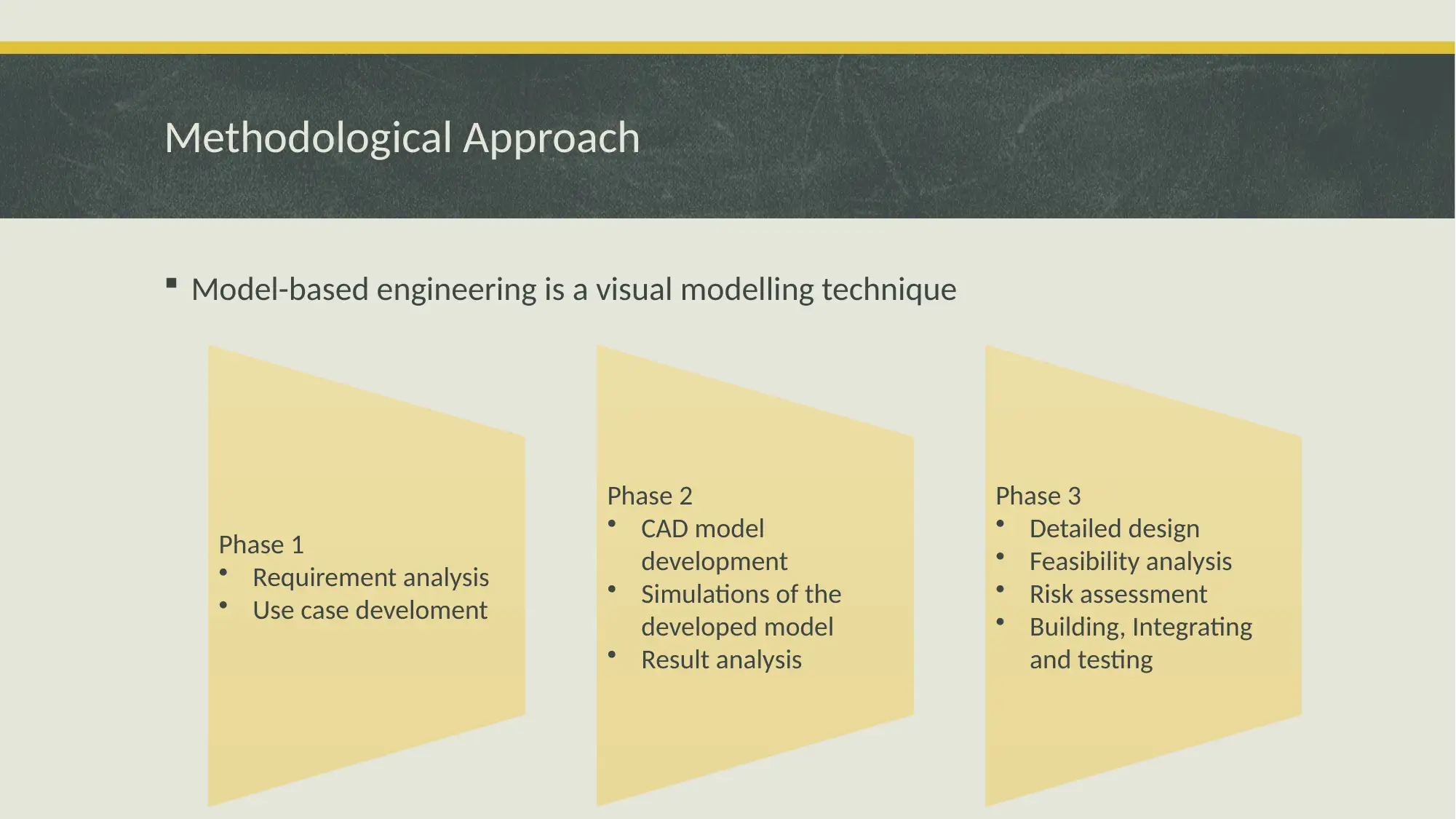
Methodological Approach
Phase 1
Requirement analysis
Use case develoment
Phase 2
CAD model
development
Simulations of the
developed model
Result analysis
Phase 3
Detailed design
Feasibility analysis
Risk assessment
Building, Integrating
and testing
Model-based engineering is a visual modelling technique
Document Page
Requirements
The robot must have a smart vision system
The vision system of the robot must capable of identifying the objects and
motions around the motion
For a transporting robot, the payload also considered as the main factor.
It must be a lightweight and simple design
Active and passive components must be included
Document Page
Design Specifications
The main focus is to develop a smarter and autonomous robot system
Capable of work in different locations
Capable of dealing with changing environments and moving objects
Capable of determining the orientation and shape of the objects
tabler-icon-diamond-filled.svg

Paraphrase This Document

Need a fresh take? Get an instant paraphrase of this document with our AI Paraphraser
Document Page
Requirement Diagram
Document Page
Use case Diagram
Document Page
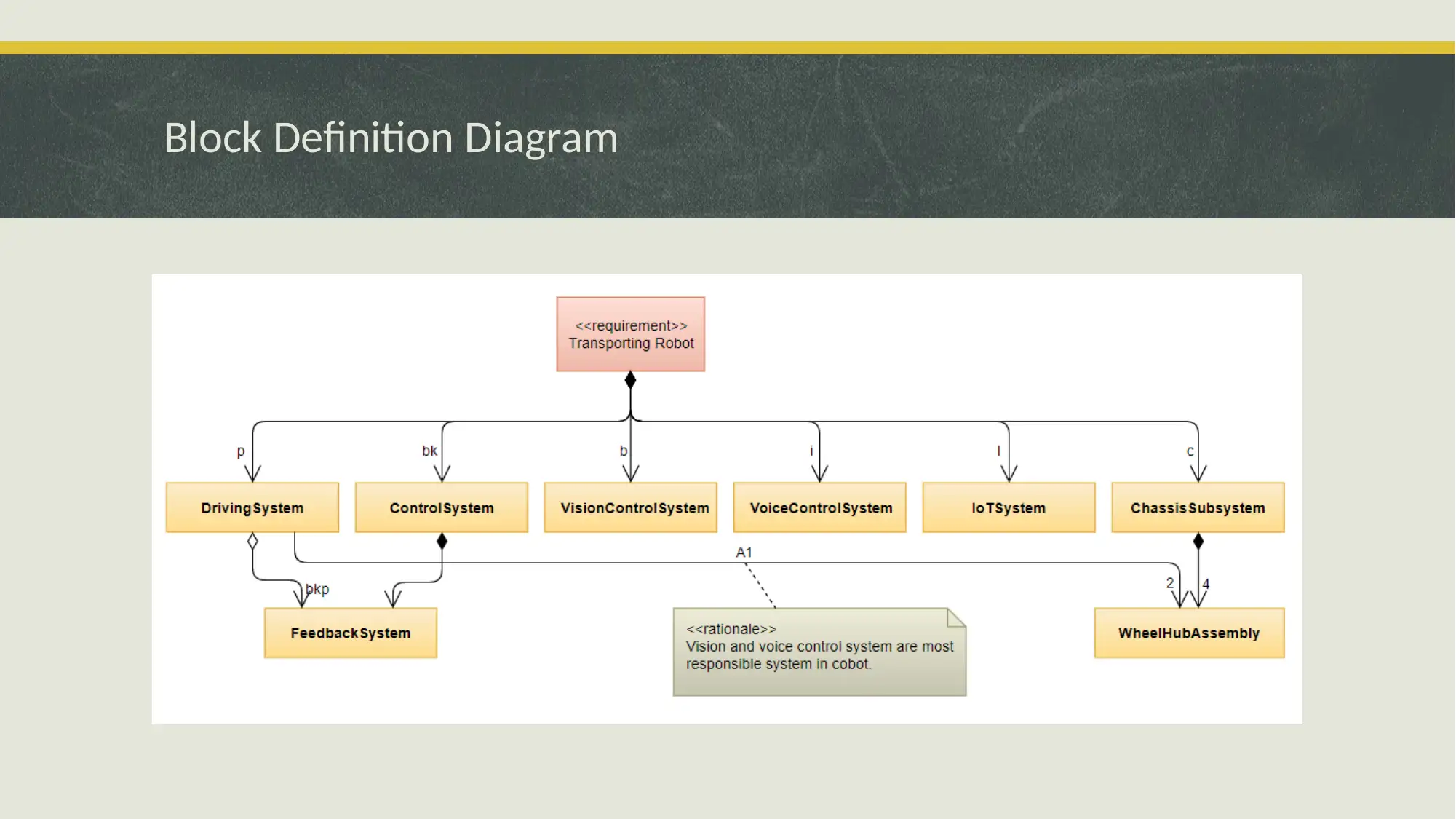
Block Definition Diagram
tabler-icon-diamond-filled.svg

Paraphrase This Document

Need a fresh take? Get an instant paraphrase of this document with our AI Paraphraser
Document Page
Activity Diagram
Document Page
State Machine Diagram
chevron_up_icon
1 out of 22
circle_padding
hide_on_mobile
zoom_out_icon
[object Object]