Engineering Report: The Space Shuttle Columbia Disaster Investigation
VerifiedAdded on 2022/12/15
|8
|1619
|284
Report
AI Summary
This report provides a comprehensive analysis of the Space Shuttle Columbia disaster, which occurred on February 1, 2003, during re-entry into Earth's atmosphere. The report examines the various contributing factors to the disaster, including the impact of foam shedding during launch, which damaged the orbiter's left wing, leading to the entry of super-heated gases. It also highlights the role of NASA's negligence in addressing safety concerns, as well as the significance of the earlier Space Shuttle Challenger disaster in shaping the events leading up to the Columbia disaster. The report discusses the findings of the Columbia Accident Investigation Board (CAIB), which criticized NASA's organizational culture and communication practices. The conclusion emphasizes the importance of human safety in space shuttle design and recommends that future research should consider the factors that led to the disaster.
The Space Shuttle Columbia Disaster 1
THE SPACE SHUTTLE COLUMBIA DISASTER.
Name of student
Course
Name of Instructor
Institution Affiliation
Location
Date
THE SPACE SHUTTLE COLUMBIA DISASTER.
Name of student
Course
Name of Instructor
Institution Affiliation
Location
Date

Paraphrase This Document
Need a fresh take? Get an instant paraphrase of this document with our AI Paraphraser
The Space Shuttle Columbia Disaster 2
Contents
Introduction......................................................................................................................................3
Discussions......................................................................................................................................3
Hit of the left wing by a loose piece of foam during the launching stages..................................3
Breaking of the orbiter as a result of the presence of hot gases inside the left wing...................4
Negligence by the NASA.............................................................................................................5
Significance of the earlier Space Shuttle Challenger disaster to the Space Shuttle Columbia
disaster.........................................................................................................................................5
Conclusion.......................................................................................................................................6
References........................................................................................................................................7
Contents
Introduction......................................................................................................................................3
Discussions......................................................................................................................................3
Hit of the left wing by a loose piece of foam during the launching stages..................................3
Breaking of the orbiter as a result of the presence of hot gases inside the left wing...................4
Negligence by the NASA.............................................................................................................5
Significance of the earlier Space Shuttle Challenger disaster to the Space Shuttle Columbia
disaster.........................................................................................................................................5
Conclusion.......................................................................................................................................6
References........................................................................................................................................7
The Space Shuttle Columbia Disaster 3
Introduction
The Space Shuttle Columbia disaster occurred on Feb. 1, 2003, upon re-entry into the
earth’s atmosphere, in fact, only sixteen minutes before its scheduled landing at the Kennedy
Space Centre in Cape Canaveral, Florida. The space shuttle had been into a 16 day trip to the
orbit where it had successfully conducted over eighty experiments ranging from fluid physics to
biology. There are several possible reasons, before and after the launch which might have
influenced the failure of the shuttle and eventual disaster which took the life of all the seven crew
members. These reasons may range from physical, to non-physical, or human error during the
planning stages as well as a failure of the components. For instance, some reasons believed to
have caused the disaster from multiple research includes; Hit of the left wing by a loose piece of
foam during the launching stages, breaking of the orbiter as a result of the presence of hot gases
inside the left wing and negligence by the NASA team. Hence, an extensive discussion of these
possible causes will be provided in section belo9w, and also the significance of the earlier Space
Shuttle Challenger disaster concerning the Space Shuttle Columbia disaster.
Discussions
Hit of the left wing by a loose piece of foam during the launching stages
The space shuttle Columbia disaster began its flight on January, 16th and as it was being
launched, a piece of thermal insulation foam detached itself from the external fuel tank and
eventually hit the left wing of the space shuttle. Typically, the shuttle fuel tanks are composed of
liquid hydrogen at a temperature of -423 degrees fare height. Additionally, the tanks contain
oxygen for propulsion as well as an insulation component to prevent the formation of ice or
melting of the external tanks upon an increase in temperatures. The separation of the foam had
been experienced in other previous launches such as space shuttle challenger, but the results
were always of less significant or rather not gravious. This had, therefore, resulted in research
Introduction
The Space Shuttle Columbia disaster occurred on Feb. 1, 2003, upon re-entry into the
earth’s atmosphere, in fact, only sixteen minutes before its scheduled landing at the Kennedy
Space Centre in Cape Canaveral, Florida. The space shuttle had been into a 16 day trip to the
orbit where it had successfully conducted over eighty experiments ranging from fluid physics to
biology. There are several possible reasons, before and after the launch which might have
influenced the failure of the shuttle and eventual disaster which took the life of all the seven crew
members. These reasons may range from physical, to non-physical, or human error during the
planning stages as well as a failure of the components. For instance, some reasons believed to
have caused the disaster from multiple research includes; Hit of the left wing by a loose piece of
foam during the launching stages, breaking of the orbiter as a result of the presence of hot gases
inside the left wing and negligence by the NASA team. Hence, an extensive discussion of these
possible causes will be provided in section belo9w, and also the significance of the earlier Space
Shuttle Challenger disaster concerning the Space Shuttle Columbia disaster.
Discussions
Hit of the left wing by a loose piece of foam during the launching stages
The space shuttle Columbia disaster began its flight on January, 16th and as it was being
launched, a piece of thermal insulation foam detached itself from the external fuel tank and
eventually hit the left wing of the space shuttle. Typically, the shuttle fuel tanks are composed of
liquid hydrogen at a temperature of -423 degrees fare height. Additionally, the tanks contain
oxygen for propulsion as well as an insulation component to prevent the formation of ice or
melting of the external tanks upon an increase in temperatures. The separation of the foam had
been experienced in other previous launches such as space shuttle challenger, but the results
were always of less significant or rather not gravious. This had, therefore, resulted in research
⊘ This is a preview!⊘
Do you want full access?
Subscribe today to unlock all pages.

Trusted by 1+ million students worldwide
The Space Shuttle Columbia Disaster 4
that, eventually terming the event as foam shedding. It thus became one of the crucial factors in
the launch of the space shuttle; however, by this time, no severe action or concerns were taken in
regards to the event (Dunbar & Garud, 2009).
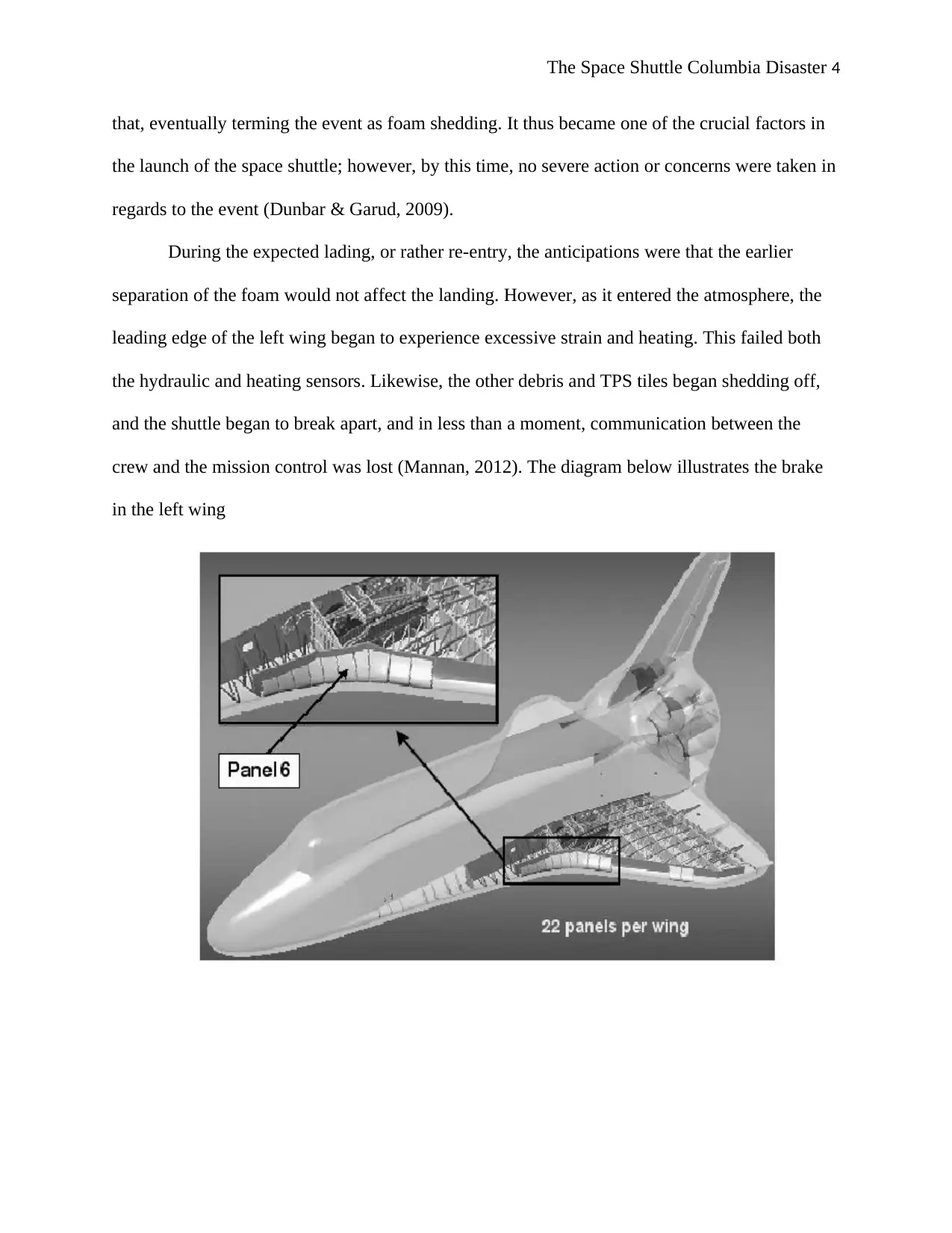
During the expected lading, or rather re-entry, the anticipations were that the earlier
separation of the foam would not affect the landing. However, as it entered the atmosphere, the
leading edge of the left wing began to experience excessive strain and heating. This failed both
the hydraulic and heating sensors. Likewise, the other debris and TPS tiles began shedding off,
and the shuttle began to break apart, and in less than a moment, communication between the
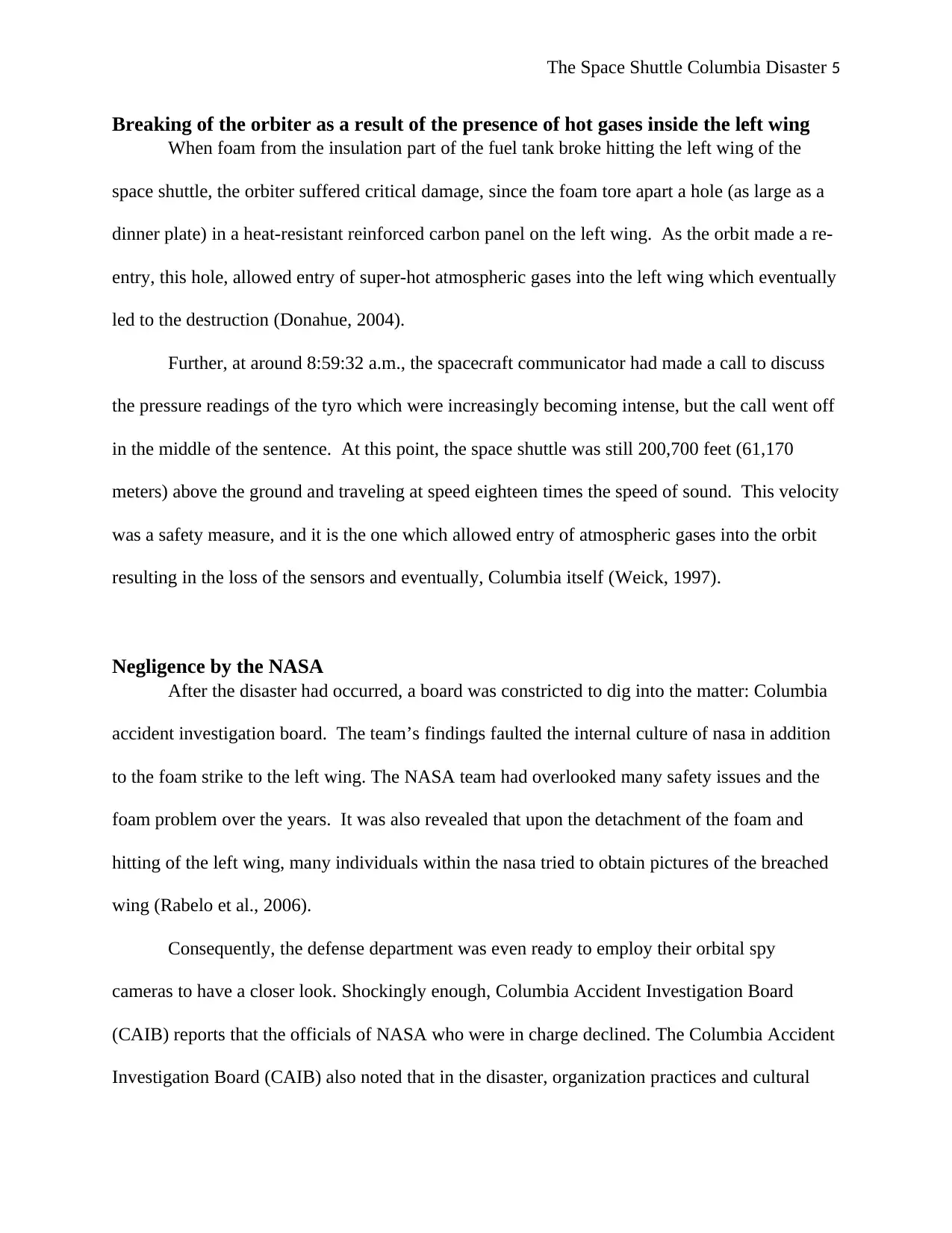
crew and the mission control was lost (Mannan, 2012). The diagram below illustrates the brake
in the left wing
that, eventually terming the event as foam shedding. It thus became one of the crucial factors in
the launch of the space shuttle; however, by this time, no severe action or concerns were taken in
regards to the event (Dunbar & Garud, 2009).
During the expected lading, or rather re-entry, the anticipations were that the earlier
separation of the foam would not affect the landing. However, as it entered the atmosphere, the
leading edge of the left wing began to experience excessive strain and heating. This failed both
the hydraulic and heating sensors. Likewise, the other debris and TPS tiles began shedding off,
and the shuttle began to break apart, and in less than a moment, communication between the
crew and the mission control was lost (Mannan, 2012). The diagram below illustrates the brake
in the left wing
Paraphrase This Document
Need a fresh take? Get an instant paraphrase of this document with our AI Paraphraser
The Space Shuttle Columbia Disaster 5
Breaking of the orbiter as a result of the presence of hot gases inside the left wing
When foam from the insulation part of the fuel tank broke hitting the left wing of the
space shuttle, the orbiter suffered critical damage, since the foam tore apart a hole (as large as a
dinner plate) in a heat-resistant reinforced carbon panel on the left wing. As the orbit made a re-
entry, this hole, allowed entry of super-hot atmospheric gases into the left wing which eventually
led to the destruction (Donahue, 2004).
Further, at around 8:59:32 a.m., the spacecraft communicator had made a call to discuss
the pressure readings of the tyro which were increasingly becoming intense, but the call went off
in the middle of the sentence. At this point, the space shuttle was still 200,700 feet (61,170
meters) above the ground and traveling at speed eighteen times the speed of sound. This velocity
was a safety measure, and it is the one which allowed entry of atmospheric gases into the orbit
resulting in the loss of the sensors and eventually, Columbia itself (Weick, 1997).
Negligence by the NASA
After the disaster had occurred, a board was constricted to dig into the matter: Columbia
accident investigation board. The team’s findings faulted the internal culture of nasa in addition
to the foam strike to the left wing. The NASA team had overlooked many safety issues and the
foam problem over the years. It was also revealed that upon the detachment of the foam and
hitting of the left wing, many individuals within the nasa tried to obtain pictures of the breached
wing (Rabelo et al., 2006).
Consequently, the defense department was even ready to employ their orbital spy
cameras to have a closer look. Shockingly enough, Columbia Accident Investigation Board
(CAIB) reports that the officials of NASA who were in charge declined. The Columbia Accident
Investigation Board (CAIB) also noted that in the disaster, organization practices and cultural
Breaking of the orbiter as a result of the presence of hot gases inside the left wing
When foam from the insulation part of the fuel tank broke hitting the left wing of the
space shuttle, the orbiter suffered critical damage, since the foam tore apart a hole (as large as a
dinner plate) in a heat-resistant reinforced carbon panel on the left wing. As the orbit made a re-
entry, this hole, allowed entry of super-hot atmospheric gases into the left wing which eventually
led to the destruction (Donahue, 2004).
Further, at around 8:59:32 a.m., the spacecraft communicator had made a call to discuss
the pressure readings of the tyro which were increasingly becoming intense, but the call went off
in the middle of the sentence. At this point, the space shuttle was still 200,700 feet (61,170
meters) above the ground and traveling at speed eighteen times the speed of sound. This velocity
was a safety measure, and it is the one which allowed entry of atmospheric gases into the orbit
resulting in the loss of the sensors and eventually, Columbia itself (Weick, 1997).
Negligence by the NASA
After the disaster had occurred, a board was constricted to dig into the matter: Columbia
accident investigation board. The team’s findings faulted the internal culture of nasa in addition
to the foam strike to the left wing. The NASA team had overlooked many safety issues and the
foam problem over the years. It was also revealed that upon the detachment of the foam and
hitting of the left wing, many individuals within the nasa tried to obtain pictures of the breached
wing (Rabelo et al., 2006).
Consequently, the defense department was even ready to employ their orbital spy
cameras to have a closer look. Shockingly enough, Columbia Accident Investigation Board
(CAIB) reports that the officials of NASA who were in charge declined. The Columbia Accident
Investigation Board (CAIB) also noted that in the disaster, organization practices and cultural
The Space Shuttle Columbia Disaster 6
traits which were detrimental to the safety of the space shuttle were allowed to develop. By
extension, thee organization and cultural barriers prevented effective communicating on critical
safety information (Columbia Accident Investigation Board, 2003).
This cultural practice was also evident on the director of mission operations, Jon Harpold
response, that, “there was no point in telling the crew their concerns because there was nothing
the Columbia's astronauts could do about it.” (National Aeronautics and Space Administration,
2005). The director of mission operations was a professional who was ardently knowledgeable in
shuttle entry, including the thermal environments, navigation, guidance, and flight control
(Weiser, 2004).
Significance of the earlier Space Shuttle Challenger disaster to the Space Shuttle
Columbia disaster.
The Space Shuttle Challenger occurred in 1986 as a result of aerodynamic forces that
resulted from detachment of the right hand SRBS aft field joint. After the disaster had happened,
a commission of inquiry was formed, and among its findings, were the cultural organizations in
NASA. These would later resurface in the Space Shuttle Columbia disaster and have influenced
future involvement of the NASA by various agencies. Further, on the positive side, the findings
have helped in the construction of a more robust Space Shuttle Columbia disaster that had taken
into consideration the failure factors that influenced the space shuttle Challenger.
Conclusion
Safety of humans should be a priority in the design of space shuttles. From the findings,
the primary factors that led to the failure of the space shuttle Columbia in 2003 included Hit of
the left wing by a loose piece of foam during the launching stages, breaking of the orbiter as a
result of the presence of hot gases inside the left wing and negligence by the NASA team.
traits which were detrimental to the safety of the space shuttle were allowed to develop. By
extension, thee organization and cultural barriers prevented effective communicating on critical
safety information (Columbia Accident Investigation Board, 2003).
This cultural practice was also evident on the director of mission operations, Jon Harpold
response, that, “there was no point in telling the crew their concerns because there was nothing
the Columbia's astronauts could do about it.” (National Aeronautics and Space Administration,
2005). The director of mission operations was a professional who was ardently knowledgeable in
shuttle entry, including the thermal environments, navigation, guidance, and flight control
(Weiser, 2004).
Significance of the earlier Space Shuttle Challenger disaster to the Space Shuttle
Columbia disaster.
The Space Shuttle Challenger occurred in 1986 as a result of aerodynamic forces that
resulted from detachment of the right hand SRBS aft field joint. After the disaster had happened,
a commission of inquiry was formed, and among its findings, were the cultural organizations in
NASA. These would later resurface in the Space Shuttle Columbia disaster and have influenced
future involvement of the NASA by various agencies. Further, on the positive side, the findings
have helped in the construction of a more robust Space Shuttle Columbia disaster that had taken
into consideration the failure factors that influenced the space shuttle Challenger.
Conclusion
Safety of humans should be a priority in the design of space shuttles. From the findings,
the primary factors that led to the failure of the space shuttle Columbia in 2003 included Hit of
the left wing by a loose piece of foam during the launching stages, breaking of the orbiter as a
result of the presence of hot gases inside the left wing and negligence by the NASA team.
⊘ This is a preview!⊘
Do you want full access?
Subscribe today to unlock all pages.
Trusted by 1+ million students worldwide
The Space Shuttle Columbia Disaster 7
Future research recommends that these factors should be taken into consideration for the safety
of those onboard.
Future research recommends that these factors should be taken into consideration for the safety
of those onboard.
Paraphrase This Document
Need a fresh take? Get an instant paraphrase of this document with our AI Paraphraser
The Space Shuttle Columbia Disaster 8
References
Columbia Accident Investigation Board (CAIB) 2003, Report volume 1, (HW Gehman,
Chairman), NASA and the Government Printing Office, Washington, D.C.
Donahue, A., 2004. The day the sky fell: the space shuttle Columbia disaster. PUBLIC
MANAGEMENT-LAWRENCE THEN WASHINGTON-, 86(8), pp.8-13.
Dunbar, R.L. and Garud, R., 2009. Distributed knowledge and indeterminate meaning: The case
of the Columbia shuttle flight. Organization Studies, 30(4), pp.397-421.
Mannan, S 2012, Lees' loss prevention in the process industries: hazard identification,
assessment and control, 4th edn, Butterworth-Heinemann, Oxford, Science Direct.
National Aeronautics and Space Administration (NASA) 2005, Space Shuttle basics, Human
Space Flight, NASA, viewed 23 January 2019,
Rabelo, L., Sepulveda, J., Compton, J., Moraga, R. and Turner, R., 2006. Disaster and prevention
management for the NASA shuttle during lift-off. Disaster Prevention and Management:
An International Journal, 15(2), pp.262-274.
Weick, K.E., 1997. The challenger launch decision: Risky technology, culture, and deviance at
NASA. Administrative Science Quarterly, 42(2), p.395.
Weiser, ES, St. Clair, TL and Nemeth, MP 2004, Assessment of technologies for the Space
Shuttle External Tank Thermal Protection System and recommendations for technology
improvement Part 1: materials characterization and analysis, NASA Center for
AeroSpace Information, Hanover, Maryland.
References
Columbia Accident Investigation Board (CAIB) 2003, Report volume 1, (HW Gehman,
Chairman), NASA and the Government Printing Office, Washington, D.C.
Donahue, A., 2004. The day the sky fell: the space shuttle Columbia disaster. PUBLIC
MANAGEMENT-LAWRENCE THEN WASHINGTON-, 86(8), pp.8-13.
Dunbar, R.L. and Garud, R., 2009. Distributed knowledge and indeterminate meaning: The case
of the Columbia shuttle flight. Organization Studies, 30(4), pp.397-421.
Mannan, S 2012, Lees' loss prevention in the process industries: hazard identification,
assessment and control, 4th edn, Butterworth-Heinemann, Oxford, Science Direct.
National Aeronautics and Space Administration (NASA) 2005, Space Shuttle basics, Human
Space Flight, NASA, viewed 23 January 2019,
Rabelo, L., Sepulveda, J., Compton, J., Moraga, R. and Turner, R., 2006. Disaster and prevention
management for the NASA shuttle during lift-off. Disaster Prevention and Management:
An International Journal, 15(2), pp.262-274.
Weick, K.E., 1997. The challenger launch decision: Risky technology, culture, and deviance at
NASA. Administrative Science Quarterly, 42(2), p.395.
Weiser, ES, St. Clair, TL and Nemeth, MP 2004, Assessment of technologies for the Space
Shuttle External Tank Thermal Protection System and recommendations for technology
improvement Part 1: materials characterization and analysis, NASA Center for
AeroSpace Information, Hanover, Maryland.

1 out of 8


Your All-in-One AI-Powered Toolkit for Academic Success.
+13062052269
info@desklib.com
Available 24*7 on WhatsApp / Email
![[object Object]](/_next/static/media/star-bottom.7253800d.svg)
Unlock your academic potential
Copyright © 2020–2026 A2Z Services. All Rights Reserved. Developed and managed by ZUCOL.