Centennial College COMM 170 Project 3: Writing Portfolio Analysis
VerifiedAdded on 2022/11/13
|17
|3958
|105
Project
AI Summary
This writing portfolio from a COMM 170 online course at Centennial College showcases a student's work on Project 3, focusing on analyzing the relationship between money and happiness. The portfolio includes a source selection from Roth's 'Your Money: The Missing Manual,' followed by a reverse outline, summary, and critical appraisal of the source. It involves devising keyword search terms, locating sources, and connecting textual evidence from research sources to the main source. Assignments include reflecting on the sources, creating an annotated bibliography, summarizing key points, outlining a research-driven critique, and drafting essays. The project culminates in peer review, reflection, and revision, offering a comprehensive look at research, writing, and critical thinking skills applied to the topic of personal finance and its impact on well-being. The student explores the impact of financial planning, the effects of income on happiness, and the pursuit of authenticity in relation to money matters.
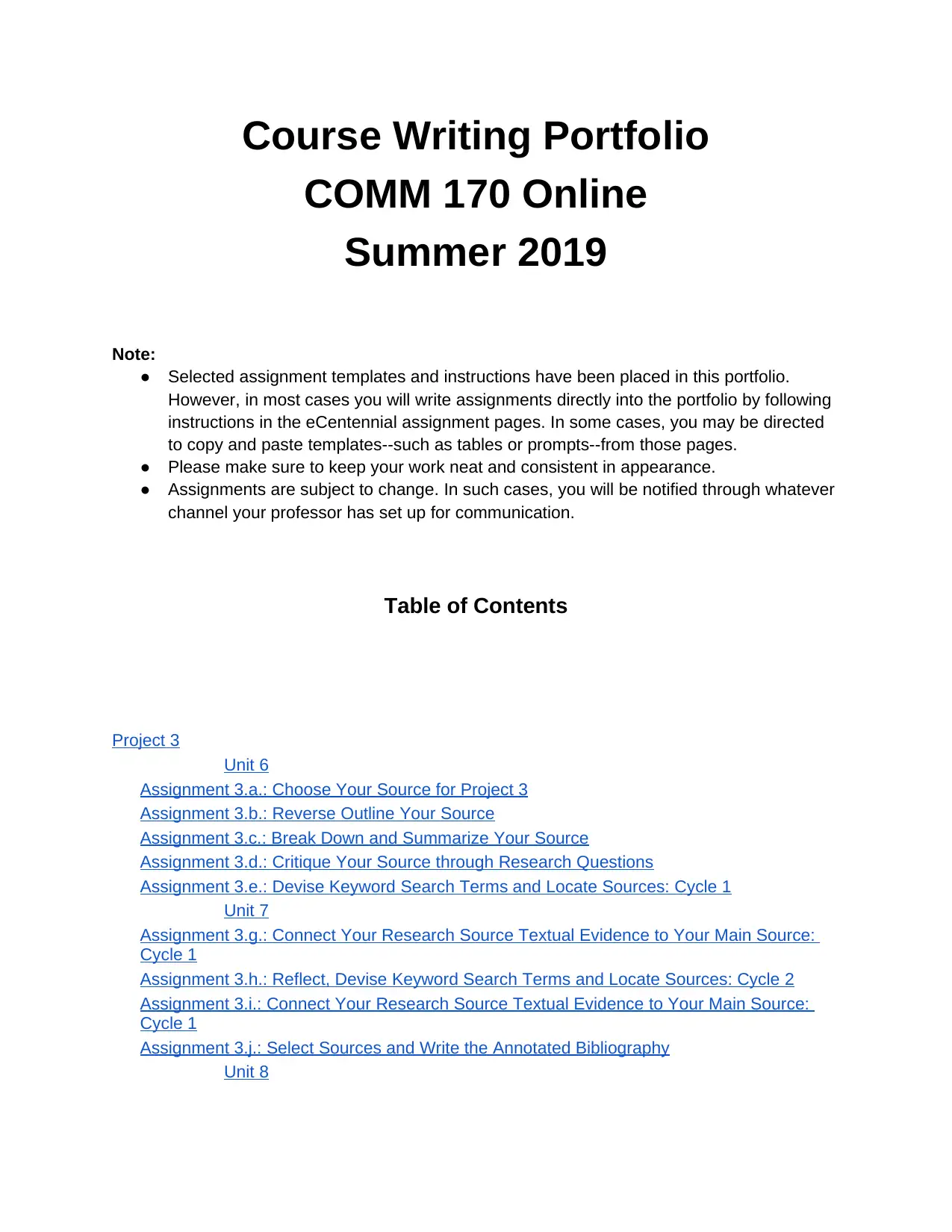
Course Writing Portfolio
COMM 170 Online
Summer 2019
Note:
● Selected assignment templates and instructions have been placed in this portfolio.
However, in most cases you will write assignments directly into the portfolio by following
instructions in the eCentennial assignment pages. In some cases, you may be directed
to copy and paste templates--such as tables or prompts--from those pages.
● Please make sure to keep your work neat and consistent in appearance.
● Assignments are subject to change. In such cases, you will be notified through whatever
channel your professor has set up for communication.
Table of Contents
Project 3
Unit 6
Assignment 3.a.: Choose Your Source for Project 3
Assignment 3.b.: Reverse Outline Your Source
Assignment 3.c.: Break Down and Summarize Your Source
Assignment 3.d.: Critique Your Source through Research Questions
Assignment 3.e.: Devise Keyword Search Terms and Locate Sources: Cycle 1
Unit 7
Assignment 3.g.: Connect Your Research Source Textual Evidence to Your Main Source:
Cycle 1
Assignment 3.h.: Reflect, Devise Keyword Search Terms and Locate Sources: Cycle 2
Assignment 3.i.: Connect Your Research Source Textual Evidence to Your Main Source:
Cycle 1
Assignment 3.j.: Select Sources and Write the Annotated Bibliography
Unit 8
COMM 170 Online
Summer 2019
Note:
● Selected assignment templates and instructions have been placed in this portfolio.
However, in most cases you will write assignments directly into the portfolio by following
instructions in the eCentennial assignment pages. In some cases, you may be directed
to copy and paste templates--such as tables or prompts--from those pages.
● Please make sure to keep your work neat and consistent in appearance.
● Assignments are subject to change. In such cases, you will be notified through whatever
channel your professor has set up for communication.
Table of Contents
Project 3
Unit 6
Assignment 3.a.: Choose Your Source for Project 3
Assignment 3.b.: Reverse Outline Your Source
Assignment 3.c.: Break Down and Summarize Your Source
Assignment 3.d.: Critique Your Source through Research Questions
Assignment 3.e.: Devise Keyword Search Terms and Locate Sources: Cycle 1
Unit 7
Assignment 3.g.: Connect Your Research Source Textual Evidence to Your Main Source:
Cycle 1
Assignment 3.h.: Reflect, Devise Keyword Search Terms and Locate Sources: Cycle 2
Assignment 3.i.: Connect Your Research Source Textual Evidence to Your Main Source:
Cycle 1
Assignment 3.j.: Select Sources and Write the Annotated Bibliography
Unit 8

Paraphrase This Document
Need a fresh take? Get an instant paraphrase of this document with our AI Paraphraser
2
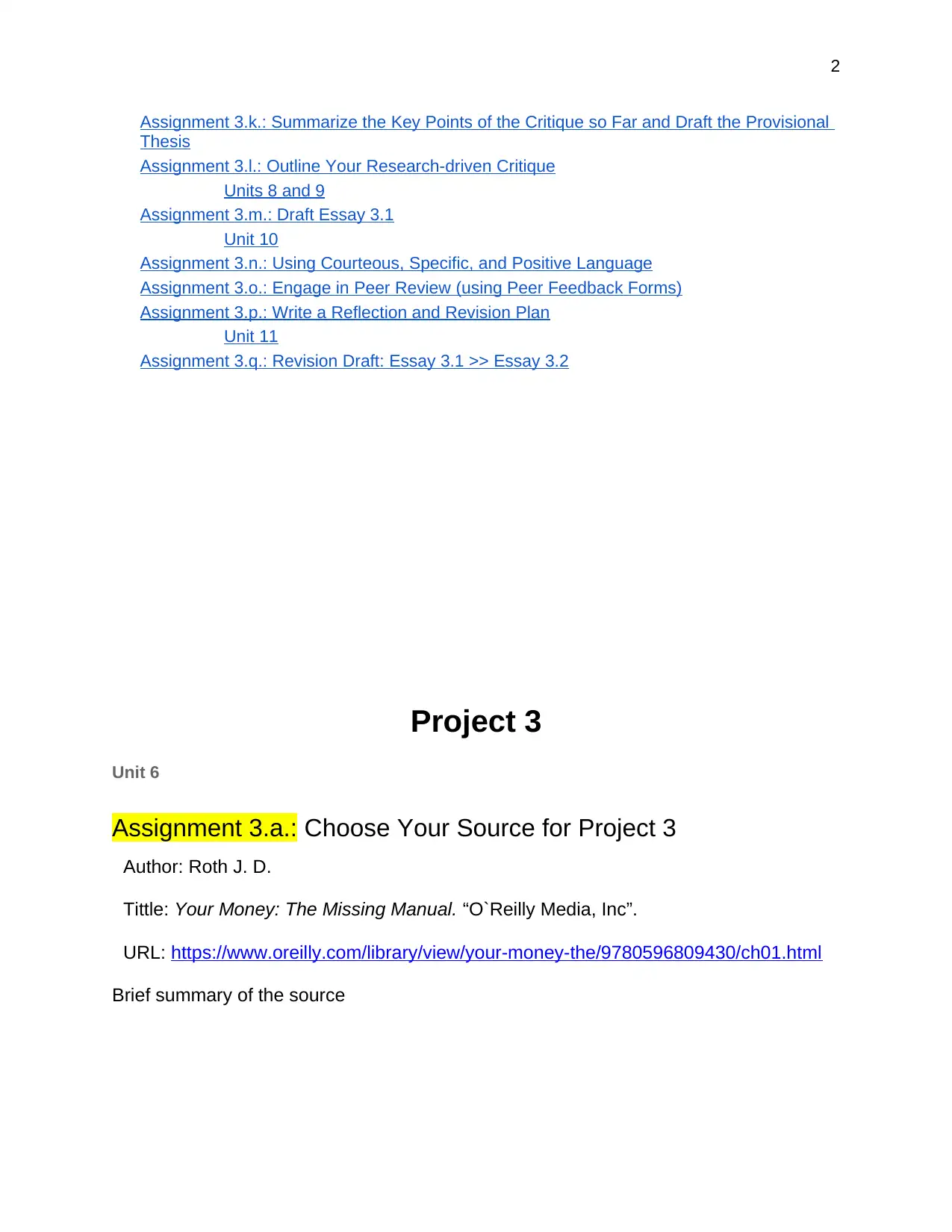
Assignment 3.k.: Summarize the Key Points of the Critique so Far and Draft the Provisional
Thesis
Assignment 3.l.: Outline Your Research-driven Critique
Units 8 and 9
Assignment 3.m.: Draft Essay 3.1
Unit 10
Assignment 3.n.: Using Courteous, Specific, and Positive Language
Assignment 3.o.: Engage in Peer Review (using Peer Feedback Forms)
Assignment 3.p.: Write a Reflection and Revision Plan
Unit 11
Assignment 3.q.: Revision Draft: Essay 3.1 >> Essay 3.2
Project 3
Unit 6
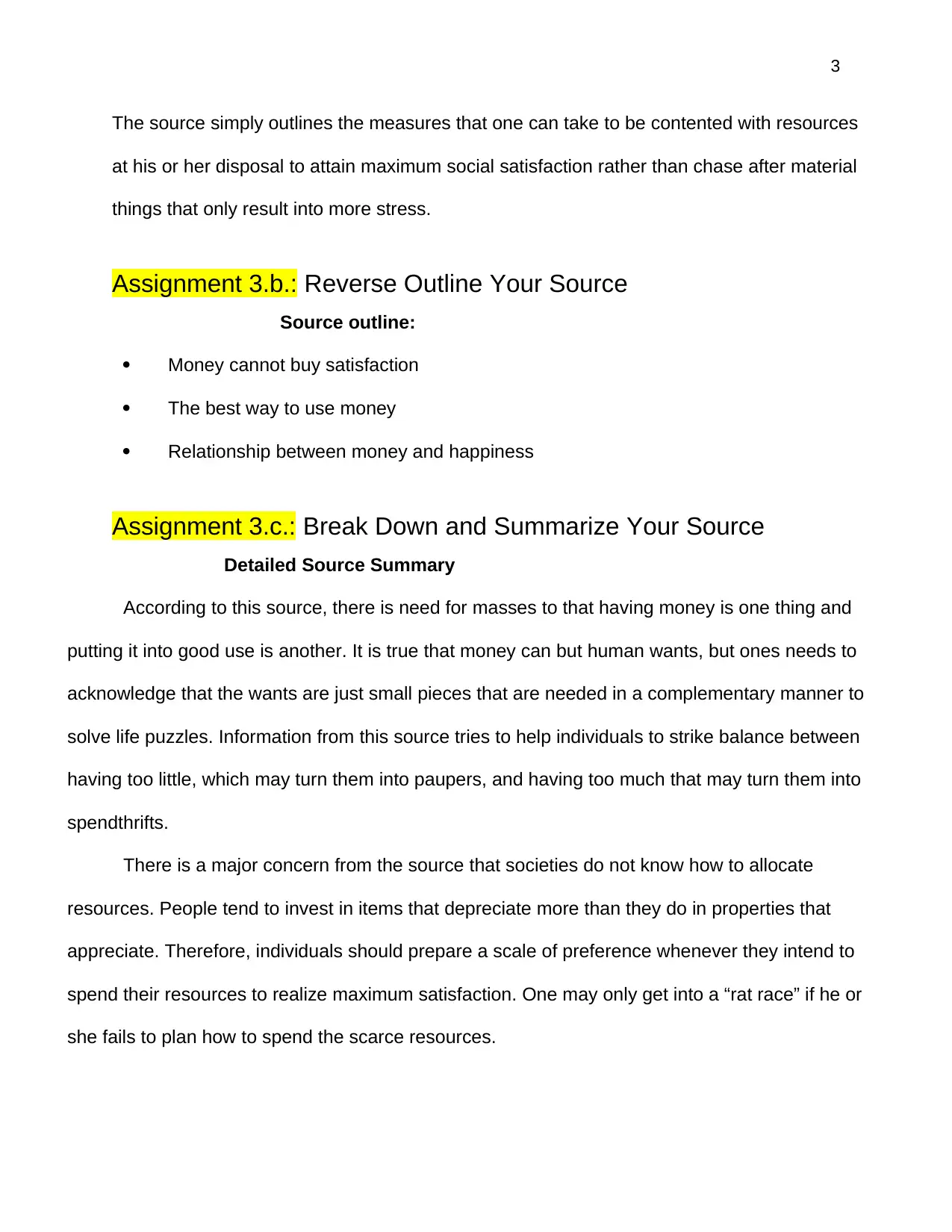
Assignment 3.a.: Choose Your Source for Project 3
Author: Roth J. D.
Tittle: Your Money: The Missing Manual. “O`Reilly Media, Inc”.
URL: https://www.oreilly.com/library/view/your-money-the/9780596809430/ch01.html
Brief summary of the source
Assignment 3.k.: Summarize the Key Points of the Critique so Far and Draft the Provisional
Thesis
Assignment 3.l.: Outline Your Research-driven Critique
Units 8 and 9
Assignment 3.m.: Draft Essay 3.1
Unit 10
Assignment 3.n.: Using Courteous, Specific, and Positive Language
Assignment 3.o.: Engage in Peer Review (using Peer Feedback Forms)
Assignment 3.p.: Write a Reflection and Revision Plan
Unit 11
Assignment 3.q.: Revision Draft: Essay 3.1 >> Essay 3.2
Project 3
Unit 6
Assignment 3.a.: Choose Your Source for Project 3
Author: Roth J. D.
Tittle: Your Money: The Missing Manual. “O`Reilly Media, Inc”.
URL: https://www.oreilly.com/library/view/your-money-the/9780596809430/ch01.html
Brief summary of the source
3
The source simply outlines the measures that one can take to be contented with resources
at his or her disposal to attain maximum social satisfaction rather than chase after material
things that only result into more stress.
Assignment 3.b.: Reverse Outline Your Source
Source outline:
Money cannot buy satisfaction
The best way to use money
Relationship between money and happiness
Assignment 3.c.: Break Down and Summarize Your Source
Detailed Source Summary
According to this source, there is need for masses to that having money is one thing and
putting it into good use is another. It is true that money can but human wants, but ones needs to
acknowledge that the wants are just small pieces that are needed in a complementary manner to
solve life puzzles. Information from this source tries to help individuals to strike balance between
having too little, which may turn them into paupers, and having too much that may turn them into
spendthrifts.
There is a major concern from the source that societies do not know how to allocate
resources. People tend to invest in items that depreciate more than they do in properties that
appreciate. Therefore, individuals should prepare a scale of preference whenever they intend to
spend their resources to realize maximum satisfaction. One may only get into a “rat race” if he or
she fails to plan how to spend the scarce resources.
The source simply outlines the measures that one can take to be contented with resources
at his or her disposal to attain maximum social satisfaction rather than chase after material
things that only result into more stress.
Assignment 3.b.: Reverse Outline Your Source
Source outline:
Money cannot buy satisfaction
The best way to use money
Relationship between money and happiness
Assignment 3.c.: Break Down and Summarize Your Source
Detailed Source Summary
According to this source, there is need for masses to that having money is one thing and
putting it into good use is another. It is true that money can but human wants, but ones needs to
acknowledge that the wants are just small pieces that are needed in a complementary manner to
solve life puzzles. Information from this source tries to help individuals to strike balance between
having too little, which may turn them into paupers, and having too much that may turn them into
spendthrifts.
There is a major concern from the source that societies do not know how to allocate
resources. People tend to invest in items that depreciate more than they do in properties that
appreciate. Therefore, individuals should prepare a scale of preference whenever they intend to
spend their resources to realize maximum satisfaction. One may only get into a “rat race” if he or
she fails to plan how to spend the scarce resources.
⊘ This is a preview!⊘
Do you want full access?
Subscribe today to unlock all pages.

Trusted by 1+ million students worldwide
4
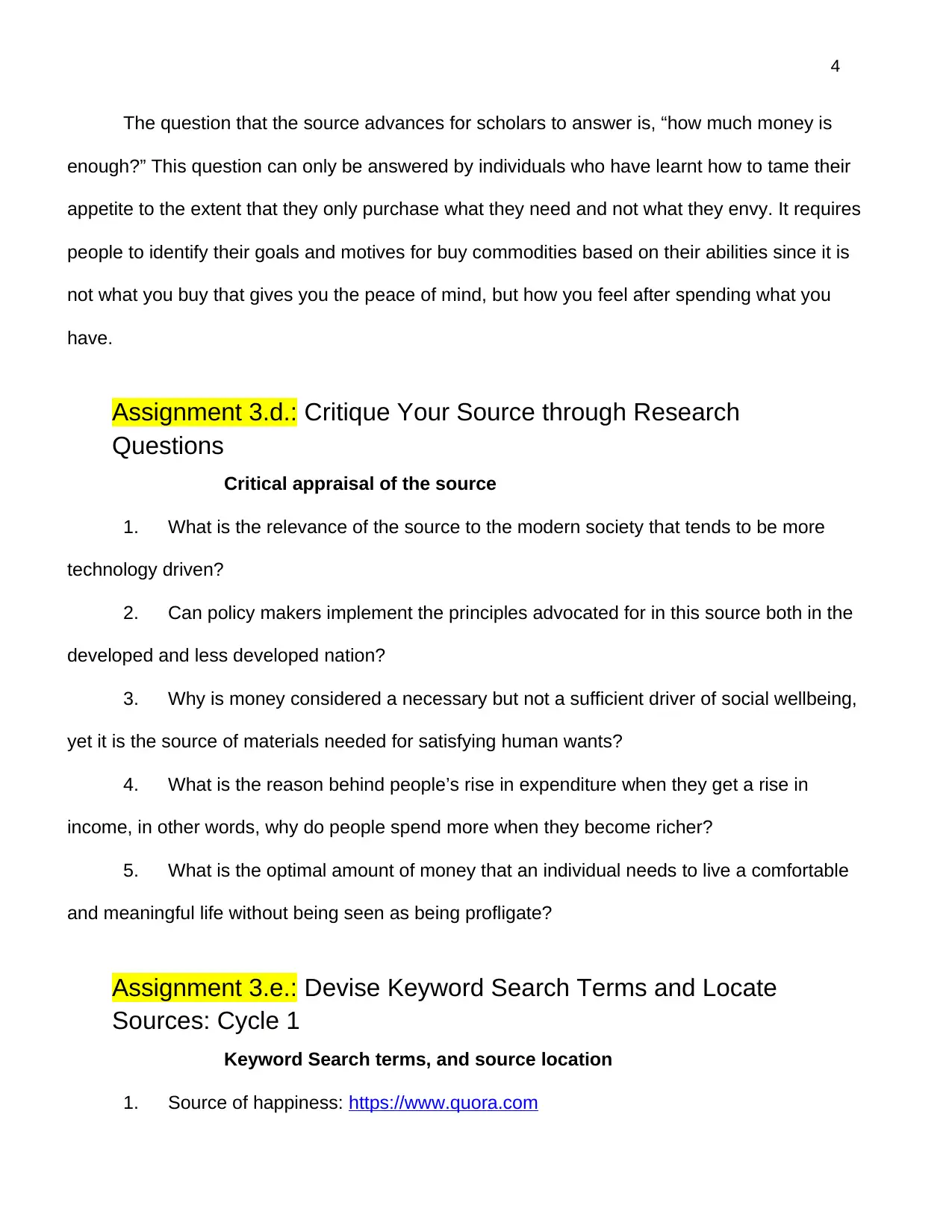
The question that the source advances for scholars to answer is, “how much money is
enough?” This question can only be answered by individuals who have learnt how to tame their
appetite to the extent that they only purchase what they need and not what they envy. It requires
people to identify their goals and motives for buy commodities based on their abilities since it is
not what you buy that gives you the peace of mind, but how you feel after spending what you
have.
Assignment 3.d.: Critique Your Source through Research
Questions
Critical appraisal of the source
1. What is the relevance of the source to the modern society that tends to be more
technology driven?
2. Can policy makers implement the principles advocated for in this source both in the
developed and less developed nation?
3. Why is money considered a necessary but not a sufficient driver of social wellbeing,
yet it is the source of materials needed for satisfying human wants?
4. What is the reason behind people’s rise in expenditure when they get a rise in
income, in other words, why do people spend more when they become richer?
5. What is the optimal amount of money that an individual needs to live a comfortable
and meaningful life without being seen as being profligate?
Assignment 3.e.: Devise Keyword Search Terms and Locate
Sources: Cycle 1
Keyword Search terms, and source location
1. Source of happiness: https://www.quora.com
The question that the source advances for scholars to answer is, “how much money is
enough?” This question can only be answered by individuals who have learnt how to tame their
appetite to the extent that they only purchase what they need and not what they envy. It requires
people to identify their goals and motives for buy commodities based on their abilities since it is
not what you buy that gives you the peace of mind, but how you feel after spending what you
have.
Assignment 3.d.: Critique Your Source through Research
Questions
Critical appraisal of the source
1. What is the relevance of the source to the modern society that tends to be more
technology driven?
2. Can policy makers implement the principles advocated for in this source both in the
developed and less developed nation?
3. Why is money considered a necessary but not a sufficient driver of social wellbeing,
yet it is the source of materials needed for satisfying human wants?
4. What is the reason behind people’s rise in expenditure when they get a rise in
income, in other words, why do people spend more when they become richer?
5. What is the optimal amount of money that an individual needs to live a comfortable
and meaningful life without being seen as being profligate?
Assignment 3.e.: Devise Keyword Search Terms and Locate
Sources: Cycle 1
Keyword Search terms, and source location
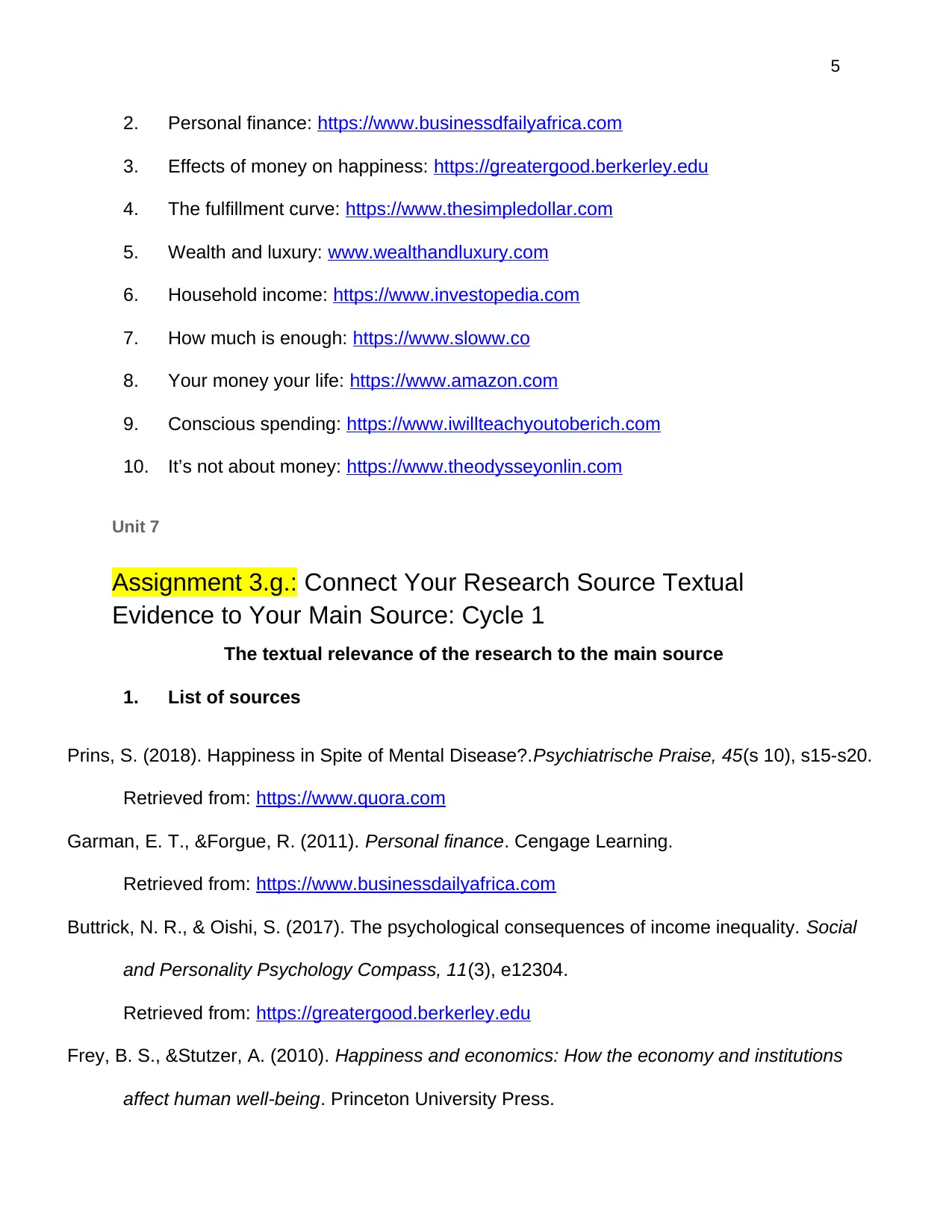
1. Source of happiness: https://www.quora.com
Paraphrase This Document
Need a fresh take? Get an instant paraphrase of this document with our AI Paraphraser
5
2. Personal finance: https://www.businessdfailyafrica.com
3. Effects of money on happiness: https://greatergood.berkerley.edu
4. The fulfillment curve: https://www.thesimpledollar.com
5. Wealth and luxury: www.wealthandluxury.com
6. Household income: https://www.investopedia.com
7. How much is enough: https://www.sloww.co
8. Your money your life: https://www.amazon.com
9. Conscious spending: https://www.iwillteachyoutoberich.com
10. It’s not about money: https://www.theodysseyonlin.com
Unit 7
Assignment 3.g.: Connect Your Research Source Textual
Evidence to Your Main Source: Cycle 1
The textual relevance of the research to the main source
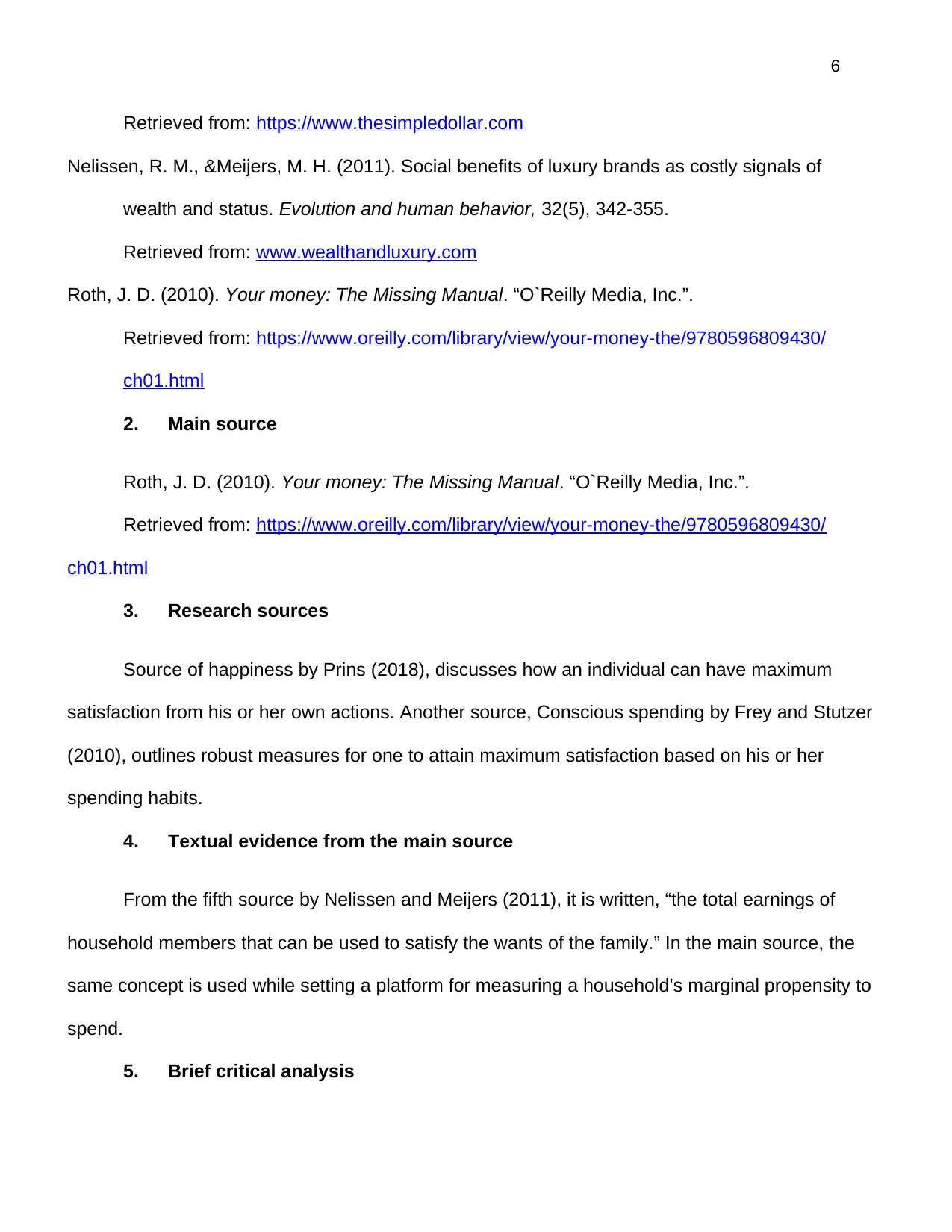
1. List of sources
Prins, S. (2018). Happiness in Spite of Mental Disease?.Psychiatrische Praise, 45(s 10), s15-s20.
Retrieved from: https://www.quora.com
Garman, E. T., &Forgue, R. (2011). Personal finance. Cengage Learning.
Retrieved from: https://www.businessdailyafrica.com
Buttrick, N. R., & Oishi, S. (2017). The psychological consequences of income inequality. Social
and Personality Psychology Compass, 11(3), e12304.
Retrieved from: https://greatergood.berkerley.edu
Frey, B. S., &Stutzer, A. (2010). Happiness and economics: How the economy and institutions
affect human well-being. Princeton University Press.
2. Personal finance: https://www.businessdfailyafrica.com
3. Effects of money on happiness: https://greatergood.berkerley.edu
4. The fulfillment curve: https://www.thesimpledollar.com
5. Wealth and luxury: www.wealthandluxury.com
6. Household income: https://www.investopedia.com
7. How much is enough: https://www.sloww.co
8. Your money your life: https://www.amazon.com
9. Conscious spending: https://www.iwillteachyoutoberich.com
10. It’s not about money: https://www.theodysseyonlin.com
Unit 7
Assignment 3.g.: Connect Your Research Source Textual
Evidence to Your Main Source: Cycle 1
The textual relevance of the research to the main source
1. List of sources
Prins, S. (2018). Happiness in Spite of Mental Disease?.Psychiatrische Praise, 45(s 10), s15-s20.
Retrieved from: https://www.quora.com
Garman, E. T., &Forgue, R. (2011). Personal finance. Cengage Learning.
Retrieved from: https://www.businessdailyafrica.com
Buttrick, N. R., & Oishi, S. (2017). The psychological consequences of income inequality. Social
and Personality Psychology Compass, 11(3), e12304.
Retrieved from: https://greatergood.berkerley.edu
Frey, B. S., &Stutzer, A. (2010). Happiness and economics: How the economy and institutions
affect human well-being. Princeton University Press.
6
Retrieved from: https://www.thesimpledollar.com
Nelissen, R. M., &Meijers, M. H. (2011). Social benefits of luxury brands as costly signals of
wealth and status. Evolution and human behavior, 32(5), 342-355.
Retrieved from: www.wealthandluxury.com
Roth, J. D. (2010). Your money: The Missing Manual. “O`Reilly Media, Inc.”.
Retrieved from: https://www.oreilly.com/library/view/your-money-the/9780596809430/
ch01.html
2. Main source
Roth, J. D. (2010). Your money: The Missing Manual. “O`Reilly Media, Inc.”.
Retrieved from: https://www.oreilly.com/library/view/your-money-the/9780596809430/
ch01.html
3. Research sources
Source of happiness by Prins (2018), discusses how an individual can have maximum
satisfaction from his or her own actions. Another source, Conscious spending by Frey and Stutzer
(2010), outlines robust measures for one to attain maximum satisfaction based on his or her
spending habits.
4. Textual evidence from the main source
From the fifth source by Nelissen and Meijers (2011), it is written, “the total earnings of
household members that can be used to satisfy the wants of the family.” In the main source, the
same concept is used while setting a platform for measuring a household’s marginal propensity to
spend.
5. Brief critical analysis
Retrieved from: https://www.thesimpledollar.com
Nelissen, R. M., &Meijers, M. H. (2011). Social benefits of luxury brands as costly signals of
wealth and status. Evolution and human behavior, 32(5), 342-355.
Retrieved from: www.wealthandluxury.com
Roth, J. D. (2010). Your money: The Missing Manual. “O`Reilly Media, Inc.”.
Retrieved from: https://www.oreilly.com/library/view/your-money-the/9780596809430/
ch01.html
2. Main source
Roth, J. D. (2010). Your money: The Missing Manual. “O`Reilly Media, Inc.”.
Retrieved from: https://www.oreilly.com/library/view/your-money-the/9780596809430/
ch01.html
3. Research sources
Source of happiness by Prins (2018), discusses how an individual can have maximum
satisfaction from his or her own actions. Another source, Conscious spending by Frey and Stutzer
(2010), outlines robust measures for one to attain maximum satisfaction based on his or her
spending habits.
4. Textual evidence from the main source
From the fifth source by Nelissen and Meijers (2011), it is written, “the total earnings of
household members that can be used to satisfy the wants of the family.” In the main source, the
same concept is used while setting a platform for measuring a household’s marginal propensity to
spend.
5. Brief critical analysis
⊘ This is a preview!⊘
Do you want full access?
Subscribe today to unlock all pages.
Trusted by 1+ million students worldwide
7
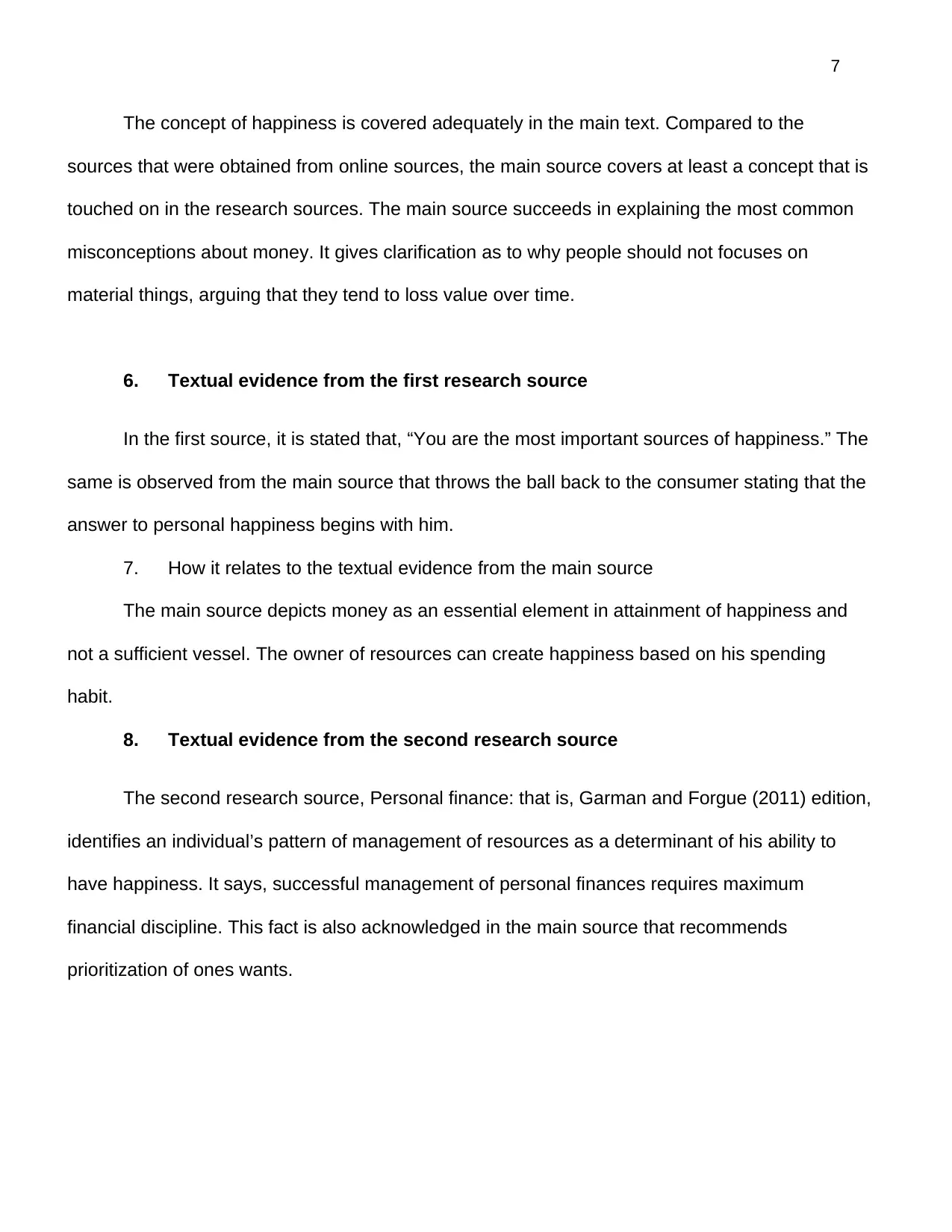
The concept of happiness is covered adequately in the main text. Compared to the
sources that were obtained from online sources, the main source covers at least a concept that is
touched on in the research sources. The main source succeeds in explaining the most common
misconceptions about money. It gives clarification as to why people should not focuses on
material things, arguing that they tend to loss value over time.
6. Textual evidence from the first research source
In the first source, it is stated that, “You are the most important sources of happiness.” The
same is observed from the main source that throws the ball back to the consumer stating that the
answer to personal happiness begins with him.
7. How it relates to the textual evidence from the main source
The main source depicts money as an essential element in attainment of happiness and
not a sufficient vessel. The owner of resources can create happiness based on his spending
habit.
8. Textual evidence from the second research source
The second research source, Personal finance: that is, Garman and Forgue (2011) edition,
identifies an individual’s pattern of management of resources as a determinant of his ability to
have happiness. It says, successful management of personal finances requires maximum
financial discipline. This fact is also acknowledged in the main source that recommends
prioritization of ones wants.
The concept of happiness is covered adequately in the main text. Compared to the
sources that were obtained from online sources, the main source covers at least a concept that is
touched on in the research sources. The main source succeeds in explaining the most common
misconceptions about money. It gives clarification as to why people should not focuses on
material things, arguing that they tend to loss value over time.
6. Textual evidence from the first research source
In the first source, it is stated that, “You are the most important sources of happiness.” The
same is observed from the main source that throws the ball back to the consumer stating that the
answer to personal happiness begins with him.
7. How it relates to the textual evidence from the main source
The main source depicts money as an essential element in attainment of happiness and
not a sufficient vessel. The owner of resources can create happiness based on his spending
habit.
8. Textual evidence from the second research source
The second research source, Personal finance: that is, Garman and Forgue (2011) edition,
identifies an individual’s pattern of management of resources as a determinant of his ability to
have happiness. It says, successful management of personal finances requires maximum
financial discipline. This fact is also acknowledged in the main source that recommends
prioritization of ones wants.
Paraphrase This Document
Need a fresh take? Get an instant paraphrase of this document with our AI Paraphraser
8
Assignment 3.h.: Reflect, Devise Keyword Search Terms and
Locate Sources: Cycle 2
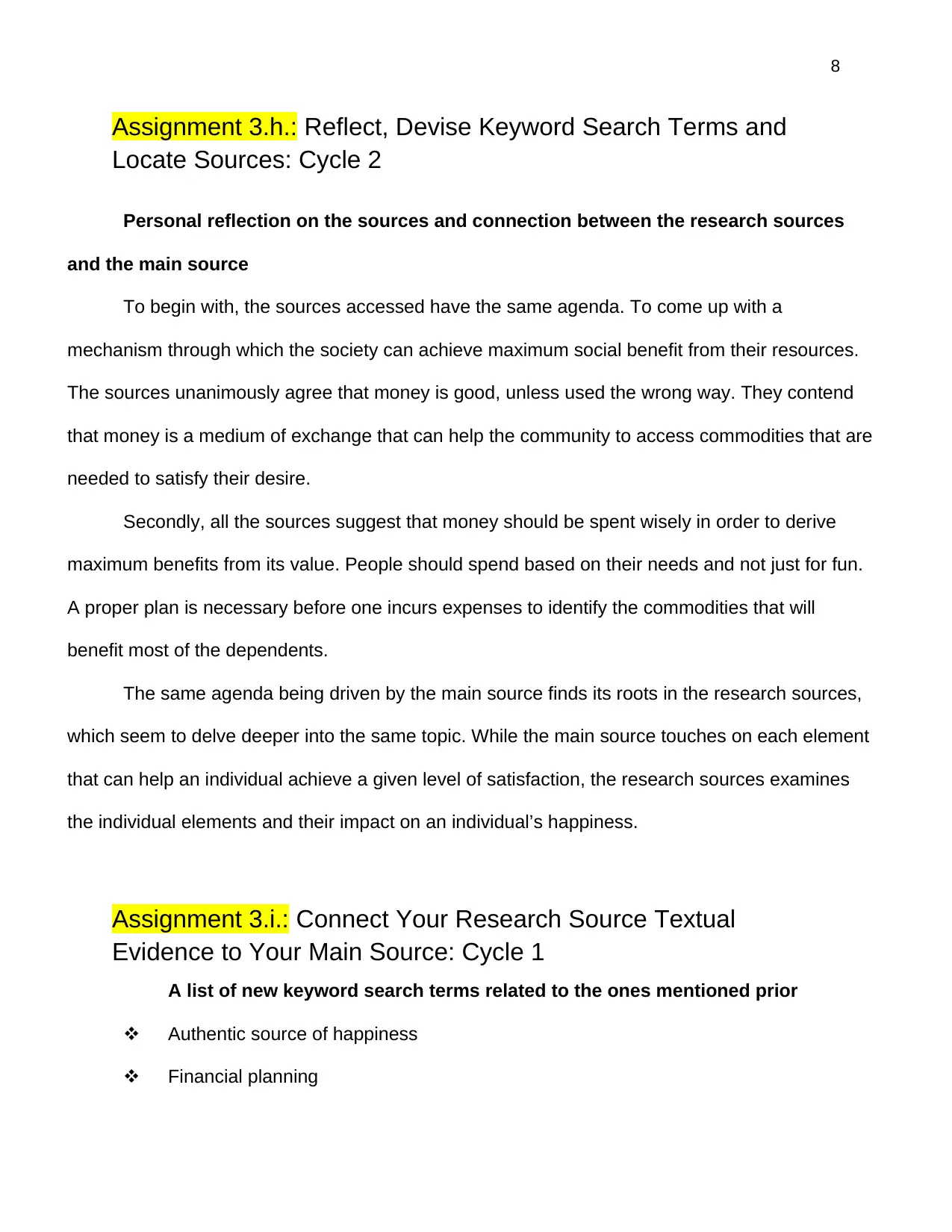
Personal reflection on the sources and connection between the research sources
and the main source
To begin with, the sources accessed have the same agenda. To come up with a
mechanism through which the society can achieve maximum social benefit from their resources.
The sources unanimously agree that money is good, unless used the wrong way. They contend
that money is a medium of exchange that can help the community to access commodities that are
needed to satisfy their desire.
Secondly, all the sources suggest that money should be spent wisely in order to derive
maximum benefits from its value. People should spend based on their needs and not just for fun.
A proper plan is necessary before one incurs expenses to identify the commodities that will
benefit most of the dependents.
The same agenda being driven by the main source finds its roots in the research sources,
which seem to delve deeper into the same topic. While the main source touches on each element
that can help an individual achieve a given level of satisfaction, the research sources examines
the individual elements and their impact on an individual’s happiness.
Assignment 3.i.: Connect Your Research Source Textual
Evidence to Your Main Source: Cycle 1
A list of new keyword search terms related to the ones mentioned prior
Authentic source of happiness
Financial planning
Assignment 3.h.: Reflect, Devise Keyword Search Terms and
Locate Sources: Cycle 2
Personal reflection on the sources and connection between the research sources
and the main source
To begin with, the sources accessed have the same agenda. To come up with a
mechanism through which the society can achieve maximum social benefit from their resources.
The sources unanimously agree that money is good, unless used the wrong way. They contend
that money is a medium of exchange that can help the community to access commodities that are
needed to satisfy their desire.
Secondly, all the sources suggest that money should be spent wisely in order to derive
maximum benefits from its value. People should spend based on their needs and not just for fun.
A proper plan is necessary before one incurs expenses to identify the commodities that will
benefit most of the dependents.
The same agenda being driven by the main source finds its roots in the research sources,
which seem to delve deeper into the same topic. While the main source touches on each element
that can help an individual achieve a given level of satisfaction, the research sources examines
the individual elements and their impact on an individual’s happiness.
Assignment 3.i.: Connect Your Research Source Textual
Evidence to Your Main Source: Cycle 1
A list of new keyword search terms related to the ones mentioned prior
Authentic source of happiness
Financial planning
9
Effect of income on happiness
New sources that can further develop the concept under discussion
De Veries, M. F. K. (2016). Sex, Money, Happiness, and Death: The quest for Authenticity.
Springer.
Retrieved from: https://www.liveyourtruestory.com
Rosly, S. A. (2018). Critical issues in Islamic banking and financial markets: Islamic economics,
banking and finance, investments, Takaful and financial Planning. Dinamas Publishing.
Retrieved from: https://www.financial-planning.com
Pwdthavee, N. (2010). How much does money really matter? Estimating the causal effects of
income on happiness. Empirical economics, 39(1), 77-92.
Retrieved from: https://www.theworldounts.com
Relationship between research source textual evidence to the main source
In accordance with the findings in Authentic source of happiness by De Veries (2016),
“everyone wants to be happy.” In the main text, it is also evident that every member of the society
seeks happiness through obtaining money and spending. In the source, Financial planning by
Rosly (2018), satisfaction is achieved through a robust strategy aimed at maximizing the benefits
of money to the entire household. In the main text, the author also acknowledges spending
money to benefit the entire society for maximum social welfare.
Assignment 3.j.: Select Sources and Write the Annotated
Bibliography
An annotated bibliography
Prins, S. (2018). Happiness in Spite of Mental Disease?.Psychiatrische Praise, 45(s 10), s15-s20.
Effect of income on happiness
New sources that can further develop the concept under discussion
De Veries, M. F. K. (2016). Sex, Money, Happiness, and Death: The quest for Authenticity.
Springer.
Retrieved from: https://www.liveyourtruestory.com
Rosly, S. A. (2018). Critical issues in Islamic banking and financial markets: Islamic economics,
banking and finance, investments, Takaful and financial Planning. Dinamas Publishing.
Retrieved from: https://www.financial-planning.com
Pwdthavee, N. (2010). How much does money really matter? Estimating the causal effects of
income on happiness. Empirical economics, 39(1), 77-92.
Retrieved from: https://www.theworldounts.com
Relationship between research source textual evidence to the main source
In accordance with the findings in Authentic source of happiness by De Veries (2016),
“everyone wants to be happy.” In the main text, it is also evident that every member of the society
seeks happiness through obtaining money and spending. In the source, Financial planning by
Rosly (2018), satisfaction is achieved through a robust strategy aimed at maximizing the benefits
of money to the entire household. In the main text, the author also acknowledges spending
money to benefit the entire society for maximum social welfare.
Assignment 3.j.: Select Sources and Write the Annotated
Bibliography
An annotated bibliography
Prins, S. (2018). Happiness in Spite of Mental Disease?.Psychiatrische Praise, 45(s 10), s15-s20.
⊘ This is a preview!⊘
Do you want full access?
Subscribe today to unlock all pages.
Trusted by 1+ million students worldwide
10
Retrieved from: https://www.quora.com
The source outlines steps which one can be used to achieve a stable state of the mind
when one in facing financial crisis. It states, “… an individual needs to strike a balance
between his income and spending habits.”
Garman, E. T., &Forgue, R. (2011). Personal finance. Cengage Learning.
Retrieved from: https://www.businessdailyafrica.com
The theme of this source is to devise the best approach to expenditure that can leave the
consumer happy at all times. It states, effective spending requires timely analysis of the
commodities before one goes out to spend the cash.
A review of the questions posted and the sources gathered in cycle 1 and 2 and the
research process
The sources that were retrieved had significant contribution to the study of the current
state of the society. They are used in financial institutions to advice individuals who obtain loans
for various reasons. In addition, policy makers rely on such information contained in the sources
to formulate regulations for the benefit of the whole community. There is adequate explanation as
to why money should not be regarded as the end of the satisfaction process, but rather a vehicle
to the destination.
Sources that have significant textual evidence related to the main source
Prins, S. (2018). Happiness in Spite of Mental Disease?.Psychiatrische Praise, 45(s 10), s15-s20.
Retrieved from: https://www.quora.com
Garman, E. T., &Forgue, R. (2011). Personal finance. Cengage Learning.
Retrieved from: https://www.businessdailyafrica.com
Retrieved from: https://www.quora.com
The source outlines steps which one can be used to achieve a stable state of the mind
when one in facing financial crisis. It states, “… an individual needs to strike a balance
between his income and spending habits.”
Garman, E. T., &Forgue, R. (2011). Personal finance. Cengage Learning.
Retrieved from: https://www.businessdailyafrica.com
The theme of this source is to devise the best approach to expenditure that can leave the
consumer happy at all times. It states, effective spending requires timely analysis of the
commodities before one goes out to spend the cash.
A review of the questions posted and the sources gathered in cycle 1 and 2 and the
research process
The sources that were retrieved had significant contribution to the study of the current
state of the society. They are used in financial institutions to advice individuals who obtain loans
for various reasons. In addition, policy makers rely on such information contained in the sources
to formulate regulations for the benefit of the whole community. There is adequate explanation as
to why money should not be regarded as the end of the satisfaction process, but rather a vehicle
to the destination.
Sources that have significant textual evidence related to the main source
Prins, S. (2018). Happiness in Spite of Mental Disease?.Psychiatrische Praise, 45(s 10), s15-s20.
Retrieved from: https://www.quora.com
Garman, E. T., &Forgue, R. (2011). Personal finance. Cengage Learning.
Retrieved from: https://www.businessdailyafrica.com
Paraphrase This Document
Need a fresh take? Get an instant paraphrase of this document with our AI Paraphraser
11
Buttrick, N. R., & Oishi, S. (2017). The psychological consequences of income inequality. Social
and Personality Psychology Compass, 11(3), e12304.
Retrieved from: https://greatergood.berkerley.edu
Frey, B. S., &Stutzer, A. (2010). Happiness and economics: How the economy and institutions
affect human well-being. Princeton University Press.
Retrieved from: https://www.thesimpledollar.com
Annotated bibliography of the three research sources
Prins, S. (2018). Happiness in Spite of Mental Disease?.Psychiatrische Praise, 45(s 10), s15-s20.
Retrieved from: https://www.quora.com
The source outlines steps which one can be used to achieve a stable state of the mind
when one in facing financial crisis. It states, “… an individual needs to strike a balance
between his income and spending habits.”
Garman, E. T., &Forgue, R. (2011). Personal finance. Cengage Learning.
Retrieved from: https://www.businessdailyafrica.com
The theme of this source is to devise the best approach to expenditure that can leave the
consumer happy at all times. It states, effective spending requires timely analysis of the
commodities before one goes out to spend the cash.
Pwdthavee, N. (2010). How much does money really matter? Estimating the causal effects of
income on happiness. Empirical economics, 39(1), 77-92.
Retrieved from: https://www.theworldounts.com
The author explains explicitly why people should concentrate on non-material things to
obtain maximum satisfaction. The source points out the need for general wellbeing of the
entire society.
Buttrick, N. R., & Oishi, S. (2017). The psychological consequences of income inequality. Social
and Personality Psychology Compass, 11(3), e12304.
Retrieved from: https://greatergood.berkerley.edu
Frey, B. S., &Stutzer, A. (2010). Happiness and economics: How the economy and institutions
affect human well-being. Princeton University Press.
Retrieved from: https://www.thesimpledollar.com
Annotated bibliography of the three research sources
Prins, S. (2018). Happiness in Spite of Mental Disease?.Psychiatrische Praise, 45(s 10), s15-s20.
Retrieved from: https://www.quora.com
The source outlines steps which one can be used to achieve a stable state of the mind
when one in facing financial crisis. It states, “… an individual needs to strike a balance
between his income and spending habits.”
Garman, E. T., &Forgue, R. (2011). Personal finance. Cengage Learning.
Retrieved from: https://www.businessdailyafrica.com
The theme of this source is to devise the best approach to expenditure that can leave the
consumer happy at all times. It states, effective spending requires timely analysis of the
commodities before one goes out to spend the cash.
Pwdthavee, N. (2010). How much does money really matter? Estimating the causal effects of
income on happiness. Empirical economics, 39(1), 77-92.
Retrieved from: https://www.theworldounts.com
The author explains explicitly why people should concentrate on non-material things to
obtain maximum satisfaction. The source points out the need for general wellbeing of the
entire society.
12
Unit 8
Assignment 3.k.: Summarize the Key Points of the Critique so Far
and Draft the Provisional Thesis
Summary of key points of the critique
Source of happiness
Personal finance
Effects of money on happiness
The fulfillment curve
Wealth and luxury
Household income
How much is enough
Your money your life
Conscious spending
It’s not about money
Assignment 3.l.: Outline Your Research-driven Critique
Summary of textual evidence.
Money cannot buy satisfaction
The best way to use money
Relationship between money and happiness
Unit 8
Assignment 3.k.: Summarize the Key Points of the Critique so Far
and Draft the Provisional Thesis
Summary of key points of the critique
Source of happiness
Personal finance
Effects of money on happiness
The fulfillment curve
Wealth and luxury
Household income
How much is enough
Your money your life
Conscious spending
It’s not about money
Assignment 3.l.: Outline Your Research-driven Critique
Summary of textual evidence.
Money cannot buy satisfaction
The best way to use money
Relationship between money and happiness
⊘ This is a preview!⊘
Do you want full access?
Subscribe today to unlock all pages.
Trusted by 1+ million students worldwide

1 out of 17


Your All-in-One AI-Powered Toolkit for Academic Success.
+13062052269
info@desklib.com
Available 24*7 on WhatsApp / Email
![[object Object]](/_next/static/media/star-bottom.7253800d.svg)
Unlock your academic potential
Copyright © 2020–2026 A2Z Services. All Rights Reserved. Developed and managed by ZUCOL.