Critical Thinking, Analysis and Argument in Hospitality: COMM 800
VerifiedAdded on 2022/11/03
|10
|2416
|302
Essay
AI Summary
This essay delves into the complexities of the hospitality and tourism industry, emphasizing the influence of cultural dimensions, technology, and service standards. It critically analyzes the hospitality workspace, focusing on the Hofstede Model's cultural dimensions through a review of literature articles and the author's personal experience in the hospitality sector in India. The essay examines individualism-collectivism, masculinity-femininity, and power distance, highlighting their impact on consumer behavior and tourist satisfaction. It also discusses the influence of globalization and technology on cultural shifts, and the need for proactive management of cultural differences. The conclusion reinforces the importance of managing cultural differences in the hospitality industry, despite the changing global landscape. The author draws from their own experiences to highlight the practical implications of cultural differences, offering insights into how these differences can affect visitor satisfaction and organizational management.
Critical Thinking
Student Name
Institution
Table of Contents
I. Introduction................................................................................................................2
II. Literature Reviewed.....................................................................................................4
Conclusion........................................................................................................................7
References........................................................................................................................8
I. Introduction
COMM 800_2019_2_Critical Thinking, Analysis and Argument: Hospitality – 19055360 - Individual Assignment 1
Page 1 of 10
Student Name
Institution
Table of Contents
I. Introduction................................................................................................................2
II. Literature Reviewed.....................................................................................................4
Conclusion........................................................................................................................7
References........................................................................................................................8
I. Introduction
COMM 800_2019_2_Critical Thinking, Analysis and Argument: Hospitality – 19055360 - Individual Assignment 1
Page 1 of 10

Paraphrase This Document
Need a fresh take? Get an instant paraphrase of this document with our AI Paraphraser
Word count: 125
In the ecosystem of the Hospitality and Tourism industry, there are complex systems of social
science which are shaped by diverse cultures, technology advancements, and higher service
standards. In addition to these factors, the Travel and Tourism industry has been fueled by
new technologies that reduce travel time and distance. So, it’s vital to critically analysis the
hospitality workspace to ensure the cultural differences are managed better and avoid
tensions.
This essay will examine the cultural dimensions identified by Hofstede Model. Initially, the
cultural dimensions will be explored by reviewing three (3) literature articles and the insights
obtained are analyzed with my previous hospitality industry experience in India.
Minkov, M., Pinaki, D., Schachner, M., Janar, J., Yerlan, K., Oswaldo, M. & Blagoev, V.
(2019) In: Cross Cultural & Strategic Management, (2019)The first article (Michael, Pinaki
& Janar 2019) discuss on the Hofstede dimensions of Individualism-Collectivism (IDV-
COLL) and Masculinity-Femininity (MAS-FEM) in the areas of consumer behavior.
The finding of the research improves the individualism-collectivism dimension of
national culture. The article further shows the relationship between IDV-COLL and the
power distance that forms part of individual logic as opposed to an independent dimension.
On the other hand, Masculinity-Femininity (MAS-FEM) shows correlation positively and job
goals within the industry and values are correlated. The research further presents a new view
of the cultural differences that divides various regional cultural differences through the
introduction of the flexibility-monumentalism (FLX-MON). The article concludes by
identifying differences and deficiencies that are found within the Hofstede cultural dimension
study.
COMM 800_2019_2_Critical Thinking, Analysis and Argument: Hospitality – 19055360 - Individual Assignment 1
Page 2 of 10
In the ecosystem of the Hospitality and Tourism industry, there are complex systems of social
science which are shaped by diverse cultures, technology advancements, and higher service
standards. In addition to these factors, the Travel and Tourism industry has been fueled by
new technologies that reduce travel time and distance. So, it’s vital to critically analysis the
hospitality workspace to ensure the cultural differences are managed better and avoid
tensions.
This essay will examine the cultural dimensions identified by Hofstede Model. Initially, the
cultural dimensions will be explored by reviewing three (3) literature articles and the insights
obtained are analyzed with my previous hospitality industry experience in India.
Minkov, M., Pinaki, D., Schachner, M., Janar, J., Yerlan, K., Oswaldo, M. & Blagoev, V.
(2019) In: Cross Cultural & Strategic Management, (2019)The first article (Michael, Pinaki
& Janar 2019) discuss on the Hofstede dimensions of Individualism-Collectivism (IDV-
COLL) and Masculinity-Femininity (MAS-FEM) in the areas of consumer behavior.
The finding of the research improves the individualism-collectivism dimension of
national culture. The article further shows the relationship between IDV-COLL and the
power distance that forms part of individual logic as opposed to an independent dimension.
On the other hand, Masculinity-Femininity (MAS-FEM) shows correlation positively and job
goals within the industry and values are correlated. The research further presents a new view
of the cultural differences that divides various regional cultural differences through the
introduction of the flexibility-monumentalism (FLX-MON). The article concludes by
identifying differences and deficiencies that are found within the Hofstede cultural dimension
study.
COMM 800_2019_2_Critical Thinking, Analysis and Argument: Hospitality – 19055360 - Individual Assignment 1
Page 2 of 10
Huang, S.S. & Crotts, J. (June 2019). Tourism Management, 72:232-241 Language:
English. Elsevier Ltd DOI: 10.1016/j.tourman.2018.12.001. The second article discussed the
relationship between Hofstede's cultural dimension and tourist satisfaction through
comparison of the tourist satisfaction index of Australia and Hong Kong. The article test
Hofstede six culture dimension and tourist's satisfaction. Besides, the article shows various
cultural dimensions and its relationship with the visitors with four cultural dimensions
showing correlation. The article presents findings that highlight the impact of cultural
difference on the tourism or hospitality industry.
The article shows various factors that take center into the importance of cultural
differences and their effect on the hospitality industry. The author indicates the dimensions
that were coined by Hofstede being a key cultural researcher. The author also compares two
countries on the cultural factors that affect tourism or visitor's satisfaction. These factors are
then analyzed to derive correlations. A positive correlation is found between individualism
and indulgence as compared to power distance (PD) and long term orientation that are
negatively related to tourist satisfaction. Moreover, cultural difference plays an important role
in research making defining the cultural dimension between two countries Australia and
Hong Kong (Velo, 2011).
Jones, M. (2007). Hofstede- Culturally questionable? Oxford Business & Economics
Conference. Oxford, UK. The final article discusses cultural research into culture dimensions,
the importance of culture and areas of argument. Hofstede identifies four cultural dimensions
that involve cross-cultural differences. The article discusses the cultural difference and its
impact through research that is divided into various sections. Firstly, the author defines
culture and various aspects of cultural differences that have an impact on business. Secondly,
the article presents Hofstede's research or study on cultural differences and the challenges
that are associated with cross-cultural research. Thirdly, the article highlights Hofstede
COMM 800_2019_2_Critical Thinking, Analysis and Argument: Hospitality – 19055360 - Individual Assignment 1
Page 3 of 10
English. Elsevier Ltd DOI: 10.1016/j.tourman.2018.12.001. The second article discussed the
relationship between Hofstede's cultural dimension and tourist satisfaction through
comparison of the tourist satisfaction index of Australia and Hong Kong. The article test
Hofstede six culture dimension and tourist's satisfaction. Besides, the article shows various
cultural dimensions and its relationship with the visitors with four cultural dimensions
showing correlation. The article presents findings that highlight the impact of cultural
difference on the tourism or hospitality industry.
The article shows various factors that take center into the importance of cultural
differences and their effect on the hospitality industry. The author indicates the dimensions
that were coined by Hofstede being a key cultural researcher. The author also compares two
countries on the cultural factors that affect tourism or visitor's satisfaction. These factors are
then analyzed to derive correlations. A positive correlation is found between individualism
and indulgence as compared to power distance (PD) and long term orientation that are
negatively related to tourist satisfaction. Moreover, cultural difference plays an important role
in research making defining the cultural dimension between two countries Australia and
Hong Kong (Velo, 2011).
Jones, M. (2007). Hofstede- Culturally questionable? Oxford Business & Economics
Conference. Oxford, UK. The final article discusses cultural research into culture dimensions,
the importance of culture and areas of argument. Hofstede identifies four cultural dimensions
that involve cross-cultural differences. The article discusses the cultural difference and its
impact through research that is divided into various sections. Firstly, the author defines
culture and various aspects of cultural differences that have an impact on business. Secondly,
the article presents Hofstede's research or study on cultural differences and the challenges
that are associated with cross-cultural research. Thirdly, the article highlights Hofstede
COMM 800_2019_2_Critical Thinking, Analysis and Argument: Hospitality – 19055360 - Individual Assignment 1
Page 3 of 10
⊘ This is a preview!⊘
Do you want full access?
Subscribe today to unlock all pages.

Trusted by 1+ million students worldwide
findings and cultural difference presented within Hofstede research as cultural dimensions.
Fourthly, the author shows various arguments that support the Hofstede study or those
arguments that are against Hofstede. Lastly, the article presents a cross country analysis that
involves Australia and Indonesia pointing out recommendations and conclusion.
Finally, a resolution or suggestion for the hospitality industry is provided for further
research. The three articles provide the importance of cultural differences as shown through
Hofstede's cultural differences with varied areas that need further research. One area that is
cited for future research is the influence of globalization and technology in a cultural shift.
Influence of technology and globalization is slowly causing a shift in cultural difference
between many countries an area that needs further research to ascertain the impact of this
phenomenon. The concept of power distance being a cultural dimension is area that the three
article cites as an area that needs further research (Watson & Hill, 2015).
II. Literature Reviewed
Individualism, defined as personal values which include self-autonomy, freedom of
choice, independent thought process and individualists consider being unique in personality
traits. The term individualism is derived from Frechrevolution (Neuliep, 2009, p.40).
Hofstede shows the cultural differences between the belief on individualism and
collectivism that has a profound impact on the hospitality industry. According to Albrecht
(2012), individualism tends to focus on a personal goal as compared to a collective goal. This
is determinant of service delivery within the hospitality industry where an employee can
focus on the satisfying desire of a person and not visitors. Collective, on the other hand, has
been explained by Gagnier (2010) as the recipe for teamwork within an organization and
influences the satisfaction of visitors from other countries. Within Australia for instance, the
COMM 800_2019_2_Critical Thinking, Analysis and Argument: Hospitality – 19055360 - Individual Assignment 1
Page 4 of 10
Fourthly, the author shows various arguments that support the Hofstede study or those
arguments that are against Hofstede. Lastly, the article presents a cross country analysis that
involves Australia and Indonesia pointing out recommendations and conclusion.
Finally, a resolution or suggestion for the hospitality industry is provided for further
research. The three articles provide the importance of cultural differences as shown through
Hofstede's cultural differences with varied areas that need further research. One area that is
cited for future research is the influence of globalization and technology in a cultural shift.
Influence of technology and globalization is slowly causing a shift in cultural difference
between many countries an area that needs further research to ascertain the impact of this
phenomenon. The concept of power distance being a cultural dimension is area that the three
article cites as an area that needs further research (Watson & Hill, 2015).
II. Literature Reviewed
Individualism, defined as personal values which include self-autonomy, freedom of
choice, independent thought process and individualists consider being unique in personality
traits. The term individualism is derived from Frechrevolution (Neuliep, 2009, p.40).
Hofstede shows the cultural differences between the belief on individualism and
collectivism that has a profound impact on the hospitality industry. According to Albrecht
(2012), individualism tends to focus on a personal goal as compared to a collective goal. This
is determinant of service delivery within the hospitality industry where an employee can
focus on the satisfying desire of a person and not visitors. Collective, on the other hand, has
been explained by Gagnier (2010) as the recipe for teamwork within an organization and
influences the satisfaction of visitors from other countries. Within Australia for instance, the
COMM 800_2019_2_Critical Thinking, Analysis and Argument: Hospitality – 19055360 - Individual Assignment 1
Page 4 of 10
Paraphrase This Document
Need a fresh take? Get an instant paraphrase of this document with our AI Paraphraser
cultural orientation is individualism and may not feature well with visitors from other
countries such as Indonesia (Hacker, 2011).
Hofstede present power difference as a key recipe for many hierarchical designs of
hospitality organizations. According to Hofstede (2011), power distance as cultural difference
dimension shows the sharing of power within an organization and largely depends on the
country's culture. In addition, the power distance determines the relationship between low
ranking official within the hospitality industry to the top management (Kwantes, 2018). This
relationship between various people within the organization differs depending on the
country's culture and difference cross-countries. Hofstede, therefore, has both positive and
weakness concerning cultural difference and impact on the hospitality industry (Hofstede &
Minkov, 2010).
These articles give us insight into problems and challenges in the industry that are
caused by cultural differences. My own experience into cultural differences and the impact of
cultural dimensions is clear.
Cultural difference is a challenge that affects the level of visitor's satisfaction within
the hospitality industry. The three articles show cultural differences and the impact these
cultural differences have on the hospitality industry. My own experience has been on the
cultural difference and how this influences tourism attraction and satisfactory. Firstly, the
cultural difference as also explained with the three articles is coincidental to my own
experience while working in hospitality in India. According to what I have witnessed, many
visitors are attracted to the country's rich culture through culture is also negatively
influencing visitor's satisfaction. For instance, cultural differences between visitors from
India and other countries such as Australia may result in a feeling of not properly served
when visiting Australia. The way I handle customers from Australia differs from the way I
handle local tourist (Minkov & Blagoev, 2011).
COMM 800_2019_2_Critical Thinking, Analysis and Argument: Hospitality – 19055360 - Individual Assignment 1
Page 5 of 10
countries such as Indonesia (Hacker, 2011).
Hofstede present power difference as a key recipe for many hierarchical designs of
hospitality organizations. According to Hofstede (2011), power distance as cultural difference
dimension shows the sharing of power within an organization and largely depends on the
country's culture. In addition, the power distance determines the relationship between low
ranking official within the hospitality industry to the top management (Kwantes, 2018). This
relationship between various people within the organization differs depending on the
country's culture and difference cross-countries. Hofstede, therefore, has both positive and
weakness concerning cultural difference and impact on the hospitality industry (Hofstede &
Minkov, 2010).
These articles give us insight into problems and challenges in the industry that are
caused by cultural differences. My own experience into cultural differences and the impact of
cultural dimensions is clear.
Cultural difference is a challenge that affects the level of visitor's satisfaction within
the hospitality industry. The three articles show cultural differences and the impact these
cultural differences have on the hospitality industry. My own experience has been on the
cultural difference and how this influences tourism attraction and satisfactory. Firstly, the
cultural difference as also explained with the three articles is coincidental to my own
experience while working in hospitality in India. According to what I have witnessed, many
visitors are attracted to the country's rich culture through culture is also negatively
influencing visitor's satisfaction. For instance, cultural differences between visitors from
India and other countries such as Australia may result in a feeling of not properly served
when visiting Australia. The way I handle customers from Australia differs from the way I
handle local tourist (Minkov & Blagoev, 2011).
COMM 800_2019_2_Critical Thinking, Analysis and Argument: Hospitality – 19055360 - Individual Assignment 1
Page 5 of 10
The cultural differences are similar to cultural differences between Hong Kong and
India. The case of Australia and India, my cultural view of Australia is individualism as
compared to India culture that is collectivism. When working in a hotel I believe in individual
delivery quality is key and this is different when compared to other managers in India that
believe in team delivery. This is a challenge as it causes a feeling of individual achievement
when serving visitors from countries such as India that believes in collective achievement. To
reduce the impact of these challenges is learned various countries' cultural difference to help
me in handling tourists from these countries (Deardorff, 2015).
Secondly, my own experience on cultural differences especially on power distance is
worrying as there is need for more research to solve these differences. This affects the level
of satisfaction of these visitors in Australia. According to Ji, Zhou, Li& Yan, (2015), the
organizational management that is used in Australia differs from other countries and visitors
will find me consulting low ranking officials of the company a culture that is different in
India. In Australia for instance, my main aim is to satisfy my boss to maintain my job or get a
promotion. This is different from the culture of India that works towards the team as
compared to an individual manager (Madlock, 2012). I have learned to treat all visitors with
care to avoid the effects of the cultural differences between my home culture and the culture
from other countries. To this effect, I have taught some cultural differences between Australia
and other countries as this enable me to treat visitors from other countries with the highest
level of quality. This is meant to increase the level of visitor satisfaction hence more visitors
to the company.
Conclusion
Word count: 100
COMM 800_2019_2_Critical Thinking, Analysis and Argument: Hospitality – 19055360 - Individual Assignment 1
Page 6 of 10
India. The case of Australia and India, my cultural view of Australia is individualism as
compared to India culture that is collectivism. When working in a hotel I believe in individual
delivery quality is key and this is different when compared to other managers in India that
believe in team delivery. This is a challenge as it causes a feeling of individual achievement
when serving visitors from countries such as India that believes in collective achievement. To
reduce the impact of these challenges is learned various countries' cultural difference to help
me in handling tourists from these countries (Deardorff, 2015).
Secondly, my own experience on cultural differences especially on power distance is
worrying as there is need for more research to solve these differences. This affects the level
of satisfaction of these visitors in Australia. According to Ji, Zhou, Li& Yan, (2015), the
organizational management that is used in Australia differs from other countries and visitors
will find me consulting low ranking officials of the company a culture that is different in
India. In Australia for instance, my main aim is to satisfy my boss to maintain my job or get a
promotion. This is different from the culture of India that works towards the team as
compared to an individual manager (Madlock, 2012). I have learned to treat all visitors with
care to avoid the effects of the cultural differences between my home culture and the culture
from other countries. To this effect, I have taught some cultural differences between Australia
and other countries as this enable me to treat visitors from other countries with the highest
level of quality. This is meant to increase the level of visitor satisfaction hence more visitors
to the company.
Conclusion
Word count: 100
COMM 800_2019_2_Critical Thinking, Analysis and Argument: Hospitality – 19055360 - Individual Assignment 1
Page 6 of 10
⊘ This is a preview!⊘
Do you want full access?
Subscribe today to unlock all pages.
Trusted by 1+ million students worldwide
In conclusion, although most researchers believe that Hofstede’s Model was built on
an old study on cultural differences, Jones (2007) noted that "Hofstede's ground-breaking
work remains the most valuable piece of work on the culture for both scholars and
practitioners".
Though the modern era of globalization and technology may change thecultural
landscape of the hospitality workspace in future and cultures may dynamically evolve, yet
arguably the modern world is polarized by nationalistic ideologies and behaviors. Hence, the
cultural differences will always co-exist in human society and the degree of these cultural
differences must be managed proactively.
COMM 800_2019_2_Critical Thinking, Analysis and Argument: Hospitality – 19055360 - Individual Assignment 1
Page 7 of 10
an old study on cultural differences, Jones (2007) noted that "Hofstede's ground-breaking
work remains the most valuable piece of work on the culture for both scholars and
practitioners".
Though the modern era of globalization and technology may change thecultural
landscape of the hospitality workspace in future and cultures may dynamically evolve, yet
arguably the modern world is polarized by nationalistic ideologies and behaviors. Hence, the
cultural differences will always co-exist in human society and the degree of these cultural
differences must be managed proactively.
COMM 800_2019_2_Critical Thinking, Analysis and Argument: Hospitality – 19055360 - Individual Assignment 1
Page 7 of 10
Paraphrase This Document
Need a fresh take? Get an instant paraphrase of this document with our AI Paraphraser
References
Albrecht, J. M. (2012). Reconstructing Individualism: A Pragmatic Tradition from Emerson
to Ellison. Fordham University Press.
Deardorff, D. K. (2015). A 21st Century Imperative: integrating intercultural competence in
Tuning. Tuning Journal for Higher Education, 3(1), 137–147.
https://doi.org/10.18543/tjhe-3(1)-2015pp137-147
Gagnier, R. (2010). Individualism, Decadence, and Globalization: On the Relationship of
Part to Whole, 1859–1920. Palgrave Macmillan.
Geier, D. (2013). Cultural differences and the online classroom. Journal of Interdisciplinary
Collaboration. 1: 29+ – via JSTOR
Hacker, V. (2011). Building Medias Industry while promoting a community of values in the
globalization: from quixotic choices to pragmatic boon for EU Citizens, Politické
Védy-Journal of Political Science, Slovakia, pp. 64-74
Hofstede, G., Hofstede, G.J. & Minkov, M. (2010). Cultures and Organizations: Software of
the Mind (Rev.3rded.).New York: McGraw-Hill.For translations see
www.geerthofstede.nland “our books”.
Hofstede, G. (2011).Dimensionalizing Cultures: The Hofstede Model in Context.
ScholarWorks@GVSU. Retrieved from
https://scholarworks.gvsu.edu/cgi/viewcontent.cgi?article=1014&context=orpc
Huang, S.S. & Crotts, J... (June 2019).Tourism Management, 72:232-241 Language: English.
Elsevier Ltd DOI: 10.1016/j.tourman.2018.12.001, Database: Scopus®
Ji, Y., Zhou, E., Li, C. & Yan, Y. (2015). Power Distance Orientation and Employee Help-
Seeking: Trust in Supervisor as a Mediator. Social Behavior & Personality. 43 (6):
1043–1054. DOI:10.2224/sbp.2015.43.6.1043.
COMM 800_2019_2_Critical Thinking, Analysis and Argument: Hospitality – 19055360 - Individual Assignment 1
Page 8 of 10
Albrecht, J. M. (2012). Reconstructing Individualism: A Pragmatic Tradition from Emerson
to Ellison. Fordham University Press.
Deardorff, D. K. (2015). A 21st Century Imperative: integrating intercultural competence in
Tuning. Tuning Journal for Higher Education, 3(1), 137–147.
https://doi.org/10.18543/tjhe-3(1)-2015pp137-147
Gagnier, R. (2010). Individualism, Decadence, and Globalization: On the Relationship of
Part to Whole, 1859–1920. Palgrave Macmillan.
Geier, D. (2013). Cultural differences and the online classroom. Journal of Interdisciplinary
Collaboration. 1: 29+ – via JSTOR
Hacker, V. (2011). Building Medias Industry while promoting a community of values in the
globalization: from quixotic choices to pragmatic boon for EU Citizens, Politické
Védy-Journal of Political Science, Slovakia, pp. 64-74
Hofstede, G., Hofstede, G.J. & Minkov, M. (2010). Cultures and Organizations: Software of
the Mind (Rev.3rded.).New York: McGraw-Hill.For translations see
www.geerthofstede.nland “our books”.
Hofstede, G. (2011).Dimensionalizing Cultures: The Hofstede Model in Context.
ScholarWorks@GVSU. Retrieved from
https://scholarworks.gvsu.edu/cgi/viewcontent.cgi?article=1014&context=orpc
Huang, S.S. & Crotts, J... (June 2019).Tourism Management, 72:232-241 Language: English.
Elsevier Ltd DOI: 10.1016/j.tourman.2018.12.001, Database: Scopus®
Ji, Y., Zhou, E., Li, C. & Yan, Y. (2015). Power Distance Orientation and Employee Help-
Seeking: Trust in Supervisor as a Mediator. Social Behavior & Personality. 43 (6):
1043–1054. DOI:10.2224/sbp.2015.43.6.1043.
COMM 800_2019_2_Critical Thinking, Analysis and Argument: Hospitality – 19055360 - Individual Assignment 1
Page 8 of 10
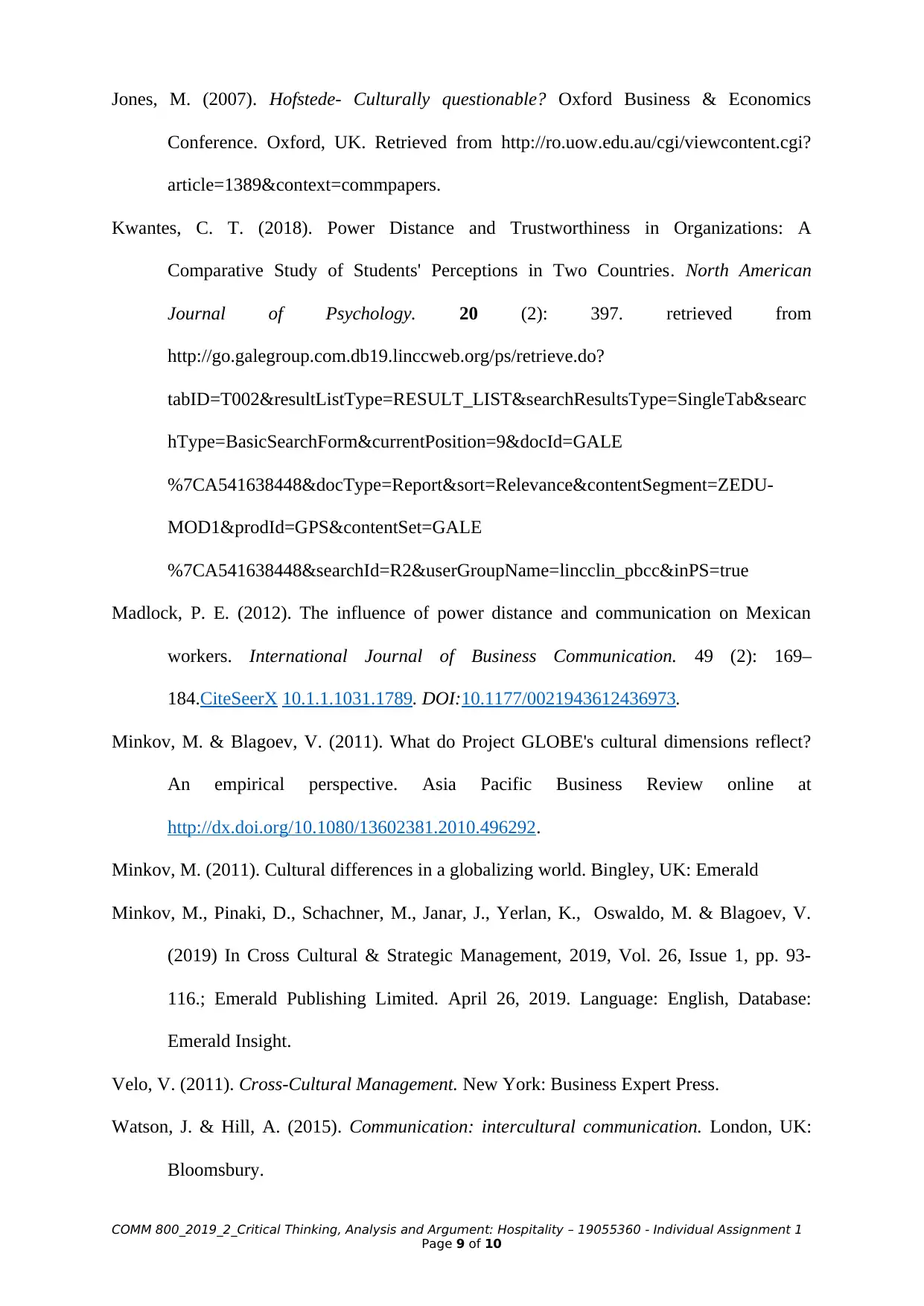
Jones, M. (2007). Hofstede- Culturally questionable? Oxford Business & Economics
Conference. Oxford, UK. Retrieved from http://ro.uow.edu.au/cgi/viewcontent.cgi?
article=1389&context=commpapers.
Kwantes, C. T. (2018). Power Distance and Trustworthiness in Organizations: A
Comparative Study of Students' Perceptions in Two Countries. North American
Journal of Psychology. 20 (2): 397. retrieved from
http://go.galegroup.com.db19.linccweb.org/ps/retrieve.do?
tabID=T002&resultListType=RESULT_LIST&searchResultsType=SingleTab&searc
hType=BasicSearchForm¤tPosition=9&docId=GALE
%7CA541638448&docType=Report&sort=Relevance&contentSegment=ZEDU-
MOD1&prodId=GPS&contentSet=GALE
%7CA541638448&searchId=R2&userGroupName=lincclin_pbcc&inPS=true
Madlock, P. E. (2012). The influence of power distance and communication on Mexican
workers. International Journal of Business Communication. 49 (2): 169–
184.CiteSeerX 10.1.1.1031.1789. DOI:10.1177/0021943612436973.
Minkov, M. & Blagoev, V. (2011). What do Project GLOBE's cultural dimensions reflect?
An empirical perspective. Asia Pacific Business Review online at
http://dx.doi.org/10.1080/13602381.2010.496292.
Minkov, M. (2011). Cultural differences in a globalizing world. Bingley, UK: Emerald
Minkov, M., Pinaki, D., Schachner, M., Janar, J., Yerlan, K., Oswaldo, M. & Blagoev, V.
(2019) In Cross Cultural & Strategic Management, 2019, Vol. 26, Issue 1, pp. 93-
116.; Emerald Publishing Limited. April 26, 2019. Language: English, Database:
Emerald Insight.
Velo, V. (2011). Cross-Cultural Management. New York: Business Expert Press.
Watson, J. & Hill, A. (2015). Communication: intercultural communication. London, UK:
Bloomsbury.
COMM 800_2019_2_Critical Thinking, Analysis and Argument: Hospitality – 19055360 - Individual Assignment 1
Page 9 of 10
Conference. Oxford, UK. Retrieved from http://ro.uow.edu.au/cgi/viewcontent.cgi?
article=1389&context=commpapers.
Kwantes, C. T. (2018). Power Distance and Trustworthiness in Organizations: A
Comparative Study of Students' Perceptions in Two Countries. North American
Journal of Psychology. 20 (2): 397. retrieved from
http://go.galegroup.com.db19.linccweb.org/ps/retrieve.do?
tabID=T002&resultListType=RESULT_LIST&searchResultsType=SingleTab&searc
hType=BasicSearchForm¤tPosition=9&docId=GALE
%7CA541638448&docType=Report&sort=Relevance&contentSegment=ZEDU-
MOD1&prodId=GPS&contentSet=GALE
%7CA541638448&searchId=R2&userGroupName=lincclin_pbcc&inPS=true
Madlock, P. E. (2012). The influence of power distance and communication on Mexican
workers. International Journal of Business Communication. 49 (2): 169–
184.CiteSeerX 10.1.1.1031.1789. DOI:10.1177/0021943612436973.
Minkov, M. & Blagoev, V. (2011). What do Project GLOBE's cultural dimensions reflect?
An empirical perspective. Asia Pacific Business Review online at
http://dx.doi.org/10.1080/13602381.2010.496292.
Minkov, M. (2011). Cultural differences in a globalizing world. Bingley, UK: Emerald
Minkov, M., Pinaki, D., Schachner, M., Janar, J., Yerlan, K., Oswaldo, M. & Blagoev, V.
(2019) In Cross Cultural & Strategic Management, 2019, Vol. 26, Issue 1, pp. 93-
116.; Emerald Publishing Limited. April 26, 2019. Language: English, Database:
Emerald Insight.
Velo, V. (2011). Cross-Cultural Management. New York: Business Expert Press.
Watson, J. & Hill, A. (2015). Communication: intercultural communication. London, UK:
Bloomsbury.
COMM 800_2019_2_Critical Thinking, Analysis and Argument: Hospitality – 19055360 - Individual Assignment 1
Page 9 of 10
⊘ This is a preview!⊘
Do you want full access?
Subscribe today to unlock all pages.
Trusted by 1+ million students worldwide

COMM 800_2019_2_Critical Thinking, Analysis and Argument: Hospitality – 19055360 - Individual Assignment 1
Page 10 of 10
Page 10 of 10

1 out of 10


Related Documents


Your All-in-One AI-Powered Toolkit for Academic Success.
+13062052269
info@desklib.com
Available 24*7 on WhatsApp / Email
![[object Object]](/_next/static/media/star-bottom.7253800d.svg)
Unlock your academic potential
Copyright © 2020–2026 A2Z Services. All Rights Reserved. Developed and managed by ZUCOL.