Commercial Law Report: Criminal, Civil, Contract & Torts
VerifiedAdded on 2021/02/21
|8
|2059
|52
Report
AI Summary
This report provides a detailed overview of commercial law, encompassing criminal and civil law distinctions, contract law essentials, and different types of contracts. It further explores tort law, including intentional, negligence, strict liability, and nuisance torts, along with the concept of duty of care. The report also explains the importance of the Memorandum and Articles of Association in company law, outlining their key components. Additionally, it provides a clear explanation of share capital and share certificates, highlighting their significance in corporate finance. The report aims to provide a comprehensive understanding of the legal and regulatory framework governing commercial activities, with a focus on ensuring compliance and ethical business practices. The report is contributed by a student to Desklib, a platform providing AI-based study tools for students.
Commercial Practice and Law

Paraphrase This Document
Need a fresh take? Get an instant paraphrase of this document with our AI Paraphraser
Table of Contents
INTRODUCTION ...............................................................................................................................3
MAIN BODY ......................................................................................................................................3
Question 1...................................................................................................................................3
Question 2...................................................................................................................................5
Question 3...................................................................................................................................6
CONCLUSION....................................................................................................................................7
REFERENCES.....................................................................................................................................8
INTRODUCTION ...............................................................................................................................3
MAIN BODY ......................................................................................................................................3
Question 1...................................................................................................................................3
Question 2...................................................................................................................................5
Question 3...................................................................................................................................6
CONCLUSION....................................................................................................................................7
REFERENCES.....................................................................................................................................8
INTRODUCTION
Commercial Law is related with rules, provisions and norms having main aim to regulate trade,
commercial and its related activities which are being undertaken by business firm for making profit.
It governs business function, working, operations thereby defining the manner in which business
can be formed and managed. The present report will define concept of Civil as well as Criminal
Law along with its distinguishing features. Further, explanation related to terms such as tort, duty of
care will be described. At last, it will streamline about importance of Memorandum and Article of
Association with brief explanation of share capital and certificate meaning & will define
information as provided by them.
MAIN BODY
Question 1.
Criminal Law is a regulatory body which governs all the offences, breach, violation such as
murder, theft, sexual assault, fraud etc. done willingly thus resulting in having negative impact on
the whole society and not on single individual person. On breaching of criminal law provisions by
any person, criminal prosecution will be started by the state.
Civil Law is related with rights associated with civil wrongs, quasi contracts. It is a body of
rules which describes individual private rights, remedies essential for governing disputes and
conflicts arises in between individuals related to property, agreements, contracts, family etc.
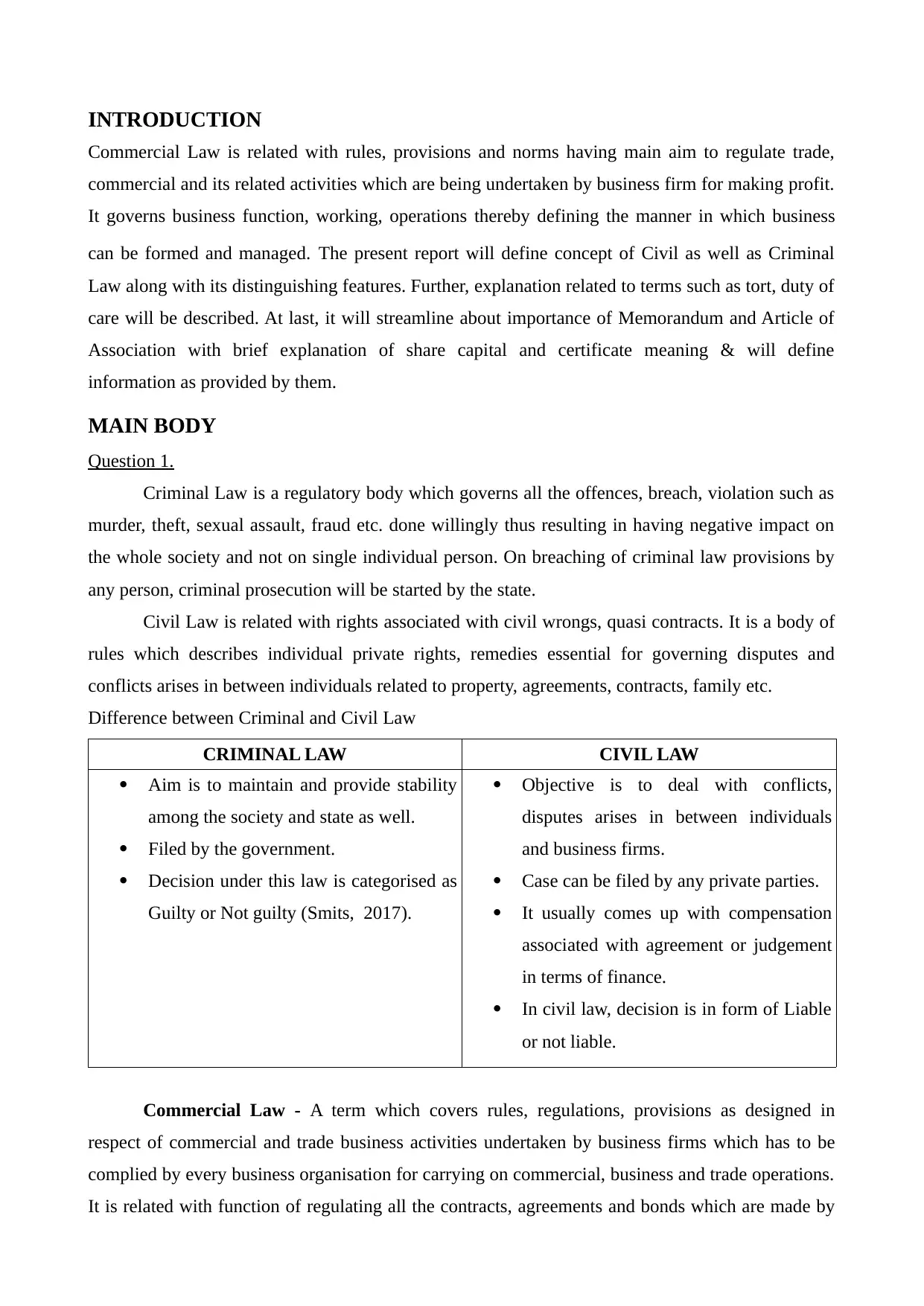
Difference between Criminal and Civil Law
CRIMINAL LAW CIVIL LAW
Aim is to maintain and provide stability
among the society and state as well.
Filed by the government.
Decision under this law is categorised as
Guilty or Not guilty (Smits, 2017).
Objective is to deal with conflicts,
disputes arises in between individuals
and business firms.
Case can be filed by any private parties.
It usually comes up with compensation
associated with agreement or judgement
in terms of finance.
In civil law, decision is in form of Liable
or not liable.
Commercial Law - A term which covers rules, regulations, provisions as designed in
respect of commercial and trade business activities undertaken by business firms which has to be
complied by every business organisation for carrying on commercial, business and trade operations.
It is related with function of regulating all the contracts, agreements and bonds which are made by
Commercial Law is related with rules, provisions and norms having main aim to regulate trade,
commercial and its related activities which are being undertaken by business firm for making profit.
It governs business function, working, operations thereby defining the manner in which business
can be formed and managed. The present report will define concept of Civil as well as Criminal
Law along with its distinguishing features. Further, explanation related to terms such as tort, duty of
care will be described. At last, it will streamline about importance of Memorandum and Article of
Association with brief explanation of share capital and certificate meaning & will define
information as provided by them.
MAIN BODY
Question 1.
Criminal Law is a regulatory body which governs all the offences, breach, violation such as
murder, theft, sexual assault, fraud etc. done willingly thus resulting in having negative impact on
the whole society and not on single individual person. On breaching of criminal law provisions by
any person, criminal prosecution will be started by the state.
Civil Law is related with rights associated with civil wrongs, quasi contracts. It is a body of
rules which describes individual private rights, remedies essential for governing disputes and
conflicts arises in between individuals related to property, agreements, contracts, family etc.
Difference between Criminal and Civil Law
CRIMINAL LAW CIVIL LAW
Aim is to maintain and provide stability
among the society and state as well.
Filed by the government.
Decision under this law is categorised as
Guilty or Not guilty (Smits, 2017).
Objective is to deal with conflicts,
disputes arises in between individuals
and business firms.
Case can be filed by any private parties.
It usually comes up with compensation
associated with agreement or judgement
in terms of finance.
In civil law, decision is in form of Liable
or not liable.
Commercial Law - A term which covers rules, regulations, provisions as designed in
respect of commercial and trade business activities undertaken by business firms which has to be
complied by every business organisation for carrying on commercial, business and trade operations.
It is related with function of regulating all the contracts, agreements and bonds which are made by
⊘ This is a preview!⊘
Do you want full access?
Subscribe today to unlock all pages.

Trusted by 1+ million students worldwide
corporate firms (Mann and Roberts, 2015). Also, compliance has to be made at the time of
manufacturing and selling of any consumer goods with the purpose of making profit and growth.
All the acts, business operations which has been performed against applicable laws, provisions will
fall under the jurisdictions of Civil law as it is related to any criminal activity.
Contract – Is an agreement which legally bound parties competent to the agreement to perform or
undertake obligation as defined and enforceable by law.
Essential elements of contract – For a contract to be enforceable by law, it is required to have
some essential elements which a valid contract should have:
1. Offer and Acceptance – Offer must be given by one party to another containing full details
about contract and must be of specific and definite nature. Acceptance given by another
[arty should be unconditional and absolute.
2. Consideration – Is “something in return” or expressed in terms of monetary value i.e. price
which is paid by one party to another for acceptance of offer.
3. Capacity – Parties entering into contract should be capable and competent enough to
perform as well as enter into contract or legal agreement as enforceable by law.
Incompetencies of parties can make contract void.
4. Legal Purpose – Agreement made should have some lawful objective in it. An agreement
having its subject matter unlawful will be considered as illegal and thus void (Poole, 2016).
5. Free consent – Party to whom offer has been made, should give their acceptance willingly
and not under any undue influence or threat. For a valid contract, consent given by party
accepting offer should be free.
Terms of contract – As per the term of contract, it can be of expressed, oral or implied nature. For
a valid contract, it is very much essential to make compliance of all applicable terms and conditions
breaching of which can attract penalties. For making a contract to be enforceable by law, it has to be
in form such as:
Expressed contract – In which parties exchange their promises related to terms of contract which
are stated in oral or written form or combination of both.
Implied contract – An agreement in which all the parties competent to the contract agrees to all the
terms and conditions having legal binding but nothing is stated or expressed in oral or written form.
Voidable contract – In voidable contract, one party is having the option to enforce the contract
under purview of law and other party is not having such option. A contract will be voidable on
manufacturing and selling of any consumer goods with the purpose of making profit and growth.
All the acts, business operations which has been performed against applicable laws, provisions will
fall under the jurisdictions of Civil law as it is related to any criminal activity.
Contract – Is an agreement which legally bound parties competent to the agreement to perform or
undertake obligation as defined and enforceable by law.
Essential elements of contract – For a contract to be enforceable by law, it is required to have
some essential elements which a valid contract should have:
1. Offer and Acceptance – Offer must be given by one party to another containing full details
about contract and must be of specific and definite nature. Acceptance given by another
[arty should be unconditional and absolute.
2. Consideration – Is “something in return” or expressed in terms of monetary value i.e. price
which is paid by one party to another for acceptance of offer.
3. Capacity – Parties entering into contract should be capable and competent enough to
perform as well as enter into contract or legal agreement as enforceable by law.
Incompetencies of parties can make contract void.
4. Legal Purpose – Agreement made should have some lawful objective in it. An agreement
having its subject matter unlawful will be considered as illegal and thus void (Poole, 2016).
5. Free consent – Party to whom offer has been made, should give their acceptance willingly
and not under any undue influence or threat. For a valid contract, consent given by party
accepting offer should be free.
Terms of contract – As per the term of contract, it can be of expressed, oral or implied nature. For
a valid contract, it is very much essential to make compliance of all applicable terms and conditions
breaching of which can attract penalties. For making a contract to be enforceable by law, it has to be
in form such as:
Expressed contract – In which parties exchange their promises related to terms of contract which
are stated in oral or written form or combination of both.
Implied contract – An agreement in which all the parties competent to the contract agrees to all the
terms and conditions having legal binding but nothing is stated or expressed in oral or written form.
Voidable contract – In voidable contract, one party is having the option to enforce the contract
under purview of law and other party is not having such option. A contract will be voidable on
Paraphrase This Document
Need a fresh take? Get an instant paraphrase of this document with our AI Paraphraser
happening of following situation:
1. Failure of one party to make disclosure of material facts pertaining to contract.
2. Mistake, fraud or misrepresentation
3. Incapacity of one party & breach of contract done.
4. Consent received in situation of unconsciousness or under undue influence.
Void contract – An agreement as enforceable by law when entered but due to some act or
happening, it becomes impossible for parties to carry on such contract thus resulting in breaching of
it. Such contract becomes void and is not enforceable by law after it becomes unlawful or illegal.
Question 2.
Tort Law is related to all the wrongful acts or civil wrong which has been occurred either
intentionally or accidentally resulting in injury, damage to others. It includes negligence cases,
intentional wrongs causing harm and loss arises due to crimes such as assault, fraud, wrongful
death, conversion & trespass on property forming as a basis for lawsuits.
Duty of care is legal obligation of individual person to adhere all applicable standards and
norms as imposed & associated with reasonable care i.e. need to be adopted while performing any
acts or activity having foreseeably nature of harming others. It defines obligation related to avoiding
or omitting performance of such acts or activities which is having such feature which can provide
harms to other.
Different types of tort includes:
1. Intentional Tort – Is a civil wrong which occurs in case wrongdoer engages in performing of
intentional activities resulting in damage or harm to other. It means violation of legal duty
has been done intentionally. It will have impact on the goodwill or image of business if it
undertakes activities which is unlawful or creating harm to society at large. Such tort can
result in bad public as well as customer relationship which can reduce profitability aspect.
2. Negligence Tort – Act which is conducted with careless attitude resulting in damage and
harm to other is known as Negligence tort. By undertaking activities which are considered
as negligence will have impact on shareholder value and wealth as well. Manager
performing unlawful and unethical business activities will have to face legal as well as
penalised actions which will in turn made current job records of manager worthless.
3. Strict Liability Tort –It is also known as Absolute Liability. Is legal responsibility for
damage or injury made even if person found as strictly liable was not having any fault or
1. Failure of one party to make disclosure of material facts pertaining to contract.
2. Mistake, fraud or misrepresentation
3. Incapacity of one party & breach of contract done.
4. Consent received in situation of unconsciousness or under undue influence.
Void contract – An agreement as enforceable by law when entered but due to some act or
happening, it becomes impossible for parties to carry on such contract thus resulting in breaching of
it. Such contract becomes void and is not enforceable by law after it becomes unlawful or illegal.
Question 2.
Tort Law is related to all the wrongful acts or civil wrong which has been occurred either
intentionally or accidentally resulting in injury, damage to others. It includes negligence cases,
intentional wrongs causing harm and loss arises due to crimes such as assault, fraud, wrongful
death, conversion & trespass on property forming as a basis for lawsuits.
Duty of care is legal obligation of individual person to adhere all applicable standards and
norms as imposed & associated with reasonable care i.e. need to be adopted while performing any
acts or activity having foreseeably nature of harming others. It defines obligation related to avoiding
or omitting performance of such acts or activities which is having such feature which can provide
harms to other.
Different types of tort includes:
1. Intentional Tort – Is a civil wrong which occurs in case wrongdoer engages in performing of
intentional activities resulting in damage or harm to other. It means violation of legal duty
has been done intentionally. It will have impact on the goodwill or image of business if it
undertakes activities which is unlawful or creating harm to society at large. Such tort can
result in bad public as well as customer relationship which can reduce profitability aspect.
2. Negligence Tort – Act which is conducted with careless attitude resulting in damage and
harm to other is known as Negligence tort. By undertaking activities which are considered
as negligence will have impact on shareholder value and wealth as well. Manager
performing unlawful and unethical business activities will have to face legal as well as
penalised actions which will in turn made current job records of manager worthless.
3. Strict Liability Tort –It is also known as Absolute Liability. Is legal responsibility for
damage or injury made even if person found as strictly liable was not having any fault or
negligent act. The injured party in such case is not required to prove fault as liability is strict
(Netter, 2015). There can be decline in revenue and market value as business managers will
be held liable for those acts which is not performed with any hard intentions. Stringent
penalty or action will be taken as per under the jurisdiction in which such tort will fall.
4. Nuisance Tort - Anything which interferes with citizens' rights, their enjoyment of property
or comfort. A civil wrong comprising of wrongful act done which interferes and annoys
others in respect of enjoying their legal rights. Imposing restriction on rights and powers can
result in decline in standard, quality value of business operations which will bring impact on
whole performance and profitability aspect of company and its managerial personnel as a
whole. Also, it will affect the efficiency and effectiveness of manager working because of
limitation applied which can help in making better allocation and decision making.
Question 3.
Memorandum of association – A document containing fundamental as well as essential
information pertaining to company's incorporation. It set down the constitution of company thereby
containing objects, powers, scope and boundary beyond which the company can't perform. It
provides information related to:
Name clause – Defines name of company with which it will be represented. Should not be
resemble to existing company's name and requires to be take approval from the Central
Government.
Situation clause – It states the place or address from where the company will undertake its
business operations and activities. Name of state in which registered office of company will
be situated has to be specified.
Object clause – Main and auxiliary objective of company (Hannigan, 2018).
Liability clause – Provides information about liabilities of company's members.
Capital clause – It focuses on the total capital as employed by the company.
Subscription clause – It provides details about shareholders,members who had subscribed
shares of the company.
Articles of association – It defines all the rules and regulations which governs the performance and
operations of company. It also helps company in conducting its administration as well as
management functions. It defines purpose of company and manner in which it will accomplish it. It
provides detail about following -
(Netter, 2015). There can be decline in revenue and market value as business managers will
be held liable for those acts which is not performed with any hard intentions. Stringent
penalty or action will be taken as per under the jurisdiction in which such tort will fall.
4. Nuisance Tort - Anything which interferes with citizens' rights, their enjoyment of property
or comfort. A civil wrong comprising of wrongful act done which interferes and annoys
others in respect of enjoying their legal rights. Imposing restriction on rights and powers can
result in decline in standard, quality value of business operations which will bring impact on
whole performance and profitability aspect of company and its managerial personnel as a
whole. Also, it will affect the efficiency and effectiveness of manager working because of
limitation applied which can help in making better allocation and decision making.
Question 3.
Memorandum of association – A document containing fundamental as well as essential
information pertaining to company's incorporation. It set down the constitution of company thereby
containing objects, powers, scope and boundary beyond which the company can't perform. It
provides information related to:
Name clause – Defines name of company with which it will be represented. Should not be
resemble to existing company's name and requires to be take approval from the Central
Government.
Situation clause – It states the place or address from where the company will undertake its
business operations and activities. Name of state in which registered office of company will
be situated has to be specified.
Object clause – Main and auxiliary objective of company (Hannigan, 2018).
Liability clause – Provides information about liabilities of company's members.
Capital clause – It focuses on the total capital as employed by the company.
Subscription clause – It provides details about shareholders,members who had subscribed
shares of the company.
Articles of association – It defines all the rules and regulations which governs the performance and
operations of company. It also helps company in conducting its administration as well as
management functions. It defines purpose of company and manner in which it will accomplish it. It
provides detail about following -
⊘ This is a preview!⊘
Do you want full access?
Subscribe today to unlock all pages.
Trusted by 1+ million students worldwide
Share types, values and rights attached
Directors – appointment, powers and duties
Meeting and minutes, voting and proxy
Accounts, audit report
Minimum subscription
Auditors information etc.
Share capital – It is the amount of funds which the company has raised from the general public
against shares issued to them. It is the part of money which has been invested by the shareholders of
company with a view of earning profit on such holdings or wealth maximization (Nelson, 2015).
Company has to disclose about its capital structure in its Articles as well as in its financials from
time to time.
Share certificates – A written document which acts as a proof or evidence for shares being issued
by the company in exchange of funds raised from the general public. The share certificate is signed
by the key personnel of company and contains number of shares, share value and name of
shareholder holding such ownership.
CONCLUSION
From the above report it can be concluded that, compliance of applicable law, rules and regulations
can make business operations more successful as well as profitable. It is very much important for
every business firms as well as individual to perform activities under duty of care and tort provision
so that no harm can be made to other from such performance. The report also specify importance of
memorandum as it defines manner and conditions in which company can operate, violation of
which can result in harm to company. Furthermore, explanation about share capital is provided i.e.
the amount contributed by shareholder in lieu of shares against which share certificates are given to
them which acts as a proof or evidence of such holdings.
Directors – appointment, powers and duties
Meeting and minutes, voting and proxy
Accounts, audit report
Minimum subscription
Auditors information etc.
Share capital – It is the amount of funds which the company has raised from the general public
against shares issued to them. It is the part of money which has been invested by the shareholders of
company with a view of earning profit on such holdings or wealth maximization (Nelson, 2015).
Company has to disclose about its capital structure in its Articles as well as in its financials from
time to time.
Share certificates – A written document which acts as a proof or evidence for shares being issued
by the company in exchange of funds raised from the general public. The share certificate is signed
by the key personnel of company and contains number of shares, share value and name of
shareholder holding such ownership.
CONCLUSION
From the above report it can be concluded that, compliance of applicable law, rules and regulations
can make business operations more successful as well as profitable. It is very much important for
every business firms as well as individual to perform activities under duty of care and tort provision
so that no harm can be made to other from such performance. The report also specify importance of
memorandum as it defines manner and conditions in which company can operate, violation of
which can result in harm to company. Furthermore, explanation about share capital is provided i.e.
the amount contributed by shareholder in lieu of shares against which share certificates are given to
them which acts as a proof or evidence of such holdings.
Paraphrase This Document
Need a fresh take? Get an instant paraphrase of this document with our AI Paraphraser
REFERENCES
Books and Journals
Books and Journals

1 out of 8


Related Documents


Your All-in-One AI-Powered Toolkit for Academic Success.
+13062052269
info@desklib.com
Available 24*7 on WhatsApp / Email
![[object Object]](/_next/static/media/star-bottom.7253800d.svg)
Unlock your academic potential
Copyright © 2020–2026 A2Z Services. All Rights Reserved. Developed and managed by ZUCOL.