Law Essay: Common Law vs Equity, and Equitable Remedies Analysis
VerifiedAdded on 2021/04/21
|9
|2239
|55
Essay
AI Summary
This law essay critically discusses the fusion of common law and equity, particularly in the context of equitable remedies within the Australian legal system. The essay examines the historical development of both systems, highlighting the role of the Court of Chancery and the evolution of equitable principles. It analyzes the ongoing debate between pro-fusionists and anti-fusionists, exploring the similarities and differences in their methodologies and objectives. The essay further delves into the application of equitable remedies such as specific performance, injunctions, and recession, illustrating how these remedies provide relief where common law remedies prove inadequate. Through case analysis, including Attorney General v Blake and Seager v Copydex Ltd CA, the essay concludes that while common law and equity share common goals, they operate in distinct ways, particularly in providing remedies for breaches of contract and other legal issues. The essay also includes a comprehensive bibliography of relevant articles, books, journals, and cases.

qwertyuiopasdfghjklzxcvbnmqwertyui
opasdfghjklzxcvbnmqwertyuiopasdfgh
jklzxcvbnmqwertyuiopasdfghjklzxcvb
nmqwertyuiopasdfghjklzxcvbnmqwer
tyuiopasdfghjklzxcvbnmqwertyuiopas
dfghjklzxcvbnmqwertyuiopasdfghjklzx
cvbnmqwertyuiopasdfghjklzxcvbnmq
wertyuiopasdfghjklzxcvbnmqwertyuio
pasdfghjklzxcvbnmqwertyuiopasdfghj
Law
Critical Discussion
23-Mar-18
(Student Details: )
opasdfghjklzxcvbnmqwertyuiopasdfgh
jklzxcvbnmqwertyuiopasdfghjklzxcvb
nmqwertyuiopasdfghjklzxcvbnmqwer
tyuiopasdfghjklzxcvbnmqwertyuiopas
dfghjklzxcvbnmqwertyuiopasdfghjklzx
cvbnmqwertyuiopasdfghjklzxcvbnmq
wertyuiopasdfghjklzxcvbnmqwertyuio
pasdfghjklzxcvbnmqwertyuiopasdfghj
Law
Critical Discussion
23-Mar-18
(Student Details: )

Paraphrase This Document
Need a fresh take? Get an instant paraphrase of this document with our AI Paraphraser
Law
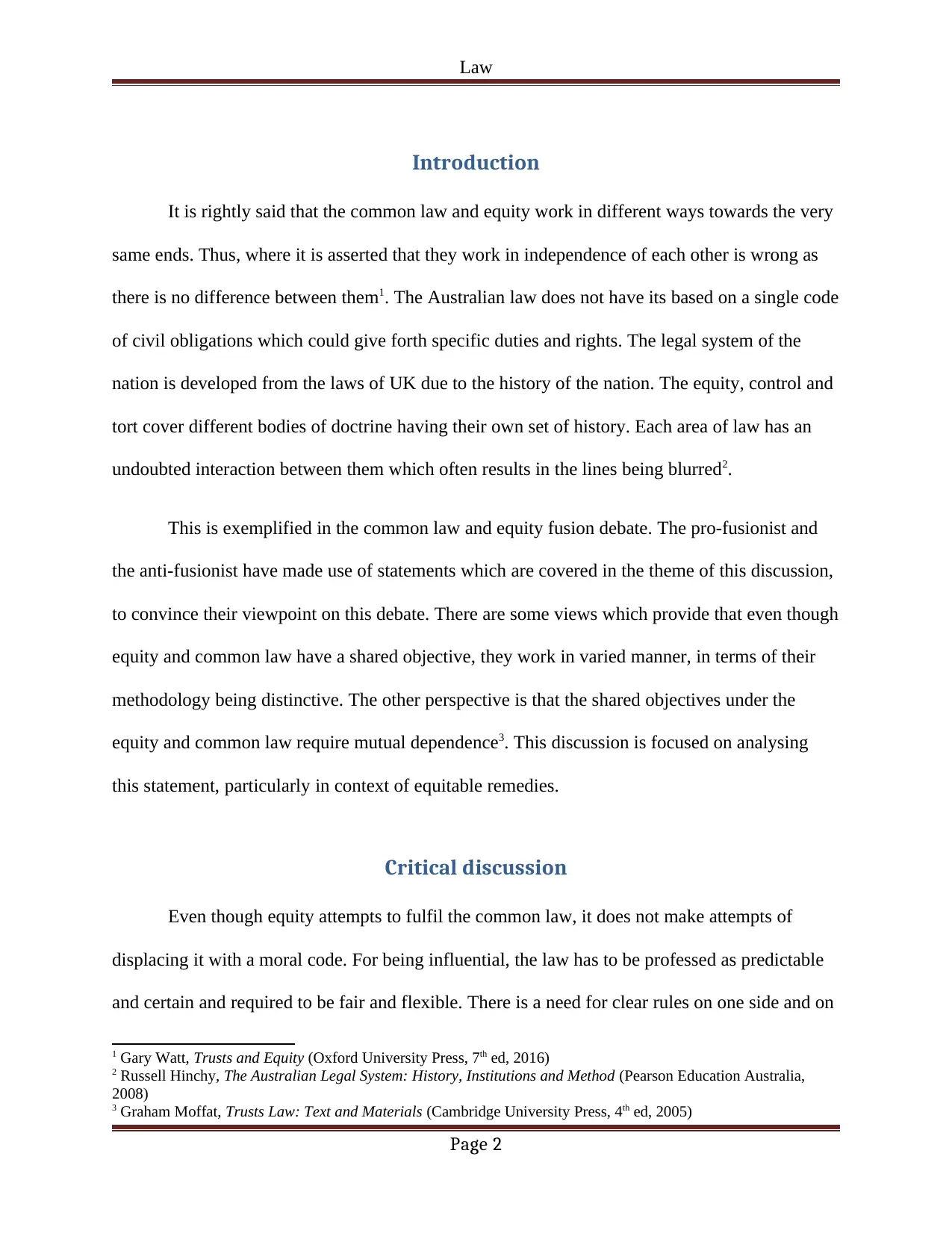
Introduction
It is rightly said that the common law and equity work in different ways towards the very
same ends. Thus, where it is asserted that they work in independence of each other is wrong as
there is no difference between them1. The Australian law does not have its based on a single code
of civil obligations which could give forth specific duties and rights. The legal system of the
nation is developed from the laws of UK due to the history of the nation. The equity, control and
tort cover different bodies of doctrine having their own set of history. Each area of law has an
undoubted interaction between them which often results in the lines being blurred2.
This is exemplified in the common law and equity fusion debate. The pro-fusionist and
the anti-fusionist have made use of statements which are covered in the theme of this discussion,
to convince their viewpoint on this debate. There are some views which provide that even though
equity and common law have a shared objective, they work in varied manner, in terms of their
methodology being distinctive. The other perspective is that the shared objectives under the
equity and common law require mutual dependence3. This discussion is focused on analysing
this statement, particularly in context of equitable remedies.
Critical discussion
Even though equity attempts to fulfil the common law, it does not make attempts of
displacing it with a moral code. For being influential, the law has to be professed as predictable
and certain and required to be fair and flexible. There is a need for clear rules on one side and on
1 Gary Watt, Trusts and Equity (Oxford University Press, 7th ed, 2016)
2 Russell Hinchy, The Australian Legal System: History, Institutions and Method (Pearson Education Australia,
2008)
3 Graham Moffat, Trusts Law: Text and Materials (Cambridge University Press, 4th ed, 2005)
Page 2
Introduction
It is rightly said that the common law and equity work in different ways towards the very
same ends. Thus, where it is asserted that they work in independence of each other is wrong as
there is no difference between them1. The Australian law does not have its based on a single code
of civil obligations which could give forth specific duties and rights. The legal system of the
nation is developed from the laws of UK due to the history of the nation. The equity, control and
tort cover different bodies of doctrine having their own set of history. Each area of law has an
undoubted interaction between them which often results in the lines being blurred2.
This is exemplified in the common law and equity fusion debate. The pro-fusionist and
the anti-fusionist have made use of statements which are covered in the theme of this discussion,
to convince their viewpoint on this debate. There are some views which provide that even though
equity and common law have a shared objective, they work in varied manner, in terms of their
methodology being distinctive. The other perspective is that the shared objectives under the
equity and common law require mutual dependence3. This discussion is focused on analysing
this statement, particularly in context of equitable remedies.
Critical discussion
Even though equity attempts to fulfil the common law, it does not make attempts of
displacing it with a moral code. For being influential, the law has to be professed as predictable
and certain and required to be fair and flexible. There is a need for clear rules on one side and on
1 Gary Watt, Trusts and Equity (Oxford University Press, 7th ed, 2016)
2 Russell Hinchy, The Australian Legal System: History, Institutions and Method (Pearson Education Australia,
2008)
3 Graham Moffat, Trusts Law: Text and Materials (Cambridge University Press, 4th ed, 2005)
Page 2
Law
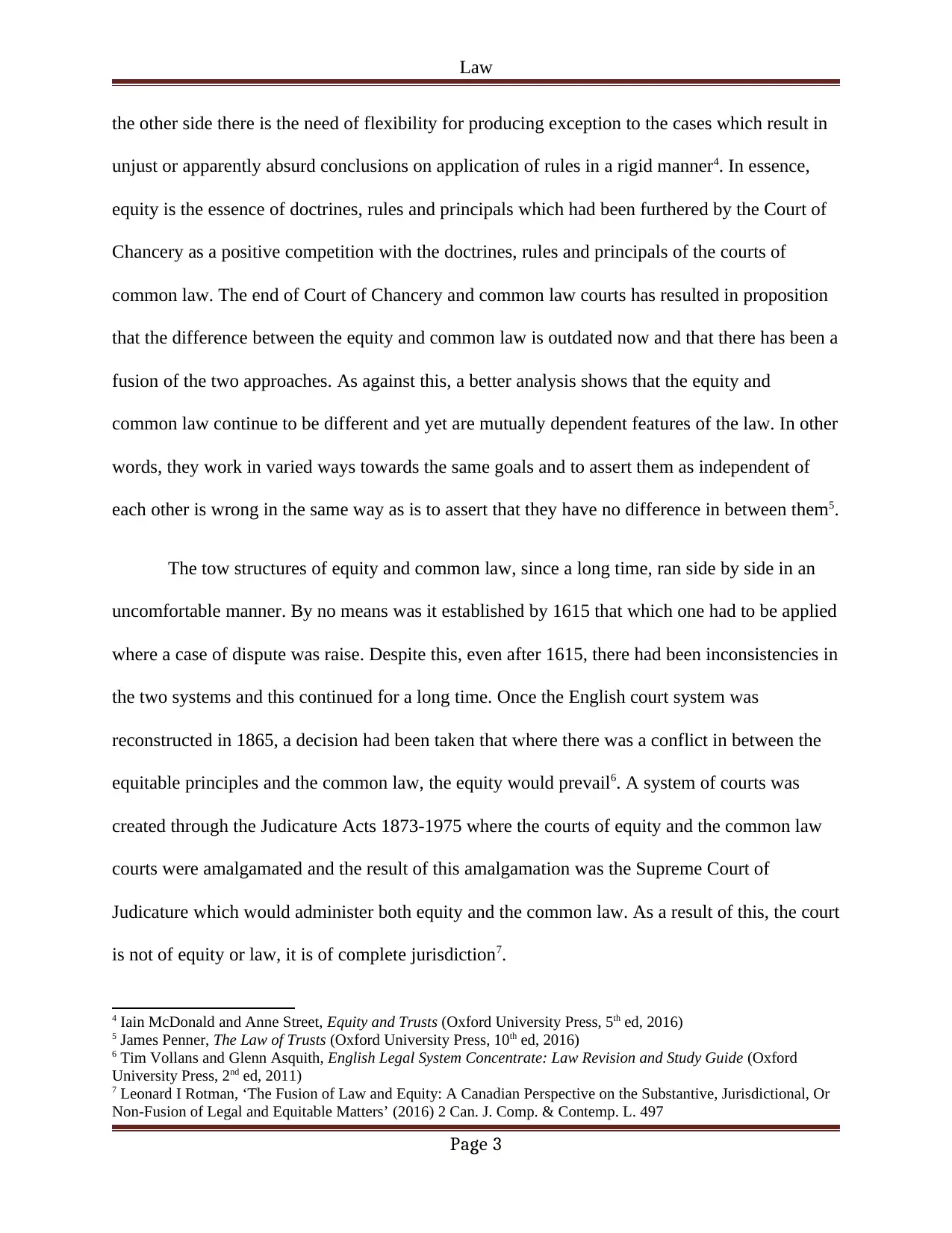
the other side there is the need of flexibility for producing exception to the cases which result in
unjust or apparently absurd conclusions on application of rules in a rigid manner4. In essence,
equity is the essence of doctrines, rules and principals which had been furthered by the Court of
Chancery as a positive competition with the doctrines, rules and principals of the courts of
common law. The end of Court of Chancery and common law courts has resulted in proposition
that the difference between the equity and common law is outdated now and that there has been a
fusion of the two approaches. As against this, a better analysis shows that the equity and
common law continue to be different and yet are mutually dependent features of the law. In other
words, they work in varied ways towards the same goals and to assert them as independent of
each other is wrong in the same way as is to assert that they have no difference in between them5.
The tow structures of equity and common law, since a long time, ran side by side in an
uncomfortable manner. By no means was it established by 1615 that which one had to be applied
where a case of dispute was raise. Despite this, even after 1615, there had been inconsistencies in
the two systems and this continued for a long time. Once the English court system was
reconstructed in 1865, a decision had been taken that where there was a conflict in between the
equitable principles and the common law, the equity would prevail6. A system of courts was
created through the Judicature Acts 1873-1975 where the courts of equity and the common law
courts were amalgamated and the result of this amalgamation was the Supreme Court of
Judicature which would administer both equity and the common law. As a result of this, the court
is not of equity or law, it is of complete jurisdiction7.
4 Iain McDonald and Anne Street, Equity and Trusts (Oxford University Press, 5th ed, 2016)
5 James Penner, The Law of Trusts (Oxford University Press, 10th ed, 2016)
6 Tim Vollans and Glenn Asquith, English Legal System Concentrate: Law Revision and Study Guide (Oxford
University Press, 2nd ed, 2011)
7 Leonard I Rotman, ‘The Fusion of Law and Equity: A Canadian Perspective on the Substantive, Jurisdictional, Or
Non-Fusion of Legal and Equitable Matters’ (2016) 2 Can. J. Comp. & Contemp. L. 497
Page 3
the other side there is the need of flexibility for producing exception to the cases which result in
unjust or apparently absurd conclusions on application of rules in a rigid manner4. In essence,
equity is the essence of doctrines, rules and principals which had been furthered by the Court of
Chancery as a positive competition with the doctrines, rules and principals of the courts of
common law. The end of Court of Chancery and common law courts has resulted in proposition
that the difference between the equity and common law is outdated now and that there has been a
fusion of the two approaches. As against this, a better analysis shows that the equity and
common law continue to be different and yet are mutually dependent features of the law. In other
words, they work in varied ways towards the same goals and to assert them as independent of
each other is wrong in the same way as is to assert that they have no difference in between them5.
The tow structures of equity and common law, since a long time, ran side by side in an
uncomfortable manner. By no means was it established by 1615 that which one had to be applied
where a case of dispute was raise. Despite this, even after 1615, there had been inconsistencies in
the two systems and this continued for a long time. Once the English court system was
reconstructed in 1865, a decision had been taken that where there was a conflict in between the
equitable principles and the common law, the equity would prevail6. A system of courts was
created through the Judicature Acts 1873-1975 where the courts of equity and the common law
courts were amalgamated and the result of this amalgamation was the Supreme Court of
Judicature which would administer both equity and the common law. As a result of this, the court
is not of equity or law, it is of complete jurisdiction7.
4 Iain McDonald and Anne Street, Equity and Trusts (Oxford University Press, 5th ed, 2016)
5 James Penner, The Law of Trusts (Oxford University Press, 10th ed, 2016)
6 Tim Vollans and Glenn Asquith, English Legal System Concentrate: Law Revision and Study Guide (Oxford
University Press, 2nd ed, 2011)
7 Leonard I Rotman, ‘The Fusion of Law and Equity: A Canadian Perspective on the Substantive, Jurisdictional, Or
Non-Fusion of Legal and Equitable Matters’ (2016) 2 Can. J. Comp. & Contemp. L. 497
Page 3
⊘ This is a preview!⊘
Do you want full access?
Subscribe today to unlock all pages.

Trusted by 1+ million students worldwide
Law
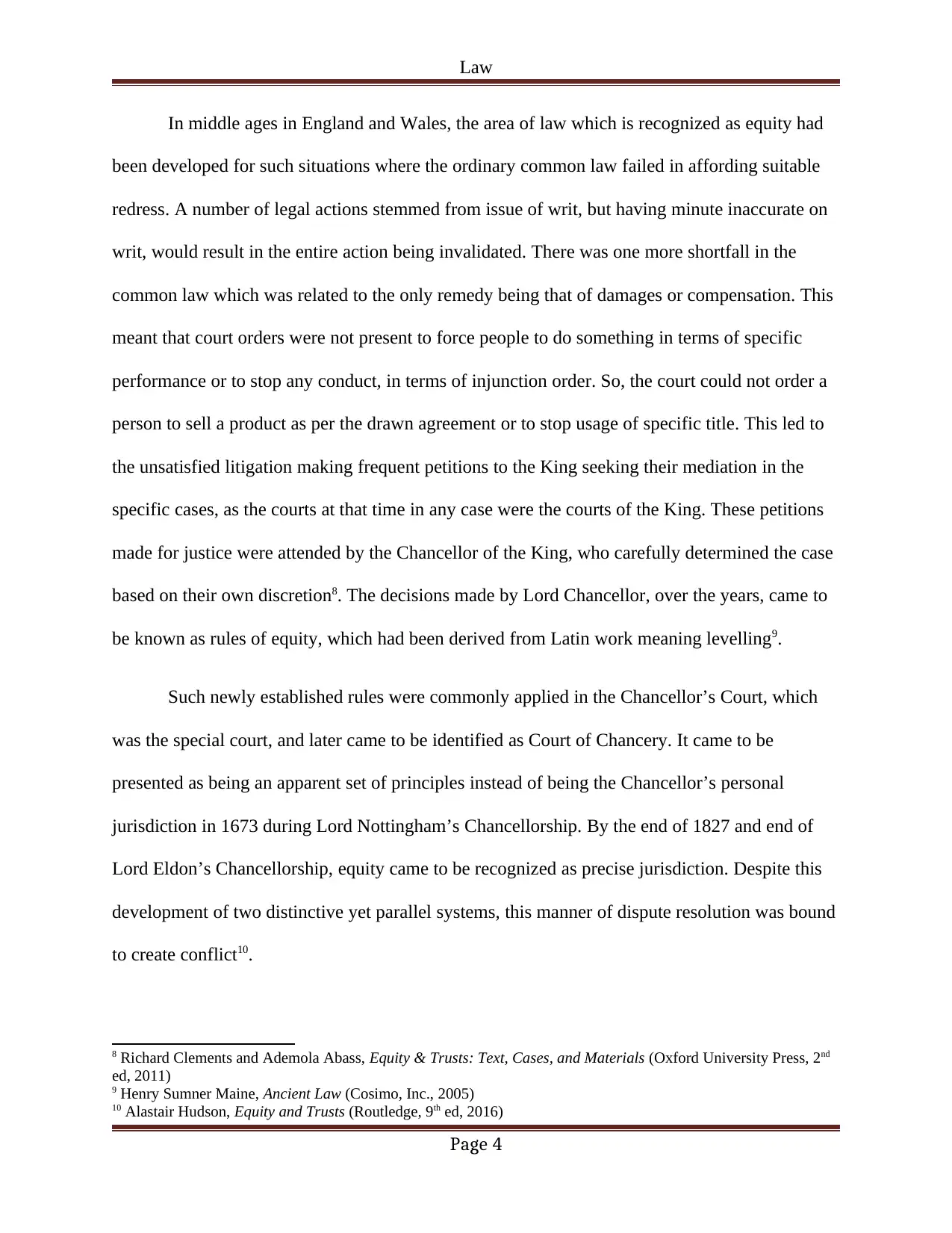
In middle ages in England and Wales, the area of law which is recognized as equity had
been developed for such situations where the ordinary common law failed in affording suitable
redress. A number of legal actions stemmed from issue of writ, but having minute inaccurate on
writ, would result in the entire action being invalidated. There was one more shortfall in the
common law which was related to the only remedy being that of damages or compensation. This
meant that court orders were not present to force people to do something in terms of specific
performance or to stop any conduct, in terms of injunction order. So, the court could not order a
person to sell a product as per the drawn agreement or to stop usage of specific title. This led to
the unsatisfied litigation making frequent petitions to the King seeking their mediation in the
specific cases, as the courts at that time in any case were the courts of the King. These petitions
made for justice were attended by the Chancellor of the King, who carefully determined the case
based on their own discretion8. The decisions made by Lord Chancellor, over the years, came to
be known as rules of equity, which had been derived from Latin work meaning levelling9.
Such newly established rules were commonly applied in the Chancellor’s Court, which
was the special court, and later came to be identified as Court of Chancery. It came to be
presented as being an apparent set of principles instead of being the Chancellor’s personal
jurisdiction in 1673 during Lord Nottingham’s Chancellorship. By the end of 1827 and end of
Lord Eldon’s Chancellorship, equity came to be recognized as precise jurisdiction. Despite this
development of two distinctive yet parallel systems, this manner of dispute resolution was bound
to create conflict10.
8 Richard Clements and Ademola Abass, Equity & Trusts: Text, Cases, and Materials (Oxford University Press, 2nd
ed, 2011)
9 Henry Sumner Maine, Ancient Law (Cosimo, Inc., 2005)
10 Alastair Hudson, Equity and Trusts (Routledge, 9th ed, 2016)
Page 4
In middle ages in England and Wales, the area of law which is recognized as equity had
been developed for such situations where the ordinary common law failed in affording suitable
redress. A number of legal actions stemmed from issue of writ, but having minute inaccurate on
writ, would result in the entire action being invalidated. There was one more shortfall in the
common law which was related to the only remedy being that of damages or compensation. This
meant that court orders were not present to force people to do something in terms of specific
performance or to stop any conduct, in terms of injunction order. So, the court could not order a
person to sell a product as per the drawn agreement or to stop usage of specific title. This led to
the unsatisfied litigation making frequent petitions to the King seeking their mediation in the
specific cases, as the courts at that time in any case were the courts of the King. These petitions
made for justice were attended by the Chancellor of the King, who carefully determined the case
based on their own discretion8. The decisions made by Lord Chancellor, over the years, came to
be known as rules of equity, which had been derived from Latin work meaning levelling9.
Such newly established rules were commonly applied in the Chancellor’s Court, which
was the special court, and later came to be identified as Court of Chancery. It came to be
presented as being an apparent set of principles instead of being the Chancellor’s personal
jurisdiction in 1673 during Lord Nottingham’s Chancellorship. By the end of 1827 and end of
Lord Eldon’s Chancellorship, equity came to be recognized as precise jurisdiction. Despite this
development of two distinctive yet parallel systems, this manner of dispute resolution was bound
to create conflict10.
8 Richard Clements and Ademola Abass, Equity & Trusts: Text, Cases, and Materials (Oxford University Press, 2nd
ed, 2011)
9 Henry Sumner Maine, Ancient Law (Cosimo, Inc., 2005)
10 Alastair Hudson, Equity and Trusts (Routledge, 9th ed, 2016)
Page 4
Paraphrase This Document
Need a fresh take? Get an instant paraphrase of this document with our AI Paraphraser
Law
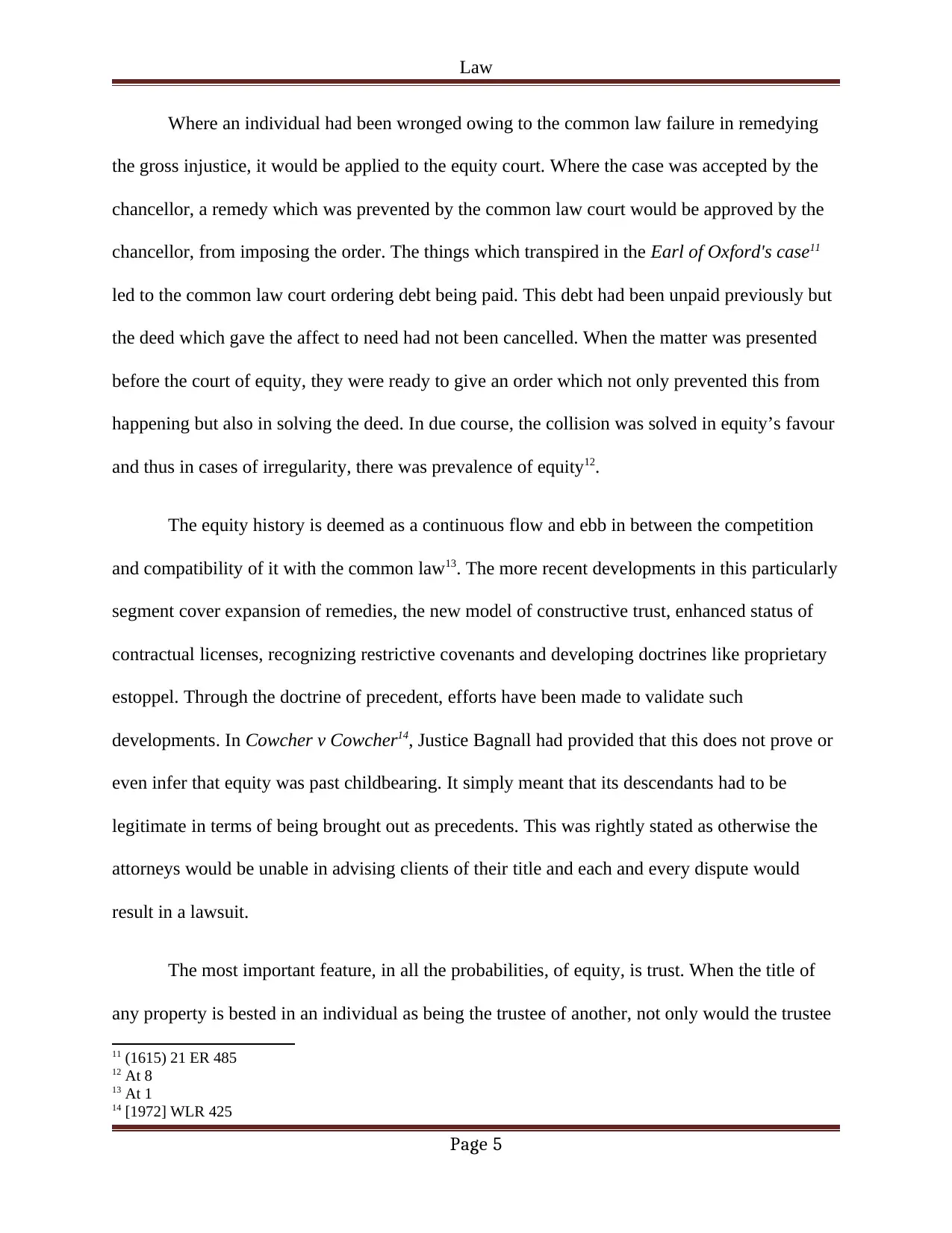
Where an individual had been wronged owing to the common law failure in remedying
the gross injustice, it would be applied to the equity court. Where the case was accepted by the
chancellor, a remedy which was prevented by the common law court would be approved by the
chancellor, from imposing the order. The things which transpired in the Earl of Oxford's case11
led to the common law court ordering debt being paid. This debt had been unpaid previously but
the deed which gave the affect to need had not been cancelled. When the matter was presented
before the court of equity, they were ready to give an order which not only prevented this from
happening but also in solving the deed. In due course, the collision was solved in equity’s favour
and thus in cases of irregularity, there was prevalence of equity12.
The equity history is deemed as a continuous flow and ebb in between the competition
and compatibility of it with the common law13. The more recent developments in this particularly
segment cover expansion of remedies, the new model of constructive trust, enhanced status of
contractual licenses, recognizing restrictive covenants and developing doctrines like proprietary
estoppel. Through the doctrine of precedent, efforts have been made to validate such
developments. In Cowcher v Cowcher14, Justice Bagnall had provided that this does not prove or
even infer that equity was past childbearing. It simply meant that its descendants had to be
legitimate in terms of being brought out as precedents. This was rightly stated as otherwise the
attorneys would be unable in advising clients of their title and each and every dispute would
result in a lawsuit.
The most important feature, in all the probabilities, of equity, is trust. When the title of
any property is bested in an individual as being the trustee of another, not only would the trustee
11 (1615) 21 ER 485
12 At 8
13 At 1
14 [1972] WLR 425
Page 5
Where an individual had been wronged owing to the common law failure in remedying
the gross injustice, it would be applied to the equity court. Where the case was accepted by the
chancellor, a remedy which was prevented by the common law court would be approved by the
chancellor, from imposing the order. The things which transpired in the Earl of Oxford's case11
led to the common law court ordering debt being paid. This debt had been unpaid previously but
the deed which gave the affect to need had not been cancelled. When the matter was presented
before the court of equity, they were ready to give an order which not only prevented this from
happening but also in solving the deed. In due course, the collision was solved in equity’s favour
and thus in cases of irregularity, there was prevalence of equity12.
The equity history is deemed as a continuous flow and ebb in between the competition
and compatibility of it with the common law13. The more recent developments in this particularly
segment cover expansion of remedies, the new model of constructive trust, enhanced status of
contractual licenses, recognizing restrictive covenants and developing doctrines like proprietary
estoppel. Through the doctrine of precedent, efforts have been made to validate such
developments. In Cowcher v Cowcher14, Justice Bagnall had provided that this does not prove or
even infer that equity was past childbearing. It simply meant that its descendants had to be
legitimate in terms of being brought out as precedents. This was rightly stated as otherwise the
attorneys would be unable in advising clients of their title and each and every dispute would
result in a lawsuit.
The most important feature, in all the probabilities, of equity, is trust. When the title of
any property is bested in an individual as being the trustee of another, not only would the trustee
11 (1615) 21 ER 485
12 At 8
13 At 1
14 [1972] WLR 425
Page 5
Law
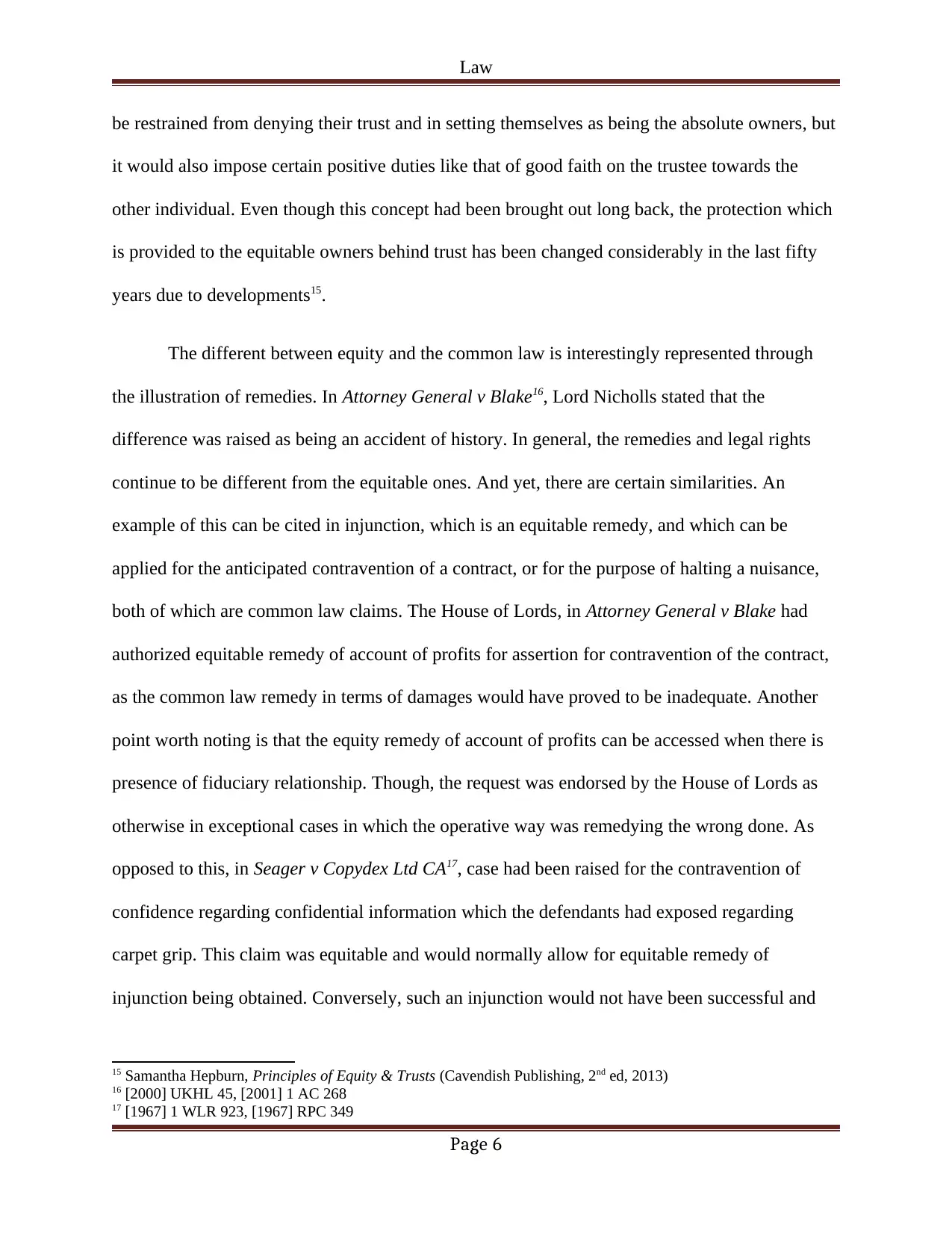
be restrained from denying their trust and in setting themselves as being the absolute owners, but
it would also impose certain positive duties like that of good faith on the trustee towards the
other individual. Even though this concept had been brought out long back, the protection which
is provided to the equitable owners behind trust has been changed considerably in the last fifty
years due to developments15.
The different between equity and the common law is interestingly represented through
the illustration of remedies. In Attorney General v Blake16, Lord Nicholls stated that the
difference was raised as being an accident of history. In general, the remedies and legal rights
continue to be different from the equitable ones. And yet, there are certain similarities. An
example of this can be cited in injunction, which is an equitable remedy, and which can be
applied for the anticipated contravention of a contract, or for the purpose of halting a nuisance,
both of which are common law claims. The House of Lords, in Attorney General v Blake had
authorized equitable remedy of account of profits for assertion for contravention of the contract,
as the common law remedy in terms of damages would have proved to be inadequate. Another
point worth noting is that the equity remedy of account of profits can be accessed when there is
presence of fiduciary relationship. Though, the request was endorsed by the House of Lords as
otherwise in exceptional cases in which the operative way was remedying the wrong done. As
opposed to this, in Seager v Copydex Ltd CA17, case had been raised for the contravention of
confidence regarding confidential information which the defendants had exposed regarding
carpet grip. This claim was equitable and would normally allow for equitable remedy of
injunction being obtained. Conversely, such an injunction would not have been successful and
15 Samantha Hepburn, Principles of Equity & Trusts (Cavendish Publishing, 2nd ed, 2013)
16 [2000] UKHL 45, [2001] 1 AC 268
17 [1967] 1 WLR 923, [1967] RPC 349
Page 6
be restrained from denying their trust and in setting themselves as being the absolute owners, but
it would also impose certain positive duties like that of good faith on the trustee towards the
other individual. Even though this concept had been brought out long back, the protection which
is provided to the equitable owners behind trust has been changed considerably in the last fifty
years due to developments15.
The different between equity and the common law is interestingly represented through
the illustration of remedies. In Attorney General v Blake16, Lord Nicholls stated that the
difference was raised as being an accident of history. In general, the remedies and legal rights
continue to be different from the equitable ones. And yet, there are certain similarities. An
example of this can be cited in injunction, which is an equitable remedy, and which can be
applied for the anticipated contravention of a contract, or for the purpose of halting a nuisance,
both of which are common law claims. The House of Lords, in Attorney General v Blake had
authorized equitable remedy of account of profits for assertion for contravention of the contract,
as the common law remedy in terms of damages would have proved to be inadequate. Another
point worth noting is that the equity remedy of account of profits can be accessed when there is
presence of fiduciary relationship. Though, the request was endorsed by the House of Lords as
otherwise in exceptional cases in which the operative way was remedying the wrong done. As
opposed to this, in Seager v Copydex Ltd CA17, case had been raised for the contravention of
confidence regarding confidential information which the defendants had exposed regarding
carpet grip. This claim was equitable and would normally allow for equitable remedy of
injunction being obtained. Conversely, such an injunction would not have been successful and
15 Samantha Hepburn, Principles of Equity & Trusts (Cavendish Publishing, 2nd ed, 2013)
16 [2000] UKHL 45, [2001] 1 AC 268
17 [1967] 1 WLR 923, [1967] RPC 349
Page 6
⊘ This is a preview!⊘
Do you want full access?
Subscribe today to unlock all pages.
Trusted by 1+ million students worldwide
Law
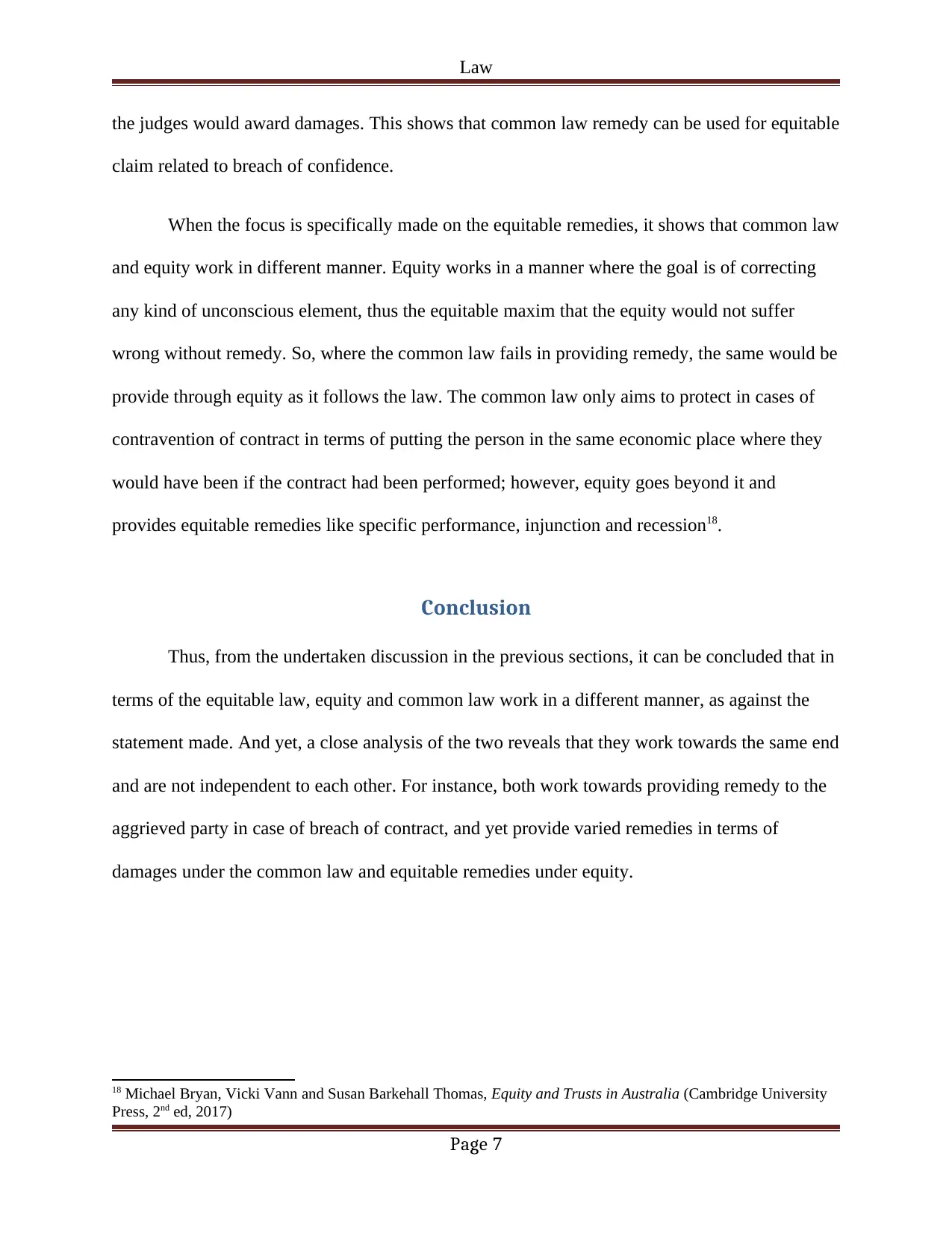
the judges would award damages. This shows that common law remedy can be used for equitable
claim related to breach of confidence.
When the focus is specifically made on the equitable remedies, it shows that common law
and equity work in different manner. Equity works in a manner where the goal is of correcting
any kind of unconscious element, thus the equitable maxim that the equity would not suffer
wrong without remedy. So, where the common law fails in providing remedy, the same would be
provide through equity as it follows the law. The common law only aims to protect in cases of
contravention of contract in terms of putting the person in the same economic place where they
would have been if the contract had been performed; however, equity goes beyond it and
provides equitable remedies like specific performance, injunction and recession18.
Conclusion
Thus, from the undertaken discussion in the previous sections, it can be concluded that in
terms of the equitable law, equity and common law work in a different manner, as against the
statement made. And yet, a close analysis of the two reveals that they work towards the same end
and are not independent to each other. For instance, both work towards providing remedy to the
aggrieved party in case of breach of contract, and yet provide varied remedies in terms of
damages under the common law and equitable remedies under equity.
18 Michael Bryan, Vicki Vann and Susan Barkehall Thomas, Equity and Trusts in Australia (Cambridge University
Press, 2nd ed, 2017)
Page 7
the judges would award damages. This shows that common law remedy can be used for equitable
claim related to breach of confidence.
When the focus is specifically made on the equitable remedies, it shows that common law
and equity work in different manner. Equity works in a manner where the goal is of correcting
any kind of unconscious element, thus the equitable maxim that the equity would not suffer
wrong without remedy. So, where the common law fails in providing remedy, the same would be
provide through equity as it follows the law. The common law only aims to protect in cases of
contravention of contract in terms of putting the person in the same economic place where they
would have been if the contract had been performed; however, equity goes beyond it and
provides equitable remedies like specific performance, injunction and recession18.
Conclusion
Thus, from the undertaken discussion in the previous sections, it can be concluded that in
terms of the equitable law, equity and common law work in a different manner, as against the
statement made. And yet, a close analysis of the two reveals that they work towards the same end
and are not independent to each other. For instance, both work towards providing remedy to the
aggrieved party in case of breach of contract, and yet provide varied remedies in terms of
damages under the common law and equitable remedies under equity.
18 Michael Bryan, Vicki Vann and Susan Barkehall Thomas, Equity and Trusts in Australia (Cambridge University
Press, 2nd ed, 2017)
Page 7
Paraphrase This Document
Need a fresh take? Get an instant paraphrase of this document with our AI Paraphraser
Law
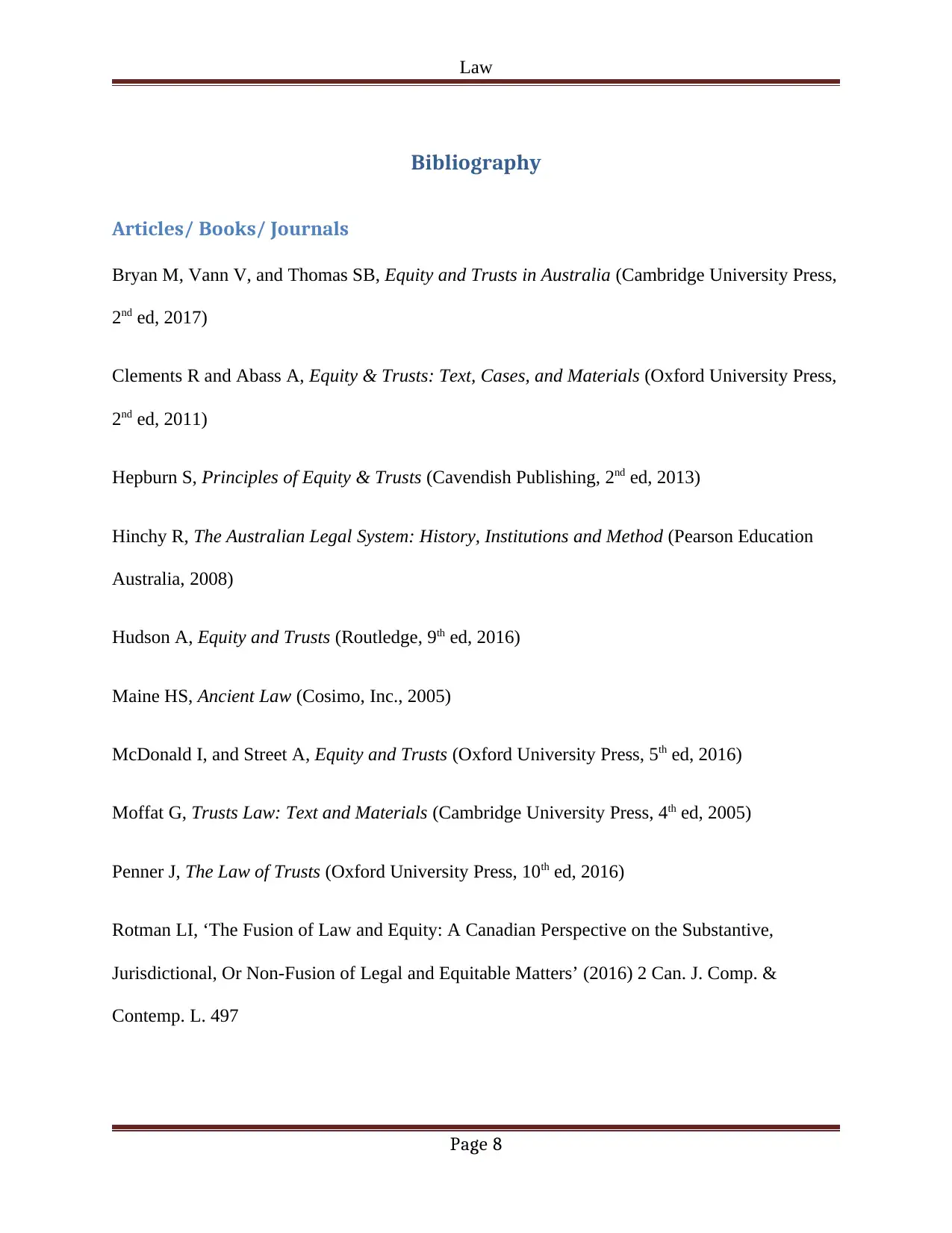
Bibliography
Articles/ Books/ Journals
Bryan M, Vann V, and Thomas SB, Equity and Trusts in Australia (Cambridge University Press,
2nd ed, 2017)
Clements R and Abass A, Equity & Trusts: Text, Cases, and Materials (Oxford University Press,
2nd ed, 2011)
Hepburn S, Principles of Equity & Trusts (Cavendish Publishing, 2nd ed, 2013)
Hinchy R, The Australian Legal System: History, Institutions and Method (Pearson Education
Australia, 2008)
Hudson A, Equity and Trusts (Routledge, 9th ed, 2016)
Maine HS, Ancient Law (Cosimo, Inc., 2005)
McDonald I, and Street A, Equity and Trusts (Oxford University Press, 5th ed, 2016)
Moffat G, Trusts Law: Text and Materials (Cambridge University Press, 4th ed, 2005)
Penner J, The Law of Trusts (Oxford University Press, 10th ed, 2016)
Rotman LI, ‘The Fusion of Law and Equity: A Canadian Perspective on the Substantive,
Jurisdictional, Or Non-Fusion of Legal and Equitable Matters’ (2016) 2 Can. J. Comp. &
Contemp. L. 497
Page 8
Bibliography
Articles/ Books/ Journals
Bryan M, Vann V, and Thomas SB, Equity and Trusts in Australia (Cambridge University Press,
2nd ed, 2017)
Clements R and Abass A, Equity & Trusts: Text, Cases, and Materials (Oxford University Press,
2nd ed, 2011)
Hepburn S, Principles of Equity & Trusts (Cavendish Publishing, 2nd ed, 2013)
Hinchy R, The Australian Legal System: History, Institutions and Method (Pearson Education
Australia, 2008)
Hudson A, Equity and Trusts (Routledge, 9th ed, 2016)
Maine HS, Ancient Law (Cosimo, Inc., 2005)
McDonald I, and Street A, Equity and Trusts (Oxford University Press, 5th ed, 2016)
Moffat G, Trusts Law: Text and Materials (Cambridge University Press, 4th ed, 2005)
Penner J, The Law of Trusts (Oxford University Press, 10th ed, 2016)
Rotman LI, ‘The Fusion of Law and Equity: A Canadian Perspective on the Substantive,
Jurisdictional, Or Non-Fusion of Legal and Equitable Matters’ (2016) 2 Can. J. Comp. &
Contemp. L. 497
Page 8
Law
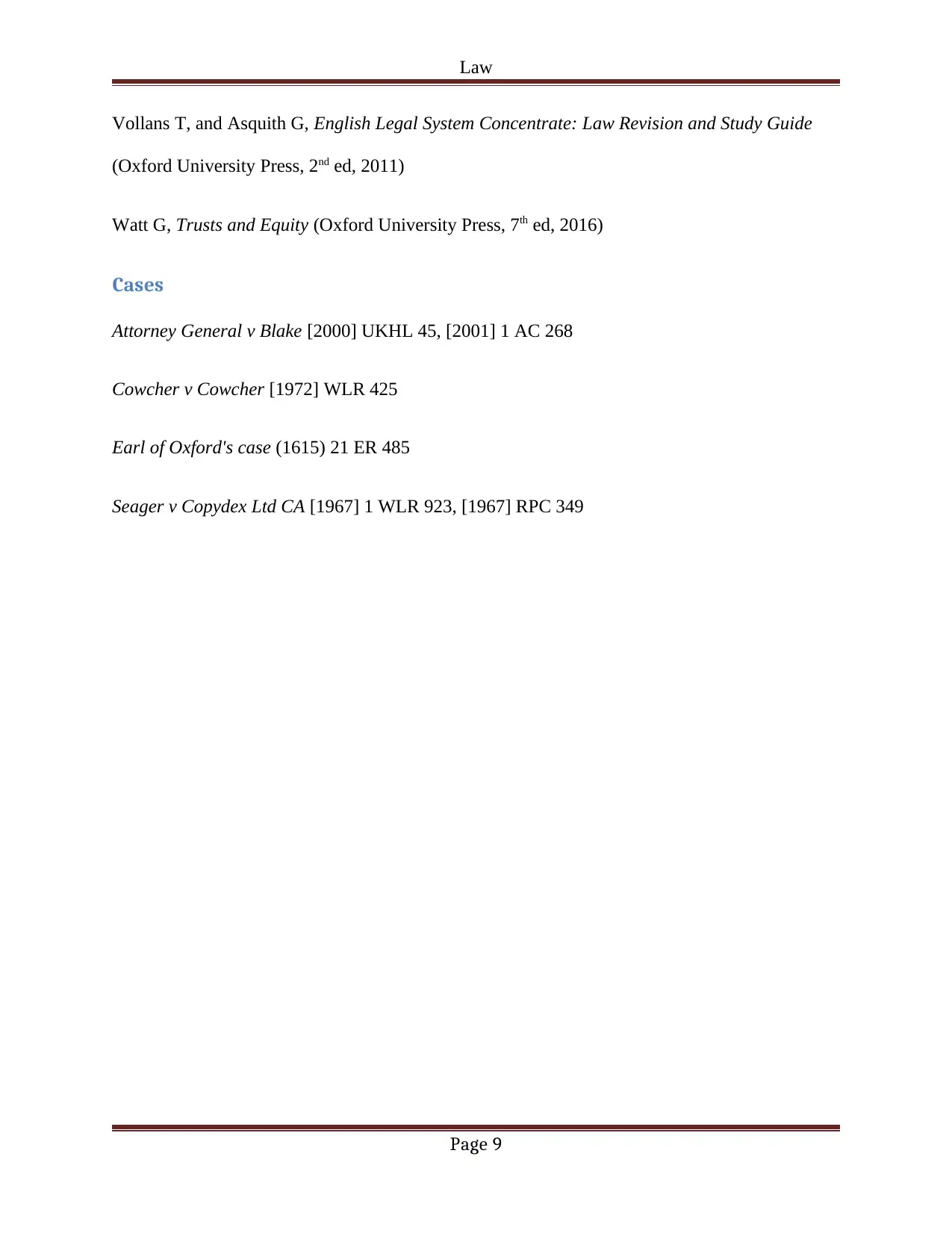
Vollans T, and Asquith G, English Legal System Concentrate: Law Revision and Study Guide
(Oxford University Press, 2nd ed, 2011)
Watt G, Trusts and Equity (Oxford University Press, 7th ed, 2016)
Cases
Attorney General v Blake [2000] UKHL 45, [2001] 1 AC 268
Cowcher v Cowcher [1972] WLR 425
Earl of Oxford's case (1615) 21 ER 485
Seager v Copydex Ltd CA [1967] 1 WLR 923, [1967] RPC 349
Page 9
Vollans T, and Asquith G, English Legal System Concentrate: Law Revision and Study Guide
(Oxford University Press, 2nd ed, 2011)
Watt G, Trusts and Equity (Oxford University Press, 7th ed, 2016)
Cases
Attorney General v Blake [2000] UKHL 45, [2001] 1 AC 268
Cowcher v Cowcher [1972] WLR 425
Earl of Oxford's case (1615) 21 ER 485
Seager v Copydex Ltd CA [1967] 1 WLR 923, [1967] RPC 349
Page 9
⊘ This is a preview!⊘
Do you want full access?
Subscribe today to unlock all pages.
Trusted by 1+ million students worldwide

1 out of 9


Your All-in-One AI-Powered Toolkit for Academic Success.
+13062052269
info@desklib.com
Available 24*7 on WhatsApp / Email
![[object Object]](/_next/static/media/star-bottom.7253800d.svg)
Unlock your academic potential
Copyright © 2020–2026 A2Z Services. All Rights Reserved. Developed and managed by ZUCOL.