Professional Project: How Debt Management Improves Bank Profitability
VerifiedAdded on 2020/05/28
|22
|4975
|87
Project
AI Summary
This professional project investigates the correlation between debt management and the profitability of the Commonwealth Bank, comparing its performance with Westpac and ANZ Bank. The study addresses research questions focusing on the impact of profitability and debt management on the bank's financial outcomes. A comprehensive literature review provides context, supported by quantitative data analysis, including descriptive statistics and correlation analysis, to assess financial figures and draw conclusions. The methodology employs secondary data collection from various sources, including websites, journals, and annual reports, to examine key financial ratios and leverage. The paper concludes with recommendations and addresses limitations, aiming to offer insights into how debt management strategies can enhance the Commonwealth Bank's profitability.

Running head: PROFESSIONAL PROJECT
How debt management will improve the expected profit of the Commonwealth Bank
Name of the Student:
Student ID No:
Unit Name:
Unit Code:
Tutor’s Name:
Name of the University:
Assignment No:
Assignment Title:
Due Date:
Date Submitted:
Author’s Note:
How debt management will improve the expected profit of the Commonwealth Bank
Name of the Student:
Student ID No:
Unit Name:
Unit Code:
Tutor’s Name:
Name of the University:
Assignment No:
Assignment Title:
Due Date:
Date Submitted:
Author’s Note:

Paraphrase This Document
Need a fresh take? Get an instant paraphrase of this document with our AI Paraphraser

1
PROFESSIONAL PROJECT
Declaration
I have read and understand the Rules Relating to Awards (Rule 3 Section 18 – Academic
Misconduct Including Plagiarism) as contained in the SCU Policy Library. I understand the
penalties that apply for plagiarism and agree to be bound by these rules. The work I am
submitting electronically is entirely my own work.
Signed:
(Please type your name)
Date:
PROFESSIONAL PROJECT
Declaration
I have read and understand the Rules Relating to Awards (Rule 3 Section 18 – Academic
Misconduct Including Plagiarism) as contained in the SCU Policy Library. I understand the
penalties that apply for plagiarism and agree to be bound by these rules. The work I am
submitting electronically is entirely my own work.
Signed:
(Please type your name)
Date:
2
PROFESSIONAL PROJECT
Executive Summary
The professional project that is under consideration looks to explain how debt management is
associated with the expected profit of Commonwealth Bank in relation to the other banks in
Australia. The other banks that have been chosen are Westpac and ANZ Bank respectively.
The research has framed the research questions and the objectives of the paper in accordance
to which the researcher has agreed to take the research ahead. The literature review explains
the advices provided by other researchers and websites that associate to debt management.
Quantitative data has been used in order to proceed with data analysis so that the financial
figures of the paper can be assessed and thereby outcome of the paper can be achieved.
PROFESSIONAL PROJECT
Executive Summary
The professional project that is under consideration looks to explain how debt management is
associated with the expected profit of Commonwealth Bank in relation to the other banks in
Australia. The other banks that have been chosen are Westpac and ANZ Bank respectively.
The research has framed the research questions and the objectives of the paper in accordance
to which the researcher has agreed to take the research ahead. The literature review explains
the advices provided by other researchers and websites that associate to debt management.
Quantitative data has been used in order to proceed with data analysis so that the financial
figures of the paper can be assessed and thereby outcome of the paper can be achieved.
⊘ This is a preview!⊘
Do you want full access?
Subscribe today to unlock all pages.

Trusted by 1+ million students worldwide
3
PROFESSIONAL PROJECT
Table of Contents
Chapter 1: Introduction..............................................................................................................4
1.1 Problem Statement...........................................................................................................4
1.2 Research Aims and Objectives.........................................................................................5
1.3 Research Questions..........................................................................................................5
Chapter 2: Literature Review.....................................................................................................6
Chapter 3: Research Methodology.............................................................................................8
3.1 Data collection process....................................................................................................8
3.2 Data Analysis...................................................................................................................9
Chapter 4: Data Analysis and Findings....................................................................................10
4.1 Descriptive Statistics......................................................................................................10
4.2 Correlation......................................................................................................................12
Chapter 5: Discussion..............................................................................................................14
5.1 Descriptive Statistics......................................................................................................14
5.2 Correlation......................................................................................................................14
Chapter 6: Conclusion and Recommendation..........................................................................15
6.1 Addressing the aims and the questions..........................................................................15
6.2 Limitation.......................................................................................................................15
6.3 Recommendation............................................................................................................15
Reference List..........................................................................................................................16
Appendix..................................................................................................................................20
PROFESSIONAL PROJECT
Table of Contents
Chapter 1: Introduction..............................................................................................................4
1.1 Problem Statement...........................................................................................................4
1.2 Research Aims and Objectives.........................................................................................5
1.3 Research Questions..........................................................................................................5
Chapter 2: Literature Review.....................................................................................................6
Chapter 3: Research Methodology.............................................................................................8
3.1 Data collection process....................................................................................................8
3.2 Data Analysis...................................................................................................................9
Chapter 4: Data Analysis and Findings....................................................................................10
4.1 Descriptive Statistics......................................................................................................10
4.2 Correlation......................................................................................................................12
Chapter 5: Discussion..............................................................................................................14
5.1 Descriptive Statistics......................................................................................................14
5.2 Correlation......................................................................................................................14
Chapter 6: Conclusion and Recommendation..........................................................................15
6.1 Addressing the aims and the questions..........................................................................15
6.2 Limitation.......................................................................................................................15
6.3 Recommendation............................................................................................................15
Reference List..........................................................................................................................16
Appendix..................................................................................................................................20
Paraphrase This Document
Need a fresh take? Get an instant paraphrase of this document with our AI Paraphraser
4
PROFESSIONAL PROJECT
Chapter 1: Introduction
In the modern world, management of debt has been one of the key issues for the
organizations that are performing in the global economy. The debt management is helpful in
determining the level of profit for any organization. In the current aspect to time, the basis of
finance is the initial step in the functioning of an organization or business. The basic and the
fundamental financial source are inclusive of equity and debt financing which is even called
the capital structure of financing (De Jonghe, & Öztekin 2015). In accordance to equity
financing, the common fund can be increased by issuing the Initial Public Offering (IPO) to
the common people and the issuance of the ordinary shares. On the other hand, debt is
explained as the agreement among two parties where the borrower has to assure to make
payments of certain amount of interest with the treaty to make payment for the principle
value in the coming future (De Mooij, & Keen 2016). The process of debt financing is
regarded as a key aspect of the financial strategy of the organization because of the fact that
debt are of numerous kinds that includes the issuing of the bonds, debentures, trade credits
and loans etc. On the other hand, profit is explained as the financial advantage or the rewards
that have been achieved when the revenue value is more than the costs of the business
operations. As the profit is associated directly with the process of decision making of an
organization and therefore has an effect on the selection of the equity or debt financing
(Alshatti, 2015).
1.1 Problem Statement
Different kinds of organisations has the option of selecting in between the equity
financing and debt financing for the activities of the business which is associated directly to
the growth and profit of the organization (Allegret et al., 2016). It can be explained that debt
financing has the benefit over the tax savings or the tax intentions over the financing related
to equity and debt financing is not a complex process with respect to the equity financing in
PROFESSIONAL PROJECT
Chapter 1: Introduction
In the modern world, management of debt has been one of the key issues for the
organizations that are performing in the global economy. The debt management is helpful in
determining the level of profit for any organization. In the current aspect to time, the basis of
finance is the initial step in the functioning of an organization or business. The basic and the
fundamental financial source are inclusive of equity and debt financing which is even called
the capital structure of financing (De Jonghe, & Öztekin 2015). In accordance to equity
financing, the common fund can be increased by issuing the Initial Public Offering (IPO) to
the common people and the issuance of the ordinary shares. On the other hand, debt is
explained as the agreement among two parties where the borrower has to assure to make
payments of certain amount of interest with the treaty to make payment for the principle
value in the coming future (De Mooij, & Keen 2016). The process of debt financing is
regarded as a key aspect of the financial strategy of the organization because of the fact that
debt are of numerous kinds that includes the issuing of the bonds, debentures, trade credits
and loans etc. On the other hand, profit is explained as the financial advantage or the rewards
that have been achieved when the revenue value is more than the costs of the business
operations. As the profit is associated directly with the process of decision making of an
organization and therefore has an effect on the selection of the equity or debt financing
(Alshatti, 2015).
1.1 Problem Statement
Different kinds of organisations has the option of selecting in between the equity
financing and debt financing for the activities of the business which is associated directly to
the growth and profit of the organization (Allegret et al., 2016). It can be explained that debt
financing has the benefit over the tax savings or the tax intentions over the financing related
to equity and debt financing is not a complex process with respect to the equity financing in
5
PROFESSIONAL PROJECT
the process of debt management and the lender is eligible only to undertake repayment of the
principle of the loan that has been agreed on and additionally the rate of interest. Therefore,
most of the organizations have the intention of undertaking debt financing (Alessandri, &
Nelson 2015). It is due to this reason that this thesis paper has looked to discuss about the
management of debt variables that have an impact on the anticipated profits of the firm, the
process of research planning that are going to be utilised in order to compare and compute the
variables that can be exploited in order to assess the various kinds of ratios, leverage and the
amount that can be used in order to undertake a comparison of the outcome in the present
scenario (Bennett et al., 2015). This paper has therefore looked to determine the debt
management process and its impact on profit of Commonwealth Bank of Australia.
1.2 Research Aims and Objectives
The objectives of the paper has been constructed in order to have an idea about the
process that would be undertaken and the factors that would be taken into consideration in
order to have an idea about the result that would be obtained in this paper. The research aims
and objectives are as follows:
Determine how profitability has an impact on the operations of a bank
Ascertain how debt management improves the level of profit in the bank
1.3 Research Questions
The researcher looks to frame the research questions in order to create a path in
accordance to which the research paper would move ahead and thereby would be able to
answer to the issues that are pertinent to this research paper. The research questions are as
follows:
Q1. How does profitability have an impact on the activities of Commonwealth Bank?
PROFESSIONAL PROJECT
the process of debt management and the lender is eligible only to undertake repayment of the
principle of the loan that has been agreed on and additionally the rate of interest. Therefore,
most of the organizations have the intention of undertaking debt financing (Alessandri, &
Nelson 2015). It is due to this reason that this thesis paper has looked to discuss about the
management of debt variables that have an impact on the anticipated profits of the firm, the
process of research planning that are going to be utilised in order to compare and compute the
variables that can be exploited in order to assess the various kinds of ratios, leverage and the
amount that can be used in order to undertake a comparison of the outcome in the present
scenario (Bennett et al., 2015). This paper has therefore looked to determine the debt
management process and its impact on profit of Commonwealth Bank of Australia.
1.2 Research Aims and Objectives
The objectives of the paper has been constructed in order to have an idea about the
process that would be undertaken and the factors that would be taken into consideration in
order to have an idea about the result that would be obtained in this paper. The research aims
and objectives are as follows:
Determine how profitability has an impact on the operations of a bank
Ascertain how debt management improves the level of profit in the bank
1.3 Research Questions
The researcher looks to frame the research questions in order to create a path in
accordance to which the research paper would move ahead and thereby would be able to
answer to the issues that are pertinent to this research paper. The research questions are as
follows:
Q1. How does profitability have an impact on the activities of Commonwealth Bank?
⊘ This is a preview!⊘
Do you want full access?
Subscribe today to unlock all pages.
Trusted by 1+ million students worldwide
6
PROFESSIONAL PROJECT
Q2. How does debt management improve the profit level of Commonwealth Bank?
Chapter 2: Literature Review
The anticipated profit and the capital structure of the organizations are dependent on
the numerous decisions associated with the capital structure that are undertaken by them. In
the current period, several researches have been explained that capital structure has been
swelling but there are empirical evidences has been key even today (Waemustafa, & Sukri
2015). There have been several studies and reports that have discovered that positive tax has
an impact on the extent of debt financing (Subrahmanyam et al., 2017). There has been
several numbers of studies that have revealed a negative impact on of tax on the extent of
leverage. Therefore, it needs the Meta assessment of the impact of marginal tax on the debt
ratio (Barth et al., 2017). The tax benefit is seen to be one of the most significant pieces of
information for the purpose of financial decisions in accordance to the capital structure. It is
due to this fact that development in the capital structure has been suggested as a central
principle as the companies have been making use of extreme utilisation of the debt in order to
damage the level of profit for an organization. DeAngelo, & Stulz (2015) have undertaken the
tax advantages of debt making use of the rate of the marginal tax at various degrees of
interest. As the taxable income after the subtraction of the rate of interest is lower than the
past financing, the process expressed by Calomiris, & Carlson (2016) has a good chance of
estimating the lower rate of marginal tax than the one predicted by Ball et al., (2015). The
development in the capital structure with the assistance of the debt to equity ratio will raise
the profitability of the firm (Ashraf et al., 2016). The extent of debt or the debt to equity ratio
themselves does not specify whether the organizations have been using increased amount of
debt or not but on the other hand, the companies that are operating outside Australia has
faced the transformations in the usage of debt after the financial crisis in accordance to the
PROFESSIONAL PROJECT
Q2. How does debt management improve the profit level of Commonwealth Bank?
Chapter 2: Literature Review
The anticipated profit and the capital structure of the organizations are dependent on
the numerous decisions associated with the capital structure that are undertaken by them. In
the current period, several researches have been explained that capital structure has been
swelling but there are empirical evidences has been key even today (Waemustafa, & Sukri
2015). There have been several studies and reports that have discovered that positive tax has
an impact on the extent of debt financing (Subrahmanyam et al., 2017). There has been
several numbers of studies that have revealed a negative impact on of tax on the extent of
leverage. Therefore, it needs the Meta assessment of the impact of marginal tax on the debt
ratio (Barth et al., 2017). The tax benefit is seen to be one of the most significant pieces of
information for the purpose of financial decisions in accordance to the capital structure. It is
due to this fact that development in the capital structure has been suggested as a central
principle as the companies have been making use of extreme utilisation of the debt in order to
damage the level of profit for an organization. DeAngelo, & Stulz (2015) have undertaken the
tax advantages of debt making use of the rate of the marginal tax at various degrees of
interest. As the taxable income after the subtraction of the rate of interest is lower than the
past financing, the process expressed by Calomiris, & Carlson (2016) has a good chance of
estimating the lower rate of marginal tax than the one predicted by Ball et al., (2015). The
development in the capital structure with the assistance of the debt to equity ratio will raise
the profitability of the firm (Ashraf et al., 2016). The extent of debt or the debt to equity ratio
themselves does not specify whether the organizations have been using increased amount of
debt or not but on the other hand, the companies that are operating outside Australia has
faced the transformations in the usage of debt after the financial crisis in accordance to the
Paraphrase This Document
Need a fresh take? Get an instant paraphrase of this document with our AI Paraphraser
7
PROFESSIONAL PROJECT
financial decisions from the point of view of the tax advantages and costs (Van Bekkum,
2016).
There have been other papers as well who have concentrated on the agency issue that
has a direct impact on the capital framework of an organization (Chan-Lau et al., 2015). The
agency issues come out when there is supposed to be the probability of disputes among the
owners of the company and the lenders which may limit the optimal capital ability decision
of the company (Panizza, & Presbitero 2014). In this case, the capital investment will look to
explain the agency issues with the help of debt financing. On the other hand, cost associated
with bankruptcy is looked upon to be comparative to the value of liquidation of the company
where the concentration is given on the assessment of the decisions of the organizations that
are associated with the capital investment in accordance to the external debt financing along
with the bankruptcy threats (Alshatti, 2015). Therefore, the companies will look to select the
extent of optimality in order to mitigate the increased expense of borrowing and bankruptcy.
But in certain scenario, the agency cost can be existent even when the estimated cost of
bankruptcy is terminated. Furthermore, when the rate of the corporate tax is raised, the
agency expense will reduce but the optimal level of capacity will rise with the rise in the
extent of borrowing (De Jonghe, & Öztekin 2015).
PROFESSIONAL PROJECT
financial decisions from the point of view of the tax advantages and costs (Van Bekkum,
2016).
There have been other papers as well who have concentrated on the agency issue that
has a direct impact on the capital framework of an organization (Chan-Lau et al., 2015). The
agency issues come out when there is supposed to be the probability of disputes among the
owners of the company and the lenders which may limit the optimal capital ability decision
of the company (Panizza, & Presbitero 2014). In this case, the capital investment will look to
explain the agency issues with the help of debt financing. On the other hand, cost associated
with bankruptcy is looked upon to be comparative to the value of liquidation of the company
where the concentration is given on the assessment of the decisions of the organizations that
are associated with the capital investment in accordance to the external debt financing along
with the bankruptcy threats (Alshatti, 2015). Therefore, the companies will look to select the
extent of optimality in order to mitigate the increased expense of borrowing and bankruptcy.
But in certain scenario, the agency cost can be existent even when the estimated cost of
bankruptcy is terminated. Furthermore, when the rate of the corporate tax is raised, the
agency expense will reduce but the optimal level of capacity will rise with the rise in the
extent of borrowing (De Jonghe, & Öztekin 2015).
8
PROFESSIONAL PROJECT
Chapter 3: Research Methodology
This segment of the research paper has the intention of revealing the process of
collecting the authentic data that would the helpful in taking the paper forward and answering
the issues that have been identified by the researcher previously. In order to discover the
effective capital structure that is related to debt financing and equity financing that will be
helpful in finding out the anticipated profit of Commonwealth Bank, the researcher has
looked to collect quantitative data.
3.1 Data collection process
The main objective of the data gathering process has been to reveal the impact of debt
management on the on the anticipated profit of Commonwealth Bank. In accordance to this
research, the researcher has looked to undertake descriptive research design in order to
explain the data that has been gathered by the researcher from several sources (Borisova et
al., 2015). The paper has tried to collect the data with the assistance of the secondary data
methods so that critical level of analysis can be attained (Black et al., 2016). In order to
gather the data in an effective and swift manner, the researcher has utilised the most general
methods of gaining the secondary data. This kind of data has been gathered by taking
assistance of the sources like the websites and even website journals. The other sources
include the journals, relevant books, and articles, reports from the governments and the
annual reports of the banks that have been taken into consideration (Greenwood et al., 2015).
The researcher has even taken assistance of the researches that have been taken previously by
other researches in order to link them with the current researches and have a clear idea about
the result that needs to be accomplished. The collection of the data with the help of these
sources will be reducing cost for the researcher and thereby this method is looked upon as
PROFESSIONAL PROJECT
Chapter 3: Research Methodology
This segment of the research paper has the intention of revealing the process of
collecting the authentic data that would the helpful in taking the paper forward and answering
the issues that have been identified by the researcher previously. In order to discover the
effective capital structure that is related to debt financing and equity financing that will be
helpful in finding out the anticipated profit of Commonwealth Bank, the researcher has
looked to collect quantitative data.
3.1 Data collection process
The main objective of the data gathering process has been to reveal the impact of debt
management on the on the anticipated profit of Commonwealth Bank. In accordance to this
research, the researcher has looked to undertake descriptive research design in order to
explain the data that has been gathered by the researcher from several sources (Borisova et
al., 2015). The paper has tried to collect the data with the assistance of the secondary data
methods so that critical level of analysis can be attained (Black et al., 2016). In order to
gather the data in an effective and swift manner, the researcher has utilised the most general
methods of gaining the secondary data. This kind of data has been gathered by taking
assistance of the sources like the websites and even website journals. The other sources
include the journals, relevant books, and articles, reports from the governments and the
annual reports of the banks that have been taken into consideration (Greenwood et al., 2015).
The researcher has even taken assistance of the researches that have been taken previously by
other researches in order to link them with the current researches and have a clear idea about
the result that needs to be accomplished. The collection of the data with the help of these
sources will be reducing cost for the researcher and thereby this method is looked upon as
⊘ This is a preview!⊘
Do you want full access?
Subscribe today to unlock all pages.
Trusted by 1+ million students worldwide
9
PROFESSIONAL PROJECT
cost efficient. The secondary data even addresses the current concern by not taking assistance
of any other sources that are available to the researcher.
The information related to Commonwealth Bank and the other banks that have been
selected for the assessment in this paper has even gathered from the Australian Statistics
Bureau (ABS) as this website contains all the data that are associated with any organization
that are functional in the Australian economy (Gomariz, & Ballesta 2014). However, as this
paper mainly concentrates on the financial aspects of the banks, effective level of information
has been available from the annual reports of the concerned banks and thereby effective
results can be attained.
3.2 Data Analysis
The researcher has looked to collect quantitative data as the paper is concerned with
assessing the financial figures that are associated with the transactions that have taken place
in Commonwealth Bank and the other banks that have been selected in order to gain the
outcome that is required in order to complete the paper. The data that has been attained needs
to go through several software tools in order to get the results out of them (Hasan et al.,
2017). Excel software and tool has been used in order to evaluate the data and the internal
aspect of the data that would explain the impact of debt management on the expected profit
for Commonwealth Bank can be obtained. The leverage ratio of the selected banks will be
taken into consideration in order to attain the results that are associated with the research
aims and questions.
PROFESSIONAL PROJECT
cost efficient. The secondary data even addresses the current concern by not taking assistance
of any other sources that are available to the researcher.
The information related to Commonwealth Bank and the other banks that have been
selected for the assessment in this paper has even gathered from the Australian Statistics
Bureau (ABS) as this website contains all the data that are associated with any organization
that are functional in the Australian economy (Gomariz, & Ballesta 2014). However, as this
paper mainly concentrates on the financial aspects of the banks, effective level of information
has been available from the annual reports of the concerned banks and thereby effective
results can be attained.
3.2 Data Analysis
The researcher has looked to collect quantitative data as the paper is concerned with
assessing the financial figures that are associated with the transactions that have taken place
in Commonwealth Bank and the other banks that have been selected in order to gain the
outcome that is required in order to complete the paper. The data that has been attained needs
to go through several software tools in order to get the results out of them (Hasan et al.,
2017). Excel software and tool has been used in order to evaluate the data and the internal
aspect of the data that would explain the impact of debt management on the expected profit
for Commonwealth Bank can be obtained. The leverage ratio of the selected banks will be
taken into consideration in order to attain the results that are associated with the research
aims and questions.
Paraphrase This Document
Need a fresh take? Get an instant paraphrase of this document with our AI Paraphraser
10
PROFESSIONAL PROJECT
Chapter 4: Data Analysis and Findings
This segment of the paper has been framed in order to have an idea about the process
and the measures that have to be taken in order to critically evaluate the financial figures and
break them down in an effective manner in order to have an idea about debt management and
their impact on the expected profit of Commonwealth bank in Australia in comparison to the
ANZ Bank and Westpac. The values that are in relation to Return on Equity, Return on Asset
and the Financial Leverage have been compared of each of the banks in order to have an idea
about their operational activities. The analysis has been given as follows:
4.1 Descriptive Statistics
Commonwealth Bank
Commonw
ealth Bank 2008 2009 2010 2011 2012 2013 2014 2015 2016 2017
Mean
13.56
67
12.86
67
12.45
67
12.59
67
12.53
67
11.95
33
11.91
33 11.88
10.96
67
10.86
33
Standard
Error
6.263
46
6.103
46
5.797
84
5.814
98
5.762
62
5.469
16
5.433
91
5.407
05
4.979
82
4.915
03
Median 19.76 17.07 17.53 18.17 17.91 16.77 16.21 16.65 15.5 15.46
Standard
Deviation
10.84
86
10.57
15
10.04
22
10.07
18
9.981
15
9.472
87
9.411
8
9.365
29
8.625
3
8.513
09
Sample
Variance
117.6
93
111.7
57
100.8
45
101.4
42
99.62
34
89.73
52
88.58
2
87.70
87
74.39
57
72.47
26
Skewness
-
1.731
7
-
1.506
4
-
1.693
2
-
1.727
6
-
1.720
5
-
1.696
5
-
1.626
2
-
1.697
4
-
1.711
8
-
1.721
4
Largest(1) 19.9 20.69 18.95 18.65 18.68 18.05 18.41 17.9 16.38 16.09
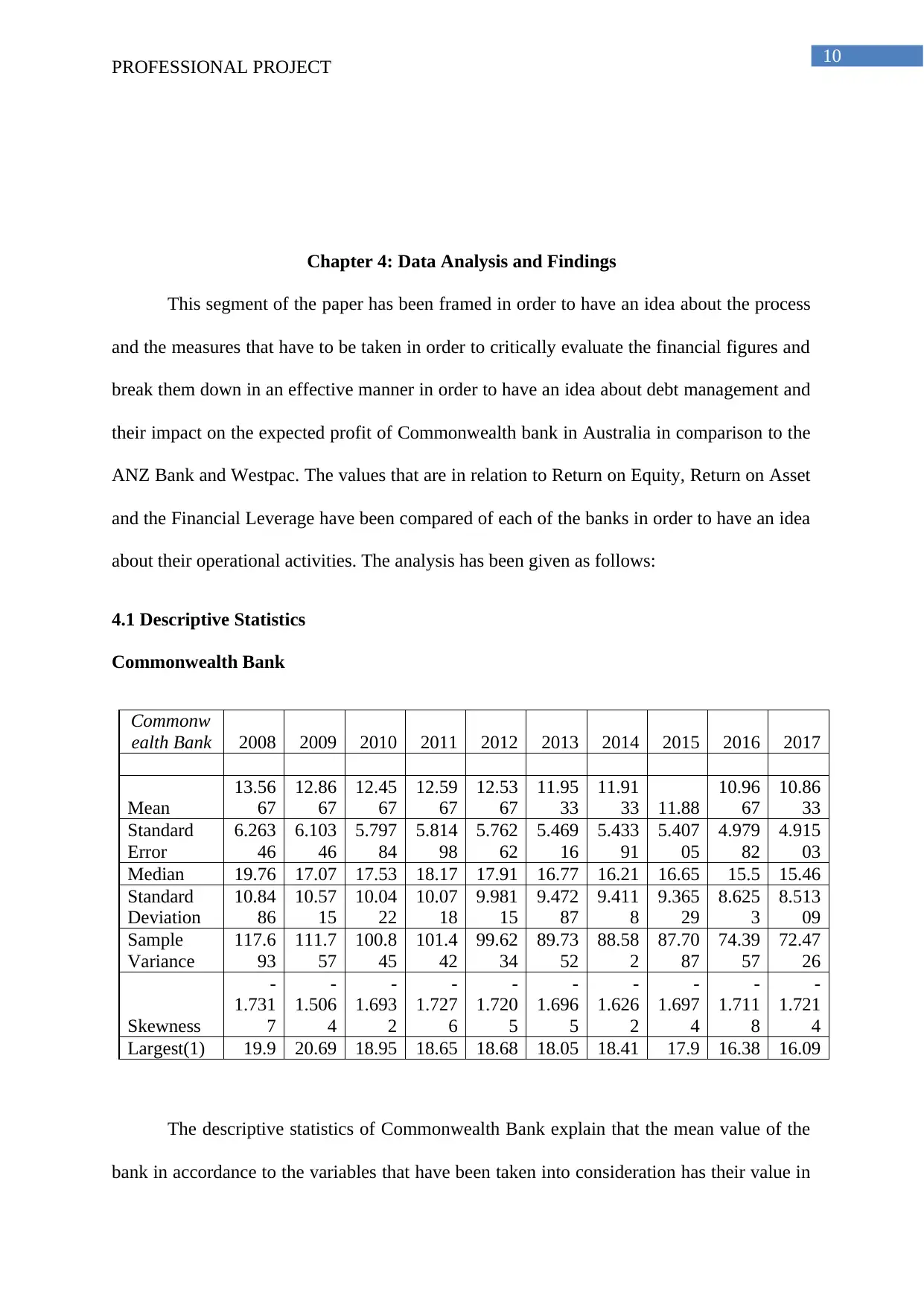
The descriptive statistics of Commonwealth Bank explain that the mean value of the
bank in accordance to the variables that have been taken into consideration has their value in
PROFESSIONAL PROJECT
Chapter 4: Data Analysis and Findings
This segment of the paper has been framed in order to have an idea about the process
and the measures that have to be taken in order to critically evaluate the financial figures and
break them down in an effective manner in order to have an idea about debt management and
their impact on the expected profit of Commonwealth bank in Australia in comparison to the
ANZ Bank and Westpac. The values that are in relation to Return on Equity, Return on Asset
and the Financial Leverage have been compared of each of the banks in order to have an idea
about their operational activities. The analysis has been given as follows:
4.1 Descriptive Statistics
Commonwealth Bank
Commonw
ealth Bank 2008 2009 2010 2011 2012 2013 2014 2015 2016 2017
Mean
13.56
67
12.86
67
12.45
67
12.59
67
12.53
67
11.95
33
11.91
33 11.88
10.96
67
10.86
33
Standard
Error
6.263
46
6.103
46
5.797
84
5.814
98
5.762
62
5.469
16
5.433
91
5.407
05
4.979
82
4.915
03
Median 19.76 17.07 17.53 18.17 17.91 16.77 16.21 16.65 15.5 15.46
Standard
Deviation
10.84
86
10.57
15
10.04
22
10.07
18
9.981
15
9.472
87
9.411
8
9.365
29
8.625
3
8.513
09
Sample
Variance
117.6
93
111.7
57
100.8
45
101.4
42
99.62
34
89.73
52
88.58
2
87.70
87
74.39
57
72.47
26
Skewness
-
1.731
7
-
1.506
4
-
1.693
2
-
1.727
6
-
1.720
5
-
1.696
5
-
1.626
2
-
1.697
4
-
1.711
8
-
1.721
4
Largest(1) 19.9 20.69 18.95 18.65 18.68 18.05 18.41 17.9 16.38 16.09
The descriptive statistics of Commonwealth Bank explain that the mean value of the
bank in accordance to the variables that have been taken into consideration has their value in
11
PROFESSIONAL PROJECT
between 10.86 to 11.56. The values have been very close to each other. The median for the
variables for the past 10 years have ranged from 15.46 to 18.17. The standard deviation on
the other hand has been around 8.5 to 10.8. The figures explain that there have been slightest
of changes in the financial scenario in accordance to the debt management and profitability.
ANZ Bank
ANZ
Bank 2008 2009 2010 2011 2012 2013 2014 2015 2016 2017
Mean 11.05 8.65 10.27
10.73
67
10.48
33 10.47 10.86 10.21 8.79
8.966
67
Standard
Error
5.298
78
4.267
38
4.729
02
4.899
34
4.801
81
4.778
38
4.936
03
4.671
28
4.421
23
4.306
78
Median 14 10.19 13.91 15.21 14.61 14.75 15.62 14.19 9.92 10.97
Standard
Deviation
9.177
75
7.391
32
8.190
9
8.485
9
8.316
98
8.276
4
8.549
46
8.090
9
7.657
79
7.459
56
Sample
Variance
84.23
11
54.63
16
67.09
08
72.01
05
69.17
21
68.49
88
73.09
33
65.46
27
58.64
17
55.64
5
Skewness
-
1.297
-
0.896
9
-
1.604
8
-
1.713
-
1.683
1
-
1.704
8
-
1.728
8
-
1.678
-
0.649
6
-
1.121
4
Confidenc
e
Level(95.
0%)
22.79
88
18.36
11
20.34
73
21.08
01
20.66
05
20.55
97
21.23
8
20.09
89
19.02
3
18.53
06
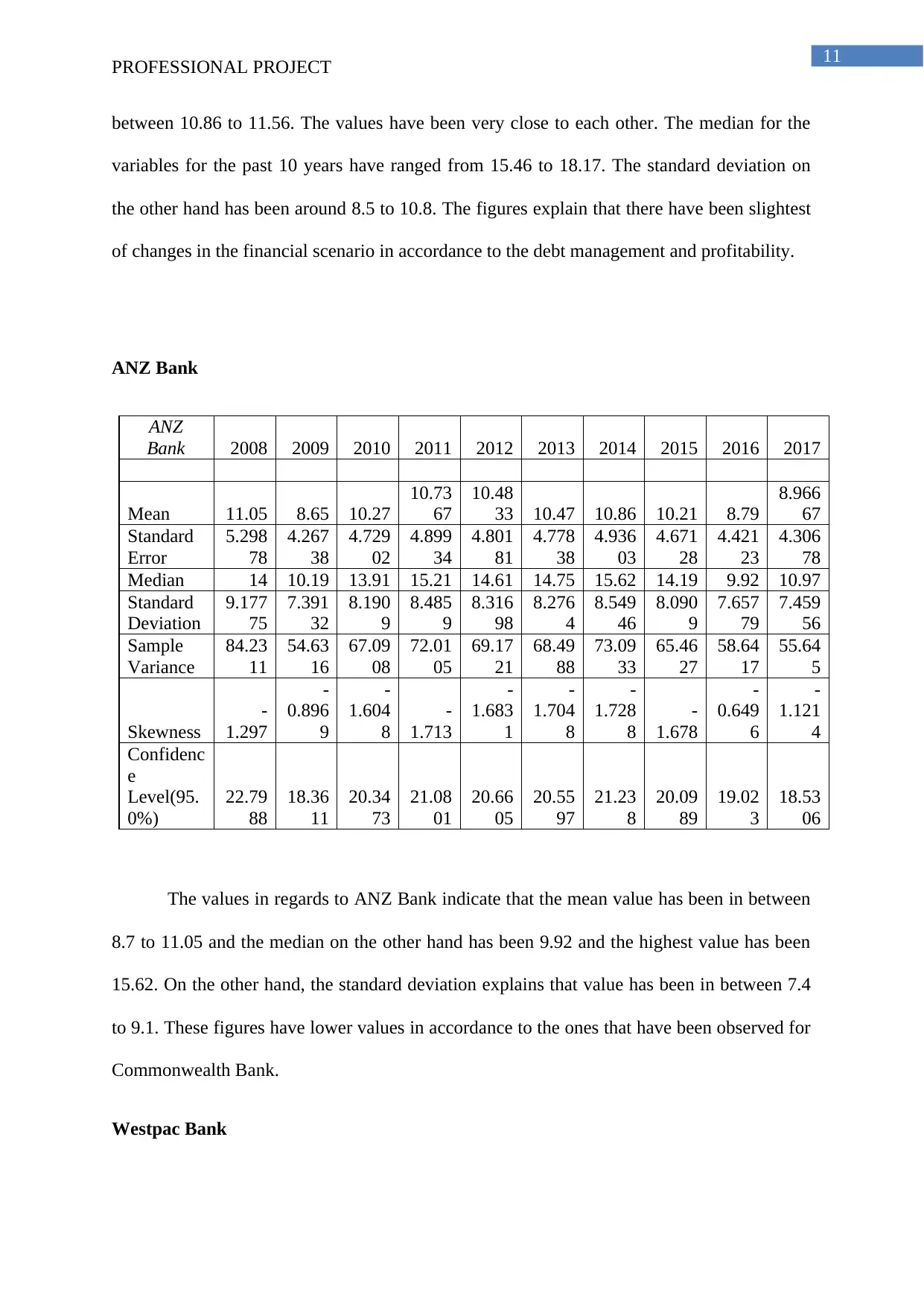
The values in regards to ANZ Bank indicate that the mean value has been in between
8.7 to 11.05 and the median on the other hand has been 9.92 and the highest value has been
15.62. On the other hand, the standard deviation explains that value has been in between 7.4
to 9.1. These figures have lower values in accordance to the ones that have been observed for
Commonwealth Bank.
Westpac Bank
PROFESSIONAL PROJECT
between 10.86 to 11.56. The values have been very close to each other. The median for the
variables for the past 10 years have ranged from 15.46 to 18.17. The standard deviation on
the other hand has been around 8.5 to 10.8. The figures explain that there have been slightest
of changes in the financial scenario in accordance to the debt management and profitability.
ANZ Bank
ANZ
Bank 2008 2009 2010 2011 2012 2013 2014 2015 2016 2017
Mean 11.05 8.65 10.27
10.73
67
10.48
33 10.47 10.86 10.21 8.79
8.966
67
Standard
Error
5.298
78
4.267
38
4.729
02
4.899
34
4.801
81
4.778
38
4.936
03
4.671
28
4.421
23
4.306
78
Median 14 10.19 13.91 15.21 14.61 14.75 15.62 14.19 9.92 10.97
Standard
Deviation
9.177
75
7.391
32
8.190
9
8.485
9
8.316
98
8.276
4
8.549
46
8.090
9
7.657
79
7.459
56
Sample
Variance
84.23
11
54.63
16
67.09
08
72.01
05
69.17
21
68.49
88
73.09
33
65.46
27
58.64
17
55.64
5
Skewness
-
1.297
-
0.896
9
-
1.604
8
-
1.713
-
1.683
1
-
1.704
8
-
1.728
8
-
1.678
-
0.649
6
-
1.121
4
Confidenc
e
Level(95.
0%)
22.79
88
18.36
11
20.34
73
21.08
01
20.66
05
20.55
97
21.23
8
20.09
89
19.02
3
18.53
06
The values in regards to ANZ Bank indicate that the mean value has been in between
8.7 to 11.05 and the median on the other hand has been 9.92 and the highest value has been
15.62. On the other hand, the standard deviation explains that value has been in between 7.4
to 9.1. These figures have lower values in accordance to the ones that have been observed for
Commonwealth Bank.
Westpac Bank
⊘ This is a preview!⊘
Do you want full access?
Subscribe today to unlock all pages.
Trusted by 1+ million students worldwide

1 out of 22


Related Documents


Your All-in-One AI-Powered Toolkit for Academic Success.
+13062052269
info@desklib.com
Available 24*7 on WhatsApp / Email
![[object Object]](/_next/static/media/star-bottom.7253800d.svg)
Unlock your academic potential
Copyright © 2020–2026 A2Z Services. All Rights Reserved. Developed and managed by ZUCOL.