COMMUNICATE AND COLLABORATIVE: Skills and Development Report
VerifiedAdded on 2020/07/22
|10
|2028
|202
Report
AI Summary
This report examines the importance of communication and collaboration skills in a managerial role, emphasizing their critical role within organizations. It utilizes Gibb's reflective model to evaluate the author's communication and collaborative abilities, detailing each stage of the model, including describing an event, personal feelings, evaluation, analysis, conclusion, and action plan. The assignment describes a real-world scenario where the author, as a manager, had to communicate organizational changes to employees. Furthermore, the report includes a personal development plan designed to maximize existing strengths and address areas of weakness, such as improving the communication of both the advantages and disadvantages of situations to employees. The report concludes with a reflection on the process and a plan for future improvements, highlighting the importance of effective communication and collaborative skills in leadership.
COMMUNICATE AND
COLLABORATIVE
COLLABORATIVE
Paraphrase This Document
Need a fresh take? Get an instant paraphrase of this document with our AI Paraphraser

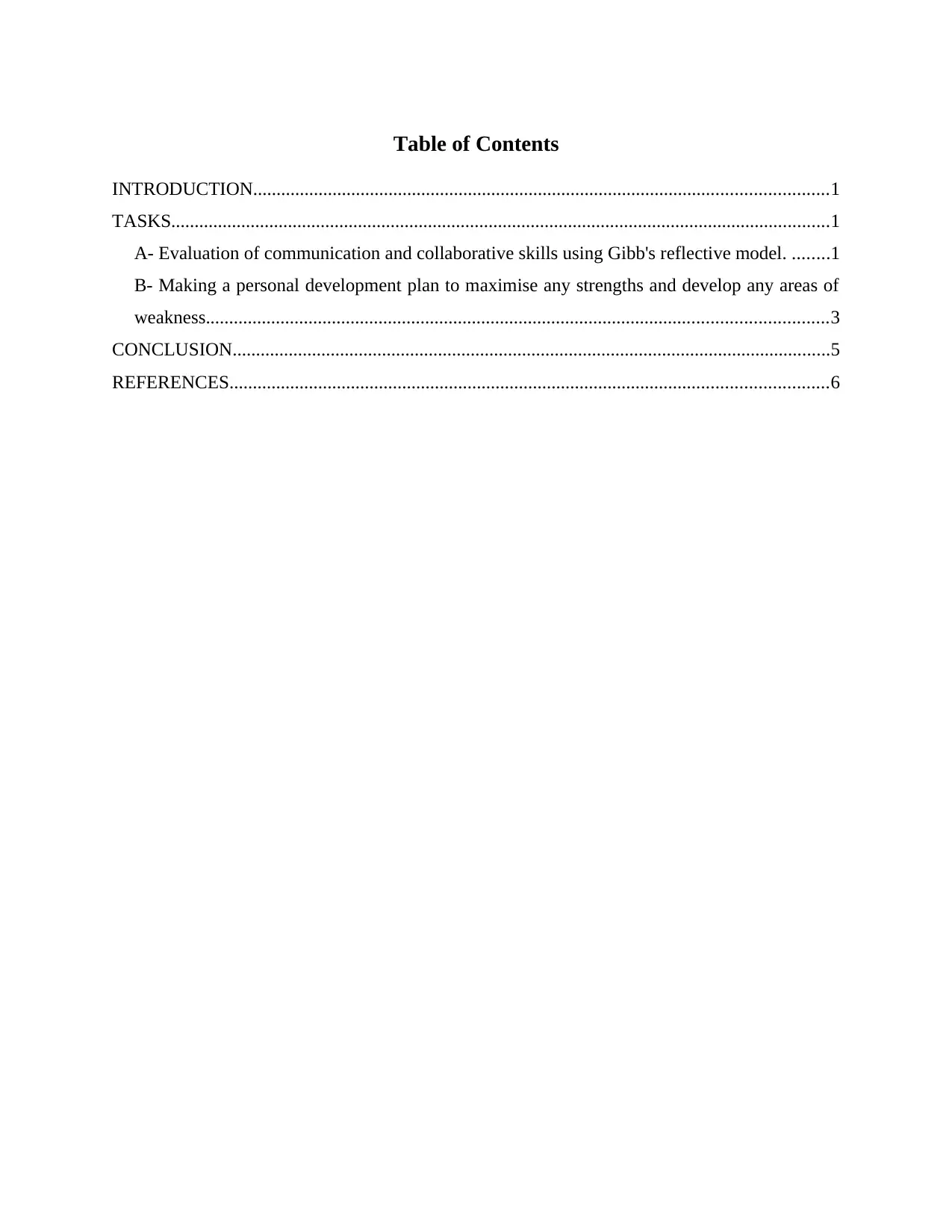
Table of Contents
INTRODUCTION...........................................................................................................................1
TASKS.............................................................................................................................................1
A- Evaluation of communication and collaborative skills using Gibb's reflective model. ........1
B- Making a personal development plan to maximise any strengths and develop any areas of
weakness.....................................................................................................................................3
CONCLUSION................................................................................................................................5
REFERENCES................................................................................................................................6
INTRODUCTION...........................................................................................................................1
TASKS.............................................................................................................................................1
A- Evaluation of communication and collaborative skills using Gibb's reflective model. ........1
B- Making a personal development plan to maximise any strengths and develop any areas of
weakness.....................................................................................................................................3
CONCLUSION................................................................................................................................5
REFERENCES................................................................................................................................6

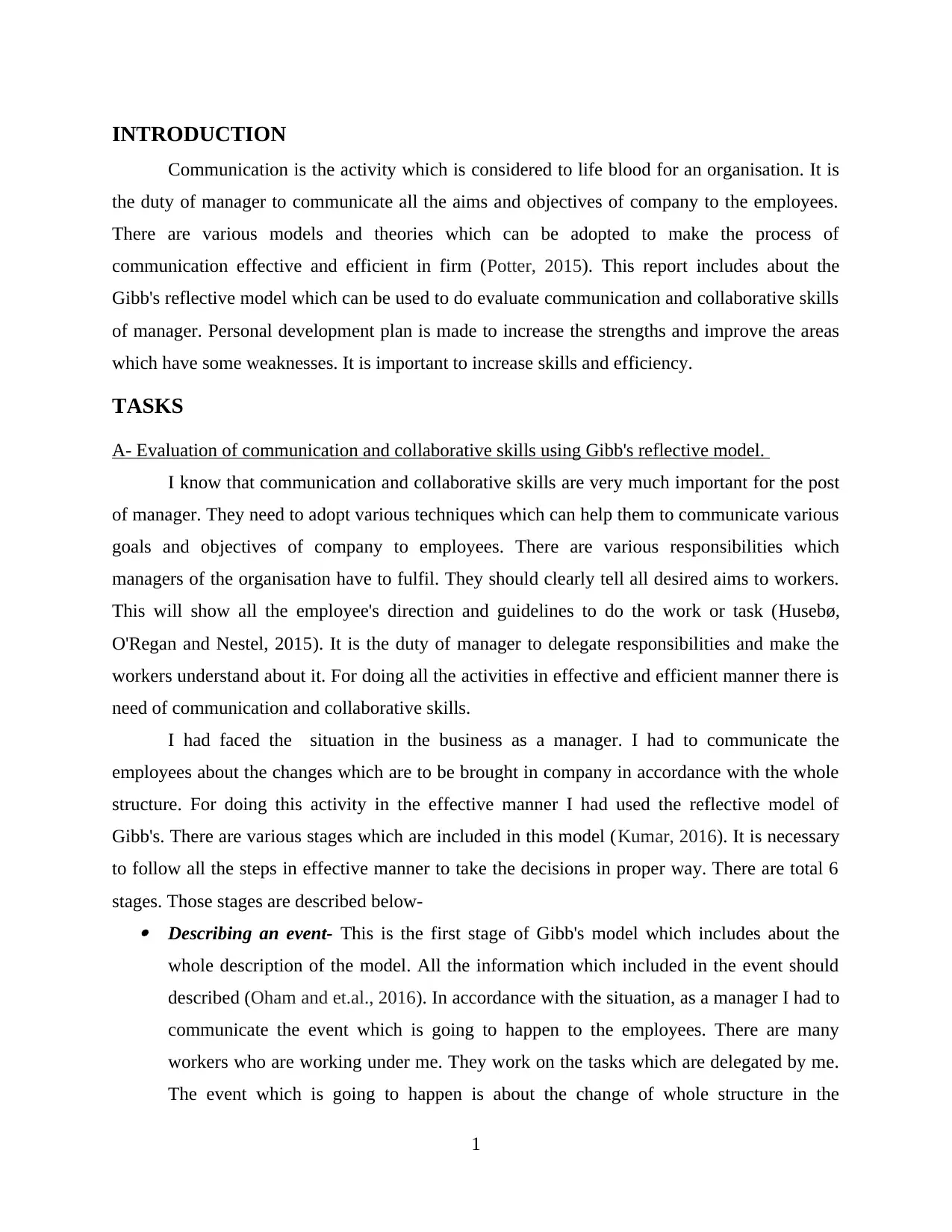
INTRODUCTION
Communication is the activity which is considered to life blood for an organisation. It is
the duty of manager to communicate all the aims and objectives of company to the employees.
There are various models and theories which can be adopted to make the process of
communication effective and efficient in firm (Potter, 2015). This report includes about the
Gibb's reflective model which can be used to do evaluate communication and collaborative skills
of manager. Personal development plan is made to increase the strengths and improve the areas
which have some weaknesses. It is important to increase skills and efficiency.
TASKS
A- Evaluation of communication and collaborative skills using Gibb's reflective model.
I know that communication and collaborative skills are very much important for the post
of manager. They need to adopt various techniques which can help them to communicate various
goals and objectives of company to employees. There are various responsibilities which
managers of the organisation have to fulfil. They should clearly tell all desired aims to workers.
This will show all the employee's direction and guidelines to do the work or task (Husebø,
O'Regan and Nestel, 2015). It is the duty of manager to delegate responsibilities and make the
workers understand about it. For doing all the activities in effective and efficient manner there is
need of communication and collaborative skills.
I had faced the situation in the business as a manager. I had to communicate the
employees about the changes which are to be brought in company in accordance with the whole
structure. For doing this activity in the effective manner I had used the reflective model of
Gibb's. There are various stages which are included in this model (Kumar, 2016). It is necessary
to follow all the steps in effective manner to take the decisions in proper way. There are total 6
stages. Those stages are described below- Describing an event- This is the first stage of Gibb's model which includes about the
whole description of the model. All the information which included in the event should
described (Oham and et.al., 2016). In accordance with the situation, as a manager I had to
communicate the event which is going to happen to the employees. There are many
workers who are working under me. They work on the tasks which are delegated by me.
The event which is going to happen is about the change of whole structure in the
1
Communication is the activity which is considered to life blood for an organisation. It is
the duty of manager to communicate all the aims and objectives of company to the employees.
There are various models and theories which can be adopted to make the process of
communication effective and efficient in firm (Potter, 2015). This report includes about the
Gibb's reflective model which can be used to do evaluate communication and collaborative skills
of manager. Personal development plan is made to increase the strengths and improve the areas
which have some weaknesses. It is important to increase skills and efficiency.
TASKS
A- Evaluation of communication and collaborative skills using Gibb's reflective model.
I know that communication and collaborative skills are very much important for the post
of manager. They need to adopt various techniques which can help them to communicate various
goals and objectives of company to employees. There are various responsibilities which
managers of the organisation have to fulfil. They should clearly tell all desired aims to workers.
This will show all the employee's direction and guidelines to do the work or task (Husebø,
O'Regan and Nestel, 2015). It is the duty of manager to delegate responsibilities and make the
workers understand about it. For doing all the activities in effective and efficient manner there is
need of communication and collaborative skills.
I had faced the situation in the business as a manager. I had to communicate the
employees about the changes which are to be brought in company in accordance with the whole
structure. For doing this activity in the effective manner I had used the reflective model of
Gibb's. There are various stages which are included in this model (Kumar, 2016). It is necessary
to follow all the steps in effective manner to take the decisions in proper way. There are total 6
stages. Those stages are described below- Describing an event- This is the first stage of Gibb's model which includes about the
whole description of the model. All the information which included in the event should
described (Oham and et.al., 2016). In accordance with the situation, as a manager I had to
communicate the event which is going to happen to the employees. There are many
workers who are working under me. They work on the tasks which are delegated by me.
The event which is going to happen is about the change of whole structure in the
1
⊘ This is a preview!⊘
Do you want full access?
Subscribe today to unlock all pages.

Trusted by 1+ million students worldwide

company. It is my duty to inform all the employees about the event and what are the
activities which are going to happen in context with this. It created very huge impact on
the employees. The workers felt insecure with the occurrence of event. They showed
some resistance after I gave then description or information on the situation. They do not
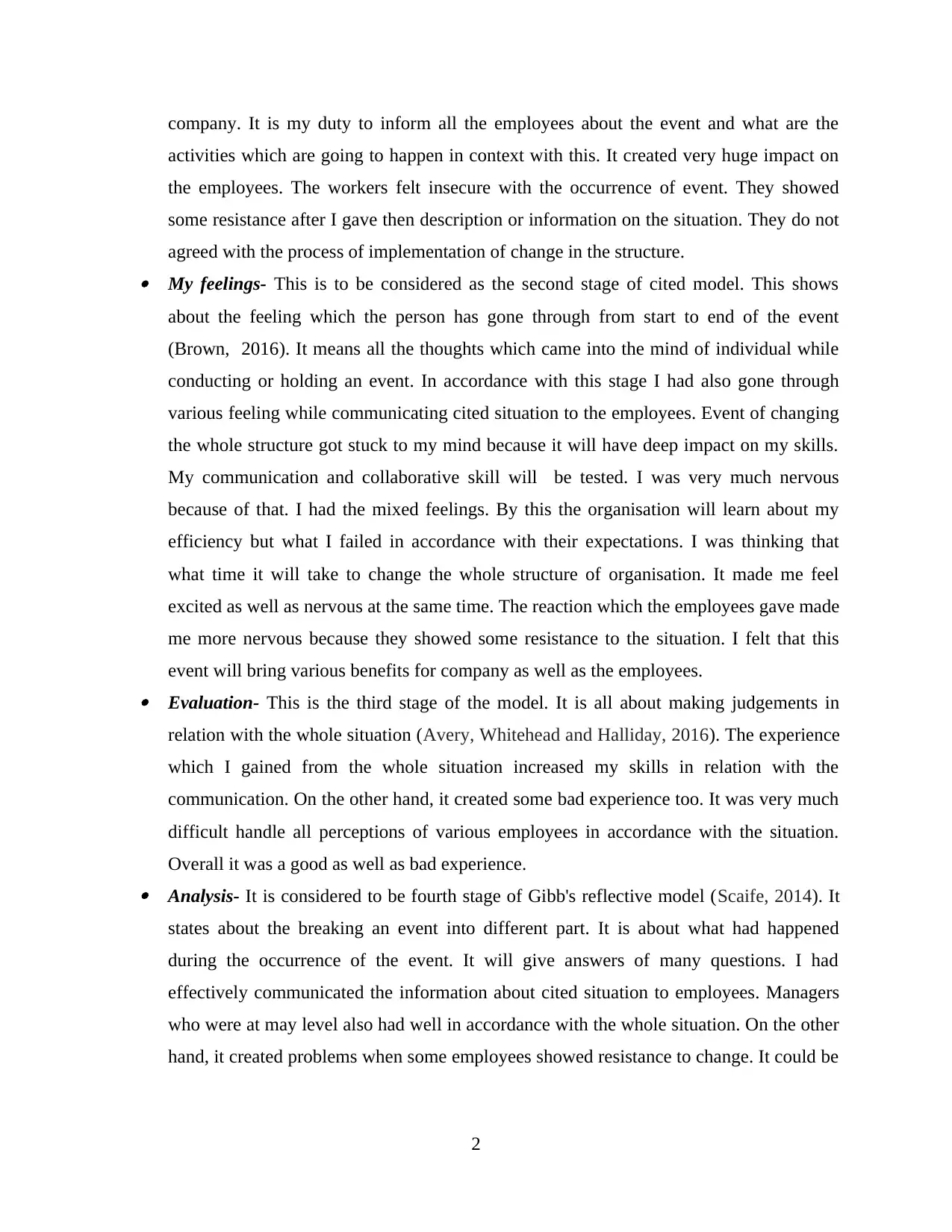
agreed with the process of implementation of change in the structure. My feelings- This is to be considered as the second stage of cited model. This shows
about the feeling which the person has gone through from start to end of the event
(Brown, 2016). It means all the thoughts which came into the mind of individual while
conducting or holding an event. In accordance with this stage I had also gone through
various feeling while communicating cited situation to the employees. Event of changing
the whole structure got stuck to my mind because it will have deep impact on my skills.
My communication and collaborative skill will be tested. I was very much nervous
because of that. I had the mixed feelings. By this the organisation will learn about my
efficiency but what I failed in accordance with their expectations. I was thinking that
what time it will take to change the whole structure of organisation. It made me feel
excited as well as nervous at the same time. The reaction which the employees gave made
me more nervous because they showed some resistance to the situation. I felt that this
event will bring various benefits for company as well as the employees. Evaluation- This is the third stage of the model. It is all about making judgements in
relation with the whole situation (Avery, Whitehead and Halliday, 2016). The experience
which I gained from the whole situation increased my skills in relation with the
communication. On the other hand, it created some bad experience too. It was very much
difficult handle all perceptions of various employees in accordance with the situation.
Overall it was a good as well as bad experience. Analysis- It is considered to be fourth stage of Gibb's reflective model (Scaife, 2014). It
states about the breaking an event into different part. It is about what had happened
during the occurrence of the event. It will give answers of many questions. I had
effectively communicated the information about cited situation to employees. Managers
who were at may level also had well in accordance with the whole situation. On the other
hand, it created problems when some employees showed resistance to change. It could be
2
activities which are going to happen in context with this. It created very huge impact on
the employees. The workers felt insecure with the occurrence of event. They showed
some resistance after I gave then description or information on the situation. They do not
agreed with the process of implementation of change in the structure. My feelings- This is to be considered as the second stage of cited model. This shows
about the feeling which the person has gone through from start to end of the event
(Brown, 2016). It means all the thoughts which came into the mind of individual while
conducting or holding an event. In accordance with this stage I had also gone through
various feeling while communicating cited situation to the employees. Event of changing
the whole structure got stuck to my mind because it will have deep impact on my skills.
My communication and collaborative skill will be tested. I was very much nervous
because of that. I had the mixed feelings. By this the organisation will learn about my
efficiency but what I failed in accordance with their expectations. I was thinking that
what time it will take to change the whole structure of organisation. It made me feel
excited as well as nervous at the same time. The reaction which the employees gave made
me more nervous because they showed some resistance to the situation. I felt that this
event will bring various benefits for company as well as the employees. Evaluation- This is the third stage of the model. It is all about making judgements in
relation with the whole situation (Avery, Whitehead and Halliday, 2016). The experience
which I gained from the whole situation increased my skills in relation with the
communication. On the other hand, it created some bad experience too. It was very much
difficult handle all perceptions of various employees in accordance with the situation.
Overall it was a good as well as bad experience. Analysis- It is considered to be fourth stage of Gibb's reflective model (Scaife, 2014). It
states about the breaking an event into different part. It is about what had happened
during the occurrence of the event. It will give answers of many questions. I had
effectively communicated the information about cited situation to employees. Managers
who were at may level also had well in accordance with the whole situation. On the other
hand, it created problems when some employees showed resistance to change. It could be
2
Paraphrase This Document
Need a fresh take? Get an instant paraphrase of this document with our AI Paraphraser

managed effectively if I had used more efficient skills of communication is describing the
benefits of change to the workers. Conclusion- It is the fifth stage of model. This step is very much different from the stage
of evaluation. It is based on individual's own experience (Bassot, 2016). This stage is
most important for making reflective report. It concludes all the stages which had
happened. I had used my communication and collaborative skills to describe an event to
the employees. This can be improved if I had used more strengths to conduct this activity.
This may have brought some difference in the results. The employees who had shown the
resistance would have been happy with the decision of higher authorities in accordance
with the change in the whole structure of organisation.
Action plan- It is the last and sixth stage of Gibb's reflective model (GIBBS –
REFLECTIVE CYCLE MODEL (1988), 2017). It shows about the methods or skills
which will be used when the individual meet with same type of situation again in the
future. I will use more effective communication and collaborative skills when I will face
same situation in the future. I will effectively describe an event to employees. I will tell
them about advantages as well as disadvantages to the workers.
These are some stages of Gibb's reflective model. All the steps are to be effectively
completed for doing the proper reflection. It will show the individual about their various skills
and strengths. On the other hand, it will also show about areas in which an individual needs some
improvement. I had effectively understood that what I had done as a manager and what can be
done by me in the future when similar situation arrives.
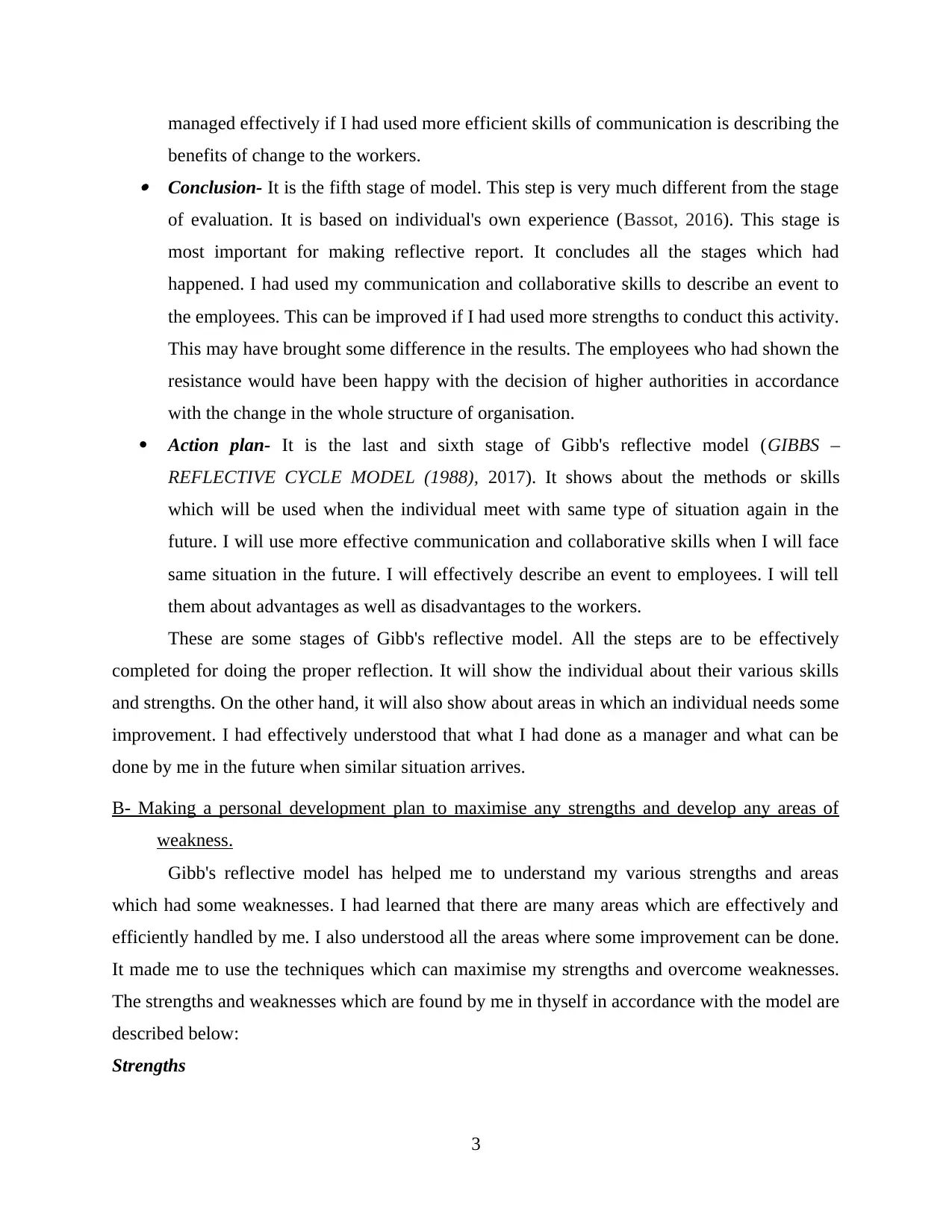
B- Making a personal development plan to maximise any strengths and develop any areas of
weakness.
Gibb's reflective model has helped me to understand my various strengths and areas
which had some weaknesses. I had learned that there are many areas which are effectively and
efficiently handled by me. I also understood all the areas where some improvement can be done.
It made me to use the techniques which can maximise my strengths and overcome weaknesses.
The strengths and weaknesses which are found by me in thyself in accordance with the model are
described below:
Strengths
3
benefits of change to the workers. Conclusion- It is the fifth stage of model. This step is very much different from the stage
of evaluation. It is based on individual's own experience (Bassot, 2016). This stage is
most important for making reflective report. It concludes all the stages which had
happened. I had used my communication and collaborative skills to describe an event to
the employees. This can be improved if I had used more strengths to conduct this activity.
This may have brought some difference in the results. The employees who had shown the
resistance would have been happy with the decision of higher authorities in accordance
with the change in the whole structure of organisation.
Action plan- It is the last and sixth stage of Gibb's reflective model (GIBBS –
REFLECTIVE CYCLE MODEL (1988), 2017). It shows about the methods or skills
which will be used when the individual meet with same type of situation again in the
future. I will use more effective communication and collaborative skills when I will face
same situation in the future. I will effectively describe an event to employees. I will tell
them about advantages as well as disadvantages to the workers.
These are some stages of Gibb's reflective model. All the steps are to be effectively
completed for doing the proper reflection. It will show the individual about their various skills
and strengths. On the other hand, it will also show about areas in which an individual needs some
improvement. I had effectively understood that what I had done as a manager and what can be
done by me in the future when similar situation arrives.
B- Making a personal development plan to maximise any strengths and develop any areas of
weakness.
Gibb's reflective model has helped me to understand my various strengths and areas
which had some weaknesses. I had learned that there are many areas which are effectively and
efficiently handled by me. I also understood all the areas where some improvement can be done.
It made me to use the techniques which can maximise my strengths and overcome weaknesses.
The strengths and weaknesses which are found by me in thyself in accordance with the model are
described below:
Strengths
3

I had the strength of giving information in the effective manner to all employees. It can
be more developed by using the model which will be beneficial for interacting with
workers. In accordance with the model I have better communication and collaborative skills
among all managers in the organisation. I can manage all the activities of an event in the
effective and efficient manner.
Weaknesses In some areas I have some weaknesses too. I lack in the skill of informing all the
advantages and disadvantages of situation to employees. This made the workers to show
some resistance. For conducting this activity in the effective manner I will need effective
and efficient communication and collaborative skills.
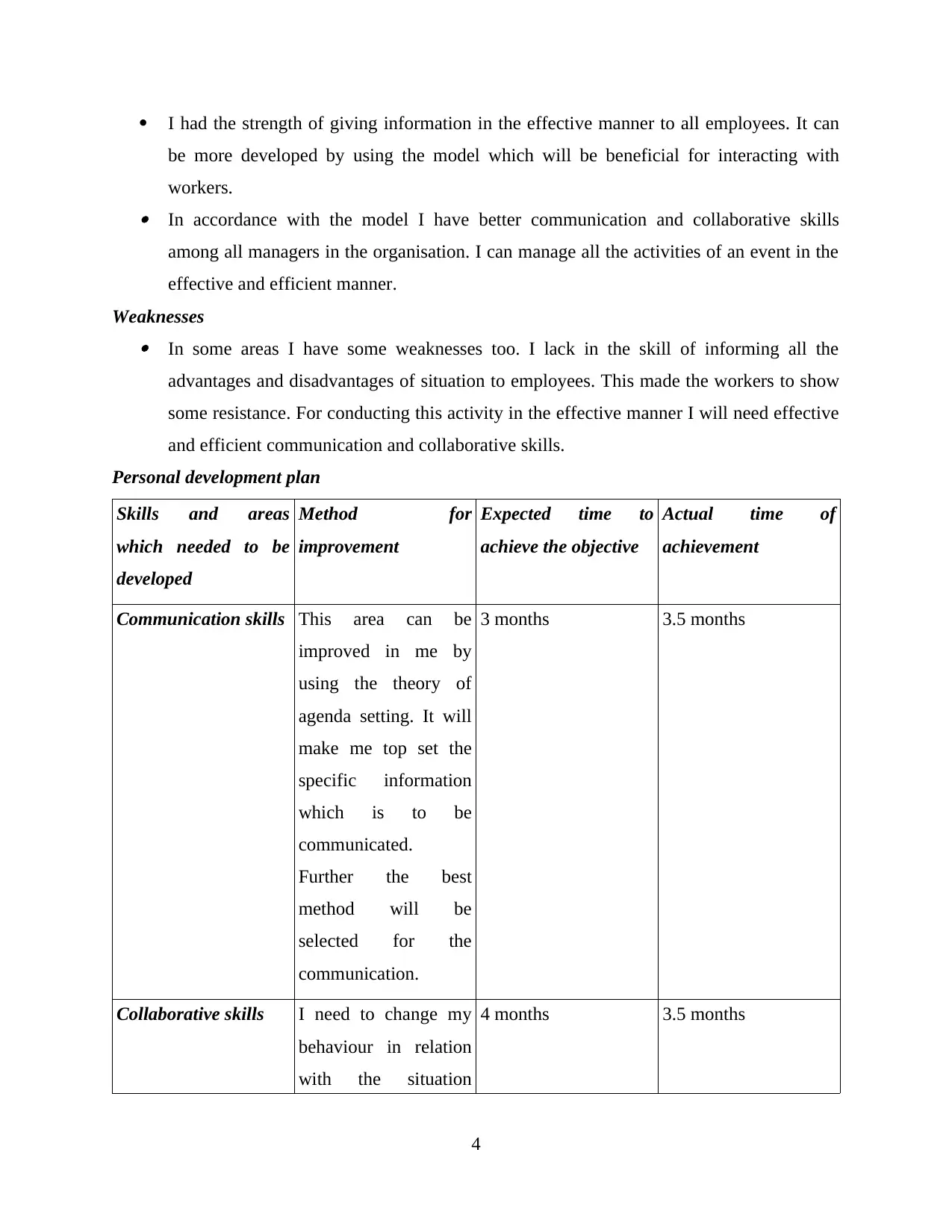
Personal development plan
Skills and areas
which needed to be
developed
Method for
improvement
Expected time to
achieve the objective
Actual time of
achievement
Communication skills This area can be
improved in me by
using the theory of
agenda setting. It will
make me top set the
specific information
which is to be
communicated.
Further the best
method will be
selected for the
communication.
3 months 3.5 months
Collaborative skills I need to change my
behaviour in relation
with the situation
4 months 3.5 months
4
be more developed by using the model which will be beneficial for interacting with
workers. In accordance with the model I have better communication and collaborative skills
among all managers in the organisation. I can manage all the activities of an event in the
effective and efficient manner.
Weaknesses In some areas I have some weaknesses too. I lack in the skill of informing all the
advantages and disadvantages of situation to employees. This made the workers to show
some resistance. For conducting this activity in the effective manner I will need effective
and efficient communication and collaborative skills.
Personal development plan
Skills and areas
which needed to be
developed
Method for
improvement
Expected time to
achieve the objective
Actual time of
achievement
Communication skills This area can be
improved in me by
using the theory of
agenda setting. It will
make me top set the
specific information
which is to be
communicated.
Further the best
method will be
selected for the
communication.
3 months 3.5 months
Collaborative skills I need to change my
behaviour in relation
with the situation
4 months 3.5 months
4
⊘ This is a preview!⊘
Do you want full access?
Subscribe today to unlock all pages.

Trusted by 1+ million students worldwide

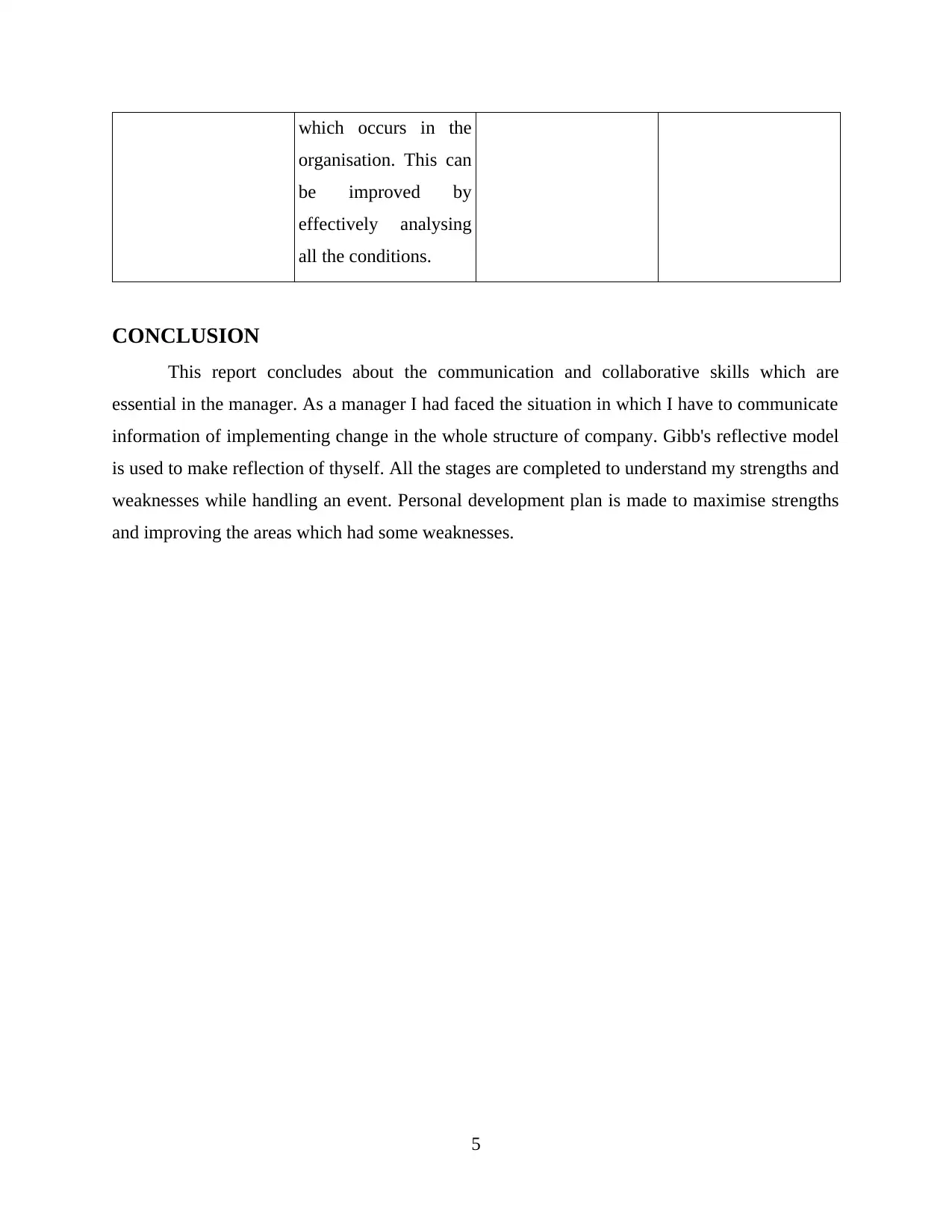
which occurs in the
organisation. This can
be improved by
effectively analysing
all the conditions.
CONCLUSION
This report concludes about the communication and collaborative skills which are
essential in the manager. As a manager I had faced the situation in which I have to communicate
information of implementing change in the whole structure of company. Gibb's reflective model
is used to make reflection of thyself. All the stages are completed to understand my strengths and
weaknesses while handling an event. Personal development plan is made to maximise strengths
and improving the areas which had some weaknesses.
5
organisation. This can
be improved by
effectively analysing
all the conditions.
CONCLUSION
This report concludes about the communication and collaborative skills which are
essential in the manager. As a manager I had faced the situation in which I have to communicate
information of implementing change in the whole structure of company. Gibb's reflective model
is used to make reflection of thyself. All the stages are completed to understand my strengths and
weaknesses while handling an event. Personal development plan is made to maximise strengths
and improving the areas which had some weaknesses.
5
Paraphrase This Document
Need a fresh take? Get an instant paraphrase of this document with our AI Paraphraser

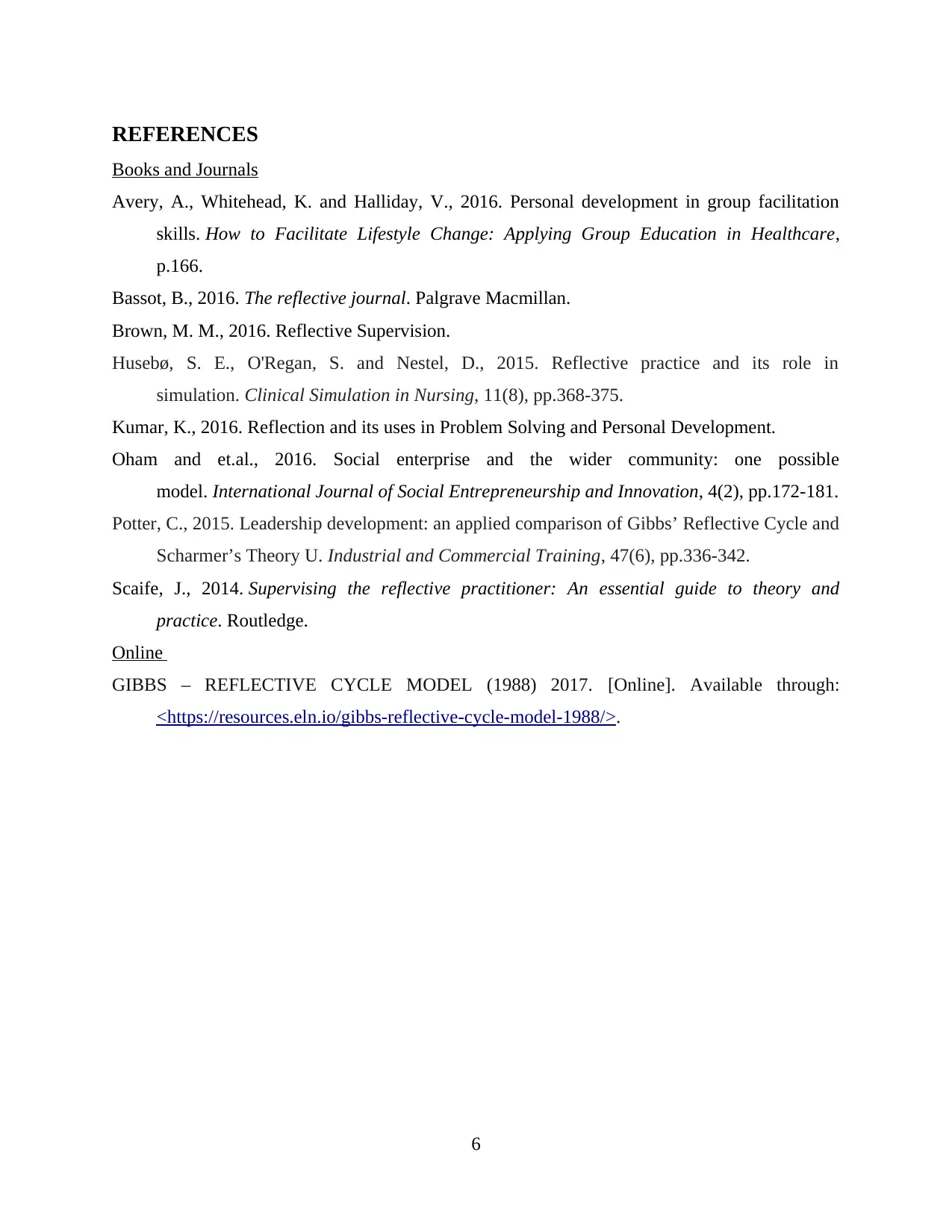
REFERENCES
Books and Journals
Avery, A., Whitehead, K. and Halliday, V., 2016. Personal development in group facilitation
skills. How to Facilitate Lifestyle Change: Applying Group Education in Healthcare,
p.166.
Bassot, B., 2016. The reflective journal. Palgrave Macmillan.
Brown, M. M., 2016. Reflective Supervision.
Husebø, S. E., O'Regan, S. and Nestel, D., 2015. Reflective practice and its role in
simulation. Clinical Simulation in Nursing, 11(8), pp.368-375.
Kumar, K., 2016. Reflection and its uses in Problem Solving and Personal Development.
Oham and et.al., 2016. Social enterprise and the wider community: one possible
model. International Journal of Social Entrepreneurship and Innovation, 4(2), pp.172-181.
Potter, C., 2015. Leadership development: an applied comparison of Gibbs’ Reflective Cycle and
Scharmer’s Theory U. Industrial and Commercial Training, 47(6), pp.336-342.
Scaife, J., 2014. Supervising the reflective practitioner: An essential guide to theory and
practice. Routledge.
Online
GIBBS – REFLECTIVE CYCLE MODEL (1988) 2017. [Online]. Available through:
<https://resources.eln.io/gibbs-reflective-cycle-model-1988/>.
6
Books and Journals
Avery, A., Whitehead, K. and Halliday, V., 2016. Personal development in group facilitation
skills. How to Facilitate Lifestyle Change: Applying Group Education in Healthcare,
p.166.
Bassot, B., 2016. The reflective journal. Palgrave Macmillan.
Brown, M. M., 2016. Reflective Supervision.
Husebø, S. E., O'Regan, S. and Nestel, D., 2015. Reflective practice and its role in
simulation. Clinical Simulation in Nursing, 11(8), pp.368-375.
Kumar, K., 2016. Reflection and its uses in Problem Solving and Personal Development.
Oham and et.al., 2016. Social enterprise and the wider community: one possible
model. International Journal of Social Entrepreneurship and Innovation, 4(2), pp.172-181.
Potter, C., 2015. Leadership development: an applied comparison of Gibbs’ Reflective Cycle and
Scharmer’s Theory U. Industrial and Commercial Training, 47(6), pp.336-342.
Scaife, J., 2014. Supervising the reflective practitioner: An essential guide to theory and
practice. Routledge.
Online
GIBBS – REFLECTIVE CYCLE MODEL (1988) 2017. [Online]. Available through:
<https://resources.eln.io/gibbs-reflective-cycle-model-1988/>.
6

7
⊘ This is a preview!⊘
Do you want full access?
Subscribe today to unlock all pages.

Trusted by 1+ million students worldwide

8
1 out of 10
Related Documents
Your All-in-One AI-Powered Toolkit for Academic Success.
+13062052269
info@desklib.com
Available 24*7 on WhatsApp / Email
Unlock your academic potential
Copyright © 2020–2025 A2Z Services. All Rights Reserved. Developed and managed by ZUCOL.