Communication Fundamentals Discussion: Week 5 Readings and Prompts

Verified

Added on  2022/09/12

|5
|815
|34
Discussion Board Post
AI Summary
This discussion post explores the fundamentals of communication, addressing key concepts such as sound arguments, deductive and inductive reasoning, and the elements of rhetoric (ethos, logos, and pathos). The post analyzes the importance of sound arguments in fostering effective communication, emphasizing the role of premises and conclusions in argumentative conversations. It differentiates between deductive and inductive reasoning, providing examples of when each is most appropriate. The post also examines the significance of dialogue and interaction within rhetoric, highlighting the role of ethos, logos, and pathos in constructing persuasive arguments. It further discusses the dangers of generalizations and identifies common fallacies, such as ad hominem and strawman, emphasizing the importance of critical thinking and logical reasoning in communication. The post uses insights from the provided readings and offers real-world examples to illustrate these concepts, making it a valuable resource for students studying communication principles. Students can access past papers and solved assignments on Desklib for further study.
Document Page
Student’s Last Name 1
Fundamentals of Communication
By (Name)
Course
Professor
Unit
Date
tabler-icon-diamond-filled.svg

Paraphrase This Document

Need a fresh take? Get an instant paraphrase of this document with our AI Paraphraser
Document Page
Student’s Last Name 2
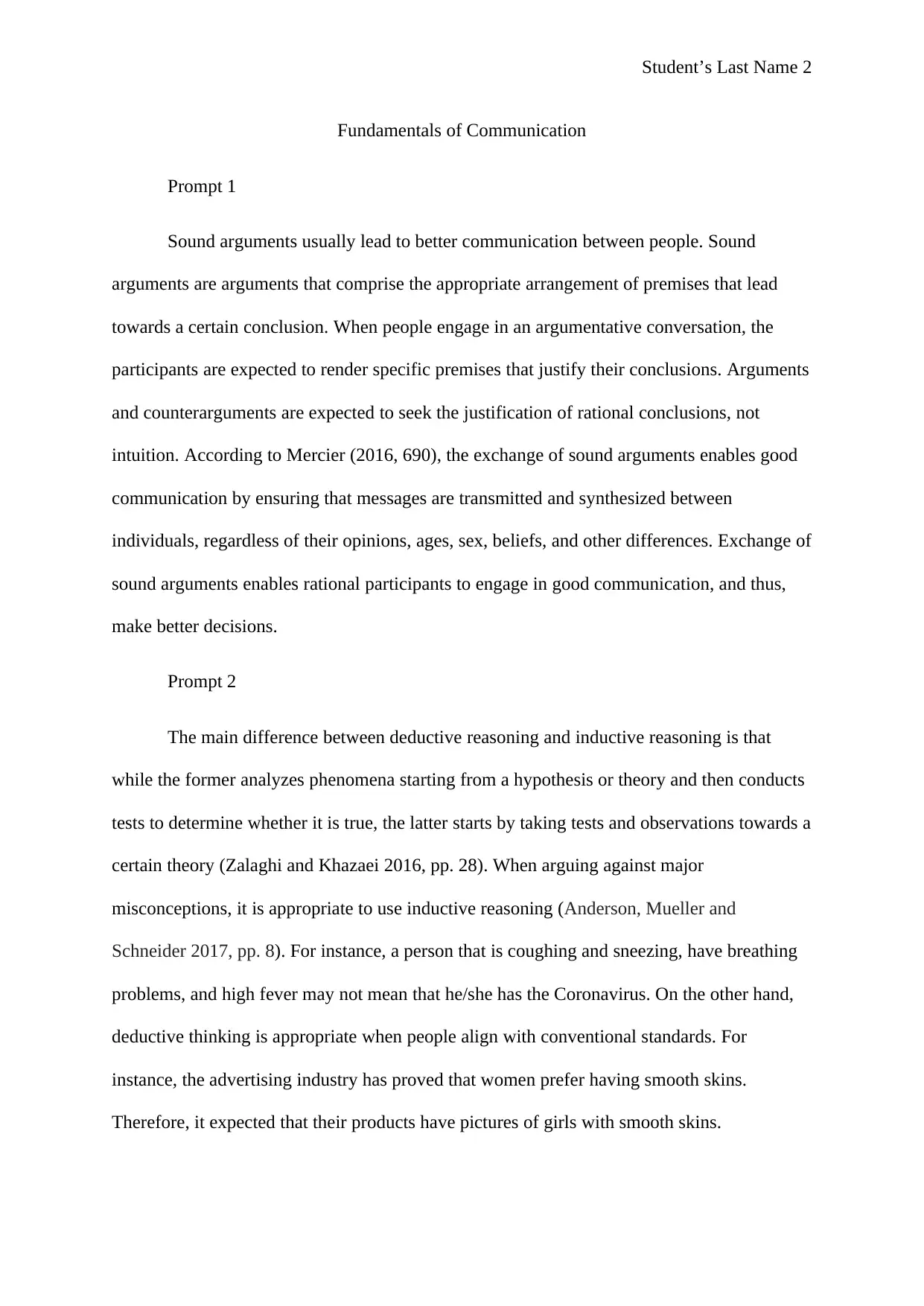
Fundamentals of Communication
Prompt 1
Sound arguments usually lead to better communication between people. Sound
arguments are arguments that comprise the appropriate arrangement of premises that lead
towards a certain conclusion. When people engage in an argumentative conversation, the
participants are expected to render specific premises that justify their conclusions. Arguments
and counterarguments are expected to seek the justification of rational conclusions, not
intuition. According to Mercier (2016, 690), the exchange of sound arguments enables good
communication by ensuring that messages are transmitted and synthesized between
individuals, regardless of their opinions, ages, sex, beliefs, and other differences. Exchange of
sound arguments enables rational participants to engage in good communication, and thus,
make better decisions.
Prompt 2
The main difference between deductive reasoning and inductive reasoning is that
while the former analyzes phenomena starting from a hypothesis or theory and then conducts
tests to determine whether it is true, the latter starts by taking tests and observations towards a
certain theory (Zalaghi and Khazaei 2016, pp. 28). When arguing against major
misconceptions, it is appropriate to use inductive reasoning (Anderson, Mueller and
Schneider 2017, pp. 8). For instance, a person that is coughing and sneezing, have breathing
problems, and high fever may not mean that he/she has the Coronavirus. On the other hand,
deductive thinking is appropriate when people align with conventional standards. For
instance, the advertising industry has proved that women prefer having smooth skins.
Therefore, it expected that their products have pictures of girls with smooth skins.
Document Page
Student’s Last Name 3
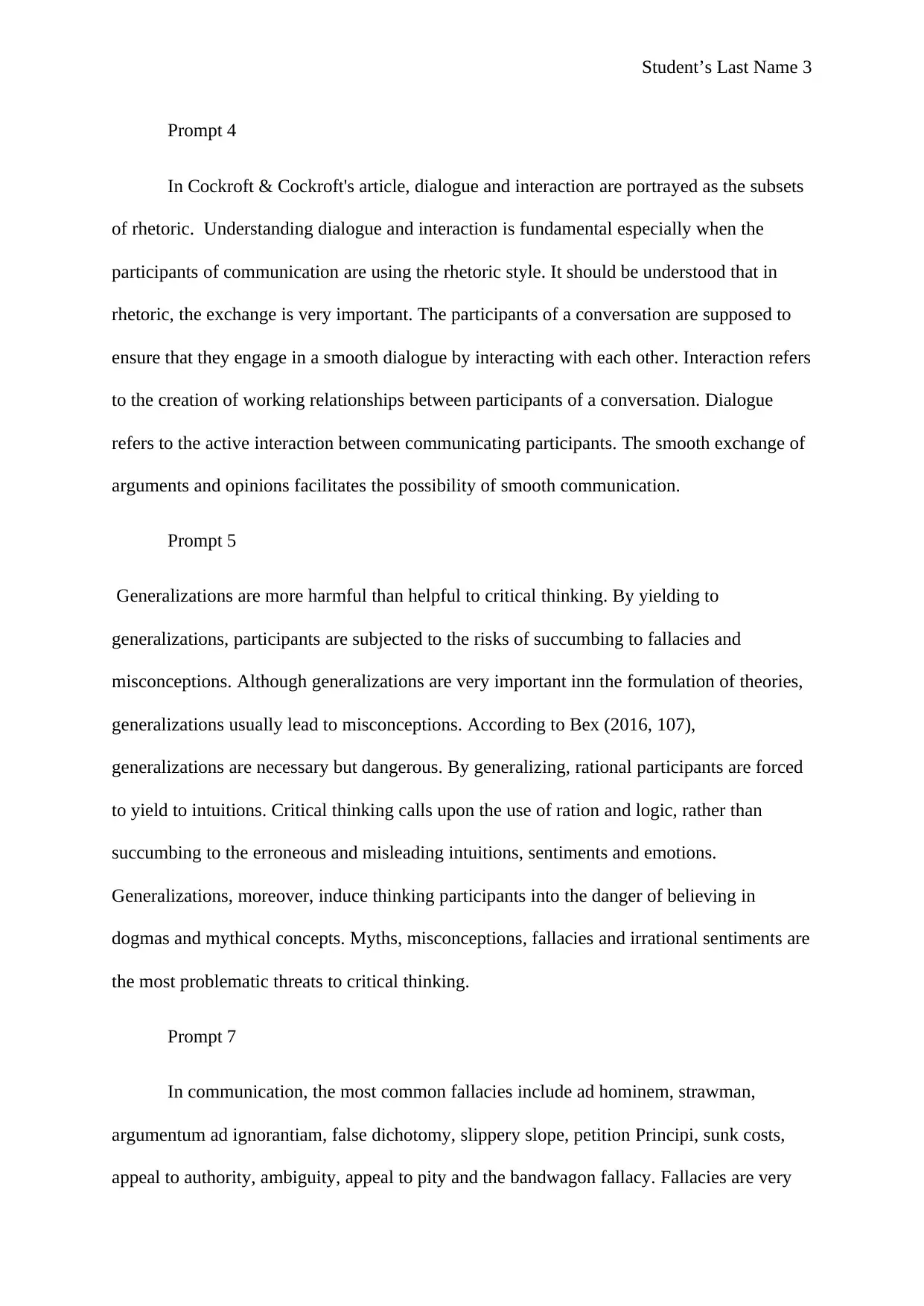
Prompt 4
In Cockroft & Cockroft's article, dialogue and interaction are portrayed as the subsets
of rhetoric. Understanding dialogue and interaction is fundamental especially when the
participants of communication are using the rhetoric style. It should be understood that in
rhetoric, the exchange is very important. The participants of a conversation are supposed to
ensure that they engage in a smooth dialogue by interacting with each other. Interaction refers
to the creation of working relationships between participants of a conversation. Dialogue
refers to the active interaction between communicating participants. The smooth exchange of
arguments and opinions facilitates the possibility of smooth communication.
Prompt 5
Generalizations are more harmful than helpful to critical thinking. By yielding to
generalizations, participants are subjected to the risks of succumbing to fallacies and
misconceptions. Although generalizations are very important inn the formulation of theories,
generalizations usually lead to misconceptions. According to Bex (2016, 107),
generalizations are necessary but dangerous. By generalizing, rational participants are forced
to yield to intuitions. Critical thinking calls upon the use of ration and logic, rather than
succumbing to the erroneous and misleading intuitions, sentiments and emotions.
Generalizations, moreover, induce thinking participants into the danger of believing in
dogmas and mythical concepts. Myths, misconceptions, fallacies and irrational sentiments are
the most problematic threats to critical thinking.
Prompt 7
In communication, the most common fallacies include ad hominem, strawman,
argumentum ad ignorantiam, false dichotomy, slippery slope, petition Principi, sunk costs,
appeal to authority, ambiguity, appeal to pity and the bandwagon fallacy. Fallacies are very
Document Page
Student’s Last Name 4
widespread because humans prefer subscribing to their intuitions rather than their ration.
Many people do not prefer employing logic and ration in their arguments. Moreover,
religious dogmas and conventional myths are instrumental in spreading fallacies. We should
be wary of fallacies because they subject us to the risk of having ineffective communication.
Ad hominem, for instance, refers to the fallacy where a participant attacks the other, rather
than the argument.
tabler-icon-diamond-filled.svg

Paraphrase This Document

Need a fresh take? Get an instant paraphrase of this document with our AI Paraphraser
Document Page
Student’s Last Name 5
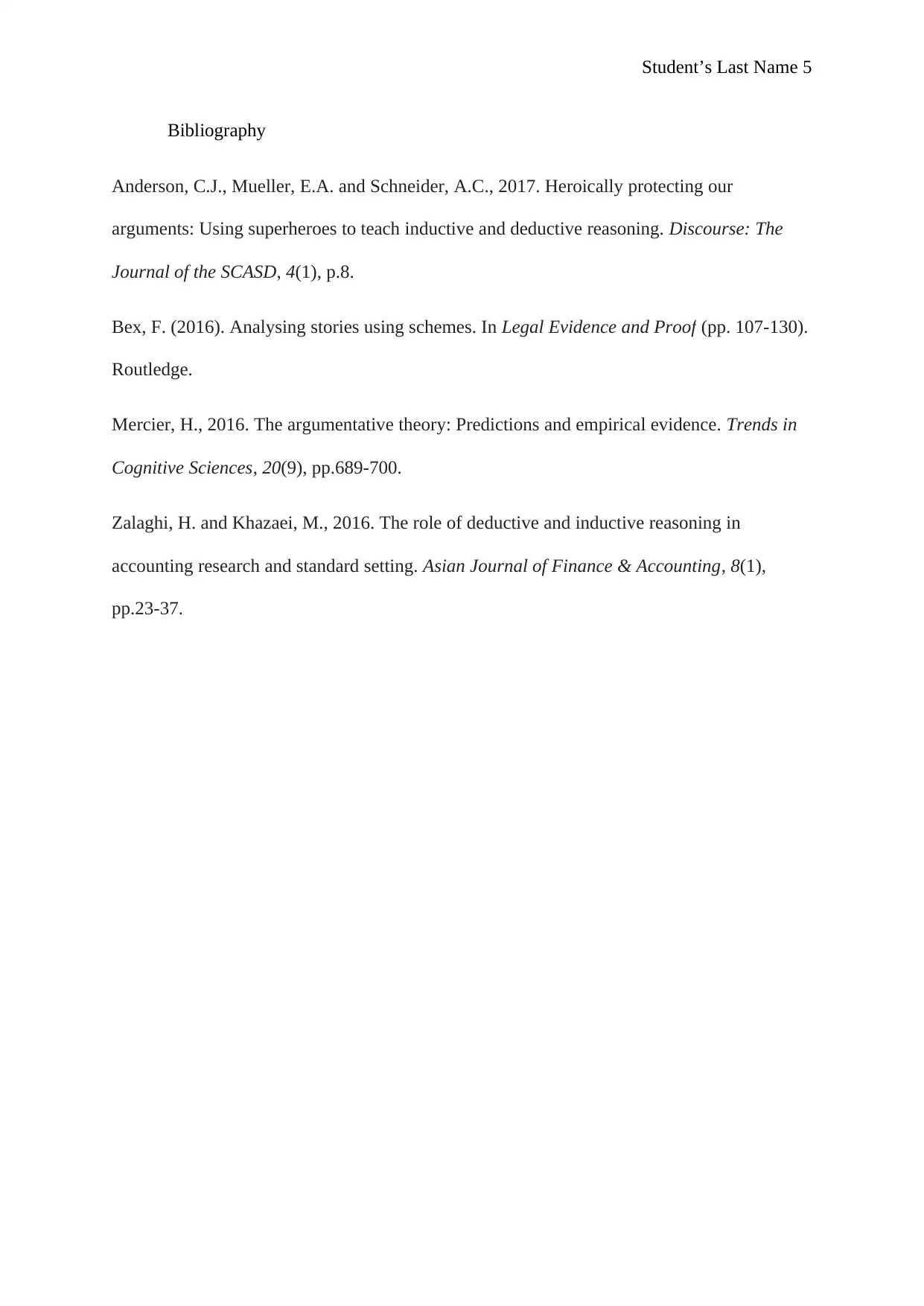
Bibliography
Anderson, C.J., Mueller, E.A. and Schneider, A.C., 2017. Heroically protecting our
arguments: Using superheroes to teach inductive and deductive reasoning. Discourse: The
Journal of the SCASD, 4(1), p.8.
Bex, F. (2016). Analysing stories using schemes. In Legal Evidence and Proof (pp. 107-130).
Routledge.
Mercier, H., 2016. The argumentative theory: Predictions and empirical evidence. Trends in
Cognitive Sciences, 20(9), pp.689-700.
Zalaghi, H. and Khazaei, M., 2016. The role of deductive and inductive reasoning in
accounting research and standard setting. Asian Journal of Finance & Accounting, 8(1),
pp.23-37.
chevron_up_icon
1 out of 5
circle_padding
hide_on_mobile
zoom_out_icon
[object Object]