Communication in Organization: Addressing Language Barriers & Ethics
VerifiedAdded on 2023/06/13
|4
|778
|349
Essay
AI Summary
This essay delves into the critical aspects of communication within organizations, addressing two key challenges: language barriers and ethical conduct. It proposes practical strategies for overcoming language barriers, such as translating documents, using interpreters, providing language classes, and employing visual communication methods. The essay also highlights the significant risks associated with unethical behavior, including legal repercussions, financial challenges, loss of credibility, reduced productivity, and psychological distress. By promoting ethical practices and effective communication strategies, organizations can foster a healthier and more productive work environment. Desklib provides similar solved assignments and study tools for students.
Running head: COMMUNICATION IN ORGANIZATION 1
Communication in Organization
Student’s Name
Institutional Affiliation
Communication in Organization
Student’s Name
Institutional Affiliation
Paraphrase This Document
Need a fresh take? Get an instant paraphrase of this document with our AI Paraphraser

COMMUNICATION IN ORGANIZATION 2
Communication in Organization
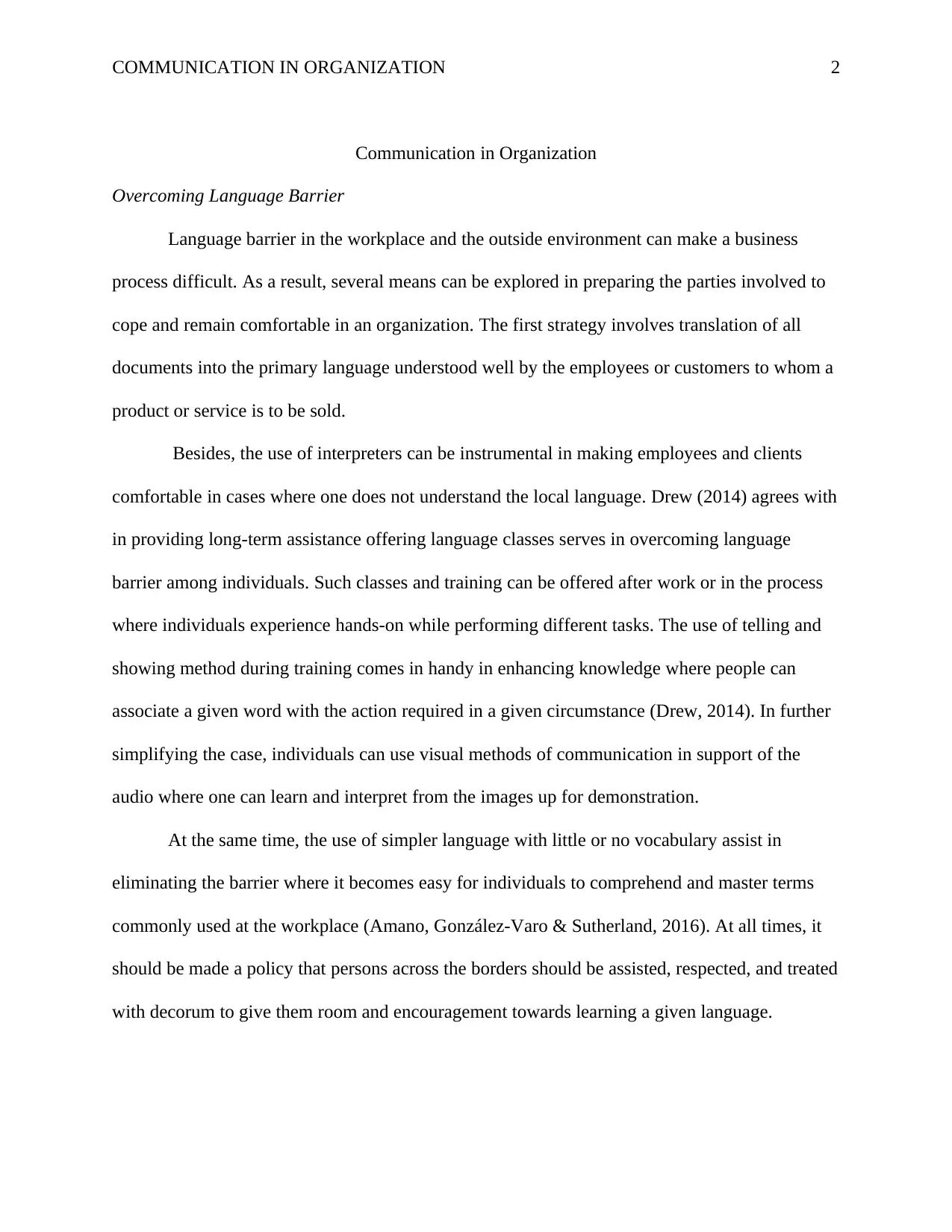
Overcoming Language Barrier
Language barrier in the workplace and the outside environment can make a business
process difficult. As a result, several means can be explored in preparing the parties involved to
cope and remain comfortable in an organization. The first strategy involves translation of all
documents into the primary language understood well by the employees or customers to whom a
product or service is to be sold.
Besides, the use of interpreters can be instrumental in making employees and clients
comfortable in cases where one does not understand the local language. Drew (2014) agrees with
in providing long-term assistance offering language classes serves in overcoming language
barrier among individuals. Such classes and training can be offered after work or in the process
where individuals experience hands-on while performing different tasks. The use of telling and
showing method during training comes in handy in enhancing knowledge where people can
associate a given word with the action required in a given circumstance (Drew, 2014). In further
simplifying the case, individuals can use visual methods of communication in support of the
audio where one can learn and interpret from the images up for demonstration.
At the same time, the use of simpler language with little or no vocabulary assist in
eliminating the barrier where it becomes easy for individuals to comprehend and master terms
commonly used at the workplace (Amano, González-Varo & Sutherland, 2016). At all times, it
should be made a policy that persons across the borders should be assisted, respected, and treated
with decorum to give them room and encouragement towards learning a given language.
Communication in Organization
Overcoming Language Barrier
Language barrier in the workplace and the outside environment can make a business
process difficult. As a result, several means can be explored in preparing the parties involved to
cope and remain comfortable in an organization. The first strategy involves translation of all
documents into the primary language understood well by the employees or customers to whom a
product or service is to be sold.
Besides, the use of interpreters can be instrumental in making employees and clients
comfortable in cases where one does not understand the local language. Drew (2014) agrees with
in providing long-term assistance offering language classes serves in overcoming language
barrier among individuals. Such classes and training can be offered after work or in the process
where individuals experience hands-on while performing different tasks. The use of telling and
showing method during training comes in handy in enhancing knowledge where people can
associate a given word with the action required in a given circumstance (Drew, 2014). In further
simplifying the case, individuals can use visual methods of communication in support of the
audio where one can learn and interpret from the images up for demonstration.
At the same time, the use of simpler language with little or no vocabulary assist in
eliminating the barrier where it becomes easy for individuals to comprehend and master terms
commonly used at the workplace (Amano, González-Varo & Sutherland, 2016). At all times, it
should be made a policy that persons across the borders should be assisted, respected, and treated
with decorum to give them room and encouragement towards learning a given language.

COMMUNICATION IN ORGANIZATION 3
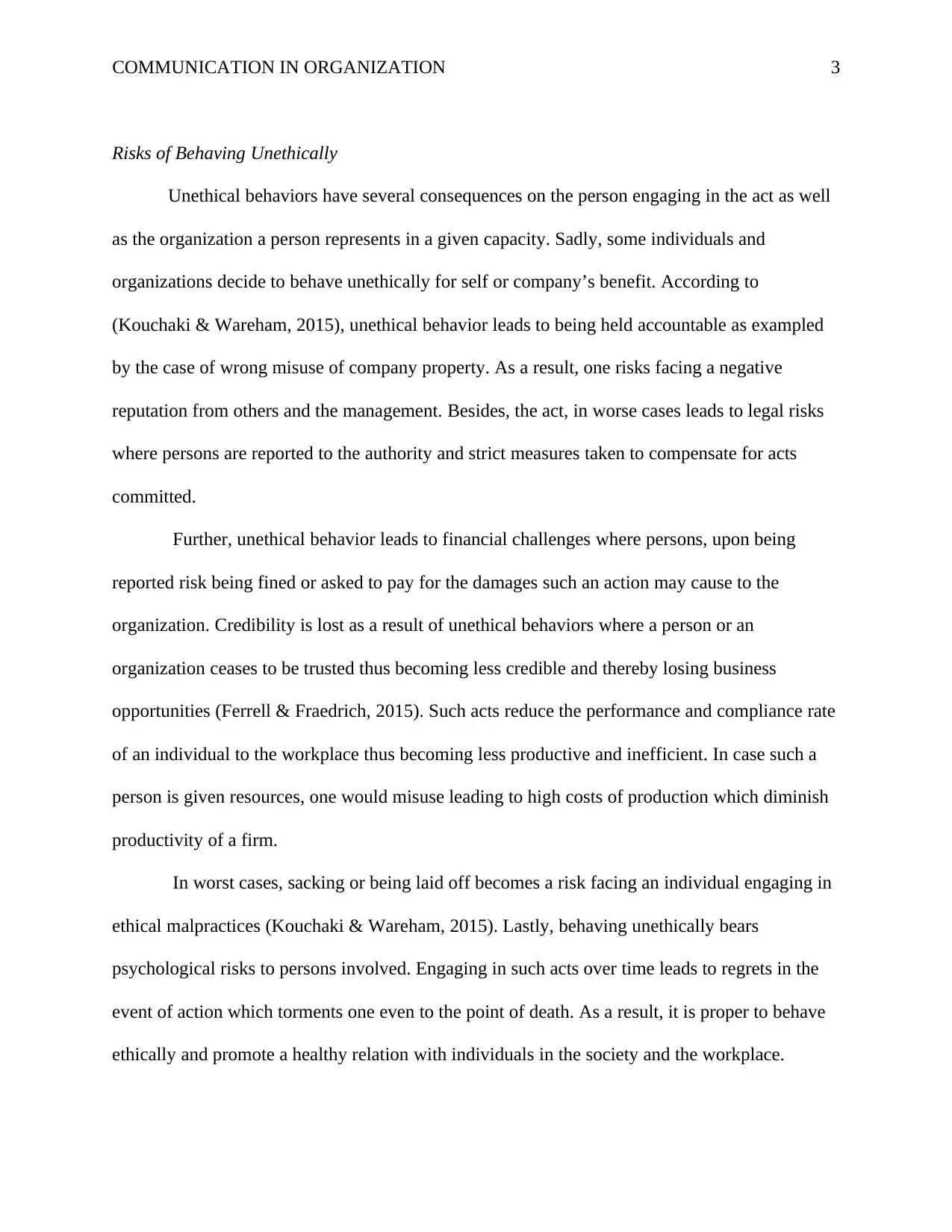
Risks of Behaving Unethically
Unethical behaviors have several consequences on the person engaging in the act as well
as the organization a person represents in a given capacity. Sadly, some individuals and
organizations decide to behave unethically for self or company’s benefit. According to
(Kouchaki & Wareham, 2015), unethical behavior leads to being held accountable as exampled
by the case of wrong misuse of company property. As a result, one risks facing a negative
reputation from others and the management. Besides, the act, in worse cases leads to legal risks
where persons are reported to the authority and strict measures taken to compensate for acts
committed.
Further, unethical behavior leads to financial challenges where persons, upon being
reported risk being fined or asked to pay for the damages such an action may cause to the
organization. Credibility is lost as a result of unethical behaviors where a person or an
organization ceases to be trusted thus becoming less credible and thereby losing business
opportunities (Ferrell & Fraedrich, 2015). Such acts reduce the performance and compliance rate
of an individual to the workplace thus becoming less productive and inefficient. In case such a
person is given resources, one would misuse leading to high costs of production which diminish
productivity of a firm.
In worst cases, sacking or being laid off becomes a risk facing an individual engaging in
ethical malpractices (Kouchaki & Wareham, 2015). Lastly, behaving unethically bears
psychological risks to persons involved. Engaging in such acts over time leads to regrets in the
event of action which torments one even to the point of death. As a result, it is proper to behave
ethically and promote a healthy relation with individuals in the society and the workplace.
Risks of Behaving Unethically
Unethical behaviors have several consequences on the person engaging in the act as well
as the organization a person represents in a given capacity. Sadly, some individuals and
organizations decide to behave unethically for self or company’s benefit. According to
(Kouchaki & Wareham, 2015), unethical behavior leads to being held accountable as exampled
by the case of wrong misuse of company property. As a result, one risks facing a negative
reputation from others and the management. Besides, the act, in worse cases leads to legal risks
where persons are reported to the authority and strict measures taken to compensate for acts
committed.
Further, unethical behavior leads to financial challenges where persons, upon being
reported risk being fined or asked to pay for the damages such an action may cause to the
organization. Credibility is lost as a result of unethical behaviors where a person or an
organization ceases to be trusted thus becoming less credible and thereby losing business
opportunities (Ferrell & Fraedrich, 2015). Such acts reduce the performance and compliance rate
of an individual to the workplace thus becoming less productive and inefficient. In case such a
person is given resources, one would misuse leading to high costs of production which diminish
productivity of a firm.
In worst cases, sacking or being laid off becomes a risk facing an individual engaging in
ethical malpractices (Kouchaki & Wareham, 2015). Lastly, behaving unethically bears
psychological risks to persons involved. Engaging in such acts over time leads to regrets in the
event of action which torments one even to the point of death. As a result, it is proper to behave
ethically and promote a healthy relation with individuals in the society and the workplace.
⊘ This is a preview!⊘
Do you want full access?
Subscribe today to unlock all pages.

Trusted by 1+ million students worldwide

COMMUNICATION IN ORGANIZATION 4
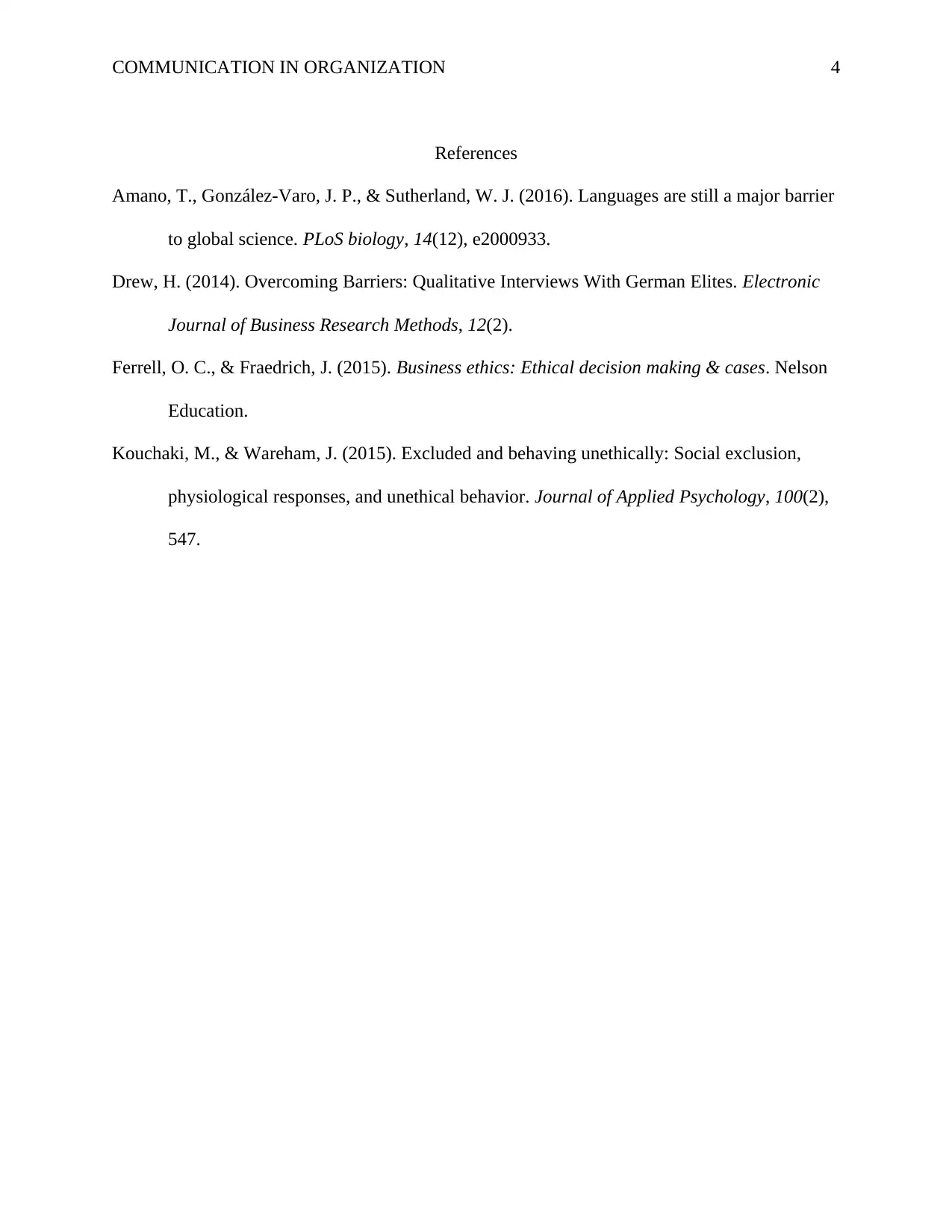
References
Amano, T., González-Varo, J. P., & Sutherland, W. J. (2016). Languages are still a major barrier
to global science. PLoS biology, 14(12), e2000933.
Drew, H. (2014). Overcoming Barriers: Qualitative Interviews With German Elites. Electronic
Journal of Business Research Methods, 12(2).
Ferrell, O. C., & Fraedrich, J. (2015). Business ethics: Ethical decision making & cases. Nelson
Education.
Kouchaki, M., & Wareham, J. (2015). Excluded and behaving unethically: Social exclusion,
physiological responses, and unethical behavior. Journal of Applied Psychology, 100(2),
547.
References
Amano, T., González-Varo, J. P., & Sutherland, W. J. (2016). Languages are still a major barrier
to global science. PLoS biology, 14(12), e2000933.
Drew, H. (2014). Overcoming Barriers: Qualitative Interviews With German Elites. Electronic
Journal of Business Research Methods, 12(2).
Ferrell, O. C., & Fraedrich, J. (2015). Business ethics: Ethical decision making & cases. Nelson
Education.
Kouchaki, M., & Wareham, J. (2015). Excluded and behaving unethically: Social exclusion,
physiological responses, and unethical behavior. Journal of Applied Psychology, 100(2),
547.
1 out of 4
Related Documents
Your All-in-One AI-Powered Toolkit for Academic Success.
+13062052269
info@desklib.com
Available 24*7 on WhatsApp / Email
Unlock your academic potential
Copyright © 2020–2025 A2Z Services. All Rights Reserved. Developed and managed by ZUCOL.