Semester 3 MB111 Essay: Communication Styles of Leadership and Impact
VerifiedAdded on 2022/08/26
|12
|2815
|16
Essay
AI Summary
This essay provides an in-depth analysis of two primary communication styles in leadership: transformational and authoritative. It explores how these styles directly and indirectly influence organizational culture and performance, drawing upon communication theories to illustrate their implications. The essay examines the characteristics of each style, highlighting the empathetic and motivational approach of transformational leadership versus the directive nature of authoritative leadership. It delves into the impact of each style on employee engagement, productivity, and overall organizational outcomes, providing examples to support the arguments. The importance of effective communication skills, the role of business communication in organizational performance, and the significance of organizational culture are also scrutinized, offering a comprehensive understanding of how leadership communication styles shape business success.
Communication style of leadership and its
impact over organisational culture and
performance
impact over organisational culture and
performance

Paraphrase This Document
Need a fresh take? Get an instant paraphrase of this document with our AI Paraphraser
1
COMMUNICATION STYLES OF LEADERSHIP AND ITS IMPACT
Introduction
In this essay an analysis will be done over the two communication style of leadership. The
focus will be provided on how different types of communication styles of leadership have a
directly or indirectly impact upon the culture and performance of the organisation. Focus will
be given on the communication theories and their implications in terms of the culture of the
organisation. The importance of transformational communication style of leadership and
authoritative communication style of leadership has been analysed in the essay. The
significance of communication skills in leadership is also scrutinised. The focus will be
provided over the role of business communication in the performance of organisation.
Analysis will also be done over the organisational culture and the role of communication
styles in improving the performance of the organisation.
Organisational culture
Organisational culture can be defined as the values and believes of a particular organisation
which maintains the working environment of the business. The culture of any organisation
refers to the behaviour and mind-set of the employees of the Company. Favourable and
positive organisational culture helps the employee by increasing their productivity. The
organisational culture may also be defined as expectations of the organisation to its
employees in order to work efficiently for improving the performance of the Company. It
also refers to the long term goals of the organisation which depicts the vision of the
Company. The behavioral component of the employees is directly linked towards achieving
the goal of the organisation (Lee, 2020).
Communication styles of leadership
COMMUNICATION STYLES OF LEADERSHIP AND ITS IMPACT
Introduction
In this essay an analysis will be done over the two communication style of leadership. The
focus will be provided on how different types of communication styles of leadership have a
directly or indirectly impact upon the culture and performance of the organisation. Focus will
be given on the communication theories and their implications in terms of the culture of the
organisation. The importance of transformational communication style of leadership and
authoritative communication style of leadership has been analysed in the essay. The
significance of communication skills in leadership is also scrutinised. The focus will be
provided over the role of business communication in the performance of organisation.
Analysis will also be done over the organisational culture and the role of communication
styles in improving the performance of the organisation.
Organisational culture
Organisational culture can be defined as the values and believes of a particular organisation
which maintains the working environment of the business. The culture of any organisation
refers to the behaviour and mind-set of the employees of the Company. Favourable and
positive organisational culture helps the employee by increasing their productivity. The
organisational culture may also be defined as expectations of the organisation to its
employees in order to work efficiently for improving the performance of the Company. It
also refers to the long term goals of the organisation which depicts the vision of the
Company. The behavioral component of the employees is directly linked towards achieving
the goal of the organisation (Lee, 2020).
Communication styles of leadership
2
COMMUNICATION STYLES OF LEADERSHIP AND ITS IMPACT
Communication style of leadership is defined as a process of sharing the thoughts and ideas
of the leaders to its employees and vice versa. A successful leader should adopt the suitable
style of communication within the Company for the well-being of the organisation. A good
communication skill is essential for becoming a successful leader (ME Broome, 2015).
Following are the communication styles of leadership
Transformational communication style of leadership
In this type of communication a leader focus over soft and empathetic way of communicating
their thoughts and views to their subordinates. In this communication style of leadership, the
leader interacts with his subordinates in a very comfortable and convenient way and with this
technique he motivates his workforce towards achieving the goals of the organisation. This
type of leader always approachable and that is why employee feel easy to talk with him. The
subordinates are able to understand the goals of the organisation in a very sophisticated
manner with the help of transformational communication style of leadership (S Peng, 2020).
Transformational communication style focuses on the team work by guiding the workforce in
order to get maximum benefit for the organisation. Transformational leaders believe in team
work and integrity. They believe that for developing a favourable environment of work, an
effective and easy approach of leadership would be best suitable which can be modified
according to the situation (NK Wardani, 2020).
In this type of communication style, a leader motivates his employees to take part in each and
every activity of the Company. A leader promotes the employee by giving value to their
opinion in terms of involving their concern in decision making. A very good verbal
communication is required in this communication style of leadership. An effective leader has
COMMUNICATION STYLES OF LEADERSHIP AND ITS IMPACT
Communication style of leadership is defined as a process of sharing the thoughts and ideas
of the leaders to its employees and vice versa. A successful leader should adopt the suitable
style of communication within the Company for the well-being of the organisation. A good
communication skill is essential for becoming a successful leader (ME Broome, 2015).
Following are the communication styles of leadership
Transformational communication style of leadership
In this type of communication a leader focus over soft and empathetic way of communicating
their thoughts and views to their subordinates. In this communication style of leadership, the
leader interacts with his subordinates in a very comfortable and convenient way and with this
technique he motivates his workforce towards achieving the goals of the organisation. This
type of leader always approachable and that is why employee feel easy to talk with him. The
subordinates are able to understand the goals of the organisation in a very sophisticated
manner with the help of transformational communication style of leadership (S Peng, 2020).
Transformational communication style focuses on the team work by guiding the workforce in
order to get maximum benefit for the organisation. Transformational leaders believe in team
work and integrity. They believe that for developing a favourable environment of work, an
effective and easy approach of leadership would be best suitable which can be modified
according to the situation (NK Wardani, 2020).
In this type of communication style, a leader motivates his employees to take part in each and
every activity of the Company. A leader promotes the employee by giving value to their
opinion in terms of involving their concern in decision making. A very good verbal
communication is required in this communication style of leadership. An effective leader has
⊘ This is a preview!⊘
Do you want full access?
Subscribe today to unlock all pages.

Trusted by 1+ million students worldwide
3
COMMUNICATION STYLES OF LEADERSHIP AND ITS IMPACT
a capability of good listening skill in order to understand the problems and concern of the
employees (Men, 2014).
Transformational leaders are able to influence and inspire their subordinates with their
effective style of communication. They actively understand the problems of the employee
and provide them the suggestions to solve the issues. The main feature of the
transformational leader is that they involve the opinion of the employees in decision making.
They provide sufficient time to employee for giving their opinion regarding any issue arises
inside the organisation (S Peng, 2020).
Transformational communication style of leadership favours the freedom of the employees
related to their job profile. They keep the morals of their employee very high by interacting
them in a polite, friendly and informal manner. This style represents the positive mind-set of
the leader which is very helpful in achieving the high level of motivation in the workforce
and results in better productivity. The members of the organisation feel safe while talking
with their leader and that is why the combined efforts of the employee lead towards achieving
the goals of the organisation (ME Broome, 2015).
Impact of transformational communication style of leadership on organisational culture
and performance
A transformational leader always maintains a favourable environment of work with his
effective and polite way of communication by using correct and easy language. Instructions
should be given in a short form with only relevant information for the better understandings
of the messages by the staff members of the organisation (Groves, 2020).
Transformational communication style of leadership always proves beneficial in those cases
where the organisation is facing the challenges in its operational part. Effective
COMMUNICATION STYLES OF LEADERSHIP AND ITS IMPACT
a capability of good listening skill in order to understand the problems and concern of the
employees (Men, 2014).
Transformational leaders are able to influence and inspire their subordinates with their
effective style of communication. They actively understand the problems of the employee
and provide them the suggestions to solve the issues. The main feature of the
transformational leader is that they involve the opinion of the employees in decision making.
They provide sufficient time to employee for giving their opinion regarding any issue arises
inside the organisation (S Peng, 2020).
Transformational communication style of leadership favours the freedom of the employees
related to their job profile. They keep the morals of their employee very high by interacting
them in a polite, friendly and informal manner. This style represents the positive mind-set of
the leader which is very helpful in achieving the high level of motivation in the workforce
and results in better productivity. The members of the organisation feel safe while talking
with their leader and that is why the combined efforts of the employee lead towards achieving
the goals of the organisation (ME Broome, 2015).
Impact of transformational communication style of leadership on organisational culture
and performance
A transformational leader always maintains a favourable environment of work with his
effective and polite way of communication by using correct and easy language. Instructions
should be given in a short form with only relevant information for the better understandings
of the messages by the staff members of the organisation (Groves, 2020).
Transformational communication style of leadership always proves beneficial in those cases
where the organisation is facing the challenges in its operational part. Effective
Paraphrase This Document
Need a fresh take? Get an instant paraphrase of this document with our AI Paraphraser
4
COMMUNICATION STYLES OF LEADERSHIP AND ITS IMPACT
transformational communication helps the employees in maintaining the rules and regulations
of the Company by receiving clear messages about the policies of the Company (FY Lai,
2020). The workforce of the Company started to feel more engaged towards the Company if
their opinion is involved in decision making and they do not have any doubt regarding the
policies and regulations of the organisation (Men, 2014).
The organisational culture becomes more positive and favourable by using the
transformational communication style of leadership. Positive working environment help the
employees in giving their maximum efforts in the organisation for improving the productivity
of the Company (Lee, 2020). The performance of the organisation is improved by receiving
the feedback from the employees of the Company. If the organisation develops its strategies
according to the concern of the employees, it will be more fruitful for the organisation
(NOUFOU OUEDRAOGO, 2019).
The two sided approach of the transformational leaders is very beneficial in obtaining the
trust of the employees which ultimately helps the organisation in receiving benefits.
Sometimes the feedback of the employees is very useful in removing the challenges of the
organisation (A Presbitero, 2019). Motivated employees always treat the customers with
more effective way and this process enhances the customer satisfaction. Overall, it can be
said that the performance of organisation is improved by using the transformational
communication style of leadership (Y Lee, 2019).
For example
If a FMCG Company wants to represent its new target policy of sales of the products to its
subordinates, it will take the help of transformational communication style of leadership for
understanding the various challenges are facing by the sales team of the Company. The
organisation will modify its pricing and marketing strategy after receiving the feedback from
COMMUNICATION STYLES OF LEADERSHIP AND ITS IMPACT
transformational communication helps the employees in maintaining the rules and regulations
of the Company by receiving clear messages about the policies of the Company (FY Lai,
2020). The workforce of the Company started to feel more engaged towards the Company if
their opinion is involved in decision making and they do not have any doubt regarding the
policies and regulations of the organisation (Men, 2014).
The organisational culture becomes more positive and favourable by using the
transformational communication style of leadership. Positive working environment help the
employees in giving their maximum efforts in the organisation for improving the productivity
of the Company (Lee, 2020). The performance of the organisation is improved by receiving
the feedback from the employees of the Company. If the organisation develops its strategies
according to the concern of the employees, it will be more fruitful for the organisation
(NOUFOU OUEDRAOGO, 2019).
The two sided approach of the transformational leaders is very beneficial in obtaining the
trust of the employees which ultimately helps the organisation in receiving benefits.
Sometimes the feedback of the employees is very useful in removing the challenges of the
organisation (A Presbitero, 2019). Motivated employees always treat the customers with
more effective way and this process enhances the customer satisfaction. Overall, it can be
said that the performance of organisation is improved by using the transformational
communication style of leadership (Y Lee, 2019).
For example
If a FMCG Company wants to represent its new target policy of sales of the products to its
subordinates, it will take the help of transformational communication style of leadership for
understanding the various challenges are facing by the sales team of the Company. The
organisation will modify its pricing and marketing strategy after receiving the feedback from
5
COMMUNICATION STYLES OF LEADERSHIP AND ITS IMPACT
the sales team. In these types of cases, transformational communication style of leadership
helps the leader in assessing the real position of the Company (T Kuo, 2019).
Authoritative communication style of leadership
In this type of communication style of leadership, the leader behaves in a dictator way and he
only convey his messages and information to his subordinates in the form of orders. He
hardly give time to his employees speak about their problems. He always communicates in an
authoritative way and because of this the subordinates feel very uncomfortable to talk with
the leader. This type of leaders are unapproachable with his subordinates and the employees
do not even get chance to say their opinion and point of view regarding any policy or
regulations of the Company (Veale, 2010).
Most of the time, this type of communication style may create problems for the organisation
because employees may misunderstand the information which is conveyed by the leader.
These types of leaders may not be able to understand the problems of the employees and this
may results in losses for the Company. Employees sometimes may even feel frustrated and
confused because of the harsh and one sided response of the authoritative leaders. The level
of job satisfaction is reduced due to the authoritative communicative style of leadership
(Afsar, 2014).
Authoritative leaders adopt dominating way of communication and because of that
employees start to feel dissatisfied and unhappy. This style of communication not only
creates frustrations but also demotivate the changes and innovations which are extremely
important to survive in this challenging global business environment (M Loon, 2019).
Actually the whole process of the organisation should be updated with respect to time and
employee’s feedback is very essential for updations. This style does not inspire the feedback
COMMUNICATION STYLES OF LEADERSHIP AND ITS IMPACT
the sales team. In these types of cases, transformational communication style of leadership
helps the leader in assessing the real position of the Company (T Kuo, 2019).
Authoritative communication style of leadership
In this type of communication style of leadership, the leader behaves in a dictator way and he
only convey his messages and information to his subordinates in the form of orders. He
hardly give time to his employees speak about their problems. He always communicates in an
authoritative way and because of this the subordinates feel very uncomfortable to talk with
the leader. This type of leaders are unapproachable with his subordinates and the employees
do not even get chance to say their opinion and point of view regarding any policy or
regulations of the Company (Veale, 2010).
Most of the time, this type of communication style may create problems for the organisation
because employees may misunderstand the information which is conveyed by the leader.
These types of leaders may not be able to understand the problems of the employees and this
may results in losses for the Company. Employees sometimes may even feel frustrated and
confused because of the harsh and one sided response of the authoritative leaders. The level
of job satisfaction is reduced due to the authoritative communicative style of leadership
(Afsar, 2014).
Authoritative leaders adopt dominating way of communication and because of that
employees start to feel dissatisfied and unhappy. This style of communication not only
creates frustrations but also demotivate the changes and innovations which are extremely
important to survive in this challenging global business environment (M Loon, 2019).
Actually the whole process of the organisation should be updated with respect to time and
employee’s feedback is very essential for updations. This style does not inspire the feedback
⊘ This is a preview!⊘
Do you want full access?
Subscribe today to unlock all pages.
Trusted by 1+ million students worldwide
6
COMMUNICATION STYLES OF LEADERSHIP AND ITS IMPACT
of the employees and that is why it is very harmful for the future growth of the Company (R
Kaur, 2019).
This communication style of leadership demotivates the innovations and change process
inside the organisation which is harmful for the organisation because the business
environment is keep on changing day by day and innovations becomes necessary to survive
in the challenging environment of business. By neglecting the concern of employees, the
organisation not only demotivate its workforce but also loose very important suggestions
which could be highly beneficial for the business of the Company (JAK Farvoodi, 2020).
Impact of authoritative communication style of leadership on organisational culture
and performance
Authoritative communication style of the leader make the workforce disappointed and
demotivated and when the employees of the organisation do not feel motivated, the
performance of the organisation will definitely degraded and reduced. These leaders usually
prefer written communication for describing the policies of the Company which is only one
way communication. Authoritative leaders do not offer and consider the feedback of their
employees and because of this the morals of the employees become down. For the success of
any organisation it is very necessary to understand the real problems of the employee by their
leaders which is not possible in authoritative communication style of leadership (M Loon,
2019).
The organisational culture is negatively affected by authoritative communication style of
leadership because the employees do not feel satisfied and inspired by their leaders. The
positive mind-set of the employees results in better productivity for the organisation whereas
the negative mind-set of the employees severely affects their performance. This situation is
also responsible for higher attrition rate that cost a lot to the Company (T Kuo, 2019).
COMMUNICATION STYLES OF LEADERSHIP AND ITS IMPACT
of the employees and that is why it is very harmful for the future growth of the Company (R
Kaur, 2019).
This communication style of leadership demotivates the innovations and change process
inside the organisation which is harmful for the organisation because the business
environment is keep on changing day by day and innovations becomes necessary to survive
in the challenging environment of business. By neglecting the concern of employees, the
organisation not only demotivate its workforce but also loose very important suggestions
which could be highly beneficial for the business of the Company (JAK Farvoodi, 2020).
Impact of authoritative communication style of leadership on organisational culture
and performance
Authoritative communication style of the leader make the workforce disappointed and
demotivated and when the employees of the organisation do not feel motivated, the
performance of the organisation will definitely degraded and reduced. These leaders usually
prefer written communication for describing the policies of the Company which is only one
way communication. Authoritative leaders do not offer and consider the feedback of their
employees and because of this the morals of the employees become down. For the success of
any organisation it is very necessary to understand the real problems of the employee by their
leaders which is not possible in authoritative communication style of leadership (M Loon,
2019).
The organisational culture is negatively affected by authoritative communication style of
leadership because the employees do not feel satisfied and inspired by their leaders. The
positive mind-set of the employees results in better productivity for the organisation whereas
the negative mind-set of the employees severely affects their performance. This situation is
also responsible for higher attrition rate that cost a lot to the Company (T Kuo, 2019).
Paraphrase This Document
Need a fresh take? Get an instant paraphrase of this document with our AI Paraphraser
7
COMMUNICATION STYLES OF LEADERSHIP AND ITS IMPACT
If the human resources of the Company do not feel valuable and recognised by the leader of
the Company, they loss their interest in their job and it is very harmful for the business of the
Company. Human resources are very valuable for any organisation because the success of the
business of the Company is very much depends upon the performance of the human resources
of the organisation. Authoritative communication style only gives orders to their subordinates
without even considering their point of view. The working environment of the Company is
also not favourable in this case and the whole organisation has to suffer because of
authoritative communication style of leadership (ME Broome, 2015).
For example
The branch manager of a banking industry directly sends an e-mail to the employees of his
organisation for telling them that their monthly sales target has been increased. Most of the
employees feel very demotivated and unhappy with the one side decision of the leader which
has been taken without consulting to them. The employees are not at all satisfied with the
communication style of their leader because they do not have a platform to interact with the
leader. This will result in a high attrition rate which is ultimately returns in loss for the
business of the Company (M Loon, 2019).
Conclusion
After analysing the impact of the above stated communication style of leadership, it can be
concluded that the various communication styles of leadership may influence the behaviour
of the employees in positive or negative direction. The motivated and satisfied workforce is
very beneficial for the growth of the organisation and that is why choosing the best
communication style is a crucial matter for every organisation.
COMMUNICATION STYLES OF LEADERSHIP AND ITS IMPACT
If the human resources of the Company do not feel valuable and recognised by the leader of
the Company, they loss their interest in their job and it is very harmful for the business of the
Company. Human resources are very valuable for any organisation because the success of the
business of the Company is very much depends upon the performance of the human resources
of the organisation. Authoritative communication style only gives orders to their subordinates
without even considering their point of view. The working environment of the Company is
also not favourable in this case and the whole organisation has to suffer because of
authoritative communication style of leadership (ME Broome, 2015).
For example
The branch manager of a banking industry directly sends an e-mail to the employees of his
organisation for telling them that their monthly sales target has been increased. Most of the
employees feel very demotivated and unhappy with the one side decision of the leader which
has been taken without consulting to them. The employees are not at all satisfied with the
communication style of their leader because they do not have a platform to interact with the
leader. This will result in a high attrition rate which is ultimately returns in loss for the
business of the Company (M Loon, 2019).
Conclusion
After analysing the impact of the above stated communication style of leadership, it can be
concluded that the various communication styles of leadership may influence the behaviour
of the employees in positive or negative direction. The motivated and satisfied workforce is
very beneficial for the growth of the organisation and that is why choosing the best
communication style is a crucial matter for every organisation.
8
COMMUNICATION STYLES OF LEADERSHIP AND ITS IMPACT
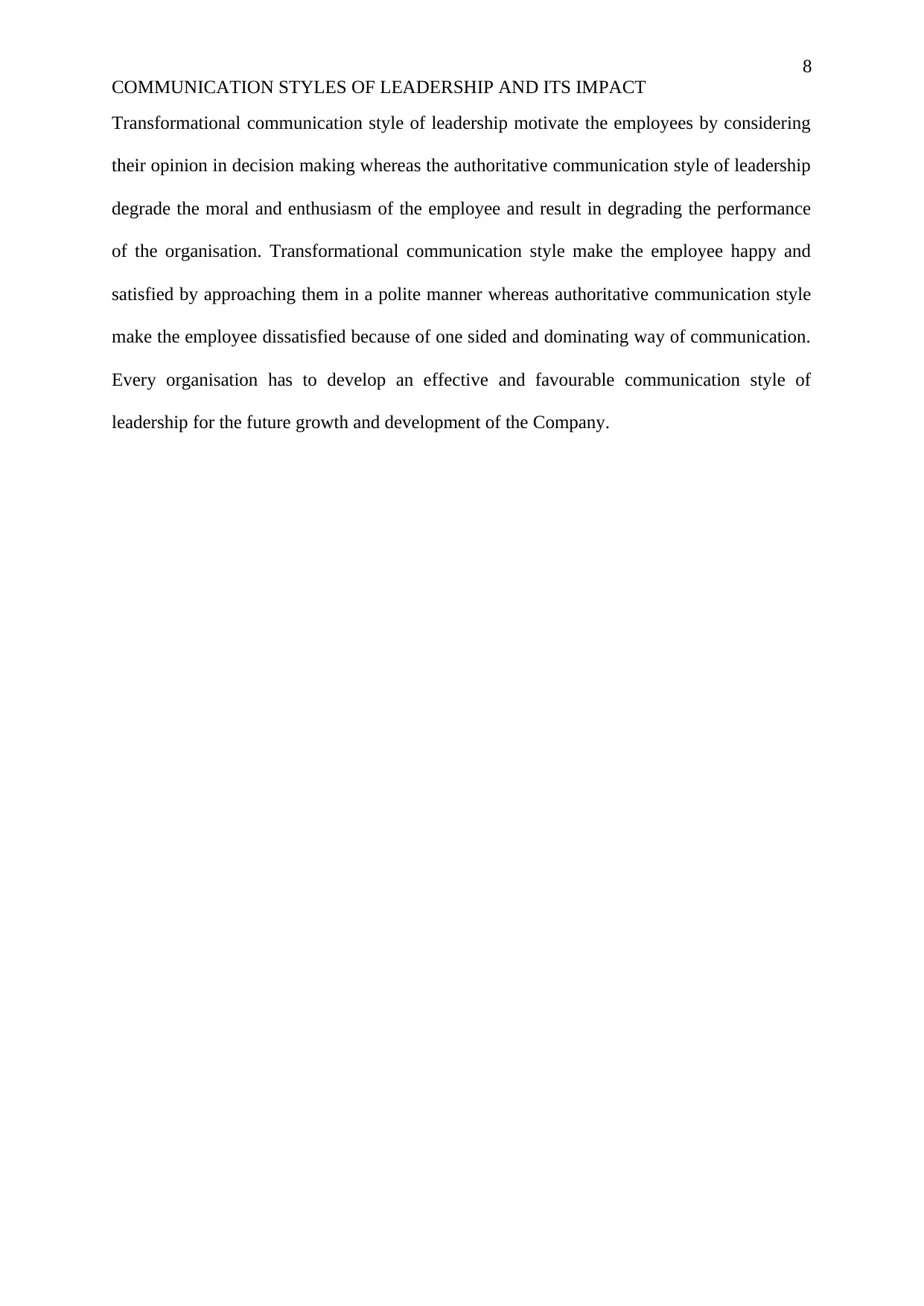
Transformational communication style of leadership motivate the employees by considering
their opinion in decision making whereas the authoritative communication style of leadership
degrade the moral and enthusiasm of the employee and result in degrading the performance
of the organisation. Transformational communication style make the employee happy and
satisfied by approaching them in a polite manner whereas authoritative communication style
make the employee dissatisfied because of one sided and dominating way of communication.
Every organisation has to develop an effective and favourable communication style of
leadership for the future growth and development of the Company.
COMMUNICATION STYLES OF LEADERSHIP AND ITS IMPACT
Transformational communication style of leadership motivate the employees by considering
their opinion in decision making whereas the authoritative communication style of leadership
degrade the moral and enthusiasm of the employee and result in degrading the performance
of the organisation. Transformational communication style make the employee happy and
satisfied by approaching them in a polite manner whereas authoritative communication style
make the employee dissatisfied because of one sided and dominating way of communication.
Every organisation has to develop an effective and favourable communication style of
leadership for the future growth and development of the Company.
⊘ This is a preview!⊘
Do you want full access?
Subscribe today to unlock all pages.
Trusted by 1+ million students worldwide
9
COMMUNICATION STYLES OF LEADERSHIP AND ITS IMPACT
References
A Presbitero, M. T.‐C. (2019). Subordinate's proactivity in performance planning:
implications for performance management systems. Asia Pacific Journal of Human
Resources, 57(1), 24-39.
Afsar, B. (2014). Moral or authoritative leadership: Which one is better for faculty members.
American Journal of Educational Research, 2(9), 793-800.
FY Lai, H. T. (2020). Transformational Leadership and Job Performance: The Mediating
Role of Work Engagement. SAGE Open, 10(1).
Groves, K. (2020). Testing a moderated mediation model of transformational leadership,
values, and organization change. Journal of Leadership & Organizational Studies,
27(1), 35-48.
JAK Farvoodi, G. E. (2020). Investigation of relationship between leadership style of
exploitative authoritarian leadership style of benevolent authoritative and
organizational citizenship. International Journal of advanced studies in humanities
and social science, 1(6), 701-770.
Lee, J. (2020). Organisational Culture and Change Management. Accelerating Organisation
Culture Change.
M Loon, L. O.-E. (2019). The paradox of employee psychological well-being practices: an
integrative literature review and new directions for research. The International
Journal of Human Resource Management, 30(1), 156-187.
ME Broome, E. M. (2015). Collaborative Leadership Contexts: It Is All About Working
Together. Leadership in Nursing: From Expert clinician to influential leader, 1-155.
COMMUNICATION STYLES OF LEADERSHIP AND ITS IMPACT
References
A Presbitero, M. T.‐C. (2019). Subordinate's proactivity in performance planning:
implications for performance management systems. Asia Pacific Journal of Human
Resources, 57(1), 24-39.
Afsar, B. (2014). Moral or authoritative leadership: Which one is better for faculty members.
American Journal of Educational Research, 2(9), 793-800.
FY Lai, H. T. (2020). Transformational Leadership and Job Performance: The Mediating
Role of Work Engagement. SAGE Open, 10(1).
Groves, K. (2020). Testing a moderated mediation model of transformational leadership,
values, and organization change. Journal of Leadership & Organizational Studies,
27(1), 35-48.
JAK Farvoodi, G. E. (2020). Investigation of relationship between leadership style of
exploitative authoritarian leadership style of benevolent authoritative and
organizational citizenship. International Journal of advanced studies in humanities
and social science, 1(6), 701-770.
Lee, J. (2020). Organisational Culture and Change Management. Accelerating Organisation
Culture Change.
M Loon, L. O.-E. (2019). The paradox of employee psychological well-being practices: an
integrative literature review and new directions for research. The International
Journal of Human Resource Management, 30(1), 156-187.
ME Broome, E. M. (2015). Collaborative Leadership Contexts: It Is All About Working
Together. Leadership in Nursing: From Expert clinician to influential leader, 1-155.
Paraphrase This Document
Need a fresh take? Get an instant paraphrase of this document with our AI Paraphraser
10
COMMUNICATION STYLES OF LEADERSHIP AND ITS IMPACT
Men, L. (2014). Strategic internal communication: Transformational leadership,
communication channels, and employee satisfaction. Management Communication
Quarterly, 28(2), 264-284.
NK Wardani, A. E. (2020). The Influence of Transformational Leadership on Employees
Performance with Communication Satisfaction Mediation. 3rd Global Conference On
Business mangement an dentrepreneurship, 247-252.
NOUFOU OUEDRAOGO, M. L. (2019). EFFECTS OF EMPLOYEE CREATIVE
PROBLEM-SOLVING ON INNOVATION OUTCOMES AND NON-FINANCIAL
PERFORMANCE: THE MODERATING ROLE OF CULTURE AND
COMMUNICATION. International Journal of Innovation Management.
R Kaur, D. S. (2019). INTERDEPENDENCE OF PERFORMANCE MANAGEMENT
SYSTEM AND EMPLOYEE ENGAGEMENT. PIMT, 1-96.
S Peng, Y. L. (2020). The Influence of Transformational Leadership on Employees' Affective
Organizational Commitment in Public and Nonprofit Organizations: A Moderated
Mediation …. Public Personnel Management, 49(1), 29-56.
T Kuo, G. T. (2019). The effects of employee perceived organisational culture on
performance: the moderating effects of management maturity. Total Quality
Management & Business Excellence, 30(4), 267-283.
Veale, N. (2010). A Comparison between Collaborative and Authoritative Leadership Styles
of Special Education Administrators. Journal of the American Academy of Special
Education , 1-156.
COMMUNICATION STYLES OF LEADERSHIP AND ITS IMPACT
Men, L. (2014). Strategic internal communication: Transformational leadership,
communication channels, and employee satisfaction. Management Communication
Quarterly, 28(2), 264-284.
NK Wardani, A. E. (2020). The Influence of Transformational Leadership on Employees
Performance with Communication Satisfaction Mediation. 3rd Global Conference On
Business mangement an dentrepreneurship, 247-252.
NOUFOU OUEDRAOGO, M. L. (2019). EFFECTS OF EMPLOYEE CREATIVE
PROBLEM-SOLVING ON INNOVATION OUTCOMES AND NON-FINANCIAL
PERFORMANCE: THE MODERATING ROLE OF CULTURE AND
COMMUNICATION. International Journal of Innovation Management.
R Kaur, D. S. (2019). INTERDEPENDENCE OF PERFORMANCE MANAGEMENT
SYSTEM AND EMPLOYEE ENGAGEMENT. PIMT, 1-96.
S Peng, Y. L. (2020). The Influence of Transformational Leadership on Employees' Affective
Organizational Commitment in Public and Nonprofit Organizations: A Moderated
Mediation …. Public Personnel Management, 49(1), 29-56.
T Kuo, G. T. (2019). The effects of employee perceived organisational culture on
performance: the moderating effects of management maturity. Total Quality
Management & Business Excellence, 30(4), 267-283.
Veale, N. (2010). A Comparison between Collaborative and Authoritative Leadership Styles
of Special Education Administrators. Journal of the American Academy of Special
Education , 1-156.
11
COMMUNICATION STYLES OF LEADERSHIP AND ITS IMPACT
Y Lee, M. H. (2019). Organisational culture and entrepreneurial orientation: An orthogonal
perspective of individualism and collectivism. International Small Business journal ,
37(2), 125-152.
COMMUNICATION STYLES OF LEADERSHIP AND ITS IMPACT
Y Lee, M. H. (2019). Organisational culture and entrepreneurial orientation: An orthogonal
perspective of individualism and collectivism. International Small Business journal ,
37(2), 125-152.
⊘ This is a preview!⊘
Do you want full access?
Subscribe today to unlock all pages.
Trusted by 1+ million students worldwide

1 out of 12


Related Documents


Your All-in-One AI-Powered Toolkit for Academic Success.
+13062052269
info@desklib.com
Available 24*7 on WhatsApp / Email
![[object Object]](/_next/static/media/star-bottom.7253800d.svg)
Unlock your academic potential
Copyright © 2020–2026 A2Z Services. All Rights Reserved. Developed and managed by ZUCOL.