Communication Processes: Enhancing Organizational Effectiveness

Verified

Added on  2022/11/25

|6
|1538
|82
Report
AI Summary
This report delves into the critical role of communication processes within organizations, highlighting their impact on employee motivation, goal achievement, and overall organizational effectiveness. It emphasizes the essential components of communication, including effective listening, feedback mechanisms, and the importance of questioning for clarification. The report explores different communication structures, such as horizontal, vertical, and diagonal communication, and stresses the significance of clear communication of company goals to employees. It underscores the role of managers in fostering open communication, providing feedback, and creating an environment where employees feel comfortable asking questions. The report references key academic sources to support its arguments and offers a comprehensive overview of communication strategies for enhancing organizational success. The report concludes that effective communication is crucial for the smooth functioning of any organization, and it provides practical insights for managers to improve their communication skills and create a more engaged and productive workforce.
Document Page
Running head: COMMUNICATION PROCESSES
Communication Processes
Name of the Student
Name of the University
Author Notes:
tabler-icon-diamond-filled.svg

Paraphrase This Document

Need a fresh take? Get an instant paraphrase of this document with our AI Paraphraser
Document Page
1COMMUNICATION PROCESSES
The importance of Communication cannot be neglected. It is crucial in every aspects
of day to day operation and is necessary in every realms of life, business and every possible
activity there exists. Communication can be defined as the exchange of information ort ideas
between two or more sources or individuals. Just as smooth flow of communication is to
share ideas between individuals, it is important for managerial level workers in an
organisation to have grasp over the skill of communication. It is the role of the management
of an organisation to effectively communicate information to the employees or an
organisation (Noe et al., 2017). The latter helps in the motivating the employees to perform
their roles effectively which ultimately help them in the achievement of the organisational
goals. Communication includes three essential components which are effective listening,
feedback and questioning, the viability of which determines the flow of communication
towards the direction of achievement and establishment of smooth flow of communication in
an organisation (O'hagan et al., 2014).
In every organisation, regardless of the nature of operations, it must be ensured that
there exists a smooth flow of communication. The boards of directors of companies have
certain goals for their organisation which they communicate to the management. It is the role
of the management of the company to educate and inform the employees of the company
about the ultimate goals of the company. In order to ensure that the employee contribute
directly towards the achievement of the strategic goals implemented by the company, it has to
be made sure that they are communicated about the managerial as well as the goals of the
company. Thus, the importance of communication cannot be neglected when dealing with
operations within an organisation.
Communication involves a systematic process. It starts from the creation of the
message or information, the sender sending the message after compilation of the message
through a selected communication channel, after which the message is received by the sender
Document Page
2COMMUNICATION PROCESSES
and interpreted (Yanagi & Baker, 2016). It is followed by a feedback from the receiver which
ends the primary process of communication. This can be followed up by questioning if either
of the sender or the receiver of the message develop any questions down the line. The scope
of communication is huge and has been developing ever since the establishment of
communication-based theories.
In role of an executive or a manager in any division of a company becomes easier
when they have effective communication skills in their repertoire. Not only should a manager
have the ability to good with words with effective base of knowledge, they should have active
listening skills. The style of leadership of that is employed by the manager determines
whether the manger would listen to their subordinates or not. Just as all the skills employed in
communication, listening is a skill that should also be employed in order to ensure the
concerns of the employees are understood by the management of the company. The mangers
of companies can work strategically towards the mitigation of any possible issue that has
been highlighted by the employees.
Feedback from the part of the employees of a company is considered crucial. It can be
opined that the managerial policies of an organisation should incorporate systems through
which the employees are able to provide effective feedback to the management regarding
their roles in the organisation or regarding any grievance that they might have developed over
time in the organisation that they are operating in (Forgas, Vincze & László, 2013). Feedback
is crucial since it signifies the success behind the communication. The purpose of
communication is to share ideas and it can also be said that it is also the goal of the
management of the company to generate a response from the receiver of the information.
Feedback gives the management of the organisations, ideas regarding the success of the
behind the policies that they have implemented and it also helps the employees helps in the
management in checking whether the management have been able to communicate the
Document Page
3COMMUNICATION PROCESSES
ultimate strategic goals of the company effectively to the management of the company. Just
as feedback is necessary from the part of the employee of the organisation, it is just as crucial
for the management to communicate the provide feedback to the employees. Performance
appraisal is a method that is used by organisations to provide feedback to the employees
regarding their performance. The latter is not a one-way process either. It involves feedback
from the employees as well. A common example of a performance appraisal technique that is
characterised by feedback from the part of the employees is a 360-degree performance
appraisal. Thus, feedback is an essential part of the communication process that determines
the efficacy of the latter.
After the process of feedback has been completed, there might still be doubts from the
part of either the employees or that of the management of the organisation. This gives rise to
questions that might be generated in the employees or the management. Questioning helps in
gaining clarification regarding the nature of communication and involves counter questioning
on facts such as mitigation of questions that were developed during the process of
communication. It helps employees to clarify that fact whether what they believe is correct.
This, helps in clarifying the doubts that the employees might have regarding the role or the
position of their job or the duty that they have been entrusted with (Valcour & Janasz, 2015).
In some organisations the employees feel that they could be penalised or punished for
questioning the authority, however, it has been recognised that it only leads to hindrances in
the performance and slows down the process of achievement of the ultimate strategic goals of
an organisation. Thus, it can be said that policies should be implemented in organisations in
order to ensure effective communication of thoughts and ideas between employee of a
company and the managerial workers of the company.
Communication processes within organisation can be of different nature, they can be
communication within co-workers which is known as horizontal communication. It can be
tabler-icon-diamond-filled.svg

Paraphrase This Document

Need a fresh take? Get an instant paraphrase of this document with our AI Paraphraser
Document Page
4COMMUNICATION PROCESSES
vertical communication that is characterised by communication from up of down the
hierarchy of an organisation or it may even be characterised by a diagonal type of
communication, that involves communication from one level of the company downward or
upward to a different division of functional wing of a company. Depending on the nature and
urgency of the communication, the structure of communication is decided.
In conclusion, it can be said that communication is crucial when it comes to
communication of ideas of the company to the employees of the organisation. It is the role of
the managers of the company to ensure that the goals of the company are directly
communicated to the employees so that they can work effectively towards the goal. Listening
is one of the most important skills that is required to be successful in communication as it
helps in understanding the point of view of another party involved in the process of
communication. Furthermore, effective communication frameworks should incorporate
feedback policies and questioning which can be used productively by the company in terms
of correcting their operational activities, to clarify the ideas and the information that is has to
be communicated.
Document Page
5COMMUNICATION PROCESSES
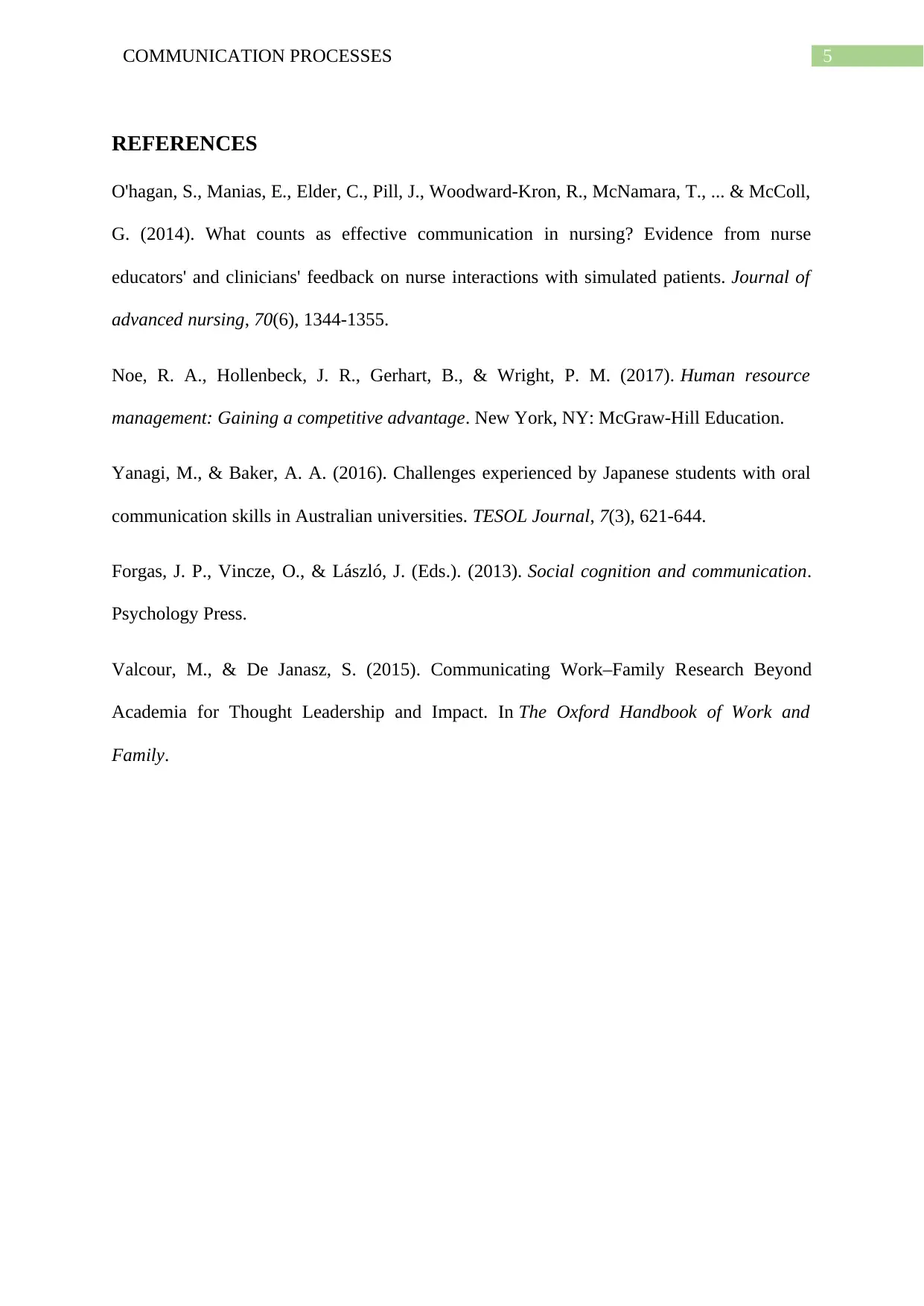
REFERENCES
O'hagan, S., Manias, E., Elder, C., Pill, J., Woodward‐Kron, R., McNamara, T., ... & McColl,
G. (2014). What counts as effective communication in nursing? Evidence from nurse
educators' and clinicians' feedback on nurse interactions with simulated patients. Journal of
advanced nursing, 70(6), 1344-1355.
Noe, R. A., Hollenbeck, J. R., Gerhart, B., & Wright, P. M. (2017). Human resource
management: Gaining a competitive advantage. New York, NY: McGraw-Hill Education.
Yanagi, M., & Baker, A. A. (2016). Challenges experienced by Japanese students with oral
communication skills in Australian universities. TESOL Journal, 7(3), 621-644.
Forgas, J. P., Vincze, O., & László, J. (Eds.). (2013). Social cognition and communication.
Psychology Press.
Valcour, M., & De Janasz, S. (2015). Communicating Work–Family Research Beyond
Academia for Thought Leadership and Impact. In The Oxford Handbook of Work and
Family.
chevron_up_icon
1 out of 6
circle_padding
hide_on_mobile
zoom_out_icon
[object Object]