Communication and its Implications in Effective Management
VerifiedAdded on 2020/03/28
|21
|4398
|224
Report
AI Summary
This report delves into the critical role of communication in effective management practices. It begins by highlighting the essential managerial skill of communication and its importance in fostering a comfortable and productive work environment. The report explores theoretical concepts, including critical theory, information theory, post-positive theory, and groupware theory, to provide a comprehensive understanding of communication dynamics within organizations. Furthermore, it examines the implications of effective communication in various aspects of management, such as intradepartmental communication, strategic direction, functional implementations, effective leadership, and risk management. The report emphasizes the benefits of clear, open communication for both managers and employees, and it provides practical steps for developing effective communication skills. The report concludes by underscoring the significance of communication in creating a positive and successful organizational culture, and it offers insights into how managers can leverage communication to enhance employee understanding, satisfaction, and overall performance.
Running head: COMMUNICATION
Managerial Skill
Name of the Student:
Name of the University:
Author’s Note:
Managerial Skill
Name of the Student:
Name of the University:
Author’s Note:

Paraphrase This Document
Need a fresh take? Get an instant paraphrase of this document with our AI Paraphraser
2COMMUNICATION
Table of Contents
Introduction.................................................................................................................................................4
Theoretical concepts...................................................................................................................................4
Implications of communication in effective management practices...........................................................7
Part 2.........................................................................................................................................................10
Conclusion.................................................................................................................................................16
References.................................................................................................................................................19
Table of Contents
Introduction.................................................................................................................................................4
Theoretical concepts...................................................................................................................................4
Implications of communication in effective management practices...........................................................7
Part 2.........................................................................................................................................................10
Conclusion.................................................................................................................................................16
References.................................................................................................................................................19
3COMMUNICATION
Executive summary
There are many qualities that an individual needs to have in order to become a successful
manager. One of essential qualities among them is that of effective communication. This is
indeed very essential on the part of the manager to see that all his employees are opening up with
one another and with him as well. This will make the employees feel wanted and valued within
the organization. The main aim of this paper is to see the possible positive outcomes that can be
initiated within a business organization through effective communication from the managerial
perspective.
Executive summary
There are many qualities that an individual needs to have in order to become a successful
manager. One of essential qualities among them is that of effective communication. This is
indeed very essential on the part of the manager to see that all his employees are opening up with
one another and with him as well. This will make the employees feel wanted and valued within
the organization. The main aim of this paper is to see the possible positive outcomes that can be
initiated within a business organization through effective communication from the managerial
perspective.
⊘ This is a preview!⊘
Do you want full access?
Subscribe today to unlock all pages.

Trusted by 1+ million students worldwide
4COMMUNICATION
Introduction
In the present day scenario, it is important for the managers to inculcate several important
managerial skills within him. It is only after he has started practicing the skill that he can
implement it within his employees as well. There are many important qualities that manager
must inculcate within himself-they are critical thinking, planning, coordinating, cooperating,
following up, determined and also communication. Communication happens to be the most
essential and basic managerial skill. Communication is the very key to management. If the
communication does not take place freely and from both the ends then the entire process of
communication remains incomplete. Effective communication is indeed a very useful tool. Being
a manager, it must be his utmost priority to effectively communicate with all his employees. This
will make the employees very free within the office environment (Shen & Austin 2017).
Theoretical concepts
The ability of the manager to successfully communicate with their superiors, colleagues
and other employees are important irrespective of the industry one works in (Austin et al., 2013).
However, communication skills are very important for any manager to ensure their success
(Dozier, Grunig & Grunig, 2013). Thus, the top 10 communication skills that can help the
managers to understand the present job market is as follows-
Listening- to be a good communicator it is important to be a good listener first. Managers
who are good listeners are always preferred more by others as they will listen to others as
well. Thus, active listening skill plays an important role for the managers where they pay
close attention to what the other person has to say.
Introduction
In the present day scenario, it is important for the managers to inculcate several important
managerial skills within him. It is only after he has started practicing the skill that he can
implement it within his employees as well. There are many important qualities that manager
must inculcate within himself-they are critical thinking, planning, coordinating, cooperating,
following up, determined and also communication. Communication happens to be the most
essential and basic managerial skill. Communication is the very key to management. If the
communication does not take place freely and from both the ends then the entire process of
communication remains incomplete. Effective communication is indeed a very useful tool. Being
a manager, it must be his utmost priority to effectively communicate with all his employees. This
will make the employees very free within the office environment (Shen & Austin 2017).
Theoretical concepts
The ability of the manager to successfully communicate with their superiors, colleagues
and other employees are important irrespective of the industry one works in (Austin et al., 2013).
However, communication skills are very important for any manager to ensure their success
(Dozier, Grunig & Grunig, 2013). Thus, the top 10 communication skills that can help the
managers to understand the present job market is as follows-
Listening- to be a good communicator it is important to be a good listener first. Managers
who are good listeners are always preferred more by others as they will listen to others as
well. Thus, active listening skill plays an important role for the managers where they pay
close attention to what the other person has to say.
Paraphrase This Document
Need a fresh take? Get an instant paraphrase of this document with our AI Paraphraser
5COMMUNICATION
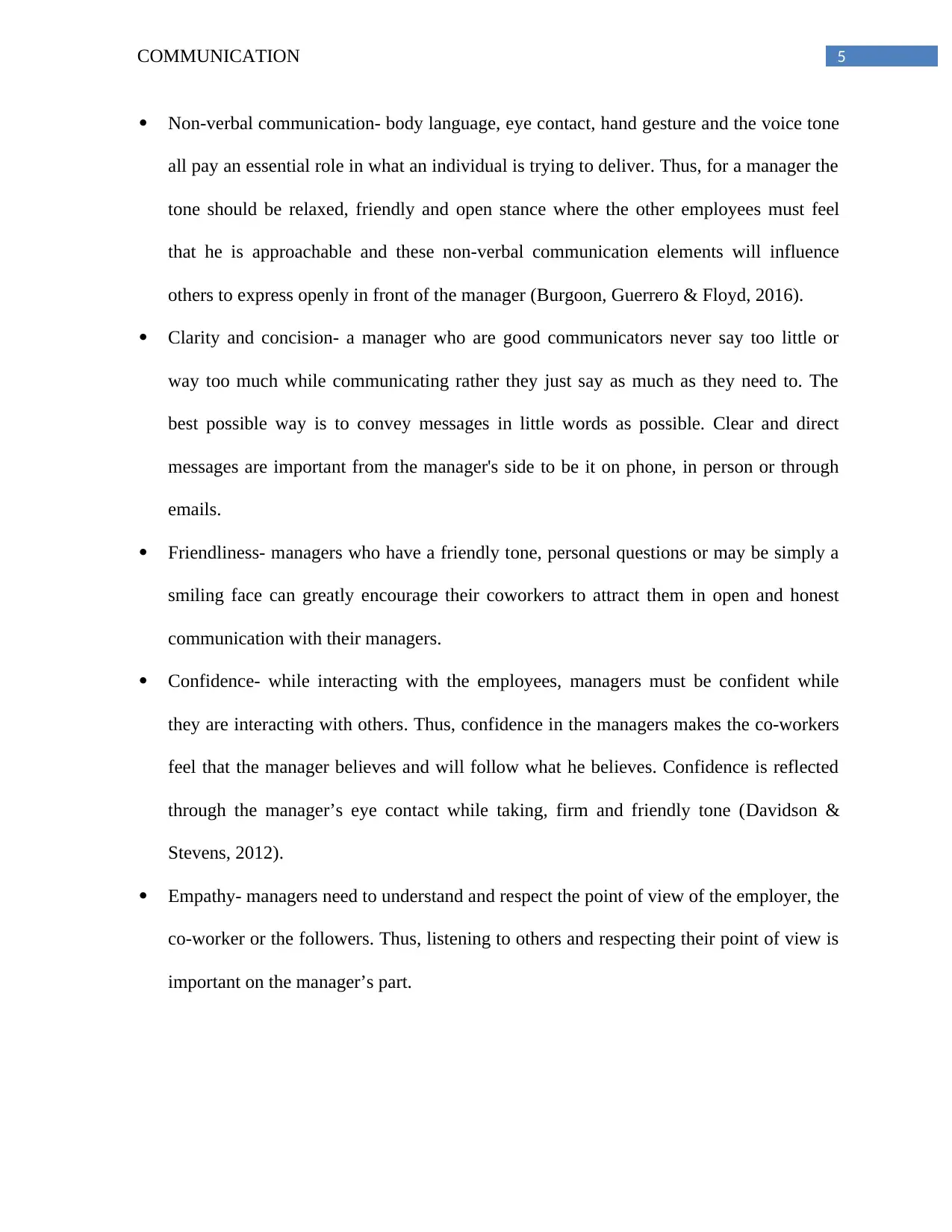
Non-verbal communication- body language, eye contact, hand gesture and the voice tone
all pay an essential role in what an individual is trying to deliver. Thus, for a manager the
tone should be relaxed, friendly and open stance where the other employees must feel
that he is approachable and these non-verbal communication elements will influence
others to express openly in front of the manager (Burgoon, Guerrero & Floyd, 2016).
Clarity and concision- a manager who are good communicators never say too little or
way too much while communicating rather they just say as much as they need to. The
best possible way is to convey messages in little words as possible. Clear and direct
messages are important from the manager's side to be it on phone, in person or through
emails.
Friendliness- managers who have a friendly tone, personal questions or may be simply a
smiling face can greatly encourage their coworkers to attract them in open and honest
communication with their managers.
Confidence- while interacting with the employees, managers must be confident while
they are interacting with others. Thus, confidence in the managers makes the co-workers
feel that the manager believes and will follow what he believes. Confidence is reflected
through the manager’s eye contact while taking, firm and friendly tone (Davidson &
Stevens, 2012).
Empathy- managers need to understand and respect the point of view of the employer, the
co-worker or the followers. Thus, listening to others and respecting their point of view is
important on the manager’s part.
Non-verbal communication- body language, eye contact, hand gesture and the voice tone
all pay an essential role in what an individual is trying to deliver. Thus, for a manager the
tone should be relaxed, friendly and open stance where the other employees must feel
that he is approachable and these non-verbal communication elements will influence
others to express openly in front of the manager (Burgoon, Guerrero & Floyd, 2016).
Clarity and concision- a manager who are good communicators never say too little or
way too much while communicating rather they just say as much as they need to. The
best possible way is to convey messages in little words as possible. Clear and direct
messages are important from the manager's side to be it on phone, in person or through
emails.
Friendliness- managers who have a friendly tone, personal questions or may be simply a
smiling face can greatly encourage their coworkers to attract them in open and honest
communication with their managers.
Confidence- while interacting with the employees, managers must be confident while
they are interacting with others. Thus, confidence in the managers makes the co-workers
feel that the manager believes and will follow what he believes. Confidence is reflected
through the manager’s eye contact while taking, firm and friendly tone (Davidson &
Stevens, 2012).
Empathy- managers need to understand and respect the point of view of the employer, the
co-worker or the followers. Thus, listening to others and respecting their point of view is
important on the manager’s part.
6COMMUNICATION
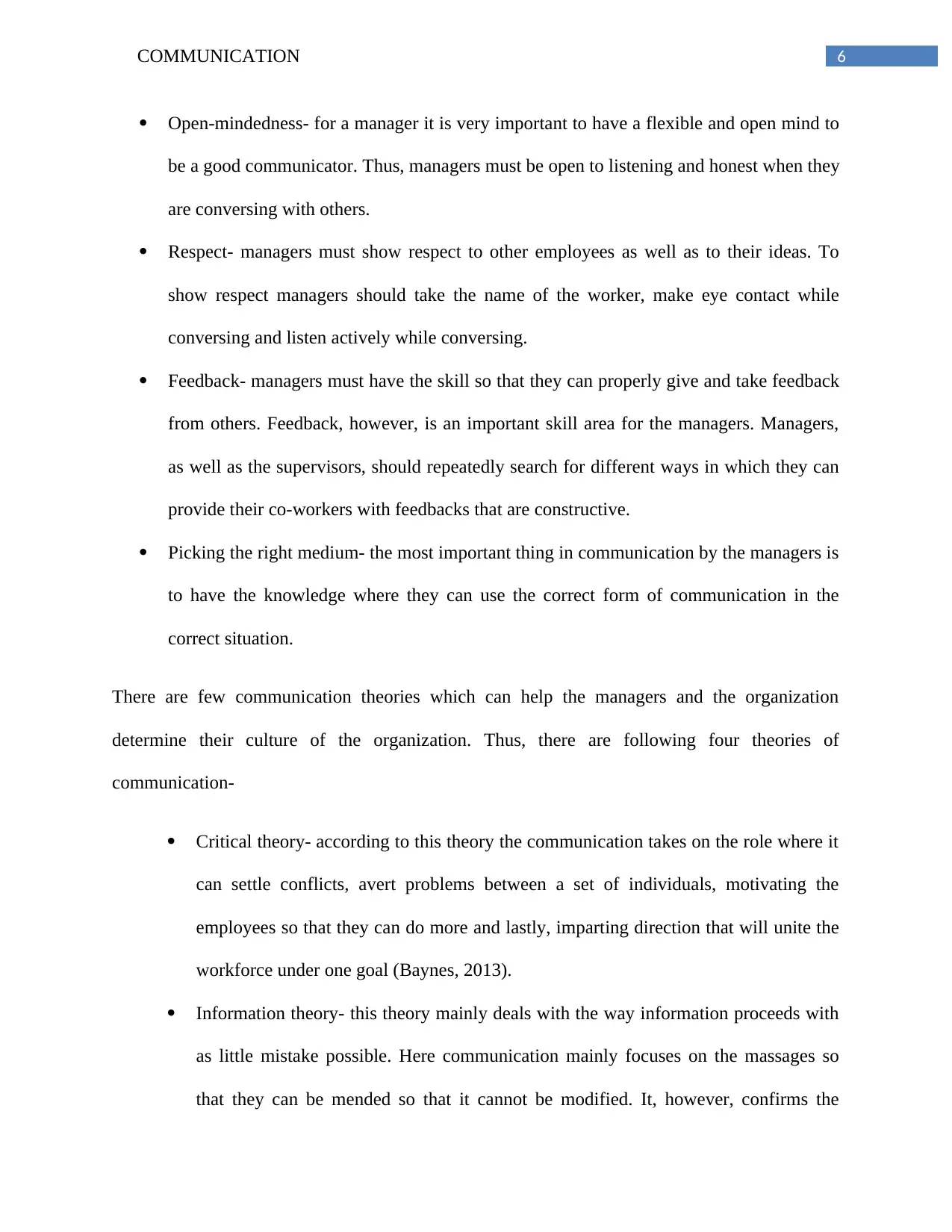
Open-mindedness- for a manager it is very important to have a flexible and open mind to
be a good communicator. Thus, managers must be open to listening and honest when they
are conversing with others.
Respect- managers must show respect to other employees as well as to their ideas. To
show respect managers should take the name of the worker, make eye contact while
conversing and listen actively while conversing.
Feedback- managers must have the skill so that they can properly give and take feedback
from others. Feedback, however, is an important skill area for the managers. Managers,
as well as the supervisors, should repeatedly search for different ways in which they can
provide their co-workers with feedbacks that are constructive.
Picking the right medium- the most important thing in communication by the managers is
to have the knowledge where they can use the correct form of communication in the
correct situation.
There are few communication theories which can help the managers and the organization
determine their culture of the organization. Thus, there are following four theories of
communication-
Critical theory- according to this theory the communication takes on the role where it
can settle conflicts, avert problems between a set of individuals, motivating the
employees so that they can do more and lastly, imparting direction that will unite the
workforce under one goal (Baynes, 2013).
Information theory- this theory mainly deals with the way information proceeds with
as little mistake possible. Here communication mainly focuses on the massages so
that they can be mended so that it cannot be modified. It, however, confirms the
Open-mindedness- for a manager it is very important to have a flexible and open mind to
be a good communicator. Thus, managers must be open to listening and honest when they
are conversing with others.
Respect- managers must show respect to other employees as well as to their ideas. To
show respect managers should take the name of the worker, make eye contact while
conversing and listen actively while conversing.
Feedback- managers must have the skill so that they can properly give and take feedback
from others. Feedback, however, is an important skill area for the managers. Managers,
as well as the supervisors, should repeatedly search for different ways in which they can
provide their co-workers with feedbacks that are constructive.
Picking the right medium- the most important thing in communication by the managers is
to have the knowledge where they can use the correct form of communication in the
correct situation.
There are few communication theories which can help the managers and the organization
determine their culture of the organization. Thus, there are following four theories of
communication-
Critical theory- according to this theory the communication takes on the role where it
can settle conflicts, avert problems between a set of individuals, motivating the
employees so that they can do more and lastly, imparting direction that will unite the
workforce under one goal (Baynes, 2013).
Information theory- this theory mainly deals with the way information proceeds with
as little mistake possible. Here communication mainly focuses on the massages so
that they can be mended so that it cannot be modified. It, however, confirms the
⊘ This is a preview!⊘
Do you want full access?
Subscribe today to unlock all pages.
Trusted by 1+ million students worldwide
7COMMUNICATION
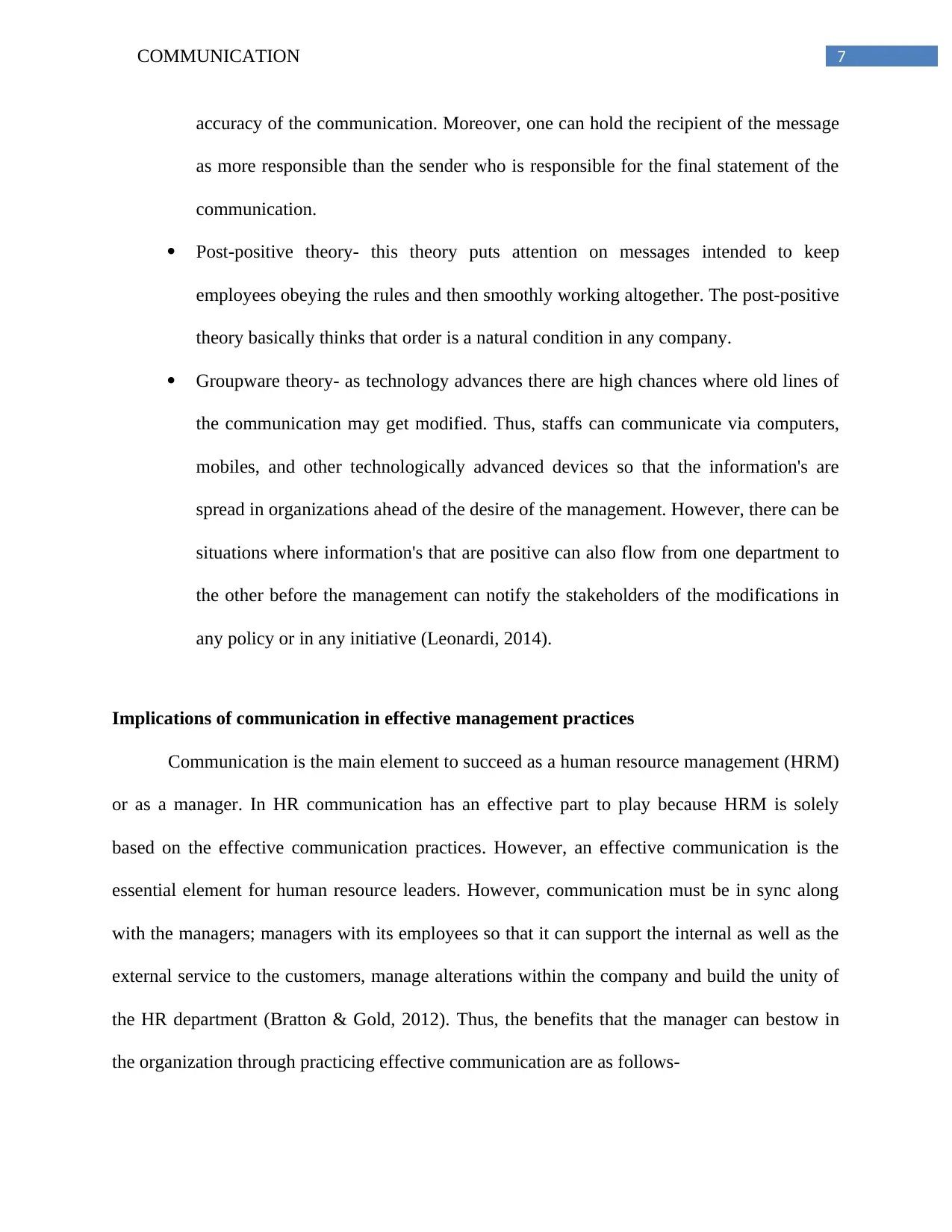
accuracy of the communication. Moreover, one can hold the recipient of the message
as more responsible than the sender who is responsible for the final statement of the
communication.
Post-positive theory- this theory puts attention on messages intended to keep
employees obeying the rules and then smoothly working altogether. The post-positive
theory basically thinks that order is a natural condition in any company.
Groupware theory- as technology advances there are high chances where old lines of
the communication may get modified. Thus, staffs can communicate via computers,
mobiles, and other technologically advanced devices so that the information's are
spread in organizations ahead of the desire of the management. However, there can be
situations where information's that are positive can also flow from one department to
the other before the management can notify the stakeholders of the modifications in
any policy or in any initiative (Leonardi, 2014).
Implications of communication in effective management practices
Communication is the main element to succeed as a human resource management (HRM)
or as a manager. In HR communication has an effective part to play because HRM is solely
based on the effective communication practices. However, an effective communication is the
essential element for human resource leaders. However, communication must be in sync along
with the managers; managers with its employees so that it can support the internal as well as the
external service to the customers, manage alterations within the company and build the unity of
the HR department (Bratton & Gold, 2012). Thus, the benefits that the manager can bestow in
the organization through practicing effective communication are as follows-
accuracy of the communication. Moreover, one can hold the recipient of the message
as more responsible than the sender who is responsible for the final statement of the
communication.
Post-positive theory- this theory puts attention on messages intended to keep
employees obeying the rules and then smoothly working altogether. The post-positive
theory basically thinks that order is a natural condition in any company.
Groupware theory- as technology advances there are high chances where old lines of
the communication may get modified. Thus, staffs can communicate via computers,
mobiles, and other technologically advanced devices so that the information's are
spread in organizations ahead of the desire of the management. However, there can be
situations where information's that are positive can also flow from one department to
the other before the management can notify the stakeholders of the modifications in
any policy or in any initiative (Leonardi, 2014).
Implications of communication in effective management practices
Communication is the main element to succeed as a human resource management (HRM)
or as a manager. In HR communication has an effective part to play because HRM is solely
based on the effective communication practices. However, an effective communication is the
essential element for human resource leaders. However, communication must be in sync along
with the managers; managers with its employees so that it can support the internal as well as the
external service to the customers, manage alterations within the company and build the unity of
the HR department (Bratton & Gold, 2012). Thus, the benefits that the manager can bestow in
the organization through practicing effective communication are as follows-
Paraphrase This Document
Need a fresh take? Get an instant paraphrase of this document with our AI Paraphraser
8COMMUNICATION
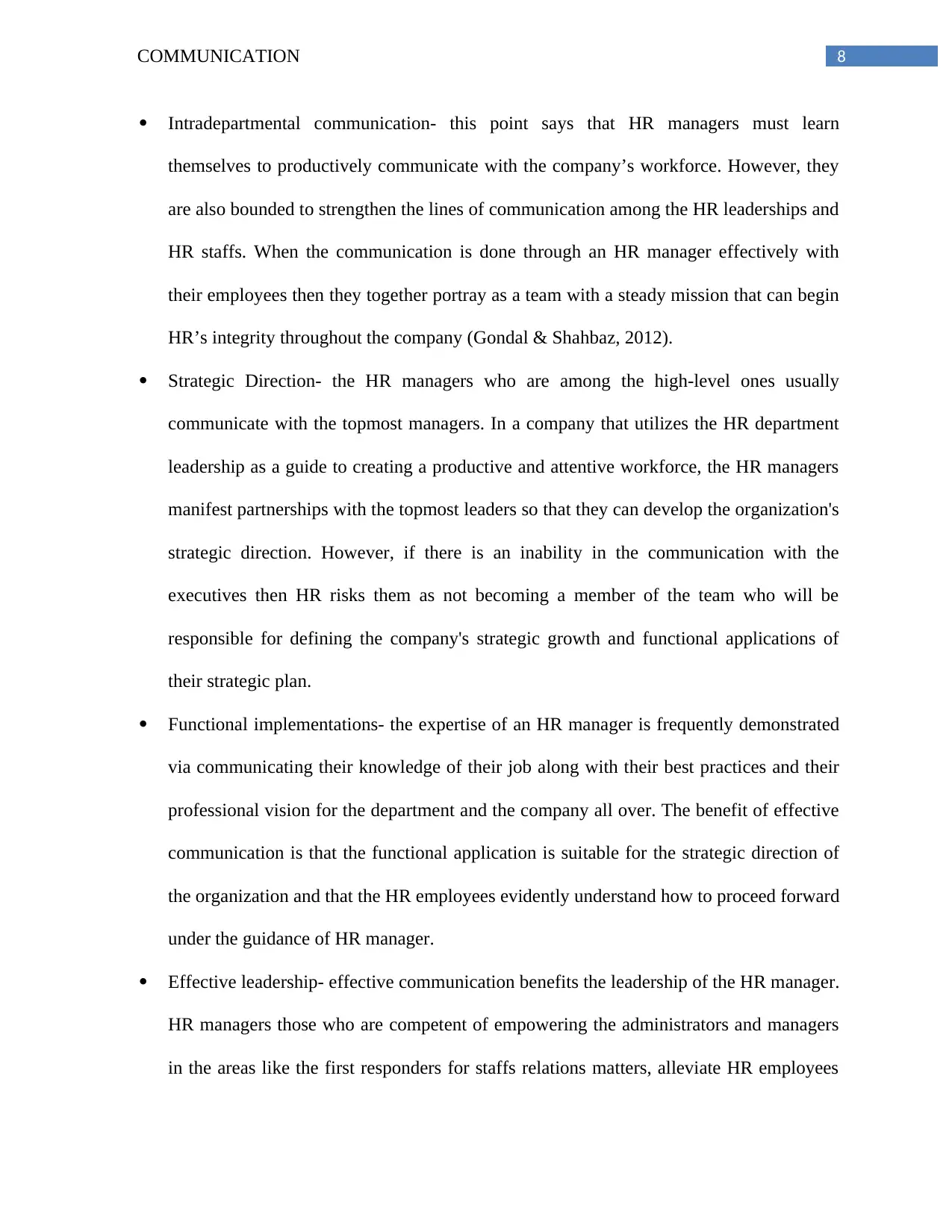
Intradepartmental communication- this point says that HR managers must learn
themselves to productively communicate with the company’s workforce. However, they
are also bounded to strengthen the lines of communication among the HR leaderships and
HR staffs. When the communication is done through an HR manager effectively with
their employees then they together portray as a team with a steady mission that can begin
HR’s integrity throughout the company (Gondal & Shahbaz, 2012).
Strategic Direction- the HR managers who are among the high-level ones usually
communicate with the topmost managers. In a company that utilizes the HR department
leadership as a guide to creating a productive and attentive workforce, the HR managers
manifest partnerships with the topmost leaders so that they can develop the organization's
strategic direction. However, if there is an inability in the communication with the
executives then HR risks them as not becoming a member of the team who will be
responsible for defining the company's strategic growth and functional applications of
their strategic plan.
Functional implementations- the expertise of an HR manager is frequently demonstrated
via communicating their knowledge of their job along with their best practices and their
professional vision for the department and the company all over. The benefit of effective
communication is that the functional application is suitable for the strategic direction of
the organization and that the HR employees evidently understand how to proceed forward
under the guidance of HR manager.
Effective leadership- effective communication benefits the leadership of the HR manager.
HR managers those who are competent of empowering the administrators and managers
in the areas like the first responders for staffs relations matters, alleviate HR employees
Intradepartmental communication- this point says that HR managers must learn
themselves to productively communicate with the company’s workforce. However, they
are also bounded to strengthen the lines of communication among the HR leaderships and
HR staffs. When the communication is done through an HR manager effectively with
their employees then they together portray as a team with a steady mission that can begin
HR’s integrity throughout the company (Gondal & Shahbaz, 2012).
Strategic Direction- the HR managers who are among the high-level ones usually
communicate with the topmost managers. In a company that utilizes the HR department
leadership as a guide to creating a productive and attentive workforce, the HR managers
manifest partnerships with the topmost leaders so that they can develop the organization's
strategic direction. However, if there is an inability in the communication with the
executives then HR risks them as not becoming a member of the team who will be
responsible for defining the company's strategic growth and functional applications of
their strategic plan.
Functional implementations- the expertise of an HR manager is frequently demonstrated
via communicating their knowledge of their job along with their best practices and their
professional vision for the department and the company all over. The benefit of effective
communication is that the functional application is suitable for the strategic direction of
the organization and that the HR employees evidently understand how to proceed forward
under the guidance of HR manager.
Effective leadership- effective communication benefits the leadership of the HR manager.
HR managers those who are competent of empowering the administrators and managers
in the areas like the first responders for staffs relations matters, alleviate HR employees
9COMMUNICATION
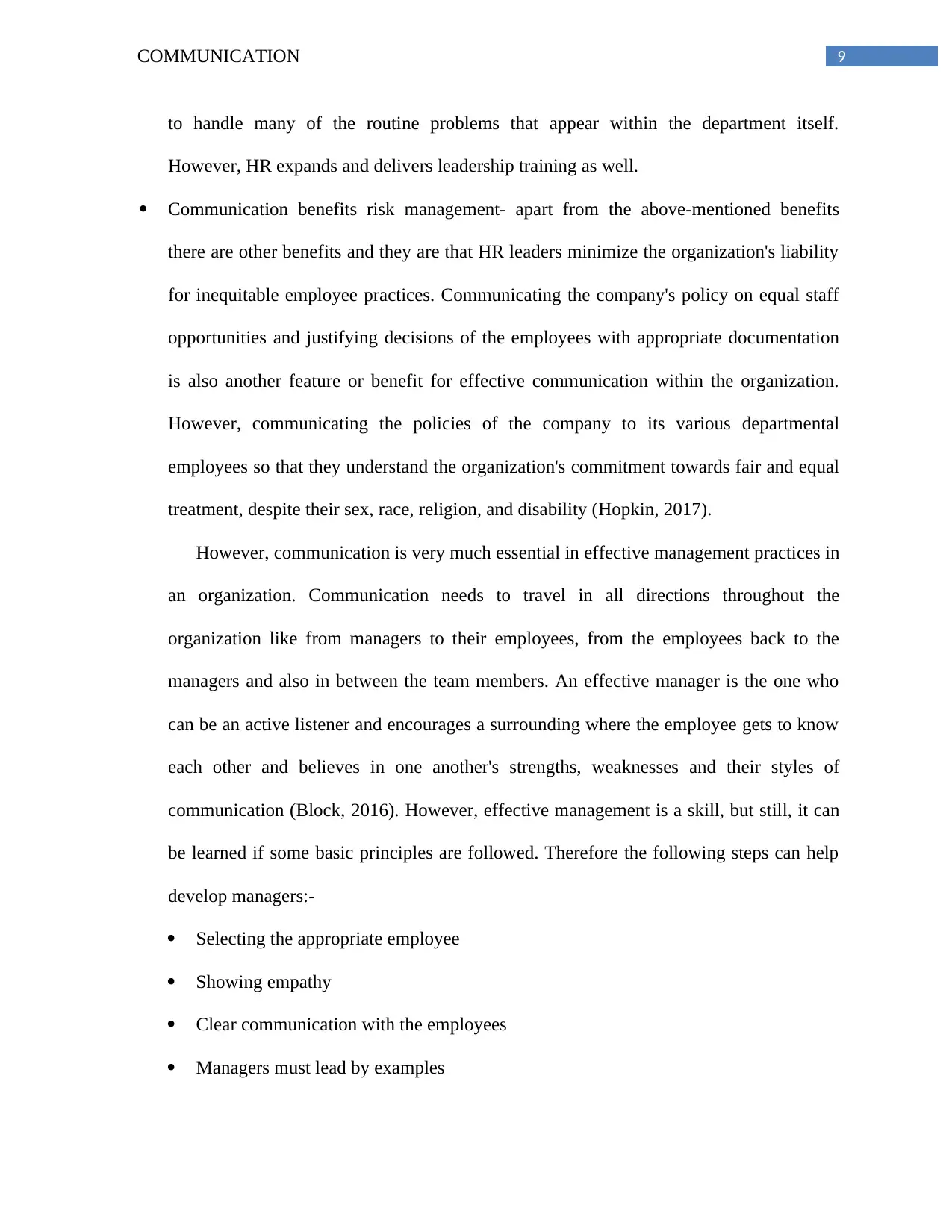
to handle many of the routine problems that appear within the department itself.
However, HR expands and delivers leadership training as well.
Communication benefits risk management- apart from the above-mentioned benefits
there are other benefits and they are that HR leaders minimize the organization's liability
for inequitable employee practices. Communicating the company's policy on equal staff
opportunities and justifying decisions of the employees with appropriate documentation
is also another feature or benefit for effective communication within the organization.
However, communicating the policies of the company to its various departmental
employees so that they understand the organization's commitment towards fair and equal
treatment, despite their sex, race, religion, and disability (Hopkin, 2017).
However, communication is very much essential in effective management practices in
an organization. Communication needs to travel in all directions throughout the
organization like from managers to their employees, from the employees back to the
managers and also in between the team members. An effective manager is the one who
can be an active listener and encourages a surrounding where the employee gets to know
each other and believes in one another's strengths, weaknesses and their styles of
communication (Block, 2016). However, effective management is a skill, but still, it can
be learned if some basic principles are followed. Therefore the following steps can help
develop managers:-
Selecting the appropriate employee
Showing empathy
Clear communication with the employees
Managers must lead by examples
to handle many of the routine problems that appear within the department itself.
However, HR expands and delivers leadership training as well.
Communication benefits risk management- apart from the above-mentioned benefits
there are other benefits and they are that HR leaders minimize the organization's liability
for inequitable employee practices. Communicating the company's policy on equal staff
opportunities and justifying decisions of the employees with appropriate documentation
is also another feature or benefit for effective communication within the organization.
However, communicating the policies of the company to its various departmental
employees so that they understand the organization's commitment towards fair and equal
treatment, despite their sex, race, religion, and disability (Hopkin, 2017).
However, communication is very much essential in effective management practices in
an organization. Communication needs to travel in all directions throughout the
organization like from managers to their employees, from the employees back to the
managers and also in between the team members. An effective manager is the one who
can be an active listener and encourages a surrounding where the employee gets to know
each other and believes in one another's strengths, weaknesses and their styles of
communication (Block, 2016). However, effective management is a skill, but still, it can
be learned if some basic principles are followed. Therefore the following steps can help
develop managers:-
Selecting the appropriate employee
Showing empathy
Clear communication with the employees
Managers must lead by examples
⊘ This is a preview!⊘
Do you want full access?
Subscribe today to unlock all pages.
Trusted by 1+ million students worldwide
10COMMUNICATION
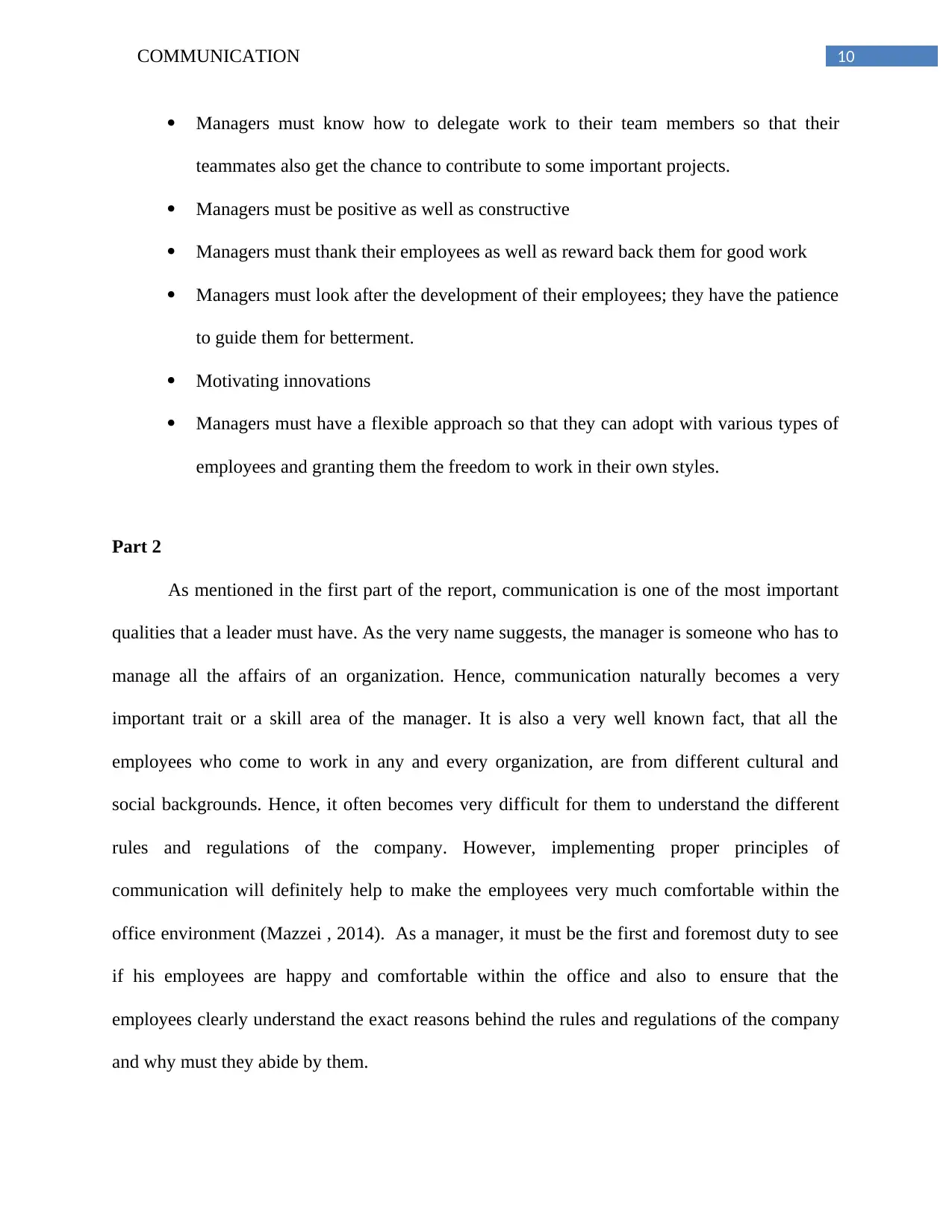
Managers must know how to delegate work to their team members so that their
teammates also get the chance to contribute to some important projects.
Managers must be positive as well as constructive
Managers must thank their employees as well as reward back them for good work
Managers must look after the development of their employees; they have the patience
to guide them for betterment.
Motivating innovations
Managers must have a flexible approach so that they can adopt with various types of
employees and granting them the freedom to work in their own styles.
Part 2
As mentioned in the first part of the report, communication is one of the most important
qualities that a leader must have. As the very name suggests, the manager is someone who has to
manage all the affairs of an organization. Hence, communication naturally becomes a very
important trait or a skill area of the manager. It is also a very well known fact, that all the
employees who come to work in any and every organization, are from different cultural and
social backgrounds. Hence, it often becomes very difficult for them to understand the different
rules and regulations of the company. However, implementing proper principles of
communication will definitely help to make the employees very much comfortable within the
office environment (Mazzei , 2014). As a manager, it must be the first and foremost duty to see
if his employees are happy and comfortable within the office and also to ensure that the
employees clearly understand the exact reasons behind the rules and regulations of the company
and why must they abide by them.
Managers must know how to delegate work to their team members so that their
teammates also get the chance to contribute to some important projects.
Managers must be positive as well as constructive
Managers must thank their employees as well as reward back them for good work
Managers must look after the development of their employees; they have the patience
to guide them for betterment.
Motivating innovations
Managers must have a flexible approach so that they can adopt with various types of
employees and granting them the freedom to work in their own styles.
Part 2
As mentioned in the first part of the report, communication is one of the most important
qualities that a leader must have. As the very name suggests, the manager is someone who has to
manage all the affairs of an organization. Hence, communication naturally becomes a very
important trait or a skill area of the manager. It is also a very well known fact, that all the
employees who come to work in any and every organization, are from different cultural and
social backgrounds. Hence, it often becomes very difficult for them to understand the different
rules and regulations of the company. However, implementing proper principles of
communication will definitely help to make the employees very much comfortable within the
office environment (Mazzei , 2014). As a manager, it must be the first and foremost duty to see
if his employees are happy and comfortable within the office and also to ensure that the
employees clearly understand the exact reasons behind the rules and regulations of the company
and why must they abide by them.
Paraphrase This Document
Need a fresh take? Get an instant paraphrase of this document with our AI Paraphraser
11COMMUNICATION
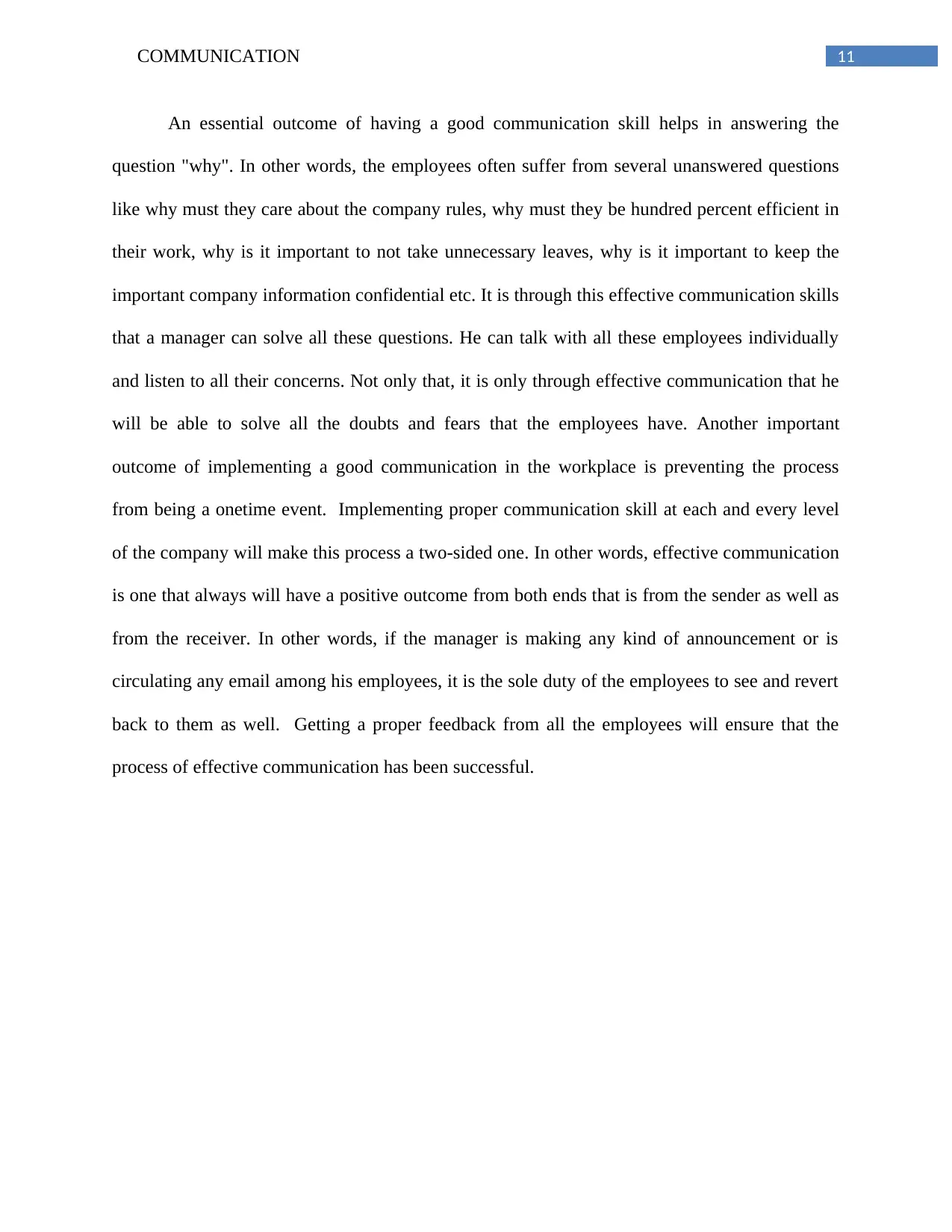
An essential outcome of having a good communication skill helps in answering the
question "why". In other words, the employees often suffer from several unanswered questions
like why must they care about the company rules, why must they be hundred percent efficient in
their work, why is it important to not take unnecessary leaves, why is it important to keep the
important company information confidential etc. It is through this effective communication skills
that a manager can solve all these questions. He can talk with all these employees individually
and listen to all their concerns. Not only that, it is only through effective communication that he
will be able to solve all the doubts and fears that the employees have. Another important
outcome of implementing a good communication in the workplace is preventing the process
from being a onetime event. Implementing proper communication skill at each and every level
of the company will make this process a two-sided one. In other words, effective communication
is one that always will have a positive outcome from both ends that is from the sender as well as
from the receiver. In other words, if the manager is making any kind of announcement or is
circulating any email among his employees, it is the sole duty of the employees to see and revert
back to them as well. Getting a proper feedback from all the employees will ensure that the
process of effective communication has been successful.
An essential outcome of having a good communication skill helps in answering the
question "why". In other words, the employees often suffer from several unanswered questions
like why must they care about the company rules, why must they be hundred percent efficient in
their work, why is it important to not take unnecessary leaves, why is it important to keep the
important company information confidential etc. It is through this effective communication skills
that a manager can solve all these questions. He can talk with all these employees individually
and listen to all their concerns. Not only that, it is only through effective communication that he
will be able to solve all the doubts and fears that the employees have. Another important
outcome of implementing a good communication in the workplace is preventing the process
from being a onetime event. Implementing proper communication skill at each and every level
of the company will make this process a two-sided one. In other words, effective communication
is one that always will have a positive outcome from both ends that is from the sender as well as
from the receiver. In other words, if the manager is making any kind of announcement or is
circulating any email among his employees, it is the sole duty of the employees to see and revert
back to them as well. Getting a proper feedback from all the employees will ensure that the
process of effective communication has been successful.
12COMMUNICATION
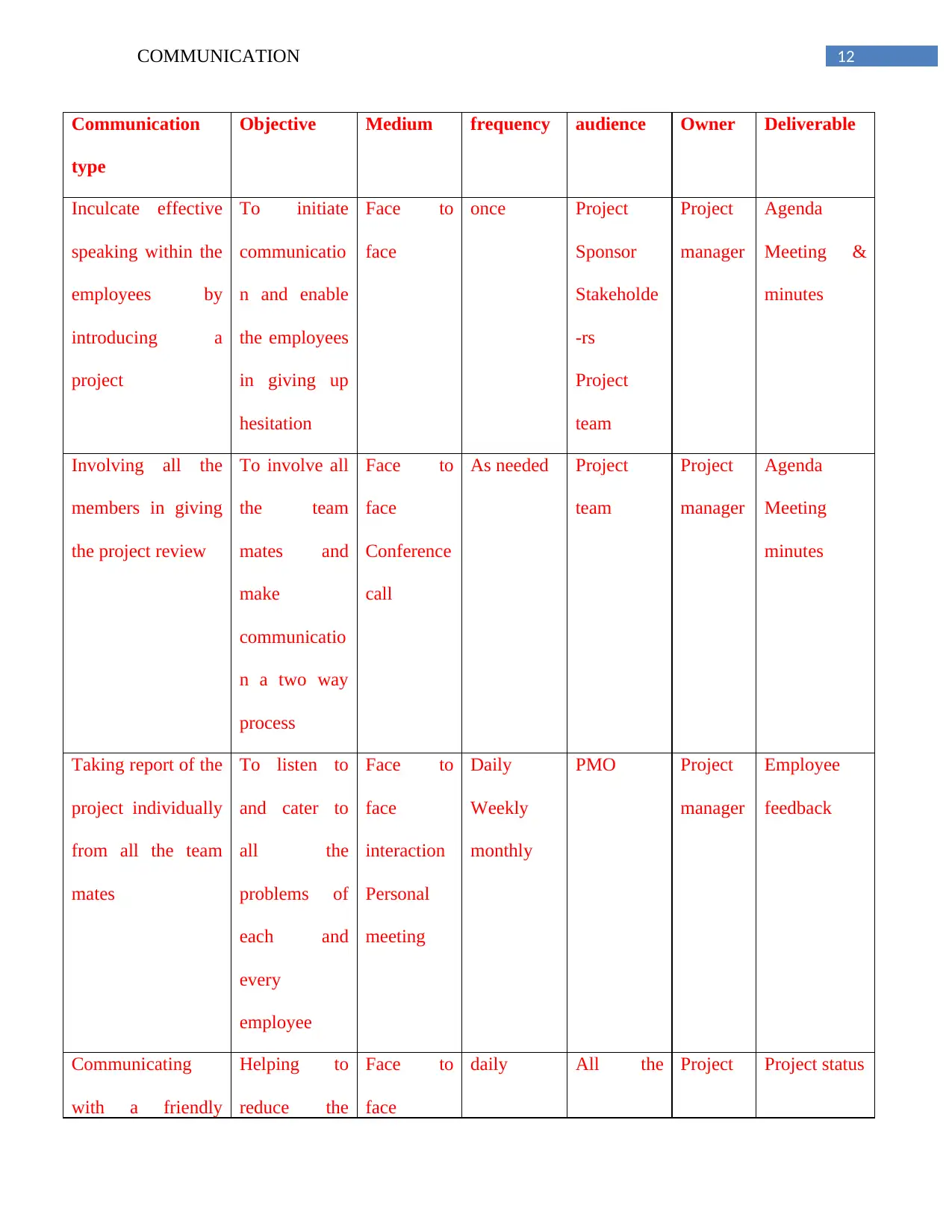
Communication
type
Objective Medium frequency audience Owner Deliverable
Inculcate effective
speaking within the
employees by
introducing a
project
To initiate
communicatio
n and enable
the employees
in giving up
hesitation
Face to
face
once Project
Sponsor
Stakeholde
-rs
Project
team
Project
manager
Agenda
Meeting &
minutes
Involving all the
members in giving
the project review
To involve all
the team
mates and
make
communicatio
n a two way
process
Face to
face
Conference
call
As needed Project
team
Project
manager
Agenda
Meeting
minutes
Taking report of the
project individually
from all the team
mates
To listen to
and cater to
all the
problems of
each and
every
employee
Face to
face
interaction
Personal
meeting
Daily
Weekly
monthly
PMO Project
manager
Employee
feedback
Communicating
with a friendly
Helping to
reduce the
Face to
face
daily All the Project Project status
Communication
type
Objective Medium frequency audience Owner Deliverable
Inculcate effective
speaking within the
employees by
introducing a
project
To initiate
communicatio
n and enable
the employees
in giving up
hesitation
Face to
face
once Project
Sponsor
Stakeholde
-rs
Project
team
Project
manager
Agenda
Meeting &
minutes
Involving all the
members in giving
the project review
To involve all
the team
mates and
make
communicatio
n a two way
process
Face to
face
Conference
call
As needed Project
team
Project
manager
Agenda
Meeting
minutes
Taking report of the
project individually
from all the team
mates
To listen to
and cater to
all the
problems of
each and
every
employee
Face to
face
interaction
Personal
meeting
Daily
Weekly
monthly
PMO Project
manager
Employee
feedback
Communicating
with a friendly
Helping to
reduce the
Face to
face
daily All the Project Project status
⊘ This is a preview!⊘
Do you want full access?
Subscribe today to unlock all pages.
Trusted by 1+ million students worldwide

1 out of 21


Related Documents


Your All-in-One AI-Powered Toolkit for Academic Success.
+13062052269
info@desklib.com
Available 24*7 on WhatsApp / Email
![[object Object]](/_next/static/media/star-bottom.7253800d.svg)
Unlock your academic potential
Copyright © 2020–2025 A2Z Services. All Rights Reserved. Developed and managed by ZUCOL.