Communication Skills in Health/Social Care Research Analysis
VerifiedAdded on 2021/01/03
|7
|1519
|352
Report
AI Summary
This report delves into the critical role of communication skills within the context of healthcare research, specifically examining their influence on outcomes for service users in health and social care settings. The report begins by outlining the purpose and process of conducting research in this field, emphasizing the importance of identifying problems, formulating objectives, selecting appropriate methodologies, and analyzing data. It then highlights the essential skills and qualities required of a researcher, including effective communication, team spirit, problem-solving abilities, adaptability, and strong analytical skills. The Gibbs Reflection Model is employed to analyze the author's own skills and knowledge in conducting research, providing a structured framework for self-assessment and identifying areas for improvement, such as enhancing communication skills and technical knowledge. The report concludes by synthesizing the key findings, emphasizing the need for researchers to possess a diverse skill set to ensure the production of high-quality research reports that can inform and improve healthcare practices. The provided references support the information presented in the report.
Communication skills in practice: the influence of
communication skills and techniques on outcomes for service
users in a health or social care service
communication skills and techniques on outcomes for service
users in a health or social care service
Paraphrase This Document
Need a fresh take? Get an instant paraphrase of this document with our AI Paraphraser

Table of Contents
INTRODUCTION...........................................................................................................................1
LO 1.................................................................................................................................................1
a. The purpose and process of conducting research in health and social care............................1
b. Skills and qualities required for conducting research in health care.......................................2
c. Using Gibbs reflection model to analyse own qualities and skills in conducting the research
and an action plan to improve the shortcomings.........................................................................2
CONCLUSION................................................................................................................................4
REFERENCES................................................................................................................................5
INTRODUCTION...........................................................................................................................1
LO 1.................................................................................................................................................1
a. The purpose and process of conducting research in health and social care............................1
b. Skills and qualities required for conducting research in health care.......................................2
c. Using Gibbs reflection model to analyse own qualities and skills in conducting the research
and an action plan to improve the shortcomings.........................................................................2
CONCLUSION................................................................................................................................4
REFERENCES................................................................................................................................5

INTRODUCTION
Communication is a life line in any organisation whether it belongs to health care sector
or social sector. The present report will cover the purpose and process of conducting the research
in health or social care. The report will lay emphasis on skills and qualities required for
conducting research. Gibbs Reflection model will be used for analysing own skills and
knowledge to conduct research with a plan to improve any deficiency which will be
discovered(Schön, 2017).
LO 1
a. The purpose and process of conducting research in health and social care
The purpose of conducting research on health care is to provide vital information
regarding treatment satisfaction by the patients, abilities of the health care to tackle complex
diseases, increasing number of deaths due to carelessness.
The process of conducting research in healthcare starts with setting the objectives of the
study. The problem is identified firstly for which the research is required. Increasing number of
deaths in the hospital, less satisfaction by the patients. When the problems are known the
solutions are then found out by considering the different aspects such number of deaths in the
hospital is causing due to lack of efficient doctors and staff. After this, the method of inquiry is
decided and the most accurate and scientific way of inquiry is selected. The scientific method
provides the use of already published information to act as lead for initiating the
research(Posavac, 2015).
Method of collection of data is decided that where to gather information regarding the
causes such as directly asking the patients regarding their experience in the hospital, how the
management treated them by giving them the questionnaires. Visiting the hospital itself and
making queries from the management and staff about the increasing deaths and less patient
satisfaction. Seeing the functioning of the hospital and noting everything from this primary
investigation and other supporting information from the secondary sources will become the base
of the research(Green and Thorogood, 2018).
When all the information is gathered, analysis is done of the information and
interpretation is concluded that giving routine prescriptions to the more complex has turned out
the cause of increase in the number of deaths and not caring the patients enough is the cause of
1
Communication is a life line in any organisation whether it belongs to health care sector
or social sector. The present report will cover the purpose and process of conducting the research
in health or social care. The report will lay emphasis on skills and qualities required for
conducting research. Gibbs Reflection model will be used for analysing own skills and
knowledge to conduct research with a plan to improve any deficiency which will be
discovered(Schön, 2017).
LO 1
a. The purpose and process of conducting research in health and social care
The purpose of conducting research on health care is to provide vital information
regarding treatment satisfaction by the patients, abilities of the health care to tackle complex
diseases, increasing number of deaths due to carelessness.
The process of conducting research in healthcare starts with setting the objectives of the
study. The problem is identified firstly for which the research is required. Increasing number of
deaths in the hospital, less satisfaction by the patients. When the problems are known the
solutions are then found out by considering the different aspects such number of deaths in the
hospital is causing due to lack of efficient doctors and staff. After this, the method of inquiry is
decided and the most accurate and scientific way of inquiry is selected. The scientific method
provides the use of already published information to act as lead for initiating the
research(Posavac, 2015).
Method of collection of data is decided that where to gather information regarding the
causes such as directly asking the patients regarding their experience in the hospital, how the
management treated them by giving them the questionnaires. Visiting the hospital itself and
making queries from the management and staff about the increasing deaths and less patient
satisfaction. Seeing the functioning of the hospital and noting everything from this primary
investigation and other supporting information from the secondary sources will become the base
of the research(Green and Thorogood, 2018).
When all the information is gathered, analysis is done of the information and
interpretation is concluded that giving routine prescriptions to the more complex has turned out
the cause of increase in the number of deaths and not caring the patients enough is the cause of
1
⊘ This is a preview!⊘
Do you want full access?
Subscribe today to unlock all pages.

Trusted by 1+ million students worldwide

less patient satisfaction. Lastly the final research report is prepared which specifies the problems
and causes of the these problems in the heath care(Batterham and et.al., 2016).
b. Skills and qualities required for conducting research in health care
The researcher should posses following qualities and skills to conduct research
efficiently. The researcher should have excellent communication skills both verbal and non
verbal. He should be good with preparing the questionnaires that asks to the point questions. A
researcher should have good team spirit so that researcher can participate in the tasks of the
team. Researcher is required to have problem solving techniques and knowledge to solve the
various problems that may arise during conducting the survey(Moss, 2017).
Ability to adapt to changes is one the quality that must be present in the researcher for
making a quality research report. A researcher needs to analyse the data so collected through
patients, staff and the management of the hospital during the market research requires a strong
analytical skills and techniques which helps researcher to draw meaningful information from the
raw data. Collection of data is gathered through various sources for which the sample size is
identified in which the may statistical tools and models are used for the accurate results. So the
researcher should fluent in developing various statistical model during the sample survey and
data collection(Mosadeghrad, 2014).
Interpersonal skills' are required in the investigator so that more genuine answers could
be get by the people involved in the research. This skill helps the researcher to get a bit familiar
by gaining a level of trust from the patients to tell the truth about their experience from the
hospital services. The same can be done by the researcher to get the true information from the
staff of the hospital by taking in confidence. Good amount of general knowledge regarding the
laws relating to the health care sector and sufficient knowledge of computer is must in a
investigator to make a well authentic research report(Castro and et.al., 2016).
c. Using Gibbs reflection model to analyse own qualities and skills in conducting the research
and an action plan to improve the shortcomings
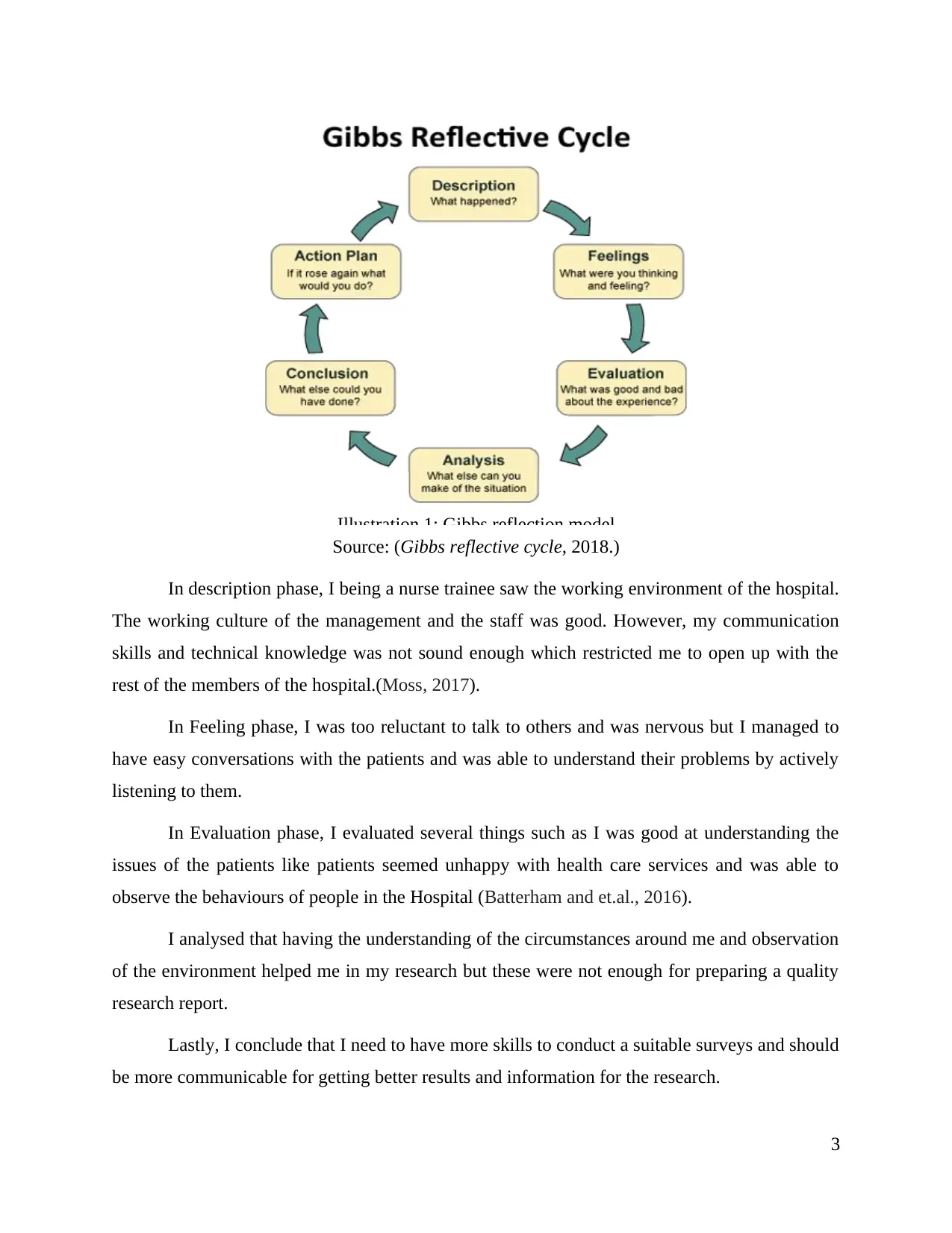
Gibbs reflection model have seven phases in its, by using this model analysis will be
done of my own research skills(Greenhalgh and et.al., 2016.).
2
and causes of the these problems in the heath care(Batterham and et.al., 2016).
b. Skills and qualities required for conducting research in health care
The researcher should posses following qualities and skills to conduct research
efficiently. The researcher should have excellent communication skills both verbal and non
verbal. He should be good with preparing the questionnaires that asks to the point questions. A
researcher should have good team spirit so that researcher can participate in the tasks of the
team. Researcher is required to have problem solving techniques and knowledge to solve the
various problems that may arise during conducting the survey(Moss, 2017).
Ability to adapt to changes is one the quality that must be present in the researcher for
making a quality research report. A researcher needs to analyse the data so collected through
patients, staff and the management of the hospital during the market research requires a strong
analytical skills and techniques which helps researcher to draw meaningful information from the
raw data. Collection of data is gathered through various sources for which the sample size is
identified in which the may statistical tools and models are used for the accurate results. So the
researcher should fluent in developing various statistical model during the sample survey and
data collection(Mosadeghrad, 2014).
Interpersonal skills' are required in the investigator so that more genuine answers could
be get by the people involved in the research. This skill helps the researcher to get a bit familiar
by gaining a level of trust from the patients to tell the truth about their experience from the
hospital services. The same can be done by the researcher to get the true information from the
staff of the hospital by taking in confidence. Good amount of general knowledge regarding the
laws relating to the health care sector and sufficient knowledge of computer is must in a
investigator to make a well authentic research report(Castro and et.al., 2016).
c. Using Gibbs reflection model to analyse own qualities and skills in conducting the research
and an action plan to improve the shortcomings
Gibbs reflection model have seven phases in its, by using this model analysis will be
done of my own research skills(Greenhalgh and et.al., 2016.).
2
Paraphrase This Document
Need a fresh take? Get an instant paraphrase of this document with our AI Paraphraser

Source: (Gibbs reflective cycle, 2018.)
In description phase, I being a nurse trainee saw the working environment of the hospital.
The working culture of the management and the staff was good. However, my communication
skills and technical knowledge was not sound enough which restricted me to open up with the
rest of the members of the hospital.(Moss, 2017).
In Feeling phase, I was too reluctant to talk to others and was nervous but I managed to
have easy conversations with the patients and was able to understand their problems by actively
listening to them.
In Evaluation phase, I evaluated several things such as I was good at understanding the
issues of the patients like patients seemed unhappy with health care services and was able to
observe the behaviours of people in the Hospital (Batterham and et.al., 2016).
I analysed that having the understanding of the circumstances around me and observation
of the environment helped me in my research but these were not enough for preparing a quality
research report.
Lastly, I conclude that I need to have more skills to conduct a suitable surveys and should
be more communicable for getting better results and information for the research.
3
Illustration 1: Gibbs reflection model
In description phase, I being a nurse trainee saw the working environment of the hospital.
The working culture of the management and the staff was good. However, my communication
skills and technical knowledge was not sound enough which restricted me to open up with the
rest of the members of the hospital.(Moss, 2017).
In Feeling phase, I was too reluctant to talk to others and was nervous but I managed to
have easy conversations with the patients and was able to understand their problems by actively
listening to them.
In Evaluation phase, I evaluated several things such as I was good at understanding the
issues of the patients like patients seemed unhappy with health care services and was able to
observe the behaviours of people in the Hospital (Batterham and et.al., 2016).
I analysed that having the understanding of the circumstances around me and observation
of the environment helped me in my research but these were not enough for preparing a quality
research report.
Lastly, I conclude that I need to have more skills to conduct a suitable surveys and should
be more communicable for getting better results and information for the research.
3
Illustration 1: Gibbs reflection model

I developed an action plan for these shortcomings I faced such as lack of my technical
knowledge, I was not so good with my communication and interpersonal skills which I can
overcome by taking guidance from my seniors in the hospitals, taking up personality
development classes to improve my communication skills and high confidence.
(Schön, 2017).
CONCLUSION
From the above essay, it has been concluded that conducting research in the healthcare
sector involve various stages in its process from identifying the problems to analysing it using
different methods and techniques. The report showed that a researcher should have good
communication, analytical, interpersonal skills to conduct a research and make a quality research
report. The study also covered the analysis of my skills by using the Gibbs reflection model.
4
knowledge, I was not so good with my communication and interpersonal skills which I can
overcome by taking guidance from my seniors in the hospitals, taking up personality
development classes to improve my communication skills and high confidence.
(Schön, 2017).
CONCLUSION
From the above essay, it has been concluded that conducting research in the healthcare
sector involve various stages in its process from identifying the problems to analysing it using
different methods and techniques. The report showed that a researcher should have good
communication, analytical, interpersonal skills to conduct a research and make a quality research
report. The study also covered the analysis of my skills by using the Gibbs reflection model.
4
⊘ This is a preview!⊘
Do you want full access?
Subscribe today to unlock all pages.

Trusted by 1+ million students worldwide

REFERENCES
Books and Journal
Schön, D. A., 2017. The reflective practitioner: How professionals think in action. Routledge.
Posavac, E. J., 2015. Program evaluation: Methods and case studies. Routledge.
Green, J. and Thorogood, N., 2018. Qualitative methods for health research. Sage.
Batterham, R. W. and et.al., 2016. Health literacy: applying current concepts to improve health
services and reduce health inequalities. Public health. 132. pp.3-12.
Moss, B., 2017. Communication skills in health and social care. Sage.
Mosadeghrad, A. M., 2014. Factors influencing healthcare service quality. International journal
of health policy and management.3(2). p.77.
Castro, E.M. and et.al., 2016. Patient empowerment, patient participation and patient-
centeredness in hospital care: a concept analysis based on a literature review. Patient
education and counseling. 99(12). pp.1923-1939.
Greenhalgh, T and et.al., 2016. Achieving research impact through co‐creation in community‐
based health services: literature review and case study. The Milbank
Quarterly.94(2).pp.392-429.
Online
Gibbs reflective cycle.2018. [Online] Available through
<https://www.crowe-associates.co.uk/coaching-and-mentoring-skills/gibbs-reflective-
cycle/>
5
Books and Journal
Schön, D. A., 2017. The reflective practitioner: How professionals think in action. Routledge.
Posavac, E. J., 2015. Program evaluation: Methods and case studies. Routledge.
Green, J. and Thorogood, N., 2018. Qualitative methods for health research. Sage.
Batterham, R. W. and et.al., 2016. Health literacy: applying current concepts to improve health
services and reduce health inequalities. Public health. 132. pp.3-12.
Moss, B., 2017. Communication skills in health and social care. Sage.
Mosadeghrad, A. M., 2014. Factors influencing healthcare service quality. International journal
of health policy and management.3(2). p.77.
Castro, E.M. and et.al., 2016. Patient empowerment, patient participation and patient-
centeredness in hospital care: a concept analysis based on a literature review. Patient
education and counseling. 99(12). pp.1923-1939.
Greenhalgh, T and et.al., 2016. Achieving research impact through co‐creation in community‐
based health services: literature review and case study. The Milbank
Quarterly.94(2).pp.392-429.
Online
Gibbs reflective cycle.2018. [Online] Available through
<https://www.crowe-associates.co.uk/coaching-and-mentoring-skills/gibbs-reflective-
cycle/>
5
1 out of 7
Related Documents
Your All-in-One AI-Powered Toolkit for Academic Success.
+13062052269
info@desklib.com
Available 24*7 on WhatsApp / Email
Unlock your academic potential
Copyright © 2020–2026 A2Z Services. All Rights Reserved. Developed and managed by ZUCOL.