Communication Theories: Media Richness, Argumentation, and Beyond
VerifiedAdded on 2021/10/11
|28
|7681
|92
Report
AI Summary
This report delves into various communication theories, providing a comprehensive overview of key concepts and models. It begins by introducing the Media Richness Theory, discussing its strengths, weaknesses, and practical applications in the context of modern communication, particularly in the age of digital media. The report then explores Argumentation Theory, examining different approaches such as Pragma-Dialectics, The New Rhetoric, and Toulmin's Argument Model, and how these theories aid in understanding and constructing effective arguments. Furthermore, it touches upon Conversation Theory and other relevant frameworks. The analysis incorporates real-world examples and critical evaluations of each theory, offering valuable insights into the complexities of human communication and its impact on various aspects of society. The report also reflects on the challenges and adaptations required in the face of evolving communication technologies and practices, particularly in educational settings.
1
Communication
Theories
Punzalan, R.
Realubit, F.
Recto, R.
Refugio, C.
Salvador, J.
Samson. J.
Ms. Maychell B. Jastia, CHASS.
November 10, 2020
Communication
Theories
Punzalan, R.
Realubit, F.
Recto, R.
Refugio, C.
Salvador, J.
Samson. J.
Ms. Maychell B. Jastia, CHASS.
November 10, 2020

Paraphrase This Document
Need a fresh take? Get an instant paraphrase of this document with our AI Paraphraser
2
Introduction
As we are currently living in the 21 st century, almost everything got
modernized. From infrastructures to technological devices and even to our
way of living has been changed and continuously changing. We adapt easily
to the developments that happened for the reason that we need it to
survive. One factor of humanity that affects us the most is communication.
Since then, humans use this process to be able to pass messages to one
another that became new learning for all of us. Trillions of knowledges have
been passed down from our fallen history to our current society which helps
us build a new.
Most of the time, we, people do not know how we achieve such
“almost” perfect way of communicating. Lots of researches were done and
maybe currently on going for us to have a better understanding on how
communication works. It may seem an easy topic for us but once you try to
evaluate it from its core, you will realize that there’s a lot of thing you didn’t
know.
In this book, we would like to present you some theories that helped
our society to shape our communication process.
Introduction
As we are currently living in the 21 st century, almost everything got
modernized. From infrastructures to technological devices and even to our
way of living has been changed and continuously changing. We adapt easily
to the developments that happened for the reason that we need it to
survive. One factor of humanity that affects us the most is communication.
Since then, humans use this process to be able to pass messages to one
another that became new learning for all of us. Trillions of knowledges have
been passed down from our fallen history to our current society which helps
us build a new.
Most of the time, we, people do not know how we achieve such
“almost” perfect way of communicating. Lots of researches were done and
maybe currently on going for us to have a better understanding on how
communication works. It may seem an easy topic for us but once you try to
evaluate it from its core, you will realize that there’s a lot of thing you didn’t
know.
In this book, we would like to present you some theories that helped
our society to shape our communication process.
3
Communication
Theories
Punzalan, R.
Realubit, F.
Recto, R.
Refugio, C.
Salvador, J.
Samson. J.
Ms. Maychell B. Jastia, CHASS.
November 10, 2020
Communication
Theories
Punzalan, R.
Realubit, F.
Recto, R.
Refugio, C.
Salvador, J.
Samson. J.
Ms. Maychell B. Jastia, CHASS.
November 10, 2020
⊘ This is a preview!⊘
Do you want full access?
Subscribe today to unlock all pages.

Trusted by 1+ million students worldwide
4
Table of Content
Media Richness Theory 5-7
Argumentation Theory 8-11
Conversation Theory 12-13
Contagion Theory 14-16
Mood Management Theory 17-20
Theory of Digital Divide 21-23
Acknowledgement 24-25
References 26-28
Table of Content
Media Richness Theory 5-7
Argumentation Theory 8-11
Conversation Theory 12-13
Contagion Theory 14-16
Mood Management Theory 17-20
Theory of Digital Divide 21-23
Acknowledgement 24-25
References 26-28
Paraphrase This Document
Need a fresh take? Get an instant paraphrase of this document with our AI Paraphraser
5
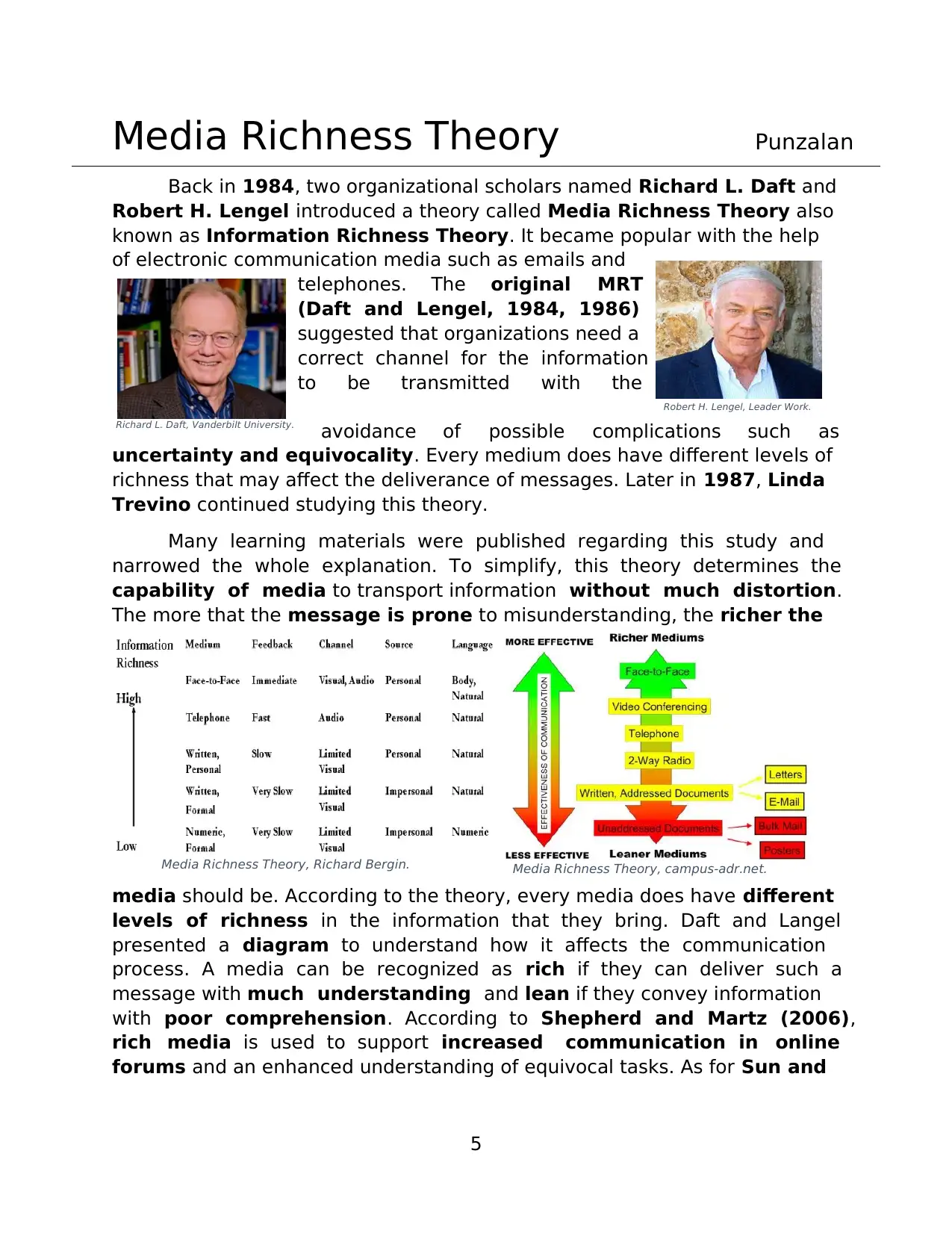
Richard L. Daft, Vanderbilt University.
Media Richness Theory, Richard Bergin.
Robert H. Lengel, Leader Work.
Media Richness Theory, campus-adr.net.
Media Richness Theory Punzalan
Back in 1984, two organizational scholars named Richard L. Daft and
Robert H. Lengel introduced a theory called Media Richness Theory also
known as Information Richness Theory. It became popular with the help
of electronic communication media such as emails and
telephones. The original MRT
(Daft and Lengel, 1984, 1986)
suggested that organizations need a
correct channel for the information
to be transmitted with the
avoidance of possible complications such as
uncertainty and equivocality. Every medium does have different levels of
richness that may affect the deliverance of messages. Later in 1987, Linda
Trevino continued studying this theory.
Many learning materials were published regarding this study and
narrowed the whole explanation. To simplify, this theory determines the
capability of media to transport information without much distortion.
The more that the message is prone to misunderstanding, the richer the
media should be. According to the theory, every media does have different
levels of richness in the information that they bring. Daft and Langel
presented a diagram to understand how it affects the communication
process. A media can be recognized as rich if they can deliver such a
message with much understanding and lean if they convey information
with poor comprehension. According to Shepherd and Martz (2006),
rich media is used to support increased communication in online
forums and an enhanced understanding of equivocal tasks. As for Sun and
Richard L. Daft, Vanderbilt University.
Media Richness Theory, Richard Bergin.
Robert H. Lengel, Leader Work.
Media Richness Theory, campus-adr.net.
Media Richness Theory Punzalan
Back in 1984, two organizational scholars named Richard L. Daft and
Robert H. Lengel introduced a theory called Media Richness Theory also
known as Information Richness Theory. It became popular with the help
of electronic communication media such as emails and
telephones. The original MRT
(Daft and Lengel, 1984, 1986)
suggested that organizations need a
correct channel for the information
to be transmitted with the
avoidance of possible complications such as
uncertainty and equivocality. Every medium does have different levels of
richness that may affect the deliverance of messages. Later in 1987, Linda
Trevino continued studying this theory.
Many learning materials were published regarding this study and
narrowed the whole explanation. To simplify, this theory determines the
capability of media to transport information without much distortion.
The more that the message is prone to misunderstanding, the richer the
media should be. According to the theory, every media does have different
levels of richness in the information that they bring. Daft and Langel
presented a diagram to understand how it affects the communication
process. A media can be recognized as rich if they can deliver such a
message with much understanding and lean if they convey information
with poor comprehension. According to Shepherd and Martz (2006),
rich media is used to support increased communication in online
forums and an enhanced understanding of equivocal tasks. As for Sun and
6
Cheng (2007), lean media is helpful to support less equivocal fact-
based learning.
The richness of media can be judged by four main factors that usually
affect the way we communicate through media or face to face.
• Cues
- Mostly known as signal and in form of richness, it can be visual or
auditory.
• Feedback
- The faster feedback you receive, the more effective
communication you have.
• Focus
- People tend to lose focus in technological conversation than face
to face since it makes you attentive in every word and gesture.
• Language Variety
- It refers to the different meanings that can be interpreted.
Chris Drew explained in his article the strengths and weaknesses of this
theory such as:
Strengths:
• The theory is very beneficial for understanding which media are
best for which tasks. You don’t always want a rich media text,
especially if you want to communicate something without any debate
or discussion.
• The four criteria for analyzing the richness of media make it a very
practical theory. Anyone can classify and rank media based on the
four criteria provided.
• The theory acknowledges communication can be uni-directional,
unlike linear theories of media communication (such as Lasswell’s
model) which only account for one-way media communication.
Weaknesses:
• The theory was developed before Web 2.0 technologies, and
therefore may not be as useful for modern technology studies are
required to see whether the theory is of value today.
• The theory would not give anyone a definitive answer about
which media to use in which circumstance. Rather, it provides a
framework for making that decision for yourself.
Cheng (2007), lean media is helpful to support less equivocal fact-
based learning.
The richness of media can be judged by four main factors that usually
affect the way we communicate through media or face to face.
• Cues
- Mostly known as signal and in form of richness, it can be visual or
auditory.
• Feedback
- The faster feedback you receive, the more effective
communication you have.
• Focus
- People tend to lose focus in technological conversation than face
to face since it makes you attentive in every word and gesture.
• Language Variety
- It refers to the different meanings that can be interpreted.
Chris Drew explained in his article the strengths and weaknesses of this
theory such as:
Strengths:
• The theory is very beneficial for understanding which media are
best for which tasks. You don’t always want a rich media text,
especially if you want to communicate something without any debate
or discussion.
• The four criteria for analyzing the richness of media make it a very
practical theory. Anyone can classify and rank media based on the
four criteria provided.
• The theory acknowledges communication can be uni-directional,
unlike linear theories of media communication (such as Lasswell’s
model) which only account for one-way media communication.
Weaknesses:
• The theory was developed before Web 2.0 technologies, and
therefore may not be as useful for modern technology studies are
required to see whether the theory is of value today.
• The theory would not give anyone a definitive answer about
which media to use in which circumstance. Rather, it provides a
framework for making that decision for yourself.
⊘ This is a preview!⊘
Do you want full access?
Subscribe today to unlock all pages.
Trusted by 1+ million students worldwide
7
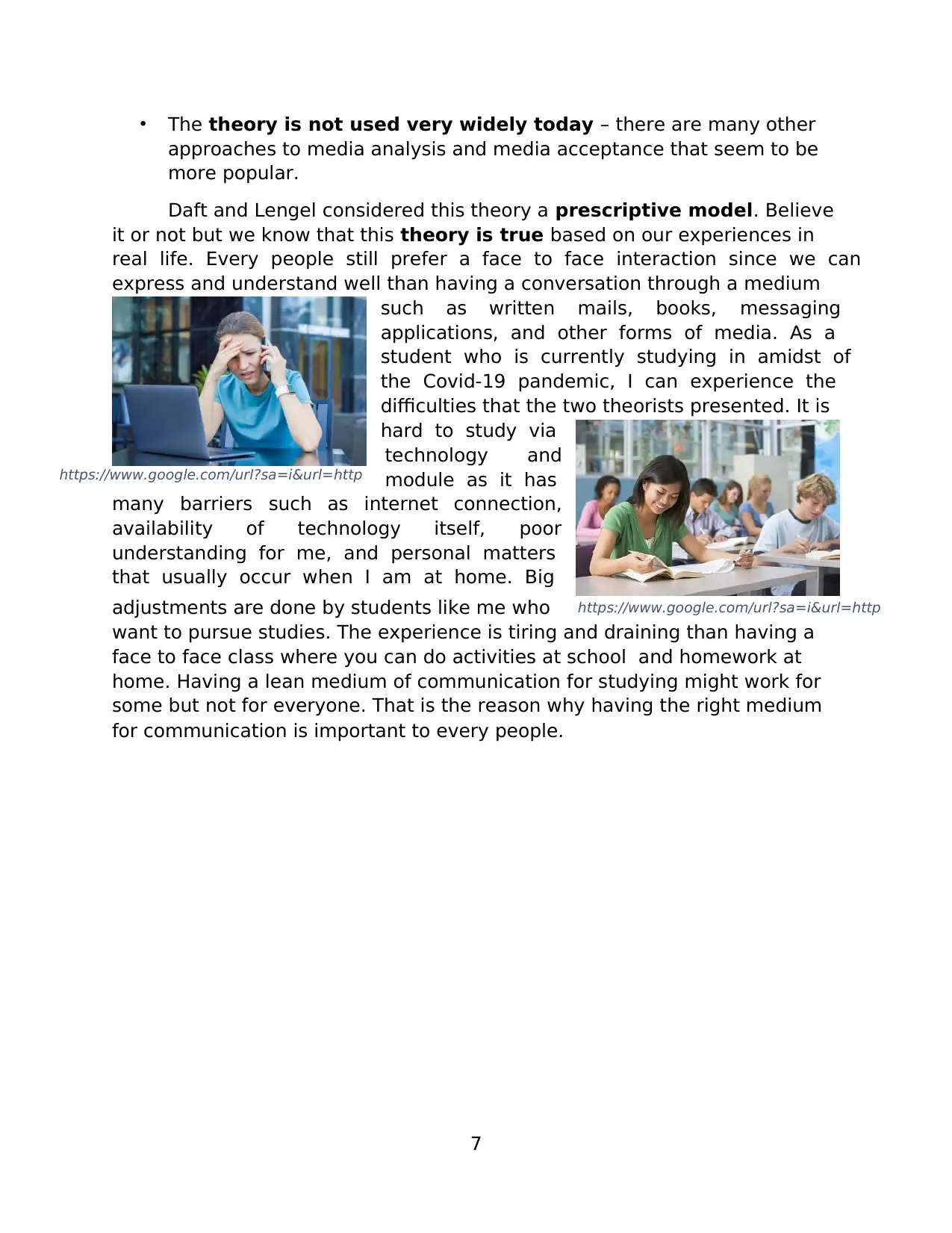
https://www.google.com/url?sa=i&url=http
• The theory is not used very widely today – there are many other
approaches to media analysis and media acceptance that seem to be
more popular.
Daft and Lengel considered this theory a prescriptive model. Believe
it or not but we know that this theory is true based on our experiences in
real life. Every people still prefer a face to face interaction since we can
express and understand well than having a conversation through a medium
such as written mails, books, messaging
applications, and other forms of media. As a
student who is currently studying in amidst of
the Covid-19 pandemic, I can experience the
difficulties that the two theorists presented. It is
hard to study via
technology and
module as it has
many barriers such as internet connection,
availability of technology itself, poor
understanding for me, and personal matters
that usually occur when I am at home. Big
adjustments are done by students like me who
want to pursue studies. The experience is tiring and draining than having a
face to face class where you can do activities at school and homework at
home. Having a lean medium of communication for studying might work for
some but not for everyone. That is the reason why having the right medium
for communication is important to every people.
https://www.google.com/url?sa=i&url=http
https://www.google.com/url?sa=i&url=http
• The theory is not used very widely today – there are many other
approaches to media analysis and media acceptance that seem to be
more popular.
Daft and Lengel considered this theory a prescriptive model. Believe
it or not but we know that this theory is true based on our experiences in
real life. Every people still prefer a face to face interaction since we can
express and understand well than having a conversation through a medium
such as written mails, books, messaging
applications, and other forms of media. As a
student who is currently studying in amidst of
the Covid-19 pandemic, I can experience the
difficulties that the two theorists presented. It is
hard to study via
technology and
module as it has
many barriers such as internet connection,
availability of technology itself, poor
understanding for me, and personal matters
that usually occur when I am at home. Big
adjustments are done by students like me who
want to pursue studies. The experience is tiring and draining than having a
face to face class where you can do activities at school and homework at
home. Having a lean medium of communication for studying might work for
some but not for everyone. That is the reason why having the right medium
for communication is important to every people.
https://www.google.com/url?sa=i&url=http
Paraphrase This Document
Need a fresh take? Get an instant paraphrase of this document with our AI Paraphraser
8
Argumentation Theory Realubit
Everyday in our lives, we may or may not do it consciously, we argue
to prove our certain point to someone. In some cases, we argue to find out
what other people believes in and why do they believe in that. We argue
because there is a difference in our opinions, or that there is conflict present
in our situation towards other people. We think of an argument like war
between two people. Politically speaking, politicians fighting, presidential
debate. Lawfully speaking, a fight over a courtroom, lawyer vs jury kind of
fight, judge vs lawyer, or opposition vs opposition. Or basically just Annalise
Keating’s unresolved conflicts over her clients and co-workers. But in this
topic, we analyze how these theories are essential in our arguments.
Theories that will help us prove the validity of our premises.
Theories
Before we discuss theories that are useful in our arguments. It is
reasonable enough to say that these theories are made of features and
concepts derived from philosophy, rhetoric, and social theories that explain
the existence of these theories.
Pragma-Dialectics
This argumentation theory was developed by Frans H. van Eemeren
and Rob Grootendorst at the University of Amsterdam. This theory relies
more on the side of reasoning and dialectical procedures in order to resolve
differences of opinion. It also emphasizes speech acts that are used in
social-reasoning process, increase or decrease the acceptability of some
arguers’ standpoints in an argument. Argument analysis is also the main
focus of pragma-dialectics. Analyst categorize arguments based on
sequential stages of confrontation, opening, argumentation, and conclusion.
They then proceed to carefully analyze the disputes base on the description
of the issues, identifying their standpoints, implicit and explicit associated to
the disputants’ standpoints, and be able to explain the complex structures
and standards also that apply to the arguments.
Pragma-dialectic theory can be applied and analyze to a simple argument
between a landlord and tenant. As well as, complex disputes or arguments
like legal forums and international negotiations.
Argumentation Theory Realubit
Everyday in our lives, we may or may not do it consciously, we argue
to prove our certain point to someone. In some cases, we argue to find out
what other people believes in and why do they believe in that. We argue
because there is a difference in our opinions, or that there is conflict present
in our situation towards other people. We think of an argument like war
between two people. Politically speaking, politicians fighting, presidential
debate. Lawfully speaking, a fight over a courtroom, lawyer vs jury kind of
fight, judge vs lawyer, or opposition vs opposition. Or basically just Annalise
Keating’s unresolved conflicts over her clients and co-workers. But in this
topic, we analyze how these theories are essential in our arguments.
Theories that will help us prove the validity of our premises.
Theories
Before we discuss theories that are useful in our arguments. It is
reasonable enough to say that these theories are made of features and
concepts derived from philosophy, rhetoric, and social theories that explain
the existence of these theories.
Pragma-Dialectics
This argumentation theory was developed by Frans H. van Eemeren
and Rob Grootendorst at the University of Amsterdam. This theory relies
more on the side of reasoning and dialectical procedures in order to resolve
differences of opinion. It also emphasizes speech acts that are used in
social-reasoning process, increase or decrease the acceptability of some
arguers’ standpoints in an argument. Argument analysis is also the main
focus of pragma-dialectics. Analyst categorize arguments based on
sequential stages of confrontation, opening, argumentation, and conclusion.
They then proceed to carefully analyze the disputes base on the description
of the issues, identifying their standpoints, implicit and explicit associated to
the disputants’ standpoints, and be able to explain the complex structures
and standards also that apply to the arguments.
Pragma-dialectic theory can be applied and analyze to a simple argument
between a landlord and tenant. As well as, complex disputes or arguments
like legal forums and international negotiations.
9
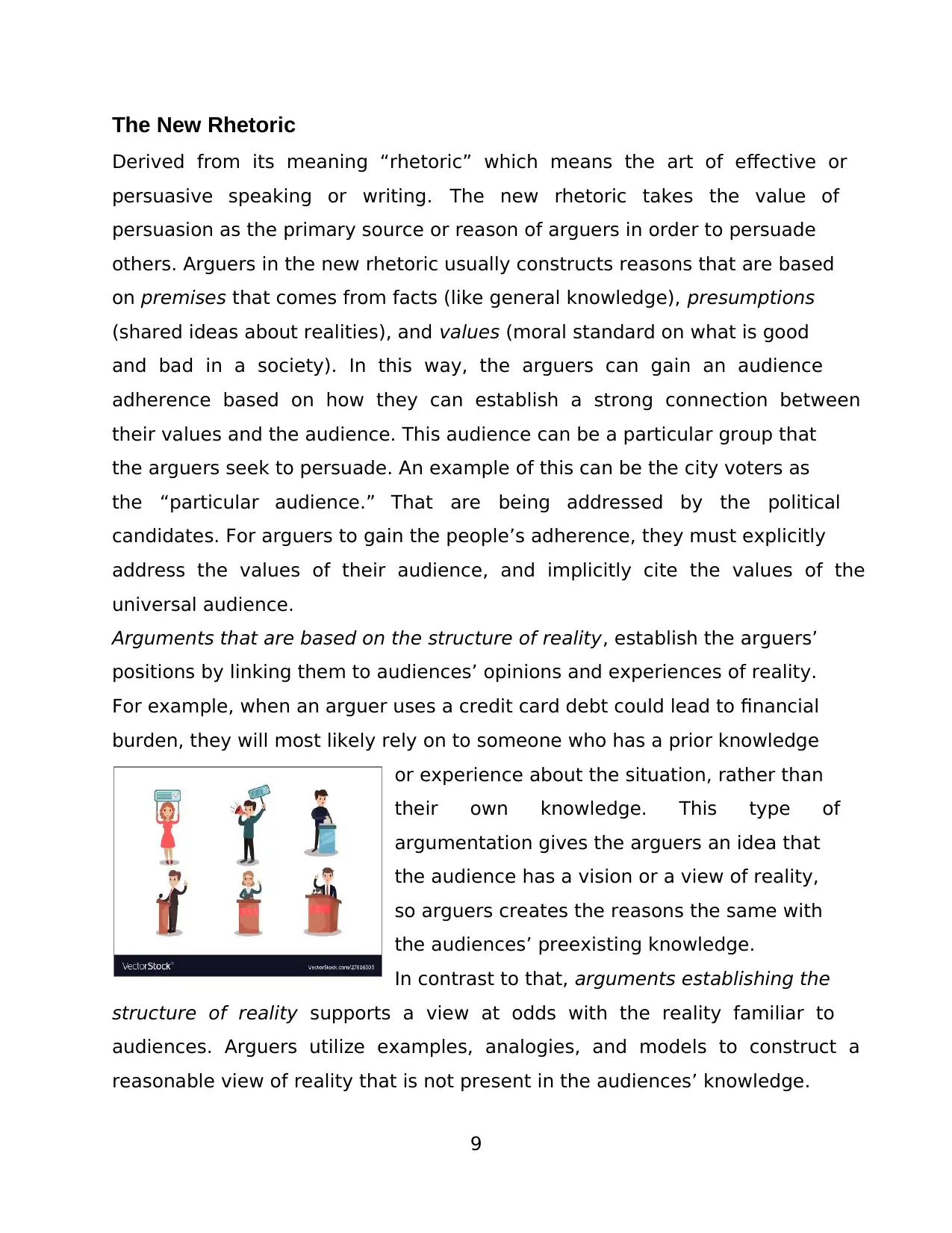
The New Rhetoric
Derived from its meaning “rhetoric” which means the art of effective or
persuasive speaking or writing. The new rhetoric takes the value of
persuasion as the primary source or reason of arguers in order to persuade
others. Arguers in the new rhetoric usually constructs reasons that are based
on premises that comes from facts (like general knowledge), presumptions
(shared ideas about realities), and values (moral standard on what is good
and bad in a society). In this way, the arguers can gain an audience
adherence based on how they can establish a strong connection between
their values and the audience. This audience can be a particular group that
the arguers seek to persuade. An example of this can be the city voters as
the “particular audience.” That are being addressed by the political
candidates. For arguers to gain the people’s adherence, they must explicitly
address the values of their audience, and implicitly cite the values of the
universal audience.
Arguments that are based on the structure of reality, establish the arguers’
positions by linking them to audiences’ opinions and experiences of reality.
For example, when an arguer uses a credit card debt could lead to financial
burden, they will most likely rely on to someone who has a prior knowledge
or experience about the situation, rather than
their own knowledge. This type of
argumentation gives the arguers an idea that
the audience has a vision or a view of reality,
so arguers creates the reasons the same with
the audiences’ preexisting knowledge.
In contrast to that, arguments establishing the
structure of reality supports a view at odds with the reality familiar to
audiences. Arguers utilize examples, analogies, and models to construct a
reasonable view of reality that is not present in the audiences’ knowledge.
The New Rhetoric
Derived from its meaning “rhetoric” which means the art of effective or
persuasive speaking or writing. The new rhetoric takes the value of
persuasion as the primary source or reason of arguers in order to persuade
others. Arguers in the new rhetoric usually constructs reasons that are based
on premises that comes from facts (like general knowledge), presumptions
(shared ideas about realities), and values (moral standard on what is good
and bad in a society). In this way, the arguers can gain an audience
adherence based on how they can establish a strong connection between
their values and the audience. This audience can be a particular group that
the arguers seek to persuade. An example of this can be the city voters as
the “particular audience.” That are being addressed by the political
candidates. For arguers to gain the people’s adherence, they must explicitly
address the values of their audience, and implicitly cite the values of the
universal audience.
Arguments that are based on the structure of reality, establish the arguers’
positions by linking them to audiences’ opinions and experiences of reality.
For example, when an arguer uses a credit card debt could lead to financial
burden, they will most likely rely on to someone who has a prior knowledge
or experience about the situation, rather than
their own knowledge. This type of
argumentation gives the arguers an idea that
the audience has a vision or a view of reality,
so arguers creates the reasons the same with
the audiences’ preexisting knowledge.
In contrast to that, arguments establishing the
structure of reality supports a view at odds with the reality familiar to
audiences. Arguers utilize examples, analogies, and models to construct a
reasonable view of reality that is not present in the audiences’ knowledge.
⊘ This is a preview!⊘
Do you want full access?
Subscribe today to unlock all pages.
Trusted by 1+ million students worldwide
10
For example, in a criminal trial defense an attorney will be able to construct
a structure of reality,
when attorneys try to
make the jury believe
that the criminal action is
accidental rather than
intentional base on what
really happened. Although
the jurors have no direct knowledge of the circumstances that happened
around the crime, the attorney will create a new reality out of the events
familiar to jurors. This argument will serve as the basis that the crime was
not intentional but rather, it is made out of an accident.
The new rhetoric explains arguers’ strategic uses of reasoning that are based
on associations and disassociations of ideas and issues in ways that will gain
the audiences’ adherence.
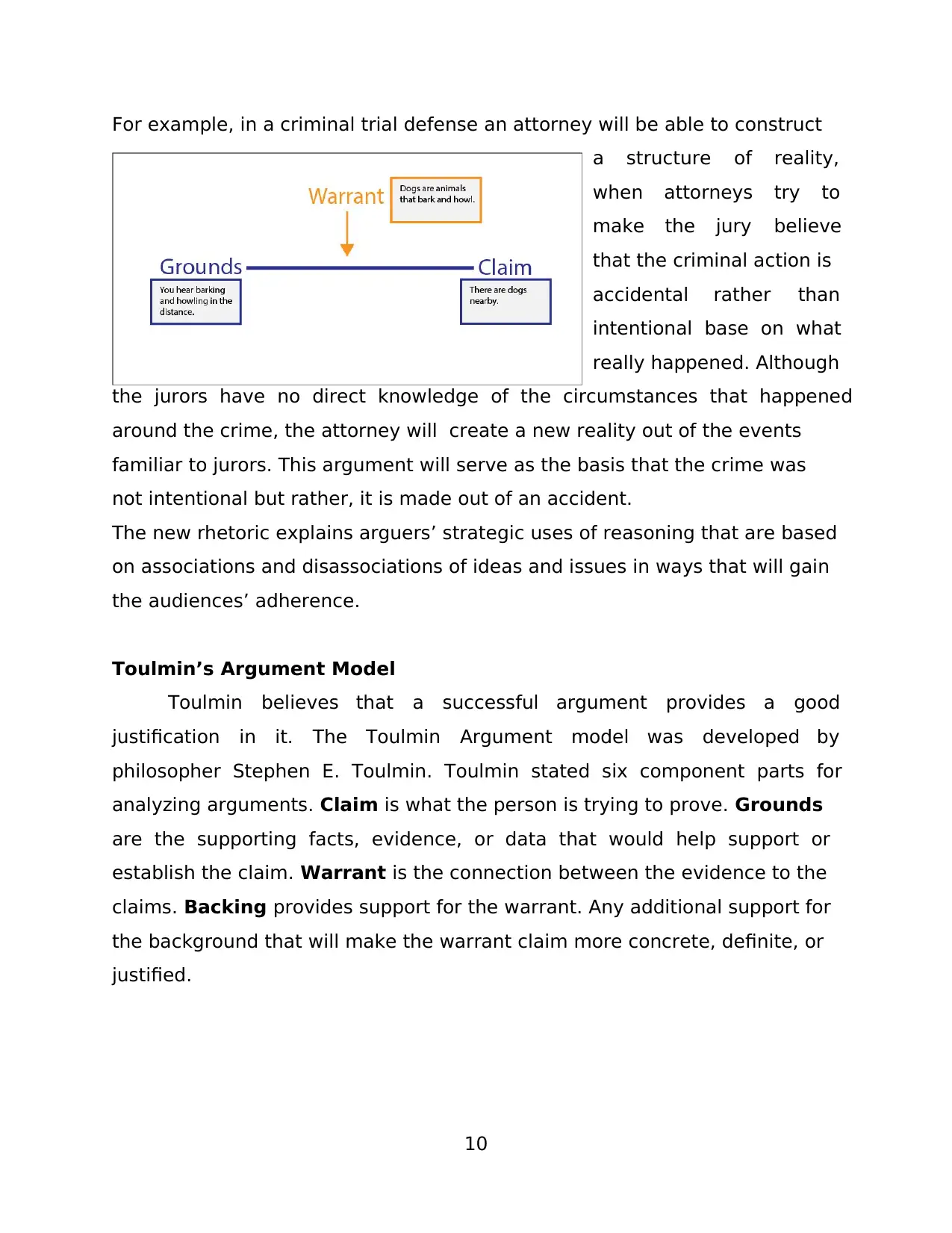
Toulmin’s Argument Model
Toulmin believes that a successful argument provides a good
justification in it. The Toulmin Argument model was developed by
philosopher Stephen E. Toulmin. Toulmin stated six component parts for
analyzing arguments. Claim is what the person is trying to prove. Grounds
are the supporting facts, evidence, or data that would help support or
establish the claim. Warrant is the connection between the evidence to the
claims. Backing provides support for the warrant. Any additional support for
the background that will make the warrant claim more concrete, definite, or
justified.
For example, in a criminal trial defense an attorney will be able to construct
a structure of reality,
when attorneys try to
make the jury believe
that the criminal action is
accidental rather than
intentional base on what
really happened. Although
the jurors have no direct knowledge of the circumstances that happened
around the crime, the attorney will create a new reality out of the events
familiar to jurors. This argument will serve as the basis that the crime was
not intentional but rather, it is made out of an accident.
The new rhetoric explains arguers’ strategic uses of reasoning that are based
on associations and disassociations of ideas and issues in ways that will gain
the audiences’ adherence.
Toulmin’s Argument Model
Toulmin believes that a successful argument provides a good
justification in it. The Toulmin Argument model was developed by
philosopher Stephen E. Toulmin. Toulmin stated six component parts for
analyzing arguments. Claim is what the person is trying to prove. Grounds
are the supporting facts, evidence, or data that would help support or
establish the claim. Warrant is the connection between the evidence to the
claims. Backing provides support for the warrant. Any additional support for
the background that will make the warrant claim more concrete, definite, or
justified.
Paraphrase This Document
Need a fresh take? Get an instant paraphrase of this document with our AI Paraphraser
11
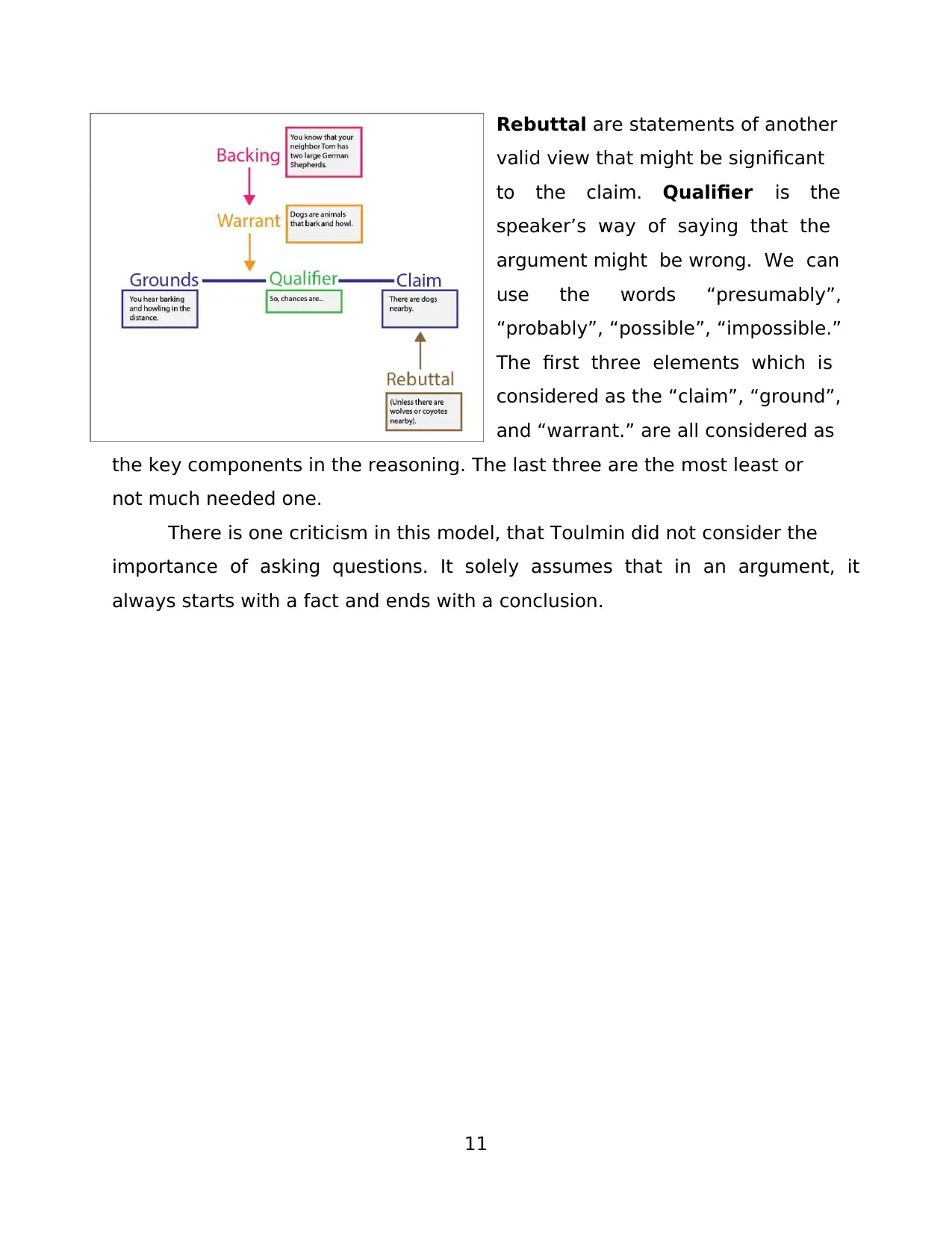
Rebuttal are statements of another
valid view that might be significant
to the claim. Qualifier is the
speaker’s way of saying that the
argument might be wrong. We can
use the words “presumably”,
“probably”, “possible”, “impossible.”
The first three elements which is
considered as the “claim”, “ground”,
and “warrant.” are all considered as
the key components in the reasoning. The last three are the most least or
not much needed one.
There is one criticism in this model, that Toulmin did not consider the
importance of asking questions. It solely assumes that in an argument, it
always starts with a fact and ends with a conclusion.
Rebuttal are statements of another
valid view that might be significant
to the claim. Qualifier is the
speaker’s way of saying that the
argument might be wrong. We can
use the words “presumably”,
“probably”, “possible”, “impossible.”
The first three elements which is
considered as the “claim”, “ground”,
and “warrant.” are all considered as
the key components in the reasoning. The last three are the most least or
not much needed one.
There is one criticism in this model, that Toulmin did not consider the
importance of asking questions. It solely assumes that in an argument, it
always starts with a fact and ends with a conclusion.
12
Conversation Theory Recto
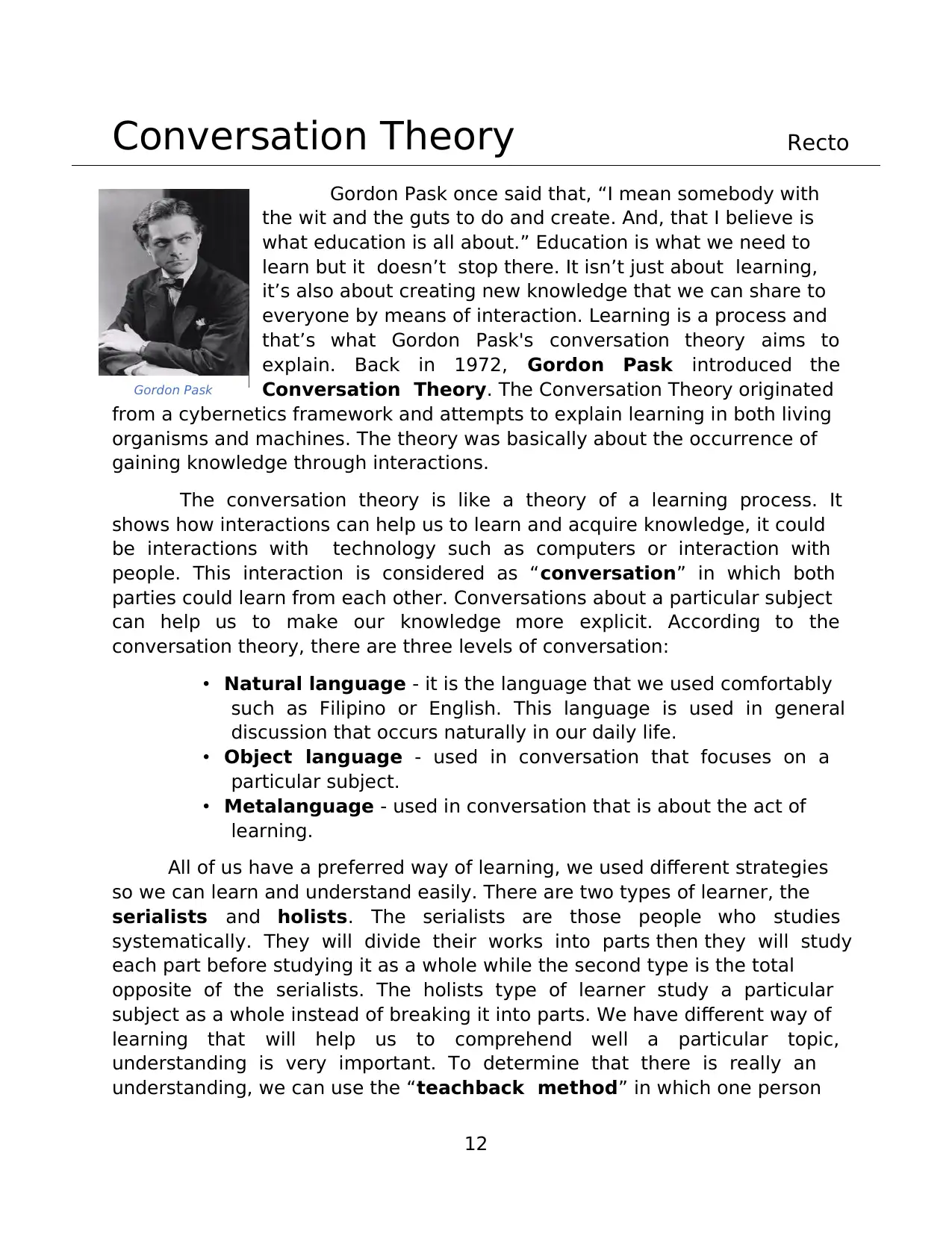
Gordon Pask once said that, “I mean somebody with
the wit and the guts to do and create. And, that I believe is
what education is all about.” Education is what we need to
learn but it doesn’t stop there. It isn’t just about learning,
it’s also about creating new knowledge that we can share to
everyone by means of interaction. Learning is a process and
that’s what Gordon Pask's conversation theory aims to
explain. Back in 1972, Gordon Pask introduced the
Conversation Theory. The Conversation Theory originated
from a cybernetics framework and attempts to explain learning in both living
organisms and machines. The theory was basically about the occurrence of
gaining knowledge through interactions.
The conversation theory is like a theory of a learning process. It
shows how interactions can help us to learn and acquire knowledge, it could
be interactions with technology such as computers or interaction with
people. This interaction is considered as “conversation” in which both
parties could learn from each other. Conversations about a particular subject
can help us to make our knowledge more explicit. According to the
conversation theory, there are three levels of conversation:
• Natural language - it is the language that we used comfortably
such as Filipino or English. This language is used in general
discussion that occurs naturally in our daily life.
• Object language - used in conversation that focuses on a
particular subject.
• Metalanguage - used in conversation that is about the act of
learning.
All of us have a preferred way of learning, we used different strategies
so we can learn and understand easily. There are two types of learner, the
serialists and holists. The serialists are those people who studies
systematically. They will divide their works into parts then they will study
each part before studying it as a whole while the second type is the total
opposite of the serialists. The holists type of learner study a particular
subject as a whole instead of breaking it into parts. We have different way of
learning that will help us to comprehend well a particular topic,
understanding is very important. To determine that there is really an
understanding, we can use the “teachback method” in which one person
Gordon Pask
Conversation Theory Recto
Gordon Pask once said that, “I mean somebody with
the wit and the guts to do and create. And, that I believe is
what education is all about.” Education is what we need to
learn but it doesn’t stop there. It isn’t just about learning,
it’s also about creating new knowledge that we can share to
everyone by means of interaction. Learning is a process and
that’s what Gordon Pask's conversation theory aims to
explain. Back in 1972, Gordon Pask introduced the
Conversation Theory. The Conversation Theory originated
from a cybernetics framework and attempts to explain learning in both living
organisms and machines. The theory was basically about the occurrence of
gaining knowledge through interactions.
The conversation theory is like a theory of a learning process. It
shows how interactions can help us to learn and acquire knowledge, it could
be interactions with technology such as computers or interaction with
people. This interaction is considered as “conversation” in which both
parties could learn from each other. Conversations about a particular subject
can help us to make our knowledge more explicit. According to the
conversation theory, there are three levels of conversation:
• Natural language - it is the language that we used comfortably
such as Filipino or English. This language is used in general
discussion that occurs naturally in our daily life.
• Object language - used in conversation that focuses on a
particular subject.
• Metalanguage - used in conversation that is about the act of
learning.
All of us have a preferred way of learning, we used different strategies
so we can learn and understand easily. There are two types of learner, the
serialists and holists. The serialists are those people who studies
systematically. They will divide their works into parts then they will study
each part before studying it as a whole while the second type is the total
opposite of the serialists. The holists type of learner study a particular
subject as a whole instead of breaking it into parts. We have different way of
learning that will help us to comprehend well a particular topic,
understanding is very important. To determine that there is really an
understanding, we can use the “teachback method” in which one person
Gordon Pask
⊘ This is a preview!⊘
Do you want full access?
Subscribe today to unlock all pages.
Trusted by 1+ million students worldwide

1 out of 28


Your All-in-One AI-Powered Toolkit for Academic Success.
+13062052269
info@desklib.com
Available 24*7 on WhatsApp / Email
![[object Object]](/_next/static/media/star-bottom.7253800d.svg)
Unlock your academic potential
Copyright © 2020–2026 A2Z Services. All Rights Reserved. Developed and managed by ZUCOL.