Community Connectedness and Identity: A Health Perspective Essay
VerifiedAdded on 2022/08/24
|8
|2566
|17
Essay
AI Summary
This essay delves into the critical role of community connectedness and identity as protective factors for health, using a narrative about a character named Tom as a central case study. The essay begins by defining community connectedness and identity, highlighting their significance for individual well-being and mental health. It examines the impact of social connections, or lack thereof, on physical and psychological health, referencing relevant scholarly articles. The narrative of Tom, who grew up in a small town and experienced social isolation due to limited opportunities, serves as a practical illustration of these concepts. The essay contrasts Tom's experiences of social isolation and its negative effects with his improved well-being when he later gains access to a broader social network. The essay further explores the impact of identity on health and discusses different dimensions of identity. Finally, the essay addresses various strategies and policies designed to mitigate the adverse effects of poor community connectedness and identity on health, citing research and interventions aimed at improving social connections and mental health outcomes.
Running head: IMPORTANCE OF COMMUNITY CONNECTEDNESS
IMPORTANCE OF COMMUNITY CONNECTEDNESS
Name of the Student
Name of the University
Author Note
IMPORTANCE OF COMMUNITY CONNECTEDNESS
Name of the Student
Name of the University
Author Note

Paraphrase This Document
Need a fresh take? Get an instant paraphrase of this document with our AI Paraphraser
1IMPORTANCE OF COMMUNITY CONNECTEDNESS
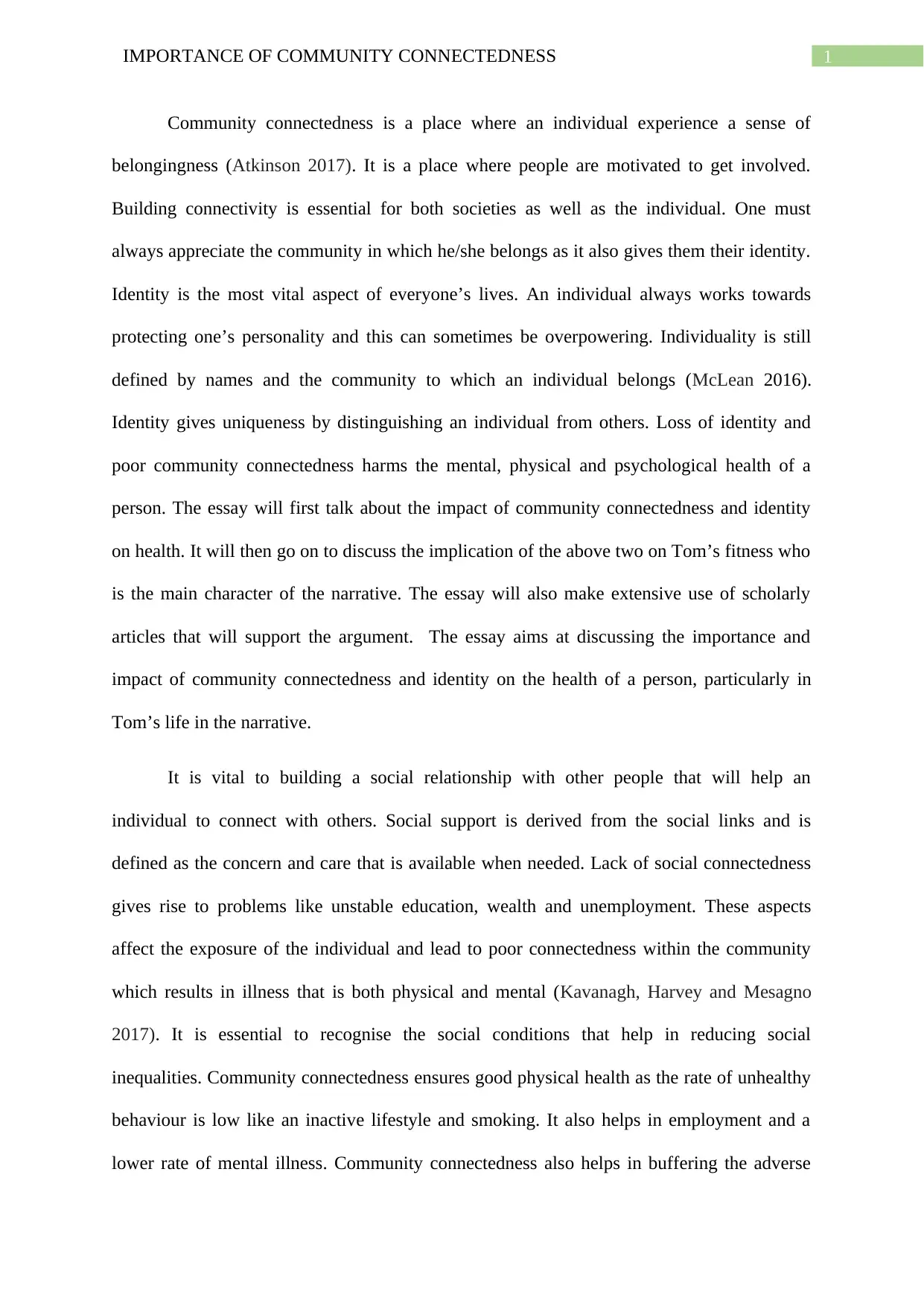
Community connectedness is a place where an individual experience a sense of
belongingness (Atkinson 2017). It is a place where people are motivated to get involved.
Building connectivity is essential for both societies as well as the individual. One must
always appreciate the community in which he/she belongs as it also gives them their identity.
Identity is the most vital aspect of everyone’s lives. An individual always works towards
protecting one’s personality and this can sometimes be overpowering. Individuality is still
defined by names and the community to which an individual belongs (McLean 2016).
Identity gives uniqueness by distinguishing an individual from others. Loss of identity and
poor community connectedness harms the mental, physical and psychological health of a
person. The essay will first talk about the impact of community connectedness and identity
on health. It will then go on to discuss the implication of the above two on Tom’s fitness who
is the main character of the narrative. The essay will also make extensive use of scholarly
articles that will support the argument. The essay aims at discussing the importance and
impact of community connectedness and identity on the health of a person, particularly in
Tom’s life in the narrative.
It is vital to building a social relationship with other people that will help an
individual to connect with others. Social support is derived from the social links and is
defined as the concern and care that is available when needed. Lack of social connectedness
gives rise to problems like unstable education, wealth and unemployment. These aspects
affect the exposure of the individual and lead to poor connectedness within the community
which results in illness that is both physical and mental (Kavanagh, Harvey and Mesagno
2017). It is essential to recognise the social conditions that help in reducing social
inequalities. Community connectedness ensures good physical health as the rate of unhealthy
behaviour is low like an inactive lifestyle and smoking. It also helps in employment and a
lower rate of mental illness. Community connectedness also helps in buffering the adverse
Community connectedness is a place where an individual experience a sense of
belongingness (Atkinson 2017). It is a place where people are motivated to get involved.
Building connectivity is essential for both societies as well as the individual. One must
always appreciate the community in which he/she belongs as it also gives them their identity.
Identity is the most vital aspect of everyone’s lives. An individual always works towards
protecting one’s personality and this can sometimes be overpowering. Individuality is still
defined by names and the community to which an individual belongs (McLean 2016).
Identity gives uniqueness by distinguishing an individual from others. Loss of identity and
poor community connectedness harms the mental, physical and psychological health of a
person. The essay will first talk about the impact of community connectedness and identity
on health. It will then go on to discuss the implication of the above two on Tom’s fitness who
is the main character of the narrative. The essay will also make extensive use of scholarly
articles that will support the argument. The essay aims at discussing the importance and
impact of community connectedness and identity on the health of a person, particularly in
Tom’s life in the narrative.
It is vital to building a social relationship with other people that will help an
individual to connect with others. Social support is derived from the social links and is
defined as the concern and care that is available when needed. Lack of social connectedness
gives rise to problems like unstable education, wealth and unemployment. These aspects
affect the exposure of the individual and lead to poor connectedness within the community
which results in illness that is both physical and mental (Kavanagh, Harvey and Mesagno
2017). It is essential to recognise the social conditions that help in reducing social
inequalities. Community connectedness ensures good physical health as the rate of unhealthy
behaviour is low like an inactive lifestyle and smoking. It also helps in employment and a
lower rate of mental illness. Community connectedness also helps in buffering the adverse
2IMPORTANCE OF COMMUNITY CONNECTEDNESS
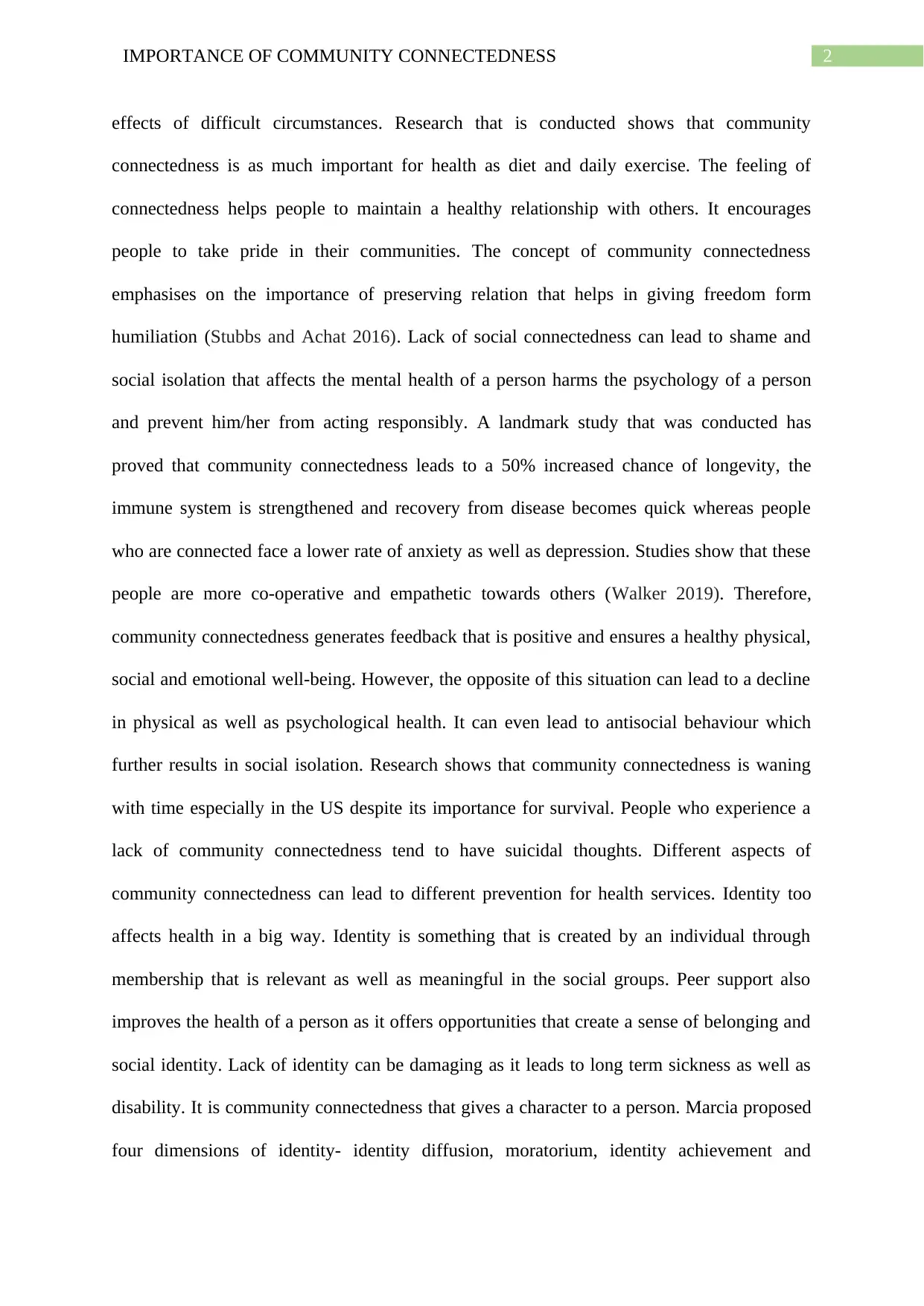
effects of difficult circumstances. Research that is conducted shows that community
connectedness is as much important for health as diet and daily exercise. The feeling of
connectedness helps people to maintain a healthy relationship with others. It encourages
people to take pride in their communities. The concept of community connectedness
emphasises on the importance of preserving relation that helps in giving freedom form
humiliation (Stubbs and Achat 2016). Lack of social connectedness can lead to shame and
social isolation that affects the mental health of a person harms the psychology of a person
and prevent him/her from acting responsibly. A landmark study that was conducted has
proved that community connectedness leads to a 50% increased chance of longevity, the
immune system is strengthened and recovery from disease becomes quick whereas people
who are connected face a lower rate of anxiety as well as depression. Studies show that these
people are more co-operative and empathetic towards others (Walker 2019). Therefore,
community connectedness generates feedback that is positive and ensures a healthy physical,
social and emotional well-being. However, the opposite of this situation can lead to a decline
in physical as well as psychological health. It can even lead to antisocial behaviour which
further results in social isolation. Research shows that community connectedness is waning
with time especially in the US despite its importance for survival. People who experience a
lack of community connectedness tend to have suicidal thoughts. Different aspects of
community connectedness can lead to different prevention for health services. Identity too
affects health in a big way. Identity is something that is created by an individual through
membership that is relevant as well as meaningful in the social groups. Peer support also
improves the health of a person as it offers opportunities that create a sense of belonging and
social identity. Lack of identity can be damaging as it leads to long term sickness as well as
disability. It is community connectedness that gives a character to a person. Marcia proposed
four dimensions of identity- identity diffusion, moratorium, identity achievement and
effects of difficult circumstances. Research that is conducted shows that community
connectedness is as much important for health as diet and daily exercise. The feeling of
connectedness helps people to maintain a healthy relationship with others. It encourages
people to take pride in their communities. The concept of community connectedness
emphasises on the importance of preserving relation that helps in giving freedom form
humiliation (Stubbs and Achat 2016). Lack of social connectedness can lead to shame and
social isolation that affects the mental health of a person harms the psychology of a person
and prevent him/her from acting responsibly. A landmark study that was conducted has
proved that community connectedness leads to a 50% increased chance of longevity, the
immune system is strengthened and recovery from disease becomes quick whereas people
who are connected face a lower rate of anxiety as well as depression. Studies show that these
people are more co-operative and empathetic towards others (Walker 2019). Therefore,
community connectedness generates feedback that is positive and ensures a healthy physical,
social and emotional well-being. However, the opposite of this situation can lead to a decline
in physical as well as psychological health. It can even lead to antisocial behaviour which
further results in social isolation. Research shows that community connectedness is waning
with time especially in the US despite its importance for survival. People who experience a
lack of community connectedness tend to have suicidal thoughts. Different aspects of
community connectedness can lead to different prevention for health services. Identity too
affects health in a big way. Identity is something that is created by an individual through
membership that is relevant as well as meaningful in the social groups. Peer support also
improves the health of a person as it offers opportunities that create a sense of belonging and
social identity. Lack of identity can be damaging as it leads to long term sickness as well as
disability. It is community connectedness that gives a character to a person. Marcia proposed
four dimensions of identity- identity diffusion, moratorium, identity achievement and
⊘ This is a preview!⊘
Do you want full access?
Subscribe today to unlock all pages.

Trusted by 1+ million students worldwide
3IMPORTANCE OF COMMUNITY CONNECTEDNESS
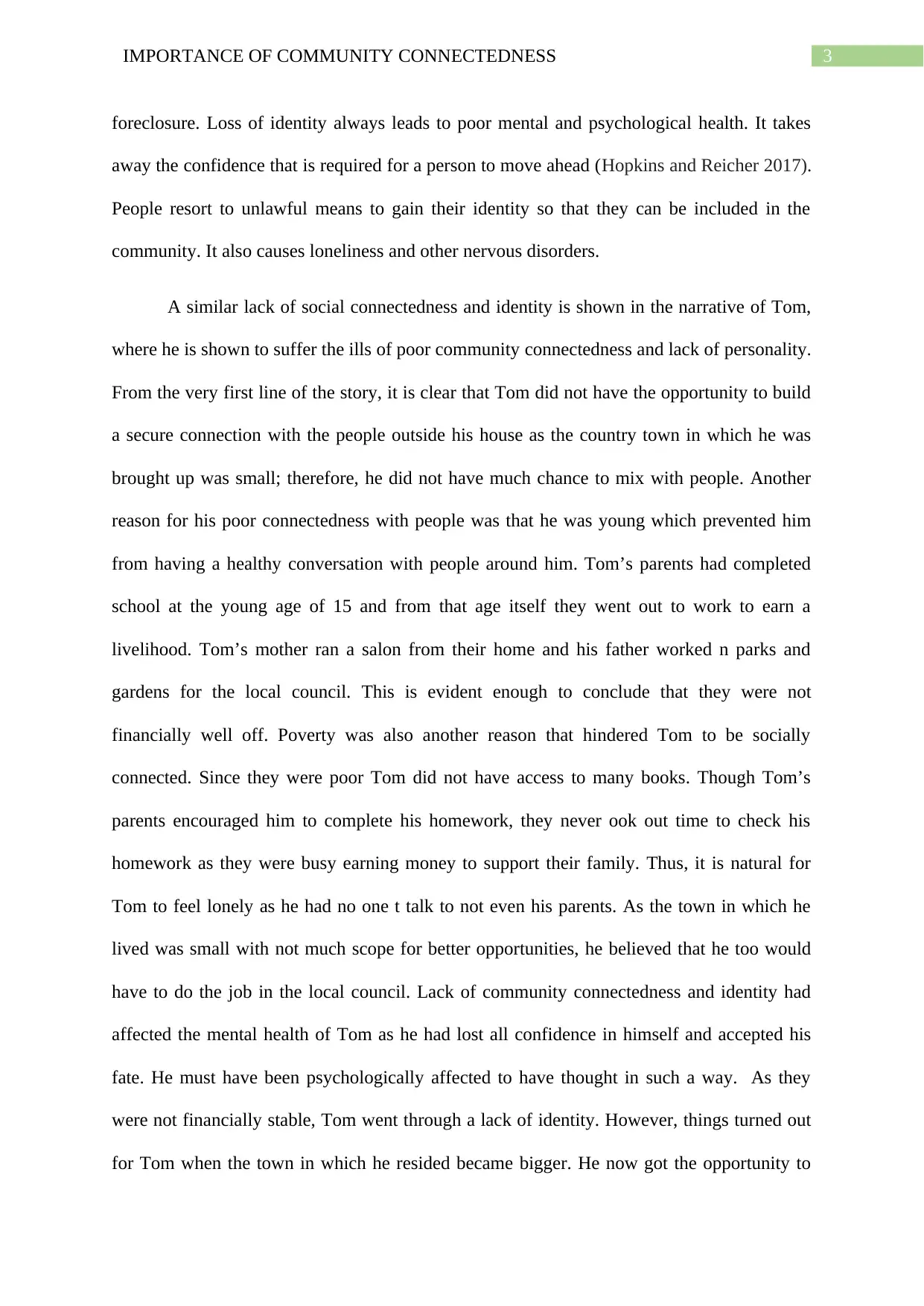
foreclosure. Loss of identity always leads to poor mental and psychological health. It takes
away the confidence that is required for a person to move ahead (Hopkins and Reicher 2017).
People resort to unlawful means to gain their identity so that they can be included in the
community. It also causes loneliness and other nervous disorders.
A similar lack of social connectedness and identity is shown in the narrative of Tom,
where he is shown to suffer the ills of poor community connectedness and lack of personality.
From the very first line of the story, it is clear that Tom did not have the opportunity to build
a secure connection with the people outside his house as the country town in which he was
brought up was small; therefore, he did not have much chance to mix with people. Another
reason for his poor connectedness with people was that he was young which prevented him
from having a healthy conversation with people around him. Tom’s parents had completed
school at the young age of 15 and from that age itself they went out to work to earn a
livelihood. Tom’s mother ran a salon from their home and his father worked n parks and
gardens for the local council. This is evident enough to conclude that they were not
financially well off. Poverty was also another reason that hindered Tom to be socially
connected. Since they were poor Tom did not have access to many books. Though Tom’s
parents encouraged him to complete his homework, they never ook out time to check his
homework as they were busy earning money to support their family. Thus, it is natural for
Tom to feel lonely as he had no one t talk to not even his parents. As the town in which he
lived was small with not much scope for better opportunities, he believed that he too would
have to do the job in the local council. Lack of community connectedness and identity had
affected the mental health of Tom as he had lost all confidence in himself and accepted his
fate. He must have been psychologically affected to have thought in such a way. As they
were not financially stable, Tom went through a lack of identity. However, things turned out
for Tom when the town in which he resided became bigger. He now got the opportunity to
foreclosure. Loss of identity always leads to poor mental and psychological health. It takes
away the confidence that is required for a person to move ahead (Hopkins and Reicher 2017).
People resort to unlawful means to gain their identity so that they can be included in the
community. It also causes loneliness and other nervous disorders.
A similar lack of social connectedness and identity is shown in the narrative of Tom,
where he is shown to suffer the ills of poor community connectedness and lack of personality.
From the very first line of the story, it is clear that Tom did not have the opportunity to build
a secure connection with the people outside his house as the country town in which he was
brought up was small; therefore, he did not have much chance to mix with people. Another
reason for his poor connectedness with people was that he was young which prevented him
from having a healthy conversation with people around him. Tom’s parents had completed
school at the young age of 15 and from that age itself they went out to work to earn a
livelihood. Tom’s mother ran a salon from their home and his father worked n parks and
gardens for the local council. This is evident enough to conclude that they were not
financially well off. Poverty was also another reason that hindered Tom to be socially
connected. Since they were poor Tom did not have access to many books. Though Tom’s
parents encouraged him to complete his homework, they never ook out time to check his
homework as they were busy earning money to support their family. Thus, it is natural for
Tom to feel lonely as he had no one t talk to not even his parents. As the town in which he
lived was small with not much scope for better opportunities, he believed that he too would
have to do the job in the local council. Lack of community connectedness and identity had
affected the mental health of Tom as he had lost all confidence in himself and accepted his
fate. He must have been psychologically affected to have thought in such a way. As they
were not financially stable, Tom went through a lack of identity. However, things turned out
for Tom when the town in which he resided became bigger. He now got the opportunity to
Paraphrase This Document
Need a fresh take? Get an instant paraphrase of this document with our AI Paraphraser
4IMPORTANCE OF COMMUNITY CONNECTEDNESS
converse and connect with people. A new high school was built that allowed Tom to read and
explore. He could now connect with people that instilled confidence in him and with time, his
physical and mental health became strong. He could now pay attention to his studies as he
was backed by his new friends and teachers in high school. He no longer had to travel hours
to reach school that tired him earlier. As he was mentally healthy, he began taking an interest
in science and maths and also participated in science experiments beyond school hours. This
further led to community connectedness as Tom was involved in the extra-curricular
activities that were arranged in his school. Furthermore, his grades had improved in maths as
well as science which helped him to win a scholarship at the end of class 12 that allowed him
to pursue a Bachelor’s degree in science. Tom’s narrative clearly shows how community
connectedness and identity can improve the mental and physical health of a person. When
Tom was suffering from lack of community connectedness and identity, his studies were
affected, and he always felt lonely which might have led to depression. As soon as the town
developed Tom was allowed to connect with people and gradually his health and studies
improved. Therefore, it can be said that community connectedness and identity plays a vital
role in maintaining physical and mental health.
Many strategies, as well as policies, have been devised to cope with the problem of
health disparities that arise due to lack of community connectedness and identity. Research
conducted amongst Californians ageing between 39-69 years by Berkman and Syme in 1979
showed that well-connected people have a high mortality rate than those who suffer from it.
While the lack of community connectedness and identity has adverse impacts on the mental
health of all age groups, the older adults are found to be more vulnerable due to their physical
disability as well as illness. Lisa Marsh Ryerson in research, tries to identify the solutions to
reduce loneliness particularly among older people of America (Horan 2018). Julianne Holt
also frames that an increased feeling of isolation can lead to unrecognised health problems.
converse and connect with people. A new high school was built that allowed Tom to read and
explore. He could now connect with people that instilled confidence in him and with time, his
physical and mental health became strong. He could now pay attention to his studies as he
was backed by his new friends and teachers in high school. He no longer had to travel hours
to reach school that tired him earlier. As he was mentally healthy, he began taking an interest
in science and maths and also participated in science experiments beyond school hours. This
further led to community connectedness as Tom was involved in the extra-curricular
activities that were arranged in his school. Furthermore, his grades had improved in maths as
well as science which helped him to win a scholarship at the end of class 12 that allowed him
to pursue a Bachelor’s degree in science. Tom’s narrative clearly shows how community
connectedness and identity can improve the mental and physical health of a person. When
Tom was suffering from lack of community connectedness and identity, his studies were
affected, and he always felt lonely which might have led to depression. As soon as the town
developed Tom was allowed to connect with people and gradually his health and studies
improved. Therefore, it can be said that community connectedness and identity plays a vital
role in maintaining physical and mental health.
Many strategies, as well as policies, have been devised to cope with the problem of
health disparities that arise due to lack of community connectedness and identity. Research
conducted amongst Californians ageing between 39-69 years by Berkman and Syme in 1979
showed that well-connected people have a high mortality rate than those who suffer from it.
While the lack of community connectedness and identity has adverse impacts on the mental
health of all age groups, the older adults are found to be more vulnerable due to their physical
disability as well as illness. Lisa Marsh Ryerson in research, tries to identify the solutions to
reduce loneliness particularly among older people of America (Horan 2018). Julianne Holt
also frames that an increased feeling of isolation can lead to unrecognised health problems.
5IMPORTANCE OF COMMUNITY CONNECTEDNESS
Certain types of community connectivity have a favourable impact on the cognitive health of
a person (Birmingham and Holt-Lunstad 2018). Antisocial behaviour of people should be
understood and ways to mitigate the problem should be derived. For instance, a person
suffering from Asperger’s should be made aware of it so that he/she can understand the
reason for behaving differently from others rather than blaming herself/herself. As people
grow older, they identify themselves with others. Lack of identity will lead to depression and
suicidal thoughts. James Lubben urges the policymakers and researchers to devise effective
methods to cope with the adverse consequences of poor connectedness (Lubben 2017).
Specific techniques are adopted to deal with the problem of identity crisis and low
community connectedness. The G4H (Groups 4 Health) was tested which involved young
adults who were suffering from social isolation and disturbance. The outcome showed mental
health problems like depression, anxiety and stress along with loneliness. However, G4H was
successful in combating the effects of mental health and social connectedness (Haslam et al
2016). Studies also show that specific interventions that aim to improve social connectedness
have a beneficial impact on the mental health of a person. For instance, people who have a
mental illness when joined recreational activities and therapy groups experienced a reduction
in the rate of depression (Saeri et al 2018). Sara Czaja draws the attention of the people to the
importance of technology that helps to cope with the problem and lack of identity,
community connectedness and isolation. Technology has enhanced the level of
communication amongst older adults and has helped them to connect with other people.
Czaja urges for the need for further research that focuses on the advanced need for
technology to address (Czaja et al 2017)
Thus to conclude, it must be understood that lack of community connectedness and
identity can harm the mental, physical and psychological health of a person. It can affect
people of all age groups. Therefore, effective measures should be adopted to cope with the
Certain types of community connectivity have a favourable impact on the cognitive health of
a person (Birmingham and Holt-Lunstad 2018). Antisocial behaviour of people should be
understood and ways to mitigate the problem should be derived. For instance, a person
suffering from Asperger’s should be made aware of it so that he/she can understand the
reason for behaving differently from others rather than blaming herself/herself. As people
grow older, they identify themselves with others. Lack of identity will lead to depression and
suicidal thoughts. James Lubben urges the policymakers and researchers to devise effective
methods to cope with the adverse consequences of poor connectedness (Lubben 2017).
Specific techniques are adopted to deal with the problem of identity crisis and low
community connectedness. The G4H (Groups 4 Health) was tested which involved young
adults who were suffering from social isolation and disturbance. The outcome showed mental
health problems like depression, anxiety and stress along with loneliness. However, G4H was
successful in combating the effects of mental health and social connectedness (Haslam et al
2016). Studies also show that specific interventions that aim to improve social connectedness
have a beneficial impact on the mental health of a person. For instance, people who have a
mental illness when joined recreational activities and therapy groups experienced a reduction
in the rate of depression (Saeri et al 2018). Sara Czaja draws the attention of the people to the
importance of technology that helps to cope with the problem and lack of identity,
community connectedness and isolation. Technology has enhanced the level of
communication amongst older adults and has helped them to connect with other people.
Czaja urges for the need for further research that focuses on the advanced need for
technology to address (Czaja et al 2017)
Thus to conclude, it must be understood that lack of community connectedness and
identity can harm the mental, physical and psychological health of a person. It can affect
people of all age groups. Therefore, effective measures should be adopted to cope with the
⊘ This is a preview!⊘
Do you want full access?
Subscribe today to unlock all pages.
Trusted by 1+ million students worldwide
6IMPORTANCE OF COMMUNITY CONNECTEDNESS
above problem to ensure better mental and physical health of a person. The narrative on Tom
also showed that he was suffering from poor connectivity but as soon as he engaged in
activities, his mental health improved. Thus, one must always pledge people who are
suffering from these disorders so that they can lead a healthy life.
References
Atkinson, S., Bagnall, A., Corcoran, R. and South, J., 2017. What is Community Wellbeing?
Conceptual Review.
Birmingham, W.C. and Holt-Lunstad, J., 2018. Social aggravation: Understanding the
complex role of social relationships on stress and health-relevant physiology. International
Journal of Psychophysiology, 131, pp.13-23.
Czaja, S.J., Boot, W.R., Charness, N., Rogers, W.A. and Sharit, J., 2017. Improving social
support for older adults through technology: Findings from the PRISM randomized
controlled trial. The Gerontologist, 58(3), pp.467-477.
Haslam, C., Cruwys, T., Haslam, S.A., Dingle, G. and Chang, M.X.L., 2016. Groups 4
Health: Evidence that a social-identity intervention that builds and strengthens social group
membership improves mental health. Journal of affective disorders, 194, pp.188-195.
Holt-Lunstad, J., 2018. Why social relationships are important for physical health: A systems
approach to understanding and modifying risk and protection. Annual review of
psychology, 69, pp.437-458.
Horan, K.A., 2018. College Companions: Undergraduate Students and Residents Unifying
Experience. Mānoa Horizons, 3(1), p.15.
above problem to ensure better mental and physical health of a person. The narrative on Tom
also showed that he was suffering from poor connectivity but as soon as he engaged in
activities, his mental health improved. Thus, one must always pledge people who are
suffering from these disorders so that they can lead a healthy life.
References
Atkinson, S., Bagnall, A., Corcoran, R. and South, J., 2017. What is Community Wellbeing?
Conceptual Review.
Birmingham, W.C. and Holt-Lunstad, J., 2018. Social aggravation: Understanding the
complex role of social relationships on stress and health-relevant physiology. International
Journal of Psychophysiology, 131, pp.13-23.
Czaja, S.J., Boot, W.R., Charness, N., Rogers, W.A. and Sharit, J., 2017. Improving social
support for older adults through technology: Findings from the PRISM randomized
controlled trial. The Gerontologist, 58(3), pp.467-477.
Haslam, C., Cruwys, T., Haslam, S.A., Dingle, G. and Chang, M.X.L., 2016. Groups 4
Health: Evidence that a social-identity intervention that builds and strengthens social group
membership improves mental health. Journal of affective disorders, 194, pp.188-195.
Holt-Lunstad, J., 2018. Why social relationships are important for physical health: A systems
approach to understanding and modifying risk and protection. Annual review of
psychology, 69, pp.437-458.
Horan, K.A., 2018. College Companions: Undergraduate Students and Residents Unifying
Experience. Mānoa Horizons, 3(1), p.15.
Paraphrase This Document
Need a fresh take? Get an instant paraphrase of this document with our AI Paraphraser
7IMPORTANCE OF COMMUNITY CONNECTEDNESS
Kavanagh, B.E., Harvey, J.T. and Mesagno, C., 2017. Social anxiety mediates the
relationship between social connectedness and test anxiety: An exploratory
investigation. Journal of Theoretical Social Psychology, 1(2), pp.60-69.
Kim, D.A., Benjamin, E.J., Fowler, J.H. and Christakis, N.A., 2016. Social connectedness is
associated with fibrinogen level in a human social network. Proceedings of the Royal Society
B: Biological Sciences, 283(1837), p.20160958.
Lubben, J., 2017. Addressing social isolation as a potent killer!. Public Policy & Aging
Report, 27(4), pp.136-138.
McLean, K.C., Syed, M., Yoder, A. and Greenhoot, A.F., 2016. The role of domain content
in understanding identity development processes. Journal of Research on Adolescence, 26(1),
pp.60-75.
Saeri, A.K., Cruwys, T., Barlow, F.K., Stronge, S. and Sibley, C.G., 2018. Social
connectedness improves public mental health: Investigating bidirectional relationships in the
New Zealand attitudes and values survey. Australian & New Zealand Journal of
Psychiatry, 52(4), pp.365-374.
Sarner, M., 2017. Alone in the crowd. New Scientist, 235(3135), pp.30-35.
Stubbs, J.M. and Achat, H.M., 2016. Sustained health home visiting can improve families’
social support and community connectedness. Contemporary nurse, 52(2-3), pp.286-299.
Walker, A.C., 2019. Hope, Social Connectedness, and Mental Health.
Kavanagh, B.E., Harvey, J.T. and Mesagno, C., 2017. Social anxiety mediates the
relationship between social connectedness and test anxiety: An exploratory
investigation. Journal of Theoretical Social Psychology, 1(2), pp.60-69.
Kim, D.A., Benjamin, E.J., Fowler, J.H. and Christakis, N.A., 2016. Social connectedness is
associated with fibrinogen level in a human social network. Proceedings of the Royal Society
B: Biological Sciences, 283(1837), p.20160958.
Lubben, J., 2017. Addressing social isolation as a potent killer!. Public Policy & Aging
Report, 27(4), pp.136-138.
McLean, K.C., Syed, M., Yoder, A. and Greenhoot, A.F., 2016. The role of domain content
in understanding identity development processes. Journal of Research on Adolescence, 26(1),
pp.60-75.
Saeri, A.K., Cruwys, T., Barlow, F.K., Stronge, S. and Sibley, C.G., 2018. Social
connectedness improves public mental health: Investigating bidirectional relationships in the
New Zealand attitudes and values survey. Australian & New Zealand Journal of
Psychiatry, 52(4), pp.365-374.
Sarner, M., 2017. Alone in the crowd. New Scientist, 235(3135), pp.30-35.
Stubbs, J.M. and Achat, H.M., 2016. Sustained health home visiting can improve families’
social support and community connectedness. Contemporary nurse, 52(2-3), pp.286-299.
Walker, A.C., 2019. Hope, Social Connectedness, and Mental Health.

1 out of 8


Related Documents


Your All-in-One AI-Powered Toolkit for Academic Success.
+13062052269
info@desklib.com
Available 24*7 on WhatsApp / Email
![[object Object]](/_next/static/media/star-bottom.7253800d.svg)
Unlock your academic potential
Copyright © 2020–2025 A2Z Services. All Rights Reserved. Developed and managed by ZUCOL.