Analyzing Communication Skills & Barriers in the Helping Process
VerifiedAdded on 2023/06/05
|9
|2823
|402
Essay
AI Summary
This essay provides an overview of the challenges faced in community development and international humanitarian aid, emphasizing the importance of the helping process and communication skills when working with diverse populations. It discusses the stages of relationship building, questioning techniques, and intervention strategies, highlighting the significance of verbal, nonverbal, written, and visual communication. The essay also identifies common communication barriers, such as language, psychological state, physiological limitations, physical distance, and attitudinal obstacles, and suggests solutions like active listening, avoiding jargon, providing constructive feedback, and using appropriate questioning techniques. The goal is to equip service providers with the skills necessary to navigate these challenges and foster effective communication in community development and humanitarian aid contexts. Desklib provides access to more solved assignments and study resources for students.

ESSAY

Paraphrase This Document
Need a fresh take? Get an instant paraphrase of this document with our AI Paraphraser
1
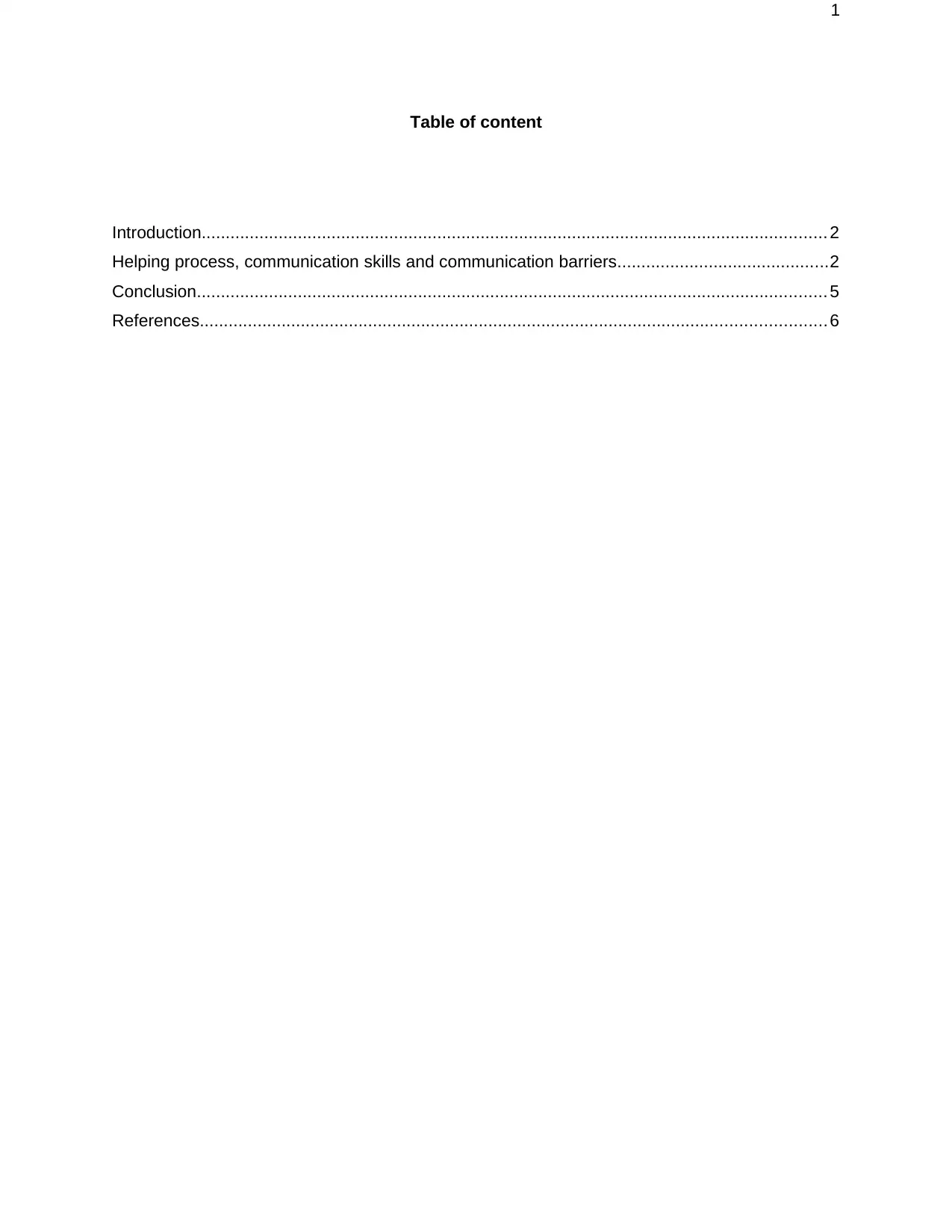
Table of content
Introduction.................................................................................................................................. 2
Helping process, communication skills and communication barriers............................................2
Conclusion................................................................................................................................... 5
References.................................................................................................................................. 6
Table of content
Introduction.................................................................................................................................. 2
Helping process, communication skills and communication barriers............................................2
Conclusion................................................................................................................................... 5
References.................................................................................................................................. 6
2
Introduction
The current essay helps in elucidating the various challenges that may be faced while tackling
community development issues as well as International assistance for humanitarian aid. In order
to tackle the challenges of working in an urban or rural area in which people of indigenous or
non-indigenous origin are present, it is necessary to understand the helping process. Along with
discussions of the various stages involved in the process, the essay will also try to shed light on
the necessity of having good communication skills, obstacles during the engagement process
as well as the solutions to these barriers.
Helping process, communication skills and communication barriers
Relationship building is necessary as it allows the client to be your and respectfully accept the
service provider to identify strengths and weaknesses. According to McCarthy & French (2017),
there are few major components of building a relationship which is namely acceptance, respect,
empathy, trust and ability to understand the problem of the client. The facilitator should be able
to accept that the client can fend for themselves which will inculcate mutual respect. The service
provider can be empathy by empathetic listening when the client vents to understand their
perspective. When all the components work together, a trust develops among the two parties.
In this stage questioning techniques will be utilised for obtaining information. There can be the
use of formal as well as informal appraisal methods. This stage can affect the client either
positively or negatively and hence it is the duty of the service provider to be caring and sensitive
so that the client feels understood and relieved (Cormier & Hackney 2015). To minimise
negative effects, the facilitator can reflect on thoughts and feelings.
This stage defines the direction in which the relationship is headed and setting a goal provides
motivational, evaluative as well as educational functions (Hepworth, Rooney, Rooney & Strom-
Gottfried 2016).
The intervention stage is necessary for problem redressal and this means the technique for
intervention selected by the service provider is based on the theoretical orientation. According to
Fazio-Griffith & Ballard (2016), the facilitator is responsible for selecting a solution that is based
on the choice of the client as well as preferred by the service provider. The three major
theoretical orientations are humanistic orientation which focusses on feelings, cognitive
orientation which focusses on a belief system and behavioural orientation.
This stage is initiated when both the parties decide that it is time to end the relationship.
However, termination of relationship should be followed by planning monitoring and necessary
referrals after which the relationship should permanently end (Cournoyer 2016).
Introduction
The current essay helps in elucidating the various challenges that may be faced while tackling
community development issues as well as International assistance for humanitarian aid. In order
to tackle the challenges of working in an urban or rural area in which people of indigenous or
non-indigenous origin are present, it is necessary to understand the helping process. Along with
discussions of the various stages involved in the process, the essay will also try to shed light on
the necessity of having good communication skills, obstacles during the engagement process
as well as the solutions to these barriers.
Helping process, communication skills and communication barriers
Relationship building is necessary as it allows the client to be your and respectfully accept the
service provider to identify strengths and weaknesses. According to McCarthy & French (2017),
there are few major components of building a relationship which is namely acceptance, respect,
empathy, trust and ability to understand the problem of the client. The facilitator should be able
to accept that the client can fend for themselves which will inculcate mutual respect. The service
provider can be empathy by empathetic listening when the client vents to understand their
perspective. When all the components work together, a trust develops among the two parties.
In this stage questioning techniques will be utilised for obtaining information. There can be the
use of formal as well as informal appraisal methods. This stage can affect the client either
positively or negatively and hence it is the duty of the service provider to be caring and sensitive
so that the client feels understood and relieved (Cormier & Hackney 2015). To minimise
negative effects, the facilitator can reflect on thoughts and feelings.
This stage defines the direction in which the relationship is headed and setting a goal provides
motivational, evaluative as well as educational functions (Hepworth, Rooney, Rooney & Strom-
Gottfried 2016).
The intervention stage is necessary for problem redressal and this means the technique for
intervention selected by the service provider is based on the theoretical orientation. According to
Fazio-Griffith & Ballard (2016), the facilitator is responsible for selecting a solution that is based
on the choice of the client as well as preferred by the service provider. The three major
theoretical orientations are humanistic orientation which focusses on feelings, cognitive
orientation which focusses on a belief system and behavioural orientation.
This stage is initiated when both the parties decide that it is time to end the relationship.
However, termination of relationship should be followed by planning monitoring and necessary
referrals after which the relationship should permanently end (Cournoyer 2016).
⊘ This is a preview!⊘
Do you want full access?
Subscribe today to unlock all pages.

Trusted by 1+ million students worldwide
3
Irrespective of the stages a combination of four basic type of communication skills are involved
in the helping process which are namely verbal communication and nonverbal communication,
written communication and visual communication. Verbal communication relies on speech and
words to convey messages. This is the most common method of communication which is
assisted by tone, gestures as well as body language. According to Banks, Burch & Woodsie
(2016), verbal communication is further divided into intrapersonal communication, interpersonal
communication, group communication and public communication. The verbal Communications
as previously mentioned is assisted by nonverbal communication like body language, facial
expression, gestures etc. It should be remembered that nonverbal communication is widely
used as the primary medium of communication.
In written communication, the message is conveyed with the help of written words. This type of
communication involved use of the personal journal, letters, reports, memos as well as emails to
communicate information and knowledge between the sender and the receiver. Written
messages can be rectified and edited before finally being forwarded to the receiver and this
makes written communication an indispensable component of formal as well as informal
communication (Lo 2017). Written communication is also assisted by electronic devices like
smartphones and laptops. Written communication are also assisted by visual communication
that involves the use of text, sentences or words.
The visual communication makes use of visual display which means that the message is
expressed or perceived by visual aids. Traffic signals, maps and posters are a very good
example of visual aids as it helps the onlooker to understand the message. Movie, animation
and short films are also a widely used form of visual communication. The visual feature helps in
ensuring clarity and eliminate the probability of ambiguity. From the perspectives of Bogo
(2018), communication skills are necessary to bridge the gap between the people, education,
entertainment, healthcare and commerce.
Language is one of the biggest barriers to communication. However, it should be kept in mind
that even when communication is done in the same language, the terminologies, if not
understood by the receiver, can act as barriers (Howe et al. 2018).
The communication process is also dependent on the psychological state of the sender as well
as the receiver. This will influence the way in which the message is being perceived. State of
mind such as anger, depression or stress is a perfect example of psychological barriers. As
observed by Brew & Kottler (2016), people having low self-esteem are usually less assertive
which makes them uncomfortable to engage in a communication process.
Irrespective of the stages a combination of four basic type of communication skills are involved
in the helping process which are namely verbal communication and nonverbal communication,
written communication and visual communication. Verbal communication relies on speech and
words to convey messages. This is the most common method of communication which is
assisted by tone, gestures as well as body language. According to Banks, Burch & Woodsie
(2016), verbal communication is further divided into intrapersonal communication, interpersonal
communication, group communication and public communication. The verbal Communications
as previously mentioned is assisted by nonverbal communication like body language, facial
expression, gestures etc. It should be remembered that nonverbal communication is widely
used as the primary medium of communication.
In written communication, the message is conveyed with the help of written words. This type of
communication involved use of the personal journal, letters, reports, memos as well as emails to
communicate information and knowledge between the sender and the receiver. Written
messages can be rectified and edited before finally being forwarded to the receiver and this
makes written communication an indispensable component of formal as well as informal
communication (Lo 2017). Written communication is also assisted by electronic devices like
smartphones and laptops. Written communication are also assisted by visual communication
that involves the use of text, sentences or words.
The visual communication makes use of visual display which means that the message is
expressed or perceived by visual aids. Traffic signals, maps and posters are a very good
example of visual aids as it helps the onlooker to understand the message. Movie, animation
and short films are also a widely used form of visual communication. The visual feature helps in
ensuring clarity and eliminate the probability of ambiguity. From the perspectives of Bogo
(2018), communication skills are necessary to bridge the gap between the people, education,
entertainment, healthcare and commerce.
Language is one of the biggest barriers to communication. However, it should be kept in mind
that even when communication is done in the same language, the terminologies, if not
understood by the receiver, can act as barriers (Howe et al. 2018).
The communication process is also dependent on the psychological state of the sender as well
as the receiver. This will influence the way in which the message is being perceived. State of
mind such as anger, depression or stress is a perfect example of psychological barriers. As
observed by Brew & Kottler (2016), people having low self-esteem are usually less assertive
which makes them uncomfortable to engage in a communication process.
Paraphrase This Document
Need a fresh take? Get an instant paraphrase of this document with our AI Paraphraser
4
These barriers evolve when the physical state of the receiver is not so well. In such cases, it is
necessary to make the client feel respected by being empathetic to their discussions, thoughts
and reflections (Nelson-Jones 2015). Overcoming physiological barriers is necessary in cases
where the person may be suffering from a disability such as deafness and thus specific
communication skills will be required.
Geographical barriers are a prime example physical barrier as it hampers the communication
process between a sender and a receiver. Communication over short distances is much easier
because of the presence of a large number of communication channels and a minimum
technology requirement. Advancement in science and technology has enabled service providers
today to minimise the impact of physical barriers. As pointed out by Burke, Sauerheber, Hughey
& Laves (2016), it is still very necessary to identify the advantages as well as disadvantages of
the modern communication channels in order to select the appropriate mode of communication.
The behaviours and perceptions of individuals which prevent them from engaging in the
communication process are known as the attitudinal barriers. The attitudinal barriers usually
originate due to personal conflicts, resistance to change, lack of motivation or poor management
(Greene 2017). Apart from the linguistic barriers, the attitudinal barriers perhaps is the another
major obstacle that disrupts the communication process.
This is a skill that can be acquired as well as developed with practice and being difficult, this skill
requires a lot of patience. One has to dedicate time to learn the skill. According to Davis (2018),
the objective of active listening is to actively listen with full concentration rather than casually
listening to it. This skill required the listener to give full attention to the individual speaking and it
is also necessary for the listener to act as if they are actually listening else the speaker may
believe that the listener is uninterested. Hence, the listener should provide timely feedback
which will make the speaker comfortable and also help the communication process to be
established smoothly and easily.
It is necessary for the facilitator to understand and remember that the language used by them
can be comprehended by the audience. For this purpose, it is necessary to avoid the use of
Technical jargon while communicating with the clients. Using such terminologies can
intermediate people which will hamper the communication process as the receiver will deny that
they have not understood what has been told (Garbarino 2017). Another way to tackle the
barriers is to take time and periodically enquire if the receiver understood the message as
intended.
Feedback is an important part of the communication process and it is necessary to understand
that all the feedback may not be necessarily positive. When the facilitator required to provide a
These barriers evolve when the physical state of the receiver is not so well. In such cases, it is
necessary to make the client feel respected by being empathetic to their discussions, thoughts
and reflections (Nelson-Jones 2015). Overcoming physiological barriers is necessary in cases
where the person may be suffering from a disability such as deafness and thus specific
communication skills will be required.
Geographical barriers are a prime example physical barrier as it hampers the communication
process between a sender and a receiver. Communication over short distances is much easier
because of the presence of a large number of communication channels and a minimum
technology requirement. Advancement in science and technology has enabled service providers
today to minimise the impact of physical barriers. As pointed out by Burke, Sauerheber, Hughey
& Laves (2016), it is still very necessary to identify the advantages as well as disadvantages of
the modern communication channels in order to select the appropriate mode of communication.
The behaviours and perceptions of individuals which prevent them from engaging in the
communication process are known as the attitudinal barriers. The attitudinal barriers usually
originate due to personal conflicts, resistance to change, lack of motivation or poor management
(Greene 2017). Apart from the linguistic barriers, the attitudinal barriers perhaps is the another
major obstacle that disrupts the communication process.
This is a skill that can be acquired as well as developed with practice and being difficult, this skill
requires a lot of patience. One has to dedicate time to learn the skill. According to Davis (2018),
the objective of active listening is to actively listen with full concentration rather than casually
listening to it. This skill required the listener to give full attention to the individual speaking and it
is also necessary for the listener to act as if they are actually listening else the speaker may
believe that the listener is uninterested. Hence, the listener should provide timely feedback
which will make the speaker comfortable and also help the communication process to be
established smoothly and easily.
It is necessary for the facilitator to understand and remember that the language used by them
can be comprehended by the audience. For this purpose, it is necessary to avoid the use of
Technical jargon while communicating with the clients. Using such terminologies can
intermediate people which will hamper the communication process as the receiver will deny that
they have not understood what has been told (Garbarino 2017). Another way to tackle the
barriers is to take time and periodically enquire if the receiver understood the message as
intended.
Feedback is an important part of the communication process and it is necessary to understand
that all the feedback may not be necessarily positive. When the facilitator required to provide a
5
feedback that is negative, it should be print in a constructive manner. In the words of Sue,
Rasheed & Rasheed (2015), the basic necessity of providing feedback is to enable and
encourage the speaker to speak more freely. This will not only help in boosting the
communication process but also strengthen the interpersonal relationship among the two parties
and increasing the chance of success. Feedback is usually provided after assessment and this
means that it is necessary to identify appropriate questioning techniques and appraisal methods
so that the receiver is not intimidated, distant or uncomfortable.
Conclusion
This essay was undertaken to provide a brief overview of the innumerable challenges that are
faced by a service provider or humanitarian aid worker while dealing with issues of community
development as well as International humanitarian aid. The necessary communication skill to
assist with the helping process has been identified which will enable in tackling the challenges
of dealing with indigenous as well as non-indigenous people living in rural or urban areas. The
various stages of the helping process have been identified and discussed in detail. The
communication skills necessary for establishing the engagement process has been also
discussed thoroughly. The potential challenges and probable solutions to communication
barriers have been also evaluated.
feedback that is negative, it should be print in a constructive manner. In the words of Sue,
Rasheed & Rasheed (2015), the basic necessity of providing feedback is to enable and
encourage the speaker to speak more freely. This will not only help in boosting the
communication process but also strengthen the interpersonal relationship among the two parties
and increasing the chance of success. Feedback is usually provided after assessment and this
means that it is necessary to identify appropriate questioning techniques and appraisal methods
so that the receiver is not intimidated, distant or uncomfortable.
Conclusion
This essay was undertaken to provide a brief overview of the innumerable challenges that are
faced by a service provider or humanitarian aid worker while dealing with issues of community
development as well as International humanitarian aid. The necessary communication skill to
assist with the helping process has been identified which will enable in tackling the challenges
of dealing with indigenous as well as non-indigenous people living in rural or urban areas. The
various stages of the helping process have been identified and discussed in detail. The
communication skills necessary for establishing the engagement process has been also
discussed thoroughly. The potential challenges and probable solutions to communication
barriers have been also evaluated.
⊘ This is a preview!⊘
Do you want full access?
Subscribe today to unlock all pages.
Trusted by 1+ million students worldwide
6
References
Banks, B., Burch, T., & Woodside, M. (2016). Introducing Mindfulness and Contemplative
Pedagogy as an Approach to Building Helping Skills in Human Services Students.
Journal of Human Services, 36(1). Retrieved from:
https://web.b.ebscohost.com/abstract?
direct=true&profile=ehost&scope=site&authtype=crawler&jrnl=08905428&AN=1212202
37&h=uNFeOiyEtZiRp3a5f%2f%2bdDsf9cblFThu
%2fbEWydN65dVVOKoURXSgqttA6d5ZJgl1yqTv3xpxu8Q9tYFkZwPi%2b9Q%3d
%3d&crl=c&resultNs=AdminWebAuth&resultLocal=ErrCrlNotAuth&crlhashurl=login.asp
x%3fdirect%3dtrue%26profile%3dehost%26scope%3dsite%26authtype%3dcrawler
%26jrnl%3d08905428%26AN%3d121220237
Bogo, M. (2018). Social Work Practice: Integrating Concepts, Processes, and Skills. Columbia
University Press. Retrieved from: https://books.google.co.uk/books?
hl=en&lr=&id=V2NbDwAAQBAJ&oi=fnd&pg=PR9&dq=Bogo,+M.+(2018).
+Social+Work+Practice:+Integrating+Concepts,+Processes,+and+Skills.
+Columbia+University+Press.&ots=PTIgrHu074&sig=73wkG2uJHKZxx2HiFLEp6FcXxq
8#v=onepage&q=Bogo%2C%20M.%20(2018).%20Social%20Work%20Practice%3A
%20Integrating%20Concepts%2C%20Processes%2C%20and%20Skills.%20Columbia
%20University%20Press.&f=false
Brew, L., & Kottler, J. A. (2016). Applied helping skills: Transforming lives. Sage Publications.
Retrieved from: https://books.google.co.uk/books?hl=en&lr=&id=FH-
zDAAAQBAJ&oi=fnd&pg=PP1&dq=Brew,+L.,+%26+Kottler,+J.+A.+(2016).
+Applied+helping+skills:+Transforming+lives.
+Sage+Publications.&ots=5hY_wdtP8i&sig=xI6Bzux3kUu88OV48eMQ1CUGh0Y#v=on
epage&q&f=false
Burke, M. G., Sauerheber, J. D., Hughey, A. W., & Laves, K. (2016). Helping Skills for Working
with College Students: Applying Counseling Theory to Student Affairs Practice.
Routledge. Retrieved from: https://www.taylorfrancis.com/books/9781317307303
Cormier, S., & Hackney, H. L. (2015). Counseling Strategies and Interventions for Professional
Helpers. Pearson Higher Ed. Retrieved from:
https://books.google.co.in/books/about/Counseling_Strategies_and_Interventions.html?
id=_fPtoQEACAAJ&redir_esc=y
Cournoyer, B. R. (2016). The social work skills workbook. Cengage Learning. Retrieved from:
https://books.google.co.uk/books?
References
Banks, B., Burch, T., & Woodside, M. (2016). Introducing Mindfulness and Contemplative
Pedagogy as an Approach to Building Helping Skills in Human Services Students.
Journal of Human Services, 36(1). Retrieved from:
https://web.b.ebscohost.com/abstract?
direct=true&profile=ehost&scope=site&authtype=crawler&jrnl=08905428&AN=1212202
37&h=uNFeOiyEtZiRp3a5f%2f%2bdDsf9cblFThu
%2fbEWydN65dVVOKoURXSgqttA6d5ZJgl1yqTv3xpxu8Q9tYFkZwPi%2b9Q%3d
%3d&crl=c&resultNs=AdminWebAuth&resultLocal=ErrCrlNotAuth&crlhashurl=login.asp
x%3fdirect%3dtrue%26profile%3dehost%26scope%3dsite%26authtype%3dcrawler
%26jrnl%3d08905428%26AN%3d121220237
Bogo, M. (2018). Social Work Practice: Integrating Concepts, Processes, and Skills. Columbia
University Press. Retrieved from: https://books.google.co.uk/books?
hl=en&lr=&id=V2NbDwAAQBAJ&oi=fnd&pg=PR9&dq=Bogo,+M.+(2018).
+Social+Work+Practice:+Integrating+Concepts,+Processes,+and+Skills.
+Columbia+University+Press.&ots=PTIgrHu074&sig=73wkG2uJHKZxx2HiFLEp6FcXxq
8#v=onepage&q=Bogo%2C%20M.%20(2018).%20Social%20Work%20Practice%3A
%20Integrating%20Concepts%2C%20Processes%2C%20and%20Skills.%20Columbia
%20University%20Press.&f=false
Brew, L., & Kottler, J. A. (2016). Applied helping skills: Transforming lives. Sage Publications.
Retrieved from: https://books.google.co.uk/books?hl=en&lr=&id=FH-
zDAAAQBAJ&oi=fnd&pg=PP1&dq=Brew,+L.,+%26+Kottler,+J.+A.+(2016).
+Applied+helping+skills:+Transforming+lives.
+Sage+Publications.&ots=5hY_wdtP8i&sig=xI6Bzux3kUu88OV48eMQ1CUGh0Y#v=on
epage&q&f=false
Burke, M. G., Sauerheber, J. D., Hughey, A. W., & Laves, K. (2016). Helping Skills for Working
with College Students: Applying Counseling Theory to Student Affairs Practice.
Routledge. Retrieved from: https://www.taylorfrancis.com/books/9781317307303
Cormier, S., & Hackney, H. L. (2015). Counseling Strategies and Interventions for Professional
Helpers. Pearson Higher Ed. Retrieved from:
https://books.google.co.in/books/about/Counseling_Strategies_and_Interventions.html?
id=_fPtoQEACAAJ&redir_esc=y
Cournoyer, B. R. (2016). The social work skills workbook. Cengage Learning. Retrieved from:
https://books.google.co.uk/books?
Paraphrase This Document
Need a fresh take? Get an instant paraphrase of this document with our AI Paraphraser
7
hl=en&lr=&id=avuzCwAAQBAJ&oi=fnd&pg=PR3&dq=Cournoyer,+B.+R.+(2016).
+The+social+work+skills+workbook.
+Cengage+Learning.&ots=8CIbMTwUAV&sig=ruiGQH_R2Hj0otD9-
8ZbS7HmDAw#v=onepage&q=Cournoyer%2C%20B.%20R.%20(2016).%20The
%20social%20work%20skills%20workbook.%20Cengage%20Learning.&f=false
Davis, M. H. (2018). Empathy: A social psychological approach. Routledge. Retrieved from:
https://content.taylorfrancis.com/books/download?dac=C2017-0-76734-
2&isbn=9780429962448&format=googlePreviewPdf
Fazio-Griffith, L., & Ballard, M. B. (2016). Transformational learning theory and transformative
teaching: A creative strategy for understanding the helping relationship. Journal of
Creativity in Mental Health, 11(2), 225-234. DOI: 10.1080/15401383.2016.1164643
Garbarino, J. (2017). Children and Families in the Social Environment: Modern Applications of
Social Work. Routledge. Retrieved from:
https://www.taylorfrancis.com/books/e/9781351528979
Greene, R. R. (2017). Human Behavior Theory and Professional Social Work Practice. In
Human Behavior Theory and Social Work Practice (pp. 31-62). Routledge. Retrieved
from:
https://www.taylorfrancis.com/books/e/9781351327398/chapters/10.4324%2F97813513
27404-2
Hepworth, D. H., Rooney, R. H., Rooney, G. D., & Strom-Gottfried, K. (2016). Empowerment
series: Direct social work practice: Theory and skills. Nelson Education. Retrieved from:
https://books.google.co.in/books/about/Brooks_Cole_Empowerment_Series_Direct_So.
html?
id=JYwJAAAAQBAJ&printsec=frontcover&source=kp_read_button&redir_esc=y#v=one
page&q&f=false
Howe, D., Kohli, R., Smith, M., Parkinson, C., McMahon, L., Solomon, R., ... & Walsh, J. (2018).
Relationship-based social work: Getting to the heart of practice. Jessica Kingsley
Publishers. Retrieved from: https://books.google.co.uk/books?
hl=en&lr=&id=cQkzDwAAQBAJ&oi=fnd&pg=PA7&dq=Howe,+D.,+Kohli,+R.,+Smith,
+M.,+Parkinson,+C.,+McMahon,+L.,+Solomon,+R.,+...+%26+Walsh,+J.+(2018).
+Relationship-based+social+work:+Getting+to+the+heart+of+practice.
+Jessica+Kingsley+Publishers.&ots=NwnoHAX5bc&sig=Ldn5KkxjvSX2jKk6OyEAC5F-
u1g#v=onepage&q&f=false
hl=en&lr=&id=avuzCwAAQBAJ&oi=fnd&pg=PR3&dq=Cournoyer,+B.+R.+(2016).
+The+social+work+skills+workbook.
+Cengage+Learning.&ots=8CIbMTwUAV&sig=ruiGQH_R2Hj0otD9-
8ZbS7HmDAw#v=onepage&q=Cournoyer%2C%20B.%20R.%20(2016).%20The
%20social%20work%20skills%20workbook.%20Cengage%20Learning.&f=false
Davis, M. H. (2018). Empathy: A social psychological approach. Routledge. Retrieved from:
https://content.taylorfrancis.com/books/download?dac=C2017-0-76734-
2&isbn=9780429962448&format=googlePreviewPdf
Fazio-Griffith, L., & Ballard, M. B. (2016). Transformational learning theory and transformative
teaching: A creative strategy for understanding the helping relationship. Journal of
Creativity in Mental Health, 11(2), 225-234. DOI: 10.1080/15401383.2016.1164643
Garbarino, J. (2017). Children and Families in the Social Environment: Modern Applications of
Social Work. Routledge. Retrieved from:
https://www.taylorfrancis.com/books/e/9781351528979
Greene, R. R. (2017). Human Behavior Theory and Professional Social Work Practice. In
Human Behavior Theory and Social Work Practice (pp. 31-62). Routledge. Retrieved
from:
https://www.taylorfrancis.com/books/e/9781351327398/chapters/10.4324%2F97813513
27404-2
Hepworth, D. H., Rooney, R. H., Rooney, G. D., & Strom-Gottfried, K. (2016). Empowerment
series: Direct social work practice: Theory and skills. Nelson Education. Retrieved from:
https://books.google.co.in/books/about/Brooks_Cole_Empowerment_Series_Direct_So.
html?
id=JYwJAAAAQBAJ&printsec=frontcover&source=kp_read_button&redir_esc=y#v=one
page&q&f=false
Howe, D., Kohli, R., Smith, M., Parkinson, C., McMahon, L., Solomon, R., ... & Walsh, J. (2018).
Relationship-based social work: Getting to the heart of practice. Jessica Kingsley
Publishers. Retrieved from: https://books.google.co.uk/books?
hl=en&lr=&id=cQkzDwAAQBAJ&oi=fnd&pg=PA7&dq=Howe,+D.,+Kohli,+R.,+Smith,
+M.,+Parkinson,+C.,+McMahon,+L.,+Solomon,+R.,+...+%26+Walsh,+J.+(2018).
+Relationship-based+social+work:+Getting+to+the+heart+of+practice.
+Jessica+Kingsley+Publishers.&ots=NwnoHAX5bc&sig=Ldn5KkxjvSX2jKk6OyEAC5F-
u1g#v=onepage&q&f=false
8
Lo, Y. S. (2017). Exploratory Study on the Conceptions and Challenges in Social Work Helping
Relationships Among the Social Workers in Guangdong China (Doctoral dissertation,
Department of Applied Social Sciences, The Hong Kong Polytechnic University).
Retrieved from: https://www.lib.polyu.edu.hk/bib/99102201
McCarthy, C., & French, K. (2017). Student Perceptions of Online Video Cases to Promote
Helping Skills Training. The Journal of Counselor Preparation and Supervision, 9(2), 4.
Retrieved from: https://repository.wcsu.edu/jcps/vol9/iss2/4
Nelson-Jones, R. (2015). Basic counselling skills: a helper's manual. Sage. Retrieved from:
https://books.google.co.uk/books?
hl=en&lr=&id=MMmICwAAQBAJ&oi=fnd&pg=PP1&dq=Nelson-Jones,+R.+(2015).
+Basic+counselling+skills:+a+helper%27s+manual.&ots=dlXyxgLjJD&sig=YCjunh-
OR08MZgOWOCR9Jc071Ag#v=onepage&q=Nelson-Jones%2C%20R.%20(2015).
%20Basic%20counselling%20skills%3A%20a%20helper's%20manual.&f=false
Sue, D. W., Rasheed, M. N., & Rasheed, J. M. (2015). Multicultural social work practice: A
competency-based approach to diversity and social justice. John Wiley & Sons.
Retrieved from: https://books.google.co.uk/books?
hl=en&lr=&id=5rM7CwAAQBAJ&oi=fnd&pg=PR15&dq=Sue,+D.+W.,+Rasheed,+M.+N.,
+%26+Rasheed,+J.+M.+(2015).+Multicultural+social+work+practice:+A+competency-
based+approach+to+diversity+and+social+justice.+John+Wiley+%26+Sons.+&ots=Lju-
zleWcy&sig=MbU8rCCeZiyXpI8uh-Fe_1ahXWE#v=onepage&q=Sue%2C%20D.%20W.
%2C%20Rasheed%2C%20M.%20N.%2C%20%26%20Rasheed%2C%20J.%20M.
%20(2015).%20Multicultural%20social%20work%20practice%3A%20A
%20competency-based%20approach%20to%20diversity%20and%20social%20justice.
%20John%20Wiley%20%26%20Sons.&f=false
Lo, Y. S. (2017). Exploratory Study on the Conceptions and Challenges in Social Work Helping
Relationships Among the Social Workers in Guangdong China (Doctoral dissertation,
Department of Applied Social Sciences, The Hong Kong Polytechnic University).
Retrieved from: https://www.lib.polyu.edu.hk/bib/99102201
McCarthy, C., & French, K. (2017). Student Perceptions of Online Video Cases to Promote
Helping Skills Training. The Journal of Counselor Preparation and Supervision, 9(2), 4.
Retrieved from: https://repository.wcsu.edu/jcps/vol9/iss2/4
Nelson-Jones, R. (2015). Basic counselling skills: a helper's manual. Sage. Retrieved from:
https://books.google.co.uk/books?
hl=en&lr=&id=MMmICwAAQBAJ&oi=fnd&pg=PP1&dq=Nelson-Jones,+R.+(2015).
+Basic+counselling+skills:+a+helper%27s+manual.&ots=dlXyxgLjJD&sig=YCjunh-
OR08MZgOWOCR9Jc071Ag#v=onepage&q=Nelson-Jones%2C%20R.%20(2015).
%20Basic%20counselling%20skills%3A%20a%20helper's%20manual.&f=false
Sue, D. W., Rasheed, M. N., & Rasheed, J. M. (2015). Multicultural social work practice: A
competency-based approach to diversity and social justice. John Wiley & Sons.
Retrieved from: https://books.google.co.uk/books?
hl=en&lr=&id=5rM7CwAAQBAJ&oi=fnd&pg=PR15&dq=Sue,+D.+W.,+Rasheed,+M.+N.,
+%26+Rasheed,+J.+M.+(2015).+Multicultural+social+work+practice:+A+competency-
based+approach+to+diversity+and+social+justice.+John+Wiley+%26+Sons.+&ots=Lju-
zleWcy&sig=MbU8rCCeZiyXpI8uh-Fe_1ahXWE#v=onepage&q=Sue%2C%20D.%20W.
%2C%20Rasheed%2C%20M.%20N.%2C%20%26%20Rasheed%2C%20J.%20M.
%20(2015).%20Multicultural%20social%20work%20practice%3A%20A
%20competency-based%20approach%20to%20diversity%20and%20social%20justice.
%20John%20Wiley%20%26%20Sons.&f=false
⊘ This is a preview!⊘
Do you want full access?
Subscribe today to unlock all pages.
Trusted by 1+ million students worldwide

1 out of 9


Related Documents


Your All-in-One AI-Powered Toolkit for Academic Success.
+13062052269
info@desklib.com
Available 24*7 on WhatsApp / Email
![[object Object]](/_next/static/media/star-bottom.7253800d.svg)
Unlock your academic potential
Copyright © 2020–2026 A2Z Services. All Rights Reserved. Developed and managed by ZUCOL.