Community Education: Emergency Food Programs for Hispanic Families

Verified

Added on  2022/09/18

|6
|1075
|23
Report
AI Summary
This report focuses on community education regarding emergency food programs, specifically the Emergency Food Assistance Program (EFAP), targeting low-income Hispanic families. It highlights the importance of the program in providing nutritionally balanced food services and financial assistance. The report emphasizes the target population, comprising Hispanic children from low-income families, and underscores the significance of cultural values and practices in healthcare interactions. Teaching strategies involve Spanish interpreters, family inclusion, and formal communication to enhance understanding and compliance. The paper concludes with recommendations for respectful, formal, and family-inclusive communication when educating Hispanic individuals about emergency food programs, considering their cultural preferences and needs.
Document Page
Running head: COMMUNITY EDUCATION: EMERGENCY FOOD PROGRAMS
COMMUNITY EDUCATION EMERGENCY FOOD PROGRAMS
Name of the Student:
Name of the University:
Author note:
tabler-icon-diamond-filled.svg

Paraphrase This Document

Need a fresh take? Get an instant paraphrase of this document with our AI Paraphraser
Document Page
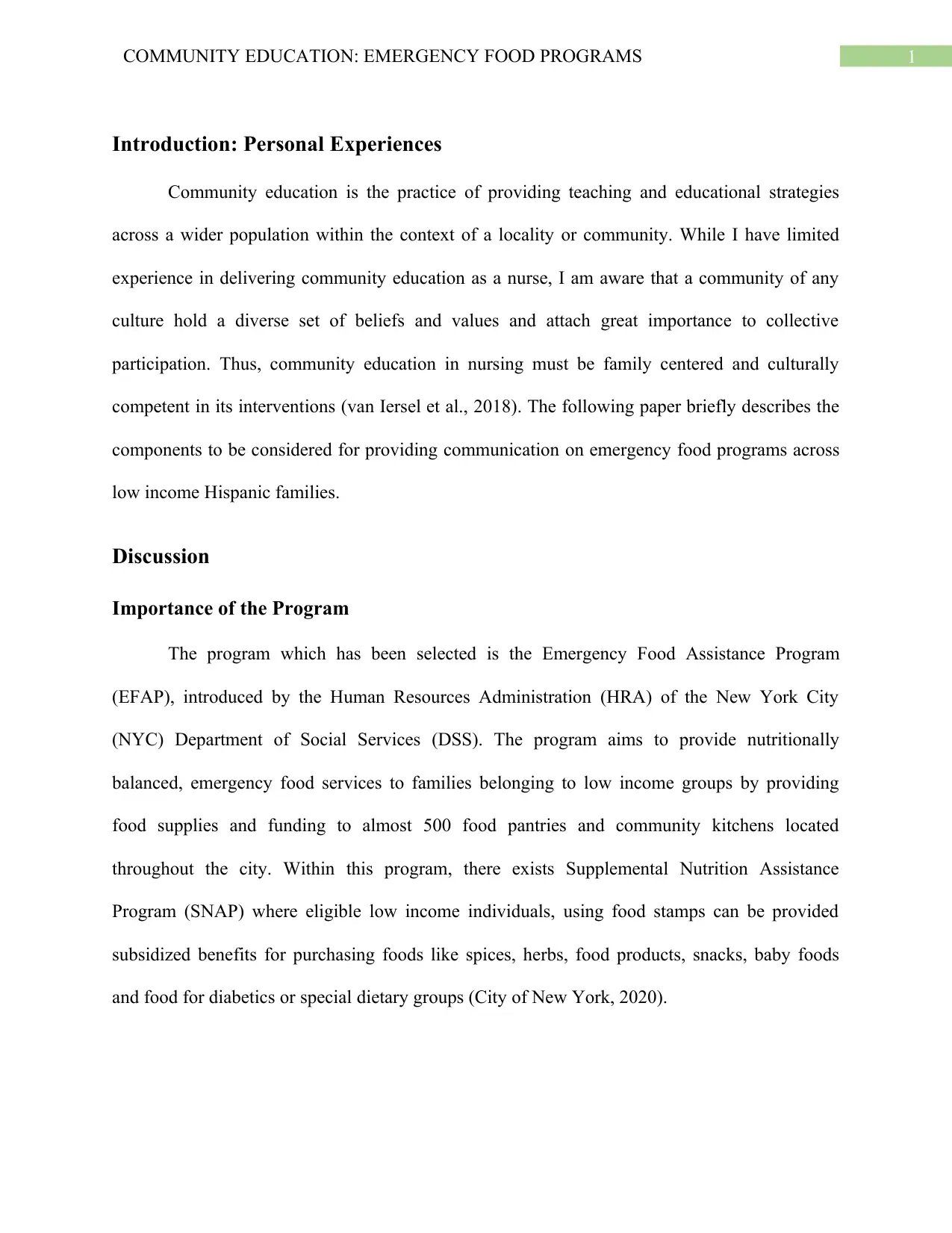
1COMMUNITY EDUCATION: EMERGENCY FOOD PROGRAMS
Introduction: Personal Experiences
Community education is the practice of providing teaching and educational strategies
across a wider population within the context of a locality or community. While I have limited
experience in delivering community education as a nurse, I am aware that a community of any
culture hold a diverse set of beliefs and values and attach great importance to collective
participation. Thus, community education in nursing must be family centered and culturally
competent in its interventions (van Iersel et al., 2018). The following paper briefly describes the
components to be considered for providing communication on emergency food programs across
low income Hispanic families.
Discussion
Importance of the Program
The program which has been selected is the Emergency Food Assistance Program
(EFAP), introduced by the Human Resources Administration (HRA) of the New York City
(NYC) Department of Social Services (DSS). The program aims to provide nutritionally
balanced, emergency food services to families belonging to low income groups by providing
food supplies and funding to almost 500 food pantries and community kitchens located
throughout the city. Within this program, there exists Supplemental Nutrition Assistance
Program (SNAP) where eligible low income individuals, using food stamps can be provided
subsidized benefits for purchasing foods like spices, herbs, food products, snacks, baby foods
and food for diabetics or special dietary groups (City of New York, 2020).
Document Page
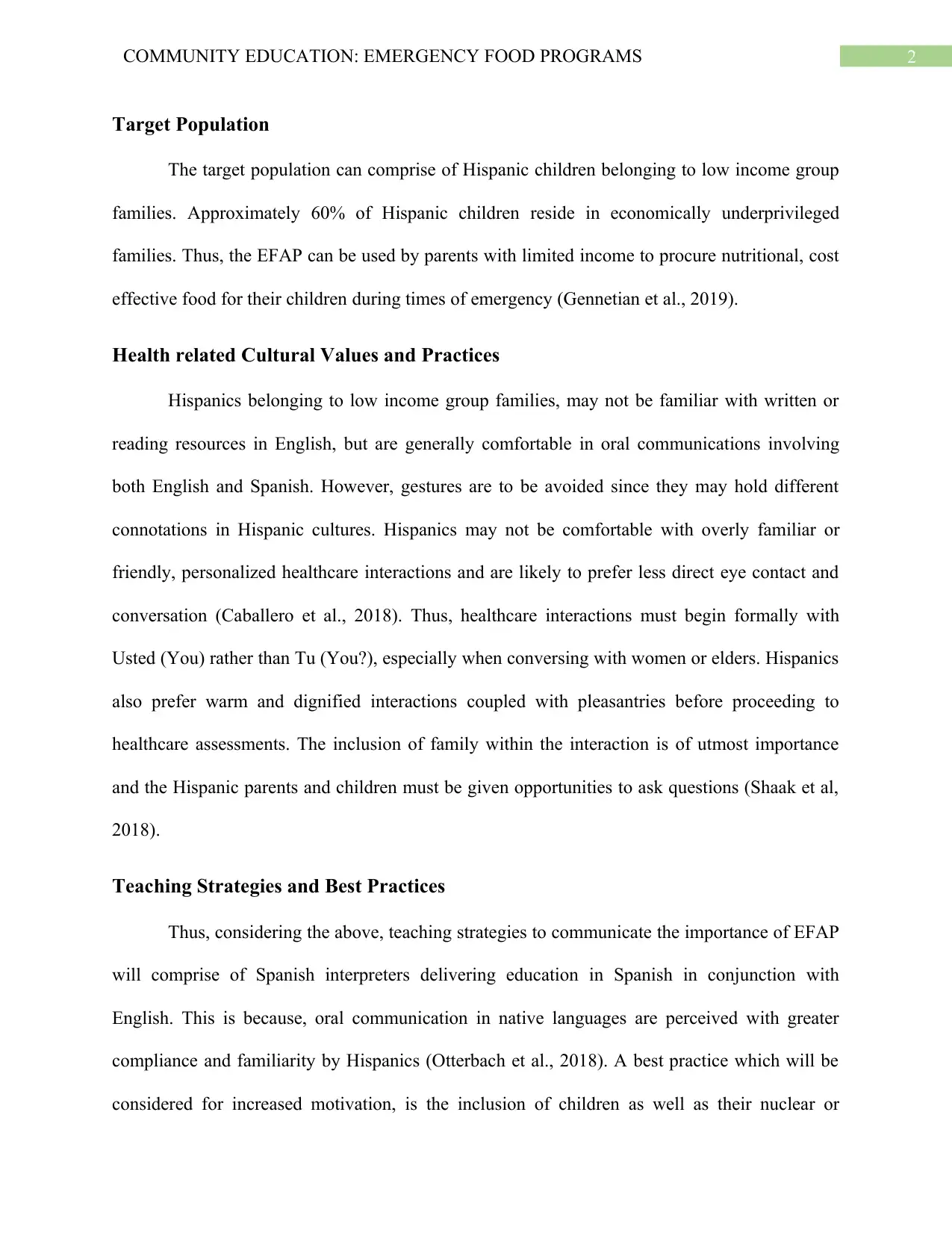
2COMMUNITY EDUCATION: EMERGENCY FOOD PROGRAMS
Target Population
The target population can comprise of Hispanic children belonging to low income group
families. Approximately 60% of Hispanic children reside in economically underprivileged
families. Thus, the EFAP can be used by parents with limited income to procure nutritional, cost
effective food for their children during times of emergency (Gennetian et al., 2019).
Health related Cultural Values and Practices
Hispanics belonging to low income group families, may not be familiar with written or
reading resources in English, but are generally comfortable in oral communications involving
both English and Spanish. However, gestures are to be avoided since they may hold different
connotations in Hispanic cultures. Hispanics may not be comfortable with overly familiar or
friendly, personalized healthcare interactions and are likely to prefer less direct eye contact and
conversation (Caballero et al., 2018). Thus, healthcare interactions must begin formally with
Usted (You) rather than Tu (You?), especially when conversing with women or elders. Hispanics
also prefer warm and dignified interactions coupled with pleasantries before proceeding to
healthcare assessments. The inclusion of family within the interaction is of utmost importance
and the Hispanic parents and children must be given opportunities to ask questions (Shaak et al,
2018).
Teaching Strategies and Best Practices
Thus, considering the above, teaching strategies to communicate the importance of EFAP
will comprise of Spanish interpreters delivering education in Spanish in conjunction with
English. This is because, oral communication in native languages are perceived with greater
compliance and familiarity by Hispanics (Otterbach et al., 2018). A best practice which will be
considered for increased motivation, is the inclusion of children as well as their nuclear or
Document Page
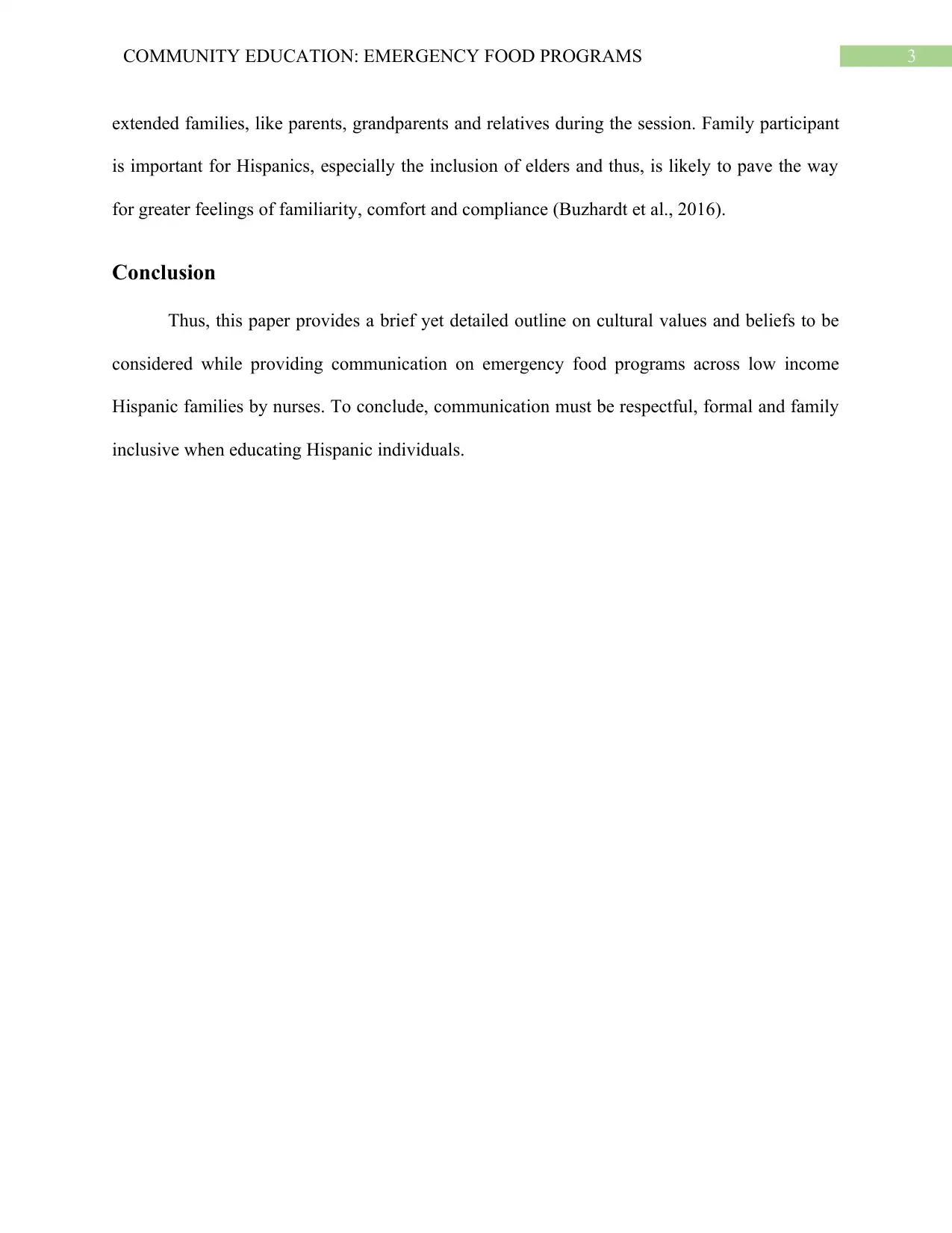
3COMMUNITY EDUCATION: EMERGENCY FOOD PROGRAMS
extended families, like parents, grandparents and relatives during the session. Family participant
is important for Hispanics, especially the inclusion of elders and thus, is likely to pave the way
for greater feelings of familiarity, comfort and compliance (Buzhardt et al., 2016).
Conclusion
Thus, this paper provides a brief yet detailed outline on cultural values and beliefs to be
considered while providing communication on emergency food programs across low income
Hispanic families by nurses. To conclude, communication must be respectful, formal and family
inclusive when educating Hispanic individuals.
tabler-icon-diamond-filled.svg

Paraphrase This Document

Need a fresh take? Get an instant paraphrase of this document with our AI Paraphraser
Document Page
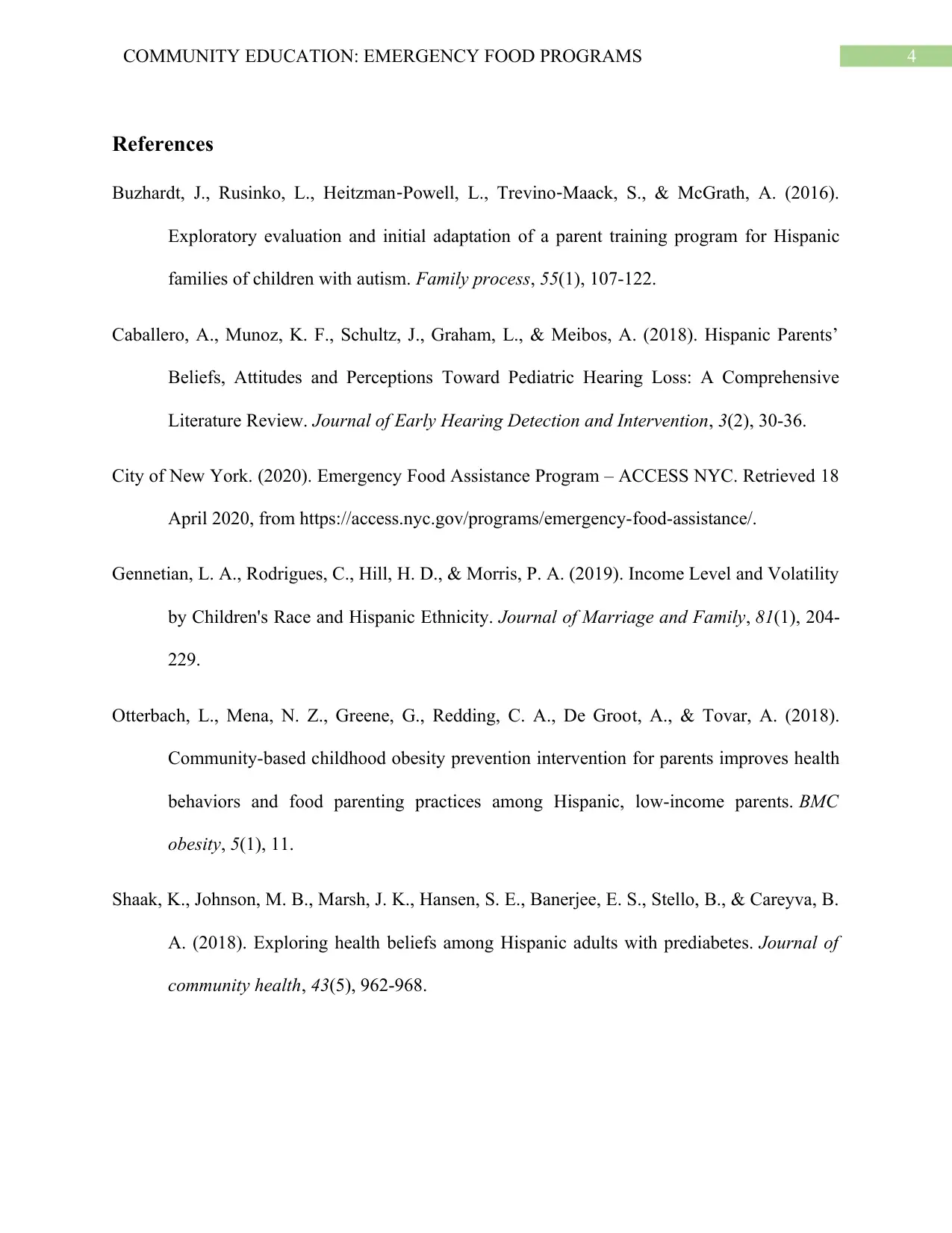
4COMMUNITY EDUCATION: EMERGENCY FOOD PROGRAMS
References
Buzhardt, J., Rusinko, L., HeitzmanPowell, L., TrevinoMaack, S., & McGrath, A. (2016).
Exploratory evaluation and initial adaptation of a parent training program for Hispanic
families of children with autism. Family process, 55(1), 107-122.
Caballero, A., Munoz, K. F., Schultz, J., Graham, L., & Meibos, A. (2018). Hispanic Parents’
Beliefs, Attitudes and Perceptions Toward Pediatric Hearing Loss: A Comprehensive
Literature Review. Journal of Early Hearing Detection and Intervention, 3(2), 30-36.
City of New York. (2020). Emergency Food Assistance Program – ACCESS NYC. Retrieved 18
April 2020, from https://access.nyc.gov/programs/emergency-food-assistance/.
Gennetian, L. A., Rodrigues, C., Hill, H. D., & Morris, P. A. (2019). Income Level and Volatility
by Children's Race and Hispanic Ethnicity. Journal of Marriage and Family, 81(1), 204-
229.
Otterbach, L., Mena, N. Z., Greene, G., Redding, C. A., De Groot, A., & Tovar, A. (2018).
Community-based childhood obesity prevention intervention for parents improves health
behaviors and food parenting practices among Hispanic, low-income parents. BMC
obesity, 5(1), 11.
Shaak, K., Johnson, M. B., Marsh, J. K., Hansen, S. E., Banerjee, E. S., Stello, B., & Careyva, B.
A. (2018). Exploring health beliefs among Hispanic adults with prediabetes. Journal of
community health, 43(5), 962-968.
Document Page
5COMMUNITY EDUCATION: EMERGENCY FOOD PROGRAMS
van Iersel, M., Latour, C. H., De Vos, R., Kirschner, P. A., & op Reimer, W. J. S. (2018).
Perceptions of community care and placement preferences in first-year nursing students:
a multicentre, cross-sectional study. Nurse education today, 60, 92-97.
chevron_up_icon
1 out of 6
circle_padding
hide_on_mobile
zoom_out_icon
[object Object]