BIPX202: Community Engagement: Building Strengths and Capabilities
VerifiedAdded on 2022/10/19
|13
|2668
|437
Report
AI Summary
This report delves into the critical concept of community engagement, emphasizing its significance in fostering employee professionalism and organizational success. It explores the multifaceted relationship between organizations and their surrounding communities, highlighting the benefits derived from strong community ties. The report examines various types of community engagement, including community-based, advocacy, direct, and project-based approaches, while also analyzing the skills acquired and challenges faced by employees and volunteers. Furthermore, it dissects the theoretical framework of community engagement, encompassing pillars such as building connections, acting with humility, developing understanding, affirming dignity, and pursuing justice. The analysis draws upon existing literature to provide a comprehensive understanding of the subject, concluding with a summary of key findings and insights into the practical implications of community engagement.

Student’s Last Name 1
BIPX202: Community Engagement: Building Strengths and Capabilities
By (Name)
Course
Professor
University
Date
BIPX202: Community Engagement: Building Strengths and Capabilities
By (Name)
Course
Professor
University
Date

Paraphrase This Document
Need a fresh take? Get an instant paraphrase of this document with our AI Paraphraser
Student’s Last Name 2
Executive Summary
The concept of community engagement is vital in establishing employee professionalism.
Considering that no organization exists in a vacuum, strong relationships between the employees
and the community is fundamental for the success of the organization. It is almost impossible for
a firm to isolate itself from the affairs of the nearby community. Firms and companies that form
good relationships with their communities derive benefits from the concept of community
engagement. Every organization needs to consider the social-economic and environmental
situations of the nearby communities. This report paper attempts to thoroughly examine the
concept of community engagement between organizations and their respective communities. The
paper investigates the various types of community engagement, the skills required and
challenges faced by employees and volunteers in community-engaged services as well as the
personal and professional abilities that can be achieved from the concept of community
engagement. Furthermore, the paper discusses in detail the concepts' theoretical framework
which comprises of pillars such as building connections, acting with humility, affirming the
dignity, developing understanding and pursuing justice. The paper will rely heavily on existing
literature concerned with the concept of community engagement. A strong conclusion would act
as a summary of the paper.
Executive Summary
The concept of community engagement is vital in establishing employee professionalism.
Considering that no organization exists in a vacuum, strong relationships between the employees
and the community is fundamental for the success of the organization. It is almost impossible for
a firm to isolate itself from the affairs of the nearby community. Firms and companies that form
good relationships with their communities derive benefits from the concept of community
engagement. Every organization needs to consider the social-economic and environmental
situations of the nearby communities. This report paper attempts to thoroughly examine the
concept of community engagement between organizations and their respective communities. The
paper investigates the various types of community engagement, the skills required and
challenges faced by employees and volunteers in community-engaged services as well as the
personal and professional abilities that can be achieved from the concept of community
engagement. Furthermore, the paper discusses in detail the concepts' theoretical framework
which comprises of pillars such as building connections, acting with humility, affirming the
dignity, developing understanding and pursuing justice. The paper will rely heavily on existing
literature concerned with the concept of community engagement. A strong conclusion would act
as a summary of the paper.
Student’s Last Name 3
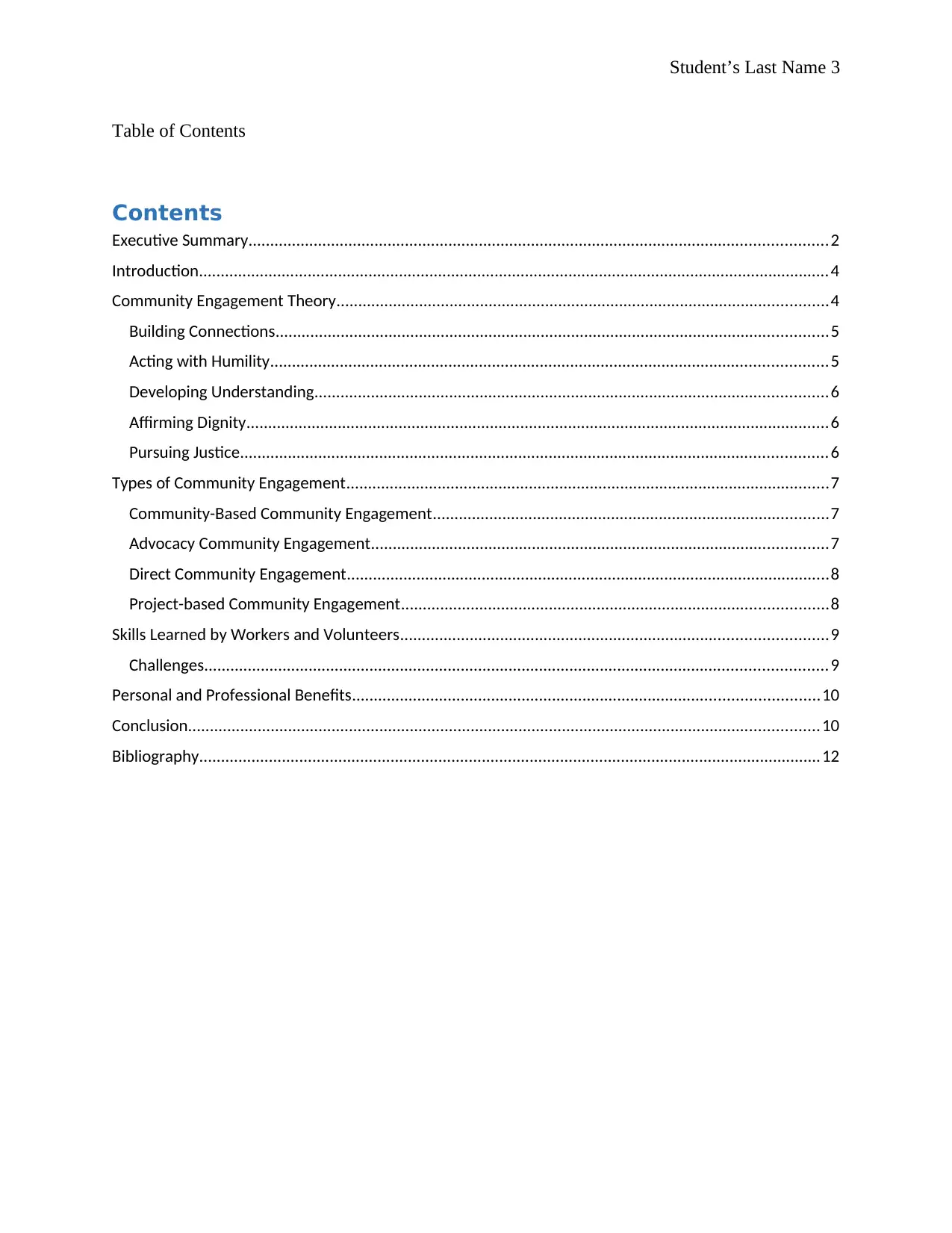
Table of Contents
Contents
Executive Summary.....................................................................................................................................2
Introduction.................................................................................................................................................4
Community Engagement Theory.................................................................................................................4
Building Connections...............................................................................................................................5
Acting with Humility................................................................................................................................5
Developing Understanding......................................................................................................................6
Affirming Dignity......................................................................................................................................6
Pursuing Justice.......................................................................................................................................6
Types of Community Engagement...............................................................................................................7
Community-Based Community Engagement...........................................................................................7
Advocacy Community Engagement.........................................................................................................7
Direct Community Engagement...............................................................................................................8
Project-based Community Engagement..................................................................................................8
Skills Learned by Workers and Volunteers..................................................................................................9
Challenges...............................................................................................................................................9
Personal and Professional Benefits...........................................................................................................10
Conclusion.................................................................................................................................................10
Bibliography...............................................................................................................................................12
Table of Contents
Contents
Executive Summary.....................................................................................................................................2
Introduction.................................................................................................................................................4
Community Engagement Theory.................................................................................................................4
Building Connections...............................................................................................................................5
Acting with Humility................................................................................................................................5
Developing Understanding......................................................................................................................6
Affirming Dignity......................................................................................................................................6
Pursuing Justice.......................................................................................................................................6
Types of Community Engagement...............................................................................................................7
Community-Based Community Engagement...........................................................................................7
Advocacy Community Engagement.........................................................................................................7
Direct Community Engagement...............................................................................................................8
Project-based Community Engagement..................................................................................................8
Skills Learned by Workers and Volunteers..................................................................................................9
Challenges...............................................................................................................................................9
Personal and Professional Benefits...........................................................................................................10
Conclusion.................................................................................................................................................10
Bibliography...............................................................................................................................................12
⊘ This is a preview!⊘
Do you want full access?
Subscribe today to unlock all pages.

Trusted by 1+ million students worldwide
Student’s Last Name 4
Introduction
Despite increased profits being the major objective for corporate organizations, efficiency
exists as the other equally important objective. In essence, firms that end up amassing
considerable profits firstly achieve efficiency in their production and operation activities. The
surrounding community plays a significant role in organizations' endeavours to achieve
efficiency. In simple terms, a firm's efficiency is facilitated by the surrounding community. It is
of great necessity, therefore, for organizations to develop healthy community relationships with
the community. This idea is referred to as community engagement. As the name suggests,
organizations are required to engage their surrounding communities in their production activities.
Organizations should not only focus on increasing their profits but also focus on improving the
welfare of their respective communities. This report aims to critically analyze the concept of
community engagement, its types, benefits, and challenges. The paper mainly seeks to establish
the impact of community engagement on employees and volunteers. Both the ideally theoretical
and the practical effects of community engagement are sufficiently discussed.
Community Engagement Theory
To derive social benefits and outcomes, both the organization and the community need
to be actively involved in forming permanent and effective relationships. According to Brodie, et
al., (2013, pp. 105), the community, which acts as the major consumer to any organization needs
to be engaged in repetitive and interactive sessions. The scholars further substitute the word
‘community’ for ‘consumer’. Community engagement can be defined as society's proactive
involvement in constructing its personalized experience with the organization through active and
Introduction
Despite increased profits being the major objective for corporate organizations, efficiency
exists as the other equally important objective. In essence, firms that end up amassing
considerable profits firstly achieve efficiency in their production and operation activities. The
surrounding community plays a significant role in organizations' endeavours to achieve
efficiency. In simple terms, a firm's efficiency is facilitated by the surrounding community. It is
of great necessity, therefore, for organizations to develop healthy community relationships with
the community. This idea is referred to as community engagement. As the name suggests,
organizations are required to engage their surrounding communities in their production activities.
Organizations should not only focus on increasing their profits but also focus on improving the
welfare of their respective communities. This report aims to critically analyze the concept of
community engagement, its types, benefits, and challenges. The paper mainly seeks to establish
the impact of community engagement on employees and volunteers. Both the ideally theoretical
and the practical effects of community engagement are sufficiently discussed.
Community Engagement Theory
To derive social benefits and outcomes, both the organization and the community need
to be actively involved in forming permanent and effective relationships. According to Brodie, et
al., (2013, pp. 105), the community, which acts as the major consumer to any organization needs
to be engaged in repetitive and interactive sessions. The scholars further substitute the word
‘community’ for ‘consumer’. Community engagement can be defined as society's proactive
involvement in constructing its personalized experience with the organization through active and
Paraphrase This Document
Need a fresh take? Get an instant paraphrase of this document with our AI Paraphraser
Student’s Last Name 5
explicit interactions (Hollebeek, 2011, pp. 556). As a theory, community engagement has five
main pillars.
Building Connections
According to Paterson and Best (2015, pp. 156) building community connections is one
of the most fundamental objectives for any organization. Building connection and links with the
community is the pillars that enables community-engaged organizations to acquire bigger market
shares. Community engagement is attributed to boosting customer involvement, trust, and loyalty
to an organization (Islam and Rahman, 2016, pp. 50). Loyalty and trust among community
members are likely to translate to increased customer bases and higher profits. When a
community is engaged by an organization, there forms a bond between the two entities. These
bonds eventually turn into the connective link between the organization and the community.
Both entities benefit from these connections. Both the community and the community have easy
access to each other.
Acting with Humility
Acting with humility pillar enables an organization to work collaboratively with the
community and not ‘for' the sake of the community (Wyborn, 2012, pp.47). This pillar of
community engagement keeps the organization from arrogance and flexing its muscles to
society. The pillar ensures the organization's activities are played in low key. The pillar prevents
the many clashes that could have been experienced if the organization operates without
considering the community. Before making big moves such as establishing new ventures, for
instance, organizations need to act humble and involve the community during decision-making
explicit interactions (Hollebeek, 2011, pp. 556). As a theory, community engagement has five
main pillars.
Building Connections
According to Paterson and Best (2015, pp. 156) building community connections is one
of the most fundamental objectives for any organization. Building connection and links with the
community is the pillars that enables community-engaged organizations to acquire bigger market
shares. Community engagement is attributed to boosting customer involvement, trust, and loyalty
to an organization (Islam and Rahman, 2016, pp. 50). Loyalty and trust among community
members are likely to translate to increased customer bases and higher profits. When a
community is engaged by an organization, there forms a bond between the two entities. These
bonds eventually turn into the connective link between the organization and the community.
Both entities benefit from these connections. Both the community and the community have easy
access to each other.
Acting with Humility
Acting with humility pillar enables an organization to work collaboratively with the
community and not ‘for' the sake of the community (Wyborn, 2012, pp.47). This pillar of
community engagement keeps the organization from arrogance and flexing its muscles to
society. The pillar ensures the organization's activities are played in low key. The pillar prevents
the many clashes that could have been experienced if the organization operates without
considering the community. Before making big moves such as establishing new ventures, for
instance, organizations need to act humble and involve the community during decision-making
Student’s Last Name 6
processes. The community may have different opinions that could reduce adverse effects such as
pollution or degradation of natural resources.
Developing Understanding
The pillar ensures that there is a clear understanding between the community and the
organization. Newman and Rubincam (2014, pp. 1557) assert that mutual understanding
between organizations and their respective communities is imperative for the success of
organizations. When organizations and their communities interact, it becomes easy for each to
understand each other. If the two entities have contradicting objectives, the two try to reach a
consensus that would to a win-win situation.
Affirming Dignity
This pillar focuses on promoting the observance of human rights. Community
engagement ensures that the organization’s practices do not violate universally held human
rights. Human rights such as life, liberty, and the pursuit of happiness are treated as unalienable
rights that were awarded to the human race by their Creators. Therefore, the community
engagement pillar ensures that in its activities, the universal human rights of its staff, third
parties, and the community are not infringed. For example, the working hours of employees are
highly considered when analyzing their welfare. The pillar ensures that the welfare of both the
employees and the community are not overstepped.
Pursuing Justice
Apart from promoting the observance of human rights, community engagement
recognizes the concepts of justice and equality in organizational activities. Organizations are
processes. The community may have different opinions that could reduce adverse effects such as
pollution or degradation of natural resources.
Developing Understanding
The pillar ensures that there is a clear understanding between the community and the
organization. Newman and Rubincam (2014, pp. 1557) assert that mutual understanding
between organizations and their respective communities is imperative for the success of
organizations. When organizations and their communities interact, it becomes easy for each to
understand each other. If the two entities have contradicting objectives, the two try to reach a
consensus that would to a win-win situation.
Affirming Dignity
This pillar focuses on promoting the observance of human rights. Community
engagement ensures that the organization’s practices do not violate universally held human
rights. Human rights such as life, liberty, and the pursuit of happiness are treated as unalienable
rights that were awarded to the human race by their Creators. Therefore, the community
engagement pillar ensures that in its activities, the universal human rights of its staff, third
parties, and the community are not infringed. For example, the working hours of employees are
highly considered when analyzing their welfare. The pillar ensures that the welfare of both the
employees and the community are not overstepped.
Pursuing Justice
Apart from promoting the observance of human rights, community engagement
recognizes the concepts of justice and equality in organizational activities. Organizations are
⊘ This is a preview!⊘
Do you want full access?
Subscribe today to unlock all pages.
Trusted by 1+ million students worldwide
Student’s Last Name 7
required to uphold the rights and freedoms of every individual equally. Organizations which defy
to observe the concepts of equality are subjected to face justice systems. For instance, an
organization where there are wage disparities between men and women may be sued.
Types of Community Engagement
Community engagement appears in different forms. As seen above, the concept can exist
in a hypothetical setting. However, community engagement may be practical. Community
engagement is both a theoretical concept and a practical approach (Kimmel, et al., 2012, pp.
224). Some of the major types of community engagement entail advocacy, direct, community-
based and project-based community engagements.
Community-Based Community Engagement
In this type of community engagement, the welfare of the community is the central focus.
Although both the organization and the community may continue with their normal exercises, the
two chiefly target improving the welfare of the community. In some cases, organizations may
even suffer losses for the benefit of the community. These engagements are mainly formed
between communities and non-profit and charity operations. Such organizations include the
World Vision and RedCross.
Advocacy Community Engagement
Advocacy community engagements involve interaction between communities and
organizations that aim to create mass awareness about various issues such as LGBTQ rights,
racism, and female genital mutilation. According to Michaels, et al. (2012, pp. 71), advocacy
groups play a primary role in spreading the message from one society to another. Like most
required to uphold the rights and freedoms of every individual equally. Organizations which defy
to observe the concepts of equality are subjected to face justice systems. For instance, an
organization where there are wage disparities between men and women may be sued.
Types of Community Engagement
Community engagement appears in different forms. As seen above, the concept can exist
in a hypothetical setting. However, community engagement may be practical. Community
engagement is both a theoretical concept and a practical approach (Kimmel, et al., 2012, pp.
224). Some of the major types of community engagement entail advocacy, direct, community-
based and project-based community engagements.
Community-Based Community Engagement
In this type of community engagement, the welfare of the community is the central focus.
Although both the organization and the community may continue with their normal exercises, the
two chiefly target improving the welfare of the community. In some cases, organizations may
even suffer losses for the benefit of the community. These engagements are mainly formed
between communities and non-profit and charity operations. Such organizations include the
World Vision and RedCross.
Advocacy Community Engagement
Advocacy community engagements involve interaction between communities and
organizations that aim to create mass awareness about various issues such as LGBTQ rights,
racism, and female genital mutilation. According to Michaels, et al. (2012, pp. 71), advocacy
groups play a primary role in spreading the message from one society to another. Like most
Paraphrase This Document
Need a fresh take? Get an instant paraphrase of this document with our AI Paraphraser
Student’s Last Name 8
community-based community engagements, many advocacy community engagements are rooted
in a non-profit organization. Besides creating awareness, advocacies are also instrumental in
lobbying on legislation.
Direct Community Engagement
Direct community engagement is a type of engagement where the organization and the
community interact on a person-to-person basis. For instance, when a community is in need, the
community directly sends members of its staff to the community members to offer their material
and immaterial help. The organization, for instance, may set aside some of its funds and
resources and offer them to the society. This type of community engagement normally comes up
when communities experience calamities and disasters. For instance, during the famous Haiti
earthquake, many international organizations offered funds and resources to the Haiti
community. In a nutshell, direct community engagement entails the direct transfer of resources
from the organization to the community.
Project-based Community Engagement
Despite the need to benefit their nearby communities, organizations practising a project-
based type of community engagement subtly benefit but only by focusing more on their
objectives. Employees in these organizations are more focused to achieve the organization's
goals rather than meeting the community's needs. However, the practices of project-based
organizations must have some connected benefit to the community. For instance, an organization
that aims to protect indigenous and endangered animal species works mainly to achieve its
benefits. However, by achieving their objectives, the general situation of the community is also
improved. Moreover, research organizations that commit their lives to discover new technologies
community-based community engagements, many advocacy community engagements are rooted
in a non-profit organization. Besides creating awareness, advocacies are also instrumental in
lobbying on legislation.
Direct Community Engagement
Direct community engagement is a type of engagement where the organization and the
community interact on a person-to-person basis. For instance, when a community is in need, the
community directly sends members of its staff to the community members to offer their material
and immaterial help. The organization, for instance, may set aside some of its funds and
resources and offer them to the society. This type of community engagement normally comes up
when communities experience calamities and disasters. For instance, during the famous Haiti
earthquake, many international organizations offered funds and resources to the Haiti
community. In a nutshell, direct community engagement entails the direct transfer of resources
from the organization to the community.
Project-based Community Engagement
Despite the need to benefit their nearby communities, organizations practising a project-
based type of community engagement subtly benefit but only by focusing more on their
objectives. Employees in these organizations are more focused to achieve the organization's
goals rather than meeting the community's needs. However, the practices of project-based
organizations must have some connected benefit to the community. For instance, an organization
that aims to protect indigenous and endangered animal species works mainly to achieve its
benefits. However, by achieving their objectives, the general situation of the community is also
improved. Moreover, research organizations that commit their lives to discover new technologies
Student’s Last Name 9
always put their organizations' goals at the forefront. However, by realizing their dreams, the
whole community eventually gain the maximum.
Skills Learned by Workers and Volunteers
While working in organizations practising community engagement, members of staff are
likely to acquire certain characteristic proficiencies. For instance, virtues such as honesty,
transparency, patience, and persistence are normally learned when working in community-
engaged organizations (Rau, 2014, pp. 15). In community-engaged organizations, moreover,
employees learn new skills such as public speaking. For instance, workers serving large numbers
of community members may be required to arrange public awareness and seminars. During these
events, the employees and volunteers have to engage with the community members by
addressing and teaching them. By playing the roles of teachers, shy employees gain new skills in
public speaking. They can now speak publicly to large sums of people. Leadership skills are also
characteristic of workers and volunteers in community-engaged organizations. By serving the
community, employees and volunteers learn to become leaders. In many cases, community-
engaged organizations select team leaders to lead several employees to deal with a certain task in
the community. These team leaders are developed to become future leaders.
Challenges
Working or volunteering in a community-engaged organization also subjects workers to
certain challenges. Firstly, the remuneration in many small community-engaged is not any
inspiring. Due to fewer profitability activities, many community-engaged organizations pay less
to their employees (Holzer and Kass, 2015, pp. 119). Secondly, some communities may be
hostile to community-engaged organizations. Some of these communities may even pose danger
always put their organizations' goals at the forefront. However, by realizing their dreams, the
whole community eventually gain the maximum.
Skills Learned by Workers and Volunteers
While working in organizations practising community engagement, members of staff are
likely to acquire certain characteristic proficiencies. For instance, virtues such as honesty,
transparency, patience, and persistence are normally learned when working in community-
engaged organizations (Rau, 2014, pp. 15). In community-engaged organizations, moreover,
employees learn new skills such as public speaking. For instance, workers serving large numbers
of community members may be required to arrange public awareness and seminars. During these
events, the employees and volunteers have to engage with the community members by
addressing and teaching them. By playing the roles of teachers, shy employees gain new skills in
public speaking. They can now speak publicly to large sums of people. Leadership skills are also
characteristic of workers and volunteers in community-engaged organizations. By serving the
community, employees and volunteers learn to become leaders. In many cases, community-
engaged organizations select team leaders to lead several employees to deal with a certain task in
the community. These team leaders are developed to become future leaders.
Challenges
Working or volunteering in a community-engaged organization also subjects workers to
certain challenges. Firstly, the remuneration in many small community-engaged is not any
inspiring. Due to fewer profitability activities, many community-engaged organizations pay less
to their employees (Holzer and Kass, 2015, pp. 119). Secondly, some communities may be
hostile to community-engaged organizations. Some of these communities may even pose danger
⊘ This is a preview!⊘
Do you want full access?
Subscribe today to unlock all pages.
Trusted by 1+ million students worldwide
Student’s Last Name 10
to the employee. For instance, working for a community-engaged organization in war effaced
Iraq may be dangerous for the employee. Additionally, working in some areas may pose health
problems for some employees.
Personal and Professional Benefits
In recent years, the community-engaged organization has continued to hire more and
more individuals. Many employees seem to assume the relatively low salaries offered by these
companies due to various reasons. Firstly, despite the low salaries, there are high allowances in
community-engaged organizations. Secondly, there are higher chances of promotions in
community-engaged organizations. These two reasons are among the major reasons why many
employees leave lucrative jobs and get enrolled in community-engaged organizations. Thirdly,
working in community-engaged organizations serve to improve the quality of an employee's
curriculum vitae. Employers prefer individuals that have worked under community-engaged
organizations.
Working under a community-engaged organization also adds professional skills. For
instance, lawyers who work under in advocacy community-engaged organizations may turn into
popular activists. Fame can be attributed to the communities they are advocating for. Moreover,
volunteers and interns acquire exposure that is significant for their later careers.
Conclusion
To conclude, community engagement is fundamental for organizations to operate
efficiently. Organizations that employ the community engagement theory five pillars are likely to
enjoy healthy relationships with their respective communities. As seen, community engagement
to the employee. For instance, working for a community-engaged organization in war effaced
Iraq may be dangerous for the employee. Additionally, working in some areas may pose health
problems for some employees.
Personal and Professional Benefits
In recent years, the community-engaged organization has continued to hire more and
more individuals. Many employees seem to assume the relatively low salaries offered by these
companies due to various reasons. Firstly, despite the low salaries, there are high allowances in
community-engaged organizations. Secondly, there are higher chances of promotions in
community-engaged organizations. These two reasons are among the major reasons why many
employees leave lucrative jobs and get enrolled in community-engaged organizations. Thirdly,
working in community-engaged organizations serve to improve the quality of an employee's
curriculum vitae. Employers prefer individuals that have worked under community-engaged
organizations.
Working under a community-engaged organization also adds professional skills. For
instance, lawyers who work under in advocacy community-engaged organizations may turn into
popular activists. Fame can be attributed to the communities they are advocating for. Moreover,
volunteers and interns acquire exposure that is significant for their later careers.
Conclusion
To conclude, community engagement is fundamental for organizations to operate
efficiently. Organizations that employ the community engagement theory five pillars are likely to
enjoy healthy relationships with their respective communities. As seen, community engagement
Paraphrase This Document
Need a fresh take? Get an instant paraphrase of this document with our AI Paraphraser

Student’s Last Name 11
helps in promoting healthy relationships between the organization and the community.
Community-engaged organized are characterized by loyal customers who may lead to increased
sales and profits for the organization. Modern organizations should practice at least one type of
community engagement. Although organizations practising community engagement suffer from
some limitations, personal and professional skills, as well as benefits, offset the challenges.
helps in promoting healthy relationships between the organization and the community.
Community-engaged organized are characterized by loyal customers who may lead to increased
sales and profits for the organization. Modern organizations should practice at least one type of
community engagement. Although organizations practising community engagement suffer from
some limitations, personal and professional skills, as well as benefits, offset the challenges.
Student’s Last Name 12
Bibliography
Brodie, R.J., Ilic, A., Juric, B. and Hollebeek, L., 2013. Consumer engagement in a virtual brand
community: An exploratory analysis. Journal of business research, 66(1), pp.105-114.
Hollebeek, L., 2011. Exploring customer brand engagement: definition and themes. Journal of
strategic Marketing, 19(7), pp.555-573.
Holzer, J. and Kass, N., 2015. Understanding the supports of and challenges to community
engagement in the CTSAs. Clinical and translational science, 8(2), pp.116-122.
Islam, J.U. and Rahman, Z., 2016. Linking customer engagement to trust and word-of-mouth on
Facebook brand communities: An empirical study. Journal of Internet Commerce, 15(1), pp.40-
58.
Kimmel, C.E., Hull, R.B., Stephenson, M.O., Robertson, D.P. and Cowgill, K.H., 2012. Building
community capacity and social infrastructure through landcare: a case study of land grant
engagement. Higher Education, 64(2), pp.223-235.
Michaels, M., Weiss, E.S., Guidry, J.A., Blakeney, N., Swords, L., Gibbs, B., Yeun, S.,
Rytkonen, B., Goodman, R., Jarama, S.L. and Greene, A.L., 2012. The promise of community-
based advocacy and education efforts for increasing cancer clinical trials accrual. Journal of
Cancer Education, 27(1), pp.67-74.
Newman, P.A. and Rubincam, C., 2014. Advancing community stakeholder engagement in
biomedical HIV prevention trials: principles, practices and evidence. Expert review of
vaccines, 13(12), pp.1553-1562.
Bibliography
Brodie, R.J., Ilic, A., Juric, B. and Hollebeek, L., 2013. Consumer engagement in a virtual brand
community: An exploratory analysis. Journal of business research, 66(1), pp.105-114.
Hollebeek, L., 2011. Exploring customer brand engagement: definition and themes. Journal of
strategic Marketing, 19(7), pp.555-573.
Holzer, J. and Kass, N., 2015. Understanding the supports of and challenges to community
engagement in the CTSAs. Clinical and translational science, 8(2), pp.116-122.
Islam, J.U. and Rahman, Z., 2016. Linking customer engagement to trust and word-of-mouth on
Facebook brand communities: An empirical study. Journal of Internet Commerce, 15(1), pp.40-
58.
Kimmel, C.E., Hull, R.B., Stephenson, M.O., Robertson, D.P. and Cowgill, K.H., 2012. Building
community capacity and social infrastructure through landcare: a case study of land grant
engagement. Higher Education, 64(2), pp.223-235.
Michaels, M., Weiss, E.S., Guidry, J.A., Blakeney, N., Swords, L., Gibbs, B., Yeun, S.,
Rytkonen, B., Goodman, R., Jarama, S.L. and Greene, A.L., 2012. The promise of community-
based advocacy and education efforts for increasing cancer clinical trials accrual. Journal of
Cancer Education, 27(1), pp.67-74.
Newman, P.A. and Rubincam, C., 2014. Advancing community stakeholder engagement in
biomedical HIV prevention trials: principles, practices and evidence. Expert review of
vaccines, 13(12), pp.1553-1562.
⊘ This is a preview!⊘
Do you want full access?
Subscribe today to unlock all pages.
Trusted by 1+ million students worldwide

1 out of 13


Related Documents


Your All-in-One AI-Powered Toolkit for Academic Success.
+13062052269
info@desklib.com
Available 24*7 on WhatsApp / Email
![[object Object]](/_next/static/media/star-bottom.7253800d.svg)
Unlock your academic potential
Copyright © 2020–2026 A2Z Services. All Rights Reserved. Developed and managed by ZUCOL.