NUR 4636C: Community Health Nursing Practice Data Assessment Report

Verified

Added on  2022/12/20

|12
|2193
|1
Report
AI Summary
This report presents a comprehensive community health assessment of Miami, Florida, based on data collected from various sources. It begins with an overview of population data, including vital statistics, mortality and morbidity rates, life expectancy, and race and gender distributions, comparing the community to county and state averages. The assessment then delves into social determinants of health, examining housing conditions, transportation, workplace health initiatives, recreational and educational facilities, places of worship, social services, and family income levels. Physical determinants, including environmental factors and sanitation, are also analyzed. The report evaluates health services across several dimensions: access, awareness, availability, affordability, accessibility, appropriateness, and adequacy. Policy making and health disparities are discussed, followed by a prioritization of health issues, including cardiovascular disease, chronic lower respiratory disease, substance and alcohol abuse, self-inflicted injuries, and contagious diseases. The report concludes with a reflection on the assignment, emphasizing the connection between community health and living conditions.
Document Page
0
Running Head: Nursing Community Research
NURSING COMMUNITY RESEARCH
tabler-icon-diamond-filled.svg

Paraphrase This Document

Need a fresh take? Get an instant paraphrase of this document with our AI Paraphraser
Document Page
1
Nursing Community Research
Part 1: Population Data
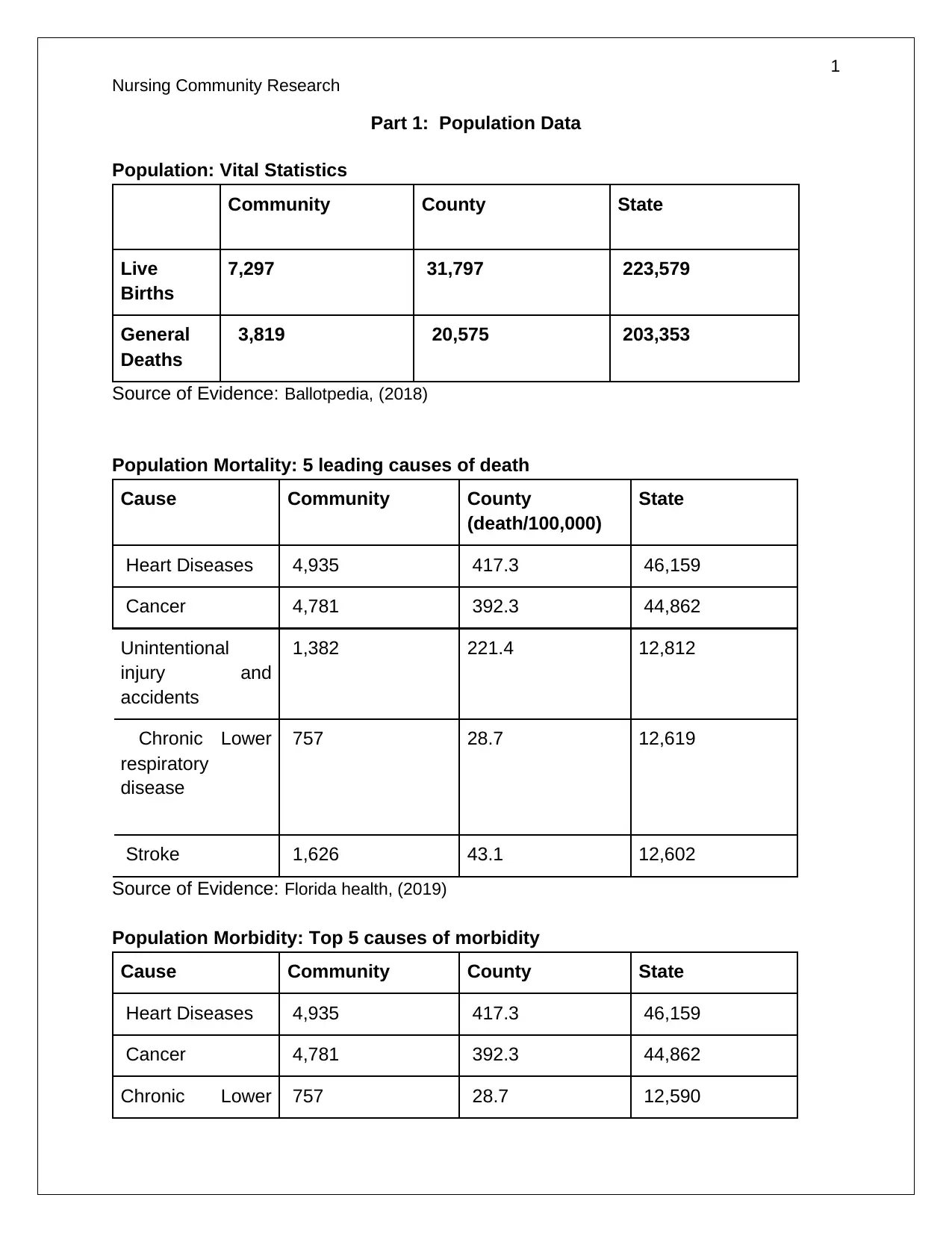
Population: Vital Statistics
Community County State
Live
Births
7,297 31,797 223,579
General
Deaths
3,819 20,575 203,353
Source of Evidence: Ballotpedia, (2018)
Population Mortality: 5 leading causes of death
Cause Community County
(death/100,000)
State
Heart Diseases 4,935 417.3 46,159
Cancer 4,781 392.3 44,862
Unintentional
injury and
accidents
1,382 221.4 12,812
Chronic Lower
respiratory
disease
757 28.7 12,619
Stroke 1,626 43.1 12,602
Source of Evidence: Florida health, (2019)
Population Morbidity: Top 5 causes of morbidity
Cause Community County State
Heart Diseases 4,935 417.3 46,159
Cancer 4,781 392.3 44,862
Chronic Lower 757 28.7 12,590
Document Page
2
Nursing Community Research
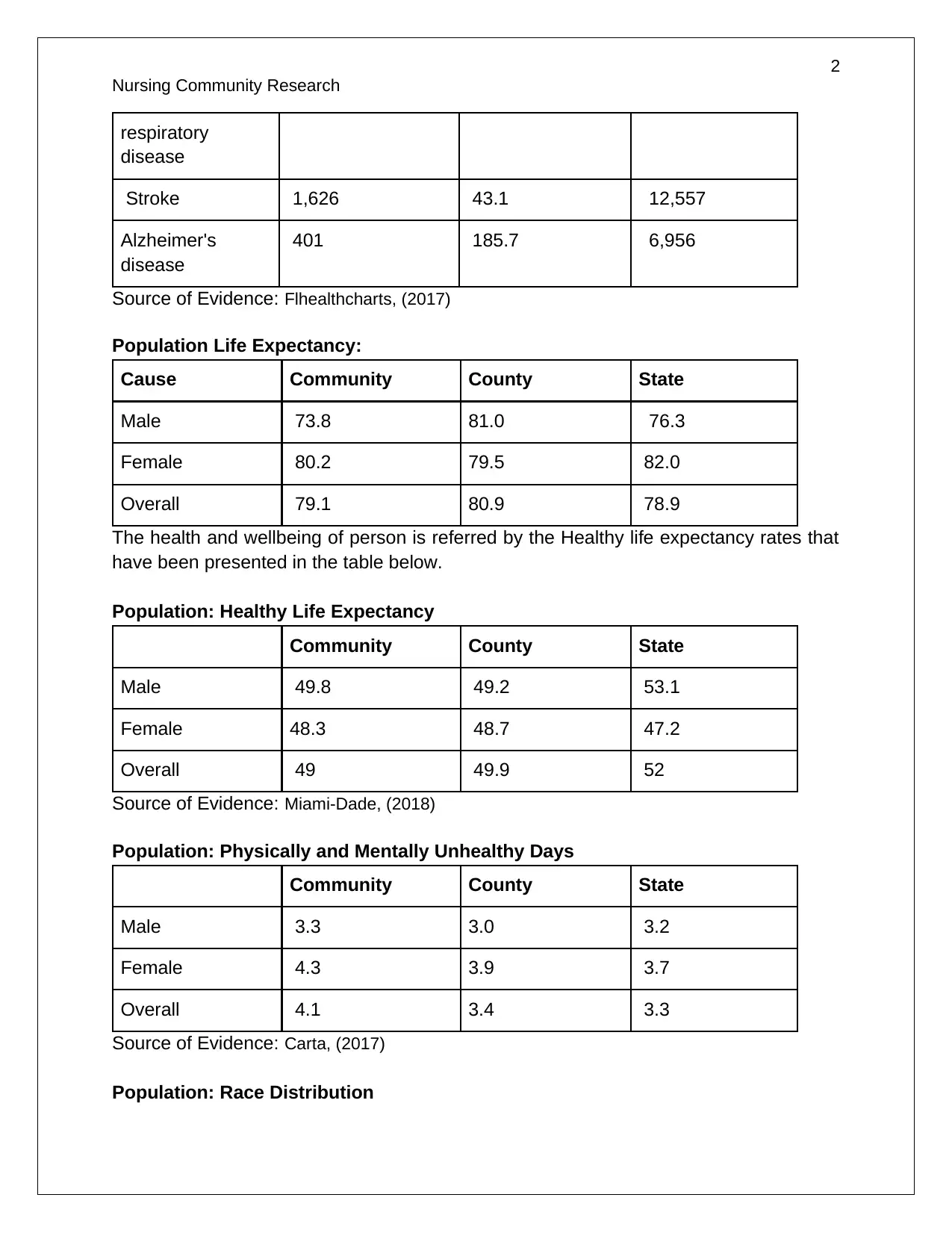
respiratory
disease
Stroke 1,626 43.1 12,557
Alzheimer's
disease
401 185.7 6,956
Source of Evidence: Flhealthcharts, (2017)
Population Life Expectancy:
Cause Community County State
Male 73.8 81.0 76.3
Female 80.2 79.5 82.0
Overall 79.1 80.9 78.9
The health and wellbeing of person is referred by the Healthy life expectancy rates that
have been presented in the table below.
Population: Healthy Life Expectancy
Community County State
Male 49.8 49.2 53.1
Female 48.3 48.7 47.2
Overall 49 49.9 52
Source of Evidence: Miami-Dade, (2018)
Population: Physically and Mentally Unhealthy Days
Community County State
Male 3.3 3.0 3.2
Female 4.3 3.9 3.7
Overall 4.1 3.4 3.3
Source of Evidence: Carta, (2017)
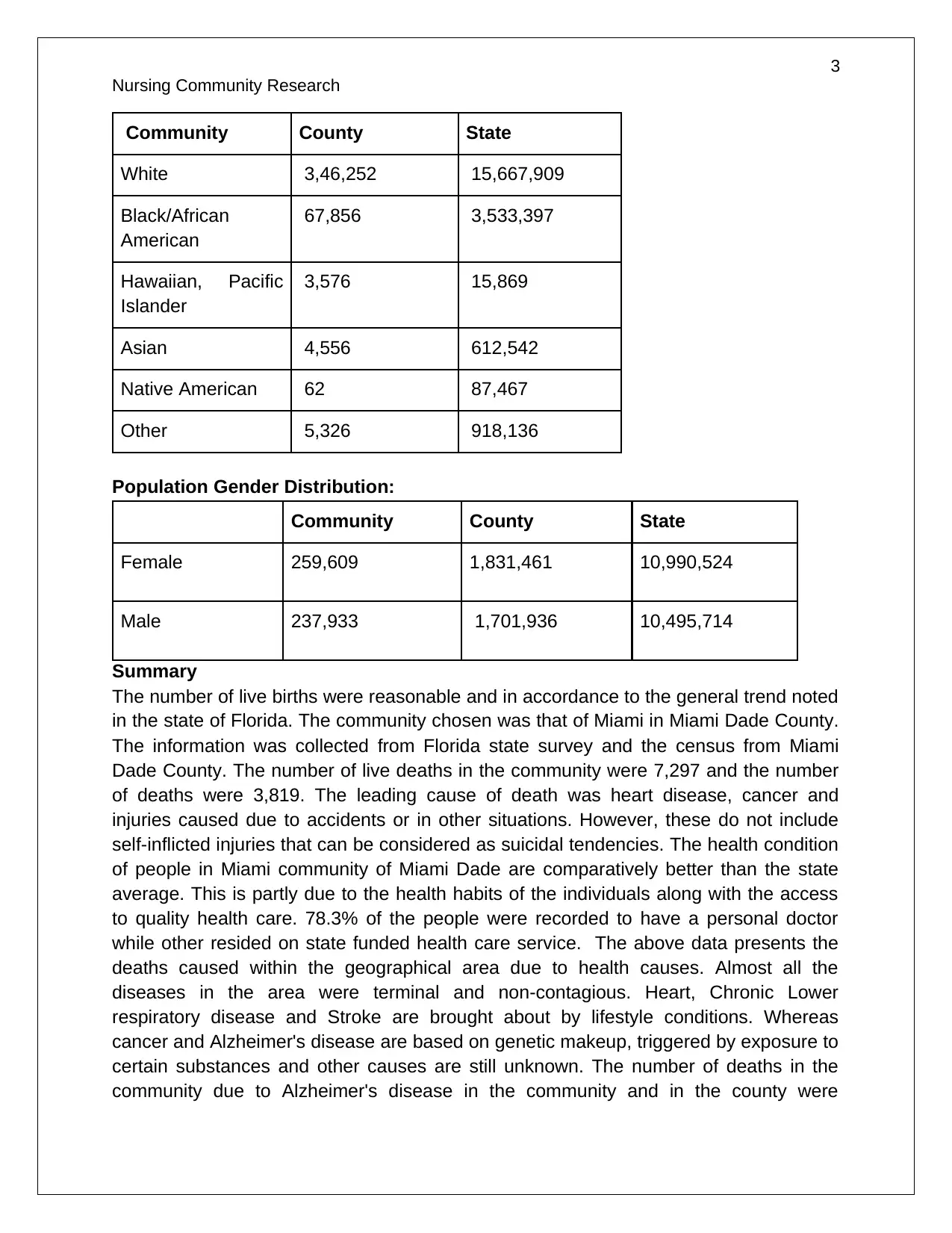
Population: Race Distribution
Document Page
3
Nursing Community Research
Community County State
White 3,46,252 15,667,909
Black/African
American
67,856 3,533,397
Hawaiian, Pacific
Islander
3,576 15,869
Asian 4,556 612,542
Native American 62 87,467
Other 5,326 918,136
Population Gender Distribution:
Community County State
Female 259,609 1,831,461 10,990,524
Male 237,933 1,701,936 10,495,714
Summary
The number of live births were reasonable and in accordance to the general trend noted
in the state of Florida. The community chosen was that of Miami in Miami Dade County.
The information was collected from Florida state survey and the census from Miami
Dade County. The number of live deaths in the community were 7,297 and the number
of deaths were 3,819. The leading cause of death was heart disease, cancer and
injuries caused due to accidents or in other situations. However, these do not include
self-inflicted injuries that can be considered as suicidal tendencies. The health condition
of people in Miami community of Miami Dade are comparatively better than the state
average. This is partly due to the health habits of the individuals along with the access
to quality health care. 78.3% of the people were recorded to have a personal doctor
while other resided on state funded health care service. The above data presents the
deaths caused within the geographical area due to health causes. Almost all the
diseases in the area were terminal and non-contagious. Heart, Chronic Lower
respiratory disease and Stroke are brought about by lifestyle conditions. Whereas
cancer and Alzheimer's disease are based on genetic makeup, triggered by exposure to
certain substances and other causes are still unknown. The number of deaths in the
community due to Alzheimer's disease in the community and in the county were
tabler-icon-diamond-filled.svg

Paraphrase This Document

Need a fresh take? Get an instant paraphrase of this document with our AI Paraphraser
Document Page
4
Nursing Community Research
comparatively higher than the average found in other counties and communities.
Access to private and public funded care organization are fairly available to all section
of people. Therefore, further information and research will be required to be able to
understand the reason behind the high rates of Alzheimer's disease in the chosen
community. The life expectancy in Florida and the communities are 2 years higher than
the overall average of the United States. This means that the people of Florida are likely
to live longer than people in other states. However, the longer life expectancy rates may
not necessarily mean that the people are healthier. Physically and mentally unhealthy
days are the average number of days a person feels unwell because of both mental and
physical reason within 30 days. The period of illness therefore accounts for physical,
emotional and social unhealth. The highest average in the country was noticed to be of
5.2 days whereas the lowest was about 3 days. Florida lies in the lower strata, when the
states are compared based on the period of unhealthy days. The inference drawn from
here can be that the communities in Florida are healthier in comparison to the other
states.
Part 2: Social Determinants
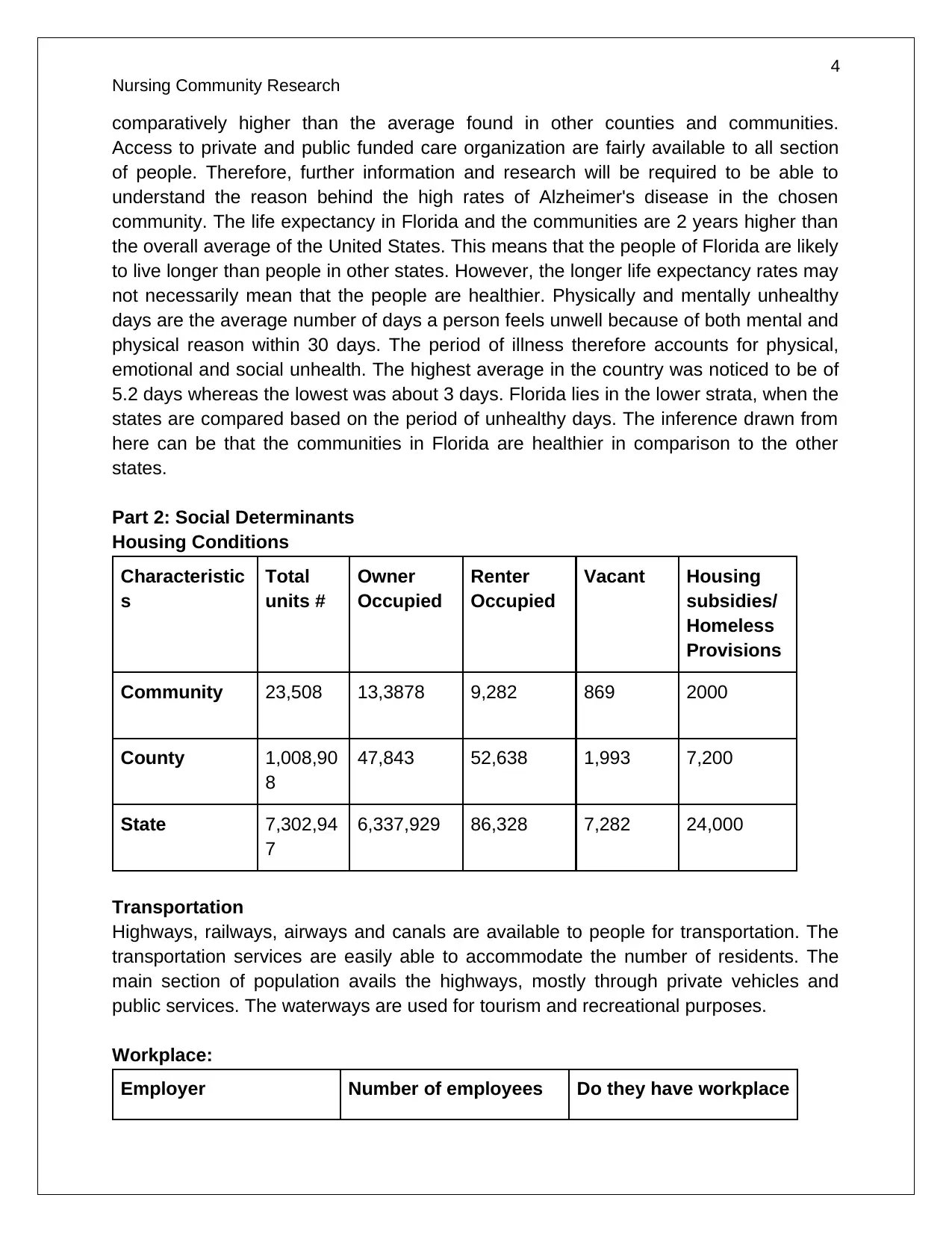
Housing Conditions
Characteristic
s
Total
units #
Owner
Occupied
Renter
Occupied
Vacant Housing
subsidies/
Homeless
Provisions
Community 23,508 13,3878 9,282 869 2000
County 1,008,90
8
47,843 52,638 1,993 7,200
State 7,302,94
7
6,337,929 86,328 7,282 24,000
Transportation
Highways, railways, airways and canals are available to people for transportation. The
transportation services are easily able to accommodate the number of residents. The
main section of population avails the highways, mostly through private vehicles and
public services. The waterways are used for tourism and recreational purposes.
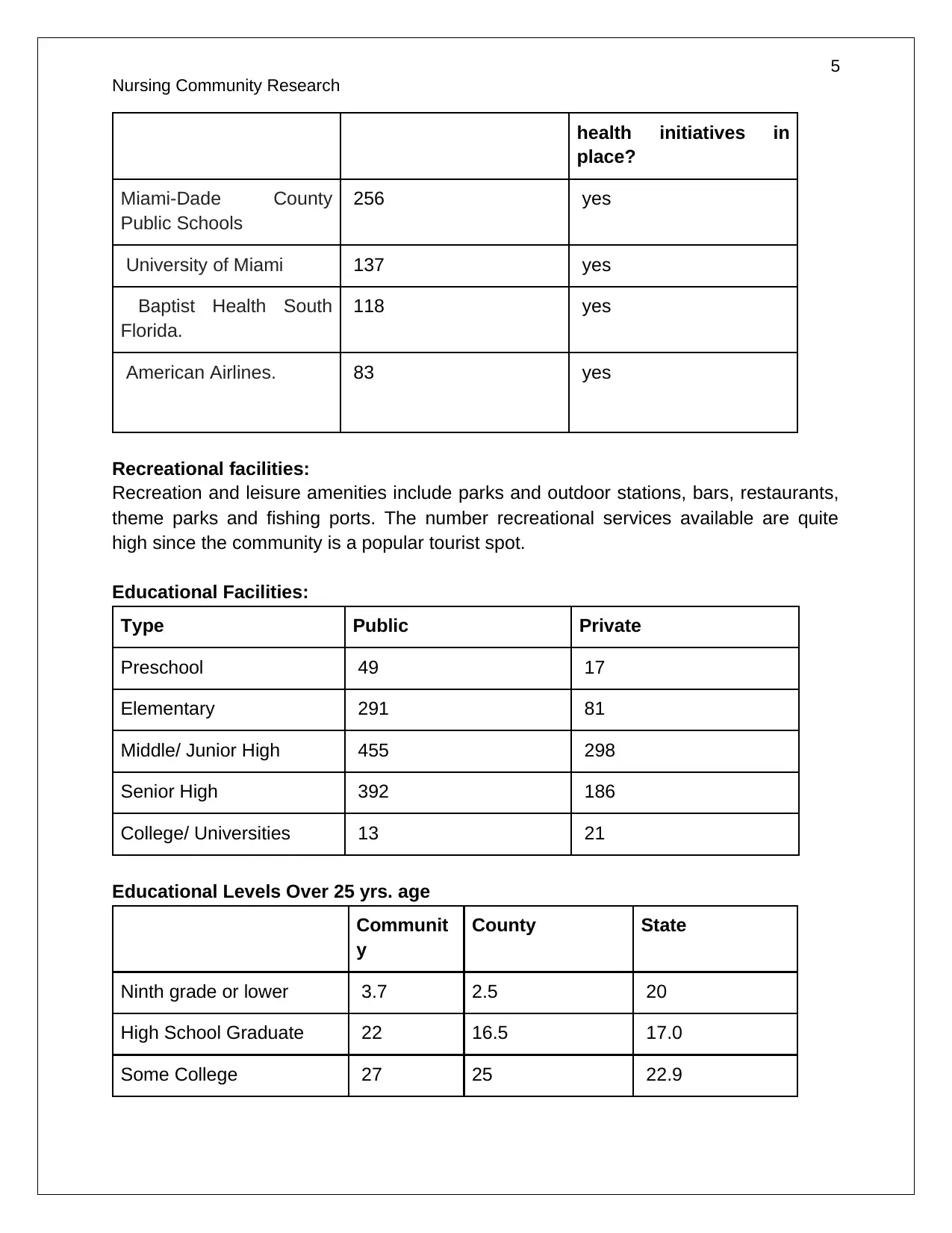
Workplace:
Employer Number of employees Do they have workplace
Document Page
5
Nursing Community Research
health initiatives in
place?
Miami-Dade County
Public Schools
256 yes
University of Miami 137 yes
Baptist Health South
Florida.
118 yes
American Airlines. 83 yes
Recreational facilities:
Recreation and leisure amenities include parks and outdoor stations, bars, restaurants,
theme parks and fishing ports. The number recreational services available are quite
high since the community is a popular tourist spot.
Educational Facilities:
Type Public Private
Preschool 49 17
Elementary 291 81
Middle/ Junior High 455 298
Senior High 392 186
College/ Universities 13 21
Educational Levels Over 25 yrs. age
Communit
y
County State
Ninth grade or lower 3.7 2.5 20
High School Graduate 22 16.5 17.0
Some College 27 25 22.9
Document Page
6
Nursing Community Research
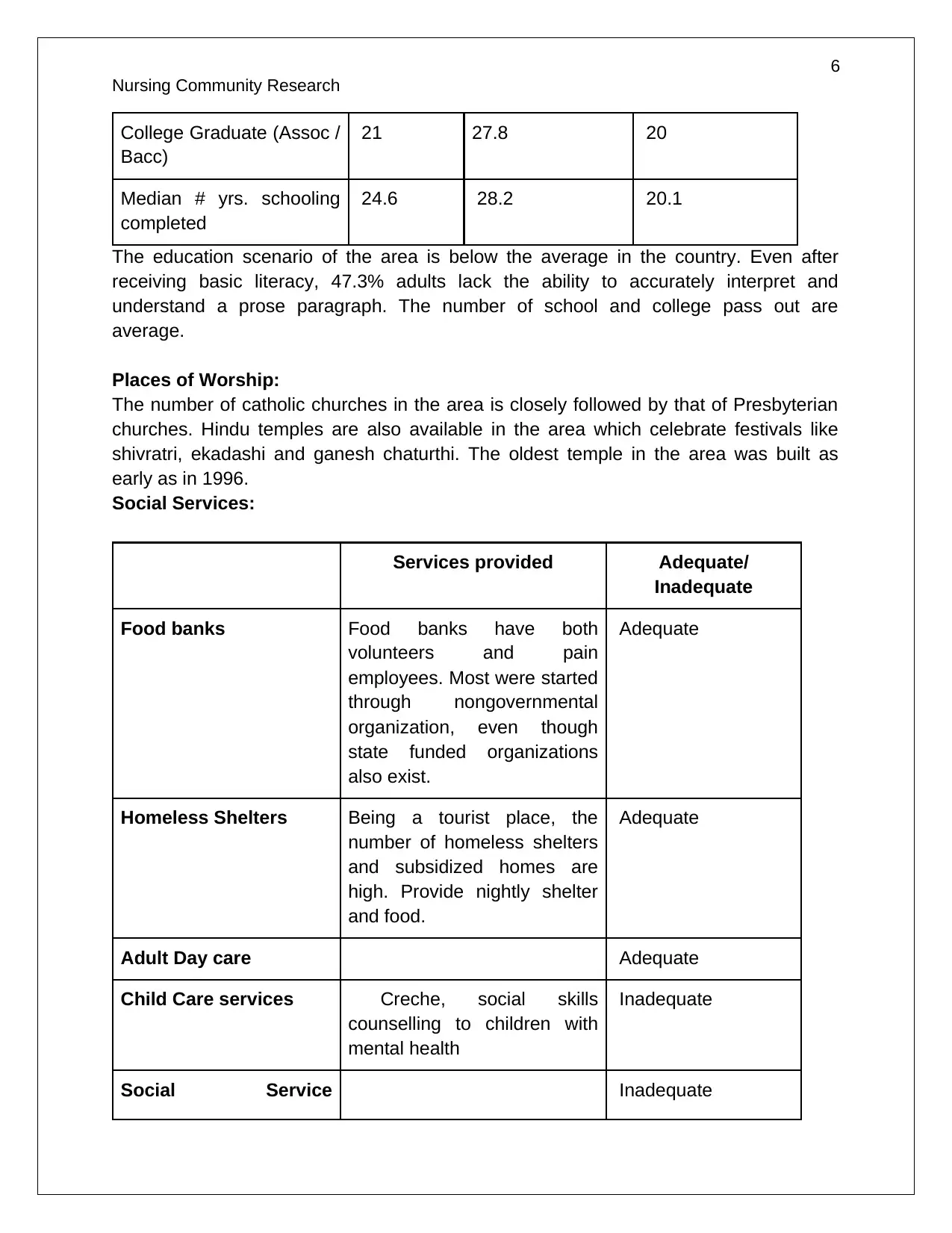
College Graduate (Assoc /
Bacc)
21 27.8 20
Median # yrs. schooling
completed
24.6 28.2 20.1
The education scenario of the area is below the average in the country. Even after
receiving basic literacy, 47.3% adults lack the ability to accurately interpret and
understand a prose paragraph. The number of school and college pass out are
average.
Places of Worship:
The number of catholic churches in the area is closely followed by that of Presbyterian
churches. Hindu temples are also available in the area which celebrate festivals like
shivratri, ekadashi and ganesh chaturthi. The oldest temple in the area was built as
early as in 1996.
Social Services:
Services provided Adequate/
Inadequate
Food banks Food banks have both
volunteers and pain
employees. Most were started
through nongovernmental
organization, even though
state funded organizations
also exist.
Adequate
Homeless Shelters Being a tourist place, the
number of homeless shelters
and subsidized homes are
high. Provide nightly shelter
and food.
Adequate
Adult Day care Adequate
Child Care services Creche, social skills
counselling to children with
mental health
Inadequate
Social Service Inadequate
tabler-icon-diamond-filled.svg

Paraphrase This Document

Need a fresh take? Get an instant paraphrase of this document with our AI Paraphraser
Document Page
7
Nursing Community Research
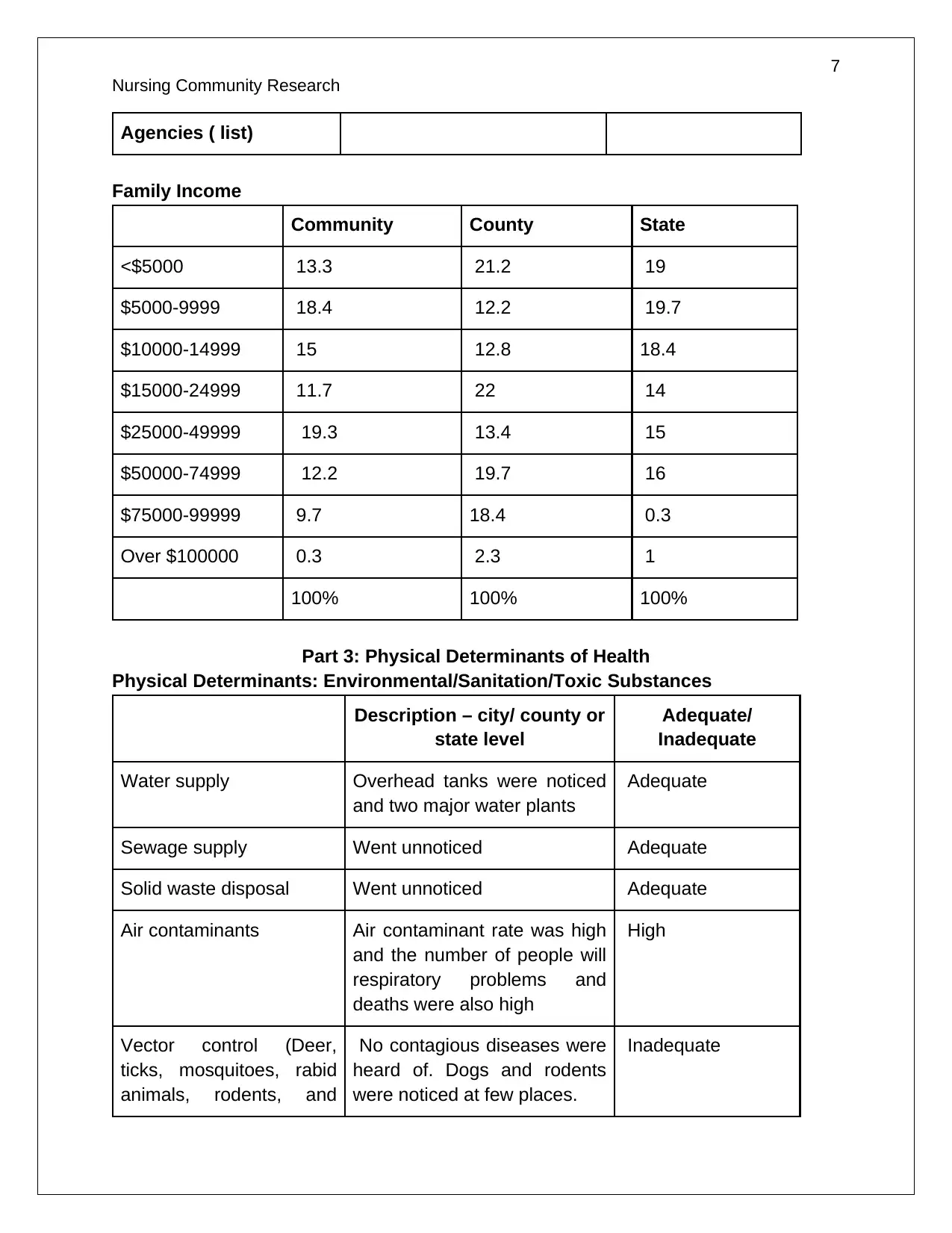
Agencies ( list)
Family Income
Community County State
<$5000 13.3 21.2 19
$5000-9999 18.4 12.2 19.7
$10000-14999 15 12.8 18.4
$15000-24999 11.7 22 14
$25000-49999 19.3 13.4 15
$50000-74999 12.2 19.7 16
$75000-99999 9.7 18.4 0.3
Over $100000 0.3 2.3 1
100% 100% 100%
Part 3: Physical Determinants of Health
Physical Determinants: Environmental/Sanitation/Toxic Substances
Description – city/ county or
state level
Adequate/
Inadequate
Water supply Overhead tanks were noticed
and two major water plants
Adequate
Sewage supply Went unnoticed Adequate
Solid waste disposal Went unnoticed Adequate
Air contaminants Air contaminant rate was high
and the number of people will
respiratory problems and
deaths were also high
High
Vector control (Deer,
ticks, mosquitoes, rabid
animals, rodents, and
No contagious diseases were
heard of. Dogs and rodents
were noticed at few places.
Inadequate
Document Page
8
Nursing Community Research
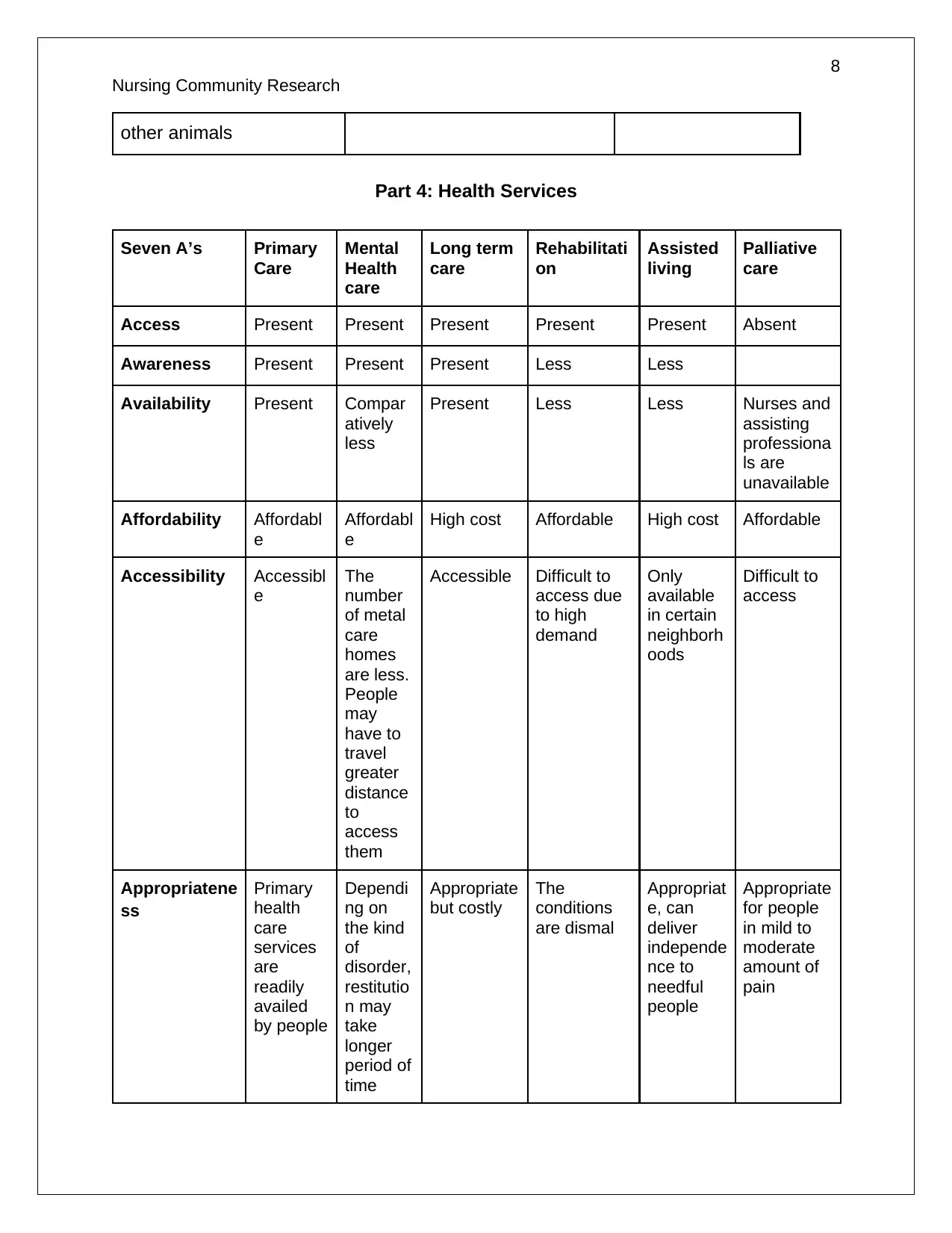
other animals
Part 4: Health Services
Seven A’s Primary
Care
Mental
Health
care
Long term
care
Rehabilitati
on
Assisted
living
Palliative
care
Access Present Present Present Present Present Absent
Awareness Present Present Present Less Less
Availability Present Compar
atively
less
Present Less Less Nurses and
assisting
professiona
ls are
unavailable
Affordability Affordabl
e
Affordabl
e
High cost Affordable High cost Affordable
Accessibility Accessibl
e
The
number
of metal
care
homes
are less.
People
may
have to
travel
greater
distance
to
access
them
Accessible Difficult to
access due
to high
demand
Only
available
in certain
neighborh
oods
Difficult to
access
Appropriatene
ss
Primary
health
care
services
are
readily
availed
by people
Dependi
ng on
the kind
of
disorder,
restitutio
n may
take
longer
period of
time
Appropriate
but costly
The
conditions
are dismal
Appropriat
e, can
deliver
independe
nce to
needful
people
Appropriate
for people
in mild to
moderate
amount of
pain
Document Page
9
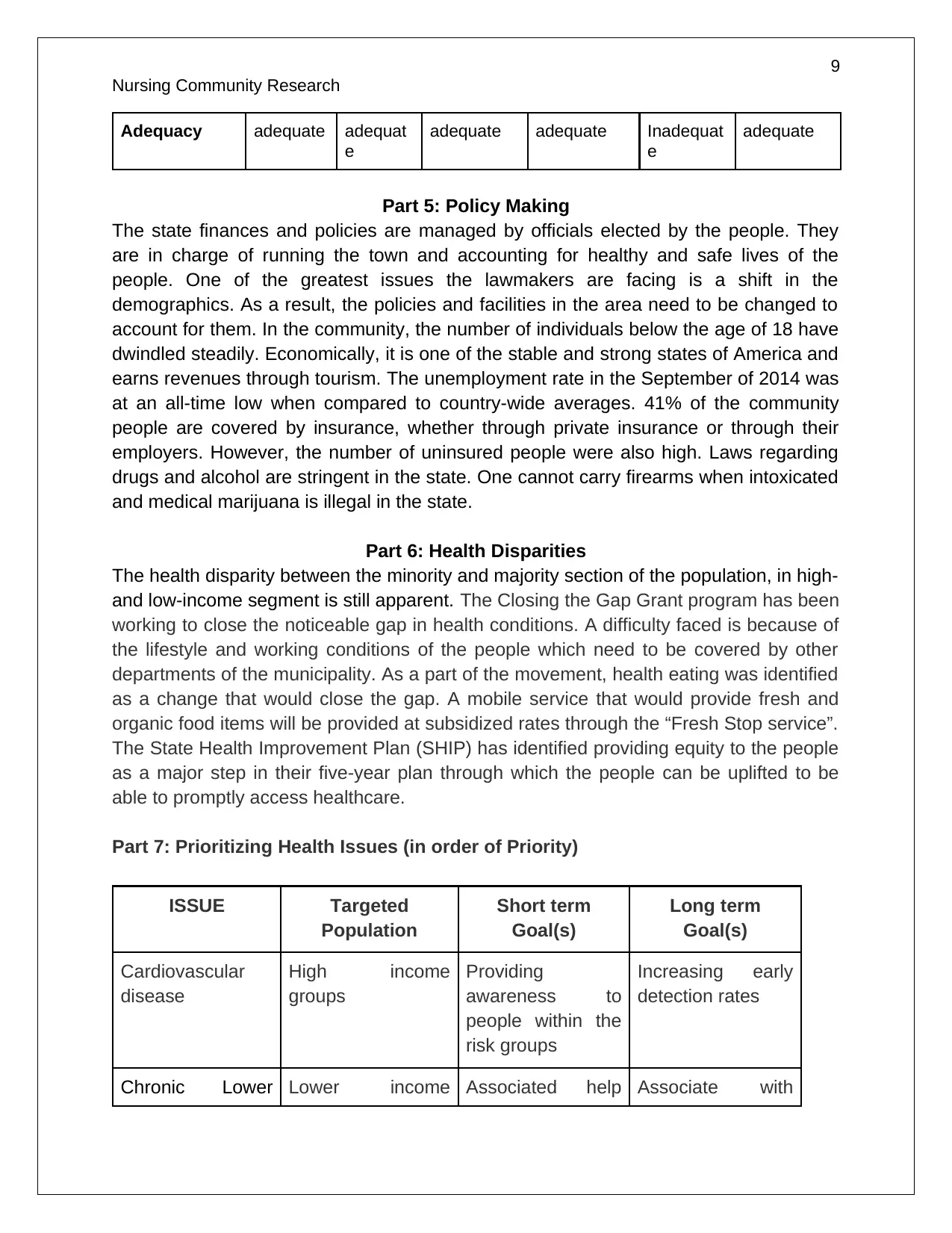
Nursing Community Research
Adequacy adequate adequat
e
adequate adequate Inadequat
e
adequate
Part 5: Policy Making
The state finances and policies are managed by officials elected by the people. They
are in charge of running the town and accounting for healthy and safe lives of the
people. One of the greatest issues the lawmakers are facing is a shift in the
demographics. As a result, the policies and facilities in the area need to be changed to
account for them. In the community, the number of individuals below the age of 18 have
dwindled steadily. Economically, it is one of the stable and strong states of America and
earns revenues through tourism. The unemployment rate in the September of 2014 was
at an all-time low when compared to country-wide averages. 41% of the community
people are covered by insurance, whether through private insurance or through their
employers. However, the number of uninsured people were also high. Laws regarding
drugs and alcohol are stringent in the state. One cannot carry firearms when intoxicated
and medical marijuana is illegal in the state.
Part 6: Health Disparities
The health disparity between the minority and majority section of the population, in high-
and low-income segment is still apparent. The Closing the Gap Grant program has been
working to close the noticeable gap in health conditions. A difficulty faced is because of
the lifestyle and working conditions of the people which need to be covered by other
departments of the municipality. As a part of the movement, health eating was identified
as a change that would close the gap. A mobile service that would provide fresh and
organic food items will be provided at subsidized rates through the “Fresh Stop service”.
The State Health Improvement Plan (SHIP) has identified providing equity to the people
as a major step in their five-year plan through which the people can be uplifted to be
able to promptly access healthcare.
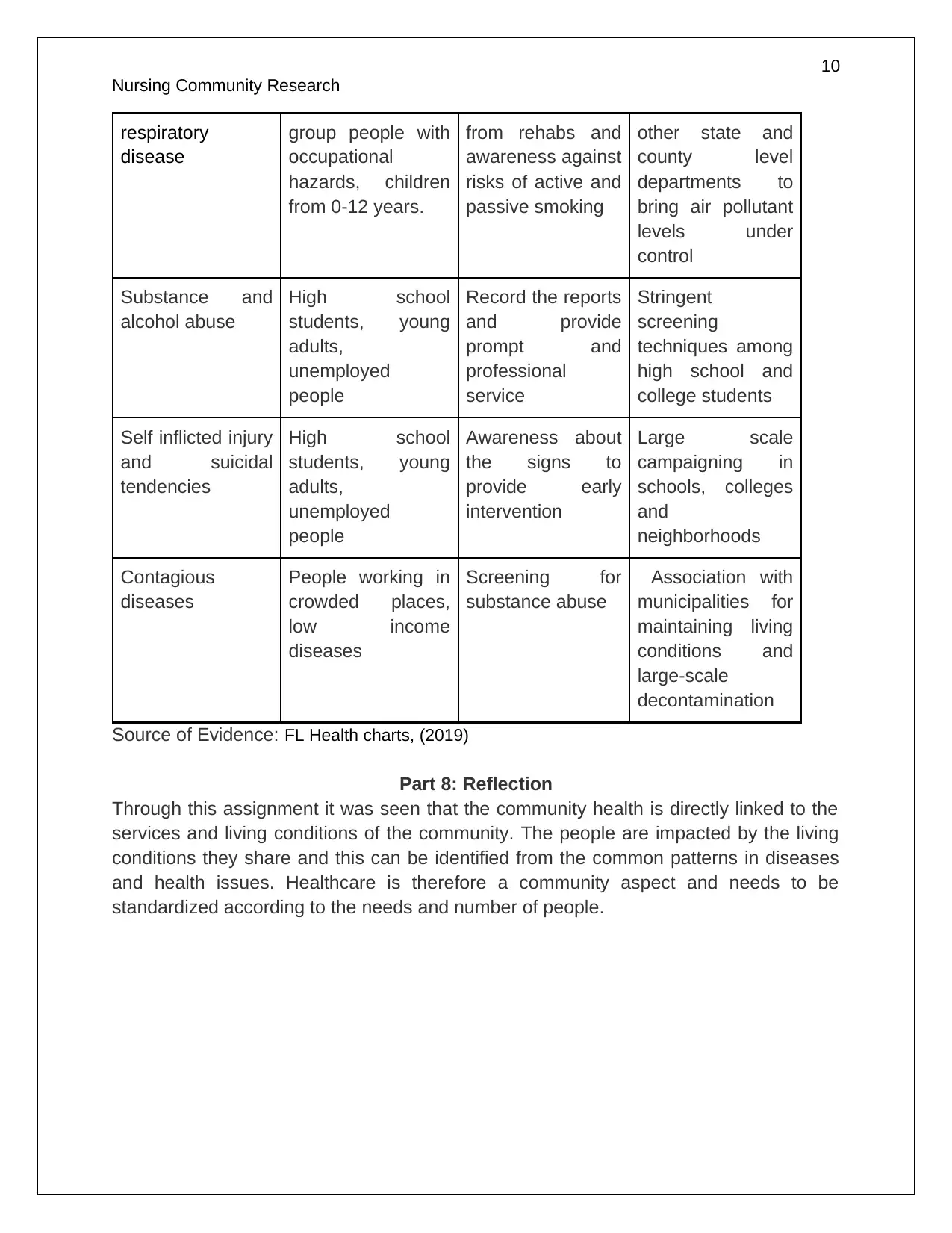
Part 7: Prioritizing Health Issues (in order of Priority)
ISSUE Targeted
Population
Short term
Goal(s)
Long term
Goal(s)
Cardiovascular
disease
High income
groups
Providing
awareness to
people within the
risk groups
Increasing early
detection rates
Chronic Lower Lower income Associated help Associate with
tabler-icon-diamond-filled.svg

Paraphrase This Document

Need a fresh take? Get an instant paraphrase of this document with our AI Paraphraser
Document Page
10
Nursing Community Research
respiratory
disease
group people with
occupational
hazards, children
from 0-12 years.
from rehabs and
awareness against
risks of active and
passive smoking
other state and
county level
departments to
bring air pollutant
levels under
control
Substance and
alcohol abuse
High school
students, young
adults,
unemployed
people
Record the reports
and provide
prompt and
professional
service
Stringent
screening
techniques among
high school and
college students
Self inflicted injury
and suicidal
tendencies
High school
students, young
adults,
unemployed
people
Awareness about
the signs to
provide early
intervention
Large scale
campaigning in
schools, colleges
and
neighborhoods
Contagious
diseases
People working in
crowded places,
low income
diseases
Screening for
substance abuse
Association with
municipalities for
maintaining living
conditions and
large-scale
decontamination
Source of Evidence: FL Health charts, (2019)
Part 8: Reflection
Through this assignment it was seen that the community health is directly linked to the
services and living conditions of the community. The people are impacted by the living
conditions they share and this can be identified from the common patterns in diseases
and health issues. Healthcare is therefore a community aspect and needs to be
standardized according to the needs and number of people.
Document Page
11
Nursing Community Research
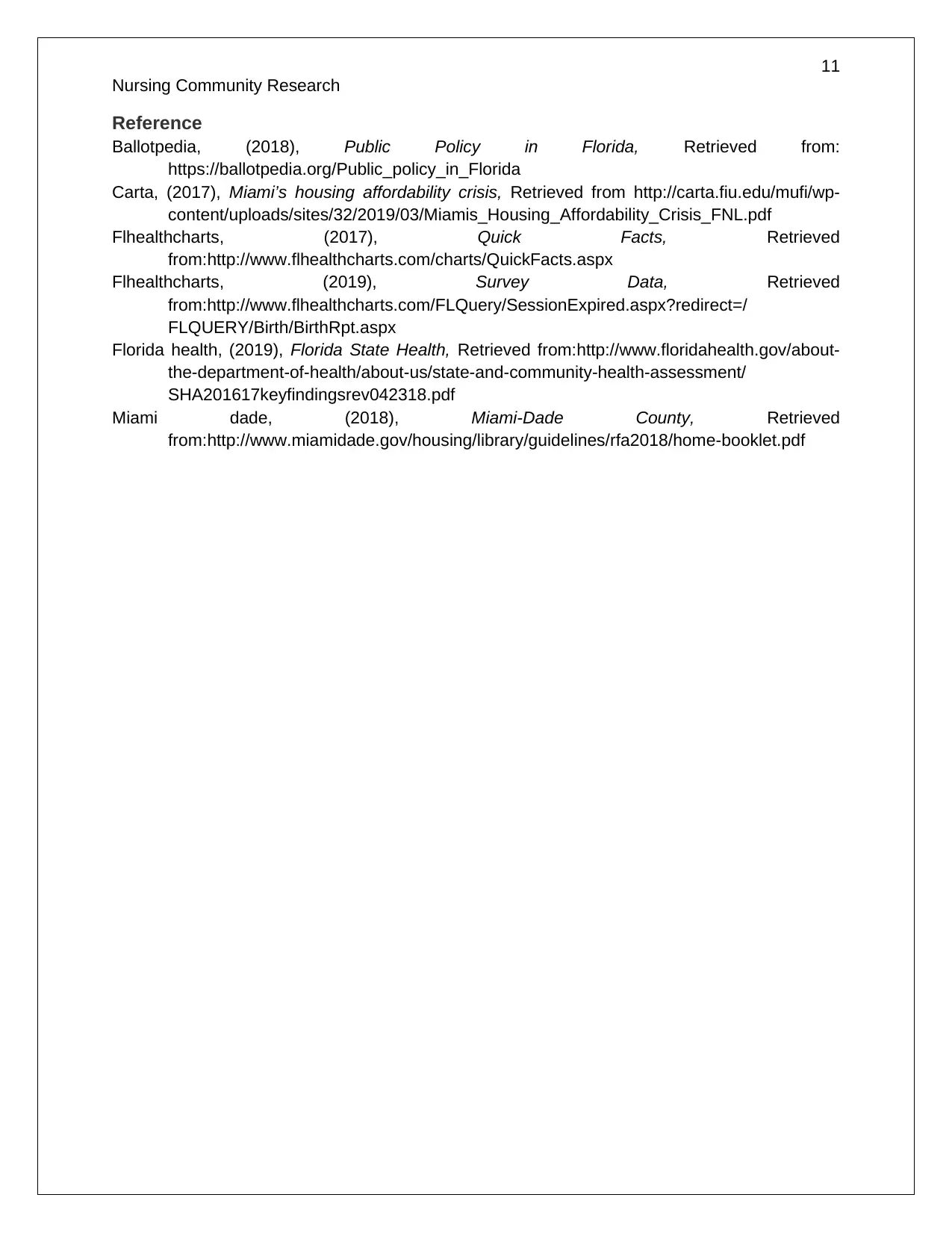
Reference
Ballotpedia, (2018), Public Policy in Florida, Retrieved from:
https://ballotpedia.org/Public_policy_in_Florida
Carta, (2017), Miami’s housing affordability crisis, Retrieved from http://carta.fiu.edu/mufi/wp-
content/uploads/sites/32/2019/03/Miamis_Housing_Affordability_Crisis_FNL.pdf
Flhealthcharts, (2017), Quick Facts, Retrieved
from:http://www.flhealthcharts.com/charts/QuickFacts.aspx
Flhealthcharts, (2019), Survey Data, Retrieved
from:http://www.flhealthcharts.com/FLQuery/SessionExpired.aspx?redirect=/
FLQUERY/Birth/BirthRpt.aspx
Florida health, (2019), Florida State Health, Retrieved from:http://www.floridahealth.gov/about-
the-department-of-health/about-us/state-and-community-health-assessment/
SHA201617keyfindingsrev042318.pdf
Miami dade, (2018), Miami-Dade County, Retrieved
from:http://www.miamidade.gov/housing/library/guidelines/rfa2018/home-booklet.pdf
chevron_up_icon
1 out of 12
circle_padding
hide_on_mobile
zoom_out_icon
[object Object]