Performance Evidence Record: Role of the Community Interpreter
VerifiedAdded on 2022/12/27
|6
|1980
|82
Homework Assignment
AI Summary
This assignment delves into the essential skills and qualities of a community interpreter, emphasizing language proficiency, soft skills, cultural competence, professionalism, self-confidence, and critical thinking. It differentiates between the roles of interpreters and translators, highlighting the differences in their work formats, methods, tools, and accuracy levels. The assignment also identifies potential difficulties interpreters face, such as hearing impairments, lack of cultural knowledge, and insufficient preparation materials. Furthermore, it outlines various situations where interpreters are needed, including school parent evenings, medical appointments, and interviews, and identifies the key individuals involved in each setting. The student provides detailed examples and analysis, demonstrating a comprehensive understanding of the community interpreter's role and responsibilities.
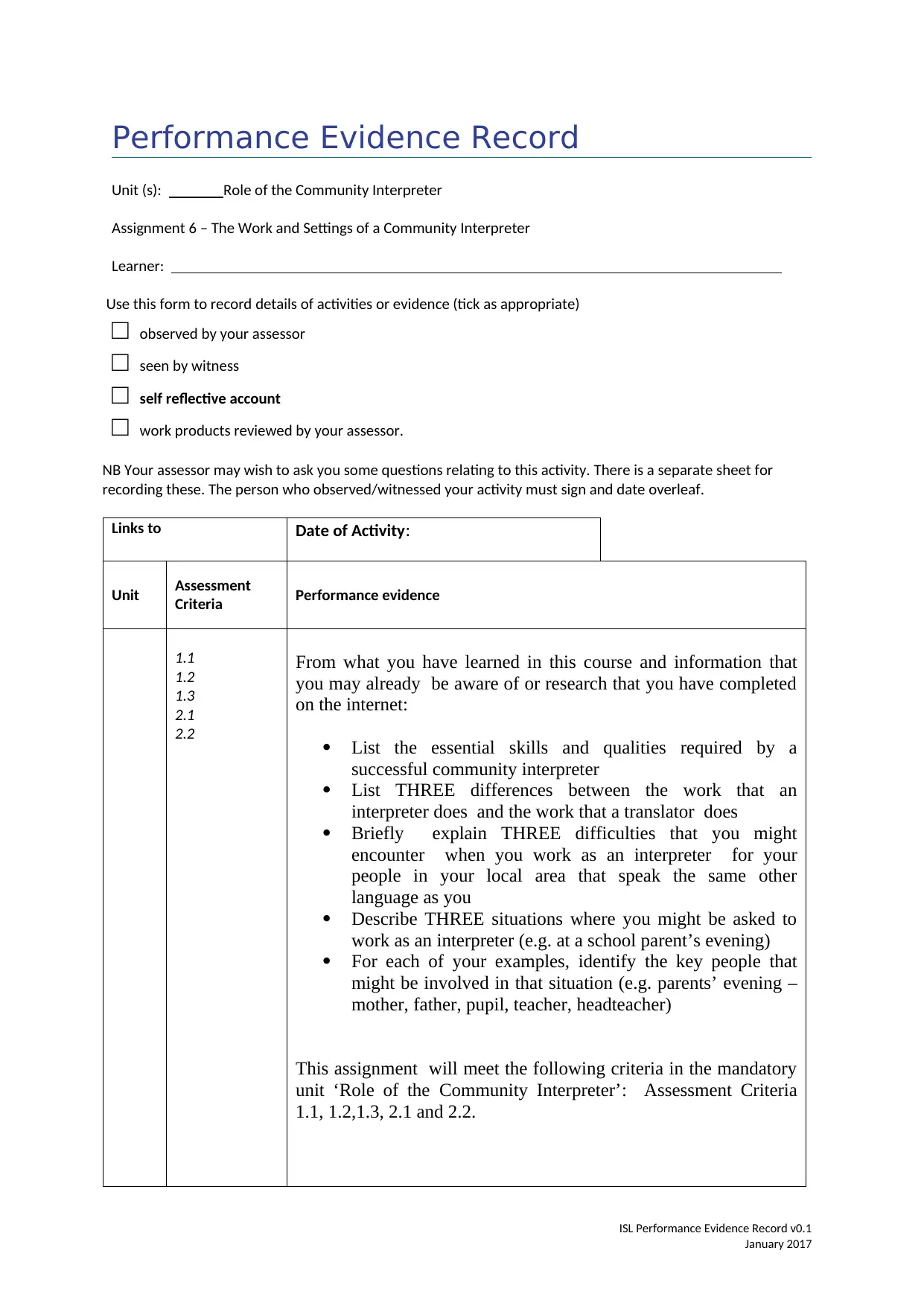
Performance Evidence Record
Unit (s): Role of the Community Interpreter
Assignment 6 – The Work and Settings of a Community Interpreter
Learner:
Use this form to record details of activities or evidence (tick as appropriate)
□ observed by your assessor
□ seen by witness
□ self reflective account
□ work products reviewed by your assessor.
NB Your assessor may wish to ask you some questions relating to this activity. There is a separate sheet for
recording these. The person who observed/witnessed your activity must sign and date overleaf.
Links to Date of Activity:
Unit Assessment
Criteria Performance evidence
1.1
1.2
1.3
2.1
2.2
From what you have learned in this course and information that
you may already be aware of or research that you have completed
on the internet:
List the essential skills and qualities required by a
successful community interpreter
List THREE differences between the work that an
interpreter does and the work that a translator does
Briefly explain THREE difficulties that you might
encounter when you work as an interpreter for your
people in your local area that speak the same other
language as you
Describe THREE situations where you might be asked to
work as an interpreter (e.g. at a school parent’s evening)
For each of your examples, identify the key people that
might be involved in that situation (e.g. parents’ evening –
mother, father, pupil, teacher, headteacher)
This assignment will meet the following criteria in the mandatory
unit ‘Role of the Community Interpreter’: Assessment Criteria
1.1, 1.2,1.3, 2.1 and 2.2.
ISL Performance Evidence Record v0.1
January 2017
Unit (s): Role of the Community Interpreter
Assignment 6 – The Work and Settings of a Community Interpreter
Learner:
Use this form to record details of activities or evidence (tick as appropriate)
□ observed by your assessor
□ seen by witness
□ self reflective account
□ work products reviewed by your assessor.
NB Your assessor may wish to ask you some questions relating to this activity. There is a separate sheet for
recording these. The person who observed/witnessed your activity must sign and date overleaf.
Links to Date of Activity:
Unit Assessment
Criteria Performance evidence
1.1
1.2
1.3
2.1
2.2
From what you have learned in this course and information that
you may already be aware of or research that you have completed
on the internet:
List the essential skills and qualities required by a
successful community interpreter
List THREE differences between the work that an
interpreter does and the work that a translator does
Briefly explain THREE difficulties that you might
encounter when you work as an interpreter for your
people in your local area that speak the same other
language as you
Describe THREE situations where you might be asked to
work as an interpreter (e.g. at a school parent’s evening)
For each of your examples, identify the key people that
might be involved in that situation (e.g. parents’ evening –
mother, father, pupil, teacher, headteacher)
This assignment will meet the following criteria in the mandatory
unit ‘Role of the Community Interpreter’: Assessment Criteria
1.1, 1.2,1.3, 2.1 and 2.2.
ISL Performance Evidence Record v0.1
January 2017
Paraphrase This Document
Need a fresh take? Get an instant paraphrase of this document with our AI Paraphraser

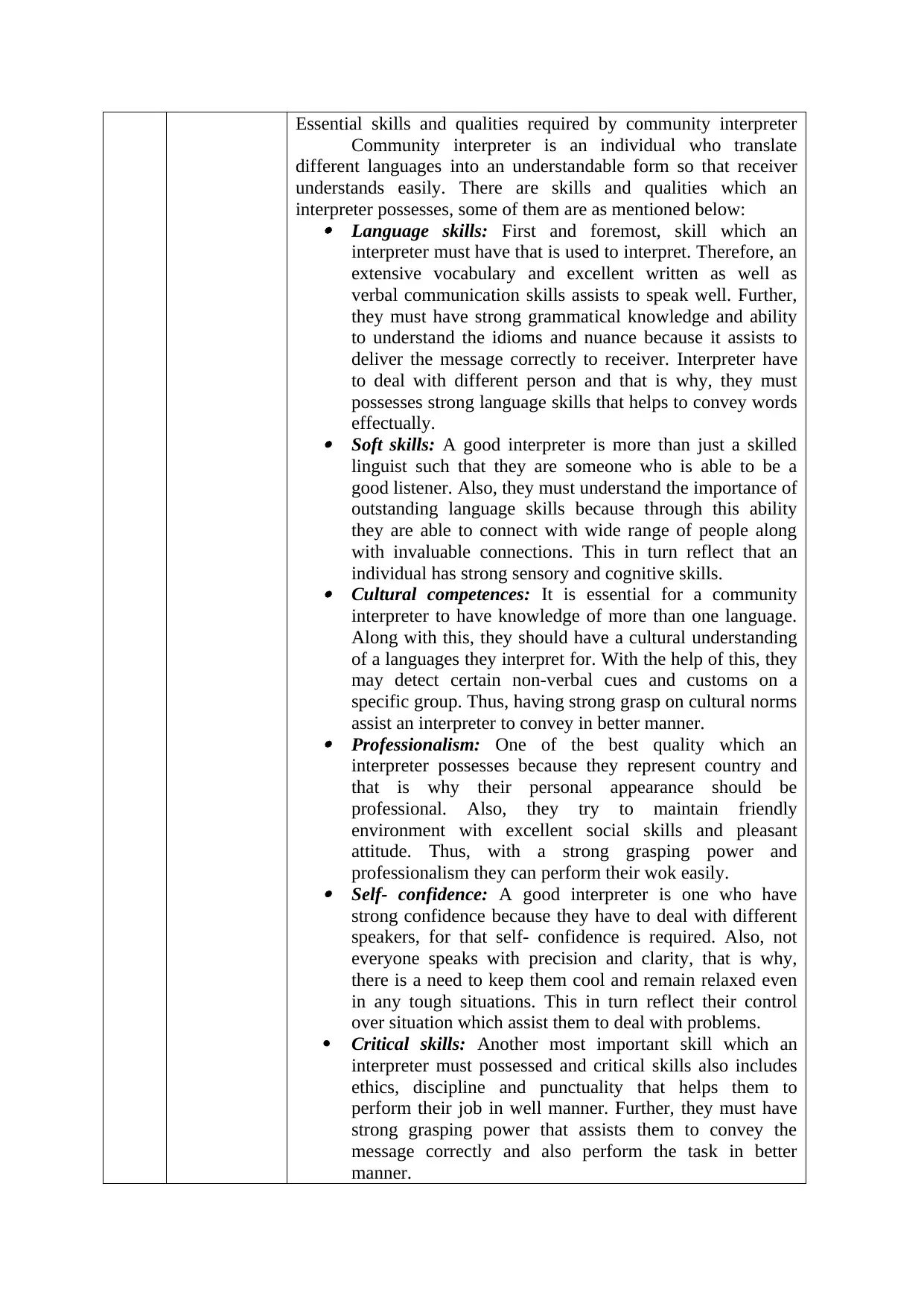
Essential skills and qualities required by community interpreter
Community interpreter is an individual who translate
different languages into an understandable form so that receiver
understands easily. There are skills and qualities which an
interpreter possesses, some of them are as mentioned below:
Language skills: First and foremost, skill which an
interpreter must have that is used to interpret. Therefore, an
extensive vocabulary and excellent written as well as
verbal communication skills assists to speak well. Further,
they must have strong grammatical knowledge and ability
to understand the idioms and nuance because it assists to
deliver the message correctly to receiver. Interpreter have
to deal with different person and that is why, they must
possesses strong language skills that helps to convey words
effectually.
Soft skills: A good interpreter is more than just a skilled
linguist such that they are someone who is able to be a
good listener. Also, they must understand the importance of
outstanding language skills because through this ability
they are able to connect with wide range of people along
with invaluable connections. This in turn reflect that an
individual has strong sensory and cognitive skills.
Cultural competences: It is essential for a community
interpreter to have knowledge of more than one language.
Along with this, they should have a cultural understanding
of a languages they interpret for. With the help of this, they
may detect certain non-verbal cues and customs on a
specific group. Thus, having strong grasp on cultural norms
assist an interpreter to convey in better manner.
Professionalism: One of the best quality which an
interpreter possesses because they represent country and
that is why their personal appearance should be
professional. Also, they try to maintain friendly
environment with excellent social skills and pleasant
attitude. Thus, with a strong grasping power and
professionalism they can perform their wok easily.
Self- confidence: A good interpreter is one who have
strong confidence because they have to deal with different
speakers, for that self- confidence is required. Also, not
everyone speaks with precision and clarity, that is why,
there is a need to keep them cool and remain relaxed even
in any tough situations. This in turn reflect their control
over situation which assist them to deal with problems.
Critical skills: Another most important skill which an
interpreter must possessed and critical skills also includes
ethics, discipline and punctuality that helps them to
perform their job in well manner. Further, they must have
strong grasping power that assists them to convey the
message correctly and also perform the task in better
manner.
Community interpreter is an individual who translate
different languages into an understandable form so that receiver
understands easily. There are skills and qualities which an
interpreter possesses, some of them are as mentioned below:
Language skills: First and foremost, skill which an
interpreter must have that is used to interpret. Therefore, an
extensive vocabulary and excellent written as well as
verbal communication skills assists to speak well. Further,
they must have strong grammatical knowledge and ability
to understand the idioms and nuance because it assists to
deliver the message correctly to receiver. Interpreter have
to deal with different person and that is why, they must
possesses strong language skills that helps to convey words
effectually.
Soft skills: A good interpreter is more than just a skilled
linguist such that they are someone who is able to be a
good listener. Also, they must understand the importance of
outstanding language skills because through this ability
they are able to connect with wide range of people along
with invaluable connections. This in turn reflect that an
individual has strong sensory and cognitive skills.
Cultural competences: It is essential for a community
interpreter to have knowledge of more than one language.
Along with this, they should have a cultural understanding
of a languages they interpret for. With the help of this, they
may detect certain non-verbal cues and customs on a
specific group. Thus, having strong grasp on cultural norms
assist an interpreter to convey in better manner.
Professionalism: One of the best quality which an
interpreter possesses because they represent country and
that is why their personal appearance should be
professional. Also, they try to maintain friendly
environment with excellent social skills and pleasant
attitude. Thus, with a strong grasping power and
professionalism they can perform their wok easily.
Self- confidence: A good interpreter is one who have
strong confidence because they have to deal with different
speakers, for that self- confidence is required. Also, not
everyone speaks with precision and clarity, that is why,
there is a need to keep them cool and remain relaxed even
in any tough situations. This in turn reflect their control
over situation which assist them to deal with problems.
Critical skills: Another most important skill which an
interpreter must possessed and critical skills also includes
ethics, discipline and punctuality that helps them to
perform their job in well manner. Further, they must have
strong grasping power that assists them to convey the
message correctly and also perform the task in better
manner.

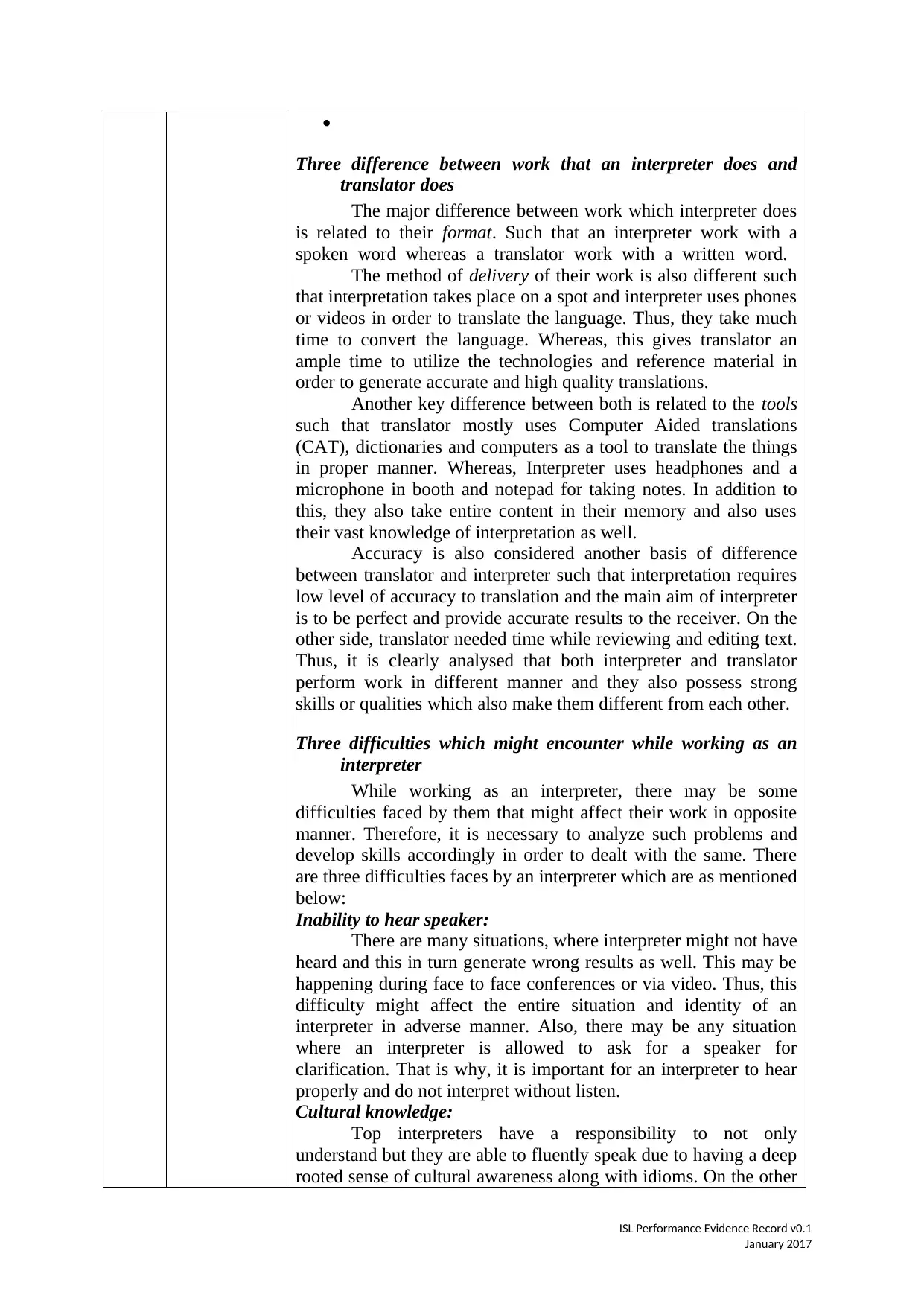
Three difference between work that an interpreter does and
translator does
The major difference between work which interpreter does
is related to their format. Such that an interpreter work with a
spoken word whereas a translator work with a written word.
The method of delivery of their work is also different such
that interpretation takes place on a spot and interpreter uses phones
or videos in order to translate the language. Thus, they take much
time to convert the language. Whereas, this gives translator an
ample time to utilize the technologies and reference material in
order to generate accurate and high quality translations.
Another key difference between both is related to the tools
such that translator mostly uses Computer Aided translations
(CAT), dictionaries and computers as a tool to translate the things
in proper manner. Whereas, Interpreter uses headphones and a
microphone in booth and notepad for taking notes. In addition to
this, they also take entire content in their memory and also uses
their vast knowledge of interpretation as well.
Accuracy is also considered another basis of difference
between translator and interpreter such that interpretation requires
low level of accuracy to translation and the main aim of interpreter
is to be perfect and provide accurate results to the receiver. On the
other side, translator needed time while reviewing and editing text.
Thus, it is clearly analysed that both interpreter and translator
perform work in different manner and they also possess strong
skills or qualities which also make them different from each other.
Three difficulties which might encounter while working as an
interpreter
While working as an interpreter, there may be some
difficulties faced by them that might affect their work in opposite
manner. Therefore, it is necessary to analyze such problems and
develop skills accordingly in order to dealt with the same. There
are three difficulties faces by an interpreter which are as mentioned
below:
Inability to hear speaker:
There are many situations, where interpreter might not have
heard and this in turn generate wrong results as well. This may be
happening during face to face conferences or via video. Thus, this
difficulty might affect the entire situation and identity of an
interpreter in adverse manner. Also, there may be any situation
where an interpreter is allowed to ask for a speaker for
clarification. That is why, it is important for an interpreter to hear
properly and do not interpret without listen.
Cultural knowledge:
Top interpreters have a responsibility to not only
understand but they are able to fluently speak due to having a deep
rooted sense of cultural awareness along with idioms. On the other
ISL Performance Evidence Record v0.1
January 2017
Three difference between work that an interpreter does and
translator does
The major difference between work which interpreter does
is related to their format. Such that an interpreter work with a
spoken word whereas a translator work with a written word.
The method of delivery of their work is also different such
that interpretation takes place on a spot and interpreter uses phones
or videos in order to translate the language. Thus, they take much
time to convert the language. Whereas, this gives translator an
ample time to utilize the technologies and reference material in
order to generate accurate and high quality translations.
Another key difference between both is related to the tools
such that translator mostly uses Computer Aided translations
(CAT), dictionaries and computers as a tool to translate the things
in proper manner. Whereas, Interpreter uses headphones and a
microphone in booth and notepad for taking notes. In addition to
this, they also take entire content in their memory and also uses
their vast knowledge of interpretation as well.
Accuracy is also considered another basis of difference
between translator and interpreter such that interpretation requires
low level of accuracy to translation and the main aim of interpreter
is to be perfect and provide accurate results to the receiver. On the
other side, translator needed time while reviewing and editing text.
Thus, it is clearly analysed that both interpreter and translator
perform work in different manner and they also possess strong
skills or qualities which also make them different from each other.
Three difficulties which might encounter while working as an
interpreter
While working as an interpreter, there may be some
difficulties faced by them that might affect their work in opposite
manner. Therefore, it is necessary to analyze such problems and
develop skills accordingly in order to dealt with the same. There
are three difficulties faces by an interpreter which are as mentioned
below:
Inability to hear speaker:
There are many situations, where interpreter might not have
heard and this in turn generate wrong results as well. This may be
happening during face to face conferences or via video. Thus, this
difficulty might affect the entire situation and identity of an
interpreter in adverse manner. Also, there may be any situation
where an interpreter is allowed to ask for a speaker for
clarification. That is why, it is important for an interpreter to hear
properly and do not interpret without listen.
Cultural knowledge:
Top interpreters have a responsibility to not only
understand but they are able to fluently speak due to having a deep
rooted sense of cultural awareness along with idioms. On the other
ISL Performance Evidence Record v0.1
January 2017
⊘ This is a preview!⊘
Do you want full access?
Subscribe today to unlock all pages.

Trusted by 1+ million students worldwide

side, if they do not have strong cultural knowledge with their local
people then it causes opposite impact upon the performance. Also,
do not able to deliver any given work or phrase into target
language. As, interpreter act as a bridge for intercultural
communication and due to this challenge they do not make quick
decision as well.
Lack of prep materials:
Another biggest challenge which an interpreter faces is
going to conference without any proper preparation. Top
interpreter will go normally without any preparation, but it is
become challenging for those people who do not receive any
briefing about speakers. That is why, having prep material assist
interpreter to familiar with topics which they are going to be
present or discussed during meeting. They also give enough extra
time to build a confidence but without prep material, they do not
able to deliver the work in proper manner and error might be occur
while interpretation.
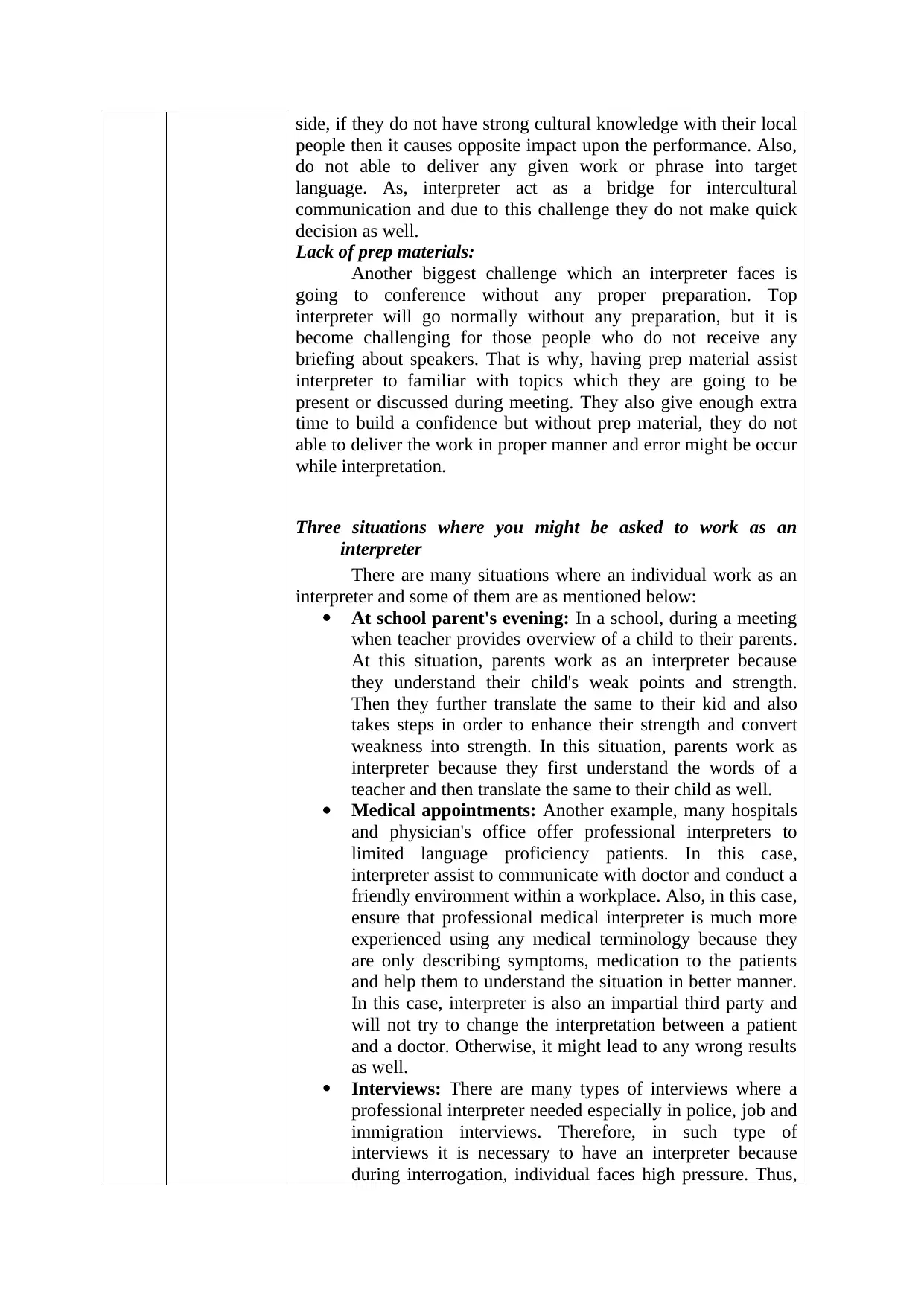
Three situations where you might be asked to work as an
interpreter
There are many situations where an individual work as an
interpreter and some of them are as mentioned below:
At school parent's evening: In a school, during a meeting
when teacher provides overview of a child to their parents.
At this situation, parents work as an interpreter because
they understand their child's weak points and strength.
Then they further translate the same to their kid and also
takes steps in order to enhance their strength and convert
weakness into strength. In this situation, parents work as
interpreter because they first understand the words of a
teacher and then translate the same to their child as well.
Medical appointments: Another example, many hospitals
and physician's office offer professional interpreters to
limited language proficiency patients. In this case,
interpreter assist to communicate with doctor and conduct a
friendly environment within a workplace. Also, in this case,
ensure that professional medical interpreter is much more
experienced using any medical terminology because they
are only describing symptoms, medication to the patients
and help them to understand the situation in better manner.
In this case, interpreter is also an impartial third party and
will not try to change the interpretation between a patient
and a doctor. Otherwise, it might lead to any wrong results
as well.
Interviews: There are many types of interviews where a
professional interpreter needed especially in police, job and
immigration interviews. Therefore, in such type of
interviews it is necessary to have an interpreter because
during interrogation, individual faces high pressure. Thus,
people then it causes opposite impact upon the performance. Also,
do not able to deliver any given work or phrase into target
language. As, interpreter act as a bridge for intercultural
communication and due to this challenge they do not make quick
decision as well.
Lack of prep materials:
Another biggest challenge which an interpreter faces is
going to conference without any proper preparation. Top
interpreter will go normally without any preparation, but it is
become challenging for those people who do not receive any
briefing about speakers. That is why, having prep material assist
interpreter to familiar with topics which they are going to be
present or discussed during meeting. They also give enough extra
time to build a confidence but without prep material, they do not
able to deliver the work in proper manner and error might be occur
while interpretation.
Three situations where you might be asked to work as an
interpreter
There are many situations where an individual work as an
interpreter and some of them are as mentioned below:
At school parent's evening: In a school, during a meeting
when teacher provides overview of a child to their parents.
At this situation, parents work as an interpreter because
they understand their child's weak points and strength.
Then they further translate the same to their kid and also
takes steps in order to enhance their strength and convert
weakness into strength. In this situation, parents work as
interpreter because they first understand the words of a
teacher and then translate the same to their child as well.
Medical appointments: Another example, many hospitals
and physician's office offer professional interpreters to
limited language proficiency patients. In this case,
interpreter assist to communicate with doctor and conduct a
friendly environment within a workplace. Also, in this case,
ensure that professional medical interpreter is much more
experienced using any medical terminology because they
are only describing symptoms, medication to the patients
and help them to understand the situation in better manner.
In this case, interpreter is also an impartial third party and
will not try to change the interpretation between a patient
and a doctor. Otherwise, it might lead to any wrong results
as well.
Interviews: There are many types of interviews where a
professional interpreter needed especially in police, job and
immigration interviews. Therefore, in such type of
interviews it is necessary to have an interpreter because
during interrogation, individual faces high pressure. Thus,
Paraphrase This Document
Need a fresh take? Get an instant paraphrase of this document with our AI Paraphraser

to deal in such type of situations it is necessary to ensure
that communication exchange is accurate due to having
sensitive information. Thus, in such situation, having a
skilled professional in term of linguistically will assist to
convey the exact message. Therefore, to deal with some
pressure during interview, an interpreter is needed that
assist to meet the problem and diffuse tension during such
types of interviews.
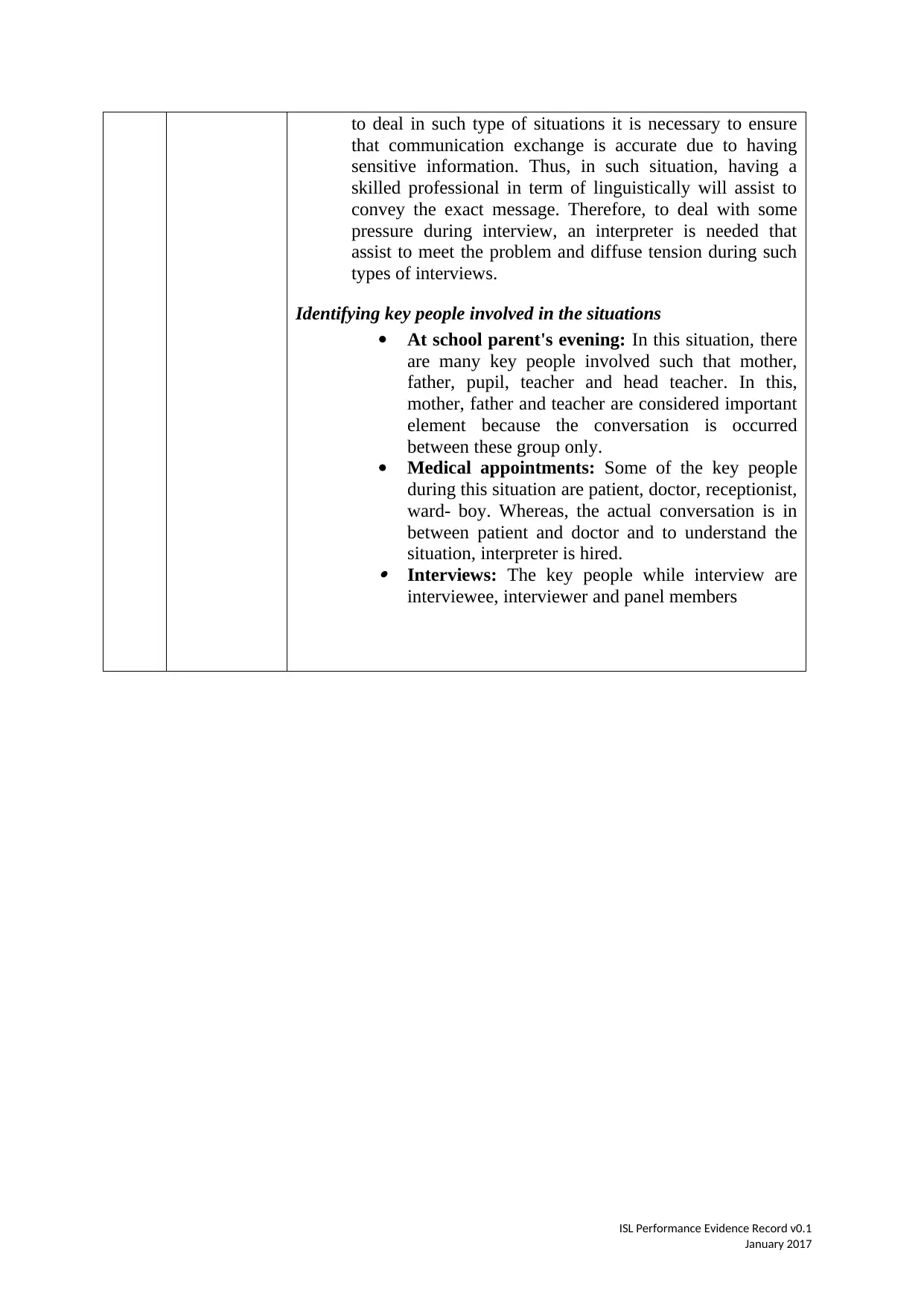
Identifying key people involved in the situations
At school parent's evening: In this situation, there
are many key people involved such that mother,
father, pupil, teacher and head teacher. In this,
mother, father and teacher are considered important
element because the conversation is occurred
between these group only.
Medical appointments: Some of the key people
during this situation are patient, doctor, receptionist,
ward- boy. Whereas, the actual conversation is in
between patient and doctor and to understand the
situation, interpreter is hired.
Interviews: The key people while interview are
interviewee, interviewer and panel members
ISL Performance Evidence Record v0.1
January 2017
that communication exchange is accurate due to having
sensitive information. Thus, in such situation, having a
skilled professional in term of linguistically will assist to
convey the exact message. Therefore, to deal with some
pressure during interview, an interpreter is needed that
assist to meet the problem and diffuse tension during such
types of interviews.
Identifying key people involved in the situations
At school parent's evening: In this situation, there
are many key people involved such that mother,
father, pupil, teacher and head teacher. In this,
mother, father and teacher are considered important
element because the conversation is occurred
between these group only.
Medical appointments: Some of the key people
during this situation are patient, doctor, receptionist,
ward- boy. Whereas, the actual conversation is in
between patient and doctor and to understand the
situation, interpreter is hired.
Interviews: The key people while interview are
interviewee, interviewer and panel members
ISL Performance Evidence Record v0.1
January 2017

Performance Evidence Record (cont’d)
Unit Assessment
Criteria Performance evidence
I confirm that the evidence listed is
my own work and was carried out
under the conditions and context
specified in the standards.
Candidate signature: Date
Assessor/Expert Witness* signature: Date
*delete as appropriate
Internal Verifier signature (if sampled): Date
Unit Assessment
Criteria Performance evidence
I confirm that the evidence listed is
my own work and was carried out
under the conditions and context
specified in the standards.
Candidate signature: Date
Assessor/Expert Witness* signature: Date
*delete as appropriate
Internal Verifier signature (if sampled): Date
⊘ This is a preview!⊘
Do you want full access?
Subscribe today to unlock all pages.

Trusted by 1+ million students worldwide
1 out of 6
Related Documents
Your All-in-One AI-Powered Toolkit for Academic Success.
+13062052269
info@desklib.com
Available 24*7 on WhatsApp / Email
Unlock your academic potential
Copyright © 2020–2025 A2Z Services. All Rights Reserved. Developed and managed by ZUCOL.