Analyzing the Impact of Community Policing on Crime and Fear of Crime

Verified

Added on  2022/11/19

|8
|1952
|484
Report
AI Summary
This sociology report examines the effects of community-oriented policing on crime rates and the fear of crime among citizens. It explores how community policing strategies, such as officer discretion, shared responsibility, and problem-solving orientations, influence public perceptions and interactions with law enforcement. The report analyzes the reduction in crime fear, the economic and societal consequences of fear, and the effectiveness of community policing in reducing crime. It references various research studies to support its arguments, highlighting the importance of police-citizen contact, public confidence, and information dissemination in mitigating fear. The report also discusses the role of decentralization and strategic communication in sustaining fear reduction, concluding that community policing is a vital tool for creating safe and secure communities.
Document Page
Running Head: SOCIOLOGY
SOCIOLOGY
Name of the University
Name of the Student
Author Note
tabler-icon-diamond-filled.svg

Paraphrase This Document

Need a fresh take? Get an instant paraphrase of this document with our AI Paraphraser
Document Page
SOCIOLOGY 1
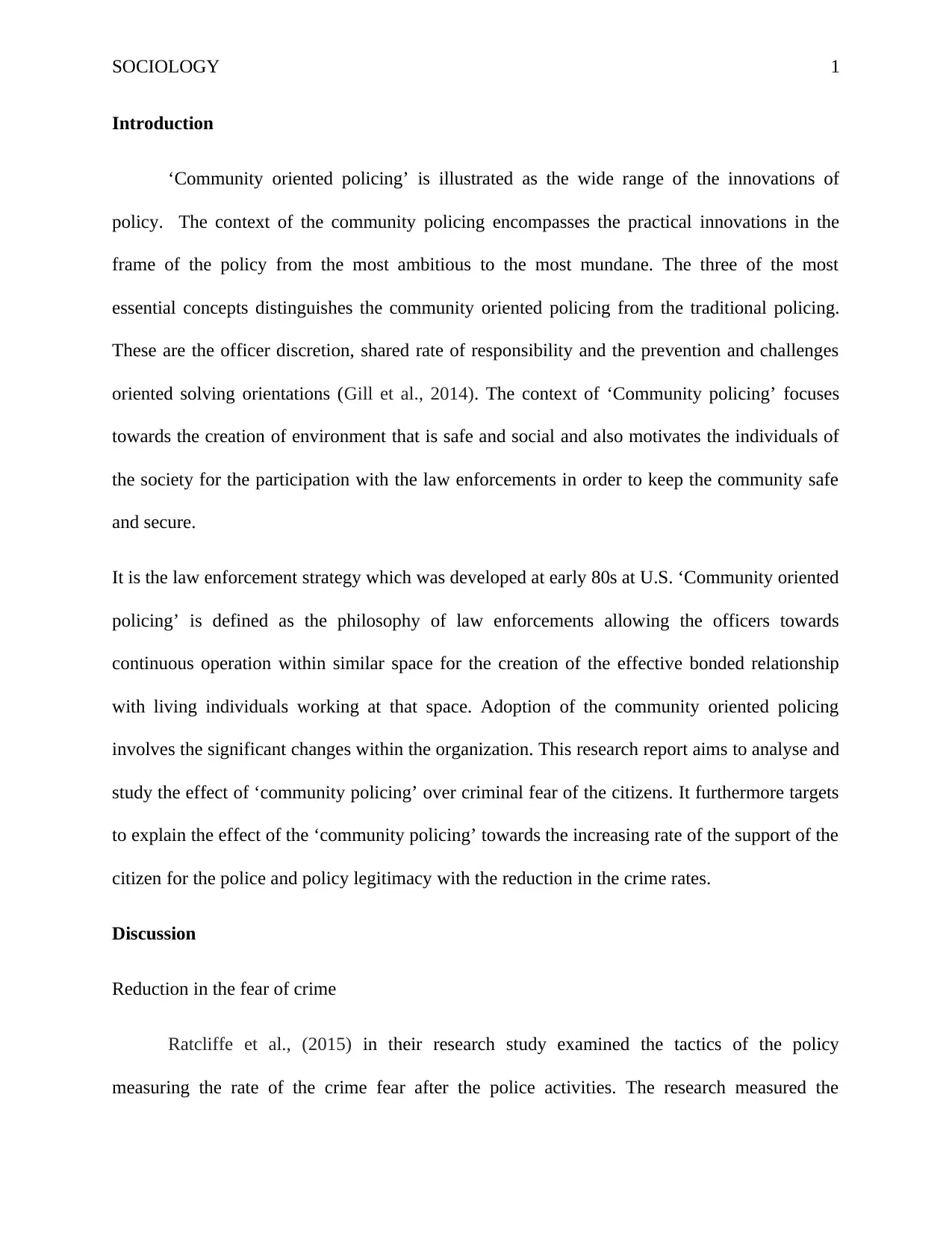
Introduction
‘Community oriented policing’ is illustrated as the wide range of the innovations of
policy. The context of the community policing encompasses the practical innovations in the
frame of the policy from the most ambitious to the most mundane. The three of the most
essential concepts distinguishes the community oriented policing from the traditional policing.
These are the officer discretion, shared rate of responsibility and the prevention and challenges
oriented solving orientations (Gill et al., 2014). The context of ‘Community policing’ focuses
towards the creation of environment that is safe and social and also motivates the individuals of
the society for the participation with the law enforcements in order to keep the community safe
and secure.
It is the law enforcement strategy which was developed at early 80s at U.S. ‘Community oriented
policing’ is defined as the philosophy of law enforcements allowing the officers towards
continuous operation within similar space for the creation of the effective bonded relationship
with living individuals working at that space. Adoption of the community oriented policing
involves the significant changes within the organization. This research report aims to analyse and
study the effect of ‘community policing’ over criminal fear of the citizens. It furthermore targets
to explain the effect of the ‘community policing’ towards the increasing rate of the support of the
citizen for the police and policy legitimacy with the reduction in the crime rates.
Discussion
Reduction in the fear of crime
Ratcliffe et al., (2015) in their research study examined the tactics of the policy
measuring the rate of the crime fear after the police activities. The research measured the
Document Page
SOCIOLOGY 2
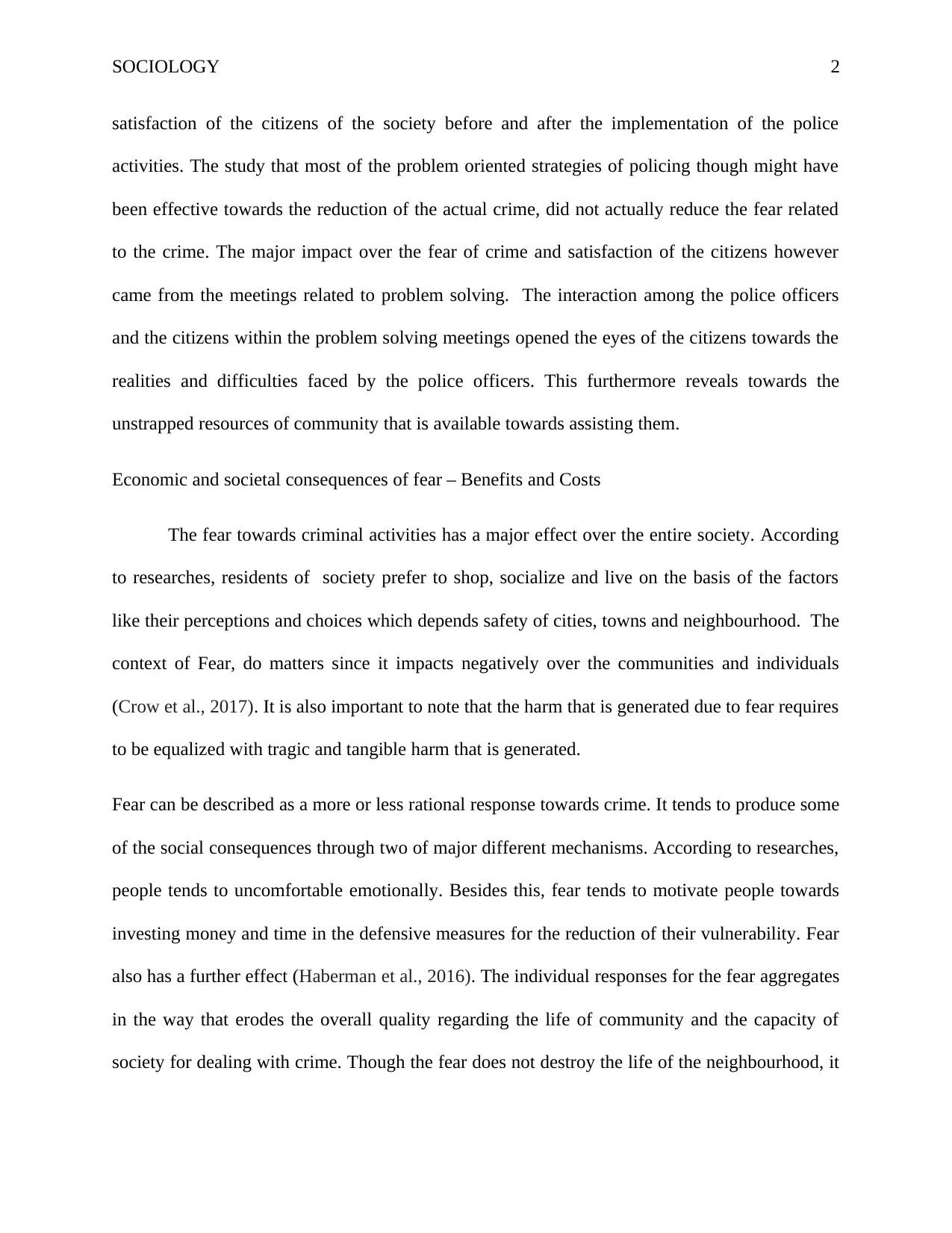
satisfaction of the citizens of the society before and after the implementation of the police
activities. The study that most of the problem oriented strategies of policing though might have
been effective towards the reduction of the actual crime, did not actually reduce the fear related
to the crime. The major impact over the fear of crime and satisfaction of the citizens however
came from the meetings related to problem solving. The interaction among the police officers
and the citizens within the problem solving meetings opened the eyes of the citizens towards the
realities and difficulties faced by the police officers. This furthermore reveals towards the
unstrapped resources of community that is available towards assisting them.
Economic and societal consequences of fear – Benefits and Costs
The fear towards criminal activities has a major effect over the entire society. According
to researches, residents of society prefer to shop, socialize and live on the basis of the factors
like their perceptions and choices which depends safety of cities, towns and neighbourhood. The
context of Fear, do matters since it impacts negatively over the communities and individuals
(Crow et al., 2017). It is also important to note that the harm that is generated due to fear requires
to be equalized with tragic and tangible harm that is generated.
Fear can be described as a more or less rational response towards crime. It tends to produce some
of the social consequences through two of major different mechanisms. According to researches,
people tends to uncomfortable emotionally. Besides this, fear tends to motivate people towards
investing money and time in the defensive measures for the reduction of their vulnerability. Fear
also has a further effect (Haberman et al., 2016). The individual responses for the fear aggregates
in the way that erodes the overall quality regarding the life of community and the capacity of
society for dealing with crime. Though the fear does not destroy the life of the neighbourhood, it
Document Page
SOCIOLOGY 3
can furthermore create damage by the prompting response that protect some of the citizens at the
expense of the others, thereby leading to the major social disparities among the poor and rich.
Community Policing - Police Strategy for fear reduction
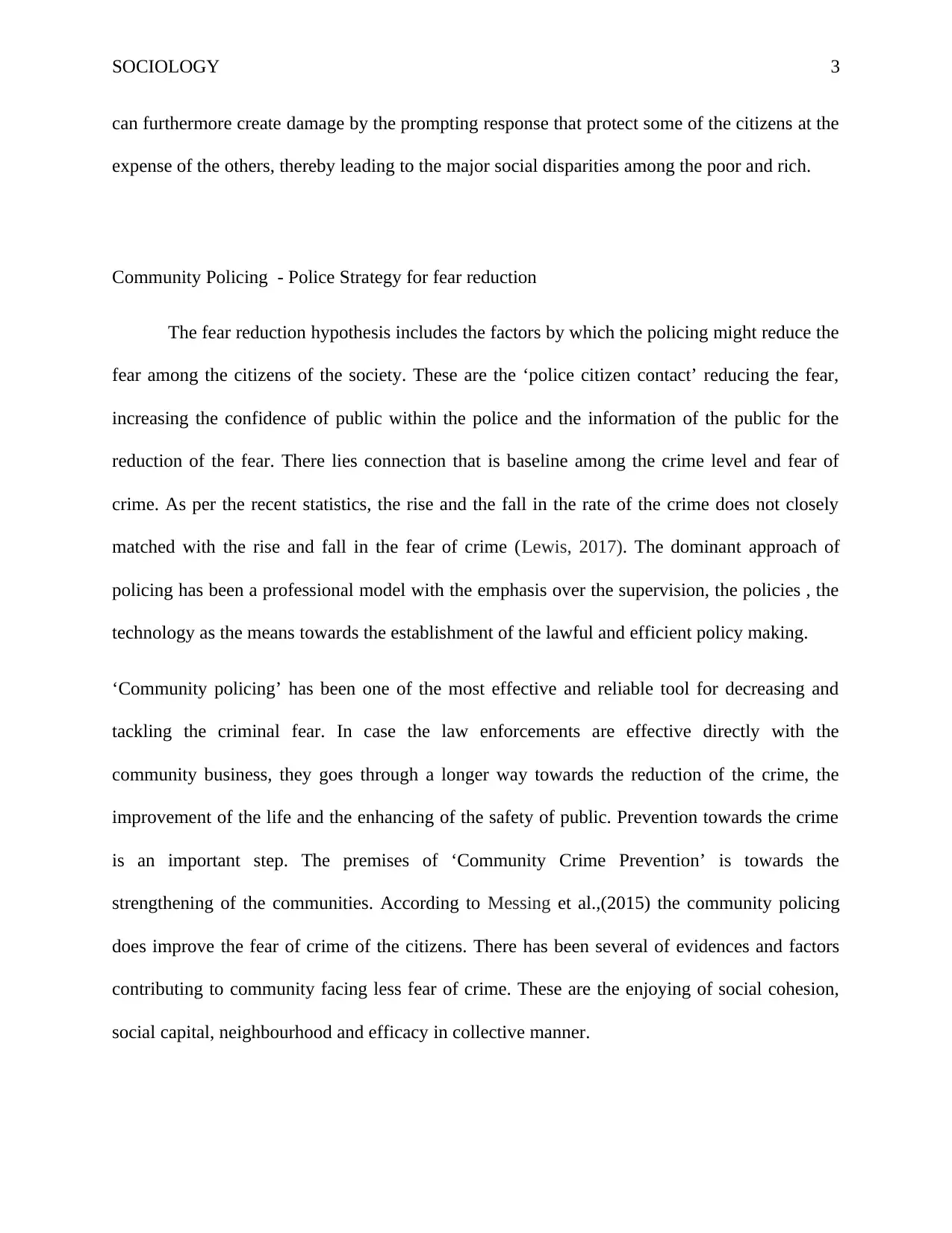
The fear reduction hypothesis includes the factors by which the policing might reduce the
fear among the citizens of the society. These are the ‘police citizen contact’ reducing the fear,
increasing the confidence of public within the police and the information of the public for the
reduction of the fear. There lies connection that is baseline among the crime level and fear of
crime. As per the recent statistics, the rise and the fall in the rate of the crime does not closely
matched with the rise and fall in the fear of crime (Lewis, 2017). The dominant approach of
policing has been a professional model with the emphasis over the supervision, the policies , the
technology as the means towards the establishment of the lawful and efficient policy making.
‘Community policing’ has been one of the most effective and reliable tool for decreasing and
tackling the criminal fear. In case the law enforcements are effective directly with the
community business, they goes through a longer way towards the reduction of the crime, the
improvement of the life and the enhancing of the safety of public. Prevention towards the crime
is an important step. The premises of ‘Community Crime Prevention’ is towards the
strengthening of the communities. According to Messing et al.,(2015) the community policing
does improve the fear of crime of the citizens. There has been several of evidences and factors
contributing to community facing less fear of crime. These are the enjoying of social cohesion,
social capital, neighbourhood and efficacy in collective manner.
tabler-icon-diamond-filled.svg

Paraphrase This Document

Need a fresh take? Get an instant paraphrase of this document with our AI Paraphraser
Document Page
SOCIOLOGY 4
‘Community Crime Prevention’ is majorly fruitful while it is being connected to the context of
policing to community. The formation of policing of the community has been a complicated
story which has been unfolding. This policy analysis has resulted many of the citizens of the
society to trust the police departments and reduce their fear towards the crime. According to the
study by Bain, Robinson and Conser (2014) the reduction in the rate of the crimes due to the
development and the implementation of the community policing is still a debatable topic.
Sustaining of Fear Reduction
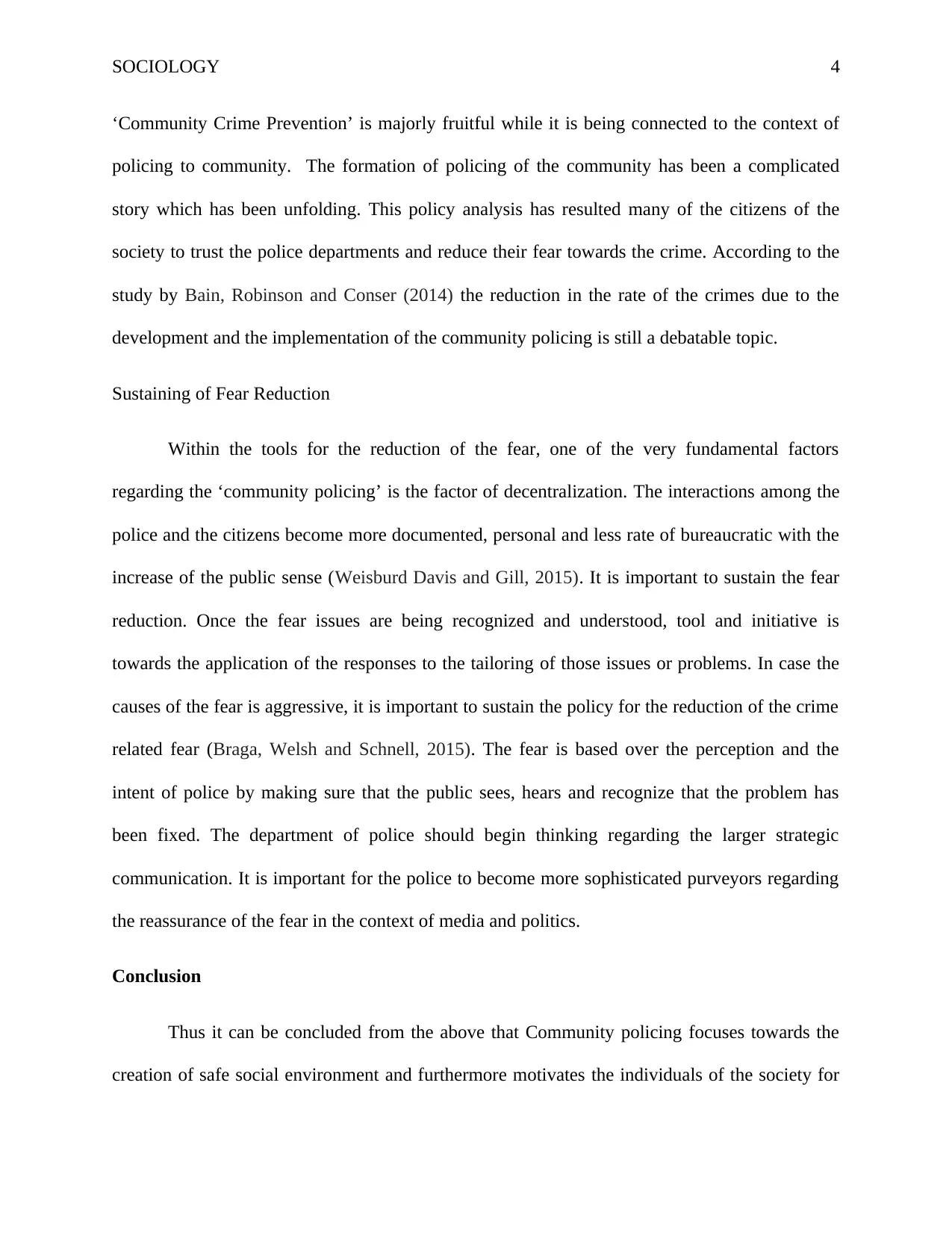
Within the tools for the reduction of the fear, one of the very fundamental factors
regarding the ‘community policing’ is the factor of decentralization. The interactions among the
police and the citizens become more documented, personal and less rate of bureaucratic with the
increase of the public sense (Weisburd Davis and Gill, 2015). It is important to sustain the fear
reduction. Once the fear issues are being recognized and understood, tool and initiative is
towards the application of the responses to the tailoring of those issues or problems. In case the
causes of the fear is aggressive, it is important to sustain the policy for the reduction of the crime
related fear (Braga, Welsh and Schnell, 2015). The fear is based over the perception and the
intent of police by making sure that the public sees, hears and recognize that the problem has
been fixed. The department of police should begin thinking regarding the larger strategic
communication. It is important for the police to become more sophisticated purveyors regarding
the reassurance of the fear in the context of media and politics.
Conclusion
Thus it can be concluded from the above that Community policing focuses towards the
creation of safe social environment and furthermore motivates the individuals of the society for
Document Page
SOCIOLOGY 5
the participation with the law enforcements in order to keep the community safe and secure. It is
the law enforcement strategy which was developed at early 80s at U.S. The major impact over
the fear of crime and satisfaction of the citizens however came from the meetings related to
problem solving. The interaction among the police officers and the citizens within the problem
solving meetings opened the eyes of the citizens towards the realities and difficulties faced by
the police officers. It has been generally defined as the philosophy of law enforcements that
allows the officers towards continuous operation in the similar area for the creation of the
stronger bond with the living citizens working in that area. There lies some of the major
economic and societal consequences of fear that needs to be covered. The assignment
highlighted the community policy as the one of the most effective tool for the improvement of
the rate of the fear and also the reduction of the crime rates in the nation.
Document Page
SOCIOLOGY 6
References
Bain, A., Robinson, B. K., & Conser, J. (2014). Perceptions of policing: Improving
communication in local communities. International Journal of Police Science &
Management, 16(4), 267-276.
Braga, A. A., Welsh, B. C., & Schnell, C. (2015). Can policing disorder reduce crime? A
systematic review and meta-analysis. Journal of Research in Crime and
Delinquency, 52(4), 567-588.
Crow, M. S., Snyder, J. A., Crichlow, V. J., & Smykla, J. O. (2017). Community perceptions of
police body-worn cameras: The impact of views on fairness, fear, performance, and
privacy. Criminal justice and behavior, 44(4), 589-610.
Gill, C., Weisburd, D., Telep, C. W., Vitter, Z., & Bennett, T. (2014). Community-oriented
policing to reduce crime, disorder and fear and increase satisfaction and legitimacy
among citizens: A systematic review. Journal of experimental criminology, 10(4), 399-
428.
Haberman, C. P., Groff, E. R., Ratcliffe, J. H., & Sorg, E. T. (2016). Satisfaction with police in
violent crime hot spots: Using community surveys as a guide for selecting hot spots
policing tactics. Crime & Delinquency, 62(4), 525-557.
Lewis, D. A. (2017). Fear of crime: Incivility and the production of a social problem. Routledge.
tabler-icon-diamond-filled.svg

Paraphrase This Document

Need a fresh take? Get an instant paraphrase of this document with our AI Paraphraser
Document Page
SOCIOLOGY 7
Messing, J. T., Becerra, D., Ward-Lasher, A., & Androff, D. K. (2015). Latinas’ perceptions of
law enforcement: Fear of deportation, crime reporting, and trust in the
system. Affilia, 30(3), 328-340.
Ratcliffe, J. H., Groff, E. R., Sorg, E. T., & Haberman, C. P. (2015). Citizens’ reactions to hot
spots policing: impacts on perceptions of crime, disorder, safety and police. Journal of
experimental criminology, 11(3), 393-417.
Weisburd, D., Davis, M., & Gill, C. (2015). Increasing collective efficacy and social capital at
crime hot spots: New crime control tools for police. Policing: A Journal of Policy and
Practice, 9(3), 265-274.
chevron_up_icon
1 out of 8
circle_padding
hide_on_mobile
zoom_out_icon
[object Object]