Community Psychology: Analyzing Network and Relational Perspectives

Verified

Added on  2019/09/13

|3
|307
|379
Report
AI Summary
This report explores the application of network and relational perspectives within the field of community psychology, drawing upon two key articles. The first article by Watling Neal (2014) emphasizes the importance of these perspectives in understanding communities, settings, and larger social systems, highlighting their ability to bridge different levels of analysis. The second article by M. Boyd (2014) connects organizational studies with community psychology, analyzing the content of the Journal of Community Psychology and American Journal of Community Psychology to determine the manifestation of organization studies in the literature. The report examines key concepts such as empowerment and health promotion, while also considering the implications of organizational studies. The report provides insights into the field, offering a comprehensive overview of the interplay between network, relational, and organizational aspects within community psychology.
Document Page
Watling Neal, J. & D. Christens, B. (2014). Linking the Levels: Network and Relational
Perspectives for Community Psychology. Retrieved from
https://www.researchgate.net/profile/Brian_Christens/publication/261771586_Linking_the_Leve
ls_Network_and_Relational_Perspectives_for_Community_Psychology/links/
557b03bc08aec87640d9b364.pdf
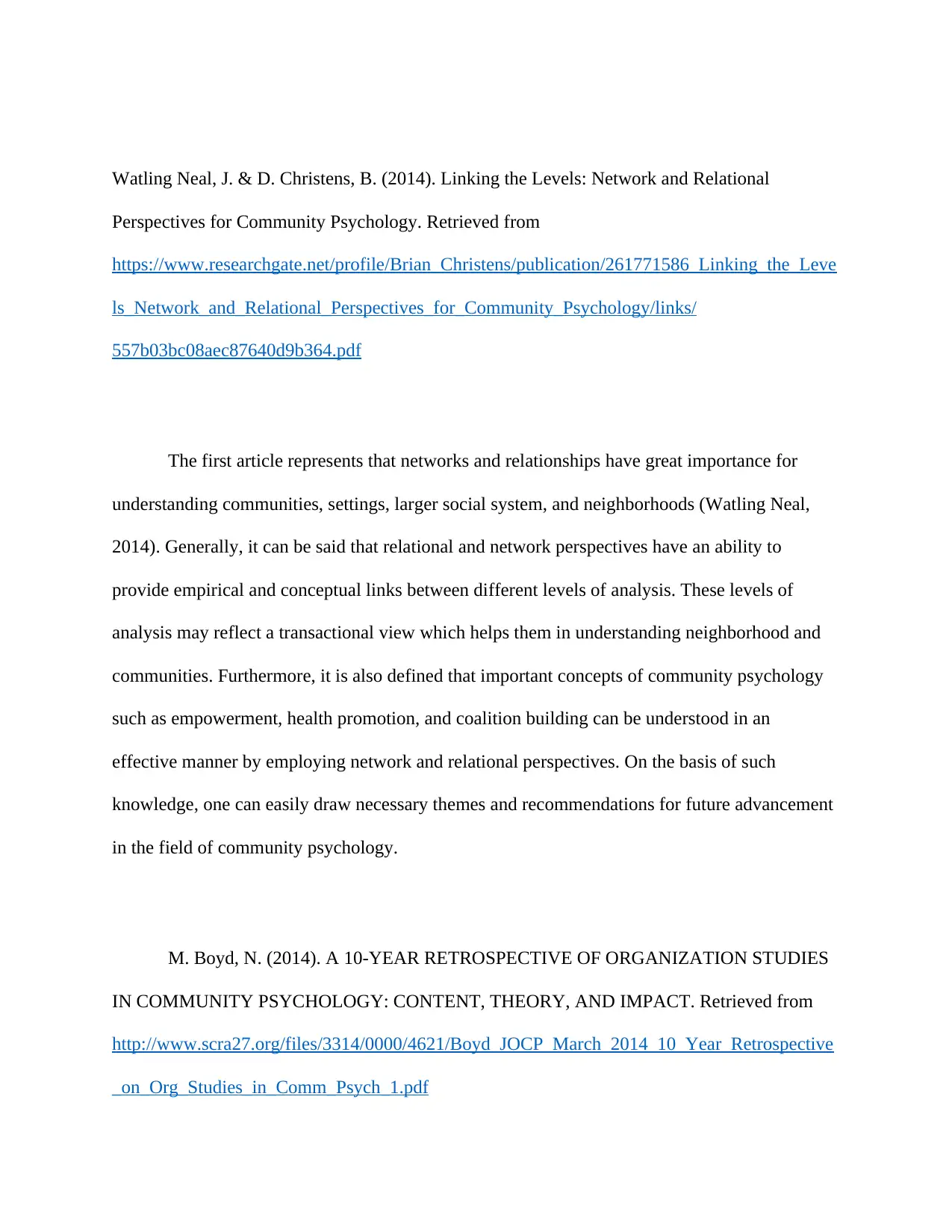
The first article represents that networks and relationships have great importance for
understanding communities, settings, larger social system, and neighborhoods (Watling Neal,
2014). Generally, it can be said that relational and network perspectives have an ability to
provide empirical and conceptual links between different levels of analysis. These levels of
analysis may reflect a transactional view which helps them in understanding neighborhood and
communities. Furthermore, it is also defined that important concepts of community psychology
such as empowerment, health promotion, and coalition building can be understood in an
effective manner by employing network and relational perspectives. On the basis of such
knowledge, one can easily draw necessary themes and recommendations for future advancement
in the field of community psychology.
M. Boyd, N. (2014). A 10-YEAR RETROSPECTIVE OF ORGANIZATION STUDIES
IN COMMUNITY PSYCHOLOGY: CONTENT, THEORY, AND IMPACT. Retrieved from
http://www.scra27.org/files/3314/0000/4621/Boyd_JOCP_March_2014_10_Year_Retrospective
_on_Org_Studies_in_Comm_Psych_1.pdf
tabler-icon-diamond-filled.svg

Paraphrase This Document

Need a fresh take? Get an instant paraphrase of this document with our AI Paraphraser
Document Page
Second chosen article defined that organization studies and community psychology are
two complementary fields. It is true somehow because community psychologists have lots of
knowledge regarding community psychology which they can share with individuals related to
that particular field and organization literature at large. Apart of this, a content analysis was also
conducted to understand both the Journal of Community Psychology and American Journal of
Community Psychology from 2001 to 2011 (M. Boyd, 2014). It was performed to determine the
manifestation of organization studies in the literature. This will prove helpful in determining the
perfect coding strategy to measure collected information.
Document Page
chevron_up_icon
1 out of 3
circle_padding
hide_on_mobile
zoom_out_icon
[object Object]